


 |
市場調查報告書
商品編碼
2116119
法國低溫運輸物流:市場佔有率分析、產業趨勢與統計及成長預測(2026-2031)France Cold Chain Logistics - Market Share Analysis, Industry Trends & Statistics, Growth Forecasts (2026 - 2031) |
||||||

※ 本網頁內容可能與最新版本有所差異。詳細情況請與我們聯繫。
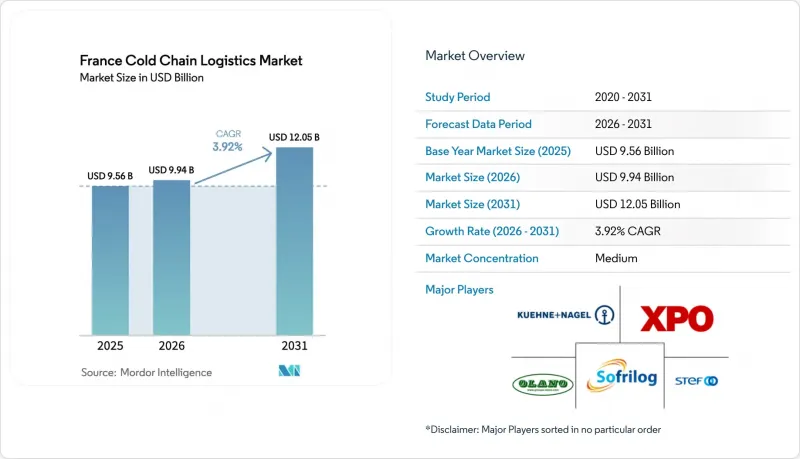
據 Mordor Intelligence 稱,法國低溫運輸物流市場預計在 2026 年達到 99.4 億美元,預計在預測期(2026-2031 年)內將以 3.92% 的複合年成長率成長,到 2031 年達到 120.5 億美元。
本報告按服務類型(冷藏保管、冷藏運輸[公路、鐵路等]、附加價值服務)、溫度類型(冷藏、冷凍、常溫、超低溫/超冷凍)和應用領域(水果蔬菜、肉類和家禽、其他)分類。市場預測以美元計價。
法國低溫運輸物流市場趨勢與洞察
新冠疫情後,隨著網路雜貨的蓬勃發展,對最後一公里冷藏貨物的需求上升。
法國正引領歐洲線上食品雜貨市場的成長,這主要得益於消費者對生鮮食品和冷凍食品宅配需求的不斷成長。預計到2030年,食品飲料電商領域將保持兩位數的成長,從而推動對適用於都市區配送路線的小型冷藏車的需求。然而,訂單密度低和燃油成本上漲正在影響盈利。零售商正在嘗試實施軸輻式系統以提高效率,但這增加了溫度控制問題的風險。同時,由於標準不同,食品雜貨和藥品連鎖店分別營運車輛,這增加了資本成本。因此,法國低溫運輸產業正日益專業化,符合GDP認證的車輛擴大用於最後一公里食品雜貨配送,而利潤更高的藥品運輸則佔據主導地位。
擴大生技藥品和mRNA疫苗的研發管線將促進符合GDP規定的物流發展。
2025年,歐盟實施了更嚴格的GDP法規,強制要求對2-8°C、-20°C和-70°C的溫度進行即時監控,採用電子隔離,並保留10年資料。目前,合規要求包括使用GPS追蹤的拖車、防篡改封條、合格的監管人員以及年度員工培訓。在法國,里昂和巴黎的物流中心在處理對溫度敏感的藥品方面發揮著至關重要的作用,違規罰款最高可達58.6萬美元。雖然DHL、UPS和Kuehne+Nagel等認證巨頭已站穩腳跟,但規模較小的企業仍在努力應對高昂的驗證成本和基於區塊鏈的追蹤技術。 mRNA療法推動了對超低溫的需求不斷成長,刺激了配備冗餘電源和液化天然氣備用系統的高規格倉庫的建設,提高了法國低溫運輸物流市場的准入門檻。
冷藏倉庫電力供應能力存在瓶頸,而冷藏倉庫消耗大量能源。
法國低溫運輸產業,特別是在巴黎和里昂郊區及周邊地區,面臨嚴重的電網限制,因為法國再生能源技術執法部門(RTE)優先發展可再生能源,而非新建工業電網。這限制了高能耗冷庫的核准,這些冷庫的年耗電量為每平方公尺50-100千瓦時。超低溫製藥設施需要昂貴的冗餘電源,這會增加21.6萬至32.4萬美元的初始成本,迫使營運商部署結合太陽能和電池儲能的微電網,而這些微電網的投資回收期長達數十年。尖峰時段時段的電費是離峰時段的三到四倍,這使得冷庫的持續運作缺乏柔軟性。有些設施會在夜間進行預冷,但這會增加溫度波動的風險。此外,儘管需求強勁,電網供不應求導致新的冷庫項目核准延遲,項目停滯不前。
細分市場分析
到2025年,冷藏保管將佔法國低溫運輸物流市場佔有率的52.63%,並繼續發揮關鍵作用,成為支撐泛歐分銷的區域集散中心的基礎。這一主導地位反映了法國高密度的倉儲網路,該網路從單一地點服務於食品零售和製藥行業。儘管道路運輸在軸輻式模式中仍然至關重要,承擔著大部分跨境運輸,但諸如套件組裝、重新貼標和合規性審核等附加價值服務預計將成為法國低溫運輸物流市場成長最快的領域,到2031年複合年成長率將達到7.14%。托運人願意為端到端溫度檢驗、序列化支援和數位化文件支付溢價,這些服務帶來的利潤是僅提供倉儲服務的設施無法實現的。
FresH2計畫的氫氣利用試點計畫預計將從2028年起降低卡車對柴油的依賴,從而降低營運成本並提升ESG(環境、社會和治理)評分。由於冷藏貨車供應有限,鐵路運輸仍是次要選擇,而航空運輸在前置作業時間緊迫的藥品運輸領域正逐漸獲得青睞。海運受益於勒阿弗爾港新增的連接,但內陸堵塞正在削弱港口效率提升帶來的效益。因此,該領域的展望表明,擁有多元化運輸能力的綜合營運商將在法國低溫運輸物流市場中佔據優勢。
其他好處
- Excel格式的市場預測(ME)表
- 3個月的分析師支持
目錄
第1章:引言
- 研究假設和市場定義
- 調查範圍
第2章:調查方法
第3章執行摘要
第4章 市場狀況
- 市場概覽
- 市場促進因素
- 新冠疫情後,隨著網路雜貨的蓬勃發展,對最後一公里冷藏貨物的需求上升。
- 擴大生技藥品和mRNA疫苗的研發管線將促進符合GDP規定的物流發展。
- 歐盟和法國全國範圍內減少食物廢棄物的強制規定,導致低溫運輸。
- 勒阿弗爾港冷藏貨櫃電力供應設施的擴建將促進進口量的成長。
- 利用人工智慧進行預測性維護,降低冷凍設備的運作成本。
- 擴大氫燃料堆高機和冷藏車的優惠待遇措施。
- 市場限制因素
- 冷藏倉庫電力供應能力存在瓶頸,而冷藏倉庫消耗大量能源。
- 由於HFC冷媒的逐步減少,對維修設備的投資增加。
- 國際航線空載率(20% 或更低)導致成本增加。
- 接受過GDP訓練的司機和技術人員嚴重短缺。
- 價值供應鏈分析
- 監理情勢
- 技術創新前景
- 波特五力模型
第5章 市場規模及成長預測(價值,2026-2031 年)
- 按服務類型
- 冷藏保管。
- 冷藏運輸
- 路
- 鐵路
- 海
- 航空
- 附加價值服務
- 按溫度類型
- 冷藏(0-5°C)
- 冰點(-18度C)
- 室溫
- 超低溫/超冷凍(-20度C或更低)
- 透過使用
- 水果和蔬菜
- 肉類/家禽
- 魚貝類
- 乳製品和冷凍甜點
- 麵包糖果甜點
- 已調理食品
- 藥品和生技藥品
- 疫苗和臨床試驗材料
- 化學品/特殊材料
- 其他生鮮食品
第6章 競爭情勢
- 市場集中度
- 關鍵策略趨勢
- 市佔率分析
- 公司簡介
- STEF
- Kuehne+Nagel
- Sofrilog
- Olano Group
- XPO
- DSV(Incl. DB Schenker)
- DHL Supply Chain
- Geodis
- CMA CGM Logistics(Incl. Bollore Logistics & CEVA Logistics)
- Seafrigo
- Mutual Logistics
- Chronofresh
- TSE Express Medical
- IRIS Logistics
- Socopal
- FM Logistic
- Lineage(Incl. Kloosterboer)
- Delanchy
- GEFCO
- UPS
第7章 市場機會與未來展望
According to Mordor Intelligence, the France cold chain logistics market size is estimated at USD 9.94 billion in 2026, and is expected to reach USD 12.05 billion by 2031, at a CAGR of 3.92% during the forecast period (2026-2031).
This report is Segmented by Service Type (Refrigerated Storage, Refrigerated Transportation [Road, Rail, and More], Value-Added Services), by Temperature Type (Chilled, Frozen, Ambient, Deep-Frozen/Ultra-Low ), and by Application (Fruits & Vegetables, Meat & Poultry, and More). The Market Forecasts are Provided in Terms of Value (USD).
France Cold Chain Logistics Market Trends and Insights
Post-COVID E-grocery Boom Elevates Last-mile Refrigerated Demand
France leads Europe in online grocery growth, driven by rising demand for home delivery of fresh and frozen goods. The food and beverage e-commerce sector is expected to grow at double-digit rates through 2030, boosting demand for compact refrigerated vans suited to urban routes. Yet, low order density and high fuel costs are straining profitability. Retailers are testing hub-and-spoke models to improve efficiency, but these raise temperature control risks. Meanwhile, grocery and pharmaceutical chains maintain separate vehicle fleets due to differing standards, increasing capital costs. This is pushing France's cold chain sector toward specialization grocery fleets expand for last-mile delivery, while GDP-certified vehicles focus on higher-margin pharmaceutical transport.
Biologics and mRNA Vaccine Pipeline Scaling GDP-compliant Logistics
In 2025, the EU enforced stricter GDP rules requiring real-time temperature monitoring at 2-8°C, -20°C, and -70°C, electronic quarantines, and 10-year data storage. Compliance now depends on GPS-tracked trailers, tamper seals, Qualified Person oversight, and annual staff training. In France, hubs in Lyon and Paris are key for handling temperature-sensitive medicines, with noncompliance fines reaching USD 586,000. Certified leaders like DHL, UPS, and Kuehne + Nagel are gaining ground, while smaller firms struggle with costly validation and blockchain tracking. Rising demand for ultra-low temperatures, driven by mRNA therapies, is fueling high-spec warehouse development with redundant power and LNG backup systems, raising entry barriers in France's cold chain logistics market.
Grid-capacity Bottlenecks for Energy-hungry Cold Warehouses
France's cold chain sector, especially around suburban Paris and Lyon, faces severe grid constraints as RTE prioritizes renewables over new industrial links. This limits approvals for energy-intensive cold stores consuming 50-100 kWh per m2 annually. Ultra-low temperature pharma sites require costly redundant power feeds, adding USD 216,000-324,000 upfront, pushing operators toward solar-plus-battery microgrids with decade-long paybacks. Peak tariffs run 3-4 times higher than off-peak rates, leaving little flexibility for continuous refrigeration. Some facilities pre-cool overnight, risking temperature swings, while grid scarcity delays permits and stalls new cold storage projects despite strong demand.
Other drivers and restraints analyzed in the detailed report include:
- EU and France-wide Food-waste Reduction Mandates Creating Cold-chain Gaps
- Port of Le Havre Reefer-plug Expansion Spurring Import Volumes
- Phase-down of HFC Refrigerants Inflating Retrofit Capex
For complete list of drivers and restraints, kindly check the Table Of Contents.
Segment Analysis
Refrigerated Storage controlled 52.63% of the France cold chain logistics market share in 2025 and continues to anchor regional consolidation hubs that feed pan-European distribution. This dominant share reflects France's dense warehouse network that services food retail and pharmaceuticals from single locations. Road transport remains essential in hub-and-spoke models and absorbs the bulk of cross-border volume, yet France cold chain logistics market size value-added services such as kitting, relabeling, and compliance audits are winning the fastest growth at a 7.14% CAGR through 2031. Shippers pay premiums for end-to-end temperature validation, serialization support, and digital paperwork, margins that storage-only facilities cannot secure.
Hydrogen pilots under the FresH2 project could cut diesel exposure for truck fleets after 2028, lowering operating costs and improving ESG scores. Rail remains a second-tier option because reefer-wagon supply is thin, while air transport captures niche pharma shipments under tight lead times. Sea freight benefits from new plugs at Le Havre, but hinterland congestion dilutes port efficiency gains. The segment outlook therefore favors integrated players with diversified modal capacity inside the France cold chain logistics market.
Complete Report Scope:
- By Service Type
- Refrigerated Storage
- Refrigerated Transportation
- Road
- Rail
- Sea
- Air
- Value-Added Services
- By Temperature Type
- Chilled (0-5 °C)
- Frozen (-18 °C)
- Ambient
- Deep-Frozen / Ultra-Low (less than -20 °C)
- By Application
- Fruits & Vegetables
- Meat & Poultry
- Fish & Seafood
- Dairy & Frozen Desserts
- Bakery & Confectionery
- Ready-to-Eat Meals
- Pharmaceuticals & Biologics
- Vaccines & Clinical Trial Materials
- Chemicals & Specialty Materials
- Other Perishables
List of Companies Covered in this Report:
- STEF
- Kuehne + Nagel
- Sofrilog
- Olano Group
- XPO
- DSV (Incl. DB Schenker)
- DHL Supply Chain
- Geodis
- CMA CGM Logistics (Incl. Bollore Logistics & CEVA Logistics)
- Seafrigo
- Mutual Logistics
- Chronofresh
- TSE Express Medical
- IRIS Logistics
- Socopal
- FM Logistic
- Lineage (Incl. Kloosterboer)
- Delanchy
- GEFCO
- UPS
Additional Benefits:
- The market estimate (ME) sheet in Excel format
- 3 months of analyst support
TABLE OF CONTENTS
1 Introduction
- 1.1 Study Assumptions & Market Definition
- 1.2 Scope of the Study
2 Research Methodology
3 Executive Summary
4 Market Landscape
- 4.1 Market Overview
- 4.2 Market Drivers
- 4.2.1 Post-COVID E-grocery Boom Elevates Last-mile Refrigerated Demand
- 4.2.2 Biologics & mRNA Vaccine Pipeline Scaling GDP-compliant Logistics
- 4.2.3 EU and France-wide Food-waste Reduction Mandates Creating Cold-chain Gaps
- 4.2.4 Port of Le Havre Reefer-plug Expansion Spurring Import Volumes
- 4.2.5 AI-driven Predictive Maintenance Cutting Refrigeration OPEX
- 4.2.6 Hydrogen-powered Forklifts & Reefers Gaining Policy Incentives
- 4.3 Market Restraints
- 4.3.1 Grid-capacity Bottlenecks for Energy-hungry Cold Warehouses
- 4.3.2 Phase-down of HFC Refrigerants Inflating Retrofit Capex
- 4.3.3 Empty-run Share less than 20 % on International Legs Raising Cost Base
- 4.3.4 Acute Shortage of GDP-trained Drivers & Technicians
- 4.4 Value / Supply-Chain Analysis
- 4.5 Regulatory Landscape
- 4.6 Technology Innovations Outlook
- 4.7 Porter's Five Forces
- 4.7.1 Threat of New Entrants
- 4.7.2 Bargaining Power of Suppliers
- 4.7.3 Bargaining Power of Buyers
- 4.7.4 Threat of Substitutes
- 4.7.5 Rivalry Among Competitors
5 Market Size & Growth Forecasts (Value, 2026-2031)
- 5.1 By Service Type
- 5.1.1 Refrigerated Storage
- 5.1.2 Refrigerated Transportation
- 5.1.2.1 Road
- 5.1.2.2 Rail
- 5.1.2.3 Sea
- 5.1.2.4 Air
- 5.1.3 Value-Added Services
- 5.2 By Temperature Type
- 5.2.1 Chilled (0-5 °C)
- 5.2.2 Frozen (-18 °C)
- 5.2.3 Ambient
- 5.2.4 Deep-Frozen / Ultra-Low (less than -20 °C)
- 5.3 By Application
- 5.3.1 Fruits & Vegetables
- 5.3.2 Meat & Poultry
- 5.3.3 Fish & Seafood
- 5.3.4 Dairy & Frozen Desserts
- 5.3.5 Bakery & Confectionery
- 5.3.6 Ready-to-Eat Meals
- 5.3.7 Pharmaceuticals & Biologics
- 5.3.8 Vaccines & Clinical Trial Materials
- 5.3.9 Chemicals & Specialty Materials
- 5.3.10 Other Perishables
6 Competitive Landscape
- 6.1 Market Concentration
- 6.2 Key Strategic Moves
- 6.3 Market Share Analysis
- 6.4 Company Profiles (includes Global level Overview, Market level overview, Core Segments, Financials as available, Strategic Information, Market Rank/Share for key companies, Products & Services, and Recent Developments)
- 6.4.1 STEF
- 6.4.2 Kuehne + Nagel
- 6.4.3 Sofrilog
- 6.4.4 Olano Group
- 6.4.5 XPO
- 6.4.6 DSV (Incl. DB Schenker)
- 6.4.7 DHL Supply Chain
- 6.4.8 Geodis
- 6.4.9 CMA CGM Logistics (Incl. Bollore Logistics & CEVA Logistics)
- 6.4.10 Seafrigo
- 6.4.11 Mutual Logistics
- 6.4.12 Chronofresh
- 6.4.13 TSE Express Medical
- 6.4.14 IRIS Logistics
- 6.4.15 Socopal
- 6.4.16 FM Logistic
- 6.4.17 Lineage (Incl. Kloosterboer)
- 6.4.18 Delanchy
- 6.4.19 GEFCO
- 6.4.20 UPS
7 Market Opportunities & Future Outlook
- 7.1 White-space & Unmet-Need Assessment

 泰國冷鏈物流:市場佔有率分析、產業趨勢與統計及成長預測(2026-2031)中國低溫運輸物流:市場佔有率分析、產業趨勢與統計及成長預測(2026-2031)美國冷鏈物流:市場佔有率分析、產業趨勢與統計及成長預測(2026-2031)英國低溫運輸物流:市場佔有率分析、產業趨勢與統計及成長預測(2026-2031)
 低溫運輸物流市場:2026-2032年全球市場預測(依服務類型、解決方案類型、溫度範圍及最終用途分類)低溫運輸市場:2026-2032年全球市場預測(依溫度區域、設備類型、服務模式、通路和最終用戶分類)低溫運輸物流:市場佔有率分析、產業趨勢與統計、成長預測(2026-2031)
 低溫運輸運輸市場預測至2034年-全球分析(按運輸方式、溫度範圍、車輛類型、技術、服務類型、最終用戶和地區分類)低溫運輸運輸市場預測至2034年-按溫度區域、運輸方式、服務類型、最終用戶產業和地區分類的全球分析
 全球低溫運輸市場:按類型、應用、溫度區間、技術和地區分類-預測至2031年