

 |
市場調查報告書
商品編碼
2125731
泰國冷鏈物流:市場佔有率分析、產業趨勢與統計及成長預測(2026-2031)Thailand Cold Chain Logistics - Market Share Analysis, Industry Trends & Statistics, Growth Forecasts (2026 - 2031) |
||||||

※ 本網頁內容可能與最新版本有所差異。詳細情況請與我們聯繫。
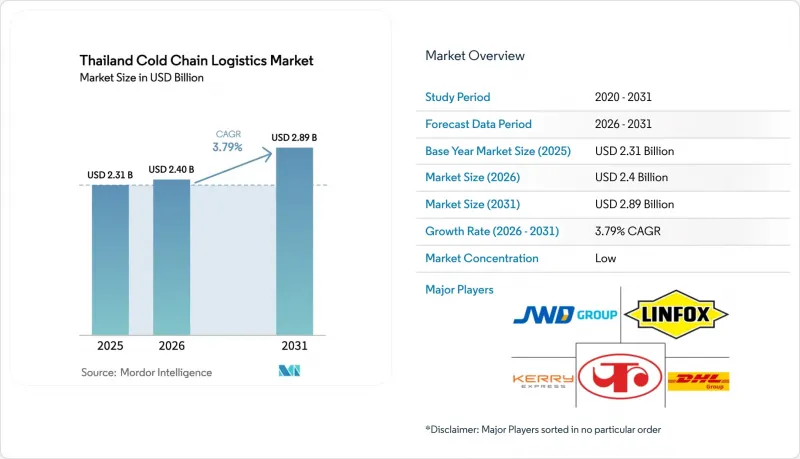
根據 Mordor Intelligence 預測,泰國冷鏈物流市場規模將從 2025 年的 23.1 億美元成長到 2026 年的 24 億美元,到 2031 年將達到 28.9 億美元,2026 年至 2031 年的複合年成長率為 3.79%。
本報告按服務類型(冷藏倉儲、冷藏運輸、附加價值服務)、溫度類型(冷藏、冷凍、常溫、超低溫冷凍)、應用領域(水果和蔬菜、肉類和家禽、魚貝類、乳製品和冷凍甜點、其他)以及地區(中部、東部、北部、其他)進行細分。市場預測以美元計價。
泰國冷鏈物流市場趨勢與洞察
線上雜貨和食材自煮包配送業務快速成長。
電子商務的興起正在加速泰國冷鏈物流市場的發展,尤其是在曼谷大都會區和東部經濟走廊(EEC)工業區內,冷藏和冷凍食品的訂單成長尤為顯著。電價下調導致的電費降低,為營運高耗能樞紐的末端配送公司創造了利潤空間。嘉里快遞(Kerry Express)和貝塔格羅(Betagro)聯合推出「嘉里酷」(Kerry Cool)品牌網路,使零售商能夠將家禽、即食食品和甜點等產品以保溫包裝的形式隔天送達泰國77個府。中國遊客的復甦帶動了公寓和飯店對食材自煮包服務的需求,擴大了目標客戶群。目前,食品藥物管理局(FDA)正在就飲料和冰塊的標籤問題進行磋商,這表明衛生管理監管正在加強。這也導致可追溯和溫控供應鏈的要求日益提高。像WICE物流這樣的公司正在投資基於雲端的運輸管理系統和手持掃描儀,以實現從裝貨碼頭到客戶家門口的產品級可視性。
擴大疫苗和生技藥品的經銷網路
泰國致力於成為區域疫苗出口國的目標與該國的冷鏈物流市場完美契合。 UPS Healthcare、DHL 和 Logisteed 已部署了符合世衛組織 GDP 指南的 -20°C冷凍庫、2-8°C冷藏庫和 -80°C 超低溫儲存設施。 2023-2027 年「國家疫苗政策」行動計畫使 Siam Bioscience 和 BioNet Asia 等國內製造商能夠擴大生技藥品生產規模,進一步提升了中部科技園區對超低溫儲存的需求。 DataKind 的試驗計畫率先在泰國本地應用了即時物聯網感測器,可將濕度和衝擊警報直接髮送給合格人員,從而降低活病毒製劑溫度偏差的風險。 DHL 供應鏈已將其位於素萬那普機場附近的醫療專用托盤儲存空間擴大了一倍,並整合了清關、檢驗包裝和最後一公里配送服務。經濟模型顯示,常規登革熱疫苗接種可使有症狀病例數減少 41% 至 57%,凸顯了耐寒、超低溫基礎設施的社會效益。
高昂的電費和燃料額外費用
儘管電費有所下調,能源成本仍佔倉庫營運費用的30%之多,而泰國國家電力局(EGAT)的債務狀況意味著附加費可能在2026年後恢復。改用二氧化碳系統可以降低每千瓦時的能耗,但一個擁有1萬個托盤的倉庫需要50萬美元的維修費用,這對中小企業來說是一個巨大的障礙。 Betagro公司透過結合屋頂太陽能發電和冰庫蓄熱系統來規避這項挑戰,從而降低尖峰時段需求。運輸商也面臨類似的燃油額外費用,而引進生質柴油B20帶來的成本節約微乎其微。
細分市場分析
到2025年,冷藏倉庫將佔泰國冷鏈物流市場40.62%的佔有率,成為全國物流樞紐的基礎,為零售、食品服務和醫療保健通路提供貨物。倉庫業主正利用東部經濟走廊(EEC)附近的土地使用優惠政策,MOL的「OMEGA 1 Bang Na」計劃在2027年將其多溫區儲存面積擴大10萬平方公尺。使用者需要溫度低至-25°C的冷藏貨架、淨高12公尺的交叉轉運平台以及穿梭式紙箱檢索系統,以提高周轉率。
到2025年,附加價值服務僅佔銷售額的9.12%,但預計到2031年將以4.63%的複合年成長率成長,成為泰國冷鏈物流市場中成長最快的領域。諸如套裝組裝、快速冷凍、清真認證標籤以及良好儲存和交付(GDP)相關文件等服務,其毛利率均超過20%,這促使第三方物流供應商(3PL)將其納入現有合約。零售商正利用這些額外的收入來源,在無需資本投資的情況下,調整產品線以適應當地市場。
其他好處
- Excel格式的市場預測(ME)表
- 3個月的分析師支持
目錄
第1章:引言
- 研究假設和市場定義
- 調查範圍
第2章:調查方法
第3章執行摘要
第4章 市場狀況
- 市場概覽
- 市場促進因素
- 線上雜貨和食材自煮包配送業務快速成長。
- 擴大疫苗和生技藥品的經銷網路
- 政府對歐共體基礎建設的補貼
- 利用自動化和物聯網實現即時溫度可視化
- 中國水果進口限制要求採用快速冷凍程序
- 獎勵建造淨零排放倉庫(屋頂太陽能發電+氨/二氧化碳系統)
- 市場限制因素
- 高昂的電費和燃料額外費用
- 冷凍設備故障或運作的風險
- 合格冷凍技術人員短缺
- 改用低全球暖化潛勢冷媒會帶來高昂的維修費用
- 價值供應鏈分析
- 監理情勢
- 技術展望
- 波特五力模型
第5章 市場規模與成長預測
- 按服務類型
- 冷藏倉庫
- 公共倉庫
- 私人倉庫
- 冷藏運輸
- 路
- 鐵路
- 海
- 航空
- 附加價值服務
- 冷藏倉庫
- 按溫度類型
- 冷藏(0-5°C)
- 冰點(-18 至 0°C)
- 室溫
- 超低溫冷凍/超低溫(-20度C或更低)
- 透過使用
- 水果和蔬菜
- 肉類/家禽
- 魚貝類
- 乳製品和冷凍甜點
- 麵包糖果甜點
- 即食食品
- 藥品和生物製藥
- 疫苗和臨床試驗材料
- 化學品/特殊材料
- 其他生鮮食品
- 按地區(泰國)
- 中部
- 東
- 北方
- 東北
- 南部
第6章 競爭情勢
- 市場集中度
- 策略趨勢
- 市佔率分析
- 公司簡介
- JWD Group
- Thai Yokorei Cold Storage
- Linfox Thailand
- DHL Supply Chain
- Kerry Express
- M-SENKO Logistics
- Thai Max Cold Storage
- Konoike Cool Logistics Co., Ltd.
- Logisteed Thailand
- Yusen Logistics
- Nichirei Logistics Group Inc.
- Chomthana(Cool Train Co., Ltd)
- Thai Global Logistics
- Integrated Logistics Services(ILS)
- FuzePost
- Inter Express Logistic
- Thai Rath Logistics Co., Ltd
- Sumisho Global Logistics Co., Ltd.
- WICE Logistics Public Company Limited
- Piti Cold Storage
第7章 市場機會與未來展望
According to Mordor Intelligence, the Thailand cold chain logistics market size is expected to grow from USD 2.31 billion in 2025 to USD 2.4 billion in 2026 and is forecast to reach USD 2.89 billion by 2031 at 3.79% CAGR over 2026-2031.
This report is Segmented by Service Type (Refrigerated Storage, Refrigerated Transportation, and Value-Added Services), Temperature Type (Chilled, Frozen, Ambient, and Deep-Frozen/Ultra-Low), Application (Fruits & Vegetables, Meat & Poultry, Fish & Seafood, Dairy & Frozen Desserts, and More), Region (Central, Eastern, Northern, and More). The Market Forecasts are Provided in Terms of Value (USD).
Thailand Cold Chain Logistics Market Trends and Insights
Boom in Online Grocery & Meal-Kit Delivery
E-commerce adoption has accelerated the Thailand cold chain logistics market, especially for chilled and frozen grocery orders delivered within metropolitan Bangkok and EEC industrial towns. Reduced electricity charges under the tariff cut create margin headroom for last-mile couriers operating energy-intensive hubs. Kerry Express and Betagro now co-brand the "Kerry Cool" network, letting retailers ship poultry, ready-to-eat meals, and desserts in insulated shippers overnight to 77 provinces. A rebound in Chinese tourist arrivals has lifted demand for meal-kit services catering to condo rentals and hotels, widening the addressable base. Ongoing Thai FDA consultations around beverage and ice labeling signal tighter hygiene oversight, which in turn boosts requirements for traceable, temperature-verified supply chains. Operators such as WICE Logistics are investing in cloud-based transport management systems and handheld scanners to deliver item-level visibility from dock to doorstep.
Expansion of Vaccine & Biologics Distribution Network
Thailand's ambition to become a regional vaccine exporter aligns squarely with the Thailand cold chain logistics market. UPS Healthcare, DHL, and Logisteed have rolled out -20 °C freezers, 2-8 °C coolers, and -80 °C ultra-cold bays that comply with WHO GDP guidelines. The National Vaccine Policy's 2023-2027 action plan positions domestic makers such as Siam Bioscience and BioNet Asia to scale biologic output, amplifying ultra-low demand in Central-region science parks. Real-time IoT sensors, pioneered locally by DataKind pilot programs, transmit humidity and shock alerts directly to qualified persons in charge, cutting excursion risk for live-virus formulations. DHL Supply Chain has doubled dedicated healthcare pallet spots near Suvarnabhumi Airport, bundling customs brokerage, validated packaging, and final-mile dispatch. Economic modeling shows routine dengue vaccination could curb symptomatic cases by 41%-57%, underscoring the social payoff of resilient sub-zero infrastructure.
High Electricity Tariffs & Fuel Surcharges
Energy still commands as much as 30% of warehouse operating cost despite the tariff cut, and EGAT's debt overhang may force surcharge reinstatements after 2026. Switching to CO2 systems cuts kilowatt-hour consumption but entails a USD 0.5 million retrofit for a 10,000-pallet site, a hurdle for SMEs. Betagro sidesteps this by coupling rooftop solar with ice-bank thermal storage to shave peak-hour demand. Haulers face similar fuel surcharges, with biodiesel B20 adoption providing only marginal cost relief.
Other drivers and restraints analyzed in the detailed report include:
- Government EEC Infrastructure Subsidies
- Automation & IoT for Real-Time Temperature Visibility
- Cold-Room Equipment Breakdown & Downtime Risk
For complete list of drivers and restraints, kindly check the Table Of Contents.
Segment Analysis
Refrigerated Storage accounted for 40.62% of Thailand's cold chain logistics market share in 2025, underpinning nationwide distribution hubs that feed retail, food-service, and healthcare channels. Warehousing landlords capitalize on land-use incentives near the EEC, where MOL's OMEGA 1 Bang Na will add multi-temperature bays across 100,000 sqm by 2027. Users demand racking to -25 °C, cross-docks with 12-meter clear heights, and shuttle-based carton retrieval to accelerate SKU churn.
Value-Added Services, although only 9.12% of 2025 revenue, will expand at a 4.63% CAGR through 2031, the fastest within the Thailand cold chain logistics market. Services such as kitting, blast-freezing, labeling for halal certification, and GDP documentation command 20%-plus gross margins, enticing 3PLs to bundle them into existing contracts. Retailers lean on these ancillary streams to localize product assortment without committing capex.
Complete Report Scope:
- By Service Type
- Refrigerated Storage
- Public Warehousing
- Private Warehousing
- Refrigerated Transportation
- Road
- Rail
- Sea
- Air
- Value-Added Services
- Refrigerated Storage
- By Temperature Type
- Chilled (0-5 °C)
- Frozen (-18-0 °C)
- Ambient
- Deep-Frozen / Ultra-Low (less than-20 °C)
- By Application
- Fruits & Vegetables
- Meat & Poultry
- Fish & Seafood
- Dairy & Frozen Desserts
- Bakery & Confectionery
- Ready-to-Eat Meals
- Pharmaceuticals & Biologics
- Vaccines & Clinical Trial Materials
- Chemicals & Specialty Materials
- Other Perishables
- By Region (Thailand)
- Central
- Eastern
- Northern
- North-Eastern
- Southern
List of Companies Covered in this Report:
- JWD Group
- Thai Yokorei Cold Storage
- Linfox Thailand
- DHL Supply Chain
- Kerry Express
- M-SENKO Logistics
- Thai Max Cold Storage
- Konoike Cool Logistics Co., Ltd.
- Logisteed Thailand
- Yusen Logistics
- Nichirei Logistics Group Inc.
- Chomthana (Cool Train Co., Ltd)
- Thai Global Logistics
- Integrated Logistics Services (ILS)
- FuzePost
- Inter Express Logistic
- Thai Rath Logistics Co., Ltd
- Sumisho Global Logistics Co., Ltd.
- WICE Logistics Public Company Limited
- Piti Cold Storage
Additional Benefits:
- The market estimate (ME) sheet in Excel format
- 3 months of analyst support
TABLE OF CONTENTS
1 Introduction
- 1.1 Study Assumptions & Market Definition
- 1.2 Scope of the Study
2 Research Methodology
3 Executive Summary
4 Market Landscape
- 4.1 Market Overview
- 4.2 Market Drivers
- 4.2.1 Boom in online grocery & meal-kit delivery
- 4.2.2 Expansion of vaccine & biologics distribution network
- 4.2.3 Government EEC infrastructure subsidies
- 4.2.4 Automation & IoT for real-time temperature visibility
- 4.2.5 Rapid-freeze protocols demanded by China fruit import rules
- 4.2.6 Net-zero warehousing incentives (rooftop solar + ammonia/CO2 systems)
- 4.3 Market Restraints
- 4.3.1 High electricity tariffs & fuel surcharges
- 4.3.2 Cold-room equipment breakdown & downtime risk
- 4.3.3 Shortage of certified refrigeration technicians
- 4.3.4 Costly retrofit to low-GWP refrigerants
- 4.4 Value / Supply-Chain Analysis
- 4.5 Regulatory Landscape
- 4.6 Technological Outlook
- 4.7 Porter's Five Forces
- 4.7.1 Threat of New Entrants
- 4.7.2 Bargaining Power of Buyers/Consumers
- 4.7.3 Bargaining Power of Suppliers
- 4.7.4 Threat of Substitute Products
- 4.7.5 Intensity of Competitive Rivalry
5 Market Size & Growth Forecasts (Value)
- 5.1 By Service Type
- 5.1.1 Refrigerated Storage
- 5.1.1.1 Public Warehousing
- 5.1.1.2 Private Warehousing
- 5.1.2 Refrigerated Transportation
- 5.1.2.1 Road
- 5.1.2.2 Rail
- 5.1.2.3 Sea
- 5.1.2.4 Air
- 5.1.3 Value-Added Services
- 5.1.1 Refrigerated Storage
- 5.2 By Temperature Type
- 5.2.1 Chilled (0-5 °C)
- 5.2.2 Frozen (-18-0 °C)
- 5.2.3 Ambient
- 5.2.4 Deep-Frozen / Ultra-Low (less than-20 °C)
- 5.3 By Application
- 5.3.1 Fruits & Vegetables
- 5.3.2 Meat & Poultry
- 5.3.3 Fish & Seafood
- 5.3.4 Dairy & Frozen Desserts
- 5.3.5 Bakery & Confectionery
- 5.3.6 Ready-to-Eat Meals
- 5.3.7 Pharmaceuticals & Biologics
- 5.3.8 Vaccines & Clinical Trial Materials
- 5.3.9 Chemicals & Specialty Materials
- 5.3.10 Other Perishables
- 5.4 By Region (Thailand)
- 5.4.1 Central
- 5.4.2 Eastern
- 5.4.3 Northern
- 5.4.4 North-Eastern
- 5.4.5 Southern
6 Competitive Landscape
- 6.1 Market Concentration
- 6.2 Strategic Moves
- 6.3 Market Share Analysis
- 6.4 Company Profiles (includes Global level Overview, Market level overview, Core Segments, Financials as available, Strategic Information, Market Rank/Share for key companies, Products & Services, and Recent Developments)
- 6.4.1 JWD Group
- 6.4.2 Thai Yokorei Cold Storage
- 6.4.3 Linfox Thailand
- 6.4.4 DHL Supply Chain
- 6.4.5 Kerry Express
- 6.4.6 M-SENKO Logistics
- 6.4.7 Thai Max Cold Storage
- 6.4.8 Konoike Cool Logistics Co., Ltd.
- 6.4.9 Logisteed Thailand
- 6.4.10 Yusen Logistics
- 6.4.11 Nichirei Logistics Group Inc.
- 6.4.12 Chomthana (Cool Train Co., Ltd)
- 6.4.13 Thai Global Logistics
- 6.4.14 Integrated Logistics Services (ILS)
- 6.4.15 FuzePost
- 6.4.16 Inter Express Logistic
- 6.4.17 Thai Rath Logistics Co., Ltd
- 6.4.18 Sumisho Global Logistics Co., Ltd.
- 6.4.19 WICE Logistics Public Company Limited
- 6.4.20 Piti Cold Storage
7 Market Opportunities & Future Outlook
- 7.1 White-space & Unmet-need Assessment

 法國低溫運輸物流:市場佔有率分析、產業趨勢與統計及成長預測(2026-2031)中國低溫運輸物流:市場佔有率分析、產業趨勢與統計及成長預測(2026-2031)美國冷鏈物流:市場佔有率分析、產業趨勢與統計及成長預測(2026-2031)英國低溫運輸物流:市場佔有率分析、產業趨勢與統計及成長預測(2026-2031)
 低溫運輸物流市場:2026-2032年全球市場預測(依服務類型、解決方案類型、溫度範圍及最終用途分類)低溫運輸市場:2026-2032年全球市場預測(依溫度區域、設備類型、服務模式、通路和最終用戶分類)低溫運輸物流:市場佔有率分析、產業趨勢與統計、成長預測(2026-2031)
 低溫運輸運輸市場預測至2034年-全球分析(按運輸方式、溫度範圍、車輛類型、技術、服務類型、最終用戶和地區分類)低溫運輸運輸市場預測至2034年-按溫度區域、運輸方式、服務類型、最終用戶產業和地區分類的全球分析
 全球低溫運輸市場:按類型、應用、溫度區間、技術和地區分類-預測至2031年