


 |
市場調查報告書
商品編碼
2115255
英國低溫運輸物流:市場佔有率分析、產業趨勢與統計及成長預測(2026-2031)United Kingdom Cold Chain Logistics - Market Share Analysis, Industry Trends & Statistics, Growth Forecasts (2026 - 2031) |
||||||

※ 本網頁內容可能與最新版本有所差異。詳細情況請與我們聯繫。
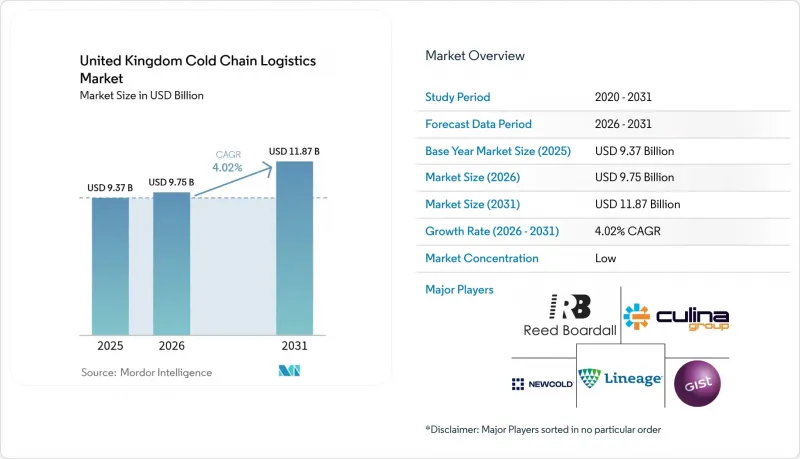
據 Mordor Intelligence 稱,2025 年英國低溫運輸物流市場價值為 93.7 億美元,預計到 2031 年將從 2026 年的 97.5 億美元成長至 118.7 億美元,預測期(2026-2031 年)的複合年預計成長率為 4.02%。
本報告按服務類型(冷藏倉儲、冷藏運輸、附加價值服務)、溫度類型(冷藏、冷凍、常溫、超低溫)和應用領域(水果和蔬菜、肉類和家禽、魚類和水產品、乳製品和冷凍甜點等)進行分類。市場預測以美元計價。
英國低溫運輸物流市場趨勢與洞察
網上購買食品雜貨和食材自煮包的需求激增。
疫情後的消費習慣鞏固了線上生鮮訂單兩位數的滲透率。大型零售商已擴展其物流網路,並將現有超級市場改造為“暗店”,以降低資本密集度,同時保持快速的訂單履行。諸如一家領先的冷凍食品專家開設的佔地50萬平方英尺的專用倉庫等,正在簡化最後一公里冷藏配送流程。感測器驅動的庫存監控平台進一步提高了準確性並最大限度地減少了浪費,從而推動了英國低溫運輸物流市場服務利用率的提升。
擴大藥品和生物技術出口
英國政府為生命科學領域的創新投入10億英鎊(約13億美元),加之溫控航空貨運量持續成長22%,凸顯了出口機會。先進的包裝技術無需使用聚苯乙烯即可將溫度維持在攝氏2-8度或超低溫36小時,這使得英國低溫運輸物流市場成為生物製藥分銷的首選樞紐。
該設施的高資本支出(CAPEX)和能源成本
冷藏倉庫的年耗電量為每立方英尺1.54千瓦時,電力成本佔倉庫總能源成本的70%。對於一座10萬立方公尺的倉庫而言,要達到10千瓦時/立方公尺/年的最佳實踐能源強度,需要採用自動化和熱回收系統,這會增加初始投資預算。由於向可再生能源轉型,電網穩定性下降,營運商面臨價格上漲的風險。但計畫於2026年在曼徹斯特附近投入運作的液氣能源儲存系統系統可望提供長期備用電源,並緩解發電限制的影響。
細分市場分析
至2025年,冷藏保管將佔英國低溫運輸物流市場規模的51.35%,並為依賴進口的食品和藥品配送提供支援。例如,對冷藏貨櫃中心的200萬英鎊(約260萬美元)投資,正在增加靠近零售配送中心的倉儲能力。從2026年到2031年,隨著托運人要求將清關、重新包裝和溫度檢驗整合到單一合約中,附加價值服務市場將以4.37%的複合年成長率成長。感測器網路和數位孿生技術將減少庫存週轉天數,並提高服務供應商的投資報酬率(ROIC)。
一系列併購,包括以7.19億美元收購Wincanton,將使企業能夠大規模採購再生能源和先進的倉儲自動化設備。由此形成的網點網路將使企業能夠靈活調整其冷凍和冷藏空間,這在英國低溫運輸物流市場應對不斷變化的消費者需求之際,將成為一項顯著優勢。
其他好處:
- Excel格式的市場預測(ME)表
- 3個月的分析師支持
目錄
第1章:引言
- 研究假設和市場定義
- 調查範圍
第2章:調查方法
第3章執行摘要
第4章 市場狀況
- 市場概覽
- 市場促進因素
- 網上購買食品雜貨和食材自煮包的需求激增
- 擴大醫藥和生物技術產品的出口
- 英國加強食品安全和可追溯性法規
- 冷凍食品和簡便食品的消費量增加
- 設施內的可再生能源微電網可降低營運成本(OPEX)。
- 都市區微型倉配「暗店」型冷藏配送中心
- 市場限制因素
- 該設施的資本支出(CAPEX)和能源成本很高。
- 大型貨車/冷藏車人手不足
- 維修低全球暖化潛勢冷媒的成本
- 電力傳輸單元和充電網路限制
- 價值供應鏈分析
- 監理情勢
- 技術展望
- 波特五力模型
- 排放標準和淨零排放目標的影響
- 新冠疫情與地緣政治事件的影響
第5章 市場規模及成長預測(價值,百萬美元)
- 按服務類型
- 冷藏倉庫
- 公共倉庫
- 私人倉庫
- 冷藏運輸
- 道路運輸
- 鐵路
- 海
- 航空
- 附加價值服務
- 冷藏倉庫
- 按溫度類型
- 冷藏(0-5 度C)
- 冷凍(-18~0 度C)
- 環境的
- 超低溫(低於-20 度C)
- 透過使用
- 水果和蔬菜
- 肉類/家禽
- 魚貝類
- 乳製品和冷凍甜點
- 麵包糖果甜點
- 即食餐
- 藥品和生技藥品
- 疫苗和臨床試驗材料
- 化學品和特殊材料
- 其他生鮮食品
第6章 競爭情勢
- 市場集中度
- 策略舉措和夥伴關係
- 市佔率分析
- 公司簡介
- Lineage Logistics
- Culina Group
- NewCold
- Gist Ltd
- Reed Boardall
- DHL Supply Chain
- Americold Logistics
- Turners(Soham)Ltd
- FreshLinc Group
- McCulla Refrigerated Transport
- Constellation Cold Logistics
- Magnavale
- Fowler Welch
- DFDS Logistics
- Kuehne+Nagel
- XPO Logistics
- Chiltern Cold Storage Group
- Fresh Logistics
- Matthews International Transport
- Cool Cargo UK
第7章 市場機會與未來展望
According to Mordor Intelligence, the United Kingdom cold chain logistics market size was valued at USD 9.37 billion in 2025 and estimated to grow from USD 9.75 billion in 2026 to reach USD 11.87 billion by 2031, at a CAGR of 4.02% during the forecast period (2026-2031).
This report is Segmented by Service Type (Refrigerated Storage, Refrigerated Transportation, Value-Added Services), Temperature Type (Chilled, Frozen, Ambient, Deep-Frozen/Ultra-Low), Application (Fruits & Vegetables, Meat & Poultry, Fish & Seafood, Dairy & Frozen Desserts, and More). The Market Forecasts are Provided in Terms of Value (USD).
United Kingdom Cold Chain Logistics Market Trends and Insights
Surge in online grocery and meal-kit demand
Post-pandemic purchasing habits have cemented double-digit e-grocery penetration. Large retailers widened distribution footprints, and dark-store conversions inside existing supermarkets reduced capital intensity while sustaining rapid fulfilment. Purpose-built hubs such as a 500,000 sq ft warehouse opened by a leading frozen specialist streamline last-mile chilled delivery. Sensor-driven stock-monitoring platforms further improve accuracy and minimize spoilage, reinforcing service uptake within the United Kingdom cold chain logistics market.
Expansion of pharmaceutical and biotech exports
Government backing of GBP 1 billion (USD 1.3 billion) for life-sciences innovation and a sustained 22% rise in temperature-controlled airfreight volumes underscore the export opportunity. Advanced packaging that maintains 2-8 °C or ultra-low parameters for 36 hours without polystyrene positions the United Kingdom cold chain logistics market as a preferred hub for biologics distribution.
High CAPEX and energy costs of facilities
Cold storage consumes 1.54 kWh per cubic foot annually and electricity accounts for 70% of a warehouse's total energy bill. Reaching best-practice intensity of 10 kWh/m3/yr in a 100,000 m3 site requires automation and heat-recovery systems, inflating upfront budgets. Grid volatility during the renewable transition exposes operators to price spikes, yet liquid-air energy storage due online near Manchester in 2026 promises long-duration backup, reducing exposure to curtailments.
Other drivers and restraints analyzed in the detailed report include:
- Stricter UK food-safety and traceability rules
- Rising frozen and convenience-food consumption
- HGV and reefer-driver labor shortage
For complete list of drivers and restraints, kindly check the Table Of Contents.
Segment Analysis
Refrigerated storage generated 51.35% of the United Kingdom cold chain logistics market size in 2025, underpinning import-heavy food and pharmaceutical flows. Investments such as a GBP 2 million (USD 2.6 million) chilled consolidation center add capacity close to retail distribution hubs. Over 2026-2031, value-added services grow at 4.37% CAGR as shippers seek integrated customs clearance, repacking, and temperature validation in a single contract. Sensor networks and digital twins cut stock-holding days, lifting return on invested capital for service providers.
A wave of mergers, including a USD 719 million takeover of Wincanton, enables scale purchasing of renewable electricity and advanced warehouse automation. The resulting footprint allows firms to flex space between frozen and chilled slots, an advantage as the United Kingdom cold chain logistics market absorbs shifting consumer demand.
Complete Report Scope:
- By Service Type
- Refrigerated Storage
- Public Warehousing
- Private Warehousing
- Refrigerated Transportation
- Road
- Rail
- Sea
- Air
- Value-Added Services
- Refrigerated Storage
- By Temperature Type
- Chilled (0-5°C)
- Frozen (-18-0°C)
- Ambient
- Deep-Frozen/Ultra-Low (less than -20°C)
- By Application
- Fruits and Vegetables
- Meat and Poultry
- Fish and Seafood
- Dairy and Frozen Desserts
- Bakery and Confectionery
- Ready-to-Eat Meals
- Pharmaceuticals and Biologics
- Vaccines and Clinical Trial Materials
- Chemicals and Specialty Materials
- Other Perishables
List of Companies Covered in this Report:
- Lineage Logistics
- Culina Group
- NewCold
- Gist Ltd
- Reed Boardall
- DHL Supply Chain
- Americold Logistics
- Turners (Soham) Ltd
- FreshLinc Group
- McCulla Refrigerated Transport
- Constellation Cold Logistics
- Magnavale
- Fowler Welch
- DFDS Logistics
- Kuehne + Nagel
- XPO Logistics
- Chiltern Cold Storage Group
- Fresh Logistics
- Matthews International Transport
- Cool Cargo UK
Additional Benefits:
- The market estimate (ME) sheet in Excel format
- 3 months of analyst support
TABLE OF CONTENTS
1 Introduction
- 1.1 Study Assumptions and Market Definition
- 1.2 Scope of the Study
2 Research Methodology
3 Executive Summary
4 Market Landscape
- 4.1 Market Overview
- 4.2 Market Drivers
- 4.2.1 Surge in online grocery and meal-kit demand
- 4.2.2 Expansion of pharma/biotech exports
- 4.2.3 Stricter UK food-safety and traceability rules
- 4.2.4 Rising frozen and convenience-food consumption
- 4.2.5 On-site renewable-energy microgrids cut OPEX
- 4.2.6 Urban micro-fulfilment "dark-store" cold hubs
- 4.3 Market Restraints
- 4.3.1 High CAPEX and energy costs of facilities
- 4.3.2 HGV/reefer-driver labour shortage
- 4.3.3 Retrofit cost for low-GWP refrigerants
- 4.3.4 Grid limits for electric TRUs and chargers
- 4.4 Value / Supply-Chain Analysis
- 4.5 Regulatory Landscape
- 4.6 Technological Outlook
- 4.7 Porter's Five Forces
- 4.7.1 Bargaining Power of Suppliers
- 4.7.2 Bargaining Power of Buyers
- 4.7.3 Threat of New Entrants
- 4.7.4 Threat of Substitutes
- 4.7.5 Degree of Competition
- 4.8 Impact of Emission Standards and Net-Zero Targets
- 4.9 Impact of COVID-19 and Geo-Political Events
5 Market Size and Growth Forecasts (Value, USD mn)
- 5.1 By Service Type
- 5.1.1 Refrigerated Storage
- 5.1.1.1 Public Warehousing
- 5.1.1.2 Private Warehousing
- 5.1.2 Refrigerated Transportation
- 5.1.2.1 Road
- 5.1.2.2 Rail
- 5.1.2.3 Sea
- 5.1.2.4 Air
- 5.1.3 Value-Added Services
- 5.1.1 Refrigerated Storage
- 5.2 By Temperature Type
- 5.2.1 Chilled (0-5°C)
- 5.2.2 Frozen (-18-0°C)
- 5.2.3 Ambient
- 5.2.4 Deep-Frozen/Ultra-Low (less than -20°C)
- 5.3 By Application
- 5.3.1 Fruits and Vegetables
- 5.3.2 Meat and Poultry
- 5.3.3 Fish and Seafood
- 5.3.4 Dairy and Frozen Desserts
- 5.3.5 Bakery and Confectionery
- 5.3.6 Ready-to-Eat Meals
- 5.3.7 Pharmaceuticals and Biologics
- 5.3.8 Vaccines and Clinical Trial Materials
- 5.3.9 Chemicals and Specialty Materials
- 5.3.10 Other Perishables
6 Competitive Landscape
- 6.1 Market Concentration
- 6.2 Strategic Moves and Partnerships
- 6.3 Market Share Analysis
- 6.4 Company Profiles (includes Global Level Overview, Market Level Overview, Core Segments, Financials as available, Strategic Information, Market Rank/Share for key companies, Products & Services, and Recent Developments)
- 6.4.1 Lineage Logistics
- 6.4.2 Culina Group
- 6.4.3 NewCold
- 6.4.4 Gist Ltd
- 6.4.5 Reed Boardall
- 6.4.6 DHL Supply Chain
- 6.4.7 Americold Logistics
- 6.4.8 Turners (Soham) Ltd
- 6.4.9 FreshLinc Group
- 6.4.10 McCulla Refrigerated Transport
- 6.4.11 Constellation Cold Logistics
- 6.4.12 Magnavale
- 6.4.13 Fowler Welch
- 6.4.14 DFDS Logistics
- 6.4.15 Kuehne + Nagel
- 6.4.16 XPO Logistics
- 6.4.17 Chiltern Cold Storage Group
- 6.4.18 Fresh Logistics
- 6.4.19 Matthews International Transport
- 6.4.20 Cool Cargo UK
7 Market Opportunities and Future Outlook
- 7.1 White-Space and Unmet-Need Assessment

 泰國冷鏈物流:市場佔有率分析、產業趨勢與統計及成長預測(2026-2031)法國低溫運輸物流:市場佔有率分析、產業趨勢與統計及成長預測(2026-2031)中國低溫運輸物流:市場佔有率分析、產業趨勢與統計及成長預測(2026-2031)美國冷鏈物流:市場佔有率分析、產業趨勢與統計及成長預測(2026-2031)
 低溫運輸物流市場:2026-2032年全球市場預測(依服務類型、解決方案類型、溫度範圍及最終用途分類)低溫運輸市場:2026-2032年全球市場預測(依溫度區域、設備類型、服務模式、通路和最終用戶分類)低溫運輸物流:市場佔有率分析、產業趨勢與統計、成長預測(2026-2031)
 低溫運輸運輸市場預測至2034年-全球分析(按運輸方式、溫度範圍、車輛類型、技術、服務類型、最終用戶和地區分類)低溫運輸運輸市場預測至2034年-按溫度區域、運輸方式、服務類型、最終用戶產業和地區分類的全球分析
 全球低溫運輸市場:按類型、應用、溫度區間、技術和地區分類-預測至2031年