


 |
市場調查報告書
商品編碼
2115254
中國低溫運輸物流:市場佔有率分析、產業趨勢與統計及成長預測(2026-2031)China Cold Chain Logistics - Market Share Analysis, Industry Trends & Statistics, Growth Forecasts (2026 - 2031) |
||||||

※ 本網頁內容可能與最新版本有所差異。詳細情況請與我們聯繫。
根據 Mordor Intelligence 預測,中國低溫運輸物流市場規模預計將從 2025 年的 944.6 億美元成長到 2026 年的 1,044.3 億美元,並將在 2026 年至 2031 年期間以 10.56% 的複合年成長率,到 2031 年達到 1726 億美元。
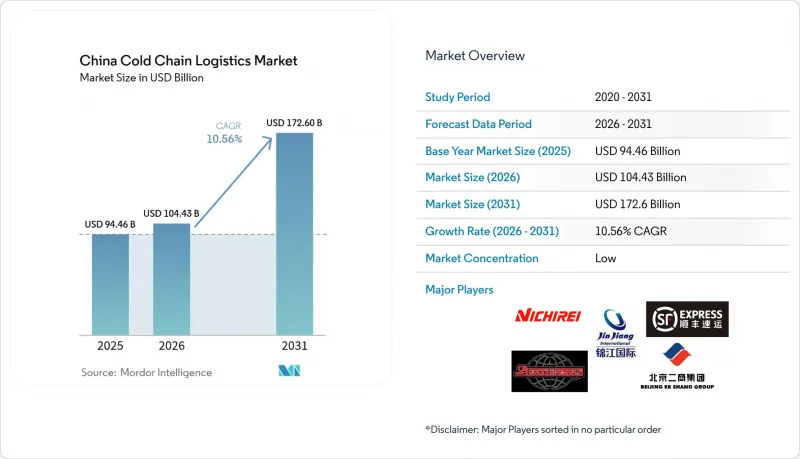
本報告按服務類型(冷藏倉儲、冷藏運輸及其他)、溫度類型(冷藏(0-5 度C)、冷凍(-18-0 度C)、其他)、應用領域(水果和蔬菜、肉類和家禽、魚貝類、乳製品和冷凍甜點、其他)以及地區(華東、華北、華中和華南、其他)進行分類。市場預測以美元計價。
中國低溫運輸物流市場趨勢與洞察
「十四五」規劃下的全國低溫運輸基礎建設正在加速倉庫建設。
中央政府計劃大力投資連接產區和城市市場的低溫運輸高速公路,目標是2027年實現水果冷藏配送率達25%,肉類冷藏配送率達45%。目前,河南、湖南、四川等內陸樞紐的新增貨運量佔比高於沿海樞紐,縮小了兩者之間的差距,縮短了運輸距離。這一發展趨勢已有效減少了農產品損耗,促進了高價值作物的種植。此舉也將豐富零售通路的產品種類。
生鮮食品電子商務快速發展
京東生鮮、盒馬鮮生等平台承諾的「當日達」服務迫使傳統物流公司在城市環城公路沿線建立微型倉配中心。每個配送中心通常設有三個溫控區,確保訂單確認後幾分鐘內即可完成揀貨。路線最佳化軟體減少了車輛的空轉距離,使都市區的冷藏車每班次能完成更多配送。消費者一旦對溫控系統充滿信心,往往會增加購買量,這進一步鞏固了這些平台的競爭優勢。
分散式最後一公里冷藏網路
根據中國低溫運輸物流市場調查數據,許多配送公司使用沒有隔熱層的貨車,導致部分三線城市綠葉蔬菜的腐爛率超過10%。保險公司在理賠時越來越要求提供溫度記錄,這使得沒有監控設備的承運商面臨更高的保費。利用科技整合門店訂單的新興參與企業正在搶佔市場佔有率,這表明都市區物流整合的可能性正在增加。
細分市場分析
到2025年,冷藏倉庫將佔中國低溫運輸物流市場佔有率的50.32%,凸顯了固定倉儲能力的需求。附加價值服務的成長正在加速,預計到2031年複合年成長率將達到11.90%,顯示托運人越來越願意為重新貼標、檢驗和套件組裝等服務付費。將倉儲與這些服務相結合的營運商提高了每平方公尺的收益,並在基礎托盤儲存的價格競爭中佔據了優勢。此外,這種一體化模式減少了操作錯誤,因為貨物從收貨到出貨都始終在一個數位生態系統內進行。
冷藏運輸仍然是第二大運輸類別,並持續受益於電子商務縮短的訂單到交付週期。配備感測器的冷藏拖車現在每兩分鐘即可傳輸一次溫度和車門開關數據,從而減少投訴,並在交通堵塞時實現動態路線調整。無力承擔這些升級的小規模運輸公司可能會將合約拱手讓給「資金籌措」技術仲介業者,後者無需擁有卡車即可保證可視性。因此,產業趨勢正在轉向少數大型運輸公司與軟體平台合作。
其他福利
- Excel格式的市場預測(ME)表
- 3個月的分析師支持
目錄
第1章:引言
- 研究假設和市場定義
- 調查範圍
第2章:調查方法
第3章執行摘要
第4章 市場狀況
- 市場概覽
- 市場促進因素
- 在「十四五」規劃架構下,加速倉庫建設,配合全國低溫運輸基礎建設。
- 生鮮食品電商(京東鮮生、盒馬鮮生)的快速擴張,推高了人們對當日送達的期望。
- 生物製藥出口的蓬勃發展帶動了對符合GDP標準的超低溫低溫運輸。
- 中產階級對進口冷藏肉類和魚貝類的需求不斷成長
- 透過現代化改造計劃,重振溫控牛奶配送,提高乳製品的安全性。
- 透過對二氧化碳/氨系統進行能源效率補貼,降低資本投資門檻。
- 市場限制因素
- 由於最後一公里冷藏運輸網分散,導致浪費率高
- 執照工業冷凍技術人員短缺
- 三級冷藏倉庫電費高且電網不穩定
- 由於中國「國六」貨車排放氣體法規,冷藏貨車改裝成本增加。
- 價值供應鏈分析
- 監理展望
- 技術展望
- 聚焦常溫/溫控儲存。
- 排放標準對低溫運輸產業的影響
- 波特五力模型
- 地緣政治事件的影響
第5章 市場規模與成長預測
- 按服務類型
- 冷藏倉庫
- 公共倉庫
- 私人倉庫
- 冷藏運輸
- 路
- 鐵路
- 海
- 航空
- 附加價值服務
- 冷藏倉庫
- 按溫度類型
- 冷藏(0-5 度C)
- 冷凍(-18~0 度C)
- 室溫
- 超低溫冷凍/超低溫(-20 度C或更低)
- 透過使用
- 水果和蔬菜
- 肉類/家禽
- 魚貝類
- 乳製品和冷凍甜點
- 麵包糖果甜點
- 即食餐
- 藥品和生技藥品
- 疫苗和臨床試驗試劑
- 化學品/特殊材料
- 其他生鮮食品
- 按地區(中國)
- 中國東部
- 中國北方
- 中國中南部
- 中國西南地區
- 中國東北
- 中國西北地區
第6章 競爭情勢
- 市場集中度
- 策略趨勢
- 市佔率分析
- 公司簡介
- Sinotrans Ltd.
- SF Express
- JD Logistics Inc.
- Beijing Er Shang Group
- Shanghai Jin Jiang International Industrial Investment Co. Ltd.
- Nichirei Logistics Group
- China Merchants Americold Logistics(CMAC)
- CJ Rokin Logistics & Supply Chain Co. Ltd.
- HNA Cold Chain
- Shandong Gaishi International Logistics Group
- Henan Fresh Easy Supply Chain(Xianyi Holding)
- Shanghai Speed Fresh Logistics
- Chengdu Silverplow Low-temperature Logistics
- Zhenjiang Hengwei Supply Chain Management
- China International Marine Containers(CIMC)
- DHL-Sinotrans International Air Courier Ltd.
- Kerry Logistics Network Ltd.
- Lineage Logistics(China JV)
- Americold Logistics LLC
- YH Global Supply Chain Co. Ltd.*
第7章 市場機會與未來展望
According to Mordor Intelligence, the China cold chain logistics market size is expected to grow from USD 94.46 billion in 2025 to USD 104.43 billion in 2026 and is forecast to reach USD 172.6 billion by 2031 at 10.56% CAGR over 2026-2031.
This report is Segmented by Service Type (Refrigerated Storage, Refrigerated Transportation and More), by Temperature Type (Chilled (0-5 °C), Frozen (-18-0 °C) and More), by Application (Fruits & Vegetables, Meat & Poultry, Fish & Seafood, Dairy & Frozen Desserts and More), by Region (East China, North China, South-Central China, and More). The Market Forecasts are Provided in Terms of Value (USD).
China Cold Chain Logistics Market Trends and Insights
National Cold Chain Infrastructure under 14th FYP Accelerating Warehouse Build-out
Central government plans earmark significant capital for cold chain highways that connect production zones to city markets, targeting a 25 % chilled distribution rate for fruit and 45 % for meat by 2027. Inland hubs in Henan, Hunan, and Sichuan now account for a larger share of new cubic metres than coastal hubs, closing historical gaps and reducing transport distances. This build-out is already cutting produce spoilage and encouraging planting of higher-value crops, a development that expands product diversity in retail channels.
Rapid Expansion of Fresh E-commerce
Same-day delivery promises from platforms such as JD Fresh and Freshippo have forced traditional carriers to install micro-fulfilment nodes inside city rings. Each node typically supports three temperature bands, allowing orders to be picked within minutes of confirmation. Route-optimisation software is cutting empty kilometres, meaning urban reefer vans can run more stops per shift. Consumers respond with larger basket sizes once they trust temperature integrity, reinforcing the platform's competitive moat.
Fragmented Last-Mile Reefer Network
China Cold Chain Logistics market study data show spoilage rates for leafy greens exceed 10 % in some tier-three cities because many delivery firms use non-insulated vans. Insurance underwriters increasingly demand temperature logs for claims, leading to higher premiums for carriers without monitoring equipment. Technology-enabled entrants that pool orders across stores are winning share, foreshadowing consolidation in urban distribution.
Other drivers and restraints analyzed in the detailed report include:
- Biopharma Export Boom Driving GDP-Compliant Ultra-Low Cold Chain
- Rising Middle-Class Appetite for Imported Chilled Protein
- Shortage of Certified Refrigeration Technicians
For complete list of drivers and restraints, kindly check the Table Of Contents.
Segment Analysis
Refrigerated storage accounted for 50.32 % China Cold Chain Logistics market share in 2025, underscoring the need for fixed capacity. Growth in value-added services is faster at a forecast 11.90 % CAGR through 2031, showing that shippers increasingly pay for tasks like relabelling, inspection, and kitting. Operators that combine warehousing with these services improve their revenue per square metre, creating a buffer against price competition in basic pallet storage. Integrated models also lower handling errors because goods remain within one digital ecosystem from inbound to outbound.
Refrigerated transportation remains the second-largest category and continues to benefit from e-commerce timelines that compress order-to-delivery cycles. Sensor-equipped trailers now stream temperature and door-open data every two minutes, reducing claims and supporting dynamic route changes when traffic builds. Small hauliers unable to finance such upgrades risk losing contracts to asset-light tech intermediaries that can guarantee visibility without owning trucks. The landscape therefore tilts toward fewer but larger fleets partnered with software platforms.
Complete Report Scope:
- By Service Type
- Refrigerated Storage
- Public Warehousing
- Private Warehousing
- Refrigerated Transportation
- Road
- Rail
- Sea
- Air
- Value-Added Services
- Refrigerated Storage
- By Temperature Type
- Chilled (0-5 °C)
- Frozen (-18-0 °C)
- Ambient
- Deep-Frozen / Ultra-Low (More than -20 °C)
- By Application
- Fruits & Vegetables
- Meat & Poultry
- Fish & Seafood
- Dairy & Frozen Desserts
- Bakery & Confectionery
- Ready-to-Eat Meals
- Pharmaceuticals & Biologics
- Vaccines & Clinical Trial Materials
- Chemicals & Specialty Materials
- Other Perishables
- By Region (China)
- East China
- North China
- South-Central China
- Southwest China
- Northeast China
- Northwest China
List of Companies Covered in this Report:
- Sinotrans Ltd.
- SF Express
- JD Logistics Inc.
- Beijing Er Shang Group
- Shanghai Jin Jiang International Industrial Investment Co. Ltd.
- Nichirei Logistics Group
- China Merchants Americold Logistics (CMAC)
- CJ Rokin Logistics & Supply Chain Co. Ltd.
- HNA Cold Chain
- Shandong Gaishi International Logistics Group
- Henan Fresh Easy Supply Chain (Xianyi Holding)
- Shanghai Speed Fresh Logistics
- Chengdu Silverplow Low-temperature Logistics
- Zhenjiang Hengwei Supply Chain Management
- China International Marine Containers (CIMC)
- DHL-Sinotrans International Air Courier Ltd.
- Kerry Logistics Network Ltd.
- Lineage Logistics (China JV)
- Americold Logistics LLC
- YH Global Supply Chain Co. Ltd.*
Additional Benefits:
- The market estimate (ME) sheet in Excel format
- 3 months of analyst support
TABLE OF CONTENTS
1 Introduction
- 1.1 Study Assumptions & Market Definition
- 1.2 Scope of the Study
2 Research Methodology
3 Executive Summary
4 Market Landscape
- 4.1 Market Overview
- 4.2 Market Drivers
- 4.2.1 National Cold Chain Infrastructure under 14th FYP Accelerating Warehouse Build-out
- 4.2.2 Rapid Expansion of Fresh E-commerce (JD Fresh, Freshippo) Raising Same-day Delivery Expectations
- 4.2.3 Biopharma Export Boom Driving GDP-compliant Ultra-low Cold Chain
- 4.2.4 Rising Middle-class Appetite for Imported Chilled Meat & Seafood
- 4.2.5 Dairy-safety Modernization Programs Stimulating Temperature-controlled Milk Logistics
- 4.2.6 Energy-efficiency Subsidies for CO?/Ammonia Systems Lowering Capex Barriers
- 4.3 Market Restraints
- 4.3.1 Fragmented Last-mile Reefer Network Causing High Spoilage Rates
- 4.3.2 Shortage of Certified Industrial Refrigeration Technicians
- 4.3.3 High Electricity Tariffs & Grid Instability in Tier-3 Cold Stores
- 4.3.4 China VI Truck Emission Rule Inflating Reefer Fleet Retrofit Costs
- 4.4 Value / Supply-Chain Analysis
- 4.5 Regulatory Outlook
- 4.6 Technological Outlook
- 4.7 Spotlight on Ambient / Temperature-Controlled Storage
- 4.8 Impact of Emission Standards on Cold Chain Industry
- 4.9 Porter's Five Forces
- 4.9.1 Supplier Power
- 4.9.2 Buyer Power
- 4.9.3 Threat of New Entrants
- 4.9.4 Threat of Substitutes
- 4.9.5 Competitive Rivalry
- 4.10 Impact of Geo-Political Events
5 Market Size & Growth Forecasts (Value)
- 5.1 By Service Type
- 5.1.1 Refrigerated Storage
- 5.1.1.1 Public Warehousing
- 5.1.1.2 Private Warehousing
- 5.1.2 Refrigerated Transportation
- 5.1.2.1 Road
- 5.1.2.2 Rail
- 5.1.2.3 Sea
- 5.1.2.4 Air
- 5.1.3 Value-Added Services
- 5.1.1 Refrigerated Storage
- 5.2 By Temperature Type
- 5.2.1 Chilled (0-5 °C)
- 5.2.2 Frozen (-18-0 °C)
- 5.2.3 Ambient
- 5.2.4 Deep-Frozen / Ultra-Low (More than -20 °C)
- 5.3 By Application
- 5.3.1 Fruits & Vegetables
- 5.3.2 Meat & Poultry
- 5.3.3 Fish & Seafood
- 5.3.4 Dairy & Frozen Desserts
- 5.3.5 Bakery & Confectionery
- 5.3.6 Ready-to-Eat Meals
- 5.3.7 Pharmaceuticals & Biologics
- 5.3.8 Vaccines & Clinical Trial Materials
- 5.3.9 Chemicals & Specialty Materials
- 5.3.10 Other Perishables
- 5.4 By Region (China)
- 5.4.1 East China
- 5.4.2 North China
- 5.4.3 South-Central China
- 5.4.4 Southwest China
- 5.4.5 Northeast China
- 5.4.6 Northwest China
6 Competitive Landscape
- 6.1 Market Concentration
- 6.2 Strategic Moves
- 6.3 Market Share Analysis
- 6.4 Company Profiles (includes Global level Overview, Market level overview, Core Segments, Financials as available, Strategic Information, Market Rank/Share for key companies, Products & Services, and Recent Developments)
- 6.4.1 Sinotrans Ltd.
- 6.4.2 SF Express
- 6.4.3 JD Logistics Inc.
- 6.4.4 Beijing Er Shang Group
- 6.4.5 Shanghai Jin Jiang International Industrial Investment Co. Ltd.
- 6.4.6 Nichirei Logistics Group
- 6.4.7 China Merchants Americold Logistics (CMAC)
- 6.4.8 CJ Rokin Logistics & Supply Chain Co. Ltd.
- 6.4.9 HNA Cold Chain
- 6.4.10 Shandong Gaishi International Logistics Group
- 6.4.11 Henan Fresh Easy Supply Chain (Xianyi Holding)
- 6.4.12 Shanghai Speed Fresh Logistics
- 6.4.13 Chengdu Silverplow Low-temperature Logistics
- 6.4.14 Zhenjiang Hengwei Supply Chain Management
- 6.4.15 China International Marine Containers (CIMC)
- 6.4.16 DHL-Sinotrans International Air Courier Ltd.
- 6.4.17 Kerry Logistics Network Ltd.
- 6.4.18 Lineage Logistics (China JV)
- 6.4.19 Americold Logistics LLC
- 6.4.20 YH Global Supply Chain Co. Ltd.*
7 Market Opportunities & Future Outlook

 泰國冷鏈物流:市場佔有率分析、產業趨勢與統計及成長預測(2026-2031)法國低溫運輸物流:市場佔有率分析、產業趨勢與統計及成長預測(2026-2031)美國冷鏈物流:市場佔有率分析、產業趨勢與統計及成長預測(2026-2031)英國低溫運輸物流:市場佔有率分析、產業趨勢與統計及成長預測(2026-2031)
 低溫運輸物流市場:2026-2032年全球市場預測(依服務類型、解決方案類型、溫度範圍及最終用途分類)低溫運輸市場:2026-2032年全球市場預測(依溫度區域、設備類型、服務模式、通路和最終用戶分類)低溫運輸物流:市場佔有率分析、產業趨勢與統計、成長預測(2026-2031)
 低溫運輸運輸市場預測至2034年-全球分析(按運輸方式、溫度範圍、車輛類型、技術、服務類型、最終用戶和地區分類)低溫運輸運輸市場預測至2034年-按溫度區域、運輸方式、服務類型、最終用戶產業和地區分類的全球分析
 全球低溫運輸市場:按類型、應用、溫度區間、技術和地區分類-預測至2031年