


 |
市場調查報告書
商品編碼
2073387
低溫運輸物流:市場佔有率分析、產業趨勢與統計、成長預測(2026-2031)Cold Chain Logistics - Market Share Analysis, Industry Trends & Statistics, Growth Forecasts (2026 - 2031) |
||||||

※ 本網頁內容可能與最新版本有所差異。詳細情況請與我們聯繫。
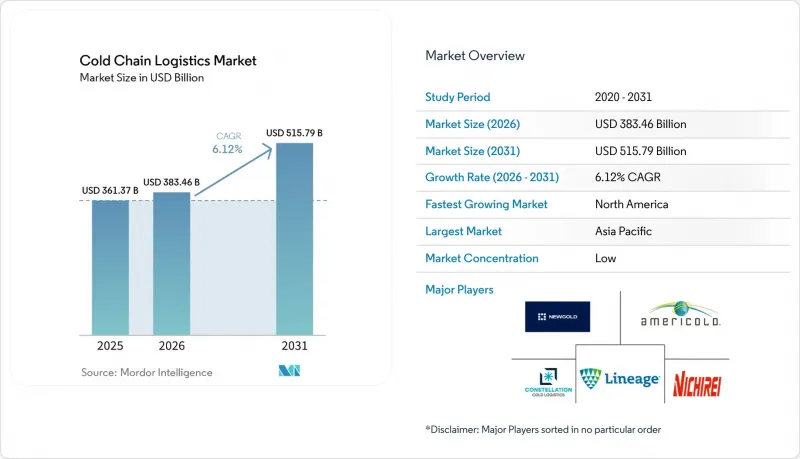
根據 Mordor Intelligence 預測,低溫運輸物流市場規模將從 2025 年的 3,613.7 億美元成長到 2026 年的 3,834.6 億美元,到 2031 年將達到 5,157.9 億美元,2026 年至 2031 年的複合年成長率為 6.12%。
本報告按服務(冷藏保管、冷藏運輸、附加價值服務)、溫度類型(冷藏(0-5 度C)、冷凍(-18-0度C)等)、應用領域(水果和蔬菜、肉類和家禽、魚類和水產品等)以及地區(北美、南美、亞太等)對產業進行分類。市場預測以美元計價。
全球低溫運輸物流市場趨勢與洞察
對需要在極低溫度下分發的mRNA疫苗的需求正在激增。
mRNA疫苗需要在-70 度C至-80 度C的溫度下儲存,遠低於傳統的冷凍溫度範圍。目前,生產商正與營運專用超低溫冷凍庫、乾冰補充站和冗餘電力系統的物流供應商合作。 DHL已撥款20億美元用於醫療保健物流,目標是在2030年前實現這一目標,其中8.6億美元將用於北美地區。疫苗劣化仍然是一個重要的成本因素。由於溫度偏差,全球整體近50%的疫苗劑量被浪費,導致製藥公司每年損失350億美元。為了減少這種浪費,市場正在加速對低溫運輸物流市場超低溫領域的投資。超低溫計畫目前收益頗豐,吸引了私募股權投資於專用冷庫設施。這些因素共同推動了該市場長期複合年成長率(CAGR)成長1.2個百分點。
生鮮電商平台的快速擴張正在改變最後一公里物流。
15-30分鐘送達的生鮮配送服務正推動亞洲人口稠密城市微型倉配中心建設的蓬勃發展。業者正在安裝多溫區儲存設施,以確保農產品、乳製品、肉類和冰淇淋在運輸過程中保持最佳狀態,避免交叉污染。預計2025年,美國線上生鮮銷售管道將佔生鮮總銷售額的五分之一。印度、印尼和韓國也呈現類似的成長趨勢,主要得益於智慧型手機普及率的提高。線上生鮮市場滲透率每提高一個百分點,低溫運輸物流市場就會隨之擴張,對溫控貨車和摩托車的需求也隨之增加。傳統零售商正在透過將本地化配送業務外包給專業的第三方公司來應對這一趨勢,這些公司能夠保證在嚴格的溫度範圍內準時送達。
在撒哈拉以南非洲,長期電力供應不穩定導致營運成本上升。
奈及利亞、肯亞和加納的冷庫每年停電時間超過500小時。營運商運作柴油發電機作為備用電源,導致能源成本佔營運支出的60%,而已開發市場這一比例僅35%。雖然結合太陽能和石化燃料的混合微電網可以降低燃料消耗,但對於小規模業主而言,初始投資仍然過高。不穩定的電力供應阻礙了溫度控制規程的執行,出口商也面臨貨物在目的地港被拒收的風險。除非可再生能源解決方案得到更廣泛的應用,否則物流業者的運輸能力擴張可能會受到限制,這可能會減緩該地區低溫運輸物流市場的成長。
細分市場分析
截至2025年,冷藏倉儲將佔低溫運輸物流市場佔有率的52.37%,但冷藏運輸的複合年成長率(CAGR)更快,達到6.88%。這一成長反映了消費者對快速新鮮配送的期望以及全球採購路線的多元化。隨著跨境電商供應鏈的延長和水產品直接配送到消費者手中的趨勢日益成長,貨物在嚴格控制溫度範圍內運輸的距離也越來越遠。透過利用多點路線規劃軟體,承運商可以最大限度地運轉率冷藏車,並抵消保溫拖車的高昂購置成本。投資拖車製冷裝置的鋰離子電池系統可以降低油耗,並有助於滿足加州和歐盟嚴格的排放氣體法規要求。
附加價值服務正逐漸成為低溫運輸物流市場中利潤豐厚的細分領域。諸如重新貼標、逆向物流和季節性包裝等作業需要熟練的勞動力和高效的工作流程,因此每個托盤的收入高於基礎倉儲作業。如今,藥品托運人期望獲得一站式服務,包括訂單組裝、臨床試驗退貨處理和溫度偏差報告,以簡化品質審核流程。食品品牌需要保鮮包裝和最終階段的品質檢驗,以滿足零售商的規格要求。為了因應這種對綜合服務日益成長的需求,傳統倉儲業者正在拓展業務,提供結合運輸和附加價值服務的打包服務,以保護其在低溫運輸物流市場的佔有率,並避免陷入單純的價格競爭。
區域分析
到2025年,北美將佔全球收入的33.62%,營運50億立方英尺的冷藏空間,其中超過五分之四位於美國。規模經濟使得企業能夠採用先進的自動化技術,例如高層起重機和可使托盤密度翻倍的穿梭車系統。然而,司機短缺和港口堵塞正給端到端的可靠性帶來壓力。 FSMA 204法規正在加速物聯網遠端資訊處理技術的應用,合規支出也正在提升服務質量,進而推動低溫運輸物流市場的發展。
在亞太地區,隨著收入的成長,人均蛋白質和高階冷凍甜點的消費量也在增加,複合年成長率最高,達到8.05%。中國已調理食品的蓬勃發展推動了二線城市對區域物流中心的需求,而印度冷藏倉庫所有權分散仍然是限制其發展的瓶頸。根據聯合國糧農組織(FAO)估計,改善低溫運輸基礎設施可將亞洲的收穫後損失減少高達40%。越南、印尼和泰國政府為氨和二氧化碳工廠提供稅收優惠,以吸引外國直接投資。這些政策使得亞太地區成為低溫運輸物流市場佔有率爭奪的關鍵戰場。
在歐洲,儘管成長緩慢,冷鏈物流產業在應對嚴格的環境標準的同時,也保持著穩定成長。歐盟的氟化氣體法規正在加速向天然冷媒的過渡,儘管需要大量的資本投入,但氨-二氧化碳級聯系統的應用仍然得到了推廣。營運商透過實施諸如隔熱材料維修、安裝LED照明和變速壓縮機等措施,獲得了能源效率認證和電力公司的補貼。與原始設備製造商(OEM)的合作正在加速即插即用型機房的普及,從而減少了停機時間。藥品運輸在歐洲貨運量中佔了相當大的佔有率,鞏固了該地區作為整個低溫運輸物流市場加值服務市場的地位。
儘管中東和非洲的冷庫規模仍然相對較小,但在電力供應不穩定的地區,利用太陽能的冷庫正以兩位數的速度成長。根據聯合國工業發展組織(UNIDO)的數據顯示,自2020年以來,非洲低溫運輸投資成長了25%。肯亞和南非已推出獎勵計劃,補貼高達30%的太陽能設施安裝成本,激發了私營部門的興趣。然而,目前仍依賴柴油發電,營運成本依然居高不下。在拉丁美洲,巴西引領著該地區的冷庫擴張。據巴西倉儲協會稱,自2020年以來,巴西的倉儲能力增加了15%。牛肉出口商正在尋求與港口相連的冷藏設施,以滿足亞洲的品質檢驗標準,這進一步鞏固了巴西在低溫運輸物流市場的戰略地位。
其他好處:
- Excel格式的市場預測(ME)表
- 3個月的分析師支持
目錄
第1章:引言
- 研究假設和市場定義
- 調查範圍
第2章:調查方法
第3章執行摘要
第4章 市場狀況
- 市場概覽
- 市場促進因素
- 北美和歐洲對需要低溫物流的mRNA疫苗的需求正在激增。
- 亞洲快速食品電商平台的迅速擴張,推動了對當天送達冷鏈食品的最後一公里配送需求的成長。
- 中東和非洲政府鼓勵建造太陽能冷藏倉庫,以減少收穫後食物浪費。
- 中國「預製食品」的蓬勃發展帶動了二線城市冷藏倉庫租賃市場的成長。
- 醫藥外包的趨勢正在推動歐洲採用符合GDP標準的第三方物流服務。
- 美國FDA的FSMA 204法規強制要求採用物聯網支援的遠端資訊處理技術,從而促進對即時溫度監控的投資。
- 市場限制因素
- 長期電力供應不穩定導致撒哈拉以南非洲冷庫的營運成本上升。
- 美國持有CDL駕照的冷凍車司機嚴重短缺,限制了運輸能力。
- 為符合歐盟氟碳法規而對氨/二氧化碳級聯系統維修,需要投入大量資金。
- 印度小規模冷庫所有權分散化阻礙了網路最佳化。
- 價值供應鏈分析
- 監管和技術展望
- 波特五力模型
第5章 市場規模與成長預測
- 按服務類型
- 冷藏倉庫
- 普通倉庫
- 私人倉庫
- 冷藏運輸
- 路
- 鐵路
- 海上運輸
- 航空
- 附加價值服務
- 冷藏倉庫
- 溫度
- 冷藏(0-5 度C)
- 冷凍(-18~0 度C)
- 濕度溫度
- 冰凍/超低溫(-20 度C或更低)
- 透過使用
- 水果和蔬菜
- 肉類/家禽
- 魚貝類
- 乳製品和冷凍甜點
- 麵包糖果甜點
- 即食餐
- 藥品和生技藥品
- 疫苗和臨床試驗材料
- 化學品/特殊材料
- 其他用途
- 按地區
- 北美洲
- 美國
- 加拿大
- 墨西哥
- 南美洲
- 巴西
- 秘魯
- 智利
- 阿根廷
- 其他南美國家
- 亞太地區
- 印度
- 中國
- 日本
- 澳洲
- 韓國
- 東南亞(新加坡、馬來西亞、泰國、印尼、越南、菲律賓)
- 其他亞太國家
- 歐洲
- 英國
- 德國
- 法國
- 西班牙
- 義大利
- 比荷盧經濟聯盟(比利時、荷蘭、盧森堡)
- 北歐國家(丹麥、芬蘭、冰島、挪威、瑞典)
- 其他歐洲國家
- 中東和非洲
- 阿拉伯聯合大公國
- 沙烏地阿拉伯
- 南非
- 奈及利亞
- 其他中東和非洲國家
- 北美洲
第6章 競爭情勢
- 市場集中度
- 策略趨勢
- 市佔率分析
- 公司簡介
- Lineage Logistics
- Americold Logistics
- NewCold Advanced Cold Logistics
- Nichirei Logistics Group Inc.
- Constellation Cold Logistics
- United States Cold Storage, Inc
- Frigolanda Cold Logistics Group
- Emergent Cold Latin America
- Snowman Logistics Ltd.
- Conestoga Cold Storage
- Interstate Cold Storage, Inc.
- SuperFrio Logistica Frigorificada
- Vertical Cold Storage
- Magnavale Ltd
- Swire Cold Storage
- Arcadia Cold Storage & Logistics
- Congebec Inc.
- Burris Logistics
- Agile Cold Storage LLC
- Groupe Conhexa*
第7章 市場機會與未來展望
According to Mordor Intelligence, the cold chain logistics market size is expected to grow from USD 361.37 billion in 2025 to USD 383.46 billion in 2026 and is forecast to reach USD 515.79 billion by 2031 at 6.12% CAGR over 2026-2031.
This report Segments the Industry Into by Service (Refrigerated Storage, Refrigerated Transportation and Value-Added Services), by Temperature Type (Chilled (0-5 °C), Frozen (-18-0 °C) and More), by Application (Fruits & Vegetables, Meat & Poultry, Fish & Seafood and More), and by Geography (North America, South America, Asia Pacific, and More). The Market Forecasts are Provided in Terms of Value (USD).
Global Cold Chain Logistics Market Trends and Insights
Surging demand for mRNA vaccines requiring ultra-low temperature distribution
mRNA vaccines must be stored between -70 °C and -80 °C, which is far below conventional frozen ranges. Manufacturers now partner with logistics providers that operate specialized ultra-low freezers, dry-ice replenishment stations, and redundant power systems. DHL earmarked USD 2 billion for healthcare logistics through 2030, with USD 860 million reserved for North America. Vaccine spoilage remains a critical cost driver; nearly 50% of global doses still go to waste because of thermal excursions, representing an annual USD 35 billion loss to drug makers. The need to mitigate this waste is accelerating investment in the deep-frozen segment of the cold chain logistics market. Ultra-low projects now command premium yields, which is drawing private equity into purpose-built freezer farms. Collectively, these forces add a 1.2 percentage-point uplift to the market's long-term CAGR.
Rapid expansion of quick-commerce grocery platforms transforming last-mile logistics
Fifteen-to-thirty-minute grocery delivery promises have triggered a wave of micro-fulfilment centre construction across densely populated Asian cities. Operators install multi-temperature chambers so that produce, dairy, meat, and ice cream depart in perfect condition without cross-contamination. The e-grocery channel is poised to account for one-fifth of all United States grocery revenue by 2025. Similar adoption curves are visible in India, Indonesia, and South Korea, aided by rising smartphone penetration. Every incremental point of e-grocery penetration raises demand for temperature-controlled vans and two-wheelers, which expands the cold chain logistics market. Legacy retailers are responding by outsourcing hyper-local distribution to third-party specialists that guarantee on-time delivery within strict temperature bands.
Chronic electricity instability inflating operational costs in Sub-Saharan Africa
Cold stores in Nigeria, Kenya, and Ghana face grid outages that exceed 500 hours per year. Operators run diesel generators for backup power, pushing energy costs to 60% of operating expenses versus 35% in developed markets. Solar-hybrid microgrids cut fuel consumption, yet upfront investments remain prohibitive for small owners. Unstable electricity hampers adherence to temperature protocols, exposing exporters to rejection at destination ports. Unless renewable solutions scale, logistics providers may limit capacity expansions, slowing the cold chain logistics market in the region.
Other drivers and restraints analyzed in the detailed report include:
- Pharmaceutical outsourcing drives GDP-compliant 3PL adoption
- IoT-enabled telematics under FSMA 204 elevate real-time monitoring investments
- Acute shortage of CDL-certified reefer drivers constraining United States capacity
For complete list of drivers and restraints, kindly check the Table Of Contents.
Segment Analysis
Refrigerated storage accounted for 52.37% of the cold chain logistics market share in 2025, yet refrigerated transportation is climbing faster at a 6.88% CAGR. The uptick mirrors consumer expectations for fast, fresh delivery and the diversification of global sourcing lanes. Longer cross-border e-commerce chains and direct-to-consumer seafood deliveries expand lane-kilometres that must stay within tight temperature ranges. Multi-stop routing software allows carriers to maximise the the utilisation of reefer trucks, offsetting the high capital cost of insulated trailers. Investments in lithium-ion battery systems for trailer refrigeration units lower fuel burn, aligning with strict emissions standards in California and the European Union.
Value-added services are emerging as a margin-rich niche inside the cold chain logistics market. Activities such as relabeling, reverse logistics, and seasonal packaging require skilled labour and high-velocity workflows that produce higher revenue per pallet than basic storage. Pharmaceutical shippers now expect order kitting, clinical return handling, and excursion reporting under one roof to streamline quality audits. Food brands request aroma-guard packaging and end-of-line quality inspection to match retailer specifications. Demand for integrated services entices traditional warehouse operators to expand into transport-plus-value-added bundles to protect share and avoid price-only competition in the cold chain logistics market.
Complete Report Scope:
- By Service Type
- Refrigerated Storage
- Public Warehousing
- Private Warehousing
- Refrigerated Transportation
- Road
- Rail
- Sea
- Air
- Value-Added Services
- Refrigerated Storage
- By Temperature Type
- Chilled (0-5 °C)
- Frozen (-18-0 °C)
- Ambient
- Deep-Frozen / Ultra-Low (more than -20 °C)
- By Application
- Fruits & Vegetables
- Meat & Poultry
- Fish & Seafood
- Dairy & Frozen Desserts
- Bakery & Confectionery
- Ready-to-Eat Meals
- Pharmaceuticals & Biologics
- Vaccines & Clinical Trial Materials
- Chemicals & Specialty Materials
- Other Applications
- By Geography
- North America
- United States
- Canada
- Mexico
- South America
- Brazil
- Peru
- Chile
- Argentina
- Rest of South America
- Asia Pacific
- India
- China
- Japan
- Australia
- South Korea
- South East Asia (Singapore, Malaysia, Thailand, Indonesia, Vietnam, and Philippines)
- Rest of Asia-Pacific
- Europe
- United Kingdom
- Germany
- France
- Spain
- Italy
- BENELUX (Belgium, Netherlands, and Luxembourg)
- NORDICS (Denmark, Finland, Iceland, Norway, and Sweden)
- Rest of Europe
- Middle East And Africa
- United Arab of Emirates
- Saudi Arabia
- South Africa
- Nigeria
- Rest of Middle East And Africa
- North America
Geography Analysis
North America generated 33.62% of 2025 revenue and operates 5 billion ft3 of refrigerated space, more than four-fifths of which sits in the United States. Scale advantages permit aggressive automation roll-outs, such as high-bay cranes and shuttle systems that double pallet density. Yet driver scarcity and port congestion pressure end-to-end reliability. The FSMA 204 rule accelerates adoption of IoT telematics, turning compliance spending into service-quality upgrades that sustain the cold chain logistics market.
Asia-Pacific registers the highest 8.05% CAGR as rising incomes increase per-capita consumption of protein and premium frozen desserts. China's ready-to-cook meal boom fuels demand for regional distribution hubs in tier-2 cities, while India's fragmented cold room ownership remains a bottleneck. FAO estimates that improving cold chain infrastructure could cut Asia's post-harvest losses by up to 40%. Governments in Vietnam, Indonesia, and Thailand offer tax breaks on ammonia-CO2 plants to lure foreign direct investment. These policies make Asia-Pacific the pivotal battleground for market share in the cold chain logistics market.
Europe exhibits slow-but-steady growth while executing stringent environmental upgrades. The EU F-Gas Regulation encourages a shift to natural refrigerants, driving installation of ammonia-CO2 cascade systems despite capital burdens. Operators retrofit insulation, LED lighting, and variable-speed compressors to earn energy-efficiency certificates that unlock utility rebates. Partnerships with OEMs accelerate deployment of plug-and-play plant rooms, limiting downtime. Pharmaceutical shipments form a sizable share of European volumes, reinforcing the region's status as a premium service market within the wider cold chain logistics market.
Middle East and Africa remain small in absolute terms but record double-digit gains where solar-powered cold stores mitigate unreliable grids. UNIDO tracks a 25% jump in African cold chain investments since 2020. Incentive schemes in Kenya and South Africa reimburse up to 30% of photovoltaic installation costs, spurring private-sector interest. However, diesel reliance persists, keeping operating costs elevated. In Latin America, Brazil leads regional expansion. Its national warehousing association notes a 15% capacity jump since 2020. Beef exporters demand near-dock freezer complexes to meet Asian quality checks, reinforcing Brazil's strategic role in the cold chain logistics market.
- Lineage Logistics
- Americold Logistics
- NewCold Advanced Cold Logistics
- Nichirei Logistics Group Inc.
- Constellation Cold Logistics
- United States Cold Storage, Inc
- Frigolanda Cold Logistics Group
- Emergent Cold Latin America
- Snowman Logistics Ltd.
- Conestoga Cold Storage
- Interstate Cold Storage, Inc.
- SuperFrio Logistica Frigorificada
- Vertical Cold Storage
- Magnavale Ltd
- Swire Cold Storage
- Arcadia Cold Storage & Logistics
- Congebec Inc.
- Burris Logistics
- Agile Cold Storage LLC
- Groupe Conhexa*
Additional Benefits:
- The market estimate (ME) sheet in Excel format
- 3 months of analyst support
TABLE OF CONTENTS
1 Introduction
- 1.1 Study Assumptions & Market Definition
- 1.2 Scope of the Study
2 Research Methodology
3 Executive Summary
4 Market Landscape
- 4.1 Market Overview
- 4.2 Market Drivers
- 4.2.1 Surging Demand for mRNA Vaccines Requiring Ultra-Low Temperature Distribution in North America & Europe
- 4.2.2 Rapid Expansion of Quick-Commerce Grocery Platforms in Asia Increasing Same-Day Refrigerated Last-Mile Needs
- 4.2.3 Government Incentives for Solar-Powered Cold Warehouses in Middle East & Africa to Curb Post-Harvest Food Losses
- 4.2.4 China's "Ready-to-Cook" Meal Boom Propelling Cold Storage Leasing in Tier-2 Cities
- 4.2.5 Pharmaceutical Outsourcing Shifts Driving GDP-Compliant 3PL Adoption in Europe
- 4.2.6 IoT-Enabled Telematics Mandates by US FDA's FSMA 204 Rule Elevating Real-Time Temperature-Monitoring Investments
- 4.3 Market Restraints
- 4.3.1 Chronic Electricity Instability Inflating Operational Costs of Sub-Saharan African Cold Stores
- 4.3.2 Acute Shortage of CDL-Certified Reefer Drivers in the United States Constraining Transport Capacity
- 4.3.3 High Capital Costs of Ammonia/CO2 Cascade Retrofits for EU F-Gas Regulation Compliance
- 4.3.4 Fragmented Ownership of Small-Scale Cold Rooms in India Hindering Network Optimization
- 4.4 Value / Supply-Chain Analysis
- 4.5 Regulatory or Technological Outlook
- 4.6 Porter's Five Forces
- 4.6.1 Bargaining Power of Suppliers
- 4.6.2 Bargaining Power of Buyers
- 4.6.3 Threat of New Entrants
- 4.6.4 Threat of Substitutes
- 4.6.5 Competitive Rivalry
5 Market Size & Growth Forecasts (Value)
- 5.1 By Service Type
- 5.1.1 Refrigerated Storage
- 5.1.1.1 Public Warehousing
- 5.1.1.2 Private Warehousing
- 5.1.2 Refrigerated Transportation
- 5.1.2.1 Road
- 5.1.2.2 Rail
- 5.1.2.3 Sea
- 5.1.2.4 Air
- 5.1.3 Value-Added Services
- 5.1.1 Refrigerated Storage
- 5.2 By Temperature Type
- 5.2.1 Chilled (0-5 °C)
- 5.2.2 Frozen (-18-0 °C)
- 5.2.3 Ambient
- 5.2.4 Deep-Frozen / Ultra-Low (more than -20 °C)
- 5.3 By Application
- 5.3.1 Fruits & Vegetables
- 5.3.2 Meat & Poultry
- 5.3.3 Fish & Seafood
- 5.3.4 Dairy & Frozen Desserts
- 5.3.5 Bakery & Confectionery
- 5.3.6 Ready-to-Eat Meals
- 5.3.7 Pharmaceuticals & Biologics
- 5.3.8 Vaccines & Clinical Trial Materials
- 5.3.9 Chemicals & Specialty Materials
- 5.3.10 Other Applications
- 5.4 By Geography
- 5.4.1 North America
- 5.4.1.1 United States
- 5.4.1.2 Canada
- 5.4.1.3 Mexico
- 5.4.2 South America
- 5.4.2.1 Brazil
- 5.4.2.2 Peru
- 5.4.2.3 Chile
- 5.4.2.4 Argentina
- 5.4.2.5 Rest of South America
- 5.4.3 Asia Pacific
- 5.4.3.1 India
- 5.4.3.2 China
- 5.4.3.3 Japan
- 5.4.3.4 Australia
- 5.4.3.5 South Korea
- 5.4.3.6 South East Asia (Singapore, Malaysia, Thailand, Indonesia, Vietnam, and Philippines)
- 5.4.3.7 Rest of Asia-Pacific
- 5.4.4 Europe
- 5.4.4.1 United Kingdom
- 5.4.4.2 Germany
- 5.4.4.3 France
- 5.4.4.4 Spain
- 5.4.4.5 Italy
- 5.4.4.6 BENELUX (Belgium, Netherlands, and Luxembourg)
- 5.4.4.7 NORDICS (Denmark, Finland, Iceland, Norway, and Sweden)
- 5.4.4.8 Rest of Europe
- 5.4.5 Middle East And Africa
- 5.4.5.1 United Arab of Emirates
- 5.4.5.2 Saudi Arabia
- 5.4.5.3 South Africa
- 5.4.5.4 Nigeria
- 5.4.5.5 Rest of Middle East And Africa
- 5.4.1 North America
6 Competitive Landscape
- 6.1 Market Concentration
- 6.2 Strategic Moves
- 6.3 Market Share Analysis
- 6.4 Company Profiles {(includes Global-level Overview, Market-level Overview, Core Segments, Financials, Strategic Information, Market Rank/Share, Products & Services, Recent Developments)}
- 6.4.1 Lineage Logistics
- 6.4.2 Americold Logistics
- 6.4.3 NewCold Advanced Cold Logistics
- 6.4.4 Nichirei Logistics Group Inc.
- 6.4.5 Constellation Cold Logistics
- 6.4.6 United States Cold Storage, Inc
- 6.4.7 Frigolanda Cold Logistics Group
- 6.4.8 Emergent Cold Latin America
- 6.4.9 Snowman Logistics Ltd.
- 6.4.10 Conestoga Cold Storage
- 6.4.11 Interstate Cold Storage, Inc.
- 6.4.12 SuperFrio Logistica Frigorificada
- 6.4.13 Vertical Cold Storage
- 6.4.14 Magnavale Ltd
- 6.4.15 Swire Cold Storage
- 6.4.16 Arcadia Cold Storage & Logistics
- 6.4.17 Congebec Inc.
- 6.4.18 Burris Logistics
- 6.4.19 Agile Cold Storage LLC
- 6.4.20 Groupe Conhexa*
7 Market Opportunities & Future Outlook

 冷鏈物流市場:全球市場預測,2026-2032年
 泰國冷鏈物流:市場佔有率分析、產業趨勢與統計及成長預測(2026-2031)法國低溫運輸物流:市場佔有率分析、產業趨勢與統計及成長預測(2026-2031)中國低溫運輸物流:市場佔有率分析、產業趨勢與統計及成長預測(2026-2031)美國冷鏈物流:市場佔有率分析、產業趨勢與統計及成長預測(2026-2031)英國低溫運輸物流:市場佔有率分析、產業趨勢與統計及成長預測(2026-2031)低溫運輸物流市場:2026-2032年全球市場預測(依服務類型、解決方案類型、溫度範圍及最終用途分類)低溫運輸市場:2026-2032年全球市場預測(依溫度區域、設備類型、服務模式、通路和最終用戶分類)
 低溫運輸運輸市場預測至2034年-全球分析(按運輸方式、溫度範圍、車輛類型、技術、服務類型、最終用戶和地區分類)低溫運輸運輸市場預測至2034年-按溫度區域、運輸方式、服務類型、最終用戶產業和地區分類的全球分析