

 |
市場調查報告書
商品編碼
2124372
美國冷鏈物流:市場佔有率分析、產業趨勢與統計及成長預測(2026-2031)US Cold Chain Logistics - Market Share Analysis, Industry Trends & Statistics, Growth Forecasts (2026 - 2031) |
||||||

※ 本網頁內容可能與最新版本有所差異。詳細情況請與我們聯繫。
據 Mordor Intelligence 稱,美國冷鏈物流市場預計在 2026 年達到 971.3 億美元,預計在預測期(2026-2031 年)內將以 6.63% 的複合年成長率成長,到 2031 年達到 1338.7 億美元。
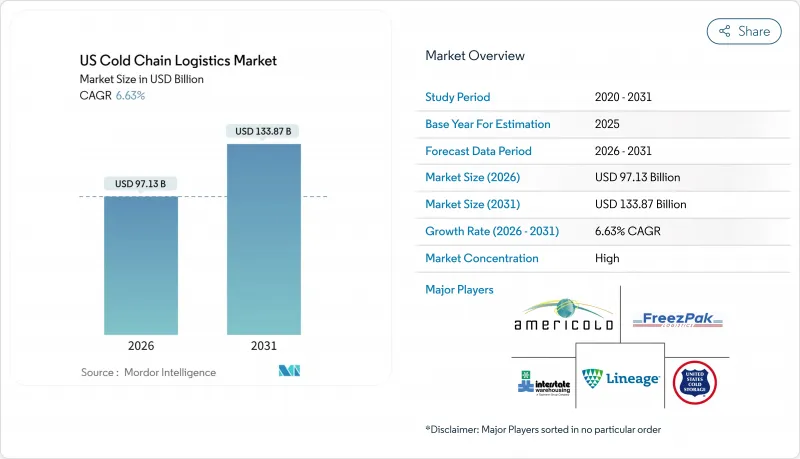
本報告按服務類型(冷藏倉儲、冷藏運輸、附加價值服務)、溫度類型(冷藏、冷凍、其他)、應用領域(水果和蔬菜、肉類和家禽、乳製品、藥品和生技藥品、疫苗、其他生鮮食品)以及地區(東北部、中西部、東南部、西南部、西部)進行細分。市場預測以美元計價。
美國冷鏈物流市場趨勢與洞察
網路食品雜貨和食材自煮包服務的銷售量激增。
2025年,線上雜貨市場將佔食品零售市場的17%,而溫控末端配送的複雜性發展速度遠超常溫電商。為了滿足分散在各個社區的訂單需求,需要在人口密集的住宅方圓10英里內建設配備多溫區存儲的微型倉配中心,這推高了空置率接近6.9%的城市中心的房地產成本。食材自煮包服務商為了滿足配送時限,在四時限內對冷凍肉類、冷藏農產品和常溫商品進行越庫作業,進一步推動了營運效率的提升。這些模式共同催生了對靈活、緊湊型設施日益成長的需求,這些設施能夠按時完成揀貨、包裝和出貨。即使缺乏增值功能的傳統設施利潤率不斷下降,整合路線最佳化軟體和即時冷藏監控系統的營運商仍然能夠獲得新的合約。成長最顯著的地區是排名前50的大都會圈,這些地區的「軸輻式」物流網路正在加速擴張,而非全國統一佈局。
藥物生物製劑和細胞/基因治療領域的快速成長
個人化醫療,例如 CAR-T 療法,需要點對點的低溫運輸、-150 度C以下的檢驗儲存以及快速送達治療中心,這使得醫療物流的重點從大規模儲存轉向了針對特定患者的客製化服務。 DHL 計劃在 2030 年之前在美洲的醫療物流領域投資 10 億歐元(11.7 億美元),凸顯了高階溫控運輸路線的盈利。醫療物流的經濟效益與食品物流截然不同。生技藥品一旦出現偏差,損失可能高達 50 萬美元,而農產品的損失僅為 5,000 美元。因此,托運人優先考慮冗餘電源、即時遙測、區塊鏈追蹤儲存歷史,並根據供應商的合規記錄而非最低價格來選擇服務商。儘管建設成本高出三到四倍,但波士頓、費城和羅利等城市運輸能力的短缺仍在推動投機性低溫設施的建設,這表明市場需求仍然強勁。
與分階段減少氫氟碳化合物相關的維修成本
美國環保署 (EPA) 的規定要求營運商更換高全球暖化潛值 (GWP) 冷媒,例如 R-404A,這將導致到 2028 年產量上限降低 40%,而每個站點的改造成本已上漲至 200 萬至 400 萬美元。 2000 年代建造的設施仍有結構使用壽命,但自 2024 年以來,冷媒價格上漲了兩倍。小型業主難以攤銷技術研究成本和運作損失,迫使他們合併到能夠將成本分攤到多個站點的小規模營運商,加速了產業結構調整。此外,維修的時間恰逢更廣泛的產能擴張計劃,迫使企業調整資本配置並推遲其他現代化項目。
細分市場分析
到2025年,冷藏倉庫將占美國冷鏈物流市場佔有率的57.53%,這反映出固定基礎設施在連接生產商和消費者方面發揮的關鍵作用。在這一領域,隨著食品公司擴大將業務外包給專業公司,將固定成本分攤到多個租戶,自動化公共倉庫的佔有率正在擴大。同時,在製藥領域,專用倉庫仍然至關重要,因為出於合規性和安全性的考慮,單一租戶模式必不可少。道路運輸在貨運量方面仍然佔據主導地位,但由於司機短缺和燃油價格波動導致的運力限制,長途冷藏貨物正轉向鐵路和多式聯運解決方案,這些方案可以降低30-40%的成本。到2031年,航空貨運的複合年成長率將達到13.23%,這反映了一個並行網路的形成,該網路經過最佳化,可以運輸高價值、小批量的藥品,這些藥品不能容忍延誤或溫度波動,從而確保承運人和處理商的高利潤。套件組裝、貼標籤和品質檢驗等附加價值服務正經歷兩位數的成長,收入來源也從倉儲和運輸多元化發展。
自動化帶來的影響是多方面的。已實施自動化立體倉庫(AS/RS)系統的設施,現場工作人員數量減少了高達70%,同時提高了每立方英尺的處理能力,並緩解了工資上漲和人手不足。由於貨架佈局緊湊且氣密性提高,能源效率也提高了10-15%。因此,投資者正在投資規模超過4000萬立方英尺的項目,這些項目得到了與環境、社會和治理(ESG)相關的融資支持。同時,傳統的人工操作設施正努力資金籌措資金,用於改造為氫氟碳化物(HFC)倉庫或進行技術維修。隨著大型營運商收購小規模倉庫並將其改造為自動化樞紐,整個產業正在經歷重組。
其他好處
- Excel格式的市場預測(ME)表
- 3個月的分析師支持
目錄
第1章:引言
- 研究假設和市場定義
- 調查範圍
第2章:調查方法
第3章執行摘要
第4章 市場狀況
- 市場概覽
- 市場促進因素
- 網路食品雜貨和食材自煮包服務的銷售量激增。
- 生物製藥和細胞/基因治療的蓬勃發展
- 毗鄰港口的自動化巨型倉庫
- 內陸冷藏樞紐(CPKC)與鐵路合作
- 透過與環境、社會及公司治理(ESG)掛鉤的貸款加速貸款升級
- 來自美國農業部(USDA)強制性減少食物廢棄物措施的壓力
- 市場限制因素
- 與分階段減少氫氟碳化合物相關的維修成本
- 零下環境下的人手不足
- 電力價格波動的風險
- 氣候變遷導致港口和運河中斷
- 價值供應鏈分析
- 監理展望
- 技術展望
- 波特五力模型
第5章 市場規模與成長預測
- 按服務類型
- 冷藏倉庫
- 冷藏運輸
- 路
- 鐵路
- 海
- 航空
- 附加價值服務
- 按溫度類型
- 冷藏(0-5 度C)
- 冷凍(-18~0 度C)
- 室溫
- 超低溫/超低溫(低於-20 度C)
- 透過使用
- 水果和蔬菜
- 肉類/家禽
- 魚貝類
- 乳製品和冷凍甜點
- 麵包糖果甜點
- 即食餐
- 藥品和生技藥品
- 疫苗和臨床試驗材料
- 化學品/特殊材料
- 其他生鮮食品
- 按地區(美國)
- 東北
- 中西部
- 東南部
- 西南
- 西
第6章 競爭情勢
- 市場集中度
- 策略趨勢
- 市佔率分析
- 公司簡介
- Lineage Logistics Holdings, LLC
- Americold Logistics, LLC
- United States Cold Storage, Inc.
- Vertical Cold
- DHL Supply Chain
- FedEx Cold Chain Logistics
- UPS Healthcare
- NewCold Advanced Cold Logistics
- AGRO Merchants Group
- AIT Worldwide Logistics
- Cloverleaf Cold Storage
- Interstate Warehousing, Inc.
- RLS Logistics
- 彭斯克物流(冷鏈)
- Ryder System, Inc.(SCS)
- FreezPak Logistics
- Congebec Logistics
- Cold Summit Development
- Nordic Cold Storage, LLC
- JB Hunt運輸服務公司(冷藏運輸)
- 施耐德國家運輸公司(冷藏車)
第7章 市場機會與未來展望
According to Mordor Intelligence, the US cold chain logistics market size is estimated at USD 97.13 billion in 2026, and is expected to reach USD 133.87 billion by 2031, at a CAGR of 6.63% during the forecast period (2026-2031).
This report is Segmented by Service Type (Refrigerated Storage, Refrigerated Transportation, Value-Added Services), by Temperature Type (Chilled, Frozen and More), by Application (Fruits & Vegetables, Meat & Poultry, Dairy, Pharmaceuticals & Biologics, Vaccines, Other Perishables), and by Region (Northeast, Midwest, Southeast, Southwest, West). Market Forecasts are in Value (USD).
US Cold Chain Logistics Market Trends and Insights
E-Grocery and Meal-Kit Volumes Surge
Online grocery penetration reached 17% of food retail in 2025, and temperature-controlled last-mile delivery complexity expanded faster than ambient e-commerce Individual order dispersion across neighborhoods is forcing micro-fulfilment centers with multi-zone rooms to locate within 10 miles of dense households, inflating real-estate costs in urban cores where vacancy stands near 6.9%. Meal-kit providers add sequencing pressure by cross-docking frozen proteins, chilled produce, and ambient items inside four-hour windows to meet delivery promises. Together, these models lift demand for flexible, small-footprint facilities that can pick, pack, and dispatch within narrow cut-offs. Operators able to integrate route optimization software with real-time refrigeration monitoring have captured new contracts, even as profit margins tighten for legacy facilities lacking value-added capabilities. Growth remains strongest in the top 50 metro areas, reinforcing a hub-and-spoke distribution build-out rather than national uniformity.
Pharma Biologics and Cell-Gene Therapy Boom
Personalized medicines such as CAR-T require point-to-point cryogenic transport, validated storage below -150 °C, and rapid release back to treatment centers, shifting emphasis from bulk storage to patient-specific orchestration. DHL's commitment to invest EUR 1 billion (USD 1.17 billion) in healthcare logistics across the Americas by 2030 underscores the profitability of premium temperature-controlled lanes. The economic calculus differs from food: a single deviation can erase USD 500,000 in biologics value, compared to USD 5,000 for produce. Consequently, shippers prioritize redundant power, real-time telemetry, and chain-of-custody blockchain, selecting providers on compliance record rather than lowest rate. Capacity shortfalls in Boston, Philadelphia, and Raleigh have spurred speculative ultra-low builds despite 3-4X higher construction costs, signaling sustained demand tailwinds.
HFC Phase-Down Retrofit Costs
EPA rules compel operators to replace high-GWP refrigerants such as R-404A, raising conversion costs to USD 2-4 million per site while production caps tighten 40% by 2028. Facilities constructed in the 2000s retain useful structural life yet face escalating refrigerant prices that have tripled since 2024. Smaller owners struggle to amortize engineering studies and downtime, accelerating consolidation as they exit scale players who spread costs across multiple locations. Retrofit timing also collides with broader capacity expansion plans, forcing capital rationing and delaying other modernization projects.
Other drivers and restraints analyzed in the detailed report include:
- Port-Adjacent Automated Mega-Warehouses
- Rail-Integrated Inland Cold Hubs
- Labor Scarcity in Sub-Zero Operations
For complete list of drivers and restraints, kindly check the Table Of Contents.
Segment Analysis
Refrigerated storage captured 57.53% of the US cold chain logistics market share in 2025, reflecting the pivotal role fixed infrastructure plays in linking producers and consumers. Within this segment, automated public warehouses are gaining share as food companies outsource specialists who distribute fixed costs across multiple tenants. Private storage remains critical for pharmaceuticals, where compliance and security justify single-tenant models. Road transport retains volume leadership, yet capacity headwinds from driver shortages and fuel volatility are steering long-haul frozen goods toward rail-intermodal solutions that offer 30-40% savings. Airfreight's 13.23% CAGR through 2031 embodies a parallel network optimized for high-value, low-volume therapies that tolerate neither delay nor temperature deviation, cementing premium yields for carriers and handlers. Value-added services - kitting, labeling, and quality testing - have grown by double digits, diversifying revenue streams beyond storage and haulage.
Automation's impact is multifaceted. Facilities employing AS/RS systems operate with up to 70% fewer floor workers and deliver higher throughput per ft3, mitigating wage inflation and labor scarcity. Energy efficiency gains of 10-15% stem from compact racking and reduced infiltration. As a result, investors funnel capital toward projects exceeding 40 million ft3, supported by ESG-linked financing. Conversely, legacy manual facilities struggle to fund HFC conversions and technology retrofits, pushing industry consolidation as scale operators acquire sub-scale warehouses to redevelop them into automated nodes.
Complete Report Scope:
- By Service Type
- Refrigerated Storage
- Refrigerated Transportation
- Road
- Rail
- Sea
- Air
- Value-Added Services
- By Temperature Type
- Chilled (0-5 °C)
- Frozen (-18-0 °C)
- Ambient
- Deep-Frozen / Ultra-Low (More than 20 °C)
- By Application
- Fruits & Vegetables
- Meat & Poultry
- Fish & Seafood
- Dairy & Frozen Desserts
- Bakery & Confectionery
- Ready-to-Eat Meals
- Pharmaceuticals & Biologics
- Vaccines & Clinical Trial Materials
- Chemicals & Specialty Materials
- Other Perishables
- By Region (United States)
- Northeast
- Midwest
- Southeast
- Southwest
- West
List of Companies Covered in this Report:
- Lineage Logistics Holdings, LLC
- Americold Logistics, LLC
- United States Cold Storage, Inc.
- Vertical Cold
- DHL Supply Chain
- FedEx Cold Chain Logistics
- UPS Healthcare
- NewCold Advanced Cold Logistics
- AGRO Merchants Group
- AIT Worldwide Logistics
- Cloverleaf Cold Storage
- Interstate Warehousing, Inc.
- RLS Logistics
- Penske Logistics (Cold Chain)
- Ryder System, Inc. (SCS)
- FreezPak Logistics
- Congebec Logistics
- Cold Summit Development
- Nordic Cold Storage, LLC
- J.B. Hunt Transport Services, Inc. (Refrigerated)
- Schneider National, Inc. (Reefer)
Additional Benefits:
- The market estimate (ME) sheet in Excel format
- 3 months of analyst support
TABLE OF CONTENTS
1 Introduction
- 1.1 Study Assumptions & Market Definition
- 1.2 Scope of the Study
2 Research Methodology
3 Executive Summary
4 Market Landscape
- 4.1 Market Overview
- 4.2 Market Drivers
- 4.2.1 E-grocery & meal-kit volumes surge
- 4.2.2 Pharma biologics & cell-gene therapy boom
- 4.2.3 Port-adjacent automated mega-warehouses
- 4.2.4 Rail-integrated inland cold hubs (CPKC)
- 4.2.5 ESG-linked financing accelerates upgrades
- 4.2.6 USDA food-waste mandate pressure
- 4.3 Market Restraints
- 4.3.1 HFC phase-down retrofit costs
- 4.3.2 Labor scarcity in sub-zero operations
- 4.3.3 Power-price volatility risk
- 4.3.4 Port & canal climate disruptions
- 4.4 Value / Supply-Chain Analysis
- 4.5 Regulatory Outlook
- 4.6 Technological Outlook
- 4.7 Porters Five Forces
- 4.7.1 Threat of New Entrants
- 4.7.2 Bargaining Power of Suppliers
- 4.7.3 Bargaining Power of Buyers
- 4.7.4 Threat of Substitutes
- 4.7.5 Competitive Rivalry
5 Market Size & Growth Forecasts (Value, USD)
- 5.1 By Service Type
- 5.1.1 Refrigerated Storage
- 5.1.2 Refrigerated Transportation
- 5.1.2.1 Road
- 5.1.2.2 Rail
- 5.1.2.3 Sea
- 5.1.2.4 Air
- 5.1.3 Value-Added Services
- 5.2 By Temperature Type
- 5.2.1 Chilled (0-5 °C)
- 5.2.2 Frozen (-18-0 °C)
- 5.2.3 Ambient
- 5.2.4 Deep-Frozen / Ultra-Low (More than 20 °C)
- 5.3 By Application
- 5.3.1 Fruits & Vegetables
- 5.3.2 Meat & Poultry
- 5.3.3 Fish & Seafood
- 5.3.4 Dairy & Frozen Desserts
- 5.3.5 Bakery & Confectionery
- 5.3.6 Ready-to-Eat Meals
- 5.3.7 Pharmaceuticals & Biologics
- 5.3.8 Vaccines & Clinical Trial Materials
- 5.3.9 Chemicals & Specialty Materials
- 5.3.10 Other Perishables
- 5.4 By Region (United States)
- 5.4.1 Northeast
- 5.4.2 Midwest
- 5.4.3 Southeast
- 5.4.4 Southwest
- 5.4.5 West
6 Competitive Landscape
- 6.1 Market Concentration
- 6.2 Strategic Moves
- 6.3 Market Share Analysis
- 6.4 Company Profiles (includes Global level Overview, Market level overview, Core Segments, Financials as available, Strategic Information, Market Rank/Share for key companies, Products & Services, and Recent Developments)
- 6.4.1 Lineage Logistics Holdings, LLC
- 6.4.2 Americold Logistics, LLC
- 6.4.3 United States Cold Storage, Inc.
- 6.4.4 Vertical Cold
- 6.4.5 DHL Supply Chain
- 6.4.6 FedEx Cold Chain Logistics
- 6.4.7 UPS Healthcare
- 6.4.8 NewCold Advanced Cold Logistics
- 6.4.9 AGRO Merchants Group
- 6.4.10 AIT Worldwide Logistics
- 6.4.11 Cloverleaf Cold Storage
- 6.4.12 Interstate Warehousing, Inc.
- 6.4.13 RLS Logistics
- 6.4.14 Penske Logistics (Cold Chain)
- 6.4.15 Ryder System, Inc. (SCS)
- 6.4.16 FreezPak Logistics
- 6.4.17 Congebec Logistics
- 6.4.18 Cold Summit Development
- 6.4.19 Nordic Cold Storage, LLC
- 6.4.20 J.B. Hunt Transport Services, Inc. (Refrigerated)
- 6.4.21 Schneider National, Inc. (Reefer)
7 Market Opportunities & Future Outlook

 泰國冷鏈物流:市場佔有率分析、產業趨勢與統計及成長預測(2026-2031)法國低溫運輸物流:市場佔有率分析、產業趨勢與統計及成長預測(2026-2031)中國低溫運輸物流:市場佔有率分析、產業趨勢與統計及成長預測(2026-2031)英國低溫運輸物流:市場佔有率分析、產業趨勢與統計及成長預測(2026-2031)
 低溫運輸物流市場:2026-2032年全球市場預測(依服務類型、解決方案類型、溫度範圍及最終用途分類)低溫運輸市場:2026-2032年全球市場預測(依溫度區域、設備類型、服務模式、通路和最終用戶分類)低溫運輸物流:市場佔有率分析、產業趨勢與統計、成長預測(2026-2031)
 低溫運輸運輸市場預測至2034年-全球分析(按運輸方式、溫度範圍、車輛類型、技術、服務類型、最終用戶和地區分類)低溫運輸運輸市場預測至2034年-按溫度區域、運輸方式、服務類型、最終用戶產業和地區分類的全球分析
 全球低溫運輸市場:按類型、應用、溫度區間、技術和地區分類-預測至2031年