


 |
市場調查報告書
商品編碼
2099973
中國GPU散熱解決方案:市佔率分析、產業趨勢與統計及成長預測(2026-2031年)China GPU Cooling Solutions - Market Share Analysis, Industry Trends & Statistics, Growth Forecasts (2026 - 2031) |
||||||

※ 本網頁內容可能與最新版本有所差異。詳細情況請與我們聯繫。
根據 Mordor Intelligence 預測,中國 GPU 散熱解決方案市場規模預計將在 2025 年達到 32.3 億美元,2026 年達到 41.1 億美元,到 2031 年達到 156 億美元,2026 年至 2031 年的複合年成長率為 30.59%。
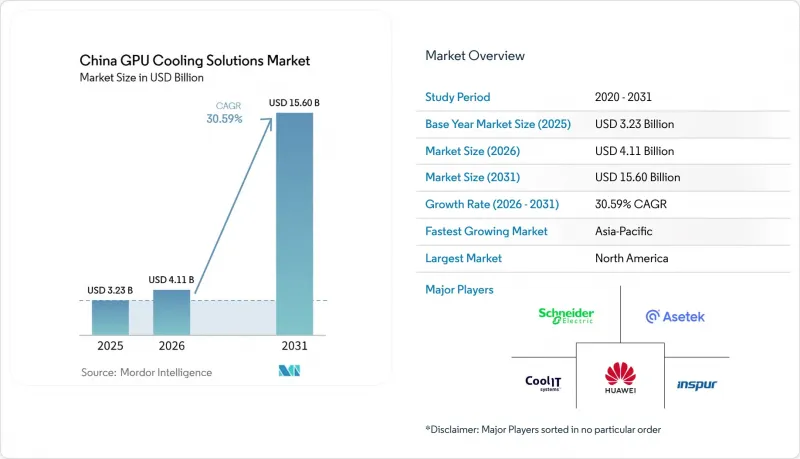
本報告按冷卻技術(風冷、水冷、晶片級直接冷卻、浸沒式冷卻等)、冷卻等級(組件級冷卻、伺服器和機架級冷卻)、部署類型(超大規模和雲端、企業級、政府和研究級高效能運算、邊緣運算)以及GPU功率密度(小於300W、300W-700W、大於700W)進行細分。市場預測以美元(USD)計價。
中國GPU散熱解決方案市場趨勢與洞察
中國超大規模資料中心人工智慧叢集的快速擴張
位元組跳動與VNET簽署的500兆瓦託管協議以及DeepSeek在內蒙古的建設項目凸顯了當前機架單機功耗超過50千瓦的現狀。在這種功耗水準下,透過空氣冷卻維持熱傳遞路徑在動態已變得不可行。阿里雲張北園區透過將浸沒式冷卻槽與風力發電結合,將PUE值降低至1.09,證明了液冷系統能夠同時滿足能源和ESG目標。 「十五」規劃要求業者將計算設施與可再生能源共址,從而將建設週期縮短至一年以內。如今,提供預製歧管、密封冷卻迴路和遠端試運行服務的供應商能夠在數週內獲得訂單,在中國GPU散熱解決方案市場佔據戰略優勢。
政府獎勵措施促進國內GPU製造和生態系統的在地化
工信部向伺服器製造商提供退稅,前提是其冷板、水泵和熱交換器等組件均採用國產組件並進行認證。華為於2026年3月發布的「星河AI Fabric 2.0」交換器採用液冷通道,在減少30%機架面積的同時,實現了國產化。華為已在上海和深圳建立了液冷測試實驗室,匯集了科研機構和組件供應商,將原型開發週期從六個月縮短至八週。這些措施確保了供應的穩定性,並縮短了符合中國RoHS指令(含氟化合物指令)的時間,該指令將於2027年生效。
液冷和浸沒式冷卻基礎設施需要較高的初始資本投資。
根據 Turner & Townsend 的資料中心成本指數,晶片級直接冷卻 (DTC) 迴路的資本支出增加了 15% 至 25%,而浸沒式冷卻槽的資本支出增加了 40% 至 60%,這意味著 10 MW 的資料中心配置將增加 300 萬至 600 萬美元的成本。超大規模資料中心業者公司透過長期合約攤提這些成本,但西安和成都的中小型企業往往會推遲升級。在工業電價低於 0.06 美元/千瓦時的地區,浸沒式冷卻的投資回收期超過四年,這使得許多運營商仍然依賴風冷,並拖慢了中國 GPU 散熱解決方案市場的部分發展。
細分市場分析
在所有冷卻技術中,浸沒式冷卻預計將以最高的複合年成長率 (CAGR 25.50%) 成長,這主要得益於超大規模資料中心營運商不斷成長的需求,他們希望將電源使用效率 (PUE) 降低到 1.10 以下。到 2025 年,風冷仍將佔據 47.04% 的相當大市場佔有率,這反映了其在功率密度低於 500 瓦的機架中的穩固地位。然而,隨著人工智慧工作負載的不斷成長,機架級熱負荷也在增加,促使營運商採用基於液冷的替代方案來提高散熱效率並適應更高的運算密度。在現有設施(棕地)中,由於樓層荷載限制和天花板高度限制,部署全浸沒式冷卻槽並不現實,因此改造為晶片級直接冷卻迴路正變得越來越普遍。在北京的一個試點部署中,浪潮的冷板機櫃實現了 1.15 的 PUE,證明了液冷在現有資料中心環境中的實用性。此外,隨著企業探索如何在不完全重新設計設施的情況下,將 AI 伺服器與傳統IT基礎設施一起運行,結合風扇牆和後門式熱交換器的混合冷卻系統也引起了人們的注意。
阿里雲張北資料中心將浸沒式冷卻技術與剩餘風能結合,提升了可再生能源豐富的張北地區在中國GPU散熱解決方案市場的競爭力。曙光科技的C8000兆瓦浸沒式冷卻槽進一步展現了國內企業直接邁向專為高效能運算和人工智慧工作負載設計的超高密度冷卻架構的能力。預計風冷仍將適用於工廠車間及類似分散式環境中的邊緣推理部署,尤其是在GPU功耗低於300瓦的情況下。因此,市場區隔很可能繼續按部署類型進行。液冷技術有望成為需要高密度運算和先進溫度控管的新型人工智慧叢集部署的主流,而大多數現有資料中心將繼續依賴經過最佳化的風冷系統,並逐步提升其效率。
預計到2025年,伺服器和機架級冷卻迴路將佔據59.02%的市場佔有率,並憑藉26.10%的強勁複合年成長率成長,這主要得益於其簡化的部署方式以及與OEM廠商保固條款的契合。這些解決方案因其能夠簡化運維並降低資料中心冷卻系統的複雜性而備受關注。Schneider Electric的EcoStruxure撬裝式冷卻系統採用創新設計,將歧管置於機架後部,使負責人能夠分階段、逐行部署液冷系統。這種分階段部署方式不僅提高了維運柔軟性,還最大限度地減少了部署停機時間。同時,華為的液冷式51.2Tbps交換器在峰值密度性能方面表現出色,是高性能環境的首選。然而,它們對單一硬體藍圖的依賴,對於尋求多樣化硬體選擇的營運商而言,在柔軟性方面構成了挑戰。
通訊業者越來越傾向採用機架環路散熱方案作為一項策略措施,以降低未來晶片遷移帶來的風險,這使其成為中國GPU散熱解決方案市場的關鍵要素。 CDCC在2025年進行的一項調查中,這一趨勢尤其明顯,68%的受訪經理表示,他們會選擇機架環路散熱方案來應對新的數據連接埠。機架環路散熱方案具有擴充性和適應性,是滿足不斷變化的技術需求的可靠選擇。然而,隨著AMD即將推出1400瓦的MI355X顯示卡,預計市場將轉向組件級冷板散熱,尤其是在頂級AI訓練機構。這些冷板很可能成為管理高階GPU高發熱量的必備工具,並將自2028年起逐步改變市場動態。這種預期的轉變凸顯了營運商需要平衡其散熱策略,以跟上未來技術發展的步伐。
其他好處:
- Excel格式的市場預測(ME)表
- 3個月的分析師支持
目錄
第1章:引言
- 研究假設和市場定義
- 調查範圍
第2章:調查方法
第3章執行摘要
第4章 市場狀況
- 市場概覽
- 市場促進因素
- 中國超大規模資料中心人工智慧叢集的快速擴張
- 政府支持措施,促進國內GPU製造和生態系統的本土化
- 在下一代加速器中,GPU 的熱設計功耗 (TDP) 正在上升到超過 700W 的水平。
- 加密貨幣礦場中浸沒式冷卻技術的應用日益廣泛
- 智慧製造區域中邊緣推理節點的引入
- 中國北方地區區域供熱中餘熱回收的整合
- 市場限制因素
- 液冷和浸沒式冷卻基礎設施需要大量的初始資本投資。
- 符合中國RoHS指令的無氟介電解決方案供應有限。
- 水冷系統設計維修人員短缺
- 北部各州因缺水而實施電網用水限制
- 產業價值鏈分析
- 監理情勢
- 技術展望
- 宏觀經濟因素對市場的影響
- 波特五力分析
第5章 市場規模與成長預測
- 按類型分類的冷卻技術
- 空冷式
- 液冷(直接冷卻至噴嘴)
- 浸沒式冷卻
- 混合冷卻
- 冷卻水平
- 組件級冷卻
- 伺服器和機架級冷卻
- 不同的發展
- 超大規模和雲
- 公司
- 政府和研究機構(高效能運算)
- 邊緣
- 按類型分類的GPU功率密度
- 小於300瓦
- 300W~700W
- 700瓦或以上
第6章 競爭情勢
- 市場集中度
- 策略趨勢
- 市佔率分析
- 公司簡介
- Asetek A/S
- CoolIT Systems Inc.
- Schneider Electric SE
- Inspur Electronic Information Industry Co., Ltd.
- Lenovo Group Limited
- Huawei Technologies Co., Ltd.
- Alibaba Cloud(Alibaba Group Holding Limited)
- Tencent Cloud Computing(Beijing)Co., Ltd.
- Sugon Information Industry Co., Ltd.
- GRC(Green Revolution Cooling, Inc.)
- Submer Technologies SL
- Nautilus Data Technologies, Inc.
- Iceotope Technologies Ltd.
- Haier Smart Home Co., Ltd.
- Chilldyne Inc.
- Asperitas BV
- Midea Group Co., Ltd.
- Vertiv Holdings Co.
- Delta Electronics, Inc.
- Fujitsu Limited
第7章 市場機會與未來展望
According to Mordor Intelligence, the China GPU cooling solutions market size is expected to be USD 3.23 billion in 2025, USD 4.11 billion in 2026, and reach USD 15.60 billion by 2031, growing at a CAGR of 30.59% from 2026 to 2031.
This report is Segmented by Cooling Technology (Air Cooling, Liquid Cooling, Direct-To-Chip, Immersion Cooling, and More), Cooling Level (Component-Level Cooling, and Server and Rack-Level Cooling), Deployment (Hyperscale and Cloud, Enterprise, Government and Research HPC, and Edge), and GPU Power Density (Below 300W, 300W-700W, and Above 700W). The Market Forecasts are Provided in Terms of Value (USD).
China GPU Cooling Solutions Market Trends and Insights
Rapid Expansion of AI Clusters in Chinese Hyperscale Data Centers
ByteDance's 500 megawatt colocation deal with VNET and DeepSeek's Inner Mongolia build highlight how racks now exceed 50 kilowatts, a level that renders air paths thermodynamically untenable. Alibaba Cloud's Zhangbei campus combined immersion tanks and wind power to cut PUE to 1.09, proving liquid systems can meet both energy and ESG targets. The Fifteenth Five-Year Plan instructs operators to colocate compute with renewables, collapsing build cycles to under a year. Vendors with prefabricated manifolds, sealed coolant loops, and remote-commissioning services now close orders in weeks, giving them a strategic edge in the China GPU cooling solutions market.
Government Incentives for Domestic GPU Manufacturing and Ecosystem Localization
The Ministry of Industry and Information Technology offers tax rebates to server makers that certify local content across cold plates, pumps, and heat exchangers. Huawei's March 2026 Xinghe AI Fabric 2.0 switch features integrated liquid channels, cutting the rack footprint 30% while anchoring procurement inside China. Shanghai and Shenzhen have opened liquid-cooling test labs that pool research bodies with component suppliers, shrinking prototype loops from six months to eight weeks. These measures secure supply resilience and accelerate time-to-compliance with the 2027 China RoHS fluorocarbon cap.
High Upfront Capital Expenditure for Liquid and Immersion Cooling Infrastructure
Turner and Townsend's Data Center Cost Index shows a 15-25% capex premium for direct-to-chip loops and 40-60% for immersion tanks, adding USD 3-6 million to a 10 MW build. Hyperscalers amortize this over long contracts, but smaller firms in Xi'an or Chengdu often defer upgrades. Where industrial power falls below USD 0.06 /kWh, payback on immersion stretches past four years, locking many operators into air cooling and slowing part of the China GPU cooling solutions market.
Other drivers and restraints analyzed in the detailed report include:
- Rising GPU Thermal Design Power Exceeding 700 W in Next-Generation Accelerators
- Growing Adoption of Immersion Cooling in Cryptocurrency Mining Farms
- Limited Availability of Fluorocarbon-Free Dielectric Fluids Meeting China RoHS
For complete list of drivers and restraints, kindly check the Table Of Contents.
Segment Analysis
Immersion cooling is expected to record the fastest growth among cooling technologies, with a CAGR of 25.50%, supported by rising demand from hyperscale data center operators seeking to reduce power usage effectiveness (PUE) to below 1.10. Air cooling accounted for a substantial 47.04% share in 2025, reflecting its established deployment in racks with power densities below 500 watts. However, as AI workloads increase, rack-level heat loads are rising, prompting operators to adopt liquid-based alternatives to improve thermal efficiency and support higher computing density. Direct-to-chip cooling loops are increasingly being retrofitted in brownfield facilities where floor-loading limitations and ceiling-height constraints make full immersion tank deployment impractical. In Beijing pilot deployments, Inspur's cold-plate cabinets achieved a PUE of 1.15, demonstrating the operational viability of liquid cooling in existing data center environments. Hybrid cooling systems, which combine fan walls with rear-door heat exchangers, are also gaining traction as enterprises seek to operate AI servers alongside legacy IT infrastructure without fully redesigning their facilities.
Alibaba Cloud's Zhangbei facility combines immersion cooling with surplus wind power, strengthening the competitiveness of renewable energy-rich regions in the Chinese GPU cooling solutions market. Sugon's C8000 megawatt-scale immersion tank further demonstrates the capability of domestic players to advance directly toward ultra-dense cooling architectures designed for high-performance computing and AI workloads. Air cooling is expected to remain relevant for edge inference deployments in factory halls and similar distributed environments, particularly where GPU power consumption remains below 300 watts. As a result, the market is likely to remain segmented by deployment type. Liquid cooling technologies are expected to dominate new AI cluster installations that require high-density computing and advanced thermal management, while a large base of legacy data centers will continue to rely on optimized air cooling systems supported by incremental efficiency upgrades.
In 2025, server and rack-level loops commanded a 59.02% market share and are projected to grow at a robust 26.10% CAGR, thanks to their simplified deployment and alignment with OEM warranties. These solutions are gaining traction due to their ability to streamline operations and reduce complexities in data center cooling systems. Schneider Electric's EcoStruxure skid introduces an innovative design by positioning manifolds at the rear of the rack, allowing operators to phase in liquid cooling row by row. This phased approach not only enhances operational flexibility but also minimizes downtime during implementation. On the other hand, Huawei's liquid-cooled 51.2 Tbps switch excels in delivering peak density performance, making it a preferred choice for high-performance environments. However, its reliance on a single hardware roadmap limits flexibility for operators seeking diverse hardware options.
Operators are increasingly favoring rack loops as a strategic measure to mitigate risks associated with future silicon transitions, a critical factor in the Chinese GPU cooling solutions market. This preference is particularly evident in a 2025 survey conducted by CDCC, where 68% of managers indicated their choice of rack loops for new data halls. Rack loops offer scalability and adaptability, making them a reliable option for evolving technological demands. However, the impending release of AMD's 1,400-watt MI355X is expected to drive a shift towards component-level cold plates, especially for top-tier AI training facilities. These cold plates are likely to become essential for managing the high thermal output of advanced GPUs, gradually altering the market dynamics after 2028. This anticipated shift underscores the need for operators to balance their cooling strategies to accommodate future advancements.
Complete Report Scope:
- By Cooling Technology
- Air Cooling
- Liquid Cooling (Direct-to-Chip)
- Immersion Cooling
- Hybrid Cooling
- By Cooling Level
- Component-Level Cooling
- Server and Rack-Level Cooling
- By Deployment
- Hyperscale and Cloud
- Enterprise
- Government and Research (HPC)
- Edge
- By GPU Power Density
- Below 300W
- 300W - 700W
- Above 700W
List of Companies Covered in this Report:
- Asetek A/S
- CoolIT Systems Inc.
- Schneider Electric SE
- Inspur Electronic Information Industry Co., Ltd.
- Lenovo Group Limited
- Huawei Technologies Co., Ltd.
- Alibaba Cloud (Alibaba Group Holding Limited)
- Tencent Cloud Computing (Beijing) Co., Ltd.
- Sugon Information Industry Co., Ltd.
- GRC (Green Revolution Cooling, Inc.)
- Submer Technologies SL
- Nautilus Data Technologies, Inc.
- Iceotope Technologies Ltd.
- Haier Smart Home Co., Ltd.
- Chilldyne Inc.
- Asperitas BV
- Midea Group Co., Ltd.
- Vertiv Holdings Co.
- Delta Electronics, Inc.
- Fujitsu Limited
Additional Benefits:
- The market estimate (ME) sheet in Excel format
- 3 months of analyst support
TABLE OF CONTENTS
1 INTRODUCTION
- 1.1 Study Assumptions and Market Definition
- 1.2 Scope of the Study
2 RESEARCH METHODOLOGY
3 EXECUTIVE SUMMARY
4 MARKET LANDSCAPE
- 4.1 Market Overview
- 4.2 Market Drivers
- 4.2.1 Rapid Expansion of AI Clusters in Chinese Hyperscale Data Centers
- 4.2.2 Government Incentives for Domestic GPU Manufacturing and Ecosystem Localization
- 4.2.3 Rising GPU Thermal Design Power Exceeding 700W in Next-Gen Accelerators
- 4.2.4 Growing Adoption of Immersion Cooling in Cryptocurrency Mining Farms
- 4.2.5 Deployment of Edge Inference Nodes in Smart Manufacturing Zones
- 4.2.6 Integration of Waste-Heat Recovery for District Heating in Northern China
- 4.3 Market Restraints
- 4.3.1 High Upfront Capital Expenditure for Liquid and Immersion Cooling Infrastructure
- 4.3.2 Limited Availability of Fluorocarbon-Free Dielectric Fluids Meeting China RoHS
- 4.3.3 Talent Shortage in Liquid Cooling System Design and Maintenance
- 4.3.4 Grid Water Usage Regulations in Water-Stressed Northern Provinces
- 4.4 Industry Value Chain Analysis
- 4.5 Regulatory Landscape
- 4.6 Technological Outlook
- 4.7 Impact of Macroeconomic Factors on the Market
- 4.8 Porter's Five Forces Analysis
- 4.8.1 Threat of New Entrants
- 4.8.2 Bargaining Power of Suppliers
- 4.8.3 Bargaining Power of Buyers
- 4.8.4 Threat of Substitutes
- 4.8.5 Competitive Rivalry
5 MARKET SIZE AND GROWTH FORECASTS (VALUE)
- 5.1 By Cooling Technology
- 5.1.1 Air Cooling
- 5.1.2 Liquid Cooling (Direct-to-Chip)
- 5.1.3 Immersion Cooling
- 5.1.4 Hybrid Cooling
- 5.2 By Cooling Level
- 5.2.1 Component-Level Cooling
- 5.2.2 Server and Rack-Level Cooling
- 5.3 By Deployment
- 5.3.1 Hyperscale and Cloud
- 5.3.2 Enterprise
- 5.3.3 Government and Research (HPC)
- 5.3.4 Edge
- 5.4 By GPU Power Density
- 5.4.1 Below 300W
- 5.4.2 300W - 700W
- 5.4.3 Above 700W
6 COMPETITIVE LANDSCAPE
- 6.1 Market Concentration
- 6.2 Strategic Moves
- 6.3 Market Share Analysis
- 6.4 Company Profiles (includes Global Level Overview, Market Level Overview, Core Segments, Financials as available, Strategic Information, Market Rank/Share, Products and Services, Recent Developments)
- 6.4.1 Asetek A/S
- 6.4.2 CoolIT Systems Inc.
- 6.4.3 Schneider Electric SE
- 6.4.4 Inspur Electronic Information Industry Co., Ltd.
- 6.4.5 Lenovo Group Limited
- 6.4.6 Huawei Technologies Co., Ltd.
- 6.4.7 Alibaba Cloud (Alibaba Group Holding Limited)
- 6.4.8 Tencent Cloud Computing (Beijing) Co., Ltd.
- 6.4.9 Sugon Information Industry Co., Ltd.
- 6.4.10 GRC (Green Revolution Cooling, Inc.)
- 6.4.11 Submer Technologies SL
- 6.4.12 Nautilus Data Technologies, Inc.
- 6.4.13 Iceotope Technologies Ltd.
- 6.4.14 Haier Smart Home Co., Ltd.
- 6.4.15 Chilldyne Inc.
- 6.4.16 Asperitas BV
- 6.4.17 Midea Group Co., Ltd.
- 6.4.18 Vertiv Holdings Co.
- 6.4.19 Delta Electronics, Inc.
- 6.4.20 Fujitsu Limited
7 MARKET OPPORTUNITIES AND FUTURE OUTLOOK
- 7.1 White-Space and Unmet-Need Assessment

 資料中心晶片直接冷卻液:市場佔有率分析、行業趨勢和統計數據以及成長預測(2026-2031 年)
 2026年資料中心機架式CDU幫浦全球市場研究報告資料中心液冷:市場佔有率分析、產業趨勢與統計、成長預測(2026-2031)GPU散熱解決方案:市佔率分析、產業趨勢與統計、成長預測(2026-2031年)GPU液冷:市佔率分析、產業趨勢與統計、成長預測(2026-2031)歐洲GPU液冷:市佔率分析、產業趨勢與統計及成長預測(2026-2031年)北美GPU液冷市場:市佔率分析、產業趨勢與統計及成長預測(2026-2031年)
 資料中心液冷市場:依冷卻技術、組件、液體類型、基礎架構層、資料中心類型、最終用戶產業及資料中心規模分類-2026-2032年全球市場預測
 全球資料中心液冷歧管市場:按歧管類型、冷卻類型、材料類型、設計類型、資料中心類型、安裝類型和地區分類-預測至2033年
 資料中心液冷市場:按組件、冷卻類型、資料中心類型、企業規模和最終用戶產業分類-市場規模、產業動態、機會分析和預測(2026-2035 年)