


 |
市場調查報告書
商品編碼
2119385
資料中心晶片直接冷卻液:市場佔有率分析、行業趨勢和統計數據以及成長預測(2026-2031 年)Data Center Direct-to-Chip Cooling Fluids - Market Share Analysis, Industry Trends & Statistics, Growth Forecasts (2026 - 2031) |
||||||

※ 本網頁內容可能與最新版本有所差異。詳細情況請與我們聯繫。
據 Mordor Intelligence 稱,資料中心直接晶片冷卻劑的市場規模在 2025 年估計為 1.6156 億美元,預計將從 2026 年的 1.9072 億美元成長到 2031 年的 5.4683 億美元,在預測期(2026-2031 年)內的複合年成長率為 23.45%。
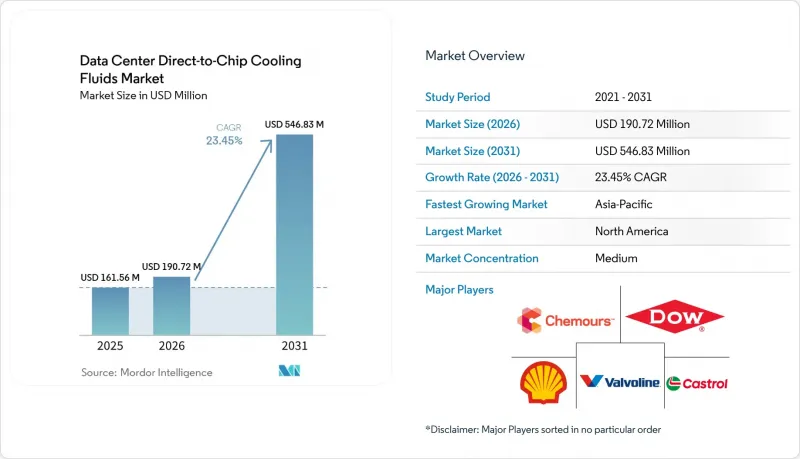
本報告按流體類型(例如,水性冷卻劑)、冷卻技術(例如,單相晶片直接冷卻)、被冷卻組件(例如,CPU冷卻)、資料中心類型(例如,超大規模資料中心)和地區(例如,亞太地區、北美地區、歐洲地區)進行細分。市場預測以美元(USD)為單位。
全球資料中心晶片直接冷卻液市場趨勢及洞察
人工智慧和高效能運算工作負載的擴展
在人工智慧訓練叢集,數千個GPU緊密連接,導致持續的熱負載。 NVIDIA的B200 SXM6 GPU的熱設計功耗為1000瓦,一台配備8個GPU的伺服器在持續負載下可能需要超過8千瓦的功率。 NVIDIA的指南不支援在B200配置中使用風冷,而是依賴液冷基礎設施。隨著GPU部署的擴展,這項要求推動了資料中心對晶片級直接冷卻液的需求。託管服務供應商正在維修其設施,以滿足越來越多使用人工智慧的租戶對晶片級直接冷卻空間的需求。隨著服務提供者為其液冷區域配備液冷設備,周圍的傳統設備也可能需要升級其相關的冷卻系統。這項工作涉及管道硬體、監控系統和冷卻液的選擇,而冷卻液的需求正在超越最初的人工智慧伺服器部署階段。
資料中心機架功率密度增加
根據資料中心專業人士協會 (AFCOM) 發布的《2026 年資料中心現況報告》,到 2026 年,平均機架密度將達到 27 kW,高於 2025 年的 16 kW。機架密度超過 20 kW 可能會超出後門式熱交換器和冷卻通道封閉方案的實際運作範圍。直接晶片冷卻板為滿足 50–132 kW 的機架密度範圍提供了一種解決方案,該範圍的大規模部署正在增加。 NVIDIA GB200 NVL72 系統的機架級熱設計功耗 (TDP) 為 120–132 kW,但後續配置預計將達到每個機架 142 kW。這些運作條件使得冷卻劑的選擇成為資料中心直接晶片冷卻劑市場基礎設施規劃的關鍵要素。這也適用於從一開始就考慮到液體分配而設計的新設施。這種基於負載的規劃會改變管道走向、冷卻分配單元的尺寸以及維護流程。此外,臨時性空氣冷卻升級的實際價值也會降低。
高昂的維修和實施成本
將風冷式機櫃維修為晶片級液冷系統,每排的成本在 5 萬至 15 萬美元之間。冷卻分配單元的安裝、管路設計、歧管整合和試運行都會延長專案週期。這些成本可能會超過許多業者採用的 3-4 年升級週期。企業級設施還需要員工培訓、洩漏檢測設備和冷卻液處理流程。託管業者必須在 AI 租戶最終確定容量之前投資建設液冷區域。這種時間安排問題可能會延遲小規模資料中心對晶片級液冷冷卻液的潛在需求。整合需要額外的規劃,在此期間,風冷設備和操作規程仍需繼續使用。營運商還必須在改造前確保洩漏檢測和冷卻液相容性檢驗。
細分市場分析
2025年,水基冷卻液佔了該細分市場的44.08%。這得歸功於乙二醇-水循環系統的成熟應用以及腐蝕抑制劑的成熟化學成分。與OCP規範的金屬和彈性體的兼容性也為採購慣例提供了支持。 2025年6月,殼牌公司推出了DLC Fluid S3,這是一款丙二醇基產品,並宣布其符合OCP PG25的所有要求。該產品的使用壽命超過6年,與風冷相比,PUE值可提高高達27%。這些成功案例推動了資料中心晶片級冷卻液市場對水基配方的採用。乙二醇基和合成烴基冷卻液可滿足某些應用中重疊的熱需求。生物基和特種冷卻液目前仍佔小規模,但它們正受到企業永續性要求的影響。
預計到2031年,含氟冷卻劑的複合年成長率將達到24.29%。這類冷卻劑適用於兩相應用,可透過潛熱傳遞實現超過500 W/cm²的冷板熱通量。 Chemoir公司的Opteon 2P50於2025年獲得三星電子認證,可用於第四代固態硬碟(SSD)。此認證可為其他組件和系統開發人員提供指南。低全球暖化潛勢(GWP)配方有助於供應商滿足資料中心晶片級冷卻劑市場的效能和監管要求。其價值在於成功獲得伺服器組件和流體分配系統的認證。這個過程將有助於供應商建立差異化的產品系列。
截至2025年,單相直接晶片冷卻將佔據該細分市場62.16%的佔有率,並持續維持業界標準。此方法具有水-乙二醇混合物運作規範成熟、與現有冷卻液系統相容性強等優點。谷歌的「Project Deschutes」冷卻液裝置已應用於四代張量處理單元(TPU),自2020年以來系統正常運轉率高達99.99%。 30 度C的OCP標準供水溫度也符合單相水-乙二醇基冷卻液的運作條件。這些條件支撐了資料中心對直接晶片冷卻液的持續需求。營運商在規劃設施時,會優先考慮其可靠性,因為熱中斷是不可接受的。此技術也適用於採用通用冷卻液溫度的新計畫。
預計到2031年,兩相晶片直接冷卻技術將以28.08%的複合年成長率成長。營運商正在考慮將此方案應用於冷板熱通量超過500 W/cm²的平台。雖然這種架構能夠應對高GPU負載,但它需要蒸氣隔離、相容的冷卻分配單元以及穩定的流體性能。 Vertiv於2026年4月收購Strategic Thermal Labs,顯示其對先進液冷技術的持續投入。預計該技術的部署將繼續集中在擁有強大工程能力的超大規模資料中心。這一趨勢正在為資料中心晶片直接冷卻劑市場開闢一條獨特的成長路徑。當單相系統無法滿足所需的熱通量時,此方法最為有效。因此,它將成為人工智慧部署領域一個細分但快速成長的細分市場。
區域分析
2025年,北美將佔據資料中心直接晶片冷卻液市場39.78%的佔有率。該地區受益於美國境內高度集中的超大規模資料中心。此外,北美超大規模資料中心營運商對OCP冷卻規範的製定貢獻巨大,其採購需求也影響全球冷卻液認證標準。預計從2027年起,美國環保署(EPA)針對某些高全球暖化潛勢(GWP)冷媒的法規將推動乙二醇基冷卻液和低GWP合成冷卻液的再合成投資。這種法規環境可能會影響設備投入運作前的冷卻液選擇,並增加對配方合規性文件的需求。
預計到2031年,亞太地區的年複合成長率將達到26.45%。在中國,許多資料中心需要將電源使用效率(PUE)控制在1.3以下,這推動了晶片級直接冷卻和浸沒式冷卻系統的應用。阿里雲、騰訊雲和華為雲必須在其國內營運中滿足這些能源效率要求。包括Envicool和凌逸科技在內的中國冷卻分配單元供應商正在提高產量以滿足國內外需求。路透社在2026年3月報道稱,Google正在與Envicool和其他中國冷卻供應商洽談採購事宜。預計印度的資料中心容量將在五年內從1.5吉瓦成長到3吉瓦,然後再成長到3.5吉瓦。封閉回路型晶片級直接冷卻系統可以減少都市區蒸發冷卻造成的水損耗,尤其是在水資源有限的地區。這項特性使得冷卻設計能夠與當地的水資源管理優先事項相契合,從而為投資液冷系統提供了超越機架密度的獨特理由。
歐洲也在資料中心直接晶片冷卻液市場中扮演著重要角色,其中德國、英國和法國在該地區處於領先地位。在德國,2026年7月1日後投入運作的資料中心,強制要求能源再利用率(ERF)達到10%。該要求計劃於2028年提高至20%,並建議採用熱水直接晶片冷卻技術。能夠在30 度C至40 度C的供液溫度下保持性能的供應商在這些專案中具有優勢。南美洲、中東和非洲仍處於起步階段。 2025年5月,DataVolt與科慕公司簽署了一項策略協議,共同開發使用Opteon絕緣液的液冷解決方案。該協議表明,海灣國家主導的人工智慧專案從一開始就考慮到了直接晶片冷卻技術。這些項目可以繞過一些老舊設施中存在的整合障礙,為在設計初期就參與討論的供應商帶來商機。
其他好處:
- Excel格式的市場預測(ME)表
- 3個月的分析師支持
目錄
第1章:引言
- 研究假設和市場定義
- 調查範圍
第2章:調查方法
第3章執行摘要
第4章 市場狀況
- 市場概覽
- 市場促進因素
- 不斷擴展的人工智慧和高效能運算工作負載
- 資料中心機架功率密度增加
- 有關永續性和能源效率的法規
- OCP相容冷卻劑的標準化
- 在現有設施中引入熱水冷卻
- 先進的封裝技術造成了晶片級散熱瓶頸。
- 市場限制因素
- 高昂的維修和實施成本
- 空冷設施整合的複雜性
- 與液體的兼容性和洩漏風險
- PFAS法規的不確定性以及兩相流體的替代方案
- 價值鏈分析
- 波特五力分析
第5章 市場規模與成長預測
- 按流體類型
- 水溶液
- 乙二醇基液體
- 合成烴類流體
- 含氟液體
- 其他(生物基冷卻液、特殊冷卻液)
- 按類型分類的冷卻技術
- 單相直接冷卻至葉尖
- 兩相直接冷卻
- 按待冷卻部件
- CPU散熱
- GPU和AI加速器的冷卻
- 內存和存儲的冷卻
- 其他(ASIC、FPGA、電力電子)
- 依資料中心類型
- 超大規模資料中心
- 託管資料中心
- 企業資料中心
- 其他(邊緣資料中心、高效能運算設施)
- 按地區
- 亞太地區
- 中國
- 印度
- 日本
- 韓國
- 其他亞太國家
- 北美洲
- 美國
- 加拿大
- 墨西哥
- 歐洲
- 德國
- 英國
- 法國
- 義大利
- 其他歐洲國家
- 南美洲
- 巴西
- 阿根廷
- 其他南美國家
- 中東和非洲
- 沙烏地阿拉伯
- 南非
- 其他中東和非洲國家
- 亞太地區
第6章 競爭情勢
- 市場集中度
- 策略趨勢
- 市佔率和排名分析
- 公司簡介
- Arteco
- Castrol Limited
- CLARIANT
- Dober
- Dow
- Dynalene, Inc.
- Engineered Fluids
- Hydratech
- Inventec Performance Chemicals
- Kilfrost Ltd.
- LANXESS
- Lubrizol
- Recochem Corporation
- Shell plc
- The Chemours Company
- Valvoline Global Operations
第7章 市場機會與未來展望
According to Mordor Intelligence, the data center direct-to-chip cooling fluids market size is estimated at USD 161.56 million in 2025 and is estimated to grow from USD 190.72 million in 2026 to USD 546.83 million by 2031, at a CAGR of 23.45% during the forecast period (2026-2031).
This report is Segmented by Fluid Type (Water-Based Coolants and More), Cooling Technology (Single-Phase Direct-To-Chip Cooling and More), Component Cooled (CPU Cooling and More), Data Center Type (Hyperscale Data Centers and More), and Geography (Asia-Pacific, North America, Europe and More). The Market Forecasts are Provided in Terms of Value (USD).
Global Data Center Direct-to-Chip Cooling Fluids Market Trends and Insights
AI and HPC Workload Expansion
AI training clusters use thousands of tightly connected GPUs and generate sustained thermal loads. NVIDIA's B200 SXM6 GPU operates at a 1,000 W thermal design power, and an 8-GPU server can require more than 8 kW under sustained load. NVIDIA guidance does not support air cooling for B200 configurations, which rely on liquid-cooling infrastructure. This requirement increases demand in the data center direct-to-chip cooling fluids market as GPU installations expand. Colocation operators are adapting their facilities because AI tenants increasingly require direct-to-chip-compatible space. As operators create liquid-ready zones, surrounding legacy equipment may also require related cooling upgrades. This work includes distribution hardware, monitoring practices, and coolant selection, extending fluid demand beyond the initial AI server installation.
Rising Data Center Rack Power Density
According to the Association for Data Center Professionals (AFCOM)'s State of the Data Center Report 2026, average rack density reached 27 kW in 2026, up from 16 kW in 2025. Rack densities above 20 kW can exceed the practical operating range of rear-door heat exchangers and chilled-aisle containment. Direct-to-chip cold plates provide a pathway for the 50-132 kW rack range, which is entering large-scale deployments. NVIDIA GB200 NVL72 systems operate at 120 kW to 132 kW rack-level thermal design power, while successor configurations are projected to reach 142 kW per rack. These operating conditions make coolant selection a key part of infrastructure planning in the data center direct-to-chip cooling fluids market. They also support new facilities designed from the outset with liquid distribution in mind. Planning for these loads changes pipe routing, cooling distribution unit sizing, and maintenance processes. It also reduces the practical value of temporary air-cooling upgrades.
High Retrofit and Deployment Costs
Retrofitting an air-cooled row for direct-to-chip liquid cooling costs USD 50,000 to USD 150,000 per row. Cooling distribution unit installation, pipe routing, manifold integration, and commissioning extend project timelines. These costs can exceed the 3- to 4-year refresh cycle that many operators use. Enterprise facilities also need staff training, leak-monitoring equipment, and fluid disposal processes. Colocation operators must fund liquid-ready zones before AI tenants commit to capacity. This timing issue can delay addressable demand for data center direct-to-chip cooling fluids at smaller facilities. Integration requires additional planning, with air-cooled equipment and operating procedures remaining in place. Operators also need validated leak detection and fluid compatibility before conversion.
Other drivers and restraints analyzed in the detailed report include:
- Sustainability and Energy-Efficiency Mandates
- OCP-Compatible Coolant Standardization
- Per- and Polyfluoroalkyl Substances (PFAS) Restrictions and Two-Phase Fluid Replacement Uncertainty
For complete list of drivers and restraints, kindly check the Table Of Contents.
Segment Analysis
Water-based coolants accounted for 44.08% of the segment in 2025, supported by the established use of glycol-water loops and proven corrosion-inhibitor chemistry. Their compatibility with OCP-specified metals and elastomers supported procurement practices. Shell launched its propylene glycol-based DLC Fluid S3 in June 2025 and stated that it met all OCP PG25 requirements. The product offers a fluid life of more than six years and can improve PUE by up to 27% compared with air cooling. This installed base supports water-based formulas in the data center direct-to-chip cooling fluids market. Glycol-based and synthetic hydrocarbon fluids address overlapping thermal requirements in some installations. Bio-based and specialty fluids remain smaller options, shaped by enterprise sustainability requirements.
Fluorinated fluids are projected to record a CAGR of 24.29% through 2031. They support two-phase applications where latent heat transfer enables cold-plate heat flux above 500 W/cm2. Chemours' Opteon 2P50 was qualified by Samsung Electronics for a fourth-generation Solid-State Drive (SSD) in 2025. The qualification provides a reference point for other component and system developers. Low-global-warming-potential formulas may help suppliers address performance needs and regulatory requirements in the data center direct-to-chip cooling fluids market. Their value depends on successful qualifications across server components and fluid distribution equipment. This process can help suppliers build a differentiated product portfolio.
Single-phase direct-to-chip cooling held 62.16% of the segment in 2025 and remains the operating standard. It benefits from established water-glycol practices and broad compatibility with existing cooling distribution systems. Google's Project Deschutes cooling distribution unit has been used across four Tensor Processing Unit (TPU) generations and has reported fleet-wide availability of 99.99% since 2020. OCP's 30°C supply-temperature standard also aligns with single-phase water-glycol operating conditions. These conditions support continued demand for data center direct-to-chip cooling fluids. Operators value established reliability when planning facilities that cannot tolerate thermal interruptions. The technology also fits greenfield projects built around a common coolant temperature.
Two-phase direct-to-chip cooling is expected to grow at a CAGR of 28.08% through 2031. Operators are considering it for platforms where cold-plate heat flux exceeds 500 W/cm2. The architecture can manage high GPU loads but requires vapor containment, compatible cooling distribution units, and stable fluid performance. Vertiv acquired Strategic Thermal Labs in April 2026, indicating continued investment in advanced liquid-cooling capabilities. Deployment is likely to remain concentrated at hyperscale sites with strong engineering capacity. This trend creates a specialized growth path for the data center direct-to-chip cooling fluids market. The approach is most relevant when single-phase systems cannot meet the required heat flux. It therefore serves a narrower but faster-moving group of AI deployments.
Complete Report Scope:
- By Fluid Type
- Water-Based Fluids
- Glycol-Based Fluids
- Synthetic Hydrocarbon Fluids
- Fluorinated Fluids
- Others (Bio-Based Cooling Fluids, Specialty Fluids)
- By Cooling Technology
- Single-Phase Direct-to-Chip Cooling
- Two-Phase Direct-to-Chip Cooling
- By Component Cooled
- CPU Cooling
- GPU and AI Accelerator Cooling
- Memory and Storage Cooling
- Others (ASICs, FPGAs, Power Electronics)
- By Data Center Type
- Hyperscale Data Centers
- Colocation Data Centers
- Enterprise Data Centers
- Others (Edge Data Centers, High-Performance Computing Facilities)
- By Geography
- Asia-Pacific
- China
- India
- Japan
- South Korea
- Rest of Asia-Pacific
- North America
- United States
- Canada
- Mexico
- Europe
- Germany
- United Kingdom
- France
- Italy
- Rest of Europe
- South America
- Brazil
- Argentina
- Rest of South America
- Middle-East and Africa
- Saudi Arabia
- South Africa
- Rest of Middle-East and Africa
- Asia-Pacific
Geography Analysis
North America held 39.78% of the data center direct-to-chip cooling fluids market in 2025. The region benefits from a high concentration of U.S. hyperscale campuses. North American hyperscalers also contribute significantly to OCP cooling specifications, and their procurement requirements influence coolant qualifications worldwide. The Environmental Protection Agency (EPA) rule on certain high-global-warming-potential refrigerants is expected to spur investments in the reformulation of glycol and low-global-warming-potential synthetic fluids starting in 2027. This regulatory environment may influence fluid selection before equipment enters service and strengthen the need for documented compliance with formulations.
Asia-Pacific is forecast to expand at a CAGR of 26.45% through 2031. China requires many data centers to maintain a Power Usage Effectiveness (PUE) below 1.3, supporting the adoption of direct-to-chip and immersion systems. Alibaba Cloud, Tencent Cloud, and Huawei Cloud must meet these efficiency requirements in their domestic operations. Chinese cooling distribution unit suppliers, including Envicool and Lingyi iTech, have increased production to meet domestic and export demand. Reuters reported in March 2026 that Google was in discussions with Envicool and other Chinese cooling suppliers regarding purchases. India's capacity is projected to grow from 1.5 GW to 3 GW to 3.5 GW within five years. Closed-loop direct-to-chip systems can reduce water losses associated with evaporative cooling in water-constrained urban areas. This capability makes cooling design relevant to local water-management priorities and creates a separate rationale for liquid-loop investment beyond rack density.
Europe contributes to the data center direct-to-chip cooling fluids market, with Germany, the United Kingdom, and France leading the region. Germany's Energy Reuse Factor requirement is 10% for data centers commissioned on or after July 1, 2026. The requirement will rise to 20% in 2028, favoring warm-water direct-to-chip operation. Suppliers that maintain performance at supply temperatures of 30°C to 40°C are well positioned for these projects. South America, the Middle-East, and Africa remain early-stage regions. DataVolt signed a strategic agreement with Chemours in May 2025 to develop liquid-cooling solutions using Opteon dielectric fluids. The agreement indicates that Gulf sovereign AI programs are being designed with direct-to-chip cooling from the outset. These projects can avoid some integration barriers found in older facilities and create opportunities for suppliers that enter design discussions early.
- Arteco
- Castrol Limited
- CLARIANT
- Dober
- Dow
- Dynalene, Inc.
- Engineered Fluids
- Hydratech
- Inventec Performance Chemicals
- Kilfrost Ltd.
- LANXESS
- Lubrizol
- Recochem Corporation
- Shell plc
- The Chemours Company
- Valvoline Global Operations
Additional Benefits:
- The market estimate (ME) sheet in Excel format
- 3 months of analyst support
TABLE OF CONTENTS
1 Introduction
- 1.1 Study Assumptions and Market Definition
- 1.2 Scope of the Study
2 Research Methodology
3 Executive Summary
4 Market Landscape
- 4.1 Market Overview
- 4.2 Market Drivers
- 4.2.1 AI and HPC Workload Expansion
- 4.2.2 Rising Data Center Rack Power Density
- 4.2.3 Sustainability and Energy-Efficiency Mandates
- 4.2.4 OCP-Compatible Coolant Standardization
- 4.2.5 Warm-Water Cooling Adoption in Existing Facilities
- 4.2.6 Chip-Level Thermal Bottlenecks from Advanced Packaging
- 4.3 Market Restraints
- 4.3.1 High Retrofit and Deployment Costs
- 4.3.2 Integration Complexity in Air-Cooled Facilities
- 4.3.3 Fluid Compatibility and Leakage Risk
- 4.3.4 PFAS Restrictions and Two-Phase Fluid Replacement Uncertainty
- 4.4 Value Chain Analysis
- 4.5 Porter's Five Forces Analysis
- 4.5.1 Threat of New Entrants
- 4.5.2 Bargaining Power of Suppliers
- 4.5.3 Bargaining Power of Buyers
- 4.5.4 Threat of Substitutes
- 4.5.5 Competitive Rivalry
5 Market Size and Growth Forecasts (Value)
- 5.1 By Fluid Type
- 5.1.1 Water-Based Fluids
- 5.1.2 Glycol-Based Fluids
- 5.1.3 Synthetic Hydrocarbon Fluids
- 5.1.4 Fluorinated Fluids
- 5.1.5 Others (Bio-Based Cooling Fluids, Specialty Fluids)
- 5.2 By Cooling Technology
- 5.2.1 Single-Phase Direct-to-Chip Cooling
- 5.2.2 Two-Phase Direct-to-Chip Cooling
- 5.3 By Component Cooled
- 5.3.1 CPU Cooling
- 5.3.2 GPU and AI Accelerator Cooling
- 5.3.3 Memory and Storage Cooling
- 5.3.4 Others (ASICs, FPGAs, Power Electronics)
- 5.4 By Data Center Type
- 5.4.1 Hyperscale Data Centers
- 5.4.2 Colocation Data Centers
- 5.4.3 Enterprise Data Centers
- 5.4.4 Others (Edge Data Centers, High-Performance Computing Facilities)
- 5.5 By Geography
- 5.5.1 Asia-Pacific
- 5.5.1.1 China
- 5.5.1.2 India
- 5.5.1.3 Japan
- 5.5.1.4 South Korea
- 5.5.1.5 Rest of Asia-Pacific
- 5.5.2 North America
- 5.5.2.1 United States
- 5.5.2.2 Canada
- 5.5.2.3 Mexico
- 5.5.3 Europe
- 5.5.3.1 Germany
- 5.5.3.2 United Kingdom
- 5.5.3.3 France
- 5.5.3.4 Italy
- 5.5.3.5 Rest of Europe
- 5.5.4 South America
- 5.5.4.1 Brazil
- 5.5.4.2 Argentina
- 5.5.4.3 Rest of South America
- 5.5.5 Middle-East and Africa
- 5.5.5.1 Saudi Arabia
- 5.5.5.2 South Africa
- 5.5.5.3 Rest of Middle-East and Africa
- 5.5.1 Asia-Pacific
6 Competitive Landscape
- 6.1 Market Concentration
- 6.2 Strategic Moves
- 6.3 Market Share (%)/Ranking Analysis
- 6.4 Company Profiles (includes Global Overview, Market Overview, Core Segments, Financials as available, Strategic Information, Products and Services, and Recent Developments)
- 6.4.1 Arteco
- 6.4.2 Castrol Limited
- 6.4.3 CLARIANT
- 6.4.4 Dober
- 6.4.5 Dow
- 6.4.6 Dynalene, Inc.
- 6.4.7 Engineered Fluids
- 6.4.8 Hydratech
- 6.4.9 Inventec Performance Chemicals
- 6.4.10 Kilfrost Ltd.
- 6.4.11 LANXESS
- 6.4.12 Lubrizol
- 6.4.13 Recochem Corporation
- 6.4.14 Shell plc
- 6.4.15 The Chemours Company
- 6.4.16 Valvoline Global Operations
7 Market Opportunities and Future Outlook
- 7.1 White-Space and Unmet-Need Assessment

 2026年資料中心機架式CDU幫浦全球市場研究報告
 資料中心液冷:市場佔有率分析、產業趨勢與統計、成長預測(2026-2031)GPU散熱解決方案:市佔率分析、產業趨勢與統計、成長預測(2026-2031年)中國GPU散熱解決方案:市佔率分析、產業趨勢與統計及成長預測(2026-2031年)GPU液冷:市佔率分析、產業趨勢與統計、成長預測(2026-2031)歐洲GPU液冷:市佔率分析、產業趨勢與統計及成長預測(2026-2031年)北美GPU液冷市場:市佔率分析、產業趨勢與統計及成長預測(2026-2031年)
 資料中心液冷市場:依冷卻技術、組件、液體類型、基礎架構層、資料中心類型、最終用戶產業及資料中心規模分類-2026-2032年全球市場預測
 全球資料中心液冷歧管市場:按歧管類型、冷卻類型、材料類型、設計類型、資料中心類型、安裝類型和地區分類-預測至2033年
 資料中心液冷市場:按組件、冷卻類型、資料中心類型、企業規模和最終用戶產業分類-市場規模、產業動態、機會分析和預測(2026-2035 年)