


 |
市場調查報告書
商品編碼
2099793
北美GPU液冷市場:市佔率分析、產業趨勢與統計及成長預測(2026-2031年)North America GPU Liquid Cooling - Market Share Analysis, Industry Trends & Statistics, Growth Forecasts (2026 - 2031) |
||||||

※ 本網頁內容可能與最新版本有所差異。詳細情況請與我們聯繫。
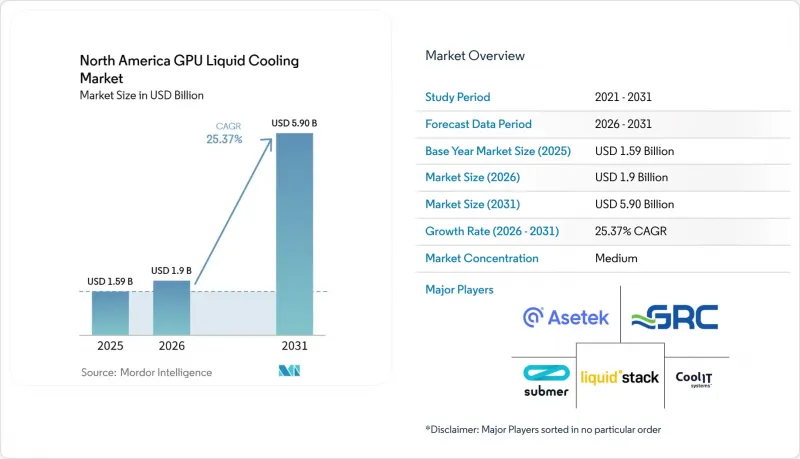
根據 Mordor Intelligence 預測,北美 GPU 水冷市場規模將從 2025 年的 15.9 億美元和 2026 年的 19 億美元成長到 2031 年的 59 億美元,2026 年至 2031 年的複合年成長率為 25.37%。
本報告按冷卻方式(單相、雙相)、冷卻等級(組件級、伺服器/機架級)、部署類型(超大規模/雲端、企業級、政府/研究(高效能運算)、邊緣人工智慧)、GPU 功率密度(低於 300W、300W-700W、高於 700W)和地區(美國、加拿大、墨西哥)進行細分。市場預測以美元 (USD) 為單位。
北美GPU水冷市場的趨勢與洞察
資料中心對高密度GPU的採用日益廣泛
在北美GPU水冷市場,GPU熱設計功耗(TDP)已發展到水冷不再是高階功能而是結構性要求的地步。 NVIDIA宣布其H100 SXM5水冷散熱器的功耗高達700W,這使得高密度AI節點在許多設施中接近了風冷散熱的實際極限。 2026年4月,微軟透露其GB200 NVL72機架式系統滿載功耗約120kW,且Vera Rubin NVL72平台沒有風冷配置。這證實了未來的高階GPU系統從一開始就將以水冷散熱為設計目標。 NVIDIA也提到了由美國能源局(DOE)支持的「COOLERCHIPS」項目,該項目旨在降低成本並提高效率,使其優於傳統的風冷設計。這顯示公共部門的檢驗方向與廠商的藍圖方向一致。換句話說,已經為前幾代 GPU 建造了水冷兼容設施的運營商在引入 Blackwell 及以後的系統時處於有利地位,這一優勢正在加速 2026 年北美 GPU 水冷市場的採購。
加速需要先進溫度控管的人工智慧訓練
在大規模人工智慧訓練叢集中,GPU 會長時間承受持續滿載運行,這使得熱穩定性成為北美 GPU 液冷市場中與能耗同等重要的可靠性問題。 2025 年,亞馬遜宣布其專有的晶片級閉合迴路液冷系統在 11 個月內從原型階段過渡到量產階段,與傳統的風冷設計相比,運算效能提升了 12%,能耗降低了高達 46%。該系統還表示,它直接解決了美國許多地區普遍存在的水資源緊張問題,因為它在閉迴路系統中循環冷卻劑,而不會增加純水的消耗量。 2026 年 4 月,微軟宣佈在不到一年的時間內,已在 Azure 雲端平台上部署了數十萬塊液冷 NVIDIA Grace Blackwell GPU,成為首家採用 NVIDIA Vera Rubin NVL72 系統的超大規模雲端服務供應商。 2025年5月,Supermicro宣布其DLC-2平台可將資料中心的電力消耗降低高達40%,並將整體擁有成本降低高達20%。這表明供應鏈現在能夠提供滿足超大規模需求的商用系統。
液冷基礎設施需要較高的初始資本投入
專案高昂的初始成本仍阻礙北美GPU液冷市場的部分發展。對於那些需要維修現有建築而非從一開始就設計液冷系統的營運商而言,這一趨勢尤其明顯。液冷系統需要額外的設備,例如冷卻液分配單元、歧管、管路、冷板和控制系統,這些設備會導致其初始預算高於同等規格的風冷系統。根據開放運算專案(OCP)關於模組化熱控制系統的指導原則,冷卻液分配單元(CDU)的設計需要冗餘和容量裕度,以適應未來密度的成長,這甚至可能導致營運商在達到運作運作之前就需要擴展基礎設施。 2026年1月,Schneider Electric宣布其NVIDIA GB300 NVL72系統的參考設計已支援每個機架高達142kW的功率,這清晰地展現了目前為高階AI部署規劃的熱基礎設施規模。供應商正在透過模組化和擴充性的CDU 平台來解決這個問題,但早期資本投資的需求意味著企業和公共部門買家的採用速度仍然很慢,這減緩了北美 GPU 水冷市場在超大規模環境之外的成長。
細分市場分析
2025年,超大規模和雲端部署佔據了北美GPU液冷市場佔有率的64.19%。這反映了大型雲端服務供應商的購買力和建設速度。 2025年,亞馬遜宣布開發出一種客製化設計的晶片級閉合迴路液冷系統,可將運算能力提升12%,並將能耗降低高達46%。這表明,超大規模提供者正在朝著標準化方向發展,而不是將液冷系統視為實驗性技術。 2026年4月,微軟宣布已在Azure部署了數十萬顆液冷Grace Blackwell GPU。這證實了雲端規模部署正以商業性的速度推進。供應商的藍圖、檢驗工作和設施設計選擇通常優先考慮超大規模的需求,因此這些部署趨勢正在塑造北美GPU液冷市場。因此,北美GPU液冷產業仍然由那些能夠將整個基礎設施升級到「液冷優先」標準的買家所驅動。
預計到2031年,企業市場將以27.89%的複合年成長率成長,這主要得益於採購壁壘的降低,使其成為成長最快的部署領域。一個關鍵轉變是,來自雲端部署的成熟效能數據降低了私人企業對實施風險的認知,這意味著液冷不再只是被視為超大規模解決方案。政府和研究機構也從美國能源局)的冷卻計劃中獲得了更明確的訊號,這些計劃支持下一代模組化溫度控管系統,其效率遠超傳統的風冷系統。邊緣人工智慧仍然是最小的部署領域,但GRC在2025年11月宣布其ICEraQ Nano系統專為小規模資料中心和通訊機房而設計。這顯示北美GPU液冷市場正開始從核心園區擴展到分散式推理站點。
到2025年,組件級散熱將佔據56.27%的市場佔有率,並持續保持其在北美GPU液冷市場的主導地位。這是因為採用冷板的晶片級直冷設計能夠比管理整個機房的氣流更精確地適應現代GPU和CPU的散熱特性。這種方法將散熱集中在產生大部分熱量的設備上,從而在無需採用高成本機房冷卻模式的情況下,實現更佳的散熱控制。 Frore Systems在2026年5月表示,他們可以透過將GPU溫度維持在低於熱極限8 度C的水平來維持計算吞吐量。這解釋了為什麼晶片級熱穩定性能夠直接轉化為性能價值。溫度與可用性能之間的這種直接關聯使得組件級解決方案即使在機架功耗持續上升的情況下也能保持其主導地位。北美GPU液冷市場仍然高度依賴這些冷板架構,因為它們為新部署和維修專案提供了最清晰的路徑。
伺服器和機架級散熱市場預計將以 28.23% 的複合年成長率成長,成為成長最快的散熱領域,因為人工智慧系統正朝著更高密度的機架級整合發展。 2026 年 4 月,微軟宣布 NVIDIA Vera Rubin NVL72 是一款完全液冷平台,不提供氣冷選項。這推動了散熱設計從選擇單一組件轉向選擇大規模的機架級散熱方案。 2026 年 5 月,LiquidStack 宣布其 GigaModular CDU 平台將支援高達 14MW 的部署。這反映出供應商正在開發專注於系統級和多機架級溫度控管的產品,而不僅僅是單節點最佳化。 2026 年 2 月,CoolIT Systems 宣布其製造和工程營運能夠支援功率超過 4000W 的人工智慧晶片和功率超過 500kW 的伺服器機架。這顯示高容量流體管理正成為產品設計的核心。開放運算專案指南強調了 CDU 系統可擴展性和冗餘性的必要性,使得機架級採購在整個北美 GPU 水冷市場中變得越來越具有戰略意義。
其他好處:
- Excel格式的市場預測(ME)表
- 3個月的分析師支持
目錄
第1章:引言
- 研究假設和市場定義
- 調查範圍
第2章:調查方法
第3章執行摘要
第4章 市場狀況
- 市場概覽
- 市場促進因素
- 擴大資料中心高密度GPU的部署
- 加速需要先進溫度控管的人工智慧訓練
- 強制性節能措施正在推動液冷技術的應用。
- 超大規模資料中心業者正在加強實現碳中和。
- 公共產業公司為節水冷卻解決方案提供獎勵的現狀
- 配備GPU的邊緣微資料中心的興起
- 市場限制因素
- 水冷基礎設施的初始資本投資成本很高。
- 缺乏兩相冷卻劑的業界標準
- 水冷系統維修人員技能不足
- 提高對關鍵任務伺服器冷卻液洩漏風險的認知
- 產業價值鏈分析
- 宏觀經濟因素對市場的影響
- 監理情勢
- 技術展望
- 波特五力分析
第5章 市場規模與成長預測
- 透過冷卻方式
- 單相液體冷卻
- 兩相液冷
- 冷卻水平
- 組件級冷卻
- 伺服器/機架級冷卻
- 不同的發展
- 超大規模/雲
- 公司
- 政府和研究機構(高效能運算)
- 邊緣人工智慧
- 按類型分類的GPU功率密度
- 小於300瓦
- 300W~700W
- 700瓦或以上
- 按地區
- 北美洲
- 美國
- 加拿大
- 墨西哥
第6章 競爭情勢
- 市場集中度
- 策略趨勢
- 市佔率分析
- 公司簡介(每份簡介包括:全球概覽、市場概覽、主要細分市場、現有財務資訊、策略資訊、市場排名/佔有率、產品和服務以及近期發展動態)
- CoolIT Systems Inc.
- Asetek Inc.
- GRC(Green Revolution Cooling)
- LiquidStack Inc.
- Submer Technologies SL
- Iceotope Technologies Ltd.
- Motivair Corporation
- Chilldyne Inc.
- Midas Green Technologies LLC
- Asperitas BV
- Rittal GmbH and Co. KG
- Schneider Electric SE
- Vertiv Group Corp.
- Advanced Cooling Solutions LLC
- Cooler Master Technology Inc.
- EKWB doo
- Corsair Gaming Inc.
- Noctua GmbH
- Alphacool International GmbH
- Thermaltake Technology Co. Ltd.
第7章 市場機會與未來展望
According to Mordor Intelligence, the North America GPU liquid cooling market size is projected to expand from USD 1.59 billion in 2025 and USD 1.90 billion in 2026 to USD 5.90 billion by 2031, registering a CAGR of 25.37% between 2026 to 2031.
This report is Segmented by Cooling Type (Single-Phase, and Two-Phase), Cooling Level (Component-Level, and Server/Rack-Level), Deployment (Hyperscale/Cloud, Enterprise, Government and Research (HPC), and Edge AI), GPU Power Density (Below 300W, 300W-700W, and Above 700W), and Geography (United States, Canada, and Mexico). The Market Forecasts are Provided in Terms of Value (USD).
North America GPU Liquid Cooling Market Trends and Insights
Growing Adoption Of High-Density GPUs In Data Centers
GPU thermal design power has moved into a range where liquid cooling is now a structural requirement for the North America GPU liquid cooling market, not a premium feature. NVIDIA stated that the H100 SXM5 operated at 700W, which already placed dense AI nodes near the practical ceiling for air cooling in many facilities. Microsoft stated in April 2026 that the GB200 NVL72 rack-scale system draws around 120kW at full load and that the Vera Rubin NVL72 platform has no air-cooled configuration, which confirms that future high-end GPU systems are being designed around liquid cooling from the outset. NVIDIA also highlighted DOE-backed COOLERCHIPS work aimed at lowering cost and improving efficiency versus traditional air-cooled designs, which shows that public-sector validation is moving in the same direction as vendor roadmaps. This means operators that already built liquid-ready facilities for earlier GPU generations are now in a better position to absorb Blackwell and post-Blackwell systems, and that advantage is accelerating procurement across the North America GPU liquid cooling market in 2026.
Acceleration Of AI Training Requiring Advanced Thermal Management
Large AI training clusters place GPUs under sustained full-load conditions for long periods, and that makes thermal stability a reliability issue as much as an energy issue for the North America GPU liquid cooling market. Amazon stated in 2025 that its custom direct-to-chip closed-loop liquid cooling system moved from prototype to production in 11 months, raised compute power by 12%, and cut energy use by up to 46% against earlier air-cooled designs.Amazon also stated that the system circulates coolant in a sealed loop without increasing net water consumption, which directly addresses water sensitivity in many U.S. locations. Microsoft stated in April 2026 that it had deployed hundreds of thousands of liquid-cooled NVIDIA Grace Blackwell GPUs across Azure in under one year and had become the first hyperscale provider to power NVIDIA Vera Rubin NVL72 systems. Supermicro stated in May 2025 that its DLC-2 platform can reduce data center power use by up to 40% and lower the total cost of ownership by up to 20%, which shows the supply chain is now matching hyperscale demand with deployable commercial systems.
High Initial Capital Expenditure For Liquid Cooling Infrastructure
Upfront project cost still slows parts of the North America GPU liquid cooling market, especially where operators must retrofit older buildings instead of designing for liquid from the start. Liquid cooling requires added equipment such as coolant distribution units, manifolds, piping, cold plates, and control systems, and those layers make first-pass budgets heavier than comparable air-cooled programs. Open Compute Project guidance for modular thermal control systems also shows that CDU design needs a capacity margin for redundancy and future density growth, which can increase infrastructure scope before operators even reach full utilization. Schneider Electric stated in January 2026 that reference designs for NVIDIA GB300 NVL72 systems already support up to 142kW per rack, which illustrates the scale of thermal infrastructure now being planned into high-end AI deployments. Vendors are responding with modular and scalable CDU platforms, but the need to commit capital early still slows adoption among enterprises and public-sector buyers, which tempers the pace of the North America GPU liquid cooling market outside hyperscale environments.
Other drivers and restraints analyzed in the detailed report include:
- Energy-Efficiency Mandates Driving Liquid Cooling Adoption
- Rising Carbon-Neutral Commitments By Hyperscalers
- Limited Industry Standards For Two-Phase Coolants
For complete list of drivers and restraints, kindly check the Table Of Contents.
Segment Analysis
Hyperscale and cloud deployments captured 64.19% of the North America GPU liquid cooling market share in 2025, which reflects the spending power and build pace of the largest cloud operators. Amazon stated in 2025 that it developed a custom direct-to-chip closed-loop liquid cooling design that increased compute power by 12% and cut energy use by up to 46%, which shows why hyperscale operators are standardizing around liquid systems instead of treating them as experimental. Microsoft stated in April 2026 that it had already deployed hundreds of thousands of liquid-cooled Grace Blackwell GPUs across Azure, which confirms that cloud-scale implementation is now happening at commercial speed. These deployments shape the wider North America GPU liquid cooling market because supplier roadmaps, validation work, and facility design choices often follow hyperscale demand first. The North America GPU liquid cooling industry is therefore still being led by buyers that can move entire fleets toward a liquid-first standard.
Enterprise is projected to grow at a 27.89% CAGR through 2031, making it the fastest-growing deployment segment as procurement barriers begin to ease. The main shift is that liquid cooling is no longer viewed only as a hyperscale solution, because proven performance data from cloud deployments has started to reduce perceived execution risk for private operators. Government and research buyers are also getting clearer signals from DOE-backed cooling efforts that support next-generation modular thermal systems and better efficiency than legacy air-cooled setups. Edge AI remains the smallest deployment group, but GRC stated in November 2025 that its ICEraQ Nano system was built specifically for smaller data rooms and communications closets, which shows that the North America GPU liquid cooling market is beginning to extend beyond core campuses into distributed inference locations.
Component-level cooling held 56.27% share in 2025 and remained the largest cooling level in the North America GPU liquid cooling market because cold-plate direct-to-chip designs match the heat profile of modern GPUs and CPUs with far greater precision than room-level airflow management. This approach keeps cooling focused on the devices that generate most of the heat, which improves thermal control without forcing the entire room into a higher-cost cooling model. Frore Systems stated in May 2026 that lowering GPU temperature by 8°C below the thermal limit can help sustain compute throughput, which explains why chip-level thermal stability is directly tied to performance value. That direct link between temperature and usable performance has helped component-level solutions retain leadership even as rack power keeps climbing. The North America GPU liquid cooling market still depends heavily on these cold-plate architectures because they offer the clearest path for both greenfield and retrofit programs.
Server and rack-level cooling is projected to expand at a 28.23% CAGR, which makes it the fastest-growing cooling level as AI systems move toward denser rack-scale integration. Microsoft stated in April 2026 that NVIDIA Vera Rubin NVL72 is designed as a fully liquid-cooled platform with no air-cooled option, which supports the shift from individual component decisions to larger rack-level thermal design choices. LiquidStack stated in May 2026 that its GigaModular CDU platform supports deployments up to 14MW, which reflects how vendors are building for whole-system and multi-rack thermal management rather than single-node optimization alone. CoolIT Systems stated in February 2026 that its manufacturing and engineering work supports AI chips above 4,000W and server racks above 500kW, which signals that higher-capacity fluid management is moving to the center of product design. Open Compute Project guidance reinforces that CDU systems need scalability and redundancy, so rack-level procurement is becoming more strategic across the North America GPU liquid cooling market.
Complete Report Scope:
- By Cooling Type
- Single-Phase Liquid Cooling
- Two-Phase Liquid Cooling
- By Cooling Level
- Component-Level Cooling
- Server / Rack-Level Cooling
- By Deployment
- Hyperscale / Cloud
- Enterprise
- Government & Research (HPC)
- Edge AI
- By GPU Power Density
- Below 300W
- 300W - 700W
- Above 700W
- By Geography
- North America
- United States
- Canada
- Mexico
List of Companies Covered in this Report:
- CoolIT Systems Inc.
- Asetek Inc.
- GRC (Green Revolution Cooling)
- LiquidStack Inc.
- Submer Technologies S.L.
- Iceotope Technologies Ltd.
- Motivair Corporation
- Chilldyne Inc.
- Midas Green Technologies LLC
- Asperitas BV
- Rittal GmbH and Co. KG
- Schneider Electric SE
- Vertiv Group Corp.
- Advanced Cooling Solutions LLC
- Cooler Master Technology Inc.
- EKWB d.o.o.
- Corsair Gaming Inc.
- Noctua GmbH
- Alphacool International GmbH
- Thermaltake Technology Co. Ltd.
Additional Benefits:
- The market estimate (ME) sheet in Excel format
- 3 months of analyst support
TABLE OF CONTENTS
1 INTRODUCTION
- 1.1 Study Assumptions and Market Definition
- 1.2 Scope of the Study
2 RESEARCH METHODOLOGY
3 EXECUTIVE SUMMARY
4 MARKET LANDSCAPE
- 4.1 Market Overview
- 4.2 Market Drivers
- 4.2.1 Growing Adoption of High-Density GPUs in Data Centers
- 4.2.2 Acceleration of AI Training Requiring Advanced Thermal Management
- 4.2.3 Energy-Efficiency Mandates Driving Liquid Cooling Adoption
- 4.2.4 Rising Carbon-Neutral Commitments by Hyperscalers
- 4.2.5 Availability of Utility Incentives for Water-Saving Cooling Solutions
- 4.2.6 Emergence of GPU-Powered Edge Micro Data Centers
- 4.3 Market Restraints
- 4.3.1 High Initial Capital Expenditure for Liquid Cooling Infrastructure
- 4.3.2 Limited Industry Standards for Two-Phase Coolants
- 4.3.3 Skill Gap in Liquid Cooling Maintenance Workforce
- 4.3.4 Perceived Risk of Coolant Leakage in Mission-Critical Servers
- 4.4 Industry Value Chain Analysis
- 4.5 Impact of Macroeconomic Factors on the Market
- 4.6 Regulatory Landscape
- 4.7 Technological Outlook
- 4.8 Porter's Five Forces Analysis
- 4.8.1 Threat of New Entrants
- 4.8.2 Bargaining Power of Suppliers
- 4.8.3 Bargaining Power of Buyers
- 4.8.4 Threat of Substitutes
- 4.8.5 Competitive Rivalry
5 MARKET SIZE AND GROWTH FORECASTS (VALUE)
- 5.1 By Cooling Type
- 5.1.1 Single-Phase Liquid Cooling
- 5.1.2 Two-Phase Liquid Cooling
- 5.2 By Cooling Level
- 5.2.1 Component-Level Cooling
- 5.2.2 Server / Rack-Level Cooling
- 5.3 By Deployment
- 5.3.1 Hyperscale / Cloud
- 5.3.2 Enterprise
- 5.3.3 Government & Research (HPC)
- 5.3.4 Edge AI
- 5.4 By GPU Power Density
- 5.4.1 Below 300W
- 5.4.2 300W - 700W
- 5.4.3 Above 700W
- 5.5 By Geography
- 5.5.1 North America
- 5.5.2 United States
- 5.5.3 Canada
- 5.5.4 Mexico
6 COMPETITIVE LANDSCAPE
- 6.1 Market Concentration
- 6.2 Strategic Moves
- 6.3 Market Share Analysis
- 6.4 Company Profiles (Each profile includes: Global Level Overview, Market Level Overview, Core Segments, Financials as available, Strategic Information, Market Rank/Share, Products and Services, Recent Developments)
- 6.4.1 CoolIT Systems Inc.
- 6.4.2 Asetek Inc.
- 6.4.3 GRC (Green Revolution Cooling)
- 6.4.4 LiquidStack Inc.
- 6.4.5 Submer Technologies S.L.
- 6.4.6 Iceotope Technologies Ltd.
- 6.4.7 Motivair Corporation
- 6.4.8 Chilldyne Inc.
- 6.4.9 Midas Green Technologies LLC
- 6.4.10 Asperitas BV
- 6.4.11 Rittal GmbH and Co. KG
- 6.4.12 Schneider Electric SE
- 6.4.13 Vertiv Group Corp.
- 6.4.14 Advanced Cooling Solutions LLC
- 6.4.15 Cooler Master Technology Inc.
- 6.4.16 EKWB d.o.o.
- 6.4.17 Corsair Gaming Inc.
- 6.4.18 Noctua GmbH
- 6.4.19 Alphacool International GmbH
- 6.4.20 Thermaltake Technology Co. Ltd.
7 MARKET OPPORTUNITIES AND FUTURE OUTLOOK
- 7.1 White-Space and Unmet-Need Assessment

 資料中心晶片直接冷卻液:市場佔有率分析、行業趨勢和統計數據以及成長預測(2026-2031 年)
 2026年資料中心機架式CDU幫浦全球市場研究報告資料中心液冷:市場佔有率分析、產業趨勢與統計、成長預測(2026-2031)GPU散熱解決方案:市佔率分析、產業趨勢與統計、成長預測(2026-2031年)中國GPU散熱解決方案:市佔率分析、產業趨勢與統計及成長預測(2026-2031年)GPU液冷:市佔率分析、產業趨勢與統計、成長預測(2026-2031)歐洲GPU液冷:市佔率分析、產業趨勢與統計及成長預測(2026-2031年)
 資料中心液冷市場:依冷卻技術、組件、液體類型、基礎架構層、資料中心類型、最終用戶產業及資料中心規模分類-2026-2032年全球市場預測
 全球資料中心液冷歧管市場:按歧管類型、冷卻類型、材料類型、設計類型、資料中心類型、安裝類型和地區分類-預測至2033年
 資料中心液冷市場:按組件、冷卻類型、資料中心類型、企業規模和最終用戶產業分類-市場規模、產業動態、機會分析和預測(2026-2035 年)