

 |
市場調查報告書
商品編碼
2099970
零售業企業內容管理 (ECM):市場佔有率分析、產業趨勢與統計數據以及成長預測 (2026-2031)Retail Enterprise Content Management (ECM) - Market Share Analysis, Industry Trends & Statistics, Growth Forecasts (2026 - 2031) |
||||||

※ 本網頁內容可能與最新版本有所差異。詳細情況請與我們聯繫。
零售業企業內容管理 (ECM) 市場預計將從 2025 年的 27.1 億美元和 2026 年的 30.4 億美元成長到 2031 年的 56.7 億美元,2026 年至 2031 年的年複合成長率(CAGR)為 13.28%。
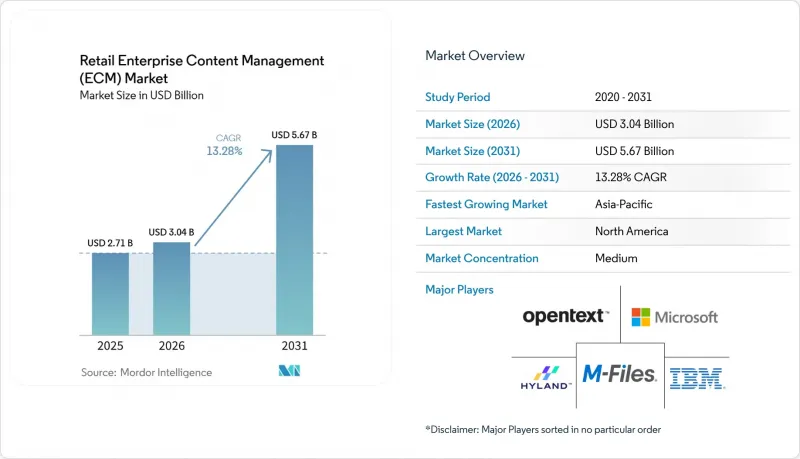
本報告按解決方案類型(文件管理、記錄管理、工作流程和業務流程管理、案例管理、數位資產管理等)、部署類型(本地部署、雲端部署、混合式部署)、企業規模(中小企業和大型企業)以及地區進行細分。市場預測以美元計價。
全球企業內容管理 (ECM) 市場趨勢及零售業洞察
全通路零售中的內容複雜性
全通路營運仍是零售業企業內容管理 (ECM) 市場需求的最強勁驅動力。這是因為隨著管道的增加,團隊需要管理的資產、記錄、批准和修訂數量也會增加。零售商不再只是發布單一的產品頁面或單一的宣傳活動文件;他們需要管理眾多管道特定的版本,並確保這些版本在市場平台、自有電商網站、實體店和合作夥伴網路中的準確性。當產品標語、圖片、定價資訊和揭露聲明需要在不同地區快速且一致地更新時,這種營運模式的挑戰性就更大了。歐盟的《人工智慧法案》進一步提高了標準。使用人工智慧內容系統的零售商必須對其內容的來源和透明度進行更嚴格的控制,這直接推動了對治理管治的儲存庫和可審計工作流程的需求。此外,亞馬遜已宣布將在 2024 年投資超過 10 億美元用於可靠性和安全性系統,以履行其《數位服務法案》的義務,這表明內容管治不再只是後勤部門任務,而是企業管理的挑戰。
人工智慧驅動的元資料和標籤自動化
人工智慧驅動的元資料增強正在改善零售商企業內容管理 (ECM) 市場的經濟效益。這是因為它使零售商能夠以最小的人工干預對大量內容進行分類和搜尋。這在零售環境中尤其重要,因為產品文件、供應商文件、宣傳活動素材和核准歷史記錄等資料量龐大且格式多元。 2026 年 6 月,M-Files 推出了元資料代理,進一步拓展了這個領域。提案文件分類、命名、標記和描述建議,並支援批量增強管治內容。隨後,IBM 也於 2026 年 6 月發布了 IBM Content Cortex Essentials Edition。該產品包含用於自動化文件分析和分類的 Navigator Core Agent,從而簡化了在受控環境中部署基於代理的內容工作流程的流程。隨著這些工具的日趨成熟,自動化在零售商企業內容管理 (ECM) 市場中的價值日益凸顯,尤其對於那些需要更快索引、更精準搜尋和更可靠審計支援的零售商而言更是如此。
PIM、DAM、CMS 和 ERP 系統整合的複雜性。
在零售企業內容管理 (ECM) 市場,整合仍然是最大的障礙。這是因為零售商很少單獨實施 ECM。大多數專案都需要將管治的內容與產品資訊系統、數位資產庫、商務平台、內容管理工具以及已投入運作的現有 ERP 環境整合。 OpenText 於 2025 年 11 月獲得 SAP S/4HANA Cloud Public Edition 認證,這表明對於企業客戶而言,在部署內容平台時,與打包 ERP 系統整合至關重要。微軟於 2026 年 6 月發布的 Dynamics 365 Commerce MCP 也反映了類似的壓力。零售商越來越希望產品搜尋、庫存狀態、定價邏輯和相關內容能夠在一個整合流程中運行,而不是作為獨立的模組。這些元素整合不佳會導致部署週期延長、手動流程重新出現,並且難以在零售企業內容管理 (ECM) 市場中證明其商業價值。
細分市場分析
到2025年,文件管理將佔據解決方案類型中最大的佔有率(28.19%)。這表明,合規相關文件、供應商記錄、產品文件和法律內容將繼續構成零售業企業內容管理(ECM)市場的核心工作負載。零售商仍然依賴文件管理,因為他們需要以確保搜尋和課責的方式儲存帶有標籤的記錄、審計文件、發票歷史記錄和合約檔案。這種主導地位反映了積極的營運需求,而非舊有系統的慣性,因為受監管的文件對於跨境零售業務仍然至關重要。記錄管理、工作流程和業務流程管理也仍然非常重要,因為零售業的批准、索賠驗證和內部審查仍然需要結構化的路由和保留設定。
數位資產管理 (DAM) 預計到 2031 年將以 13.96% 的複合年成長率成長,這表明富媒體在零售企業內容管理 (ECM) 市場正在迅速擴張。零售商現在需要獲得已通過核准的圖片、影片、宣傳活動內容和社交電商資產,這些資產無需重複手動修改即可跨通路自由使用。 Adobe 報告稱,已實施其內容供應鏈解決方案的組織在資產重用效率方面提高了 30%,在管理內容和數位體驗所需的時間方面減少了 70%,這證實了增強的資產管治能夠提高生產力。隨著 DAM 功能與文件管治和發布工作流程的日益融合,零售業的企業內容管理 (ECM) 行業正在從單純的文件儲存轉向協調的內容營運。
區域分析
到2025年,北美將佔據零售業企業內容管理(ECM)市場規模的38.73%,在全球需求中佔據最大佔有率。美國憑藉其大規模的零售企業、成熟的雲端技術應用以及大量的多通路內容,仍然是該地區的主要收入來源。在加拿大,隨著企業數位轉型,發展勢頭強勁。加拿大統計局在2025年6月發布的數據顯示,過去12個月中,加拿大企業人工智慧(AI)的採用率達12.2%,高於去年同期的6.1%。這種轉變推動了對易於搜尋、分類和重複使用的內容環境的需求,以滿足人工智慧驅動的零售工作流程的需求。墨西哥和全部區域目前的市場規模相對較小,但正受益於跨國零售商的區域擴張,這些零售商尋求在各個市場實現更標準化的內容管治。
預計到2026年,亞太地區將成為零售業企業內容管理(ECM)市場成長最快的地區,2031年之前的複合年成長率(CAGR)將達到13.51%。這一成長主要得益於大規模的電子商務交易量、快速變化的通路模式以及對在地化的強烈需求,使亞太地區在全球ECM應用方面處於領先地位。中國、印度、東南亞、日本、韓國和澳洲的零售商在商業環境中運營,發布速度與記錄準確性同等重要。這推動了對可管理的產品內容、可重複使用數位資產以及能夠適應市場差異且不影響管治的工作流程系統的需求。此外,該地區眾多製造商和D2C(直接面對消費者)品牌的存在,以及它們隨著業務擴張而建構更正式的內容管理架構,也為市場成長提供了助力。
歐洲監管密集,這為零售業的企業內容管理 (ECM) 創造了強勁且以合規主導的需求基礎。歐盟人工智慧立法提高了人們對人工智慧相關內容流程可追溯性和透明度的期望,進一步增強了對治理管治的儲存庫和可審計工作流程的興趣。德國將於 2025 年 1 月生效的強制性電子帳單制度新增了文件處理方面的要求,這些要求與 ECM 功能非常契合。雖然中東地區隨著數位商務的廣泛發展而投資不斷推進,但非洲仍處於起步階段,其應用主要由那些正在系統化零售營運和數位文件管理實踐的市場推動。
其他好處:
- Excel格式的市場預測(ME)表
- 3個月的分析師支持
目錄
第1章:引言
- 研究假設和市場定義
- 調查範圍
第2章:調查方法
第3章執行摘要
第4章 市場狀況
- 市場概覽
- 市場促進因素
- 全通路零售中的內容複雜性
- 人工智慧驅動的元資料和標籤自動化
- 零售業的合規性和審計追蹤要求
- 產品資訊與數位資產管治的整合
- 零售商對更快的宣傳活動在地化需求。
- 遷移到雲端原生內容管理
- 市場限制因素
- PIM、DAM、CMS 和 ERP 系統整合的複雜性。
- 變革管理給門市和現場團隊帶來了沉重的負擔。
- 去中心化零售網路中的內容安全和品牌外洩風險
- 多通路內容管治中不斷上升的總擁有成本 (TCO)
- 產業價值鏈分析
- 監理情勢
- 技術展望
- 宏觀經濟因素對市場的影響
- 波特五力分析
第5章 市場規模與成長預測
- 按解決方案類型
- 文件管理
- 記錄管理
- 工作流程和業務流程管理
- 個案管理
- 數位資產管理
- 網站內容管理
- 其他解決方案
- 部署模式
- 現場
- 雲
- 混合
- 按公司規模
- 中小企業
- 大公司
- 按地區
- 北美洲
- 美國
- 加拿大
- 墨西哥
- 南美洲
- 巴西
- 阿根廷
- 其他南美國家
- 歐洲
- 英國
- 德國
- 法國
- 其他歐洲國家
- 亞太地區
- 中國
- 日本
- 印度
- 韓國
- 澳洲
- 其他亞太國家
- 中東和非洲
- 中東
- 阿拉伯聯合大公國
- 沙烏地阿拉伯
- 其他中東國家
- 非洲
- 南非
- 肯亞
- 其他非洲國家
- 中東
- 北美洲
第6章 競爭情勢
- 市場集中度
- 策略趨勢
- 市佔率分析
- 公司簡介
- OpenText Corporation
- IBM Corporation
- Hyland Software, Inc.
- M-Files Corporation
- Box, Inc.
- DocuWare GmbH
- Laserfiche, Inc.
- Alfresco Software, Inc.
- SER Group
- Fabasoft AG
- KnowledgeLake, Inc.
- Objective Corporation Limited
- Datamatics Global Services Limited
- Microsoft Corporation
- Oracle Corporation
- SAP SE
- Adobe Inc.
- Zoho Corporation Pvt. Ltd.
- Egnyte, Inc.
- Newgen Software Technologies Limited
- Everteam
- iManage
- eFileCabinet
第7章 市場機會與未來展望
According to Mordor Intelligence, the retail enterprise content management (ECM) market size is projected to expand from USD 2.71 billion in 2025 and USD 3.04 billion in 2026 to USD 5.67 billion by 2031, registering a CAGR of 13.28% between 2026 and 2031.
This report is Segmented by Solution Type (Document Management, Records Management, Workflow and Business Process Management, Case Management, Digital Asset Management, and More), Deployment Mode (On-Premises, Cloud, and Hybrid), Enterprise Size (Small and Medium Enterprises (SME), and Large Enterprises), and Geography. The Market Forecasts are Provided in Terms of Value (USD).
Global Retail Enterprise Content Management (ECM) Market Trends and Insights
Omnichannel Retail Content Complexity
Omnichannel operations remain the strongest demand trigger for the retail enterprise content management (ECM) market because every added channel raises the number of assets, records, approvals, and revisions that teams must control. Retailers are no longer publishing a single product page or a single campaign file, and they are managing many channel-specific versions that must stay accurate across marketplaces, owned commerce sites, stores, and partner networks. This operating model becomes harder when product claims, images, pricing references, and disclosure language must be updated quickly and consistently across regions. The EU AI Act raises the bar further because retailers using AI-supported content systems must maintain stronger control over content provenance and transparency, which directly supports demand for governed repositories and auditable workflows. Amazon also reported more than USD 1 billion of 2024 investment in trust and safety systems tied to its Digital Services Act obligations, which shows that content governance is now treated as a business control issue rather than only a back-office task.
AI-Assisted Metadata and Tagging Automation
AI-based metadata enrichment is improving the economics of the retail enterprise content management (ECM) market because retailers can classify and retrieve high volumes of content with less manual work. This matters in retail environments where product documentation, supplier files, campaign assets, and approval trails arrive in large volumes and in mixed formats. M-Files expanded this area in June 2026 with its Metadata Agent, which suggests document classification, naming, tagging, and description at ingestion and also supports bulk enrichment of legacy content. IBM followed in June 2026 with IBM Content Cortex Essentials Edition, which includes a Navigator Core Agent for automated document analysis and classification, making agentic content workflows easier to deploy inside governed environments. As these tools mature, the retail enterprise content management (ECM) market is gaining a stronger automation case, especially for retailers that need faster indexing, cleaner retrieval, and more reliable audit support.
Integration Complexity Across PIM, DAM, CMS, and ERP Stacks
Integration remains the heaviest brake on the retail enterprise content management (ECM) market because retailers rarely deploy ECM in isolation. Most projects must connect governed content with product information systems, digital asset libraries, commerce platforms, content management tools, and ERP environments that already support live operations. OpenText's SAP S/4HANA Cloud Public Edition certification in November 2025 shows how important packaged ERP linkage has become for content platform adoption in enterprise accounts. Microsoft's June 2026 Dynamics 365 Commerce MCP release also reflects the same pressure, because retailers increasingly expect product discovery, inventory availability, pricing logic, and related content to work in connected flows rather than stand-alone modules. When those links are weak, deployment timelines stretch, manual work returns, and the business case for the retail enterprise content management (ECM) market becomes harder to defend.
Other drivers and restraints analyzed in the detailed report include:
- Retail Compliance and Audit Trail Requirements
- Product Information and Digital Asset Governance Convergence
- High Change Management Burden in Store and Field Teams
For complete list of drivers and restraints, kindly check the Table Of Contents.
Segment Analysis
Document management held the largest solution type share at 28.19% in 2025, which shows that compliance files, supplier records, product documentation, and legal content still form the core workload of the retail enterprise content management (ECM) market. Retailers continue to depend on document control because labeling records, audit files, invoicing trails, and contract archives must be stored in ways that support retrieval and accountability. This leadership reflects an active operating need rather than legacy inertia, since regulated documentation remains essential across cross-border retail operations. Records Management, Workflow, and Business Process Management also stay relevant because retail approvals, claims checks, and internal reviews still require structured routing and retention.
Digital asset management is projected to grow at a 13.96% CAGR through 2031, which shows how quickly rich media has expanded inside the retail enterprise content management (ECM) market. Retailers now need approved images, video, campaign content, and social commerce assets that can move across channels without repeated manual correction. Adobe reported a 30% increase in asset reuse efficiency and a 70% reduction in time spent managing content and digital experiences for organizations using its content supply chain solutions, which supports the productivity case for stronger asset governance. As DAM capabilities move closer to document governance and publishing workflows, the retail enterprise content management industry is shifting from file storage toward coordinated content operations.
Complete Report Scope:
- By Solution Type
- Document Management
- Records Management
- Workflow and Business Process Management
- Case Management
- Digital Asset Management
- Web Content Management
- Other Solutions
- By Deployment Mode
- On-Premises
- Cloud
- Hybrid
- By Enterprise Size
- Small and Medium Enterprises (SME)
- Large Enterprises
- By Geography
- North America
- United States
- Canada
- Mexico
- South America
- Brazil
- Argentina
- Rest of South America
- Europe
- United Kingdom
- Germany
- France
- Rest of Europe
- Asia-Pacific
- China
- Japan
- India
- South Korea
- Australia
- Rest of Asia-Pacific
- Middle East and Africa
- Middle East
- United Arab Emirates
- Saudi Arabia
- Rest of Middle East
- Africa
- South Africa
- Kenya
- Rest of Africa
- Middle East
- North America
Geography Analysis
North America held 38.73% of the retail enterprise content management (ECM) market size in 2025, giving the region the largest share of global demand. The United States remains the main regional revenue center because it combines large enterprise retailers, mature cloud adoption, and heavy multichannel content volume. Canada adds momentum through rising enterprise digitization, and Statistics Canada reported in June 2025 that AI use among businesses reached 12.2% over the prior 12 months, up from 6.1% a year earlier. That shift supports demand for content environments that are easier to search, classify, and reuse in AI-supported retail workflows. Mexico and the wider South America region remain smaller in current value terms, but they are benefiting from regional expansion by multinational retailers that want more standardized content governance across markets.
Asia-Pacific enters 2026 as the fastest-growing region in the retail enterprise content management (ECM) market, with a projected CAGR of 13.51% through 2031. This growth is driven by the region's combination of large e-commerce volumes, fast-moving channel formats, and strong localization needs, positioning Asia-Pacific at the forefront of ECM adoption globally. Retailers in China, India, Southeast Asia, Japan, South Korea, and Australia are operating in commerce environments where speed of publishing matters as much as accuracy of records. This raises demand for controlled product content, reusable digital assets, and workflow systems that can support market-specific variations without losing governance. The region also benefits from a large base of manufacturers and direct-to-consumer brands that are building more formal content operations as they expand their reach.
Europe is defined by regulatory density, which gives the retail enterprise content management (ECM) market a strong compliance-led demand base. The EU AI Act raises expectations around traceability and transparency for AI-related content processes, which supports stronger interest in governed repositories and auditable workflows. Germany's mandatory e-invoicing regime from January 2025 adds another document-heavy requirement that aligns well with ECM capabilities. The Middle East is investing through broader digital commerce build-outs, while Africa remains earlier stage, with adoption led by markets that are formalizing retail operations and digital documentation practices.
- OpenText Corporation
- IBM Corporation
- Hyland Software, Inc.
- M-Files Corporation
- Box, Inc.
- DocuWare GmbH
- Laserfiche, Inc.
- Alfresco Software, Inc.
- SER Group
- Fabasoft AG
- KnowledgeLake, Inc.
- Objective Corporation Limited
- Datamatics Global Services Limited
- Microsoft Corporation
- Oracle Corporation
- SAP SE
- Adobe Inc.
- Zoho Corporation Pvt. Ltd.
- Egnyte, Inc.
- Newgen Software Technologies Limited
- Everteam
- iManage
- eFileCabinet
Additional Benefits:
- The market estimate (ME) sheet in Excel format
- 3 months of analyst support
TABLE OF CONTENTS
1 INTRODUCTION
- 1.1 Study Assumptions and Market Definition
- 1.2 Scope of the Study
2 RESEARCH METHODOLOGY
3 EXECUTIVE SUMMARY
4 MARKET LANDSCAPE
- 4.1 Market Overview
- 4.2 Market Drivers
- 4.2.1 Omnichannel Retail Content Complexity
- 4.2.2 AI Assisted Metadata and Tagging Automation
- 4.2.3 Retail Compliance and Audit Trail Requirements
- 4.2.4 Product Information and Digital Asset Governance Convergence
- 4.2.5 Retailer Demand for Faster Campaign Localization
- 4.2.6 Shift to Cloud Native Content Operations
- 4.3 Market Restraints
- 4.3.1 Integration Complexity Across PIM, DAM, CMS, and ERP Stacks
- 4.3.2 High Change Management Burden in Store and Field Teams
- 4.3.3 Content Security and Brand Leakage Risks in Distributed Retail Networks
- 4.3.4 Rising Total Cost of Ownership for Multi-Channel Content Governance
- 4.4 Industry Value-Chain Analysis
- 4.5 Regulatory Landscape
- 4.6 Technological Outlook
- 4.7 Impact of Macroeconomic Factors on the Market
- 4.8 Porter's Five Forces Analysis
- 4.8.1 Threat of New Entrants
- 4.8.2 Bargaining Power of Buyers
- 4.8.3 Bargaining Power of Suppliers
- 4.8.4 Threat of Substitutes
- 4.8.5 Intensity of Competitive Rivalry
5 MARKET SIZE AND GROWTH FORECASTS (VALUE)
- 5.1 By Solution Type
- 5.1.1 Document Management
- 5.1.2 Records Management
- 5.1.3 Workflow and Business Process Management
- 5.1.4 Case Management
- 5.1.5 Digital Asset Management
- 5.1.6 Web Content Management
- 5.1.7 Other Solutions
- 5.2 By Deployment Mode
- 5.2.1 On-Premises
- 5.2.2 Cloud
- 5.2.3 Hybrid
- 5.3 By Enterprise Size
- 5.3.1 Small and Medium Enterprises (SME)
- 5.3.2 Large Enterprises
- 5.4 By Geography
- 5.4.1 North America
- 5.4.1.1 United States
- 5.4.1.2 Canada
- 5.4.1.3 Mexico
- 5.4.2 South America
- 5.4.2.1 Brazil
- 5.4.2.2 Argentina
- 5.4.2.3 Rest of South America
- 5.4.3 Europe
- 5.4.3.1 United Kingdom
- 5.4.3.2 Germany
- 5.4.3.3 France
- 5.4.3.4 Rest of Europe
- 5.4.4 Asia-Pacific
- 5.4.4.1 China
- 5.4.4.2 Japan
- 5.4.4.3 India
- 5.4.4.4 South Korea
- 5.4.4.5 Australia
- 5.4.4.6 Rest of Asia-Pacific
- 5.4.5 Middle East and Africa
- 5.4.5.1 Middle East
- 5.4.5.1.1 United Arab Emirates
- 5.4.5.1.2 Saudi Arabia
- 5.4.5.1.3 Rest of Middle East
- 5.4.5.2 Africa
- 5.4.5.2.1 South Africa
- 5.4.5.2.2 Kenya
- 5.4.5.2.3 Rest of Africa
- 5.4.5.1 Middle East
- 5.4.1 North America
6 COMPETITIVE LANDSCAPE
- 6.1 Market Concentration
- 6.2 Strategic Moves
- 6.3 Market Share Analysis
- 6.4 Company Profiles (includes Global Level Overview, Market Level Overview, Core Segments, Financials as available, Strategic Information, Market Rank/Share, Products and Services, Recent Developments)
- 6.4.1 OpenText Corporation
- 6.4.2 IBM Corporation
- 6.4.3 Hyland Software, Inc.
- 6.4.4 M-Files Corporation
- 6.4.5 Box, Inc.
- 6.4.6 DocuWare GmbH
- 6.4.7 Laserfiche, Inc.
- 6.4.8 Alfresco Software, Inc.
- 6.4.9 SER Group
- 6.4.10 Fabasoft AG
- 6.4.11 KnowledgeLake, Inc.
- 6.4.12 Objective Corporation Limited
- 6.4.13 Datamatics Global Services Limited
- 6.4.14 Microsoft Corporation
- 6.4.15 Oracle Corporation
- 6.4.16 SAP SE
- 6.4.17 Adobe Inc.
- 6.4.18 Zoho Corporation Pvt. Ltd.
- 6.4.19 Egnyte, Inc.
- 6.4.20 Newgen Software Technologies Limited
- 6.4.21 Everteam
- 6.4.22 iManage
- 6.4.23 eFileCabinet
7 MARKET OPPORTUNITIES AND FUTURE OUTLOOK
- 7.1 White-Space and Unmet-Need Assessment
- 7.2 Product Content Governance For Marketplace Heavy Retailers
- 7.3 Retail Media Content Workflow Orchestration
- 7.4 Headless Commerce Content Operations

 基於雲端的企業內容管理市場-2026年至2032年全球市場預測企業內容管理市場-2026-2032年全球市場預測
 法國企業內容管理 (ECM):市場佔有率分析、產業趨勢與統計及成長預測 (2026-2031)IT和電信行業的企業內容管理(ECM):市場佔有率分析、行業趨勢和統計數據以及成長預測(2026-2031)中東和非洲企業內容管理 (ECM):市場佔有率分析、行業趨勢和統計數據以及成長預測 (2026-2031)南美洲企業內容管理 (ECM):市場佔有率分析、產業趨勢與統計及成長預測 (2026-2031)印度企業內容管理 (ECM):市場佔有率分析、產業趨勢與統計及成長預測 (2026-2031)德國企業內容管理 (ECM):市場佔有率分析、產業趨勢與統計及成長預測 (2026-2031)教育企業內容管理(ECM):市場佔有率分析、產業趨勢與統計、成長預測(2026-2031)日本企業內容管理 (ECM):市佔率分析、產業趨勢與統計及成長預測 (2026-2031)