

 |
市場調查報告書
商品編碼
2099841
教育企業內容管理(ECM):市場佔有率分析、產業趨勢與統計、成長預測(2026-2031)Education Enterprise Content Management (ECM) - Market Share Analysis, Industry Trends & Statistics, Growth Forecasts (2026 - 2031) |
||||||

※ 本網頁內容可能與最新版本有所差異。詳細情況請與我們聯繫。
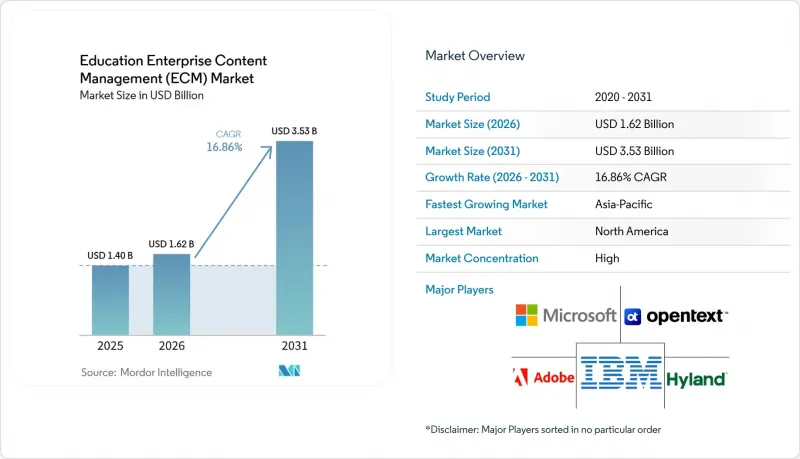
根據 Mordor Intelligence 預測,教育企業內容管理 (ECM) 市場規模預計將在 2025 年達到 14 億美元,2026 年達到 16.2 億美元,到 2031 年達到 35.3 億美元,2026 年至 2031 年的複合年成長率為 16.86%。
本報告按解決方案類型(文件管理、記錄管理、工作流程和業務流程管理、案例管理等)、部署類型(本地部署、雲端部署、混合部署)、企業規模(中小企業、大型企業)、教育機構類型(K-12 等)以及地區進行細分。市場預測以美元計價。
全球教育企業內容管理 (ECM) 市場趨勢與洞察
在學習工作流程中實現人工智慧驅動的內容搜尋、標記和搜尋功能。
人工智慧驅動的搜尋和標籤功能正在改變教育企業內容管理 (ECM) 市場為教職員工、管理人員和學生提供服務的方式。語義搜尋使用戶能夠使用自然語言搜尋存檔內容,而無需依賴嚴格的關鍵字規則。 2026 年 6 月,IBM 發布了 Content Cortex Essentials Edition,其中包含一個人工智慧代理,可以對海量攝取的資料進行分類、組織和更新文檔,同時確保安全性和管治。在教育企業內容管理 (ECM) 市場中,這種自動化對於研究型大學和大規模教育系統至關重要,因為它們需要管理各種格式的津貼相關文件、教學材料和檔案。因此,內容儲存庫正變得更加方便用戶使用,從被動的儲存系統演變為不斷更新的組織知識庫。
跨多個校區的雲端遷移,實現統一的內容管治
在教育企業內容管理 (ECM) 市場,由於目前各校區、系所和衛星站點之間的管治分散,雲端遷移正在加速推進。各機構正在利用雲端專案來規範策略、改善內容存取並減少對本地儲存庫的依賴。馬裡蘭大學圖書館於 2025 年完成了資料中心向 AWS 的全面雲端遷移,在不到六個月的時間內遷移了 95 TB 的儲存空間並關閉了所有校內資料中心的營運。 Hyland 於 2026 年 6 月在 Microsoft Azure 上推出了內容創新雲,進一步強化了這一趨勢,該雲支援區域資料居住選項,並可在 Microsoft Marketplace 上取得。因此,在教育企業內容管理 (ECM) 市場,雲端整合已不僅僅是基礎設施的變更,它正在演變為管治重塑計畫。
將傳統堆疊整合到整個校園系統中的複雜性。
在教育企業內容管理 (ECM) 市場,舊有系統是一大瓶頸,因為許多教育機構仍在運行獨立構建的、過時的學生資訊系統 (SIS)、企業資源計劃 (ERP) 和檔案管理系統。這些系統通常介面有限、資料結構專有,並且深度嵌入到部門工作流程中。據 EDUCAUSE 稱,系統整合仍然是教育機構面臨的最大技術挑戰,這也解釋了為什麼儘管需求強勁,ECM 的採用仍然面臨技術障礙。教育企業內容管理 (ECM) 市場轉型困難的原因在於,每所學校都必須重新設計其流程並整合軟體。這延長了實施週期,並增加了教育機構僅部分實施管治工具的風險。
細分市場分析
到2025年,文件管理將佔教育企業內容管理(ECM)市場20.14%的佔有率,成為最大的解決方案類別。這一主導地位反映出,在更廣泛的自動化實施之前,需要一個可靠的基礎架構來收集、儲存、搜尋和管理招生文件、獎學金記錄、合約、成績單、認證證明和其他文件。此類別在教育企業內容管理(ECM)市場中持續佔據核心地位,通常是因為在核心文件管理系統到位之前,核准、儲存或個案工作流程無法標準化。加州浸會大學利用Laserfiche建構了無紙化的學術事務和核算環境,並將記錄存取權限與Banner SIS系統整合。這表明,文件管理通常是教育機構改善更廣泛工作流程的起點。
預計到2031年,工作流程和業務流程管理將以19.42%的複合年成長率成長,成為教育企業內容管理(ECM)市場中成長最快的解決方案類型。教育機構正在實現招生流程自動化、助學金檢驗、學生行為準則合規、教師入職以及其他任何可能因延誤而影響服務品質和招生效果的流程。隨著教育機構管理大規模的影片講座、類比和互動內容庫,數位資產管理的重要性也日益凸顯,這些內容需要版本控制和權限管理。此外,隨著教育企業內容管理(ECM)市場向公共網站、內網、學生入口網站和學習平台等統一管治轉變,Web內容管理也重新受到關注。
到2025年,雲端運算將佔據教育企業內容管理(ECM)市場74.41%的佔有率,成為主流採用模式。教育機構優先採用雲端運算,因為它能夠實現跨校區的通用存取、更強大的災害復原能力,並減輕本地基礎設施的維護負擔。在教育企業內容管理(ECM)市場,雲端運算也有助於管治管理。 Hyland和OpenText都強調雲端環境能夠滿足基礎架構和內容管理層面的資料儲存和管治需求。
此外,預計到2031年,雲端市場將以18.83%的複合年成長率成長,並有望繼續維持教育企業內容管理(ECM)市場中成長最快的部署模式。當國家法規和內部政策限制學生資料的異地儲存時,本地部署系統仍將繼續使用。混合配置在以研究為導向的教育機構中越來越受歡迎,這些機構希望將一些高度敏感的工作負載保留在本地環境中,同時將託管內容遷移到託管雲端服務。 EDUCAUSE指出,未來幾年,基於雲端的服務將在高等教育IT環境中佔據更大的佔有率,這印證了教育企業內容管理(ECM)市場將繼續以雲端主導採購為主導的預期。
區域分析
到2025年,北美將佔據教育企業內容管理(ECM)市場41.14%的佔有率,成為最大的區域市場。該地區擁有密集的教育機構基礎設施、成熟的企業軟體生態系統,以及對隱私和可訪問性的高期望,因此對超越簡單儲存工具的管治內容管理系統的需求日益成長。 2026年6月,微軟透過LTI整合,將新的AI驅動的教育功能引入Microsoft 365教育版,進一步拓展了這一市場格局,並與Canvas、Brightspace、Moodle和Schoology等平台實現了整合。北美也繼續保持其在教育企業內容管理(ECM)市場工作流程改進方面的重要試驗場地位,教育機構需要更快的核准流程、更清晰的審計追蹤以及學術系統與管理系統之間更強大的整合。
預計到2031年,亞太地區將以19.24%的複合年成長率成長,成為教育企業內容管理(ECM)市場成長最快的地區。印度的「2020年國家教育政策」正在推動數位基礎設施的發展,並將影響2025年和2026年大學和學院的採購週期。該地區的許多教育機構正在從紙本記錄環境遷移到管理管治的雲端儲存庫,以支援學生服務和數位化學習的擴展。歐洲仍然是教育企業內容管理(ECM)市場的關鍵地區,因為隱私法規、記錄保存要求和研究文件標準不斷強調可審計的內容系統。美國國立衛生研究院(NIH)正在透過更新「資料管理和共用計畫」的提交格式要求來加強全球研究網路中大學的正式研究文件實踐,該要求將於2026年5月25日生效。
儘管南美洲、中東和非洲的市場規模仍然相對較小,但它們都在教育企業內容管理 (ECM) 市場中開闢各自的發展道路。在南美,巴西和阿根廷引領 ECM 的應用,兩國大學正持續推動行政記錄的數位化,並減少對紙本流程的依賴。阿拉伯聯合大公國高等技術學院正在利用 OpenText Documentum 推動整個校園的「零官僚主義」轉型,這體現了國家層面的現代化政策如何塑造中東的教育企業內容管理 (ECM) 市場。非洲的 ECM 應用仍處於起步階段,目前以雲端優先策略為主。這種策略使教育機構能夠在無需建構大規模本地基礎設施的情況下確保管治職能的正常運作。
其他好處:
- Excel格式的市場預測(ME)表
- 3個月的分析師支持
目錄
第1章:引言
- 研究假設和市場定義
- 調查範圍
第2章:調查方法
第3章執行摘要
第4章 市場狀況
- 市場概覽
- 市場促進因素
- AI驅動的內容搜尋、標記和學習工作流程中的搜尋。
- 實現統一內容管治的多校區雲端遷移
- ECM、LMS、SIS 和 ERP 平台之間互通性的需求日益成長
- 遵守記錄保存、可審計性和學生內容可訪問性方面的規定
- 數位認證、微認證和循證評估庫的成長
- 需要保存調查數據、津貼相關文件和組織知識。
- 市場限制因素
- 將傳統堆疊整合到整個校園系統中的複雜性。
- 教育機構的預算週期和公共採購延誤
- 關於資料儲存位置、隱私和學生同意的限制。
- 教師和管理人員對內容標準化方案改革的抵制
- 產業價值鏈分析
- 監理情勢
- 技術展望
- 宏觀經濟因素對市場的影響
- 波特五力分析
第5章 市場規模與成長預測
- 按解決方案類型
- 文件管理
- 記錄管理
- 工作流程和業務流程管理
- 個案管理
- 數位資產管理
- 網站內容管理
- 其他解決方案
- 部署模式
- 現場
- 雲
- 混合
- 按公司規模
- 中小企業
- 大公司
- 引擎類型
- K-12
- 高等教育
- 企業和專業人士的教育
- 政府和非營利組織
- 按地區
- 北美洲
- 美國
- 加拿大
- 墨西哥
- 南美洲
- 巴西
- 阿根廷
- 其他南美國家
- 歐洲
- 英國
- 德國
- 法國
- 其他歐洲國家
- 亞太地區
- 中國
- 日本
- 印度
- 韓國
- 澳洲
- 其他亞太國家
- 中東
- 阿拉伯聯合大公國
- 沙烏地阿拉伯
- 其他中東國家
- 非洲
- 南非
- 肯亞
- 其他非洲國家
- 北美洲
第6章 競爭情勢
- 市場集中度
- 策略趨勢
- 市佔率分析
- 公司簡介
- Microsoft Corporation
- Adobe Inc.
- OpenText Corporation
- IBM Corporation
- Hyland Software, Inc.
- Box, Inc.
- Laserfiche
- DocuWare GmbH
- M-Files Corporation
- Alfresco Software, Inc.
- Oracle Corporation
- SAP SE
- Anthology Inc.
- Instructure Holdings, Inc.
- D2L Inc.
- PowerSchool Holdings, Inc.
- Ellucian Company LP
- Moodle Pty Ltd
- Workday, Inc.
- ServiceNow, Inc.
第7章 市場機會與未來展望
According to Mordor Intelligence, the education enterprise content management (ECM) market size is projected to be USD 1.40 billion in 2025, USD 1.62 billion in 2026, and reach USD 3.53 billion by 2031, growing at a CAGR of 16.86% from 2026 to 2031.
This report is Segmented by Solution Type (Document Management, Records Management, Workflow and Business Process Management, Case Management, and More), Deployment Mode (On-Premises, Cloud, and Hybrid), Enterprise Size (Small and Medium Enterprises, and Large Enterprises), Institution Type (K-12, and More), and Geography. The Market Forecasts are Provided in Terms of Value (USD).
Global Education Enterprise Content Management (ECM) Market Trends and Insights
AI-Driven Content Search, Tagging, and Retrieval in Learning Workflows
AI search and tagging are changing how the education enterprise content management (ECM) market serves faculty, administrators, and students. Semantic retrieval lets users query archived content in plain language instead of relying on rigid keyword rules. IBM launched the Content Cortex Essentials Edition in June 2026, featuring AI agents that classify, organize, and update documents at very high ingestion volumes while preserving security and governance. In the education enterprise content management (ECM) market, that kind of automation matters most for research universities and large education systems that manage grant files, course materials, and archives in many formats. The result is that content repositories are becoming more usable as living institutional knowledge bases rather than passive storage systems.
Multi-Campus Cloud Migration for Unified Content Governance
Cloud migration is accelerating because the education enterprise content management (ECM) market now faces governance fragmentation across campuses, departments, and satellite sites. Institutions are using cloud programs to standardize policies, improve content access, and reduce dependence on separate local repositories. The University of Maryland Libraries completed a full data center cloud migration on AWS in 2025, moving 95 TB of storage and shutting down all on-campus data center operations in less than 6 months. Hyland strengthened this direction in June 2026 by bringing its Content Innovation Cloud to Microsoft Azure with geography-specific data residency options and Microsoft Marketplace availability. In the education enterprise content management (ECM) market, cloud consolidation is therefore becoming a governance redesign program rather than just an infrastructure change.
Legacy Stack Integration Complexity Across Campus Systems
Legacy systems remain a major brake on the education enterprise content management (ECM) market because many institutions still run older SIS, ERP, and records systems built in isolation. These systems often have limited interfaces, proprietary data structures, and deeply embedded departmental workflows. EDUCAUSE reported that system integration remained the top technology challenge for institutions, which shows why ECM rollouts still face technical friction even when demand is strong. In the education enterprise content management (ECM) market, migration is difficult because schools must redesign processes and integrate software. This extends deployment timelines and increases the risk that institutions adopt governance tools only partially.
Other drivers and restraints analyzed in the detailed report include:
- Interoperability Pressure Between ECM, LMS, SIS, and ERP Platforms
- Record Retention, Auditability, and Accessibility Compliance for Student Content
- Budget Cycles and Public Procurement Delays in Education Institutions
For complete list of drivers and restraints, kindly check the Table Of Contents.
Segment Analysis
Document management accounted for 20.14% of the education enterprise content management (ECM) market in 2025, making it the largest solution category. Its lead reflects the need for a reliable layer that can capture, store, retrieve, and control admissions files, financial aid records, contracts, transcripts, and accreditation evidence before wider automation is added. In the education enterprise content management (ECM) market, this category stays central because institutions usually cannot standardize approvals, retention, or case workflows until core document control is in place. California Baptist University used Laserfiche to support a paperless registrar and accounting environment while integrating record access with Banner SIS, demonstrating how document management often serves as the starting point for broader institutional workflow improvement.
Workflow and business process management is projected to expand at a 19.42% CAGR through 2031, making it the fastest-growing solution type in the education enterprise content management (ECM) market. Schools are automating admissions routing, financial aid verification, student conduct handling, staff onboarding, and other processes where delays affect service quality and enrollment outcomes. Digital asset management is also gaining importance as institutions manage larger libraries of video lessons, simulations, and interactive content that require version control and rights oversight. Web content management is drawing renewed attention as the education enterprise content management (ECM) market moves toward unified governance across public websites, intranets, student portals, and learning platforms.
Cloud accounted for 74.41% of the education enterprise content management (ECM) market in 2025, making it the dominant deployment model. Institutions value cloud delivery because it supports common access across campuses, stronger disaster recovery, and less local infrastructure maintenance. In the education enterprise content management (ECM) market, cloud is also helping schools better manage governance across distributed operations and remote learning environments. Hyland and OpenText have both emphasized cloud environments that address residency and governance needs at the infrastructure and content-control level.
Cloud is also projected to expand at a 18.83% CAGR through 2031, keeping it the fastest-growing deployment model in the education enterprise content management (ECM) market. On-premises systems remain in use where national rules or internal policies limit off-site storage of student data. Hybrid setups are gaining ground among research-heavy institutions that want to keep some sensitive workloads in local environments while moving administrative content into managed cloud services. EDUCAUSE noted that cloud-based services are expected to manage a larger share of higher education IT environments over the next few years, which supports continued cloud-led procurement in the education enterprise content management (ECM) market.
Complete Report Scope:
- By Solution Type
- Document Management
- Records Management
- Workflow and Business Process Management
- Case Management
- Digital Asset Management
- Web Content Management
- Other Solutions
- By Deployment Mode
- On-Premises
- Cloud
- Hybrid
- By Enterprise Size
- Small and Medium Enterprises (SME)
- Large Enterprises
- By Institution Type
- K-12
- Higher Education
- Corporate And Professional Education
- Government and Non-Profit
- By Geography
- North America
- United States
- Canada
- Mexico
- South America
- Brazil
- Argentina
- Rest of South America
- Europe
- United Kingdom
- Germany
- France
- Rest of Europe
- Asia-Pacific
- China
- Japan
- India
- South Korea
- Australia
- Rest of Asia-Pacific
- Middle East
- United Arab Emirates
- Saudi Arabia
- Rest of Middle East
- Africa
- South Africa
- Kenya
- Rest of Africa
- North America
Geography Analysis
North America held 41.14% of the education enterprise content management (ECM) market share in 2025, making it the largest regional market. The region benefits from a dense base of institutions, a mature enterprise software ecosystem, and strong privacy and accessibility expectations that make governed content systems more necessary than simple storage tools. Microsoft expanded this environment further in June 2026 by introducing new AI-powered teaching capabilities in Microsoft 365 Education and linking them to Canvas, Brightspace, Moodle, and Schoology via LTI integrations. In the education enterprise content management (ECM) market, North America also remains a key testing ground for workflow improvements, as institutions seek faster approvals, cleaner audit trails, and better coordination across academic and administrative systems.
Asia-Pacific is projected to expand at a 19.24% CAGR through 2031, which makes it the fastest-growing region in the education enterprise content management (ECM) market. India's National Education Policy 2020 digital infrastructure push is shaping procurement cycles across universities and colleges in 2025 and 2026. Many institutions across the region are moving from paper-heavy records environments to governed cloud repositories that can support student services and digital learning growth. Europe remains an important region in the education enterprise content management (ECM) market because privacy rules, records retention requirements, and research documentation standards continue to favor auditable content systems. The NIH updated the format requirements for Data Management and Sharing Plan submissions, effective May 25, 2026, reinforcing more formal research documentation practices for universities active in global research networks.
South America, the Middle East, and Africa remain smaller in scale, but each is carving out a distinct path in the education enterprise content management (ECM) market. Brazil and Argentina are leading South American adoption as universities continue to digitize administrative records and reduce dependence on paper-heavy processes. The UAE Higher Colleges of Technology used OpenText Documentum to support a zero-bureaucracy transformation across campuses, which shows how national modernization agendas are shaping the education enterprise content management (ECM) market in the Middle East. African adoption remains at an earlier stage and leans toward a cloud-first approach, which lets institutions gain governance capabilities without a major on-premises buildout.
- Microsoft Corporation
- Adobe Inc.
- OpenText Corporation
- IBM Corporation
- Hyland Software, Inc.
- Box, Inc.
- Laserfiche
- DocuWare GmbH
- M-Files Corporation
- Alfresco Software, Inc.
- Oracle Corporation
- SAP SE
- Anthology Inc.
- Instructure Holdings, Inc.
- D2L Inc.
- PowerSchool Holdings, Inc.
- Ellucian Company L.P.
- Moodle Pty Ltd
- Workday, Inc.
- ServiceNow, Inc.
Additional Benefits:
- The market estimate (ME) sheet in Excel format
- 3 months of analyst support
TABLE OF CONTENTS
1 INTRODUCTION
- 1.1 Study Assumptions and Market Definition
- 1.2 Scope of the Study
2 RESEARCH METHODOLOGY
3 EXECUTIVE SUMMARY
4 MARKET LANDSCAPE
- 4.1 Market Overview
- 4.2 Market Drivers
- 4.2.1 AI-Driven Content Search, Tagging, and Retrieval In Learning Workflows
- 4.2.2 Multi-Campus Cloud Migration for Unified Content Governance
- 4.2.3 Interoperability Pressure Between ECM, LMS, SIS, and ERP Platforms
- 4.2.4 Record Retention, Auditability, and Accessibility Compliance for Student Content
- 4.2.5 Growth In Digital Credentials, Micro-Credentials, and Evidence-Based Assessment Repositories
- 4.2.6 Research Data, Grant Documentation, and Institutional Knowledge Preservation Needs
- 4.3 Market Restraints
- 4.3.1 Legacy Stack Integration Complexity Across Campus Systems
- 4.3.2 Budget Cycles And Public Procurement Delays in Education Institutions
- 4.3.3 Data Residency, Privacy, and Student Consent Constraints
- 4.3.4 Faculty And Administrator Change Resistance in Content Standardization Programs
- 4.4 Industry Value-Chain Analysis
- 4.5 Regulatory Landscape
- 4.6 Technological Outlook
- 4.7 Impact of Macroeconomic Factors on the Market
- 4.8 Porter's Five Forces Analysis
- 4.8.1 Threat of New Entrants
- 4.8.2 Bargaining Power of Buyers
- 4.8.3 Bargaining Power of Suppliers
- 4.8.4 Threat of Substitutes
- 4.8.5 Intensity of Competitive Rivalry
5 MARKET SIZE AND GROWTH FORECASTS (VALUE)
- 5.1 By Solution Type
- 5.1.1 Document Management
- 5.1.2 Records Management
- 5.1.3 Workflow and Business Process Management
- 5.1.4 Case Management
- 5.1.5 Digital Asset Management
- 5.1.6 Web Content Management
- 5.1.7 Other Solutions
- 5.2 By Deployment Mode
- 5.2.1 On-Premises
- 5.2.2 Cloud
- 5.2.3 Hybrid
- 5.3 By Enterprise Size
- 5.3.1 Small and Medium Enterprises (SME)
- 5.3.2 Large Enterprises
- 5.4 By Institution Type
- 5.4.1 K-12
- 5.4.2 Higher Education
- 5.4.3 Corporate And Professional Education
- 5.4.4 Government and Non-Profit
- 5.5 By Geography
- 5.5.1 North America
- 5.5.1.1 United States
- 5.5.1.2 Canada
- 5.5.1.3 Mexico
- 5.5.2 South America
- 5.5.2.1 Brazil
- 5.5.2.2 Argentina
- 5.5.2.3 Rest of South America
- 5.5.3 Europe
- 5.5.3.1 United Kingdom
- 5.5.3.2 Germany
- 5.5.3.3 France
- 5.5.3.4 Rest of Europe
- 5.5.4 Asia-Pacific
- 5.5.4.1 China
- 5.5.4.2 Japan
- 5.5.4.3 India
- 5.5.4.4 South Korea
- 5.5.4.5 Australia
- 5.5.4.6 Rest of Asia-Pacific
- 5.5.5 Middle East
- 5.5.5.1 United Arab Emirates
- 5.5.5.2 Saudi Arabia
- 5.5.5.3 Rest of Middle East
- 5.5.6 Africa
- 5.5.6.1 South Africa
- 5.5.6.2 Kenya
- 5.5.6.3 Rest of Africa
- 5.5.1 North America
6 COMPETITIVE LANDSCAPE
- 6.1 Market Concentration
- 6.2 Strategic Moves
- 6.3 Market Share Analysis
- 6.4 Company Profiles (includes Global Level Overview, Market Level Overview, Core Segments, Financials as Available, Strategic Information, Market Rank/Share for Key Companies, Products and Services, and Recent Developments)
- 6.4.1 Microsoft Corporation
- 6.4.2 Adobe Inc.
- 6.4.3 OpenText Corporation
- 6.4.4 IBM Corporation
- 6.4.5 Hyland Software, Inc.
- 6.4.6 Box, Inc.
- 6.4.7 Laserfiche
- 6.4.8 DocuWare GmbH
- 6.4.9 M-Files Corporation
- 6.4.10 Alfresco Software, Inc.
- 6.4.11 Oracle Corporation
- 6.4.12 SAP SE
- 6.4.13 Anthology Inc.
- 6.4.14 Instructure Holdings, Inc.
- 6.4.15 D2L Inc.
- 6.4.16 PowerSchool Holdings, Inc.
- 6.4.17 Ellucian Company L.P.
- 6.4.18 Moodle Pty Ltd
- 6.4.19 Workday, Inc.
- 6.4.20 ServiceNow, Inc.
7 MARKET OPPORTUNITIES AND FUTURE OUTLOOK
- 7.1 White-Space and Unmet-Need Assessment

 基於雲端的企業內容管理市場-2026年至2032年全球市場預測企業內容管理市場-2026-2032年全球市場預測
 法國企業內容管理 (ECM):市場佔有率分析、產業趨勢與統計及成長預測 (2026-2031)零售業企業內容管理 (ECM):市場佔有率分析、產業趨勢與統計數據以及成長預測 (2026-2031)IT和電信行業的企業內容管理(ECM):市場佔有率分析、行業趨勢和統計數據以及成長預測(2026-2031)中東和非洲企業內容管理 (ECM):市場佔有率分析、行業趨勢和統計數據以及成長預測 (2026-2031)南美洲企業內容管理 (ECM):市場佔有率分析、產業趨勢與統計及成長預測 (2026-2031)印度企業內容管理 (ECM):市場佔有率分析、產業趨勢與統計及成長預測 (2026-2031)德國企業內容管理 (ECM):市場佔有率分析、產業趨勢與統計及成長預測 (2026-2031)日本企業內容管理 (ECM):市佔率分析、產業趨勢與統計及成長預測 (2026-2031)