

 |
市場調查報告書
商品編碼
2099842
德國企業內容管理 (ECM):市場佔有率分析、產業趨勢與統計及成長預測 (2026-2031)Germany Enterprise Content Management (ECM) - Market Share Analysis, Industry Trends & Statistics, Growth Forecasts (2026 - 2031) |
||||||

※ 本網頁內容可能與最新版本有所差異。詳細情況請與我們聯繫。
根據 Mordor Intelligence 預測,德國企業內容管理 (ECM) 市場規模預計在 2025 年為 20.3 億美元,2026 年為 24.4 億美元,到 2031 年將達到 39.8 億美元,2026 年至 2031 年的複合年成長率為 10.28%。
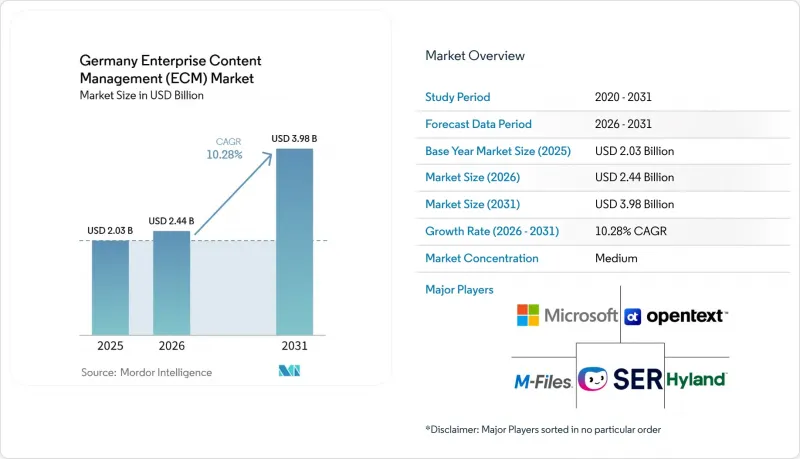
本報告按解決方案類型(文件管理、記錄管理等)、部署模式(本地部署、雲端部署、混合部署)、企業規模(中小企業、大型企業)和最終用戶行業(銀行、金融服務和保險 (BFSI)、政府和公共部門、醫療保健、IT 和電信等)進行分類。市場預測以美元 (USD) 為單位。
德國企業內容管理 (ECM) 市場的趨勢與洞察
德國公司的監管合規和審計應對系統
德國的合規體係正在為德國企業內容管理 (ECM) 市場創造強勁的需求基礎。 《成長機會法》(Wachstumschancengesetz) 規定,自 2025 年 1 月 1 日起,所有增值稅註冊企業必須以結構化的電子格式接收發票。該措施也適用於年營業額超過 80 萬歐元(約 86.6 萬美元)的企業,並於 2027 年開始實施;其他企業則自 2028 年起適用。這些法規至關重要,因為在審計過程中,文件保存必須確保可追溯性、符合保存期限以及可靠的搜尋。這項轉變也促使中小企業首次採用正式的文件管理。隨著這些企業將業務拓展到發票歸檔之外,德國企業內容管理 (ECM) 市場對工作流程、記錄保存和搜尋工具的需求日益成長。
利用人工智慧進行非結構化內容的分類與搜尋
人工智慧的普及正推動德國企業內容管理 (ECM) 市場從被動儲存轉向更主動的內容利用。根據 DSAG 發布的《2026 年投資報告》,在德語區 (DACH) 接受調查的公司中,43% 已實施了人工智慧應用案例,77% 的運作環境依賴非 SAP 人工智慧解決方案。這一趨勢有利於能夠與多種人工智慧技術堆疊整合的 ECM 供應商,而不是將客戶限制在單一方案中。 ELO 透過推出 ELO ECM Suite 25 進一步鞏固了其在這一領域的地位,該套件將於 2025 年新增人工智慧助理並擴大低程式碼支援範圍。如今,買家期望獲得更好的分類、更快的搜尋速度以及在文件密集型流程中減少人工操作。隨著這些功能的提升,預計德國企業內容管理 (ECM) 市場將進一步增加投資,以加速流程並提高搜尋品質。
從傳統企業內容管理 (ECM) 環境遷移的複雜性
在德國企業內容管理 (ECM) 市場,傳統儲存庫仍然是一個瓶頸,因為舊系統仍然與業務流程深度交織。許多大型企業仍在無法快速遷移的系統中管理著長期存在的歸檔文件、獨特的元資料結構以及特定產業的保留規則。當 ECM 環境與客製化的 SAP ECC 工作流程整合時,這個問題會更加嚴重,需要重新設計工作流程才能與 S/4HANA 實現更順暢的整合。 DSAG 的研究表明,繼續使用本地部署的 S/4HANA 印證了這樣一種觀點:許多公司仍在拖延其整個核心系統的遷移週期。因此,遷移專案通常需要數年時間,使用者才能體驗到明顯的功能優勢。即使公司意識到現代化的長期必要性,這也減緩了系統更新的步伐。
細分市場分析
到2025年,文件管理在德國企業內容管理(ECM)市場中佔據28.14%的佔有率,而工作流程和業務流程管理預計到2031年將以12.82%的複合年成長率成長。這一細分錶明,儘管資料保存和管理仍然是收入的主要來源,但新增支出正轉向流程執行。德國企業越來越需要內容系統來檢驗核准、驗證記錄並支援在受監管的工作流程中進行異常處理。 SAP的「Clean Core」策略正在提升能夠處理ERP核心以外的工作流程,同時又能與企業資料緊密整合的ECM平台的價值。因此,德國企業內容管理(ECM)市場正從以儲存庫主導的採購模式轉向以流程主導的採購模式,同時又不影響合規歸檔的需求。
2025 年,ELO ECM Suite 25 透過更廣泛的低程式碼工作流程工具和 AI 驅動的任務處理,進一步強化了這個方向。隨著合規性始於資料收集、儲存和搜尋,文件管理繼續發揮主導作用。結構化電子帳單的需求增加了不同規模企業對可靠檔案的需求,尤其對於那些在 2025 年之前沒有文件管理系統的組織而言更是如此。隨著各組織加強對金融、行政和監管服務業審計追蹤的管理,記錄管理和案例管理也從中受益。雖然 Web 內容管理和數位資產管理在德國企業內容管理 (ECM) 市場中所佔佔有率仍然相對較小,但在多通路發布和內容一致性至關重要的領域,它們正日益受到關注。
預計到2025年,雲端技術將佔據德國企業內容管理(ECM)市場73.41%的佔有率,並將在2031年之前以13.24%的複合年成長率成長。這使得雲端技術成為德國企業內容管理(ECM)市場中規模最大、成長最快的採用模式。這項結果表明,大部分新增需求來自訂閱式服務、預先建置服務和易於部署的模式。這也表明,買家正在尋求能夠支援電子帳單、搜尋和工作流程的內容平台,而無需進行長期的本地基礎設施建設。對於許多中型企業而言,基於雲端的解決方案可以減輕初始部署成本和持續維護的負擔。
本地部署仍然是至關重要的基礎,因為許多德國公司仍然在本地運行其核心ERP環境。根據DSAG發布的《2026年投資報告》, 全部區域)的本地S/4HANA使用率達到56%,顯示市場對本地客製化的歸檔和託管存儲庫模型的需求依然旺盛。混合架構仍然非常重要,因為它們允許企業在嚴格控制的環境中維護高度敏感的記錄,同時利用雲端進行工作流程和協作。 Gaia-X進一步強調了以主權為中心的雲端設計選擇的重要性,尤其是在公共部門和涉及受監管採購標準的領域。這種平衡確保了德國企業內容管理(ECM)市場的架構多樣性,即使雲端技術持續擴大其主導地位。
其他好處:
- Excel格式的市場預測(ME)表
- 3個月的分析師支持
目錄
第1章:引言
- 研究假設和市場定義
- 調查範圍
第2章:調查方法
第3章執行摘要
第4章 市場狀況
- 市場概覽
- 市場促進因素
- 德國公司的監管合規和審計應對系統
- 加速從傳統本地儲存庫遷移到雲端。
- 人工智慧驅動的非結構化內容分類與搜尋
- 製造業對內容整合(主要是SAP)的需求
- 混合工作模式的日益普及,使得安全的內容協作需求日益成長。
- 公共部門電子文件(eFile)和電子文檔(eAkte)現代化計劃
- 市場限制因素
- 從傳統企業內容管理 (ECM) 環境遷移的複雜性
- 對數據主權的擔憂正在減緩雲端運算的普及。
- 與 ERP、CRM 和特定產業應用程式整合時的摩擦
- 中型買家的高階實施與管治成本
- 產業價值鏈分析
- 監理情勢
- 技術展望
- 宏觀經濟因素對市場的影響
- 波特五力分析
第5章 市場規模與成長預測
- 按解決方案類型
- 文件管理
- 記錄管理
- 工作流程和業務流程管理
- 個案管理
- 數位資產管理
- 網站內容管理
- 其他解決方案
- 部署模式
- 現場
- 雲
- 混合
- 按公司規模
- 小型企業
- 大公司
- 按最終用戶行業分類
- BFSI
- 政府/公共部門
- 衛生保健
- IT/通訊
- 製造業
- 零售
- 媒體與娛樂
- 教育
- 能源公用事業
- 其他終端用戶產業
第6章 競爭情勢
- 市場集中度
- 策略趨勢
- 市佔率分析
- 公司簡介
- OpenText Corporation
- Hyland Software, Inc.
- Laserfiche, Inc.
- SERgroup Holding International GmbH
- M-Files Corporation
- DocuWare GmbH
- ELO Digital Office GmbH
- Box, Inc.
- Microsoft Corporation
- IBM Corporation
- Oracle Corporation
- Newgen Software Technologies Limited
- Adobe Inc.
- SAP SE
- Alfresco Software, Inc.
- Nuxeo, a Hyland company
- d.velop AG
- Optimal Systems GmbH
- Ricoh Company, Ltd.
- Konica Minolta, Inc.
第7章 市場機會與未來展望
According to Mordor Intelligence, the Germany enterprise content management (ECM) market size was valued at USD 2.03 billion in 2025, USD 2.44 billion in 2026 and is projected to reach USD 3.98 billion by 2031, at a CAGR of 10.28% from 2026 to 2031.
This report is Segmented by Solution Type (Document Management, Records Management, and More), Deployment Mode (On-Premises, Cloud, and Hybrid), Enterprise Size (Small and Medium Enterprises, and Large Enterprises), and End-User Industry (BFSI, Government and Public Sector, Healthcare, IT and Telecommunications, and More). The Market Forecasts are Provided in Terms of Value (USD).
Germany Enterprise Content Management (ECM) Market Trends and Insights
Regulatory Compliance And Audit Readiness Across German Enterprises
Germany's compliance structure gives the Germany enterprise content management (ECM) market a firm demand base. The Wachstumschancengesetz required all VAT-registered enterprises to receive invoices in structured digital formats from Jan 1, 2025. The rollout also extends to invoice issuance from 2027 for enterprises with annual turnover above EUR 800,000 (USD 866,000), and from 2028 for the remaining businesses. These rules matter because document storage now has to support traceability, retention, and reliable retrieval during audits. That change is bringing smaller firms into formal document management for the first time. As those firms move beyond invoice archiving, the Germany enterprise content management (ECM) market gains follow-on demand for workflow, records control, and search tools.
AI-Enabled Classification and Search for Unstructured Content
AI adoption is pushing the Germany enterprise content management (ECM) market toward more active use of content rather than passive storage. The DSAG Investment Report 2026 showed that 43% of surveyed DACH companies had already implemented AI use cases, and 77% of those production deployments relied on non-SAP AI solutions. That pattern favors ECM vendors that can connect to multiple AI stacks, rather than locking customers into a single route. ELO strengthened its position in this direction with ELO ECM Suite 25, which added an AI assistant and broader low-code support in 2025. Buyers are now expecting better classification, faster retrieval, and less manual handling in document-heavy processes. As these functions improve, the Germany enterprise content management (ECM) market is likely to see more spending on process acceleration and search quality.
High Migration Complexity from Legacy ECM Estates
Legacy repositories continue to slow the Germany enterprise content management (ECM) market where old systems remain deeply tied to operating processes. Many large organizations still manage years of archived documents, custom metadata structures, and sector-specific retention rules inside systems that cannot be moved quickly. The problem is even larger when ECM environments are linked to customized SAP ECC workflows that now need redesign to achieve cleaner S/4HANA integration paths. The DSAG evidence continues on-premises S/4HANA use supports the view that many enterprises are still carrying long transition cycles across core systems. Migration programs, therefore, often become multi-year efforts before users see clear functional gains. This slows replacement activity even when enterprises accept the long-term need to modernize.
Other drivers and restraints analyzed in the detailed report include:
- Accelerated Cloud Migration from Legacy On-Premises Repositories
- SAP-Centric Content Integration Demand in Industrial Enterprises
- Data Sovereignty Concerns Slowing Cloud Adoption
For complete list of drivers and restraints, kindly check the Table Of Contents.
Segment Analysis
Document management held 28.14% of Germany enterprise content management (ECM) market share in 2025, while workflow and business process management is projected to expand at a 12.82% CAGR through 2031. This split shows that storage and control still anchor revenue, but new spending is moving toward process execution. German enterprises increasingly want content systems to trigger approvals, validate records, and support exception handling across regulated workflows. SAP's clean-core direction raises the value of ECM platforms that can handle workflow outside the ERP core while remaining tightly connected to enterprise data. The Germany enterprise content management (ECM) market is therefore shifting from repository-led buying toward process-led buying without reducing the need for compliant archiving.
ELO ECM Suite 25 strengthened this direction in 2025 through broader low-code workflow tools and AI-assisted task handling. Document management continues to lead because compliance starts with capture, retention, and retrieval. The structured e-invoicing requirement widened the need for reliable archiving across firms of different sizes, especially among organizations that had not formalized document controls before 2025. Records management and case management are also benefiting as organizations tighten audit trails across finance, public administration, and regulated services. Web content management and digital asset management remain smaller parts of the Germany enterprise content management (ECM) market, but they are gaining attention where multi-channel publishing and content consistency matter.
Cloud held a 73.41% share of the Germany enterprise content management (ECM) market in 2025 and is projected to grow at a 13.24% CAGR through 2031. This makes cloud both the largest and the fastest-moving deployment path in the Germany enterprise content management (ECM) market. The result suggests that a large part of new demand is entering through subscription delivery, prebuilt services, and easier rollout models. It also shows that buyers want content platforms that can support e-invoicing, search, and workflow without long local infrastructure projects. For many mid-sized firms, cloud delivery reduces the up-front burden of deployment and ongoing maintenance.
On-premises deployment still retains a meaningful base because many German enterprises continue to run core ERP environments locally. The DSAG Investment Report 2026 showed on-premises S/4HANA use at 56% across DACH, which supports continued demand for locally aligned archiving and controlled repository models. Hybrid architecture remains important because it lets firms keep sensitive records in tightly governed environments while using cloud layers for workflow and collaboration. Gaia-X has also added weight to sovereignty-led cloud design choices, especially when public-sector and regulated procurement standards are involved. That balance means the Germany enterprise content management (ECM) market is likely to stay mixed in architecture even as cloud keeps extending its lead.
Complete Report Scope:
- By Solution Type
- Document Management
- Records Management
- Workflow and Business Process Management
- Case Management
- Digital Asset Management
- Web Content Management
- Other Solutions
- By Deployment Mode
- On-Premises
- Cloud
- Hybrid
- By Enterprise Size
- Small and Medium Enterprises
- Large Enterprises
- By End-User Industry
- BFSI
- Government and Public Sector
- Healthcare
- IT and Telecommunications
- Manufacturing
- Retail
- Media and Entertainment
- Education
- Energy and Utilities
- Other End-User Industries
List of Companies Covered in this Report:
- OpenText Corporation
- Hyland Software, Inc.
- Laserfiche, Inc.
- SERgroup Holding International GmbH
- M-Files Corporation
- DocuWare GmbH
- ELO Digital Office GmbH
- Box, Inc.
- Microsoft Corporation
- IBM Corporation
- Oracle Corporation
- Newgen Software Technologies Limited
- Adobe Inc.
- SAP SE
- Alfresco Software, Inc.
- Nuxeo, a Hyland company
- d.velop AG
- Optimal Systems GmbH
- Ricoh Company, Ltd.
- Konica Minolta, Inc.
Additional Benefits:
- The market estimate (ME) sheet in Excel format
- 3 months of analyst support
TABLE OF CONTENTS
1 INTRODUCTION
- 1.1 Study Assumptions and Market Definition
- 1.2 Scope of the Study
2 RESEARCH METHODOLOGY
3 EXECUTIVE SUMMARY
4 MARKET LANDSCAPE
- 4.1 Market Overview
- 4.2 Market Drivers
- 4.2.1 Regulatory Compliance and Audit Readiness Across German Enterprises
- 4.2.2 Accelerated Cloud Migration from Legacy On-Premises Repositories
- 4.2.3 AI-Enabled Classification and Search for Unstructured Content
- 4.2.4 SAP-Centric Content Integration Demand in Industrial Enterprises
- 4.2.5 Hybrid Workforces Increasing Need For Secure Content Collaboration
- 4.2.6 Public Sector eFile and eAkte Modernization Programs
- 4.3 Market Restraints
- 4.3.1 High Migration Complexity From Legacy ECM Estates
- 4.3.2 Data Sovereignty Concerns Slowing Cloud Adoption
- 4.3.3 Integration Friction With ERP, CRM, and Sector-Specific Applications
- 4.3.4 Premium Implementation and Governance Costs for Mid-Market Buyers
- 4.4 Industry Value-Chain Analysis
- 4.5 Regulatory Landscape
- 4.6 Technological Outlook
- 4.7 Impact of Macroeconomic Factors on the Market
- 4.8 Porter's Five Forces Analysis
- 4.8.1 Threat of New Entrants
- 4.8.2 Bargaining Power of Buyers
- 4.8.3 Bargaining Power of Suppliers
- 4.8.4 Threat of Substitutes
- 4.8.5 Intensity of Competitive Rivalry
5 MARKET SIZE AND GROWTH FORECASTS (VALUE)
- 5.1 By Solution Type
- 5.1.1 Document Management
- 5.1.2 Records Management
- 5.1.3 Workflow and Business Process Management
- 5.1.4 Case Management
- 5.1.5 Digital Asset Management
- 5.1.6 Web Content Management
- 5.1.7 Other Solutions
- 5.2 By Deployment Mode
- 5.2.1 On-Premises
- 5.2.2 Cloud
- 5.2.3 Hybrid
- 5.3 By Enterprise Size
- 5.3.1 Small and Medium Enterprises
- 5.3.2 Large Enterprises
- 5.4 By End-User Industry
- 5.4.1 BFSI
- 5.4.2 Government and Public Sector
- 5.4.3 Healthcare
- 5.4.4 IT and Telecommunications
- 5.4.5 Manufacturing
- 5.4.6 Retail
- 5.4.7 Media and Entertainment
- 5.4.8 Education
- 5.4.9 Energy and Utilities
- 5.4.10 Other End-User Industries
6 COMPETITIVE LANDSCAPE
- 6.1 Market Concentration
- 6.2 Strategic Moves
- 6.3 Market Share Analysis
- 6.4 Company Profiles (includes Global Level Overview, Market Level Overview, Core Segments, Financials as Available, Strategic Information, Market Rank/Share for Key Companies, Products and Services, and Recent Developments)
- 6.4.1 OpenText Corporation
- 6.4.2 Hyland Software, Inc.
- 6.4.3 Laserfiche, Inc.
- 6.4.4 SERgroup Holding International GmbH
- 6.4.5 M-Files Corporation
- 6.4.6 DocuWare GmbH
- 6.4.7 ELO Digital Office GmbH
- 6.4.8 Box, Inc.
- 6.4.9 Microsoft Corporation
- 6.4.10 IBM Corporation
- 6.4.11 Oracle Corporation
- 6.4.12 Newgen Software Technologies Limited
- 6.4.13 Adobe Inc.
- 6.4.14 SAP SE
- 6.4.15 Alfresco Software, Inc.
- 6.4.16 Nuxeo, a Hyland company
- 6.4.17 d.velop AG
- 6.4.18 Optimal Systems GmbH
- 6.4.19 Ricoh Company, Ltd.
- 6.4.20 Konica Minolta, Inc.
7 MARKET OPPORTUNITIES AND FUTURE OUTLOOK
- 7.1 White-Space and Unmet-Need Assessment

 基於雲端的企業內容管理市場-2026年至2032年全球市場預測企業內容管理市場-2026-2032年全球市場預測
 法國企業內容管理 (ECM):市場佔有率分析、產業趨勢與統計及成長預測 (2026-2031)零售業企業內容管理 (ECM):市場佔有率分析、產業趨勢與統計數據以及成長預測 (2026-2031)IT和電信行業的企業內容管理(ECM):市場佔有率分析、行業趨勢和統計數據以及成長預測(2026-2031)中東和非洲企業內容管理 (ECM):市場佔有率分析、行業趨勢和統計數據以及成長預測 (2026-2031)南美洲企業內容管理 (ECM):市場佔有率分析、產業趨勢與統計及成長預測 (2026-2031)印度企業內容管理 (ECM):市場佔有率分析、產業趨勢與統計及成長預測 (2026-2031)教育企業內容管理(ECM):市場佔有率分析、產業趨勢與統計、成長預測(2026-2031)日本企業內容管理 (ECM):市佔率分析、產業趨勢與統計及成長預測 (2026-2031)