

 |
市場調查報告書
商品編碼
2099844
日本企業內容管理 (ECM):市佔率分析、產業趨勢與統計及成長預測 (2026-2031)Japan Enterprise Content Management (ECM) - Market Share Analysis, Industry Trends & Statistics, Growth Forecasts (2026 - 2031) |
||||||

※ 本網頁內容可能與最新版本有所差異。詳細情況請與我們聯繫。
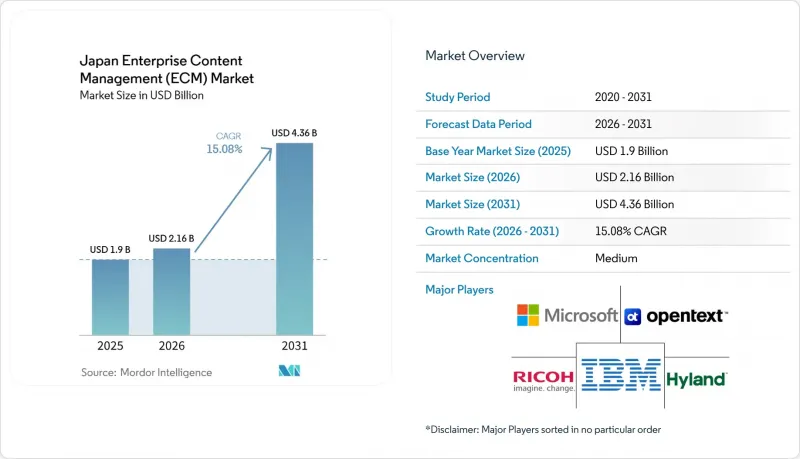
據 Mordor Intelligence 稱,日本企業內容管理 (ECM) 市場在 2025 年的價值為 19 億美元,在 2026 年的價值為 21.6 億美元,預計從 2026 年到 2031 年將以 15.08% 的複合年成長率成長,到 2031 年達到 2031 年。
本報告按解決方案類型(文件管理、記錄管理等)、部署模式(本地部署、雲端部署、混合部署)、企業規模(中小企業、大型企業)和最終用戶行業(銀行、金融服務和保險業、政府和公共部門、IT和電信業等)進行分類。市場預測以美元計價。
日本企業內容管理(ECM)市場趨勢及洞察。
人工智慧驅動的文件分類和搜尋在日語工作流程中的應用
日本企業內容管理 (ECM) 市場受益於日語商業文件通常包含漢字、平假名、片假名、羅馬字、表格、印章和手寫註釋等多種文字,僅靠標準 OCR 技術難以有效管理。 NTT 宣布將於 2026 年 5 月發布其「tsuzumi 2」模型的升級版,透過基於影像的理解功能,提升對複雜佈局日文商業文件的辨識能力。這項改進意義重大,因為它提升了 ECM 工具的價值,使其能夠更準確地對內容進行分類、摘要和搜尋,而不僅僅是儲存文件。住友電工資訊系統公司宣布,截至 2026 年 3 月,其具備 AI 聊天、文件摘要和翻譯功能的「RakuRaku Document Plus」的企業客戶數量已超過 1000 家。 AXLBIT 宣布將於 2026 年 6 月發布“SAIS InDocs”,並計劃在未來兩年內將 AI 代理的應用擴展到整個後勤部門文件工作流程。因此,日本企業內容管理 (ECM) 市場正在從基於儲存庫規模的競爭轉向基於日本內容情報的供應商之間的競爭。
從傳統檔案伺服器遷移到支援管治的內容平台
此外,日本企業內容管理 (ECM) 市場正受到企業從長期使用的文件伺服器遷移的推動,這些伺服器已無法滿足審計、存取和管治需求。 IPA 的數位轉型資料持續強調「數位懸崖」議題,並日益關注 2025 年以後傳統 IT 環境帶來的營運和財務風險。日本經濟產業省 (METI) 的「2026 DX 品牌」評選也印證了這一趨勢,入選企業與人工智慧主導的數位轉型和增強的跨職能數據利用密切相關。這代表著一種前景廣闊的平台替代方案,因為企業尋求的不僅僅是簡單的檔案傳輸——還需要在整個遷移過程中映射權限、確保元資料連續性並維護可驗證的審計記錄。 Springer 於 2026 年發布的日本中小企業數位轉型的調查也指出,舊有系統既構成巨大的成本障礙,也為提供現代化解決方案的供應商帶來了巨大的機會。因此,在日本企業內容管理 (ECM) 市場,越來越多的組織將管理管治的內容平台視為合規性和提高生產力的工具,而不僅僅是儲存升級。
從長期本地存檔進行複雜的遷移。
由於難以將長期運作的本地環境中遺留的歸檔系統遷移到新系統,日本企業內容管理 (ECM) 市場仍面臨許多挑戰。許多公司多年來透過在地化客製化建立文件資產,這使得元資料組織、權限映射和法律連續性的標準化變得極具挑戰性。 Springer 2026 年發布的一項關於日本中小企業轉型的調查顯示,遺留 IT 系統是主要的成本障礙,而對於擁有龐大文件歷史的大型企業而言,這個問題更為突出。此外,遷移可能會導致新舊系統之間的索引結構和搜尋習慣出現碎片化,可能會削弱平台變更帶來的預期管治效益。因此,能夠提供諮詢、遷移規劃和合規性遷移工具等綜合服務的供應商,相比那些僅將遷移視為一項小型實施任務的供應商,具有顯著優勢。這意味著,儘管日本企業內容管理 (ECM) 市場具有快速成長的潛力,但由於現有系統固有的歸檔複雜性,大規模遷移仍然耗時費力。
細分市場分析
到2025年,文件管理將佔日本企業內容管理(ECM)市場佔有率的28.14%,顯示許多買家仍從文件的捕獲、儲存和搜尋等基本需求入手,之後才會轉向更高級的自動化功能。工作流程和業務流程管理預計到2031年將以17.62%的複合年成長率成長,這表明隨著企業將文件流與核准和業務任務關聯起來,下一階段的支出即將到來。由於保留法規和審計要求仍然影響許多企業客戶的採購標準,記錄管理仍佔有重要地位。 NX Manryo Archives在2026年為其「WAN-RECORD Plus」產品新增了人工智慧產生功能,該公司表示,該功能將能夠自動提取、分類和組織海量記錄管理任務中的文件屬性。
個案管理不僅在銀行、金融服務和保險業,而且在政府機構中也日益受到關注,因為這些機構的索賠、申請和監管事務重複性高,且涉及大量文件。數位資產管理 (DAM) 和網路內容管理 (WCM) 雖然目前在整體市場中所佔佔有率仍然相對較小,但隨著電子商務和媒體數位化進程的推進以及對文件和內容需求的持續成長,它們正呈現活躍成長態勢。 2026年2月,住友電工資訊系統發表了「RakuRaku Document Plus Ver. 6.9」。此版本增強了手寫字元的AI-OCR功能,並在現有ChatGPT連接的基礎上,擴展了與生成式AI(包括Gemini)的整合範圍。這個產品方向表明,日本企業內容管理 (ECM) 產業的解決方案類別正在朝向AI輔助方向融合,而非繼續保持完全獨立的架構。因此,那些在核心儲存庫中添加分類、摘要和搜尋智慧功能的供應商,比那些僅專注於儲存效率的供應商擁有更強的競爭優勢。
2025年,雲端運算在日本企業內容管理(ECM)市場佔了75.41%的佔有率。這反映了混合辦公模式、「雲端優先」現代化以及人工智慧驅動的內容平台對基礎設施的需求。據Box Japan稱,其平台在日本被約22,000家企業使用,其中包括85%的日經225指數成分股公司。三菱日聯信託銀行於2026年3月採用Box作為其人工智慧驅動的內容管理平台,用於集中管理非結構化資料。整體雲端運算市場趨勢依然強勁,預計到2026年,日本雲端服務市場規模將達到335.3億美元,年增率達15.7%。這個廣泛的投資週期解釋了為何雲端運算在日本企業內容管理(ECM)市場已成為主流。
在監管嚴格的行業以及需要管理敏感、長期檔案且管理要求嚴格的組織中,本地部署仍然至關重要。然而,隨著許多公司尋求在受控環境中維護特定檔案和存取受限記錄,同時在雲端運行活躍的工作流程,混合部署的重要性日益凸顯。 NTT 更新後的「tsuzumi 2」專為本地和私有雲端使用而設計,這表明公共雲端並非適用於日本所有文件環境。因此,能夠支援跨本地和雲端儲存庫的統一元元資料、搜尋和稽核連續性的供應商仍然需求旺盛。事實上,日本企業內容管理 (ECM) 市場中最強大的供應商,正是那些將雲端領導地位和混合管治視為互補而非對立模式的供應商。
其他好處:
- Excel格式的市場預測(ME)表
- 3個月的分析師支持
目錄
第1章:引言
- 研究假設和市場定義
- 調查範圍
第2章:調查方法
第3章執行摘要
第4章 市場狀況
- 市場概覽
- 市場促進因素
- 從傳統文件伺服器快速遷移到支援管治的內容平台
- 基於人工智慧的日語知識工作流程中的文件分類和搜尋
- 受監管行業面臨電子記錄保存和審計合規的壓力
- 將企業記錄遷移到雲端,以實現混合辦公模式
- 由於 SAP 和 ERP 整合,對統一內容可見性的需求日益成長。
- 日本區域運作中的多語言內容管治
- 市場限制因素
- 從長期本地存檔進行複雜的遷移。
- 分散式業務應用程式整合帶來的負擔
- 雲端工作流程中的資料居住要求和合規性限制
- 企業內容管理架構師與內容管治專家短缺
- 產業價值鏈分析
- 監理情勢
- 技術展望
- 宏觀經濟因素對市場的影響
- 波特五力分析
第5章 市場規模與成長預測
- 按解決方案類型
- 文件管理
- 記錄管理
- 工作流程和業務流程管理
- 個案管理
- 數位資產管理
- 網站內容管理
- 其他解決方案
- 部署模式
- 現場
- 雲
- 混合
- 按公司規模
- 小型企業
- 大公司
- 按最終用戶行業分類
- BFSI
- 政府/公共部門
- 衛生保健
- IT/通訊
- 製造業
- 零售
- 媒體與娛樂
- 教育
- 能源公用事業
- 其他終端用戶產業
第6章 競爭情勢
- 市場集中度
- 策略趨勢
- 市佔率分析
- 公司簡介
- OpenText Corporation
- Hyland Software, Inc.
- Microsoft Corporation
- IBM Corporation
- M-Files Corporation
- Laserfiche, Inc.
- Box, Inc.
- DocuWare GmbH
- Alfresco Software, Inc.
- Nuxeo SA
- Ricoh Company, Ltd.
- Fujifilm Business Innovation Corp.
- Konica Minolta, Inc.
- NEC Corporation
- Fujitsu Limited
- NTT DATA Group Corporation
- Hitachi, Ltd.
- Panasonic Connect Co., Ltd.
- Kyocera Document Solutions Inc.
- Brother Industries, Ltd.
第7章 市場機會與未來展望
According to Mordor Intelligence, the Japan enterprise content management (ECM) market size was valued at USD 1.90 billion in 2025, USD 2.16 billion in 2026, and is forecast to reach USD 4.36 billion by 2031, at a CAGR of 15.08% from 2026 to 2031.
This report is Segmented by Solution Type (Document Management, Records Management, and More), Deployment Mode (On-Premises, Cloud, and Hybrid), Enterprise Size (Small and Medium Enterprises, and Large Enterprises), and End-User Industry (BFSI, Government and Public Sector, IT and Telecommunications, and More). The Market Forecasts are Provided in Terms of Value (USD).
Japan Enterprise Content Management (ECM) Market Trends and Insights
AI-Assisted Document Classification and Retrieval in Japanese Workflows
The Japan enterprise content management (ECM) market is benefiting from the fact that Japanese business documents are difficult to manage with standard OCR alone, because they often mix kanji, hiragana, katakana, romaji, tables, stamps, and handwritten notes. NTT released the updated tsuzumi 2 model in May 2026, and the company said it improved its understanding of Japanese business documents with complex layouts through image-based comprehension. That change matters because it raises the value of ECM tools that can classify, summarize, and retrieve content with greater precision, rather than just storing files. Sumitomo Electric Information Systems said RakuRaku Document Plus surpassed 1,000 enterprise customers by March 2026, supported by AI chat, document summarization, and translation functions. AXLBIT launched SAIS InDocs in June 2026 and said it plans to widen AI agent coverage across back-office document workflows over the next 2 years. As a result, the Japan enterprise content management (ECM) market is moving toward vendor competition based on Japanese-language content intelligence as much as on repository breadth.
Shift from Legacy File Servers to Governed Content Platforms
The Japan enterprise content management (ECM) market is also gaining support from the move away from long-used file servers that no longer fit audit, access, and governance needs. IPA's digital transformation material continued to highlight the Digital Cliff problem, which kept attention on the operational and financial risks tied to legacy IT environments after 2025. METI's 2026 DX Brand selection reinforced the same direction, because recognized companies were closely linked to AI-led digital transformation and stronger data use across business functions. This is an encouraging platform replacement, because enterprises want permission mapping, metadata continuity, and defensible audit records during migration rather than simple file transfer. Springer's 2026 study on SME digital transformation in Japan also described legacy systems as both a major cost barrier and a major opportunity area for modernization vendors. The result is that the Japan enterprise content management (ECM) market is drawing demand from organizations that now see governed content platforms as a compliance and productivity tool, not just a storage upgrade.
Complex Migration From Long-Retained On-Premises Archives
The Japan enterprise content management (ECM) market still faces a major drag from the difficulty of migrating legacy archives from long-established on-premises environments. Many enterprises built document estates over the years of local customization, making metadata cleanup, permission mapping, and legal continuity difficult to standardize. Springer's 2026 work on Japanese SME transformation described legacy IT as a major cost barrier, and the same issue applies even more strongly in large enterprises with heavier document histories. Migration can also leave index structures and lookup habits split across old and new systems, weakening the governance gains the platform change was meant to deliver. Vendors that combine consulting, migration planning, and compliance-aware transfer tools are therefore in a better position than providers that treat migration as a light implementation task. This means the Japan enterprise content management (ECM) market can grow quickly, but large conversions still take time because archive complexity is built into the installed base.
Other drivers and restraints analyzed in the detailed report include:
- Cloud Migration of Enterprise Records for Hybrid Work
- Electronic Book Preservation and Audit Readiness Pressure
- Data Residency and Compliance Constraints On Cloud Workflows
For complete list of drivers and restraints, kindly check the Table Of Contents.
Segment Analysis
Document Management held 28.14% of the Japan enterprise content management (ECM) market share in 2025, which shows that many buyers still began with capture, storage, and retrieval needs before moving into deeper automation. Workflow and Business Process Management is projected to expand at a 17.62% CAGR through 2031, indicating the next stage of spending as organizations connect document flows to approvals and operational tasks. Records Management remains important because retention rules and audit demands still shape buying criteria across many enterprise accounts. NX Wanbishi Archives added a generative AI function to WAN-RECORD Plus in 2026, and the company said it can automatically extract, classify, and sort document attributes for high-volume record operations.
Case Management is gaining traction in banking, financial services, and insurance, as well as government settings, where claims, applications, and regulatory matters follow repeatable but document-heavy paths. Digital Asset Management and Web Content Management remain smaller parts of the mix, but they are staying active as e-commerce and media digitization continue to expand document and content needs. Sumitomo Electric Information Systems released RakuRaku Document Plus Ver. 6.9 in February 2026 with stronger AI-OCR for handwritten text and broader generative AI integration, including Gemini alongside existing ChatGPT connectivity. That product direction shows how solution categories in the Japan enterprise content management (ECM) industry are converging around AI support rather than remaining fully separate stacks. Vendors that attach classification, summarization, and search intelligence to core repositories are therefore gaining a stronger competitive position than those centered only on storage efficiency.
Cloud accounted for 75.41% of the Japan enterprise content management (ECM) market in 2025, reflecting the impact of hybrid work, cloud-first modernization, and the infrastructure needs of AI-enabled content platforms. Box Japan said its platform was used by around 22,000 companies in Japan, including 85% of Nikkei 225 companies, and that Mitsubishi UFJ Trust and Banking Corporation adopted Box in March 2026 as an AI-ready content management foundation for centralizing unstructured data. The broader cloud backdrop also remains favorable, as Japan's cloud services market was projected at USD 33.53 billion in 2026, with a 15.7% growth rate. That broader investment cycle helps explain why cloud deployment already dominates the Japan enterprise content management (ECM) market.
On-premises deployment still matters in regulated industries and in organizations that manage sensitive, long-tenure archives with strict control requirements. Hybrid deployment is becoming increasingly important as many enterprises seek to run active workflows in the cloud while keeping selected archives and restricted records in controlled environments. NTT's updated tsuzumi 2 was designed for on-premises and private cloud use, which confirms that public cloud will not fit every document environment in Japan. This keeps demand high for vendors that can support unified metadata, search, and audit continuity across both local and cloud repositories. In practice, the strongest providers in the Japan enterprise content management (ECM) market are those that treat cloud leadership and hybrid governance as complementary rather than opposing models.
Complete Report Scope:
- By Solution Type
- Document Management
- Records Management
- Workflow and Business Process Management
- Case Management
- Digital Asset Management
- Web Content Management
- Other Solutions
- By Deployment Mode
- On-Premises
- Cloud
- Hybrid
- By Enterprise Size
- Small and Medium Enterprises
- Large Enterprises
- By End-User Industry
- BFSI
- Government and Public Sector
- Healthcare
- IT and Telecommunications
- Manufacturing
- Retail
- Media and Entertainment
- Education
- Energy and Utilities
- Other End-User Industries
List of Companies Covered in this Report:
- OpenText Corporation
- Hyland Software, Inc.
- Microsoft Corporation
- IBM Corporation
- M-Files Corporation
- Laserfiche, Inc.
- Box, Inc.
- DocuWare GmbH
- Alfresco Software, Inc.
- Nuxeo S.A.
- Ricoh Company, Ltd.
- Fujifilm Business Innovation Corp.
- Konica Minolta, Inc.
- NEC Corporation
- Fujitsu Limited
- NTT DATA Group Corporation
- Hitachi, Ltd.
- Panasonic Connect Co., Ltd.
- Kyocera Document Solutions Inc.
- Brother Industries, Ltd.
Additional Benefits:
- The market estimate (ME) sheet in Excel format
- 3 months of analyst support
TABLE OF CONTENTS
1 INTRODUCTION
- 1.1 Study Assumptions and Market Definition
- 1.2 Scope of the Study
2 RESEARCH METHODOLOGY
3 EXECUTIVE SUMMARY
4 MARKET LANDSCAPE
- 4.1 Market Overview
- 4.2 Market Drivers
- 4.2.1 Rapid Shift From Legacy File Servers to Governed Content Platforms
- 4.2.2 AI Assisted Document Classification and Retrieval in Japanese Knowledge Workflows
- 4.2.3 Electronic Book Preservation and Audit Readiness Pressure Across Regulated Industries
- 4.2.4 Cloud Migration of Enterprise Records for Hybrid Work Enablement
- 4.2.5 SAP and ERP Integration Demand for Unified Content Visibility
- 4.2.6 Multilingual Content Governance for Japan Based Regional Operations
- 4.3 Market Restraints
- 4.3.1 Complex Migration From Long Retained On Premises Archives
- 4.3.2 Integration Burden With Fragmented Line of Business Applications
- 4.3.3 Data Residency and Compliance Constraints On Cloud Workflows
- 4.3.4 Shortage of ECM Architects and Content Governance Specialists
- 4.4 Industry Value-Chain Analysis
- 4.5 Regulatory Landscape
- 4.6 Technological Outlook
- 4.7 Impact of Macroeconomic Factors on the Market
- 4.8 Porter's Five Forces Analysis
- 4.8.1 Threat of New Entrants
- 4.8.2 Bargaining Power of Buyers
- 4.8.3 Bargaining Power of Suppliers
- 4.8.4 Threat of Substitutes
- 4.8.5 Intensity of Competitive Rivalry
5 MARKET SIZE AND GROWTH FORECASTS (VALUE)
- 5.1 By Solution Type
- 5.1.1 Document Management
- 5.1.2 Records Management
- 5.1.3 Workflow and Business Process Management
- 5.1.4 Case Management
- 5.1.5 Digital Asset Management
- 5.1.6 Web Content Management
- 5.1.7 Other Solutions
- 5.2 By Deployment Mode
- 5.2.1 On-Premises
- 5.2.2 Cloud
- 5.2.3 Hybrid
- 5.3 By Enterprise Size
- 5.3.1 Small and Medium Enterprises
- 5.3.2 Large Enterprises
- 5.4 By End-User Industry
- 5.4.1 BFSI
- 5.4.2 Government and Public Sector
- 5.4.3 Healthcare
- 5.4.4 IT and Telecommunications
- 5.4.5 Manufacturing
- 5.4.6 Retail
- 5.4.7 Media and Entertainment
- 5.4.8 Education
- 5.4.9 Energy and Utilities
- 5.4.10 Other End-User Industries
6 COMPETITIVE LANDSCAPE
- 6.1 Market Concentration
- 6.2 Strategic Moves
- 6.3 Market Share Analysis
- 6.4 Company Profiles (includes Global Level Overview, Market Level Overview, Core Segments, Financials as Available, Strategic Information, Market Rank/Share for Key Companies, Products and Services, and Recent Developments)
- 6.4.1 OpenText Corporation
- 6.4.2 Hyland Software, Inc.
- 6.4.3 Microsoft Corporation
- 6.4.4 IBM Corporation
- 6.4.5 M-Files Corporation
- 6.4.6 Laserfiche, Inc.
- 6.4.7 Box, Inc.
- 6.4.8 DocuWare GmbH
- 6.4.9 Alfresco Software, Inc.
- 6.4.10 Nuxeo S.A.
- 6.4.11 Ricoh Company, Ltd.
- 6.4.12 Fujifilm Business Innovation Corp.
- 6.4.13 Konica Minolta, Inc.
- 6.4.14 NEC Corporation
- 6.4.15 Fujitsu Limited
- 6.4.16 NTT DATA Group Corporation
- 6.4.17 Hitachi, Ltd.
- 6.4.18 Panasonic Connect Co., Ltd.
- 6.4.19 Kyocera Document Solutions Inc.
- 6.4.20 Brother Industries, Ltd.
7 MARKET OPPORTUNITIES AND FUTURE OUTLOOK
- 7.1 White-Space and Unmet-Need Assessment

 基於雲端的企業內容管理市場-2026年至2032年全球市場預測企業內容管理市場-2026-2032年全球市場預測
 法國企業內容管理 (ECM):市場佔有率分析、產業趨勢與統計及成長預測 (2026-2031)零售業企業內容管理 (ECM):市場佔有率分析、產業趨勢與統計數據以及成長預測 (2026-2031)IT和電信行業的企業內容管理(ECM):市場佔有率分析、行業趨勢和統計數據以及成長預測(2026-2031)中東和非洲企業內容管理 (ECM):市場佔有率分析、行業趨勢和統計數據以及成長預測 (2026-2031)南美洲企業內容管理 (ECM):市場佔有率分析、產業趨勢與統計及成長預測 (2026-2031)印度企業內容管理 (ECM):市場佔有率分析、產業趨勢與統計及成長預測 (2026-2031)德國企業內容管理 (ECM):市場佔有率分析、產業趨勢與統計及成長預測 (2026-2031)教育企業內容管理(ECM):市場佔有率分析、產業趨勢與統計、成長預測(2026-2031)