

 |
市場調查報告書
商品編碼
2099944
IT和電信行業的企業內容管理(ECM):市場佔有率分析、行業趨勢和統計數據以及成長預測(2026-2031)IT and Telecommunications Enterprise Content Management (ECM) - Market Share Analysis, Industry Trends & Statistics, Growth Forecasts (2026 - 2031) |
||||||

※ 本網頁內容可能與最新版本有所差異。詳細情況請與我們聯繫。
據 Mordor Intelligence 稱,2025 年 IT 和電信行業的企業內容管理 (ECM) 市場價值為 45.3 億美元,預計將從 2026 年的 50.1 億美元成長到 2031 年的 83.8 億美元,複合年成長率為 10.84%。
預測期(2026-2031 年)。
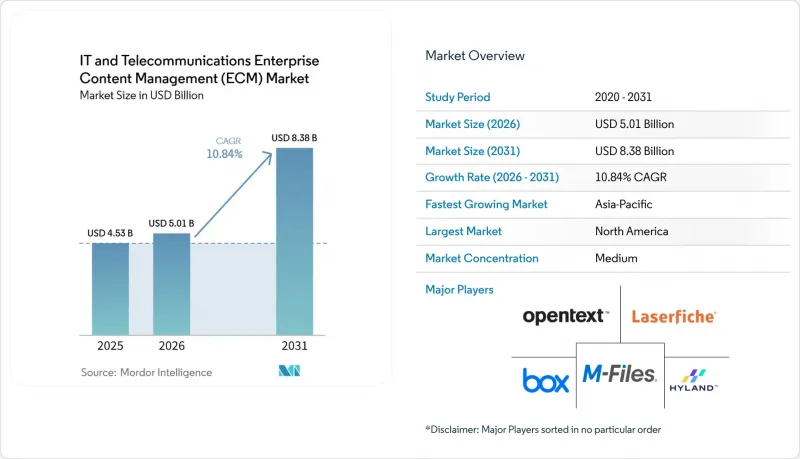
本報告按解決方案類型(文件管理、記錄管理、工作流程和業務流程管理、案例管理等)、部署模式(本地部署、雲端部署、混合部署)、企業規模(中小企業和大型企業)以及地區進行細分。市場預測以美元(USD)計價。
全球IT及電信市場趨勢及洞察
通訊網路中向零接觸內容管理的快速轉變
通訊業者正在重新思考其內容運營,圍繞自動化流程創建、路由、分類和歸檔記錄,同時最大限度地減少人工干預。由於這些記錄與實際通訊環境中的配置事件、服務變更、網路事故和合規性檢查密切相關,因此內容層需要與營運工作流程保持同步運作。隨著服務流程日益事件驅動,IT 和通訊業的企業內容管理 (ECM) 市場正從被動儲存工具轉向能夠回應通訊系統觸發事件的平台。紐西蘭一家公司在實施 UiPath Maestro 後,將行動裝置配置時間從 10 天縮短到不到 10 分鐘,這表明通訊業的工作流程自動化正迅速從試驗計畫過渡到核心營運。這種轉變正在推動 IT 和通訊業內容管理 (ECM) 市場對能夠將文件、記錄和服務操作保持在同一營運循環中的工作流程工具的需求。
從傳統企業內容管理 (ECM) 儲存庫遷移到雲端原生協作堆疊
許多通訊業者仍在經營雲端交付普及之前所建置的傳統儲存庫,而這些平台現在正被雲端原生內容環境所取代。這些遷移專案的主要挑戰不僅在於檔案遷移,更在於遷移後如何維護將內容與電信工作流程關聯的業務情境。在面向IT和通訊業的企業內容管理(ECM)市場中,這是選擇遷移工具的關鍵購買因素,因為通訊業者需要的不僅僅是儲存文件的雲端歸檔,而是能夠保留與這些文件相關的業務資訊的歸檔。德國電信(Telefónica Germany)計畫在2026年第一季將其首批10萬用戶的4G和5G語音服務遷移到雲端原生平台。這標誌著向雲端運營模式的更廣泛轉變,隨之而來的是,對一致的內容遷移的需求也日益成長。 OpenText 在 2026 年 6 月發布的 Content Management CE 26.2 中增加了更強大的遷移支援。這表明,IT 和通訊業的企業內容管理 (ECM) 市場的供應商現在不僅將遷移支援定位為輔助服務,而且將其定位為產品不可分割的一部分。
與傳統OSS、BSS和網路庫存系統進行複雜整合。
在IT和電信業的企業內容管理(ECM)市場中,最大的障礙仍然是內容平台與傳統電信作業系統之間的深度整合。由於許多OSS和BSS環境仍然使用專有資料模型,新的內容平台可能會作為一個獨立的層運行,而不是電信運營的整合功能。這會帶來管治風險,因為同一服務事件的記錄存在於多個位置,且缺乏清晰的審計路徑來追蹤這些記錄。這也是大型企業儘管在2025年佔據69.61%的收入佔有率,但仍保持謹慎的原因之一,因為系統調整的成本和時間通常遠遠超過最初的軟體選擇階段。 OpenText於2025年11月獲得SAP S/4HANA Cloud Public Edition認證,這反映出互通性檢驗的需求日益成長,並將成為IT和通訊業企業內容管理(ECM)市場中供應商縮短引進週期的一項實際要求。
細分市場分析
預計到2025年,文件管理將佔IT和通訊業企業內容管理(ECM)市場規模的27.36%,並持續維持其在營收方面最大的解決方案類別地位。這一地位仍然反映了通訊業者每天產生的大量技術文件、監管申報文件、現場記錄和內部營運文件。儘管通訊業者的優先事項已轉向自動化和營運整合,但由於其龐大的規模,文件管理仍然是IT和通訊業內容管理(ECM)市場的核心。此外,通訊記錄的長期保存也使這一領域受益,因為許多資產和合規相關文件必須在初始服務交付或建置週期結束後很長一段時間內保持可訪問性。
隨著通訊內容產生方式從行動、使用者生成流程轉向系統,這種需求的性質也在改變。這意味著,在面向IT和電信行業的企業內容管理(ECM)市場中,能夠以營運速度攝取、標記和路由系統產生文件的文件平台正變得越來越重要。預計到2031年,工作流程和業務流程管理將以16.98%的複合年成長率成長,這表明通訊業者開始投資於整合到服務提供、訂單處理和問題解決流程中的內容工具。 OpenText於2026年6月發布的Content Management CE 26.2版本增加了基於代理的文件管理、元資料感知和記錄處理功能。這表明供應商正在將基本的儲存庫功能轉變為工作流程主導的營運工具。雖然記錄管理、案例管理、數位資產管理和Web內容管理在面向IT和通訊業的企業內容管理(ECM)市場中仍然發揮著重要作用,但與文件管理和流程自動化相關的大規模核心需求相比,它們的應用場景仍然有限。
區域分析
到2025年,北美仍將是最大的區域市場,佔IT和通訊業企業內容管理(ECM)市場規模的36.72%。該地區受益於美國和加拿大主要通訊業者成熟的數位化項目,這些運營商的內容平台已整合到更廣泛的營運和支援系統的現代化改造中。在IT和電信企業內容管理(ECM)市場,北美也呈現出明顯的趨勢,即管治層正在與Microsoft 365環境協作,而非與其競爭,從而促進日常協作。然而,歐洲的需求趨勢有所不同,因為內容管理深受監管義務、可審計性和司法管轄區層面的記錄保存的影響。歐盟資料法於2024年1月生效,並將於2025年9月開始實施,由於GDPR和各國電信資料法規,本已嚴格的營運環境進一步加劇,從而推動了對具有高管治水準的內容平台的持續需求。
預計到2031年,亞太地區將以14.59%的複合年成長率成長,成為IT和電信企業內容管理(ECM)市場成長最快的地區。印度、中國、東南亞和其他受監管市場的通訊業者正在快速擴展其數位服務和網路項目,同時面臨日益嚴格的在地化和隱私要求。在2025年6月舉行的GSMA亞太圓桌會議上,數位資訊通訊科技(DICT)服務的擴展被認為是通訊業者轉型的重中之重,這顯示管理管治的內容和工作流程系統在電信商業模式中的作用將進一步擴大。 2026年6月,Hyland將其內容創新雲擴展到AWS亞太悉尼區域。這顯示供應商將亞太地區的IT和通訊業企業內容管理(ECM)市場視為一個緊迫且監管敏感的市場。
儘管南美洲的規模仍不如北美和亞太地區,但隨著通訊業者對其記錄管理、服務和光纖部署工作流程進行現代化改造,企業內容管理 (ECM) 市場在 IT 和電信行業的重要性日益凸顯。巴西尤其引人注目,由於隱私和記錄管理標準的不斷提高,對加強電信文件管治的需求也日益成長。中東和非洲地區在 IT 和電信行業的企業內容管理 (ECM) 市場中所佔佔有率仍然較小,但與主權雲端計畫、國家數位基礎設施和政府相關電信業務相關的需求明顯集中。雖然非洲的 ECM 應用仍處於起步階段,支出主要集中在大規模通訊業者和公共部門機構,但未來的擴張很可能高度依賴雲端模式,而雲端模式也將變得更加適用於小規模通訊業者。
其他好處:
- Excel格式的市場預測(ME)表
- 3個月的分析師支持
目錄
第1章:引言
- 研究假設和市場定義
- 調查範圍
第2章:調查方法
第3章執行摘要
第4章 市場狀況
- 市場概覽
- 市場促進因素
- 通訊網路中向零接觸內容管理的快速轉變
- 擴展 5G、光纖和邊緣基礎設施的文件工作流程。
- 跨境通訊記錄合規負擔日益加重
- 將傳統企業內容管理 (ECM) 儲存庫遷移到雲端原生協作堆疊
- 需要為客戶、合作夥伴和現場服務人員提供統一的內容存取權限。
- 引入人工智慧驅動的元資料提取和智慧搜尋。
- 市場限制因素
- 與傳統OSS、BSS和網路資產管理系統進行複雜整合。
- 受監管市場中的資料居住要求和主權限制
- 去中心化通訊業者的內容管治缺陷
- 大型跨區域電信公司面臨的變革管理負擔。
- 產業價值鏈分析
- 監理情勢
- 技術展望
- 宏觀經濟因素對市場的影響
- 波特五力分析
第5章 市場規模與成長預測
- 按解決方案類型
- 文件管理
- 記錄管理
- 工作流程和業務流程管理
- 個案管理
- 數位資產管理
- 網站內容管理
- 其他解決方案
- 部署模式
- 現場
- 雲
- 混合
- 按公司規模
- 中小企業
- 大公司
- 按地區
- 北美洲
- 美國
- 加拿大
- 墨西哥
- 南美洲
- 巴西
- 阿根廷
- 其他南美國家
- 歐洲
- 英國
- 德國
- 法國
- 其他歐洲國家
- 亞太地區
- 中國
- 日本
- 印度
- 韓國
- 澳洲
- 其他亞太國家
- 中東和非洲
- 中東
- 阿拉伯聯合大公國
- 沙烏地阿拉伯
- 其他中東國家
- 非洲
- 南非
- 肯亞
- 其他非洲國家
- 中東
- 北美洲
第6章 競爭情勢
- 市場集中度
- 策略趨勢
- 市佔率分析
- 公司簡介
- OpenText Corporation
- Hyland Software, Inc.
- Box, Inc.
- M-Files Corporation
- Laserfiche, Inc.
- SER Group GmbH
- Fabasoft AG
- Objective Corporation Limited
- DocuWare GmbH
- Newgen Software Technologies Limited
- Datamatics Global Services Limited
- iManage LLC
- Alfresco Software, Ltd.
- Everteam
- KnowledgeLake, Inc.
- Egnyte, Inc.
- DocuSign, Inc.
- Hyland Nuxeo
- Perceptive Content
- Ephesoft, Inc.
- Liferay, Inc.
第7章 市場機會與未來展望
According to Mordor Intelligence, the IT and telecommunications enterprise content management (ECM) market size was valued at USD 4.53 billion in 2025 and estimated to grow from USD 5.01 billion in 2026 to reach USD 8.38 billion by 2031, at a CAGR of 10.84% during the forecast period (2026-2031).
This report is Segmented by Solution Type (Document Management, Records Management, Workflow and Business Process Management, Case Management, and More), Deployment Mode (On-Premises, Cloud, and Hybrid), Enterprise Size (Small and Medium Enterprises (SME), and Large Enterprises), and Geography. The Market Forecasts are Provided in Terms of Value (USD).
Global IT and Telecommunications Enterprise Content Management (ECM) Market Trends and Insights
Rapid Shift to Zero-Touch Content Operations in Telecom Networks
Telecom operators are reorganizing content operations around automated flows that create, route, classify, and archive records with less manual work. In live telecom environments, these records are tied to provisioning events, service changes, network incidents, and compliance checks, so the content layer has to move at the same pace as the operating workflow. As more service processes become event-driven, the IT and telecommunications enterprise content management (ECM) market is moving toward platforms that can respond to triggers from telecom systems instead of acting as passive storage tools. One NZ reduced mobile provisioning time from 10 days to under 10 minutes after deploying UiPath Maestro, which shows how fast telecom workflow automation is moving from pilot programs into core operations. This shift supports stronger demand in the IT and telecommunications enterprise content management (ECM) market for workflow tools that can keep documents, records, and service actions inside the same operating loop.
Migration of Legacy ECM Repositories into Cloud-Native Collaboration Stacks
Many operators still carry older repositories that were built before cloud delivery became normal, and those platforms are now being replaced by cloud-native content environments. The main issue in these programs is not only moving files, but also preserving the business context that links content to telecom workflows after migration. In the IT and telecommunications enterprise content management (ECM) market, this makes migration tooling a buying factor because operators do not want cloud archives that hold documents but lose the operational meaning attached to them. Telefonica Germany moved 4G and 5G voice services for its first 100,000 customers to a cloud-native platform by Q1 2026, which illustrates the broader shift toward cloud operating models that also raises the need for aligned content migration. OpenText added stronger migration support in its Content Management CE 26.2 release in June 2026, which shows that vendors in the IT and telecommunications enterprise content management (ECM) market now treat migration assistance as part of the product, not as a side service.
Complex Integration With Legacy OSS, BSS, and Network Inventory Systems
The biggest obstacle in the IT and telecommunications enterprise content management (ECM) market remains the large integration surface between content platforms and older telecom operating systems. Many OSS and BSS environments still use proprietary data models, so a new content platform can end up functioning as a separate layer rather than as an embedded function within telecom operations. That creates governance risk because the same service event can have records in more than 1 place with no clean audit path between them. This is one reason large enterprises still move cautiously, even though they held 69.61% revenue share in 2025, since the cost and timing of system coordination often stretch well beyond the initial software decision. OpenText's SAP S/4HANA Cloud Public Edition certification in November 2025 reflects how validated interoperability is becoming a practical requirement for vendors trying to shorten deployment cycles in the IT and telecommunications enterprise content management (ECM) market.
Other drivers and restraints analyzed in the detailed report include:
- AI-Driven Metadata Extraction and Intelligent Search Adoption
- Expansion of 5G, Fiber, and Edge Infrastructure Documentation Workflows
- Data Residency and Sovereignty Constraints Across Regulated Markets
For complete list of drivers and restraints, kindly check the Table Of Contents.
Segment Analysis
Document management accounted for 27.36% of the IT and telecommunications enterprise content management (ECM) market size in 2025, which kept it as the largest solution category by revenue. Its position still reflects the sheer volume of technical files, regulatory submissions, field records, and internal operating documents created by telecom carriers every day. In the IT and telecommunications enterprise content management (ECM) market, that scale keeps document management central even as operator priorities move toward automation and operational integration. The segment also benefits from the long retention life of telecom records, since many assets and compliance files must remain accessible well beyond the initial service or build cycle.
The nature of that demand is changing because a growing share of telecom content is now generated by systems rather than by manual users. This means the IT and telecommunications enterprise content management (ECM) market increasingly rewards document platforms that can ingest, tag, and route machine-created files at operating speed. Workflow and business process management is projected to grow at a 16.98% CAGR through 2031, which shows that operators are directing new spending toward content tools that sit inside service provisioning, order handling, and issue resolution processes. OpenText's June 2026 Content Management CE 26.2 release added agentic actions for document management, metadata support, and records handling, which shows how vendors are turning basic repository functions into workflow-led operating tools. Records management, case management, digital asset management, and web content management still hold defined roles in the IT and telecommunications enterprise content management (ECM) market, but they serve narrower use cases than the large core demand tied to document control and process automation.
Complete Report Scope:
- By Solution Type
- Document Management
- Records Management
- Workflow and Business Process Management
- Case Management
- Digital Asset Management
- Web Content Management
- Other Solutions
- By Deployment Mode
- On-Premises
- Cloud
- Hybrid
- By Enterprise Size
- Small and Medium Enterprises (SME)
- Large Enterprises
- By Geography
- North America
- United States
- Canada
- Mexico
- South America
- Brazil
- Argentina
- Rest of South America
- Europe
- United Kingdom
- Germany
- France
- Rest of Europe
- Asia-Pacific
- China
- Japan
- India
- South Korea
- Australia
- Rest of Asia-Pacific
- Middle East and Africa
- Middle East
- United Arab Emirates
- Saudi Arabia
- Rest of Middle East
- Africa
- South Africa
- Kenya
- Rest of Africa
- Middle East
- North America
Geography Analysis
North America accounted for 36.72% of the IT and telecommunications enterprise content management (ECM) market size in 2025, which kept it as the largest regional base. The region benefits from mature digital programs at major U.S. and Canadian carriers, where content platforms are already tied to broader operating and support system modernization work. In the IT and telecommunications enterprise content management (ECM) market, North America also shows a clear shift toward governance layers that work with Microsoft 365 environments instead of competing against them for everyday collaboration. Europe presents a different demand profile because content control is shaped heavily by regulatory obligations, auditability, and jurisdiction-level records handling. The EU Data Act, which entered into force in January 2024 and applies from September 2025, adds to the already strict operating environment created by GDPR and national telecom data rules, which supports durable demand for high-governance content platforms.
Asia-Pacific is projected to grow at a 14.59% CAGR through 2031, making it the fastest-growing region in the IT and telecommunications enterprise content management (ECM) market. Operators across India, China, Southeast Asia, and other regulated markets are dealing with stricter localization and privacy requirements while also expanding digital service and network programs at pace. GSMA's June 2025 Asia-Pacific roundtable described DICT service expansion as a core part of carrier transformation, which supports the wider role of governed content and workflow systems in telecom operating models. Hyland expanded its Content Innovation Cloud into the AWS Asia-Pacific Sydney Region in June 2026, which signals that vendors see the IT and telecommunications enterprise content management (ECM) market in APAC as both urgent and regulation-sensitive.
South America remains smaller than North America and Asia-Pacific, but the IT and telecommunications enterprise content management (ECM) market is gaining relevance there as operators modernize records, service, and fiber rollout workflows. Brazil stands out because higher privacy and records standards are raising the need for stronger governance around telecom documentation. The Middle East and Africa still represent a smaller revenue pool in the IT and telecommunications enterprise content management (ECM) market, though the region has clear demand pockets tied to sovereign cloud programs, national digital infrastructure, and government-linked telecom operations. Africa remains earlier in adoption, with spending concentrated more heavily in larger operators and public-sector aligned entities, while future expansion is likely to depend strongly on cloud models that make deployment practical for smaller telecom providers.
- OpenText Corporation
- Hyland Software, Inc.
- Box, Inc.
- M-Files Corporation
- Laserfiche, Inc.
- SER Group GmbH
- Fabasoft AG
- Objective Corporation Limited
- DocuWare GmbH
- Newgen Software Technologies Limited
- Datamatics Global Services Limited
- iManage LLC
- Alfresco Software, Ltd.
- Everteam
- KnowledgeLake, Inc.
- Egnyte, Inc.
- DocuSign, Inc.
- Hyland Nuxeo
- Perceptive Content
- Ephesoft, Inc.
- Liferay, Inc.
Additional Benefits:
- The market estimate (ME) sheet in Excel format
- 3 months of analyst support
TABLE OF CONTENTS
1 INTRODUCTION
- 1.1 Study Assumptions and Market Definition
- 1.2 Scope of the Study
2 RESEARCH METHODOLOGY
3 EXECUTIVE SUMMARY
4 MARKET LANDSCAPE
- 4.1 Market Overview
- 4.2 Market Drivers
- 4.2.1 Rapid Shift to Zero-Touch Content Operations in Telecom Networks
- 4.2.2 Expansion of 5G, Fiber, and Edge Infrastructure Documentation Workflows
- 4.2.3 Escalating Compliance Burden Across Cross-Border Telecom Records
- 4.2.4 Migration of Legacy ECM Repositories Into Cloud-Native Collaboration Stacks
- 4.2.5 Need for Unified Customer, Partner, and Field-Service Content Access
- 4.2.6 AI-Driven Metadata Extraction and Intelligent Search Adoption
- 4.3 Market Restraints
- 4.3.1 Complex Integration With Legacy OSS, BSS, and Network Inventory Systems
- 4.3.2 Data Residency and Sovereignty Constraints Across Regulated Markets
- 4.3.3 Content Governance Gaps Across Distributed Telco Partner Ecosystems
- 4.3.4 High Change-Management Load for Large, Multi-Region Telecom Enterprises
- 4.4 Industry Value-Chain Analysis
- 4.5 Regulatory Landscape
- 4.6 Technological Outlook
- 4.7 Impact of Macroeconomic Factors on the Market
- 4.8 Porter's Five Forces Analysis
- 4.8.1 Threat of New Entrants
- 4.8.2 Bargaining Power of Buyers
- 4.8.3 Bargaining Power of Suppliers
- 4.8.4 Threat of Substitutes
- 4.8.5 Intensity of Competitive Rivalry
5 MARKET SIZE AND GROWTH FORECASTS (VALUE)
- 5.1 By Solution Type
- 5.1.1 Document Management
- 5.1.2 Records Management
- 5.1.3 Workflow and Business Process Management
- 5.1.4 Case Management
- 5.1.5 Digital Asset Management
- 5.1.6 Web Content Management
- 5.1.7 Other Solutions
- 5.2 By Deployment Mode
- 5.2.1 On-Premises
- 5.2.2 Cloud
- 5.2.3 Hybrid
- 5.3 By Enterprise Size
- 5.3.1 Small and Medium Enterprises (SME)
- 5.3.2 Large Enterprises
- 5.4 By Geography
- 5.4.1 North America
- 5.4.1.1 United States
- 5.4.1.2 Canada
- 5.4.1.3 Mexico
- 5.4.2 South America
- 5.4.2.1 Brazil
- 5.4.2.2 Argentina
- 5.4.2.3 Rest of South America
- 5.4.3 Europe
- 5.4.3.1 United Kingdom
- 5.4.3.2 Germany
- 5.4.3.3 France
- 5.4.3.4 Rest of Europe
- 5.4.4 Asia-Pacific
- 5.4.4.1 China
- 5.4.4.2 Japan
- 5.4.4.3 India
- 5.4.4.4 South Korea
- 5.4.4.5 Australia
- 5.4.4.6 Rest of Asia-Pacific
- 5.4.5 Middle East and Africa
- 5.4.5.1 Middle East
- 5.4.5.1.1 United Arab Emirates
- 5.4.5.1.2 Saudi Arabia
- 5.4.5.1.3 Rest of Middle East
- 5.4.5.2 Africa
- 5.4.5.2.1 South Africa
- 5.4.5.2.2 Kenya
- 5.4.5.2.3 Rest of Africa
- 5.4.5.1 Middle East
- 5.4.1 North America
6 COMPETITIVE LANDSCAPE
- 6.1 Market Concentration
- 6.2 Strategic Moves
- 6.3 Market Share Analysis
- 6.4 Company Profiles (includes Global Level Overview, Market Level Overview, Core Segments, Financials as available, Strategic Information, Market Rank/Share, Products and Services, Recent Developments)
- 6.4.1 OpenText Corporation
- 6.4.2 Hyland Software, Inc.
- 6.4.3 Box, Inc.
- 6.4.4 M-Files Corporation
- 6.4.5 Laserfiche, Inc.
- 6.4.6 SER Group GmbH
- 6.4.7 Fabasoft AG
- 6.4.8 Objective Corporation Limited
- 6.4.9 DocuWare GmbH
- 6.4.10 Newgen Software Technologies Limited
- 6.4.11 Datamatics Global Services Limited
- 6.4.12 iManage LLC
- 6.4.13 Alfresco Software, Ltd.
- 6.4.14 Everteam
- 6.4.15 KnowledgeLake, Inc.
- 6.4.16 Egnyte, Inc.
- 6.4.17 DocuSign, Inc.
- 6.4.18 Hyland Nuxeo
- 6.4.19 Perceptive Content
- 6.4.20 Ephesoft, Inc.
- 6.4.21 Liferay, Inc.
7 MARKET OPPORTUNITIES AND FUTURE OUTLOOK
- 7.1 White-Space and Unmet-Need Assessment

 基於雲端的企業內容管理市場-2026年至2032年全球市場預測企業內容管理市場-2026-2032年全球市場預測
 法國企業內容管理 (ECM):市場佔有率分析、產業趨勢與統計及成長預測 (2026-2031)零售業企業內容管理 (ECM):市場佔有率分析、產業趨勢與統計數據以及成長預測 (2026-2031)中東和非洲企業內容管理 (ECM):市場佔有率分析、行業趨勢和統計數據以及成長預測 (2026-2031)南美洲企業內容管理 (ECM):市場佔有率分析、產業趨勢與統計及成長預測 (2026-2031)印度企業內容管理 (ECM):市場佔有率分析、產業趨勢與統計及成長預測 (2026-2031)德國企業內容管理 (ECM):市場佔有率分析、產業趨勢與統計及成長預測 (2026-2031)教育企業內容管理(ECM):市場佔有率分析、產業趨勢與統計、成長預測(2026-2031)日本企業內容管理 (ECM):市佔率分析、產業趨勢與統計及成長預測 (2026-2031)