

 |
市場調查報告書
商品編碼
2099915
日本固定無線接取市場:市場佔有率分析、產業趨勢與統計及成長預測(2026-2031 年)Japan Fixed Wireless Access - Market Share Analysis, Industry Trends & Statistics, Growth Forecasts (2026 - 2031) |
||||||

※ 本網頁內容可能與最新版本有所差異。詳細情況請與我們聯繫。
據 Mordor Intelligence 稱,2025 年日本固定無線存取市場價值為 27.1 億美元,預計到 2031 年將達到 61 億美元,2026 年至 2031 年的複合年成長率為 14.28%。
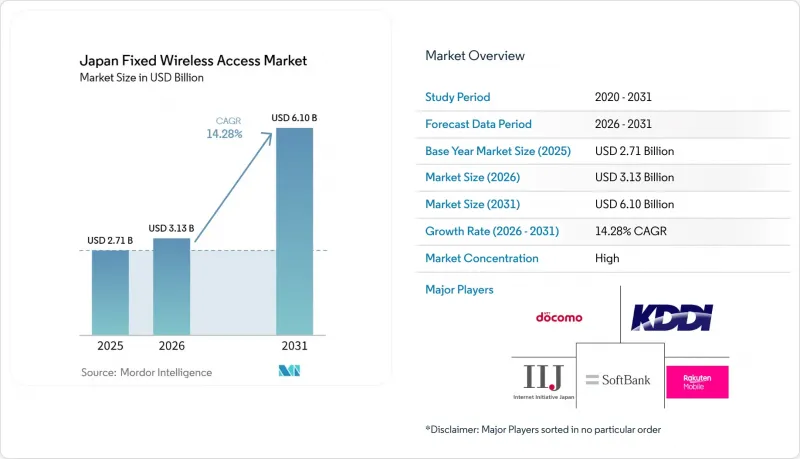
本報告按類型(硬體[接入單元等]和服務)、應用(住宅、商業、工業、政府/公共安全)、頻段(6 GHz 以下頻段、毫米波(24 GHz 及以上頻段)和免許可/共用CBRS 頻段)以及部署類型(室內 CPE、室外 CPE 和自行安裝的窗式 CPE)進行細分。市場預測以美元 (USD) 為單位。
日本固定無線接取市場趨勢與洞察
5G獨立組網的部署擴大了FWA的性能潛力。
日本固定無線接取市場最強勁的成長要素是轉型為高效能5G獨立的組網。愛立信2026年的展望報告指出,日本將成為固定無線接取市場中最具潛力的市場之一。這得益於5G技術的高度成熟以及基於速度的收費系統的整合式發展,而非各自獨立發展。Softbank Corporation和愛立信也在鈴鹿賽道的商用5G獨立組網中檢驗了五個網路切片。其中一個用例利用毫米波(mmWave)回程傳輸在固定無線存取環境中提供公共Wi-Fi服務。這種網路行為之所以重要,是因為在擁擠的都市區,固定無線存取的效能更取決於網路的穩定性、延遲處理能力以及在流量增加時維持服務品質的能力,而不僅僅是尖峰時段標稱速度。因此,日本固定無線接取市場在開發更具差異化的服務方案方面擁有廣闊的空間。在通訊業者願意為高可靠性、快速部署或業務永續營運等用例收取更高費用的地區,這種趨勢尤其明顯。隨著 5G 獨立組網功能在運作網路中變得越來越明顯,市場正在建立一個強大的基礎,以速度和品質為基礎進行分層服務交付,而不是簡單地將其視為寬頻計劃的替代品。
人口稠密市場中光纖線路的飽和,為備用線路和二線服務開闢了應用情境。
支撐日本固定無線接取市場發展的第二個主要因素是人口密集都市區固定寬頻的極高普及率,這正在改變無線寬頻的行銷方式。 KDDI 於 2025 年 12 月為其「au Hikari」10Gbps 和 5Gbps 服務推出支援 Wi-Fi 7 的家庭閘道器,這表明日本家庭使用高階光纖接入的固定通訊環境已非常先進。在此背景下,固定無線存取 (FWA) 的速度不一定需要超過光纖才能獲得市場需求,因為 FWA 可以作為第二條線路,提供更快捷的部署方式,或在佈線管理由業主或物業管理公司負責的建築中提供切實可行的解決方案。Softbank Corporation推出的「Air Terminal 6」也表明,儘管光纖市場依然強勁,但通訊業者仍在繼續投資家庭 FWA 硬體,這表明這兩種技術不再是簡單的「贏家通吃」局面,而是根據不同的接入優先級進行定位。正因如此,在日本的城市中心,即使傳統光纖競爭已經十分激烈,固定無線接入市場仍有成長空間。其成長路徑並非完全取代光纖,而是專注於在安裝障礙依然存在的環境中提供備份、柔軟性和易於部署等優勢。
頻寬可用性和中波頻段連續性的限制
日本固定無線接取市場最明顯的技術限制因素是,頻寬的改進並未完全消除人口密集區域的效能瓶頸。儘管內務部於2024年批准了4.9 GHz頻段的使用,提升了Softbank Corporation的容量,但這並未解決5G接入層高需求部分對更寬、更連續頻寬的需求。此外,KDDI和NTT Docomo將於2026年聯合實施的毫米波中繼器計畫也凸顯了在實際城市環境中高效擴展高頻覆蓋範圍仍需付出巨大的技術努力。只要通訊業者仍然需要共用中繼器、更高密度的中繼架構以及精細的覆蓋設計,高品質、高吞吐量的固定無線存取(FWA)的擴展速度就會緩慢,並且需要更大的資本投入。雖然日本固定無線接取市場在6 GHz以下頻段仍永續成長,但要實現與光纖媲美的多Gigabit性能,其路徑仍比需求預測所顯示的更為狹窄。在高密度建築中,由於使用需求高,訊號條件最佳化難度最大,這種限制帶來了最大的問題。
細分市場分析
2025年,硬體收入佔市場總收入的25.98%,而服務業預計將在2026年至2031年間以14.76%的複合年成長率成長。這一構成表明,日本固定無線接入市場更多地受到持續接入價值的驅動,而非一次性終端銷售。由於數據機、路由器和閘道器的升級直接影響客戶滿意度和網路效率,通訊業者仍需要硬體創新。 2024年底,Softbank Corporation成為首家推出Wi-Fi 7相容家用路由器「Air Terminal 6」的日本行動通訊業者。隨後,2025年12月,KDDI推出了高速家用連接閘道器“HGW-BL4000HM”,進一步增加了日本家庭接入性能標準的提升壓力。
服務的加速擴張反映出通訊業者可以透過快速服務部署、支援、品質保證和業務永續營運來提供更多增值服務。正因如此,日本固定無線接取市場正持續從硬體主導的差異化定價轉向服務主導的定價。Softbank Corporation的「BizCell」就是一個典型的例子,它將無線存取定位為企業和現場應用的實用通訊環境,而不僅僅是消費級路由器。在日本固定無線接入行業,這種模式支援更高價值的契約,因為客戶購買的是運作、快速部署和服務覆蓋範圍,而不僅僅是終端設備。雖然終端層仍然很重要,但它正日益成為降低服務部署門檻和提高用戶留存率的工具,而不是收入成長的主要來源。
預計到2025年,住宅用戶將佔日本固定無線接取市場佔有率的67.88%,而政府和公共安全部門預計將以15.41%的複合年成長率成長至2031年。即插即用的無線路由器非常適合住宅、居住者居住者希望無需等待安裝即可使用該服務的家庭,因此擁有龐大的住宅用戶群。儘管在許多都市區面臨來自光纖的激烈競爭,但這種情況仍然為日本固定無線存取市場提供了穩固的消費群。Softbank Corporation推出的「Air Terminal 6」表明,通訊業者正透過改進Wi-Fi標準和提升室內通訊效能,持續大力投資家庭接取服務。因此,即使隨著普及率的提高,成長率趨於正常化,住宅用戶仍將是銷售額的支柱。
隨著通訊連續性在災害應變、事件管理和地理環境複雜地區變得日益重要,政府和公共安全部門的業務也迅速擴張。Softbank Corporation的「BizCell」服務透過支援隧道、山區和固定基礎設施有限的偏遠工作場所的通訊,直接滿足了許多此類需求。日本固定無線接入市場也因此受益,因為營運需求已不再局限於網路連接,還包括容錯和快速恢復。因此,在民用和緊急部署中,採用託管無線解決方案而非普通家庭寬頻更具優勢。在日本固定無線接取產業,這種應用情境的多元化將持續推動收入成長,而收入成長的重點將放在支援通訊連續性、臨時覆蓋範圍和關鍵任務營運的服務上。
其他好處:
- Excel格式的市場預測(ME)表
- 3個月的分析師支持
目錄
第1章:引言
- 研究假設和市場定義
- 調查範圍
第2章:調查方法
第3章執行摘要
第4章 市場狀況
- 市場概覽
- 市場促進因素
- 5G獨立組網的部署正在擴展FWA的效能潛力。
- 在飽和的市場中,光纖的應用:探索備份和二線應用場景。
- 中小企業對快速部署和容錯移轉轉移連線的需求。
- 日本大力推動數位基礎建設,正在促進光纖以外的最後一公里通訊方式的發展。
- 透過 CPE 的自行安裝和現場維修次數的減少,成本效益提高了。
- 節能型無線接入有助於通訊業者實現永續性目標。
- 市場限制因素
- 頻寬可用性和中波頻段連續性的限制
- 光纖價格的壓力使得住宅固定Wi-Fi(FWA)的溢價保持在可控範圍內。
- 密集的城市環境造成的干擾以及無線電波穿透建築物內部的挑戰。
- 高空部署期間天氣的影響
- 產業價值鏈分析
- 監理情勢
- 技術展望
- FWA實施的關鍵要素
- 供應商計劃和合作關係
- 商業考量和前提條件
- FWA 與 FTTH/FTTdp 的比較
- 農村、郊區和都市區的用例模型
- 宏觀經濟因素對市場的影響
- 波特五力分析
第5章 市場規模與成長預測
- 按類型
- 硬體
- 消費性設備(CPE)
- 接入單元(毫微微基地台和微微型基地台)
- 服務
- 硬體
- 透過使用
- 住宅
- 商業
- 產業
- 政府/公共安全
- 按頻段
- 低於 6 GHz
- 毫米波(24 GHz 以上)
- 免執照頻段/共用CBRS
- 部署模式
- 室內CPE
- 戶外CPE
- 自行安裝的窗型CPE
第6章 競爭情勢
- 市場集中度
- 策略趨勢
- 市佔率分析
- 公司簡介
- NTT DOCOMO, INC.
- KDDI CORPORATION
- SoftBank Corp.
- Rakuten Mobile, Inc.
- Internet Initiative Japan Inc.
- Nippon Telegraph and Telephone Corporation
- NTT Communications Corporation
- NTT East Corporation
- NTT West Corporation
- NEC Corporation
- Fujitsu Limited
- Samsung Electronics Co. Ltd.
- Nokia Corporation
- Ericsson AB
- Huawei Technologies Co. Ltd.
- ZTE Corporation
- Qualcomm Technologies, Inc.
- Cambium Networks Corporation
- Tarana Wireless, Inc.
- Inseego Corp.
- NETGEAR, Inc.
- Airspan Networks Holdings Inc.
- Siklu Communication Ltd.
- Casa Systems, Inc.
第7章 市場機會與未來展望
According to Mordor Intelligence, the Japan fixed wireless access market size was valued at USD 2.71 billion in 2025 and is projected to reach USD 6.10 billion by 2031, growing at a CAGR of 14.28% from 2026 to 2031.
This report is Segmented by Type (Hardware [Access Units, and More], and Services), Application (Residential, Commercial, Industrial, and Government and Public Safety), Frequency Band (Sub-6 GHz, Mmwave (Above 24 GHz), and Unlicensed / Shared CBRS), and Deployment Mode (Indoor CPE, Outdoor CPE, and Self-Install Window-Mount CPE). The Market Forecasts are Provided in Terms of Value (USD).
Japan Fixed Wireless Access Market Trends and Insights
5G Standalone Rollout Expanding FWA Performance Headroom
The strongest growth support for the Japan fixed wireless access market comes from the shift toward more capable 5G Standalone networks. Ericsson's 2026 outlook placed Japan among the stronger FWA markets because high 5G maturity and speed-based tariff design are now moving together rather than separately. SoftBank and Ericsson also validated 5 network slices on a commercial 5G Standalone network at Suzuka Circuit, and one of those use cases relied on mmWave backhaul for public Wi-Fi in a fixed wireless access setting. That kind of network behavior matters because FWA performance in busy urban environments depends less on peak headline speeds alone and more on consistency, latency handling, and the ability to maintain service quality as traffic rises. The Japan fixed wireless access market is therefore gaining room for more differentiated service plans, especially where operators want to charge more for higher reliability, faster setup, or business continuity use cases. As 5G Standalone capabilities become more visible in live networks, the market gains a stronger basis for speed- and quality-tiered offers rather than simple replacement broadband plans.
Fiber Saturation in Dense Markets Opening a Backup and Second Line Use Case
A second major support for the Japan fixed wireless access market is that dense urban areas already have deep fixed broadband penetration, which changes how wireless broadband is sold. KDDI's December 2025 launch of a Wi-Fi 7 home gateway for au Hikari 10 Gbps and 5 Gbps services shows how advanced the fixed environment already is in Japanese homes with premium fiber access. In that setting, FWA does not always need to beat fiber on speed to win demand, because it can serve as a second line, a faster activation option, or a practical answer in buildings where wiring control sits with landlords or building associations. SoftBank's Air Terminal 6 launch also shows that operators continue to invest in home FWA hardware even as fiber remains strong, indicating that both technologies are now being positioned for different access priorities rather than a simple winner-takes-all outcome. This is why the Japan fixed wireless access market keeps finding room in urban cores where conventional fiber competition is already intense. The growth path is less about universal fiber substitution and more about backup, flexibility, and easier onboarding in settings where installation friction still matters.
Spectrum Availability and Mid-Band Contiguity Constraints
The clearest technical restraint on the Japan fixed wireless access market is that spectrum improvements have not fully eliminated performance bottlenecks in dense areas. MIC's 2024 approval in the 4.9 GHz band added capacity for SoftBank, but it did not resolve the broader need for deeper contiguous bandwidth across the high-demand parts of the 5G access layer. KDDI and NTT DOCOMO's shared mmWave repeater project in 2026 also underscores the significant engineering effort still required to extend high-band coverage efficiently in real urban environments. When operators still need shared repeaters, denser relay structures, and careful coverage design, scaling premium, high-throughput FWA becomes slower and more capital-intensive. The Japan fixed wireless access market can keep growing on Sub-6 GHz, but the path toward more fiber-like multi-gigabit performance remains narrower than the demand narrative suggests. This limitation matters most in dense buildings where usage demand is high, and signal conditions are hardest to optimize.
Other drivers and restraints analyzed in the detailed report include:
- SME Demand for Rapid Deploy, Failover Connectivity
- Japan Digital Infrastructure Push Supporting Non-Fiber Last-Mile Options
- Fiber Price Pressure Limiting Residential FWA Premiums
For complete list of drivers and restraints, kindly check the Table Of Contents.
Segment Analysis
Hardware accounted for 25.98% of market revenue in 2025, while services are projected to expand at a 14.76% CAGR from 2026 to 2031. That split shows that the Japan fixed wireless access market is led more by recurring access value than by one-time device sales. Operators still need hardware innovation because modem, router, and gateway upgrades directly influence customer satisfaction and network efficiency. SoftBank launched Air Terminal 6 in late 2024 as the first Wi-Fi 7-compatible home router offered by a domestic mobile network operator in Japan. KDDI followed with the HGW-BL4000HM gateway for high-speed home connectivity in December 2025, which kept pressure on the device benchmark for access performance inside Japanese homes.
The faster expansion of services reflects where operators can add more value through faster activation, support, quality assurance, and enterprise continuity. This is why the Japan fixed wireless access market keeps moving toward service-led pricing rather than hardware-led differentiation. SoftBank's BizCell is a good example because it frames wireless access as a practical communications environment for business and field locations rather than only a consumer router offer. In the Japan fixed wireless access industry, that model supports higher-value contracts because customers are buying uptime, rapid deployment, and operational coverage rather than just a device. The device layer still matters, but it is increasingly a tool for reducing activation friction and improving plan retention rather than the main source of revenue growth.
Residential held 67.88% of the Japan fixed wireless access market share in 2025, while government and public safety are projected to expand at a 15.41% CAGR through 2031. The residential base is large because plug-and-play wireless routers suit renters, temporary residents, and households that prefer not to wait for installation. That position gives Japan's fixed wireless access market a durable consumer foundation, even though the service still faces strong fiber competition in many urban neighborhoods. SoftBank's Air Terminal 6 launch shows how seriously operators continue to invest in the home access proposition through better Wi-Fi standards and improved in-home performance. The residential segment is therefore likely to remain the volume anchor even if its growth rate normalizes as penetration rises.
Government and public safety are expanding faster because communication continuity matters more in disaster response, event operations, and difficult terrain. SoftBank's BizCell service directly targets many of these requirements by supporting communications in tunnels, mountainous areas, and remote worksites where fixed infrastructure is limited. The Japan fixed wireless access market also benefits here, as the operational need is not only internet access but also resilience and the speed of restoration. That gives public-facing and emergency-sensitive deployments a stronger case for managed wireless solutions than ordinary household broadband. In the Japan fixed wireless access industry, this application mix should keep revenue growth tilted toward services that support continuity, temporary coverage, and mission-sensitive operations.
Complete Report Scope:
- By Type
- Hardware
- Consumer Premise Equipment (CPE)
- Access Units (Femto and Picocells)
- Services
- Hardware
- By Application
- Residential
- Commercial
- Industrial
- Government and Public Safety
- By Frequency Band
- Sub-6 GHz
- mmWave (Above 24 GHz)
- Unlicensed / Shared CBRS
- By Deployment Mode
- Indoor CPE
- Outdoor CPE
- Self-Install Window-Mount CPE
List of Companies Covered in this Report:
- NTT DOCOMO, INC.
- KDDI CORPORATION
- SoftBank Corp.
- Rakuten Mobile, Inc.
- Internet Initiative Japan Inc.
- Nippon Telegraph and Telephone Corporation
- NTT Communications Corporation
- NTT East Corporation
- NTT West Corporation
- NEC Corporation
- Fujitsu Limited
- Samsung Electronics Co. Ltd.
- Nokia Corporation
- Ericsson AB
- Huawei Technologies Co. Ltd.
- ZTE Corporation
- Qualcomm Technologies, Inc.
- Cambium Networks Corporation
- Tarana Wireless, Inc.
- Inseego Corp.
- NETGEAR, Inc.
- Airspan Networks Holdings Inc.
- Siklu Communication Ltd.
- Casa Systems, Inc.
Additional Benefits:
- The market estimate (ME) sheet in Excel format
- 3 months of analyst support
TABLE OF CONTENTS
1 INTRODUCTION
- 1.1 Study Assumptions and Market Definition
- 1.2 Scope of the Study
2 RESEARCH METHODOLOGY
3 EXECUTIVE SUMMARY
4 MARKET LANDSCAPE
- 4.1 Market Overview
- 4.2 Market Drivers
- 4.2.1 5G Standalone Rollout Expanding FWA Performance Headroom
- 4.2.2 Fiber Saturation In Dense Markets: Opening A Backup And Second-Line Use Case
- 4.2.3 SME Demand For Rapid Deploy, Failover Connectivity
- 4.2.4 Japan Digital Infrastructure Push Supporting Non-Fiber Last Mile Options
- 4.2.5 Self-Install CPE And Reduced Truck Rolls Improving Economics
- 4.2.6 Power-Efficient Wireless Access Supporting Operator Sustainability Goals
- 4.3 Market Restraints
- 4.3.1 Spectrum Availability And Mid-Band Contiguity Constraints
- 4.3.2 Fiber Price Pressure Limiting Residential FWA Premiums
- 4.3.3 Dense Urban Interference And Building Penetration Challenges
- 4.3.4 Weather Sensitivity For Higher Band Deployments
- 4.4 Industry Value-Chain Analysis
- 4.5 Regulatory Landscape
- 4.6 Technological Outlook
- 4.6.1 Key Enablers for FWA Adoption
- 4.6.2 Vendor Initiatives and Partnerships
- 4.6.3 Business Considerations and Prerequisites
- 4.6.4 FWA vs FTTH / FTTdp Comparison
- 4.6.5 Rural, Semi-Urban and Urban Use-Case Models
- 4.7 Impact of Macroeconomic Factors on the Market
- 4.8 Porter's Five Forces Analysis
- 4.8.1 Bargaining Power of Suppliers
- 4.8.2 Bargaining Power of Buyers
- 4.8.3 Threat of New Entrants
- 4.8.4 Threat of Substitutes
- 4.8.5 Competitive Rivalry
5 MARKET SIZE AND GROWTH FORECASTS (VALUE)
- 5.1 By Type
- 5.1.1 Hardware
- 5.1.1.1 Consumer Premise Equipment (CPE)
- 5.1.1.2 Access Units (Femto and Picocells)
- 5.1.2 Services
- 5.1.1 Hardware
- 5.2 By Application
- 5.2.1 Residential
- 5.2.2 Commercial
- 5.2.3 Industrial
- 5.2.4 Government and Public Safety
- 5.3 By Frequency Band
- 5.3.1 Sub-6 GHz
- 5.3.2 mmWave (Above 24 GHz)
- 5.3.3 Unlicensed / Shared CBRS
- 5.4 By Deployment Mode
- 5.4.1 Indoor CPE
- 5.4.2 Outdoor CPE
- 5.4.3 Self-Install Window-Mount CPE
6 COMPETITIVE LANDSCAPE
- 6.1 Market Concentration
- 6.2 Strategic Moves
- 6.3 Market Share Analysis
- 6.4 Company Profiles (includes Global Level Overview, Market Level Overview, Core Segments, Financials as Available, Strategic Information, Market Rank/Share for Key Companies, Products and Services, and Recent Developments)
- 6.4.1 NTT DOCOMO, INC.
- 6.4.2 KDDI CORPORATION
- 6.4.3 SoftBank Corp.
- 6.4.4 Rakuten Mobile, Inc.
- 6.4.5 Internet Initiative Japan Inc.
- 6.4.6 Nippon Telegraph and Telephone Corporation
- 6.4.7 NTT Communications Corporation
- 6.4.8 NTT East Corporation
- 6.4.9 NTT West Corporation
- 6.4.10 NEC Corporation
- 6.4.11 Fujitsu Limited
- 6.4.12 Samsung Electronics Co. Ltd.
- 6.4.13 Nokia Corporation
- 6.4.14 Ericsson AB
- 6.4.15 Huawei Technologies Co. Ltd.
- 6.4.16 ZTE Corporation
- 6.4.17 Qualcomm Technologies, Inc.
- 6.4.18 Cambium Networks Corporation
- 6.4.19 Tarana Wireless, Inc.
- 6.4.20 Inseego Corp.
- 6.4.21 NETGEAR, Inc.
- 6.4.22 Airspan Networks Holdings Inc.
- 6.4.23 Siklu Communication Ltd.
- 6.4.24 Casa Systems, Inc.
7 MARKET OPPORTUNITIES AND FUTURE OUTLOOK
- 7.1 White-Space and Unmet-Need Assessment

 2026-2030年全球5G固定無線存取(FWA)市場
 固定無線存取:市場佔有率分析、產業趨勢與統計資料、成長預測(2026-2031 年)中國固定無線接取市場:市場佔有率分析、產業趨勢與統計及成長預測(2026-2031年)印度固定無線存取:市場佔有率分析、產業趨勢與統計及成長預測(2026-2031 年)英國固定無線接取:市場佔有率分析、產業趨勢與統計及成長預測(2026-2031 年)
 固定無線存取固定無線存取(FWA):市場數據概覽(2026 年第二季)消費者 FWA(固定無線存取)消費者固定無線接取市場數據概覽:2026 年第二季度美國固定無線接取:市場佔有率分析、產業趨勢與統計、成長預測(2026-2031 年)