


 |
市場調查報告書
商品編碼
2118054
英國固定無線接取:市場佔有率分析、產業趨勢與統計及成長預測(2026-2031 年)United Kingdom Fixed Wireless Access - Market Share Analysis, Industry Trends & Statistics, Growth Forecasts (2026 - 2031) |
||||||

※ 本網頁內容可能與最新版本有所差異。詳細情況請與我們聯繫。
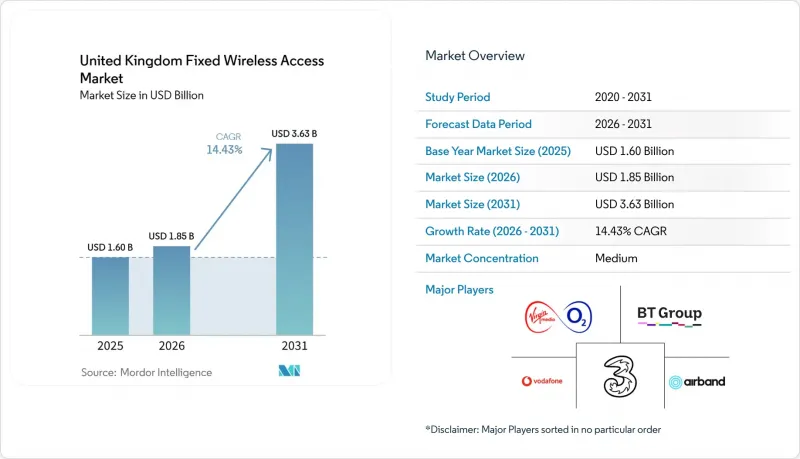
據 Mordor Intelligence 稱,英國固定無線接入市場預計將從 2025 年的 16 億美元成長到 2026 年的 18.5 億美元,到 2031 年達到 36.3 億美元,2026 年至 2031 年的複合年成長率為 14.43%。
本報告按類型(硬體和服務)、應用領域(住宅、商業、工業、政府和公共安全)、頻段(6 GHz 以下、毫米波(24 GHz 以上)、免許可和共用CBRS)以及部署模式(室內 CPE、室外 CPE、自行安裝的窗式 CPE)進行細分。市場預測以美元 (USD) 為單位。
英國固定無線接取市場的趨勢與洞察
5G的部署將擴大Gigabit級固定無線存取的覆蓋範圍。
向 5G 獨立組網 (SA) 基礎設施的轉型正在將網路容量轉化為一項服務,從而在英國固定無線存取市場實現大規模銷售和支援。沃達豐Three 制定了一項 110 億英鎊(148 億美元)的投資計劃,目標是在 2030 年前實現 5G 獨立組網覆蓋 99% 的人口。該公司利用其在超過 10,000 個共用站點的多運營商核心網路基礎設施,在不顯著增加資本密集度的情況下,擴大目標固定無線接入的覆蓋範圍。 Virgin Media O2 於 2025 年 2 月在英國500 個城鎮面向大型企業、公共部門以及中小企業客戶推出了 5G 獨立組網商用服務,從而改善了企業級固定無線接入應用場景的網路基礎。英國通訊管理局 (Ofcom) 在 2026 年春季報告稱,所有主要營運商的 5G 戶外覆蓋率已從 2025 年年中的 47%–65% 擴大到 76%–94%。這使得英國固定無線接入市場的覆蓋建築數量顯著增加。與先前的4G主導週期不同,此階段營運商將產品發布與5G獨立組網功能結合,從而實現了服務差異化、更低延遲和更穩定的效能。支持英國無線基礎設施策略的監管措施也有助於將覆蓋義務轉化為商業性動力,從而增強英國固定無線接取市場的商業可行性。
區域寬頻差距正在推動對最後一公里快速配送的需求。
許多地區普遍認為固網基礎設施連接成本高昂,這種觀念仍體現在公共資金的分配上,使得農村地區的需求佔據關鍵地位,從而在英國固定無線接入市場中保持著顯著優勢。 「英國數位建設」(Building Digital UK)計劃在2029年至2030年間撥款19億英鎊(約24.3億美元)用於資本支出,而「千兆項目」(Project Gigabit )的修訂目標旨在到2032年實現99%的Gigabit覆蓋,這將延長無線接入服務欠缺期的需求。英國數位建設(BDUK)也確認,在2024/25會計年度,所有獲得補貼的連接中有89%位於農村地區,這表明這些地區仍然佔據政府主導的寬頻支出的很大一部分。截至2025年12月,Airband的網路已覆蓋威爾斯和英格蘭西南部超過44萬戶家庭;Quickline在2025年提供了36,650個「Gigabit計畫」連接,預計到2026年初將覆蓋超過4萬戶家庭。這表明,在實際部署計劃下,農村地區的固定無線存取可以擴展到相當可觀的規模。此外,根據英國通訊管理局(Ofcom)的報告,截至2026年1月,英國仍有3.9萬戶家庭缺乏足夠的固網或固定無線網路寬頻存取。這意味著,對於這部分優先群體而言,無線解決方案預計將比昂貴的明挖線路建設更具優勢。在此背景下,即使大型業者不斷擴張業務,本地供應商的重要性依然存在,英國人口稀少地區的固定無線接入市場提供了長期成長的動力。
頻段可用性限制和授權不確定性
在英國固定無線接取市場,頻段接取仍然是最明顯的結構性限制因素之一。這是因為允許使用頻段的監管系統本身就造成了全國性業者和小規模本地業者之間接入機會的不平衡。 2025年10月,英國通訊管理局(Ofcom)完成了毫米波(mmWave)頻段的競標,在68個高密度區域內,分別向EE、O2和Vodafone Three三家業者分配了26 GHz頻段的800 MHz和40 GHz頻段的1 GHz這提高了高容量都市區的網路可用性,但也使這些資源集中在三大營運商手中。同時,截至2025年10月,英國3.8-4.2 GHz頻段共有575張有效的共用存取許可證,這增加了沒有獨佔頻率所有權的營運商在干擾管理方面的複雜性和技術負擔。由倫敦瑪麗女王大學主導、政府支持的動態頻率分配研究項目,正在探索更靈活的頻段分配模式,包括1.8 GHz、3.8–4.2 GHz以及6 GHz以上的頻段;然而,這項工作仍處於研究階段,無法立即緩解當前的問題。英國通訊管理局(Ofcom)於2025年10月決定免除5.8 GHz頻段固定無線存取設備的許可,這有助於降低無線網路服務供應商(WISP)的准入門檻,但這並未解決普遍存在的存取不均問題,僅緩解了部分壓力。因此,頻率策略仍然是英國固定無線接取市場,特別是大型業者和本地專業業者之間持續競爭的關鍵。
細分市場分析
2025年,硬體在英國固定無線接取市場中佔比60.13%,但預計到2031年,服務領域將以15.10%的複合年成長率成長,顯示價值成長方式正在發生顯著轉變。硬體仍然佔據主導地位,這主要得益於室內Wi-Fi 6和Wi-Fi 7路由器以及室外定向設備的出貨量增加,尤其是在住宅和商業環境中,而家庭寬頻的普及正是推動這一成長的主要動力。隨著營運商在多用戶住宅和企業環境中提高服務密度,包括毫微微基地台和微微型基地台在內的接入單元的重要性也在不斷提升,諾基亞和愛立信被認為是該基礎設施的關鍵供應商。同時,服務領域的成長速度甚至更快。這是因為企業買家越來越需要具備服務等級保證、監控和容錯能力的託管連接,而不僅僅是終端設備,這與英國固定無線接入市場運營商的整體商業性目標相契合。
此外,隨著行動電信商將固定無線存取作為寬頻、行動和媒體等服務的整合套餐的一部分進行銷售,服務配置也在發生變化。隨著用戶群的成熟,這將帶來可衡量的業務收益的成長。報告還指出,愛立信和諾基亞的專業服務業務正在為英國營運商提供網路設計、頻寬最佳化和用戶端設備(CPE)管理營運方面的支持,從而將部分價值鏈從一次性設備銷售轉移出去。英國通訊管理局(Ofcom)對固定寬頻效能的要求是營運商重視管理服務層的另一個原因,因為服務供應商不僅需要在硬體交付後,而且需要在安裝後保持品質保證。在整個預測期內,預計這將使服務板塊在英國固定無線接入市場的未來價值創造中佔據更大的佔有率,而硬體仍將是銷售額的核心。
截至2025年,住宅服務佔英國固定無線接入市場佔有率的65.13%,但預計到2031年,政府和公共安全部門的市場佔有率將以15.76%的複合年成長率成長,這反映出當前市場規模與未來成長勢頭之間的差距。公共部門的數位化專案正在推動政府對偏遠地區(固網部署緩慢或難以證明其合理性)、緊急服務、地方政府營運和現場基礎設施等領域的彈性連接需求不斷成長。 2025年2月,Virgin Media O2在500個城鎮為公共和企業客戶推出了5G獨立組網(SA)服務,提高了這些應用場景下的服務品質標準。 BDUK的採購框架也支持這一趨勢,因為它能夠比商業主導的光纖部署更快地響應許多農村和戰略要地的特定連接需求。
儘管工業應用規模仍然相對較小,但隨著製造商和物流供應商利用專用 5G 和共用存取頻段實現自動化、物聯網連接和流程數位化,該領域正在穩步成長。在住宅市場,Three UK、BT/EE 和 Vodafone Three 等品牌的消費者寬頻產品依然強勁,這些供應商繼續保持著英國固定無線接入市場最大的用戶群。 Three UK 的「2026 年夏季促銷」活動以每月 18 英鎊(22.86 美元)起的價格提供 5G 家庭寬頻服務,需簽訂 24 個月的合約,這有助於固定無線接入在服務區域內與價格更低的、性能預期相當的光纖寬頻展開競爭。商業應用的需求介於這兩種極端情況之間,既滿足了分店間連接的高容量使用需求,又需要比一般家庭用戶更高的容錯能力。
其他好處:
- Excel格式的市場預測(ME)表
- 3個月的分析師支持
目錄
第1章:引言
- 研究假設和市場定義
- 調查範圍
第2章:調查方法
第3章執行摘要
第4章 市場狀況
- 市場概覽
- 市場促進因素
- 5G 的部署正在擴大Gigabit級固定無線存取的覆蓋範圍。
- 農村地區寬頻覆蓋不足,導致對最後一公里快速配送的需求不斷成長。
- 在難以到達的地區,固定無線存取是比光纖更經濟有效的替代方案。
- 中小企業和分店網路的企業備份連線需求
- 私人 5G 和邊緣應用場景正在推動企業固定無線存取 (FWA) 部署的擴展。
- 透過讓客戶自行安裝設備,可以減少安裝和現場工作的麻煩。
- 市場限制因素
- 頻寬可用性限制和授權不確定性
- 天氣敏感度會影響高頻段的性能和可靠性。
- 光纖網路的普及和寬頻價格的上漲限制了加值服務的普及。
- 與規劃、回程傳輸和屋頂接入相關的限制正在減緩網路密集化的速度。
- 產業價值鏈分析
- 監理情勢
- 技術展望
- FWA實施的關鍵要素
- 供應商計劃和合作關係
- 商業考量和前提條件
- FWA 與 FTTH/FTTdp 的比較
- 農村、郊區和都市區。
- 宏觀經濟因素對市場的影響
- 波特五力分析
第5章 市場規模與成長預測
- 按類型
- 硬體
- 消費性設備(CPE)
- 接入單元(毫微微基地台和微微型基地台)
- 服務
- 硬體
- 透過使用
- 住宅
- 商業的
- 產業
- 政府/公共安全
- 按頻段
- 6GHz以下頻段
- 毫米波(24 GHz 以上)
- 免執照頻段/共用CBRS
- 部署模式
- 室內CPE
- 戶外CPE
- 自行安裝的窗型CPE
第6章 競爭情勢
- 市場集中度
- 策略趨勢
- 市佔率分析
- 公司簡介
- BT Group plc
- Virgin Media O2 Limited
- Vodafone Group Plc
- Hutchison 3G UK Limited
- Airband Community Internet Limited
- Quickline Communications Limited
- Connexin Limited
- Voneus Limited
- Freshwave Group Limited
- Nokia Corporation
- Ericsson AB
- Mavenir Systems, Inc.
- Qualcomm Technologies, Inc.
- Samsung Electronics Co., Ltd.
- ADTRAN Holdings, Inc.
- Cambium Networks Corporation
- DZS Inc.
- Airspan Networks Holdings Inc.
- Arcadyan Technology Corporation
- Sercomm Corporation
- Ceragon Networks Ltd.
第7章 市場機會與未來展望
According to Mordor Intelligence, the United Kingdom fixed wireless access market size is expected to increase from USD 1.60 billion in 2025 to USD 1.85 billion in 2026 and reach USD 3.63 billion by 2031, growing at a CAGR of 14.43% over 2026-2031.
This report is Segmented by Type (Hardware and Services), Application (Residential, Commercial, Industrial, and Government and Public Safety), Frequency Band (Sub-6 GHz, Mmwave (Above 24 GHz), and Unlicensed/Shared CBRS), and Deployment Mode (Indoor CPE, Outdoor CPE, and Self-Install Window-Mount CPE). The Market Forecasts are Provided in Value (USD).
United Kingdom Fixed Wireless Access Market Trends and Insights
5G Roll-Out Expanding Gigabit-Grade Fixed Wireless Access Coverage
The shift toward 5G Standalone infrastructure is turning network capacity into services that can be sold and supported at scale across the UK fixed wireless access market. VodafoneThree said its GBP 11 billion (USD 14.8 billion) investment plan targets 99% 5G Standalone population coverage by 2030, and the company is using Multi Operator Core Network infrastructure across more than 10,000 shared sites to widen addressable fixed wireless access coverage without a matching rise in capital intensity. Virgin Media O2 activated 5G Standalone for large enterprise, public-sector, and SME customers across 500 UK towns and cities in February 2025, which improved the network baseline for enterprise-grade fixed wireless access use cases. Ofcom reported in Spring 2026 that 5G outdoor coverage from all major operators had moved to a 76%-94% range, up from 47%-65% in mid-2025, which materially increased the addressable premises base for the UK fixed wireless access market. This stage differs from earlier 4G-led cycles because operators are tying product launches to 5G Standalone capability, which supports service differentiation, lower latency, and more stable performance. The regulatory push behind the UK Wireless Infrastructure Strategy is also helping convert coverage obligations into commercial momentum, which strengthens the operating case for the UK fixed wireless access market.
Rural Broadband Gap Sustaining Demand for Rapid Last-Mile Deployment
The rural demand base remains important because public funding continues to recognize that many areas are expensive to connect with fixed-line infrastructure, thereby preserving a clear role for the UK fixed wireless access market. Building Digital UK allocated GBP 1.9 billion (USD 2.43 billion) in capital investment through 2029-2030, and the revised Project Gigabit target of 99% gigabit coverage by 2032 extends the demand window for fixed wireless access operators in underserved areas. BDUK also confirmed that 89% of all premises connected through subsidy in fiscal 2024/25 were in rural areas, indicating that these geographies still account for a large share of intervention-led broadband spending. Airband's network covered more than 440,000 premises across Wales and South West England by December 2025, and Quickline delivered 36,650 Project Gigabit connections during 2025 before passing more than 40,000 premises by early 2026, which shows that rural fixed wireless access can scale to meaningful volumes under live delivery programs. Ofcom also reported that 39,000 UK premises still could not access decent broadband from any fixed-line or fixed-wireless network in January 2026, leaving a priority group that is more likely to be served by wireless solutions than by expensive trenching projects. That backdrop keeps rural providers relevant even as larger operators expand, and it supports a longer runway for the UK fixed wireless access market in low-density areas.
Spectrum Availability Constraints and Licensing Uncertainty
Spectrum access remains one of the clearest structural limits on the UK fixed wireless access market, because the same regulatory system that opens bands for use also creates uneven access between national operators and smaller rural providers. Ofcom completed the mmWave auction in October 2025 and awarded EE, O2, and VodafoneThree each 800 MHz at 26 GHz and 1 GHz at 40 GHz for GBP 13 million (USD 16.64 million) per operator across 68 high-density areas, improving high-capacity urban availability but concentrating those assets among 3 large players. At the same time, the United Kingdom had 575 active shared access licenses in the 3.8-4.2 GHz band by October 2025, which increased interference management complexity and technical overhead for operators without exclusive holdings. A government-backed dynamic spectrum assignment research program led by Queen Mary University of London is exploring more flexible models in bands including 1.8 GHz, 3.8-4.2 GHz, and the upper 6 GHz, but the work remains in the research phase and has not provided immediate relief. Ofcom's October 2025 decision to make 5.8 GHz fixed wireless access equipment license-exempt helped reduce entry barriers for WISPs, but it only eased part of the pressure rather than resolving the broader access imbalance. This leaves spectrum strategy as a lasting competitive divider inside the UK fixed wireless access market, especially between scale operators and rural specialists.
Other drivers and restraints analyzed in the detailed report include:
- Fixed Wireless Access as a Cost-Effective Alternative to Fiber in Hard-to-Reach Locations
- Enterprise Backup Connectivity Demand From SMB And Branch Networks
- Weather Sensitivity Affecting High-Band Performance and Reliability
For complete list of drivers and restraints, kindly check the Table Of Contents.
Segment Analysis
Hardware accounted for 60.13% of the UK fixed wireless access market in 2025, while services are projected to expand at a 15.10% CAGR through 2031, indicating a clear shift in how value is expected to grow over time. Hardware remained dominant because consumer premise equipment volumes rose across residential and commercial deployments, especially indoor Wi-Fi 6 and Wi-Fi 7 routers and outdoor directional units tied to household broadband rollouts. Access units, including femtocells and picocells, are also gaining importance as operators densify service in multi-dwelling buildings and enterprise settings, and the source content identified Nokia and Ericsson as core suppliers in these buildouts. Services, however, are expanding faster because enterprise buyers increasingly want managed connectivity with service-level commitments, monitoring, and fault support rather than a device-only offer, and that aligns with the broader commercial preferences of operators in the UK fixed wireless access market.
The type mix is also changing because mobile operators are selling fixed wireless access as part of converged bundles that combine broadband, mobile, and media, which increases measured services revenue as subscriber bases mature. The source content also noted that Ericsson and Nokia's professional services businesses are supporting UK operators with network design, spectrum optimization, and managed CPE fleet operations, thereby shifting part of the value chain away from one-time equipment sales. Ofcom's performance expectations for fixed broadband add another reason for operators to favor managed service layers, as providers need to sustain quality commitments after installation rather than simply complete a hardware shipment. Over the forecast period, this should keep hardware central to volume while allowing services to capture a larger share of future value creation in the UK fixed wireless access market.
Residential accounted for 65.13% of the UK fixed wireless access market share in 2025, while government and public safety are projected to expand at a 15.76% CAGR through 2031, reflecting the divide between current scale and future momentum. Government demand is rising because public-sector digital programs need resilient connectivity for remote sites, emergency services, local authority operations, and field infrastructure where fixed-line deployment is slower or harder to justify. Virgin Media O2's February 2025 5G Standalone activation for public-sector and business customers across 500 towns and cities widened the quality baseline for those use cases. BDUK procurement frameworks also support this pattern because they can move faster on targeted connectivity needs than commercially led fiber rollouts in many rural or strategic locations.
Industrial applications remain small, but the segment is growing steadily as manufacturers and logistics operators use private 5G and shared-access spectrum for automation, IoT links, and process digitization. Residential scale still reflects the strength of branded consumer broadband products from Three UK, BT/EE, and VodafoneThree, which continue to carry the largest subscriber base in the UK fixed wireless access market. Three UK's Summer Sale 2026 priced 5G Home Broadband from GBP 18 (USD 22.86) per month on 24-month terms, which helped position fixed wireless access against lower-end fiber tariffs in coverage areas where performance expectations are comparable. Commercial applications sit between these two ends of demand, because they combine the volume logic of branch connectivity with a need for resilience that is stronger than in typical household use.
Complete Report Scope:
- By Type
- Hardware
- Consumer Premise Equipment (CPE)
- Access Units (Femto and Picocells)
- Services
- Hardware
- By Application
- Residential
- Commercial
- Industrial
- Government and Public Safety
- By Frequency Band
- Sub-6 GHz
- mmWave (Above 24 GHz)
- Unlicensed / Shared CBRS
- By Deployment Mode
- Indoor CPE
- Outdoor CPE
- Self-Install Window-Mount CPE
List of Companies Covered in this Report:
- BT Group plc
- Virgin Media O2 Limited
- Vodafone Group Plc
- Hutchison 3G UK Limited
- Airband Community Internet Limited
- Quickline Communications Limited
- Connexin Limited
- Voneus Limited
- Freshwave Group Limited
- Nokia Corporation
- Ericsson AB
- Mavenir Systems, Inc.
- Qualcomm Technologies, Inc.
- Samsung Electronics Co., Ltd.
- ADTRAN Holdings, Inc.
- Cambium Networks Corporation
- DZS Inc.
- Airspan Networks Holdings Inc.
- Arcadyan Technology Corporation
- Sercomm Corporation
- Ceragon Networks Ltd.
Additional Benefits:
- The market estimate (ME) sheet in Excel format
- 3 months of analyst support
TABLE OF CONTENTS
1 INTRODUCTION
- 1.1 Study Assumptions and Market Definition
- 1.2 Scope of the Study
2 RESEARCH METHODOLOGY
3 EXECUTIVE SUMMARY
4 MARKET LANDSCAPE
- 4.1 Market Overview
- 4.2 Market Drivers
- 4.2.1 5G Roll-Out Expanding Gigabit-Grade Fixed Wireless Access Coverage
- 4.2.2 Rural Broadband Gap Sustaining Demand for Rapid Last-Mile Deployment
- 4.2.3 Fixed Wireless Access as a Cost-Effective Alternative to Fiber in Hard-to-Reach Locations
- 4.2.4 Enterprise Backup Connectivity Demand from SMB and Branch Networks
- 4.2.5 Private 5G and Edge Use Cases Expanding Enterprise Fixed Wireless Access Adoption
- 4.2.6 Self-Install Customer Premises Equipment Reducing Installation Friction and Truck Rolls
- 4.3 Market Restraints
- 4.3.1 Spectrum Availability Constraints and Licensing Uncertainty
- 4.3.2 Weather Sensitivity Affecting High-Band Performance and Reliability
- 4.3.3 Fiber Substitution and Aggressive Broadband Pricing Limiting Premium Uptake
- 4.3.4 Planning, Backhaul, and Rooftop Access Constraints Slowing Network Densification
- 4.4 Industry Value-Chain Analysis
- 4.5 Regulatory Landscape
- 4.6 Technological Outlook
- 4.6.1 Key Enablers for FWA Adoption
- 4.6.2 Vendor Initiatives and Partnerships
- 4.6.3 Business Considerations and Prerequisites
- 4.6.4 FWA vs FTTH / FTTdp Comparison
- 4.6.5 Rural, Semi-Urban and Urban Use-Case Models
- 4.7 Impact of Macroeconomic Factors on the Market
- 4.8 Porter's Five Forces Analysis
- 4.8.1 Bargaining Power of Suppliers
- 4.8.2 Bargaining Power of Buyers
- 4.8.3 Threat of New Entrants
- 4.8.4 Threat of Substitutes
- 4.8.5 Competitive Rivalry
5 MARKET SIZE AND GROWTH FORECASTS (VALUE)
- 5.1 By Type
- 5.1.1 Hardware
- 5.1.1.1 Consumer Premise Equipment (CPE)
- 5.1.1.2 Access Units (Femto and Picocells)
- 5.1.2 Services
- 5.1.1 Hardware
- 5.2 By Application
- 5.2.1 Residential
- 5.2.2 Commercial
- 5.2.3 Industrial
- 5.2.4 Government and Public Safety
- 5.3 By Frequency Band
- 5.3.1 Sub-6 GHz
- 5.3.2 mmWave (Above 24 GHz)
- 5.3.3 Unlicensed / Shared CBRS
- 5.4 By Deployment Mode
- 5.4.1 Indoor CPE
- 5.4.2 Outdoor CPE
- 5.4.3 Self-Install Window-Mount CPE
6 COMPETITIVE LANDSCAPE
- 6.1 Market Concentration
- 6.2 Strategic Moves
- 6.3 Market Share Analysis
- 6.4 Company Profiles (includes Global Level Overview, Market Level Overview, Core Segments, Financials as Available, Strategic Information, Market Rank/Share for Key Companies, Products and Services, and Recent Developments)
- 6.4.1 BT Group plc
- 6.4.2 Virgin Media O2 Limited
- 6.4.3 Vodafone Group Plc
- 6.4.4 Hutchison 3G UK Limited
- 6.4.5 Airband Community Internet Limited
- 6.4.6 Quickline Communications Limited
- 6.4.7 Connexin Limited
- 6.4.8 Voneus Limited
- 6.4.9 Freshwave Group Limited
- 6.4.10 Nokia Corporation
- 6.4.11 Ericsson AB
- 6.4.12 Mavenir Systems, Inc.
- 6.4.13 Qualcomm Technologies, Inc.
- 6.4.14 Samsung Electronics Co., Ltd.
- 6.4.15 ADTRAN Holdings, Inc.
- 6.4.16 Cambium Networks Corporation
- 6.4.17 DZS Inc.
- 6.4.18 Airspan Networks Holdings Inc.
- 6.4.19 Arcadyan Technology Corporation
- 6.4.20 Sercomm Corporation
- 6.4.21 Ceragon Networks Ltd.
7 MARKET OPPORTUNITIES AND FUTURE OUTLOOK
- 7.1 White-Space and Unmet-Need Assessment

 固定無線接取市場預測至2034年-按服務類型、技術、頻率、設備類型、應用、部署環境、最終用戶和地區分類的全球分析
 2026-2030年全球5G固定無線存取(FWA)市場
 固定無線存取:市場佔有率分析、產業趨勢與統計資料、成長預測(2026-2031 年)中國固定無線接取市場:市場佔有率分析、產業趨勢與統計及成長預測(2026-2031年)印度固定無線存取:市場佔有率分析、產業趨勢與統計及成長預測(2026-2031 年)日本固定無線接取市場:市場佔有率分析、產業趨勢與統計及成長預測(2026-2031 年)
 固定無線存取固定無線存取(FWA):市場數據概覽(2026 年第二季)消費者 FWA(固定無線存取)消費者固定無線接取市場數據概覽:2026 年第二季度