


 |
市場調查報告書
商品編碼
2118051
印度固定無線存取:市場佔有率分析、產業趨勢與統計及成長預測(2026-2031 年)India Fixed Wireless Access - Market Share Analysis, Industry Trends & Statistics, Growth Forecasts (2026 - 2031) |
||||||

※ 本網頁內容可能與最新版本有所差異。詳細情況請與我們聯繫。
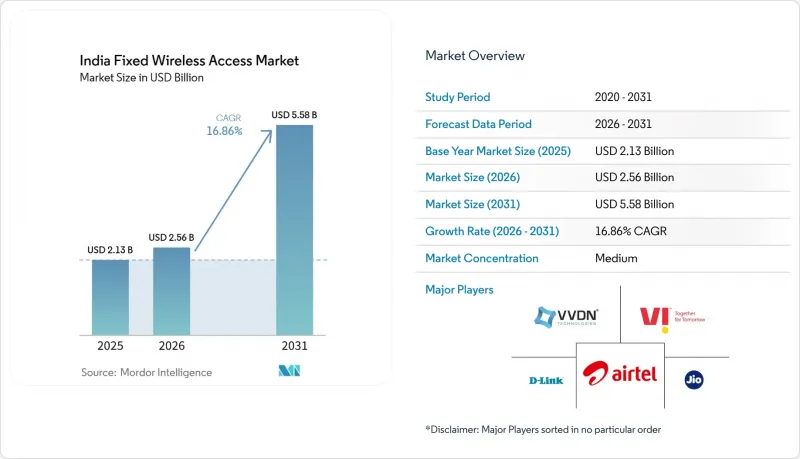
據 Mordor Intelligence 稱,2025 年印度固定無線接入市場價值為 21.3 億美元,預計到 2031 年將從 2026 年的 25.6 億美元成長至 55.8 億美元,預測期(2026-2031 年)複合年成長率為 16.86%。
本報告按類型(硬體和服務)、應用領域(住宅、商業、工業、政府和公共安全)、頻段(6 GHz 以下、毫米波(24 GHz 以上)和免許可/共用CBRS)以及部署模式(室內 CPE、室外 CPE 和自行安裝的窗式 CPE)進行細分。市場預測以美元 (USD) 為單位。
印度固定無線接入市場趨勢與洞察
5G獨立組網的部署將把無線容量擴展到與光纖相同的水平。
印度從非獨立組網(NSA)向獨立組網(SA)的5G架構過渡,對固定無線接取服務的品質和總合產生了最顯著的影響。兩大業者已計劃在2025年前將其固定無線接取平台遷移至5G獨立網路核心網,以提升服務控制能力,並增強應對力。愛立信的一份報告顯示,到2025年9月,Jio和Airtel的固定無線接入連接總數將達到1200萬,表明用戶使用情況已開始響應此次網路升級。印度固定無線接取市場也受惠於5G獨立網路網路帶來的更低延遲和更強大的流量處理能力,尤其是在多用戶住宅和高流量區域。 Airtel於2025年2月與諾基亞和高通簽署的終端合約表明,營運商並未將固定無線存取視為一項附加服務。這是因為營運商已根據其全國部署計畫調整了客戶終端和Wi-Fi效能。卓越的核心架構、廣泛的無線覆蓋範圍以及完善的終端設備相結合,使得印度固定無線接入市場的普及速度比大多數其他固定寬頻市場都要快。
農村寬頻的發展,加上 BharatNet 的普及,正在推動固定無線存取技術的快速發展。
BharatNet 不僅僅是一個光纖項目;它旨在改善家庭光纖商業化仍面臨挑戰的地區最後一公里無線鏈路的經濟效益。 BharatNet 計畫的第三階段預算為 1.39 兆印度盧比(約 180 億美元),將在三年內累計新增的 4 萬個鄉村自治機構(Gham Panchayat)和 60 萬個村莊。一旦光纖覆蓋到鄉村自治機構,營運商就可以使用固定無線存取作為最終連接層,而無需為每個家庭鋪設昂貴的光纖。根據印度電信管理局(TRAI)的數據,到 2026 年 3 月,農村地區的 5G 固定無線接取用戶數將達到 615 萬,與都市區的 617 萬用戶數基本持平,這證實了印度的固定無線接取市場已擴展到主要城市以外的地區。 BharatNet的環形拓撲設計和遠端光纖監控系統也是至關重要的因素,因為固定無線存取的聚合節點不僅依賴無線電波的覆蓋範圍,還依賴可靠的回程傳輸。這使得印度的固定無線接取市場能夠比傳統無線寬頻模式更廣泛地擴展到農村地區。
各頻段的可用性和政策清晰度仍然不一致。
關於26 GHz頻段的政策清晰度仍不足,導致高吞吐量固定無線接取部署的決策被延後。截至2026年6月,Reliance Jio提出的將26 GHz頻段重新用於Wi-Fi寬頻的提案仍在技術審查階段,這表明一些非IMT應用場景的運作框架尚未最終確定。印度電信管理局(TRAI)於2025年5月發布的關於多頻寬微波頻率分配的諮詢文件中也強調了類似的問題,因為無線回程傳輸及相關應用場景的廣泛頻率結構仍在考慮之中。這對印度的固定無線接取市場來說是一個關鍵問題,因為毫米波(mmWave)設備的選用、企業部署計劃以及供應商採購方案都依賴於監管的確定性。這種不確定性給中小供應商和專業企業用戶帶來了更大的負擔,因為他們無法承受採購和部署計畫長期處於不確定狀態。在政策決定最終確定之前,印度的固定無線接取市場預計將繼續擴張,最初主要集中在 6 GHz 以下的頻段,而高頻率的使用將有選擇地發展。
細分市場分析
2025年,印度固定無線接取市場中,硬體佔了61.22%的市場。這反映了營運商為新連線部署用戶端設備(CPE)的速度。整合Wi-Fi 6的室內5G閘道器成為大眾市場部署的標準用戶終端,因為營運商可以將寬頻和硬體打包成單一提案。毫微微基地台和微微型基地台等接入單元在印度固定無線接入市場也日益重要,尤其是在需要增強室內無線覆蓋的企業大樓和多用戶住宅。根據GSA的報告,2025年全球5G固定無線接入CPE的出貨量增加了26%,其中印度佔5G固定無線接入CPE出貨量的50%以上。這顯示印度正在快速向最新一代硬體過渡。這種以硬體為中心的結構非常適合用戶成長仍然依賴終端邊緣安裝和啟動速度的市場。
預計到2031年,服務市場將以16.92%的複合年成長率成長,顯示印度的固定無線接取產業正從一次性設備銷售轉向持續的連接服務和平台收入。 Airtel於2025年2月與諾基亞達成協議,其中包括在印度製造的5G室外固定無線接取閘道器接收器和Wi-Fi 6網路基地台,將大規模部署與國內供應鏈的支援連結起來。 HFCL基於聯發科T750晶片組的5G室內固定無線接取CPE,具備零接觸管理和人工智慧應用功能,顯示本地供應商也不斷提升設備層的可維護性。隨著部署量的增加,預計印度的固定無線存取市場將從託管連接、雲端支援、安全功能和捆綁內容中獲得更多價值,而不僅僅是硬體本身。
預計到2025年,印度固定無線接取市場中,住宅用戶將佔66.76%,證實了家庭寬頻仍是主要應用場景。這一主導地位源於大量住宅,尤其是在半都市區和人口稀少的都市區多用戶住宅,因為這些地區的光纖電纜安裝往往由於許可程序和施工而延誤。因此,儘管商業和公共部門的應用也在不斷成長,但印度固定無線接入市場的成長主要得益於住宅用戶的普及。這種平衡使得電信業者既能獲得大規模的用戶群,又能為其他應用領域的高價值合約留出空間。
預計到2031年,政府和公共安全部門將以17.11%的複合年成長率成長,成為印度固定無線接取市場成長最快的應用領域。印度鐵路公司於2026年1月部署5G和4G SD-WAN作為關鍵通訊技術,顯示公共基礎設施機構願意在關鍵營運環境中採用「無線優先」架構。此外,BSNL在海得拉巴推出的「Quantum 5G FWA」表明,企業、微型、中小型微企業(MSME)和智慧製造群正在擴大採用這項技術,因為在這些領域,網路彈性比入門級價格更為重要。因此,印度商業和工業領域對固定無線存取的需求正在從單純的連接選項轉向與生產力、業務永續營運和位置柔軟性相關的更具戰略意義的企業存取層級。
其他好處:
- Excel格式的市場預測(ME)表
- 3個月的分析師支持
目錄
第1章:引言
- 研究假設和市場定義
- 調查範圍
第2章:調查方法
第3章執行摘要
第4章 市場狀況
- 市場概覽
- 市場促進因素
- 5G獨立組網的部署正在將無線容量擴展到與光纖相當的水平。
- 與 BharatNet 連接的農村寬頻網路的發展正在推動 FWA(Free Wide-Away)的快速普及。
- 在光纖尚未獲利的地區,固定廣域網路 (FWA) 正在成為最佳的最後一公里選擇。
- 隨著企業對 SD-WAN 和雲端的依賴性日益增強,對備用連線的需求也越來越大。
- 自行安裝的 CPE 和減少現場支援頻率可提高設備經濟效益。
- 對於 FWA 而言,捆綁數位服務可以提高客戶留存率並降低客戶解約率。
- 市場限制因素
- 各頻寬的可用頻寬和政策清晰度仍不均衡。
- 光纖價格的下降抑制了高階FWA的ARPU成長。
- 戶外 CPE 和毫米波技術的可靠性問題阻礙了它們在人口稠密的都市區的普及。
- 對於價格敏感型家庭來說,能否負擔得起 CPE 仍然是一個障礙。
- 產業價值鏈分析
- 監理情勢
- 技術展望
- FWA實施的關鍵要素
- 供應商計劃和夥伴關係
- 商業考量和前提條件
- FWA 與 FTTH/FTTdp 的比較
- 農村、郊區和都市區的用例模型
- 宏觀經濟因素對市場的影響
- 波特五力分析
第5章 市場規模與成長預測
- 按類型
- 硬體
- 消費性設備(CPE)
- 接入單元(毫微微基地台和微微型基地台)
- 服務
- 硬體
- 透過使用
- 住宅
- 商業
- 產業
- 政府/公共安全
- 按頻段
- 6GHz以下頻段
- 毫米波(24 GHz 以上)
- 無需許可證/共用CBRS
- 部署模式
- 室內CPE
- 戶外CPE
- 自行安裝的窗型CPE
第6章 競爭情勢
- 市場集中度
- 策略趨勢
- 市佔率分析
- 公司簡介
- Reliance Jio Infocomm Limited
- Bharti Airtel Limited
- Vodafone Idea Limited
- Nokia Corporation
- Telefonaktiebolaget LM Ericsson
- Samsung Electronics Co., Ltd.
- Qualcomm Technologies, Inc.
- VVDN Technologies Pvt. Ltd.
- D-Link(India)Limited
- Arcadyan Technology Corporation
- Sercomm Corporation
- Askey Computer Corp.
- Wistron NeWeb Corporation(WNC)
- Cambium Networks Corporation
- HFCL Limited
- Tejas Networks Limited
- CommScope Holding Company, Inc.
- PLANET Technology Corporation
- ZTE Corporation
第7章 市場機會與未來展望
According to Mordor Intelligence, the India fixed wireless access market size was valued at USD 2.13 billion in 2025 and is estimated to grow from USD 2.56 billion in 2026 to reach USD 5.58 billion by 2031, at a CAGR of 16.86% during the forecast period (2026-2031).
This report is Segmented by Type (Hardware and Services), Application (Residential, Commercial, Industrial, and Government and Public Safety), Frequency Band (Sub-6 GHz, Mmwave (Above 24 GHz), and Unlicensed/Shared CBRS), and Deployment Mode (Indoor CPE, Outdoor CPE, and Self-Install Window-Mount CPE). The Market Forecasts are Provided in Value (USD).
India Fixed Wireless Access Market Trends and Insights
5G Standalone Rollout Expands Fiber-Like Wireless Capacity
India's move from non-standalone to standalone 5G architecture has had the clearest impact on the quality and scale of fixed wireless access services. Both major operators pushed their fixed wireless access platforms toward 5G standalone cores by 2025, improving service control and enabling stronger responses to fiber broadband in dense areas. Ericsson reported that combined Jio and Airtel fixed wireless access connections reached 12 million by September 2025, which showed that subscriber uptake was already responding to this network transition. The Indian fixed wireless access market also benefits from the lower latency and improved traffic handling that 5G standalone enables in apartment clusters and high-traffic neighborhoods. Airtel's February 2025 device contract with Nokia and Qualcomm showed that operators were not treating fixed wireless access as an add-on service, because they were already aligning customer equipment and Wi-Fi performance with national rollout plans. That combination of better core architecture, broader radio coverage, and device readiness has kept the Indian fixed wireless access market on a faster adoption path than most fixed broadband categories.
BharatNet-Linked Rural Broadband Build-Out Supports Fast FWA Take-Up
BharatNet has become more than a fiber program because it improves the economics of the last-mile wireless link in places where household fiber remains difficult to monetize. Phase 3 of the amended BharatNet program carries an outlay of INR 1.39 trillion (USD 18 billion) and targets an additional 40,000 gram panchayats and 600,000 villages over 3 years. Once fiber reaches the gram panchayat level, operators can use fixed wireless access as the final connection layer instead of extending expensive fiber all the way to each home. TRAI data showed that rural 5G fixed wireless access subscriptions stood at 6.15 million in March 2026, almost equal to the urban base of 6.17 million, and confirmed that the Indian fixed wireless access market was already scaling beyond major cities. BharatNet's ring-topology design and remote fiber monitoring structure also matter, because fixed wireless access aggregation nodes depend on dependable backhaul rather than only on radio reach. This has given India's fixed wireless access market a broader rural runway than earlier wireless broadband models could sustain.
Spectrum Availability And Policy Clarity Remain Uneven Across Bands
Policy clarity around the 26 GHz band has remained incomplete, slowing decisions on high-throughput fixed wireless access deployments. Reliance Jio's proposal to repurpose 26 GHz spectrum for Wi-Fi-based broadband was still under technical review in June 2026, which showed that the operating framework for some non-IMT use cases was not yet settled. TRAI's May 2025 consultation paper on microwave spectrum assignment across several bands highlighted the same issue, as the broader spectrum structure for wireless backhaul and related use cases was still being worked through. This matters for the India fixed wireless access market because mmWave equipment decisions, enterprise deployment schedules, and vendor sourcing plans all depend on regulatory certainty. The uncertainty weighs more heavily on smaller device vendors and specialized enterprise users, as they cannot keep procurement and deployment plans open for long. Until policy decisions are finalized, the Indian fixed wireless access market is likely to continue expanding, initially in sub-6 GHz bands, while high-frequency use cases advance more selectively.
Other drivers and restraints analyzed in the detailed report include:
- FWA Becomes the Preferred Last-Mile Option Where Fiber Monetization is Slow
- Enterprise Backup Connectivity Demand Rises With SD-WAN And Cloud Deployment
- Fiber Price Compression Caps Premium FWA ARPU Expansion
For complete list of drivers and restraints, kindly check the Table Of Contents.
Segment Analysis
Hardware accounted for 61.22% of the India fixed wireless access market share in 2025, reflecting the pace at which operators deployed customer premises equipment for new connections. Indoor 5G gateways with integrated Wi-Fi 6 became the standard customer device in mass-market rollouts, because they allowed operators to package broadband and hardware as a single service proposition. The Indian fixed wireless access market also saw access units such as femtocells and picocells gain relevance in enterprise buildings and multi-dwelling settings where indoor radio coverage needed reinforcement. GSA reported that global 5G fixed wireless access CPE shipments grew 26% in 2025, and India accounted for more than 50% of its fixed wireless access CPE shipments that were 5G-enabled, underscoring the country's rapid move toward current-generation hardware. This hardware-heavy structure suited a market where subscriber growth still depended on how quickly devices could be placed and activated at the edge.
Services are projected to grow at a 16.92% CAGR through 2031, indicating that the Indian fixed wireless access industry is moving from one-time equipment value to recurring connectivity and platform revenue. Airtel's February 2025 contract with Nokia covered 5G outdoor fixed wireless access gateway receivers and Wi-Fi 6 access points manufactured in India, which linked scale deployment with domestic supply support. HFCL's 5G indoor fixed wireless access CPE, built on MediaTek's T750 chipset with zero-touch management and an AI-enabled application, showed that local vendors were also improving the serviceability of the device layer. As the installed base grows, the Indian fixed wireless access market is likely to capture more value from managed connectivity, cloud support, security features, and bundled content rather than from hardware alone.
Residential connections accounted for 66.76% of the Indian fixed wireless access market in 2025, confirming that household broadband remained the anchor use case. That dominance stemmed from the large number of homes that still lack full fiber-to-the-home coverage, especially in semi-urban and lower-density districts. Airtel's AirFiber presence in more than 2,000 cities also showed that operators continued to focus on urban multi-dwelling units, where permissions and civil works can delay fiber builds. The India fixed wireless access market, therefore, expanded first through residential adoption, even as business and public use began to grow. That balance gives operators a large subscriber base today while still leaving room for higher-value contracts in other applications.
Government and public safety are projected to expand at a 17.11% CAGR through 2031, which made it the fastest-growing application in the Indian fixed wireless access market. Indian Railways' January 2026 adoption of 5G and 4G SD-WAN for critical communications demonstrated that public infrastructure agencies were willing to adopt wireless-first architectures in critical operating environments. BSNL's Quantum 5G FWA launch in Hyderabad also pointed to broader use in enterprises, MSMEs, and smart manufacturing clusters, where network resilience matters more than entry-level pricing. Commercial and industrial demand in the Indian fixed wireless access industry is therefore moving from optional connectivity toward a more deliberate enterprise access layer tied to productivity, continuity, and site flexibility.
Complete Report Scope:
- By Type
- Hardware
- Consumer Premise Equipment (CPE)
- Access Units (Femto and Picocells)
- Services
- Hardware
- By Application
- Residential
- Commercial
- Industrial
- Government and Public Safety
- By Frequency Band
- Sub-6 GHz
- mmWave (Above 24 GHz)
- Unlicensed/Shared CBRS
- By Deployment Mode
- Indoor CPE
- Outdoor CPE
- Self-Install Window-Mount CPE
List of Companies Covered in this Report:
- Reliance Jio Infocomm Limited
- Bharti Airtel Limited
- Vodafone Idea Limited
- Nokia Corporation
- Telefonaktiebolaget LM Ericsson
- Samsung Electronics Co., Ltd.
- Qualcomm Technologies, Inc.
- VVDN Technologies Pvt. Ltd.
- D-Link (India) Limited
- Arcadyan Technology Corporation
- Sercomm Corporation
- Askey Computer Corp.
- Wistron NeWeb Corporation (WNC)
- Cambium Networks Corporation
- HFCL Limited
- Tejas Networks Limited
- CommScope Holding Company, Inc.
- PLANET Technology Corporation
- ZTE Corporation
Additional Benefits:
- The market estimate (ME) sheet in Excel format
- 3 months of analyst support
TABLE OF CONTENTS
1 INTRODUCTION
- 1.1 Study Assumptions and Market Definition
- 1.2 Scope of the Study
2 RESEARCH METHODOLOGY
3 EXECUTIVE SUMMARY
4 MARKET LANDSCAPE
- 4.1 Market Overview
- 4.2 Market Drivers
- 4.2.1 5G Standalone Rollout Expands Fiber-Like Wireless Capacity
- 4.2.2 BharatNet-Linked Rural Broadband Build-Out Supports Fast FWA Take-Up
- 4.2.3 FWA Becomes the Preferred Last-Mile Option Where Fiber Monetization Is Slow
- 4.2.4 Enterprise Backup Connectivity Demand Rises With SD-WAN and Cloud Dependency
- 4.2.5 Self-Install CPE and Lower Truck-Roll Intensity Improve Unit Economics
- 4.2.6 Bundled Digital Services Improve FWA Stickiness and Reduce Churn
- 4.3 Market Restraints
- 4.3.1 Spectrum Availability and Policy Clarity Remain Uneven Across Bands
- 4.3.2 Fiber Price Compression Caps Premium FWA ARPU Expansion
- 4.3.3 Outdoor CPE and mmWave Reliability Issues Slow Mass Adoption in Dense Urban Areas
- 4.3.4 CPE Affordability Remains a Barrier in Price-Sensitive Households
- 4.4 Industry Value-Chain Analysis
- 4.5 Regulatory Landscape
- 4.6 Technological Outlook
- 4.6.1 Key Enablers for FWA Adoption
- 4.6.2 Vendor Initiatives and Partnerships
- 4.6.3 Business Considerations and Prerequisites
- 4.6.4 FWA vs FTTH / FTTdp Comparison
- 4.6.5 Rural, Semi-Urban and Urban Use-Case Models
- 4.7 Impact of Macroeconomic Factors on the Market
- 4.8 Porter's Five Forces Analysis
- 4.8.1 Bargaining Power of Suppliers
- 4.8.2 Bargaining Power of Buyers
- 4.8.3 Threat of New Entrants
- 4.8.4 Threat of Substitutes
- 4.8.5 Competitive Rivalry
5 MARKET SIZE AND GROWTH FORECASTS (VALUE)
- 5.1 By Type
- 5.1.1 Hardware
- 5.1.1.1 Consumer Premise Equipment (CPE)
- 5.1.1.2 Access Units (Femto and Picocells)
- 5.1.2 Services
- 5.1.1 Hardware
- 5.2 By Application
- 5.2.1 Residential
- 5.2.2 Commercial
- 5.2.3 Industrial
- 5.2.4 Government and Public Safety
- 5.3 By Frequency Band
- 5.3.1 Sub-6 GHz
- 5.3.2 mmWave (Above 24 GHz)
- 5.3.3 Unlicensed/Shared CBRS
- 5.4 By Deployment Mode
- 5.4.1 Indoor CPE
- 5.4.2 Outdoor CPE
- 5.4.3 Self-Install Window-Mount CPE
6 COMPETITIVE LANDSCAPE
- 6.1 Market Concentration
- 6.2 Strategic Moves
- 6.3 Market Share Analysis
- 6.4 Company Profiles (includes Global Level Overview, Market Level Overview, Core Segments, Financials as Available, Strategic Information, Market Rank/Share for Key Companies, Products and Services, and Recent Developments)
- 6.4.1 Reliance Jio Infocomm Limited
- 6.4.2 Bharti Airtel Limited
- 6.4.3 Vodafone Idea Limited
- 6.4.4 Nokia Corporation
- 6.4.5 Telefonaktiebolaget LM Ericsson
- 6.4.6 Samsung Electronics Co., Ltd.
- 6.4.7 Qualcomm Technologies, Inc.
- 6.4.8 VVDN Technologies Pvt. Ltd.
- 6.4.9 D-Link (India) Limited
- 6.4.10 Arcadyan Technology Corporation
- 6.4.11 Sercomm Corporation
- 6.4.12 Askey Computer Corp.
- 6.4.13 Wistron NeWeb Corporation (WNC)
- 6.4.14 Cambium Networks Corporation
- 6.4.15 HFCL Limited
- 6.4.16 Tejas Networks Limited
- 6.4.17 CommScope Holding Company, Inc.
- 6.4.18 PLANET Technology Corporation
- 6.4.19 ZTE Corporation
7 MARKET OPPORTUNITIES AND FUTURE OUTLOOK
- 7.1 White-Space and Unmet-Need Assessment

 固定無線接取市場預測至2034年-按服務類型、技術、頻率、設備類型、應用、部署環境、最終用戶和地區分類的全球分析
 2026-2030年全球5G固定無線存取(FWA)市場
 固定無線存取:市場佔有率分析、產業趨勢與統計資料、成長預測(2026-2031 年)中國固定無線接取市場:市場佔有率分析、產業趨勢與統計及成長預測(2026-2031年)英國固定無線接取:市場佔有率分析、產業趨勢與統計及成長預測(2026-2031 年)日本固定無線接取市場:市場佔有率分析、產業趨勢與統計及成長預測(2026-2031 年)
 固定無線存取固定無線存取(FWA):市場數據概覽(2026 年第二季)消費者 FWA(固定無線存取)消費者固定無線接取市場數據概覽:2026 年第二季度