


 |
市場調查報告書
商品編碼
2118049
中國固定無線接取市場:市場佔有率分析、產業趨勢與統計及成長預測(2026-2031年)China Fixed Wireless Access - Market Share Analysis, Industry Trends & Statistics, Growth Forecasts (2026 - 2031) |
||||||

※ 本網頁內容可能與最新版本有所差異。詳細情況請與我們聯繫。
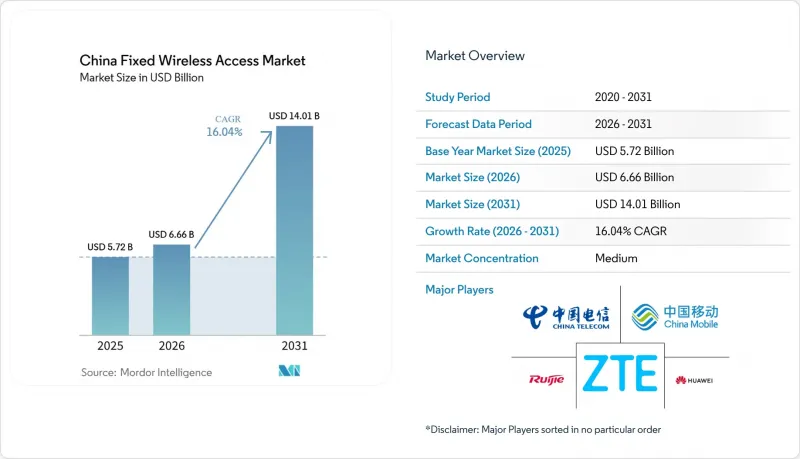
根據 Mordor Intelligence 預測,中國固定無線接取市場規模預計將從 2025 年的 57.2 億美元和 2026 年的 66.6 億美元成長到 2031 年的 140.1 億美元,2026 年至 2031 年的複合年成長率為 16.04%。
本報告按類型(硬體和服務)、應用領域(住宅、商業、工業、政府和公共安全)、頻段(6 GHz 以下、毫米波(24 GHz 及以上)和免許可/共用CBRS)以及部署類型(室內 CPE、室外 CPE 和自行安裝的窗式 CPE)進行細分。市場預測以美元 (USD) 為單位。
中國固定無線接取市場趨勢及洞察
5G 和 5G-Advanced 的部署將擴大Gigabit級固定無線存取 (FWA) 的覆蓋範圍。
2025年中期,中國三大電信業者已將5G-Advanced服務擴展至300多個城市,並在30多個省級行政區推出相關服務方案,覆蓋超過1,000萬用戶。這項發展對中國固定無線存取市場意義重大,因為Gigabit級無線效能將提升先前一直將光纖視為首選的家庭和企業用戶的服務可靠性。達到此性能標準將使營運商能夠從價格、服務水準和可靠性等方面對固定無線存取(FWA)進行定位。此外,隨著新平台進入更廣泛的生產週期,這個轉型過程將滿足用戶對升級到更高規格終端設備日益成長的需求。同時,營運商將有空間把寬頻擴展與區域數位基礎設施項目相結合,從而提高共用網路投資的盈利。因此,高階FWA方案在郊區家庭和企業用戶中的商業性基礎將更加穩固。
從縣級層面來看,寬頻經濟效益更有利於無線最後一公里傳輸,而不是全面部署光纖。
預計2025年底,中國農村寬頻用戶將達到2.04億。中國移動宣布其「每鄉Gigabit」舉措已提前涵蓋所有鄉鎮和村莊。這一覆蓋範圍的擴大改變了中國固定無線接入市場的經濟格局,尤其是在山口、流域和分散居民點等溝渠建設成本高且耗時的地區。如果現有的5G基地台能夠滿足最後一公里寬頻需求,電信業者可以避免大部分建設工作,並加快用戶服務部署。新華社報道稱,改善農村和邊遠地區的通訊品質仍然是「十五」規劃的重點,這也支撐了對戶外CPE和接入設備的持續需求。實際上,這使得固定無線接入(FWA)在通訊塔已建但用戶密度過低、不值得鋪設新光纖的地區仍然具有吸引力。此外,在那些依賴額外連接成本且投資回收期較短的城鎮,資金配置將轉向無線網路的擴張。
FTTR 和光纖價格的降低阻礙了人口稠密的都市區向 FWA 的過渡。
中國都市區寬頻基礎設施已基本飽和,光纖到府(FTTR)用戶預計2025年底將達到5,939萬人。這種成熟的基礎設施限制了中國固定無線接入市場對現有都市區用戶的轉換能力,因為一線城市已經提供FTTR套餐,使得用戶轉換營運商的吸引力降低。在人口密集的多用戶住宅,營運商提供的專業光纖安裝服務和成熟的套餐進一步降低了用戶將家庭寬頻存取方式轉向無線存取的迫切性。光纖成本的上漲在專案層面起到了一定的緩解作用。 2025年中期至2026年初,G.652D單模光纖的價格從每公里20元人民幣(已在輸入中顯示為2.76美元)上漲至50元人民幣以上(已在輸入中顯示為6.90美元)。然而,這主要影響的是新建待開發區,並不會削弱已連接光纖用戶的處境。因此,都市區固定無線接取網路 (FWA) 的需求仍主要集中在臨時安裝、新綜合大樓和企業備援場景,而不是從現有光纖線路進行大規模遷移。
細分市場分析
2025年,硬體市佔率達到60.76%。這反映出隨著營運商擴展基於5G的最後一公里覆蓋,對CPE和存取單元的強勁需求。硬體層仍然是中國固定無線存取市場的主要收入來源,因為設備端的升級對於深化住宅、企業和政府部署中的服務貨幣化至關重要。 CPE出貨量包括室內6GHz以下頻段設備、室外高增益設備和窗式安裝設備,而接入單元則支援營運商網路中更高的密度和最後一公里回程傳輸。中興通訊於2026年3月發表了G6 Ultra和G6 Max,進一步提升了效能標準。這兩款產品被譽為首批支援Wi-Fi 8的5G-Advanced設備,峰值吞吐量分別達到10Gbps和12.5Gbps。這些產品的發布意義重大,因為它們提高了營運商未來採購的預期規格水準。此外,即使在整體硬體市場競爭日益激烈的背景下,這也有助於增強高階市場的定價權。
預計到2031年,服務市場將以16.86%的複合年成長率成長,成為中國固定無線接入產業成長最快的細分市場。這一成長表明市場正從純粹的設備週期模式轉向以效能管理和支援為中心的持續服務模式。電信業者提供的服務計畫擴大整合了遠端韌體控制、服務品質(QoS)調整以及面向企業和公共部門用戶的基於服務等級的上行鏈路保障。中國聯通和中興通訊於2026年6月推出的「UniMAX 1.0+」進一步推進了這一方向,將5G-Advanced確定性連結定位為企業級管理服務。隨著不同廠商硬體的比較變得更加容易,服務分層對於差異化變得越來越重要。這為電信業者提供了更穩定的收入前景,並降低了終端產品逐漸趨於同質化的風險。
預計到2025年,中國固定無線接取市場中,住宅用戶將佔64.22%,顯示住宅需求仍是該領域最大的用戶群。這一主導地位主要由農村和半都市區推動,在這些地區,無線存取仍然扮演著主要而非次要的角色。中國移動在城鎮層級推進5G和Gigabit寬頻覆蓋,為住宅市場進入當前成長階段之前,奠定了必要的無線網路基礎設施。住宅用戶也受益於「即插即用」的終端形式,這降低了安裝難度,方便了那些偏好快速部署的用戶。因此,即使在都市區面臨光纖網路的激烈競爭,中國固定無線接取市場在消費者層面也已轉向以銷售主導的模式。
預計到2031年,政府和公共安全領域的年複合成長率將達到16.98%,成為成長最快的應用領域。緊急應變、邊境監控、交通監控和公共產業監控都需要強大的存取能力,尤其是在行動和時間緊迫的情況下,這種存取方式的部署速度比有線方式更快。 2026年6月,五個部會正式將公共安全和關鍵基礎設施連接納入不斷擴展的工業5G專用網路架構。這項政策支持可望加速戶外CPE、冗餘無線路徑和託管連接方案的採購,確保業務永續營運和運作。商業用戶仍然非常重要,尤其是在零售、飯店以及中小企業園區等需要備用線路(除主光纖線路外)的場所。雖然工業用戶的佔有率仍然較小,但他們在智慧製造和自動化物流環境中的作用正在不斷擴大,確定性無線鏈路的價值也日益凸顯。
其他好處:
- Excel格式的市場預測(ME)表
- 3個月的分析師支持
目錄
第1章:引言
- 研究假設和市場定義
- 調查範圍
第2章:調查方法
第3章執行摘要
第4章 市場狀況
- 市場概覽
- 市場促進因素
- 5G 和 5G-Advanced 的部署正在擴大Gigabit級 FWA 的覆蓋範圍。
- 從縣級層面來看,寬頻經濟效益更有利於無線最後一公里連接,而不是全光纖網路。
- 零售、物流和分店網路對企業備份連線的需求
- 對人工智慧驅動的上行鏈路的需求不斷成長,提高了寬頻對家庭和企業的確定性價值。
- 國產CPE、晶片組和RAN的本地化縮短了引進週期,降低了單位成本。
- 營運商彈性價格設定和捆綁策略正在推動 FWA(自由廣域)技術的普及。
- 市場限制因素
- FTTR 和光纖價格的降低正在減緩人口稠密的都市區向 FWA 的過渡。
- 高密度城市中波頻率的調整與規劃限制
- 大規模部署中戶外安裝高增益CPE的功率、散熱和安裝限制
- 高頻率部署期間的雨致衰減和故障損失
- 產業價值鏈分析
- 監理情勢
- 技術展望
- FWA實施的關鍵促進因素
- 供應商計劃和合作關係
- 商業考量和前提條件
- FWA 與 FTTH/FTTdp 的比較
- 農村、郊區和都市區的用例模型
- 宏觀經濟因素對市場的影響
- 波特五力分析
第5章 市場規模與成長預測
- 按類型
- 硬體
- 消費性設備(CPE)
- 接入單元(毫微微基地台和微微型基地台)
- 服務
- 硬體
- 透過使用
- 住宅
- 商業的
- 產業
- 政府/公共安全
- 按頻段
- 6GHz以下頻段
- 毫米波(24 GHz 以上)
- 無需許可證/共用CBRS
- 部署模式
- 室內CPE
- 戶外CPE
- 自行安裝的窗型CPE
第6章 競爭情勢
- 市場集中度
- 策略趨勢
- 市佔率分析
- 公司簡介
- Huawei Technologies Co., Ltd.
- ZTE Corporation
- China Mobile Limited
- China Telecom Corporation Limited
- China United Network Communications Group Co., Ltd.
- Ruijie Networks Co., Ltd.
- Shenzhen Gongjin Electronics Co., Ltd.
- Qualcomm Technologies, Inc.
- FiberHome Telecommunication Technologies Co., Ltd.
- Datang Mobile Communications Equipment Co., Ltd.
- H3C Technologies Co., Limited
- TD Tech Ltd.
- Arcadyan Technology Corporation
- Sercomm Corporation
- Quectel Wireless Solutions Co., Ltd.
- Fibocom Wireless Inc.
- Meig Smart Technology Co., Ltd.
- Tongyu Communication Inc.
- Shenzhen Skyworth Digital Technology Co., Ltd.
- Askey Computer Corp.
第7章 市場機會與未來展望
According to Mordor Intelligence, the China fixed wireless access market size is projected to expand from USD 5.72 billion in 2025 and USD 6.66 billion in 2026 to USD 14.01 billion by 2031, registering a CAGR of 16.04% from 2026 to 2031.
This report is Segmented by Type (Hardware and Services), Application (Residential, Commercial, Industrial, and Government and Public Safety), Frequency Band (Sub-6 GHz, Mmwave (Above 24 GHz), and Unlicensed/Shared CBRS), and Deployment Mode (Indoor CPE, Outdoor CPE, and Self-Install Window-Mount CPE). The Market Forecasts are Provided in Value (USD).
China Fixed Wireless Access Market Trends and Insights
5G and 5G-Advanced Rollout Expanding Gigabit-Class FWA Coverage
China's 3 major telecom operators had already extended 5G-Advanced services across more than 300 cities by mid-2025, and more than 30 provincial-level regions had introduced related service plans with over 10 million users enrolled. That rollout matters for the China fixed wireless access market because gigabit-class wireless performance makes the service more credible for homes and businesses that previously defaulted to fiber. Once that performance threshold is met, operators can position FWA on service tier and reliability rather than only on price. The migration path also supports stronger refresh demand for higher-specification customer premises equipment, especially as newer platforms move into broader production cycles. It also gives operators room to align broadband expansion with local digital infrastructure projects, which improves the return profile of shared network investments. The result is a stronger commercial case for premium FWA plans in both semi-urban households and enterprise locations.
County-Level Broadband Economics Favor Wireless Last Mile Over Full Fiber Buildout
Rural broadband users in China reached 204 million by the end of 2025, and China Mobile stated that its dual-gigabit-per-township initiative had already reached all township-level administrative units ahead of schedule. That coverage base changed the economics of the China fixed wireless access market in areas where mountain passes, river valleys, and scattered settlements make trenching expensive and slow. When existing 5G base stations can serve last-mile broadband demand, operators avoid most civil works and speed up subscriber activation. Xinhua also reported that the 15th Five-Year Plan agenda continued to emphasize signal upgrades in rural and border regions, which supports ongoing demand for outdoor CPE and access equipment. In practice, this keeps FWA attractive in counties where tower assets are already in place, and user density is too low to justify fresh fiber buildouts. It also shifts capital allocation toward wireless expansion in townships where payback periods depend on low incremental connection costs.
FTTR and Fiber Price Compression Reducing FWA Conversion in Dense Urban Areas
China's urban broadband base remained heavily fiber-saturated, and FTTR users reached 59.39 million by the end of 2025. That installed base limits how far the China fixed wireless access market can convert existing urban subscribers, because bundled FTTR packages already come with low switching appeal in tier-1 cities. In dense apartment clusters, professional fiber installation and mature operator bundles continue to reduce the urgency to shift core household access to wireless. Fiber cost inflation did provide some relief at the project level, with G.652D single-mode fiber rising from CNY 20 (already shown as USD 2.76 in the input) to above CNY 50 (already shown as USD 6.90 in the input) per fiber-kilometer between mid-2025 and early 2026. Even so, that mainly affects new greenfield builds and does not weaken the position of already connected fiber subscribers. As a result, urban FWA remains strongest in temporary setups, new complexes, and enterprise backup scenarios rather than mass migration from established fiber lines.
Other drivers and restraints analyzed in the detailed report include:
- AI-Driven Uplink Demand Increasing the Value of Deterministic Home and Enterprise Broadband
- Enterprise Backup Connectivity Demand From Retail, Logistics, and Branch Networks
- Mid-Band Spectrum Coordination and Planning Constraints in High-Density Cities
For complete list of drivers and restraints, kindly check the Table Of Contents.
Segment Analysis
Hardware accounted for 60.76% of the market in 2025, reflecting strong demand for CPE and access units as operators expanded 5G-based last-mile coverage. The hardware layer remained the main revenue anchor for the China fixed wireless access market, as residential, enterprise, and government deployments all required device-side upgrades before service monetization could deepen. CPE shipments covered indoor sub-6 GHz devices, outdoor high-gain units, and window-mount formats, while access units supported densification and last-mile backhaul across operator networks. ZTE strengthened that performance benchmark in March 2026 when it launched the G6 Ultra and G6 Max, described as the first 5G-Advanced devices with Wi-Fi 8 and peak throughputs of 10 Gbps and 12.5 Gbps. Those launches matter because they raise the expected specification level for the next phase of operator procurement. They also support stronger pricing power at the premium end, even as broader hardware competition intensifies.
Services are projected to grow at a 16.86% CAGR through 2031, making them the faster-moving part of the China fixed wireless access industry. That growth shows that the market is shifting from a pure equipment cycle to a more recurring service model built around managed performance and support. Operator-managed offers increasingly combine remote firmware control, quality-of-service tuning, and service-level-backed uplink commitments for enterprise and public-sector users. China Unicom and ZTE moved further in that direction in June 2026 with the UniMAX 1.0+ launch, which positioned 5G-Advanced deterministic connectivity as a managed enterprise service. As hardware becomes easier to compare across vendors, service layering becomes more important for differentiation. That supports more stable revenue visibility for operators and reduces the risk of simple device commoditization over time.
Residential connections accounted for 64.22% of the China fixed wireless access market in 2025, indicating that household demand remained the largest installed base for the category. This lead came mainly from rural and semi-urban households, where wireless access still played a primary role rather than a backup one. China Mobile's township-level 5G and gigabit broadband coverage milestone established the radio footprint needed for this residential-scale-up before the market entered its current growth phase. The residential segment also benefited from plug-and-play device formats that lowered installation friction and improved adoption among users who preferred quick activation. That made the China fixed wireless access market more volume-driven at the consumer level, even while urban fiber competition remained strong.
Government and public safety are projected to grow at a 16.98% CAGR through 2031, making them the fastest-growing application area. Emergency response, border surveillance, transport monitoring, and utility oversight all require resilient access that can be deployed faster than wired alternatives in mobile or time-sensitive scenarios. In June 2026, 5 ministries formally included public safety and critical infrastructure connectivity within the industrial 5G private network expansion framework. That policy support should strengthen procurement for outdoor CPE, redundant radio paths, and managed connectivity packages built for continuity and uptime. Commercial users also remain important, especially for retail, hospitality, and small-business campuses that want backup links alongside primary fiber. Industrial users still account for a smaller share, yet their role is rising in smart manufacturing and automated logistics environments, where deterministic wireless links are increasingly valuable.
Complete Report Scope:
- By Type
- Hardware
- Consumer Premise Equipment (CPE)
- Access Units (Femto and Picocells)
- Services
- Hardware
- By Application
- Residential
- Commercial
- Industrial
- Government and Public Safety
- By Frequency Band
- Sub-6 GHz
- mmWave (Above 24 GHz)
- Unlicensed/Shared CBRS
- By Deployment Mode
- Indoor CPE
- Outdoor CPE
- Self-Install Window-Mount CPE
List of Companies Covered in this Report:
- Huawei Technologies Co., Ltd.
- ZTE Corporation
- China Mobile Limited
- China Telecom Corporation Limited
- China United Network Communications Group Co., Ltd.
- Ruijie Networks Co., Ltd.
- Shenzhen Gongjin Electronics Co., Ltd.
- Qualcomm Technologies, Inc.
- FiberHome Telecommunication Technologies Co., Ltd.
- Datang Mobile Communications Equipment Co., Ltd.
- H3C Technologies Co., Limited
- TD Tech Ltd.
- Arcadyan Technology Corporation
- Sercomm Corporation
- Quectel Wireless Solutions Co., Ltd.
- Fibocom Wireless Inc.
- Meig Smart Technology Co., Ltd.
- Tongyu Communication Inc.
- Shenzhen Skyworth Digital Technology Co., Ltd.
- Askey Computer Corp.
Additional Benefits:
- The market estimate (ME) sheet in Excel format
- 3 months of analyst support
TABLE OF CONTENTS
1 INTRODUCTION
- 1.1 Study Assumptions and Market Definition
- 1.2 Scope of the Study
2 RESEARCH METHODOLOGY
3 EXECUTIVE SUMMARY
4 MARKET LANDSCAPE
- 4.1 Market Overview
- 4.2 Market Drivers
- 4.2.1 5G and 5G-Advanced Rollout Expanding Gigabit-Class FWA Coverage
- 4.2.2 County-Level Broadband Economics Favor Wireless Last Mile Over Full Fiber Buildout
- 4.2.3 Enterprise Backup Connectivity Demand from Retail, Logistics, and Branch Networks
- 4.2.4 AI-Driven Uplink Demand Increasing the Value of Deterministic Home and Enterprise Broadband
- 4.2.5 Domestic CPE, Chipset, and RAN Localization Shortening Deployment Cycles and Lowering Unit Cost
- 4.2.6 Flexible Pricing and Bundling by Operators Improving FWA Adoption
- 4.3 Market Restraints
- 4.3.1 FTTR and Fiber Price Compression Reducing FWA Conversion in Dense Urban Areas
- 4.3.2 Mid-Band Spectrum Coordination and Planning Constraints in High-Density Cities
- 4.3.3 Power, Thermal, and Installation Constraints for Outdoor and High-Gain CPE in Large-Scale Rollouts
- 4.3.4 Rain Fade and Obstruction Losses in Higher Frequency Deployments
- 4.4 Industry Value-Chain Analysis
- 4.5 Regulatory Landscape
- 4.6 Technological Outlook
- 4.6.1 Key Enablers for FWA Adoption
- 4.6.2 Vendor Initiatives and Partnerships
- 4.6.3 Business Considerations and Prerequisites
- 4.6.4 FWA vs FTTH / FTTdp Comparison
- 4.6.5 Rural, Semi-Urban and Urban Use-Case Models
- 4.7 Impact of Macroeconomic Factors on the Market
- 4.8 Porter's Five Forces Analysis
- 4.8.1 Bargaining Power of Suppliers
- 4.8.2 Bargaining Power of Buyers
- 4.8.3 Threat of New Entrants
- 4.8.4 Threat of Substitutes
- 4.8.5 Competitive Rivalry
5 MARKET SIZE AND GROWTH FORECASTS (VALUE)
- 5.1 By Type
- 5.1.1 Hardware
- 5.1.1.1 Consumer Premise Equipment (CPE)
- 5.1.1.2 Access Units (Femto and Picocells)
- 5.1.2 Services
- 5.1.1 Hardware
- 5.2 By Application
- 5.2.1 Residential
- 5.2.2 Commercial
- 5.2.3 Industrial
- 5.2.4 Government and Public Safety
- 5.3 By Frequency Band
- 5.3.1 Sub-6 GHz
- 5.3.2 mmWave (Above 24 GHz)
- 5.3.3 Unlicensed/Shared CBRS
- 5.4 By Deployment Mode
- 5.4.1 Indoor CPE
- 5.4.2 Outdoor CPE
- 5.4.3 Self-Install Window-Mount CPE
6 COMPETITIVE LANDSCAPE
- 6.1 Market Concentration
- 6.2 Strategic Moves
- 6.3 Market Share Analysis
- 6.4 Company Profiles (includes Global Level Overview, Market Level Overview, Core Segments, Financials as Available, Strategic Information, Market Rank/Share for Key Companies, Products and Services, and Recent Developments)
- 6.4.1 Huawei Technologies Co., Ltd.
- 6.4.2 ZTE Corporation
- 6.4.3 China Mobile Limited
- 6.4.4 China Telecom Corporation Limited
- 6.4.5 China United Network Communications Group Co., Ltd.
- 6.4.6 Ruijie Networks Co., Ltd.
- 6.4.7 Shenzhen Gongjin Electronics Co., Ltd.
- 6.4.8 Qualcomm Technologies, Inc.
- 6.4.9 FiberHome Telecommunication Technologies Co., Ltd.
- 6.4.10 Datang Mobile Communications Equipment Co., Ltd.
- 6.4.11 H3C Technologies Co., Limited
- 6.4.12 TD Tech Ltd.
- 6.4.13 Arcadyan Technology Corporation
- 6.4.14 Sercomm Corporation
- 6.4.15 Quectel Wireless Solutions Co., Ltd.
- 6.4.16 Fibocom Wireless Inc.
- 6.4.17 Meig Smart Technology Co., Ltd.
- 6.4.18 Tongyu Communication Inc.
- 6.4.19 Shenzhen Skyworth Digital Technology Co., Ltd.
- 6.4.20 Askey Computer Corp.
7 MARKET OPPORTUNITIES AND FUTURE OUTLOOK
- 7.1 White-Space and Unmet-Need Assessment

 固定無線接取市場預測至2034年-按服務類型、技術、頻率、設備類型、應用、部署環境、最終用戶和地區分類的全球分析
 2026-2030年全球5G固定無線存取(FWA)市場
 固定無線存取:市場佔有率分析、產業趨勢與統計資料、成長預測(2026-2031 年)印度固定無線存取:市場佔有率分析、產業趨勢與統計及成長預測(2026-2031 年)英國固定無線接取:市場佔有率分析、產業趨勢與統計及成長預測(2026-2031 年)日本固定無線接取市場:市場佔有率分析、產業趨勢與統計及成長預測(2026-2031 年)
 固定無線存取固定無線存取(FWA):市場數據概覽(2026 年第二季)消費者 FWA(固定無線存取)消費者固定無線接取市場數據概覽:2026 年第二季度