

 |
市場調查報告書
商品編碼
2099908
日本塑膠廢棄物管理服務:市場佔有率分析、產業趨勢與統計及成長預測(2026-2031)Japan Plastic Waste Management Services - Market Share Analysis, Industry Trends & Statistics, Growth Forecasts (2026 - 2031) |
||||||

※ 本網頁內容可能與最新版本有所差異。詳細情況請與我們聯繫。
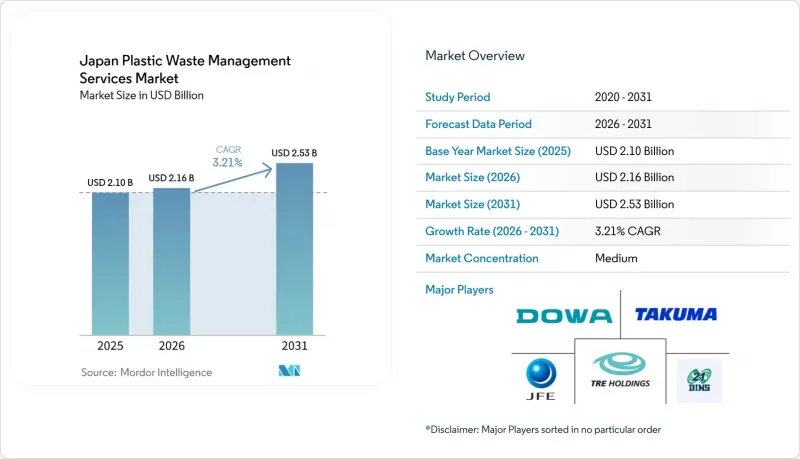
據 Mordor Intelligence 稱,2025 年日本塑膠廢棄物管理服務市值為 21 億美元,預計到 2031 年將從 2026 年的 21.6 億美元成長至 25.3 億美元,預測期(2026-2031 年)複合年成長率為 3.21%。
本報告按來源(住宅、商業、工業及其他)、服務提供者(公共/市政、私人廢棄物管理公司及其他)和服務類型(收集、運輸、分類/分離、處置/處理及其他)進行細分。報告提供了上述所有細分市場的規模和預測(以美元計)。
日本塑膠廢棄物管理服務市場趨勢及洞察。
對工業廢棄物的處理規定
在日本,有關工業廢棄物的法規不再只是基本的合規要求,而是影響著整個日本塑膠廢棄物管理服務市場的需求形成。自2026年起,更嚴格的法規將要求相關製造商制定再生材料使用計畫並報告實施進展。這提升了能夠管理可追溯流程並保持準確文件記錄的企業的價值。與之相關的是,與塑膠回收績效掛鉤的認證體系的出現。與合規製造商合作的企業能夠比僅提供運輸和加工能力的競爭對手建立更強大、更長期的市場地位。此外,根據《塑膠資源回收法》,經濟產業省於2026年首次實施的設計認證,為符合已核准循環標準的產品和回收系統提供了更清晰的路徑。這使得擁有卓越分揀能力、完善的審計追蹤和成熟的下游合作夥伴關係的服務供應商更具優勢。因此,在日本塑膠廢棄物管理服務市場,獲得許可的專業企業比主要依靠運輸成本競爭的小規模企業更受青睞。
工業廢棄物管理外包業務正在不斷擴大。
在清單制度下,廢棄物產生者的合規負擔日益加重,使得工業廢棄物管理外包成為日本塑膠廢棄物管理服務市場結構性需求的促進因素。許多製造商現在更傾向於選擇能夠提供一站式服務,涵蓋收集、處理、追溯和最終報告等環節的合作夥伴,而不是自行管理這些業務。這種轉變不僅促進了現有合約的簽訂,也降低了客戶轉換,因為服務提供者已融入客戶的合規工作流程。這一趨勢與近期廢棄物服務業的重組不謀而合。大型企業正在建立區域網路,以便為全國各地的客戶提供一致的服務標準。這使得工廠間外包合約的規模化更容易實現,尤其對於在多個縣設有工廠的汽車、電子和化學製造商而言更是如此。因此,日本塑膠廢棄物管理服務市場不僅受益於處理量向承包商的轉移,也受益於合約的深化,因為外包服務已從簡單的運輸擴展到合規管理服務。
勞動力老化和人手不足
日本的勞動力結構對日本塑膠廢棄物管理服務市場構成結構性限制。這是因為廢棄物需要穩定的勞動力、熟練的車輛駕駛員和可靠的本地服務網路。根據經合組織的報告,日本的勞動年齡人口預計將從1995年的尖峰時段8730萬下降到2024年的7,370萬,這意味著日本將面臨嚴重的長期勞動力短缺。此外,國際貨幣基金組織的一項調查預測,到2024年,30%的企業將面臨人手不足,顯示勞動力競爭遠不止於環衛和環境服務業。對於廢棄物管理業者而言,這會導致人事費用上升,並削弱收集路線的可靠性,尤其是在人才儲備有限的農村市場。另一方面,這種情況也為那些能夠在簽證配額擴大之前投資於多語言招聘系統和系統性人力資源規劃的私人企業帶來了優勢。從長遠來看,能夠持續解決人員招聘瓶頸和處理能力不足問題的企業預計將在日本塑膠廢棄物管理服務市場中佔據優勢。
細分市場分析
到2025年,工業廢棄物將佔日本塑膠廢棄物管理服務市場佔有率的41%,成為以金額為準最高的細分市場。這一主導地位反映了汽車、電子和化學製造業在主要工業區的集中,這些地區廢棄物產生量大、法規嚴格、管理更為複雜。在日本塑膠廢棄物管理服務業,清單制度要求從產生到最終處置全程可追溯,因此工業合約往往合約期限長,且文件工作量大。這使得授權公司能夠持續獲得收入,並提高了分類、處理和資源回收設施的資產利用效率。住宅廢棄物仍然是重要的垃圾來源,但其服務的經濟效益與市政系統和公共收集方案的關聯更為密切。
預計到2031年,商業廢棄物將以3.9%的複合年成長率成長,成為日本塑膠廢棄物管理服務市場中成長最快的領域。這一成長主要受以下因素驅動:生產者責任範圍的擴大、環境、社會和治理(ESG)報告壓力的增加,以及混合塑膠垃圾出口管道柔軟性的降低。這一點意義重大,因為商業垃圾產生者需要比家庭更精細化的服務,但規模又不如大規模工業客戶,這為擁有靈活合約模式的中型企業創造了發展空間。 「其他」類別(包括機構和農業排放)也在成長,因為針對特定產品的塑膠收集實踐正日益標準化。因此,在日本整體塑膠廢棄物管理服務市場中,排放源的組成正逐漸從單純的收集量轉向更加重視合規性和合約客製化的細分領域。
其他好處:
- Excel格式的市場預測(ME)表
- 3個月的分析師支持
目錄
第1章:引言
- 研究假設和市場定義
- 調查範圍
第2章:調查方法
第3章執行摘要
第4章 市場狀況
- 市場概覽
- 市場促進因素
- 對工業廢棄物的分類和處置有嚴格的規定
- 工業廢棄物管理外包增加
- 擴大垃圾焚化發電(WtE)基礎設施
- 地方政府建立的完善的分類和收集基礎設施
- 掩埋空間短缺,推動了回收和廢棄物發電 (WtE) 解決方案的普及。
- 實施智慧垃圾收集和數位追蹤系統
- 市場限制因素
- 廢棄物收集和運輸相關的營運成本很高。
- 勞動力老化和人手不足
- 先進廢棄物處理設施需要大量資金
- 能源和燃料價格波動
- 價值供應鏈分析
- 監理情勢
- 技術展望
- 波特五力模型
- 創業生態系分析
- 全球貿易趨勢和進口限制(廢棄塑膠)
- 地緣政治事件對市場的影響
第5章 市場規模與成長預測
- 來源
- 住宅
- 商業設施(零售、辦公室等)
- 產業
- 其他(組織、農業等)
- 透過服務供應商
- 公共/市政
- 私人廢棄物管理公司
- 其他組織包括生產者責任組織(PRO)等。
- 按服務類型
- 收集、運輸、分類和分離
- 處置/處理
- 掩埋處置
- 回收和資源回收
- 焚燒和垃圾焚化發電
- 其他(化學處理、堆肥等)
- 其他服務(諮詢、審計、訓練等)
第6章 競爭情勢
- 市場集中度
- 策略趨勢
- 市佔率分析
- 公司簡介
- DOWA Holdings
- JFE Environment Corporation
- TRE Holdings Corporation
- Takuma Co., Ltd.
- Daiei Kankyo
- Mitsui E&S Environment Engineering Co., Ltd.
- Matsuda Sangyo Co., Ltd.
- Mitsubishi Materials Techno Corporation
- Nippon Steel Eco-Tech Corporation
- Nomura Kohsan Co., Ltd.
- Veolia Environnement SA
- Kobelco Eco-Solutions Co., Ltd.
- Kureha Ecology Management Co., Ltd.
- Ebara Environmental Plant Co., Ltd.
- Asahi Eco Create Co., Ltd.
- Sansho Co., Ltd.
- Kanadevia Corporation
- Midac Holdings Co., Ltd.
- Suzuto Holdings Co., Ltd.
- Clean Authority Group
第7章 市場機會與未來展望
According to Mordor Intelligence, the Japan plastic waste management services market size was valued at USD 2.10 billion in 2025 and is estimated to grow from USD 2.16 billion in 2026 to reach USD 2.53 billion by 2031, at a CAGR of 3.21% during the forecast period (2026-2031).
This report is Segmented by Source (Residential, Commercial, Industrial, and Others), by Service Provider (Public/Municipal, Private Waste Management Companies, and Others), and by Service Type (Collection, Transportation, Sorting & Segregation, Disposal / Treatment, and Others). The Report Offers Market Size and Forecasts in Value (USD) for all the Above Segments.
Japan Plastic Waste Management Services Market Trends and Insights
Stringent Industrial Waste Segregation and Disposal Regulations
Japan's industrial waste rules are no longer limited to basic compliance, and they now shape how service demand is formed across the Japan plastic waste management services market. The 2026 regulatory tightening requires affected manufacturers to prepare recycled-material-use plans and report on implementation progress, which raises the value of operators that can manage traceable flows and documentation with fewer errors. A related shift is the certification pathway tied to plastic collection performance, because operators aligned with compliant manufacturers can gain stronger, long-term positions than peers who offer only basic transport or treatment capacity. METI's first design certifications under the Plastic Resource Circulation Act in 2026 also created a clearer route for products and recovery systems that fit approved circularity standards. This favors service providers with better sorting capability, stronger audit trails, and established downstream links. The result is a Japan plastic waste management services market that increasingly rewards licensed specialists over small operators that compete mainly on route economics.
Rising Outsourcing of Industrial Waste Management
Industrial outsourcing has become a structural demand driver in the Japan plastic waste management services market because waste generators face a heavier compliance burden under the manifest system. Many manufacturers now prefer service partners that can handle collection, treatment, traceability, and final reporting in a single arrangement rather than managing these tasks internally. This shift supports recurring contracts and also reduces switching once a provider becomes embedded in the client's compliance workflow. The trend also aligns with the recent consolidation in waste services, where larger operators have been building regional networks to serve national accounts with consistent standards. That makes outsourced contracts easier to scale across plants, especially for automotive, electronics, and chemical producers with facilities in multiple prefectures. The Japan plastic waste management services market therefore gains not only from volume transfer to contractors, but also from higher contract depth as outsourced work moves beyond hauling into managed compliance services.
Aging Workforce and Labor Shortages
Japan's labor profile is a structural restraint for the Japan plastic waste management services market because waste handling depends on steady field staffing, skilled vehicle operation, and reliable local service coverage. The OECD reported that Japan's working-age population fell from 87.3 million at its 1995 peak to 73.7 million in 2024, which shows the scale of long-term labor tightening. The IMF also found that 30% of firms reported labor shortages in 2024, which indicates that competition for workers extends well beyond sanitation and environmental services. For waste operators, this raises labor costs and complicates route reliability, especially in regional markets where recruitment pools are thinner. It also gives private groups an advantage by enabling them to invest in multilingual hiring systems and structured workforce planning before visa expansion. Over time, the Japan plastic waste management services market is likely to reward companies that can consistently address staffing bottlenecks and treatment capacity gaps.
Other drivers and restraints analyzed in the detailed report include:
- Expansion of Waste-to-Energy (WtE) Infrastructure
- Smart Waste Collection and Digital Tracking Adoption
- High Operating Costs for Waste Collection and Transportation
For complete list of drivers and restraints, kindly check the Table Of Contents.
Segment Analysis
Industrial generators held 41% of the Japan plastic waste management services market share in 2025, making them the largest source segment by value. This leadership reflects the concentration of automotive, electronics, and chemical manufacturing across major industrial belts, where waste streams are larger, more regulated, and more complex to manage. In the Japan plastic waste management services industry, industrial contracts also tend to be longer and more documentation-heavy because the manifest system requires clear traceability from generation to final treatment. That produces recurring revenue for licensed operators and supports better asset utilization across sorting, treatment, and recovery facilities. Residential waste remains an important volume base, but its service economics are more closely tied to municipal systems and public collection frameworks.
Commercial waste is projected to expand at a 3.9% CAGR through 2031, making this segment the fastest-growing source in the Japan plastic waste management services market. The rise comes from broader producer responsibility obligations, stronger ESG reporting pressure, and reduced flexibility for mixed-plastic disposal through export channels. This matters because commercial generators often need more tailored services than households but lack the scale of large industrial clients, creating room for mid-tier operators with flexible contract models. The others category, which includes institutional and agricultural streams, is also rising as product-specific plastic collection practices become more formalized. Across the Japan plastic waste management services market, source mix is therefore gradually shifting toward segments where compliance depth and contract customization matter more than pure collection scale.
Complete Report Scope:
- By Source
- Residential
- Commercial (retail, office, etc.)
- Industrial
- Others (institutional, agricultural, etc)
- By Service Provider
- Public/Municipal
- Private Waste Management Companies
- Others - Producer Responsibility Organizations (PROs), etc.
- By Service Type
- Collection, Transportation, Sorting & Segregation
- Disposal / Treatment
- Landfill
- Recycling & Resource Recovery
- Incineration & Waste-to-Energy
- Others (Chemical Treatment, Composting, etc.)
- Others (Consulting, Audit & Training, etc.)
List of Companies Covered in this Report:
- DOWA Holdings
- JFE Environment Corporation
- TRE Holdings Corporation
- Takuma Co., Ltd.
- Daiei Kankyo
- Mitsui E&S Environment Engineering Co., Ltd.
- Matsuda Sangyo Co., Ltd.
- Mitsubishi Materials Techno Corporation
- Nippon Steel Eco-Tech Corporation
- Nomura Kohsan Co., Ltd.
- Veolia Environnement S.A.
- Kobelco Eco-Solutions Co., Ltd.
- Kureha Ecology Management Co., Ltd.
- Ebara Environmental Plant Co., Ltd.
- Asahi Eco Create Co., Ltd.
- Sansho Co., Ltd.
- Kanadevia Corporation
- Midac Holdings Co., Ltd.
- Suzuto Holdings Co., Ltd.
- Clean Authority Group
Additional Benefits:
- The market estimate (ME) sheet in Excel format
- 3 months of analyst support
TABLE OF CONTENTS
1 Introduction
- 1.1 Study Assumptions & Market Definition
- 1.2 Scope of the Study
2 Research Methodology
3 Executive Summary
4 Market Landscape
- 4.1 Market Overview
- 4.2 Market Drivers
- 4.2.1 Stringent Industrial Waste Segregation and Disposal Regulations
- 4.2.2 Rising Outsourcing of Industrial Waste Management
- 4.2.3 Expansion of Waste-to-Energy (WtE) Infrastructure
- 4.2.4 Strong Municipal Segregation and Collection Infrastructure
- 4.2.5 Landfill Scarcity Supporting Recycling and WtE Adoption
- 4.2.6 Smart Waste Collection and Digital Tracking Adoption
- 4.3 Market Restraints
- 4.3.1 High Operating Costs for Waste Collection and Transportation
- 4.3.2 Aging Workforce and Labor Shortages
- 4.3.3 High Capital Requirements for Advanced Waste Treatment Facilities
- 4.3.4 Volatile Energy and Fuel Prices
- 4.4 Value / Supply-Chain Analysis
- 4.5 Regulatory Landscape
- 4.6 Technological Outlook
- 4.7 Porter's Five Forces
- 4.7.1 Threat of New Entrants
- 4.7.2 Bargaining Power of Suppliers
- 4.7.3 Bargaining Power of Buyers
- 4.7.4 Threat of Substitutes
- 4.7.5 Industry Rivalry
- 4.8 Startup Ecosystem Analysis
- 4.9 Global Trade Flows & Import Restrictions (waste plastics)
- 4.10 Impact of Geo-political Events on the Market
5 Market Size and Growth Forecasts (Value)
- 5.1 By Source
- 5.1.1 Residential
- 5.1.2 Commercial (retail, office, etc.)
- 5.1.3 Industrial
- 5.1.4 Others (institutional, agricultural, etc)
- 5.2 By Service Provider
- 5.2.1 Public/Municipal
- 5.2.2 Private Waste Management Companies
- 5.2.3 Others - Producer Responsibility Organizations (PROs), etc.
- 5.3 By Service Type
- 5.3.1 Collection, Transportation, Sorting & Segregation
- 5.3.2 Disposal / Treatment
- 5.3.2.1 Landfill
- 5.3.2.2 Recycling & Resource Recovery
- 5.3.2.3 Incineration & Waste-to-Energy
- 5.3.2.4 Others (Chemical Treatment, Composting, etc.)
- 5.3.3 Others (Consulting, Audit & Training, etc.)
6 Competitive Landscape
- 6.1 Market Concentration
- 6.2 Strategic Moves
- 6.3 Market Share Analysis
- 6.4 Company Profiles (includes Global level Overview, Market level overview, Core Segments, Financials as available, Strategic Information, Market Rank/Share for key companies, Products & Services, and Recent Developments)
- 6.4.1 DOWA Holdings
- 6.4.2 JFE Environment Corporation
- 6.4.3 TRE Holdings Corporation
- 6.4.4 Takuma Co., Ltd.
- 6.4.5 Daiei Kankyo
- 6.4.6 Mitsui E&S Environment Engineering Co., Ltd.
- 6.4.7 Matsuda Sangyo Co., Ltd.
- 6.4.8 Mitsubishi Materials Techno Corporation
- 6.4.9 Nippon Steel Eco-Tech Corporation
- 6.4.10 Nomura Kohsan Co., Ltd.
- 6.4.11 Veolia Environnement S.A.
- 6.4.12 Kobelco Eco-Solutions Co., Ltd.
- 6.4.13 Kureha Ecology Management Co., Ltd.
- 6.4.14 Ebara Environmental Plant Co., Ltd.
- 6.4.15 Asahi Eco Create Co., Ltd.
- 6.4.16 Sansho Co., Ltd.
- 6.4.17 Kanadevia Corporation
- 6.4.18 Midac Holdings Co., Ltd.
- 6.4.19 Suzuto Holdings Co., Ltd.
- 6.4.20 Clean Authority Group
7 Market Opportunities & Future Outlook
- 7.1 White-space & unmet-need assessment

 新加坡塑膠廢棄物管理服務:市場佔有率分析、行業趨勢和統計數據以及成長預測(2026-2031 年)美國塑膠廢棄物管理服務:市場佔有率分析、行業趨勢和統計數據以及成長預測(2026-2031 年)英國塑膠廢棄物管理服務:市場佔有率分析、行業趨勢和統計數據、成長預測(2026-2031 年)德國塑膠廢棄物管理服務:市場佔有率分析、產業趨勢與統計及成長預測(2026-2031)
 塑膠廢棄物管理服務市場:按服務類型、塑膠類型、來源和最終用途產業分類-2026-2032年全球市場預測塑膠廢棄物管理與回收:市場佔有率分析、產業趨勢與統計、成長預測(2026-2031)
 全球塑膠廢棄物管理市場規模、佔有率、趨勢和成長分析報告(2026-2034年)
 塑膠廢棄物管理市場:依塑膠類型、應用、回收方法、技術、國家及地區分類-全球產業分析、市場規模、市場佔有率及2026年至2033年預測
 寵物水族箱及池塘維護系統市場預測至2034年-全球水族箱設備及系統、池塘設備及系統、水族箱及池塘耗材、水族箱及池塘配件、服務及解決方案以及區域分析自動化寵物護理系統市場預測至2034年—按系統類型、寵物類型、連接方式、技術、最終用戶、分銷管道和地區分類的全球分析