


 |
市場調查報告書
商品編碼
2118194
新加坡塑膠廢棄物管理服務:市場佔有率分析、行業趨勢和統計數據以及成長預測(2026-2031 年)Singapore Plastic Waste Management Services - Market Share Analysis, Industry Trends & Statistics, Growth Forecasts (2026 - 2031) |
||||||

※ 本網頁內容可能與最新版本有所差異。詳細情況請與我們聯繫。
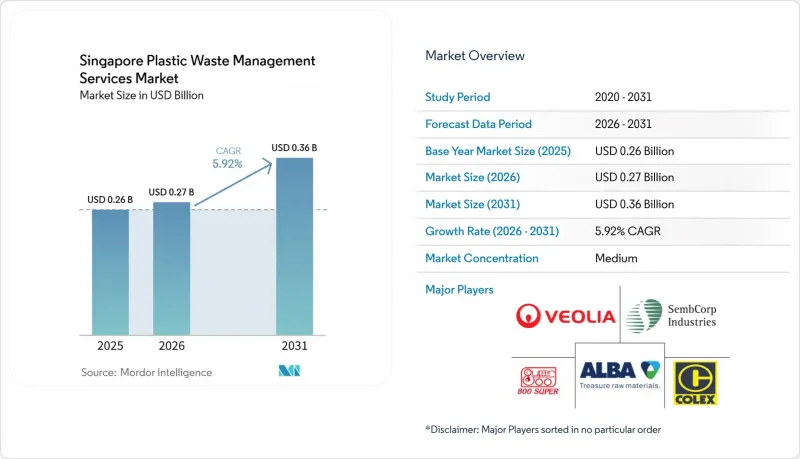
根據 Mordor Intelligence 預測,新加坡塑膠廢棄物管理服務市場規模將從 2025 年的 2.6 億美元和 2026 年的 2.7 億美元成長到 2031 年的 3.6 億美元,2026 年至 2031 年的複合年成長率為 5.92%。
本報告按來源(住宅、商業、工業及其他)、服務提供者(公共/市政、私人廢棄物管理公司及其他)和服務類型(收集、運輸、分類/分離、處置/處理及其他)進行細分。市場預測以價值(美元)和數量(噸)表示。
新加坡塑膠廢棄物管理服務市場趨勢及洞察
飲料容器回收系統(BCRS)簡介
在新加坡的塑膠廢棄物管理服務市場,最顯著的營運變革體現在飲料容器回收計畫(BCRS)上。該計畫於2026年4月1日根據《2019年資源永續性法》的規定正式啟動,對容量在150毫升至3000毫升之間的塑膠和金屬飲料容器徵收0.10新元(0.08美元)的押金,從而提供了一種直接的經濟機制,以提高回收率並確保材料的可追溯性。 BCRS有限公司是一家獲得許可的非營利組織,負責代表生產商進行收集、分類和回收。截至2026年3月,約有800家公司(佔市場佔有率的95%以上)已註冊或正在報名手續中。這對新加坡的塑膠廢棄物管理服務市場意義重大,因為與混合藍色垃圾桶計劃相比,該計劃創造了更清潔的PET來源,提高了原料質量,並支持服務供應商開展專門的運輸和收集業務。新加坡國家環境局的目標是到 2026 年達到 60% 的回收率,並在 2029 年達到 80% 的回收率。該系統不僅將迅速增加正規塑膠的回收量,而且還有可能影響未來除飲料包裝以外的生產者責任法規的設計。
政府資助循環經濟和回收創新
新加坡的塑膠廢棄物管理市場也正獲得直接的公共資金支持,旨在建立循環經濟基礎並創新處理技術。在「閉迴路資源循環資助計畫」下,新加坡國家環境局 (NEA) 和南洋理工大學 (NTU) 於 2026 年 6 月推出了“TREASURES 中心”,投資額達 3500 萬新元(約 2680 萬美元)。該中心將於 2026 年 1 月至 2030 年 3 月期間營運。該中心匯集了南洋理工大學、新加坡國立大學 (NUS) 和其他高等教育機構,為新加坡提供了一個正式平台,將廢棄物研究成果轉化為實用化。同時,NEA 的「3R 基金」可為符合條件的廢棄物減量和回收項目提供高達 80% 的聯合資助,每個項目最高資助額為 100 萬新元(約 80 萬美元)。這將降低試點計畫和中等規模製程改進的准入門檻。這些資金籌措組合將使新加坡的塑膠廢棄物管理服務市場超越簡單的收集,轉向改善分類流程、處理方案設計和高價值資源回收。這將有助於逐步從依賴出口的模式轉向擴大國內加工能力,鑑於目前的回收流程仍然嚴重依賴海外市場,這一點至關重要。
過度依賴垃圾焚化發電發電(WTE)
新加坡的塑膠廢棄物管理服務市場目前仍以焚燒作為主要廢棄物處理方式。新加坡的四座垃圾焚化發電發電廠每天總合處理9,710噸垃圾,由於塑膠熱值高,因此仍是這些工廠的重要資源。這種營運邏輯使得擴大回收利用變得困難,因為在現有體系下,將塑膠從垃圾焚化發電廠運作中出來並不一定能改善短期經濟效益。數據也印證了這一點:2025年塑膠回收再利用僅4%,而整體回收率則高達52%。綜合廢棄物管理設施(IWMF)第一階段工程計畫從2027年開始分階段完工,除非回收和生產者責任延伸(EPR)措施同步擴展,否則將無法進一步提升處理能力。因此,在可預見的未來,新加坡的塑膠廢棄物管理服務市場很可能繼續優先發展收集和垃圾焚化發電相關服務,而非全面擴大垃圾焚化發電利用。
細分市場分析
到2025年,商業領域將佔新加坡塑膠廢棄物管理服務市場的39.4%,成為以金額為準最高的來源類別。該領域包括零售商店、餐廳、酒店、購物中心和辦公室,這些場所包裝材料的使用量都很高,非常適合透過正式合約記錄廢棄物產生量。新加坡餐飲服務和零售業高度集中,導致一次性飲料容器、食品包裝薄膜和零售塑膠的持續產生,這些都非常適合專業的回收計劃。因此,在新加坡的塑膠廢棄物管理服務市場中,商業機構被認為是建立正式合約和可追溯回收路線的最佳來源。
這項定位得到了相關法規和營運模式的進一步支持。自2024年3月起,新建建築中的大規模商業和工業食品廢棄物源必須對食品廢棄物進行分類、處理和報告,從而改善垃圾流記錄,並提高混合商業環境中垃圾收集的透明度。裕廊島和大士的工業垃圾量仍然很大,特別是需要特殊分類的工業薄膜、PP和PE材料。由於約80%的人口居住在組屋中,住宅塑膠廢棄物仍然數量龐大。然而,由於藍色垃圾桶的污染率持續居高不下,因此混合生活垃圾價值低且難以收集。在新加坡的塑膠廢棄物管理服務市場,這些情況表明,商業廢棄物是短期服務需求最可靠的來源。
其他好處:
- Excel格式的市場預測(ME)表
- 3個月的分析師支持
目錄
第1章:引言
- 研究假設和市場定義
- 調查範圍
第2章:調查方法
第3章執行摘要
第4章 市場狀況
- 市場概覽
- 市場促進因素
- 飲料容器回收系統(BCRS)簡介
- 生產者在包裝上的報告義務
- 反向彎曲機(RVM)網路擴展
- 快速消費品公司擴大循環包裝計劃
- 食品配送和便利商店產生的塑膠廢棄物增加
- 政府為循環經濟和回收利用領域的創新提供資金。
- 市場限制因素
- 過度依賴垃圾焚化發電發電(WTE)
- 為回收基礎建設取得土地十分困難。
- 居家廢棄物中塑膠污染比例高
- 對出口或特定塑膠產品組的專業加工的依賴
- 價值供應鏈分析
- 監理情勢
- 技術展望
- 評估地緣政治事件對新加坡塑膠廢棄物管理服務市場的影響。
- 創業生態系分析
- 再生塑膠與原生塑膠的比較分析
- 全球貿易趨勢和進口限制(廢棄塑膠)
第5章 市場規模與成長預測
- 來源
- 住宅
- 商業設施(零售、辦公室等)
- 產業
- 其他(組織、農業等)
- 透過服務提供者
- 公共/市政
- 私人廢棄物管理公司
- 其他組織包括生產者責任組織(PRO)等。
- 按服務類型
- 收集、運輸、分類和分離
- 處置/處理
- 掩埋處置
- 回收和資源回收
- 焚燒和垃圾焚化發電
- 其他(化學加工等)
- 其他服務(諮詢、審計、訓練等)
第6章 競爭情勢
- 市場集中度
- 策略趨勢
- 市佔率分析
- 公司簡介
- Veolia Singapore
- SembWaste Pte Ltd
- ALBA Group Asia
- 800 Super Waste Management
- Colex Holdings Limited
- Blue Planet Environmental Solutions
- Wah & Hua Pte Ltd
- TES Envirocorp Pte. Ltd.
- LHN Recycling Pte Ltd
- Hiap Shing Recycling
- Remondis Singapore
- Envcares Waste Management
- Re Sustainability Limited
- TerraCycle
- Virogreen(Singapore)Pte. Ltd.
- SGRecycle Pte. Ltd.
- ECO Industrial Environmental Engineering
- Bee Joo Industries Pte. Ltd.
- Sembcorp Environment Pte. Ltd.
- Choon Poh Recycling Pte. Ltd.
第7章 市場機會與未來展望
According to Mordor Intelligence, the Singapore plastic waste management services market size is projected to expand from USD 0.26 billion in 2025 and USD 0.27 billion in 2026 to USD 0.36 billion by 2031, registering a CAGR of 5.92% between 2026 to 2031.
This report is Segmented by Source (Residential, Commercial, Industrial, and Others), by Service Provider (Public/Municipal, Private Waste Management Companies, and Others), and by Service Type (Collection, Transportation, Sorting & Segregation, Disposal / Treatment, and Others). The Market Forecasts are Provided in Terms of Value (USD) and Volume (Tons).
Singapore Plastic Waste Management Services Market Trends and Insights
Implementation of the Beverage Container Return Scheme (BCRS)
The Singapore plastic waste management services market is seeing its clearest operational shift through the Beverage Container Return Scheme, which began on 1 April 2026 under regulations issued under the Resource Sustainability Act 2019. The scheme applies a SGD 0.1 deposit (USD 0.08), on plastic and metal beverage containers ranging from 150 ml to 3,000 ml, providing the system with a direct financial mechanism to improve returns and material traceability. BCRS Ltd., the licensed not-for-profit operator, is responsible for collection, sorting, and recycling on behalf of producers, and around 800 companies representing more than 95% of market volume were registered or in the process of registration as of March 2026. This matters for the Singapore plastic waste management services market because it creates a cleaner PET stream outside the mixed blue-bin system, thereby improving feedstock quality and supporting dedicated transport and aggregation work for service providers. NEA targets a 60% return rate in 2026 and 80% by 2029, which means the scheme can quickly lift formal plastic collection volumes and also shape the design of future producer responsibility rules beyond beverage packaging.
Government Funding for Circular Economy and Recycling Innovation
The Singapore plastic waste management market is also gaining support from direct public funding aimed at building circular-economy capacity and advancing treatment innovation. NEA and NTU launched the TREASURES Centre in June 2026 with SGD 35 million (USD 26.8 million) under the Closing the Resource Loop Funding Initiative, and the centre runs from January 2026 to March 2030. The centre brings together NTU, NUS, and other higher education institutions, providing the country with a formal platform to advance waste research toward operational use in treatment systems. In parallel, NEA's 3R Fund can co-fund up to 80% of qualifying waste reduction and recycling projects, with support capped at SGD 1 million (USD 0.8 million) per project, which lowers the entry barrier for pilots and mid-scale process upgrades. This funding mix helps the Singapore plastic waste management services market move beyond collection alone and toward sorting improvement, treatment design, and higher-value resource recovery. It also supports a gradual shift away from an export-heavy model toward greater domestic processing capacity, which is important because current recycling flows still rely heavily on overseas markets.
Heavy Dependence on Waste-to-Energy Incineration
The Singapore plastic waste management services market still operates within a system in which incineration is the default treatment for a large share of waste. Singapore's four active waste-to-energy plants process a combined 9,710 tonnes per day, and plastics remain useful to those plants because of their calorific value. That operating logic makes it harder to expand recycling because diverting plastic away from WTE does not always yield a stronger short-term economic outcome under the current system. The gap is evident in the data: plastic recycling was 4% in 2025, while the overall recycling rate was 52%. The first phase of the Integrated Waste Management Facility is planned to be progressively completed from 2027, adding further treatment capacity unless recycling and EPR measures grow in parallel. This keeps the Singapore plastic waste management services market more supportive of collection and WTE-adjacent services than of broad recycling growth in the near term.
Other drivers and restraints analyzed in the detailed report include:
- Expansion of Reverse Vending Machine (RVM) Network
- Mandatory Packaging Reporting for Producers
- Limited Land Availability for Recycling Infrastructure
For complete list of drivers and restraints, kindly check the Table Of Contents.
Segment Analysis
The commercial segment held 39.4% of the Singapore plastic waste management services market in 2025, making it the largest source category by value. This segment includes retail outlets, food and beverage establishments, hotels, shopping malls, and offices, where packaging use is concentrated, and waste generation is easier to document through formal contracts. Singapore's dense food service and retail environment supports recurring volumes of single-use beverage containers, food packaging films, and retail plastics that are suitable for specialized collection programs. The Singapore plastic waste management services market, therefore, sees commercial locations as the most serviceable source base for formal contracts and traceable recovery routes.
That position is also supported by regulation and operating patterns. Since March 2024, large commercial and industrial food waste generators in new buildings have had to segregate, treat, and report food waste, which has improved waste stream documentation and strengthened collection visibility in mixed commercial settings. The industrial segment still contributes important volumes from Jurong Island and Tuas, especially industrial film and PP and PE materials that need specialized sorting. Residential plastic waste remains large in tonnage because around 80% of the population lives in HDB estates. Still, mixed household streams are lower in value and harder to recover because contamination stays high in blue-bin collection. In the Singapore plastic waste management services market, that mix leaves commercial waste as the clearest anchor for near-term service demand.
Complete Report Scope:
- By Source
- Residential
- Commercial (Retail, Office, etc.)
- Industrial
- Others (Institutional, Agricultural, etc)
- By Service Provider
- Public/Municipal
- Private Waste Management Companies
- Others - Producer Responsibility Organizations (PROs), etc.
- By Service Type
- Collection, Transportation, Sorting & Segregation
- Disposal / Treatment
- Landfill
- Recycling & Resource Recovery
- Incineration & Waste-to-Energy
- Others (Chemical Treatment, etc.)
- Others (Consulting, Audit & Training, etc.)
List of Companies Covered in this Report:
- Veolia Singapore
- SembWaste Pte Ltd
- ALBA Group Asia
- 800 Super Waste Management
- Colex Holdings Limited
- Blue Planet Environmental Solutions
- Wah & Hua Pte Ltd
- TES Envirocorp Pte. Ltd.
- LHN Recycling Pte Ltd
- Hiap Shing Recycling
- Remondis Singapore
- Envcares Waste Management
- Re Sustainability Limited
- TerraCycle
- Virogreen (Singapore) Pte. Ltd.
- SGRecycle Pte. Ltd.
- ECO Industrial Environmental Engineering
- Bee Joo Industries Pte. Ltd.
- Sembcorp Environment Pte. Ltd.
- Choon Poh Recycling Pte. Ltd.
Additional Benefits:
- The market estimate (ME) sheet in Excel format
- 3 months of analyst support
TABLE OF CONTENTS
1 Introduction
- 1.1 Study Assumptions & Market Definition
- 1.2 Scope of the Study
2 Research Methodology
3 Executive Summary
4 Market Landscape
- 4.1 Market Overview
- 4.2 Market Drivers
- 4.2.1 Implementation of the Beverage Container Return Scheme (BCRS)
- 4.2.2 Mandatory Packaging Reporting for Producers
- 4.2.3 Expansion of Reverse Vending Machine (RVM) Network
- 4.2.4 Growth of Circular Packaging Initiatives by FMCG Companies
- 4.2.5 Increasing Plastic Waste from Food Delivery and Convenience Retail
- 4.2.6 Government Funding for Circular Economy and Recycling Innovation
- 4.3 Market Restraints
- 4.3.1 Heavy Dependence on Waste-to-Energy Incineration
- 4.3.2 Limited Land Availability for Recycling Infrastructure
- 4.3.3 High Contamination in Household Plastic Waste
- 4.3.4 Dependence on Export or Specialized Processing for Certain Plastic Streams
- 4.4 Value / Supply-Chain Analysis
- 4.5 Regulatory Landscape
- 4.6 Technological Outlook
- 4.7 Impact Assessment of Geoplotical Events on the Singapore Plastic Waste Management Services Market
- 4.8 Startup Ecosystem Analysis
- 4.9 Analysis of Recycled Plastics on Virgin Plastics
- 4.10 Global Trade Flows & Import Restrictions (Waste Plastics)
5 Market Size and Growth Forecasts
- 5.1 By Source
- 5.1.1 Residential
- 5.1.2 Commercial (Retail, Office, etc.)
- 5.1.3 Industrial
- 5.1.4 Others (Institutional, Agricultural, etc)
- 5.2 By Service Provider
- 5.2.1 Public/Municipal
- 5.2.2 Private Waste Management Companies
- 5.2.3 Others - Producer Responsibility Organizations (PROs), etc.
- 5.3 By Service Type
- 5.3.1 Collection, Transportation, Sorting & Segregation
- 5.3.2 Disposal / Treatment
- 5.3.2.1 Landfill
- 5.3.2.2 Recycling & Resource Recovery
- 5.3.2.3 Incineration & Waste-to-Energy
- 5.3.2.4 Others (Chemical Treatment, etc.)
- 5.3.3 Others (Consulting, Audit & Training, etc.)
6 Competitive Landscape
- 6.1 Market Concentration
- 6.2 Strategic Moves
- 6.3 Market Share Analysis
- 6.4 Company Profiles {(includes Global level Overview, Market level overview, Core Segments, Financials as available, Strategic Information, Products & Services, and Recent Developments)}
- 6.4.1 Veolia Singapore
- 6.4.2 SembWaste Pte Ltd
- 6.4.3 ALBA Group Asia
- 6.4.4 800 Super Waste Management
- 6.4.5 Colex Holdings Limited
- 6.4.6 Blue Planet Environmental Solutions
- 6.4.7 Wah & Hua Pte Ltd
- 6.4.8 TES Envirocorp Pte. Ltd.
- 6.4.9 LHN Recycling Pte Ltd
- 6.4.10 Hiap Shing Recycling
- 6.4.11 Remondis Singapore
- 6.4.12 Envcares Waste Management
- 6.4.13 Re Sustainability Limited
- 6.4.14 TerraCycle
- 6.4.15 Virogreen (Singapore) Pte. Ltd.
- 6.4.16 SGRecycle Pte. Ltd.
- 6.4.17 ECO Industrial Environmental Engineering
- 6.4.18 Bee Joo Industries Pte. Ltd.
- 6.4.19 Sembcorp Environment Pte. Ltd.
- 6.4.20 Choon Poh Recycling Pte. Ltd.
7 Market Opportunities & Future Outlook
- 7.1 White-space & Unmet-need Assessment

 美國塑膠廢棄物管理服務:市場佔有率分析、行業趨勢和統計數據以及成長預測(2026-2031 年)英國塑膠廢棄物管理服務:市場佔有率分析、行業趨勢和統計數據、成長預測(2026-2031 年)日本塑膠廢棄物管理服務:市場佔有率分析、產業趨勢與統計及成長預測(2026-2031)德國塑膠廢棄物管理服務:市場佔有率分析、產業趨勢與統計及成長預測(2026-2031)
 塑膠廢棄物管理服務市場:按服務類型、塑膠類型、來源和最終用途產業分類-2026-2032年全球市場預測塑膠廢棄物管理與回收:市場佔有率分析、產業趨勢與統計、成長預測(2026-2031)
 全球塑膠廢棄物管理市場規模、佔有率、趨勢和成長分析報告(2026-2034年)
 塑膠廢棄物管理市場:依塑膠類型、應用、回收方法、技術、國家及地區分類-全球產業分析、市場規模、市場佔有率及2026年至2033年預測
 寵物水族箱及池塘維護系統市場預測至2034年-全球水族箱設備及系統、池塘設備及系統、水族箱及池塘耗材、水族箱及池塘配件、服務及解決方案以及區域分析自動化寵物護理系統市場預測至2034年—按系統類型、寵物類型、連接方式、技術、最終用戶、分銷管道和地區分類的全球分析