


 |
市場調查報告書
商品編碼
2118131
英國塑膠廢棄物管理服務:市場佔有率分析、行業趨勢和統計數據、成長預測(2026-2031 年)United Kingdom Plastic Waste Management Services - Market Share Analysis, Industry Trends & Statistics, Growth Forecasts (2026 - 2031) |
||||||

※ 本網頁內容可能與最新版本有所差異。詳細情況請與我們聯繫。
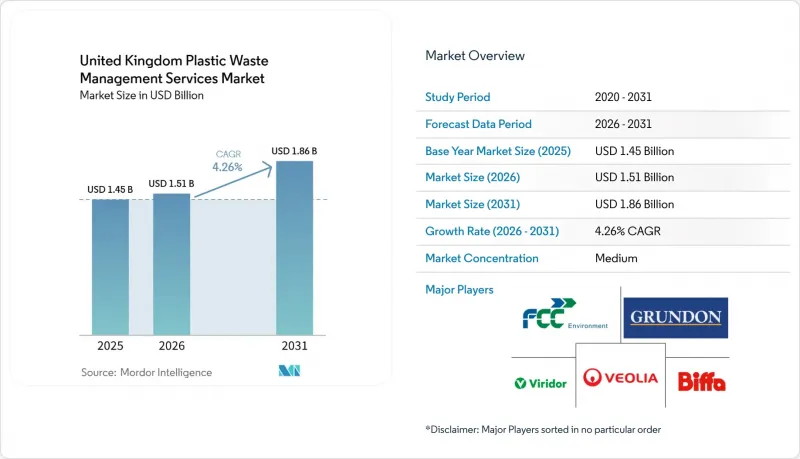
根據 Mordor Intelligence 預測,英國塑膠廢棄物管理服務市場規模將從 2025 年的 14.5 億美元和 2026 年的 15.1 億美元成長到 2031 年的 18.6 億美元,2026 年至 2031 年的年複合成長率(CAGR)為 4.26%。
本報告按來源(住宅、商業、工業及其他)、服務提供者(公共/市政、私人廢棄物管理公司及其他)和服務類型(收集、運輸、分類/分離、處置/處理及其他)進行分類。市場預測以貨幣價值(美元)和數量(噸)兩種形式呈現。
英國塑膠廢棄物管理服務市場趨勢與洞察
在英格蘭各地實施“簡化回收”
「簡易回收」政策於2026年3月31日在英格蘭所有家庭生效,該政策強制要求除廚餘廢棄物和一般廢棄物外,還需對乾燥的可回收物(包括塑膠)進行分類收集。此前,英格蘭擁有10名或以上員工的企業及其相關非住宅設施已於2025年3月31日開始實施職場回收法規,這意味著在家庭實施截止日期之前,服務模式的轉變已經開始。自2027年3月31日起,塑膠薄膜和塑膠袋也將納入分類收集範圍,這將擴大英國塑膠廢棄物管理服務市場的範圍,並為日常收集系統增加更具挑戰性的廢棄物類型。該政策預計在其實施期間將減少118億英鎊(155億美元)的溫室氣體排放,這表明該計劃旨在進行長期的基礎設施改革,而非短期的合規措施。威立雅表示,其進軍家庭服務領域將使其整個網路的年度塑膠回收量增加超過4萬噸,而英國垃圾處理公司Bifa也已為此招募了約250名現場回收人員。這顯示監管變化已經開始影響企業的規模和人員配置計畫。因此,更完善的家庭回收服務將導致原料廢棄物量的增加,從而要求資源回收設施具備更高的處理能力和更嚴格的污染物控制,這將推動英國塑膠廢棄物管理服務市場的短期需求。
調整包裝材料的生產者延伸責任制(pEPR)費用
自2025年10月起,英國主要包裝製造商開始繳納廢棄物處理費,塑膠包裝的基本費率為每噸423英鎊(557.30美元)。從2026/27年度起,對於評級「紅色」且被認為不可回收的包裝材料,將適用1.2倍的乘數,第一年生效,之後逐年遞增至1.6倍,最終達到2.0倍。這將為製造商提供直接的經濟獎勵,促使他們重新設計包裝並提高其可回收性。 PackUK於2026年4月1日正式成立,作為一個由生產商資助的組織,其收入根據檢驗的廢棄物管理成本資料進行分配。這將改變英國塑膠廢棄物管理服務市場的經濟效益衡量方式。費用調整也催生了對報告、生產者責任組織(PRO)會員資格、審計和可回收性評估服務的需求,因為這些不再是自願的永續發展舉措,而是受到監管成本框架的約束。這將使合規服務在英國塑膠廢棄物管理服務市場中發揮更永續的作用。對於能夠將收集數據、材料檢驗和向生產商報告整合到單一服務線中的供應商而言,這一趨勢尤其顯著。
地方政府的廢棄物收集模式不一致
英國擁有超過317個廢棄物收集機構,但每個機構的合約、車輛、收集頻率和分類方法各不相同,這阻礙了標準化進程,並降低了下游處理設施原料的一致性。英國政府宣布,英格蘭超過三分之二的地方政府正在為2026年3月31日的家庭垃圾收集截止日期做準備,這意味著相當一部分地方政府將無法按計畫全面實施。 WRAP的一份報告顯示,36%的物料回收設施(MRF)合約將於2025年底到期,65%將於2026年底到期,隨著許多合約條款的審查,市場正在擴大其服務範圍。這種碎片化不僅增加了污染風險(因為進入分類過程的塑膠並非以統一的形式存在),而且還增加了覆蓋多個地方政府轄區的營運商的員工培訓和路線規劃成本。過渡支持措施已幫助地方政府為新模式做好準備。然而,在人口稠密的都市區和住宅佈局複雜的地區,由於服務本身的複雜性,預算仍然十分緊張。在合約結構更加標準化之前,這很可能仍將是英國塑膠廢棄物管理服務市場最突出的營運限制因素之一。
細分市場分析
到2025年,工業廢棄物將佔英國塑膠廢棄物管理服務市場佔有率的37.5%,成為目前需求結構中最大的來源細分市場。這一地位反映了製造、物流和加工場所大量且持續排放聚乙烯、聚丙烯和類似通用聚合物,而這些場所正是塑膠包裝和防護材料的主要分銷地。此外,工業廢棄物產生者通常簽訂正式的服務契約,其中規定了定期收集,這使得企業能夠獲得比大多數家庭管道更密集的收集路線和更可預測的收集量。自2024年起,大規模工業包裝製造商必須根據《生產者責任規則》進行註冊和報告,並將於2025年10月起開始收取處置費。這些合規負擔正在推動英國塑膠廢棄物管理服務市場對能夠改善可回收性評估並減輕未來處置費負擔的專業服務供應商的需求。
住宅領域目前正建立在更穩固的基礎上。這得歸功於「簡易回收」(Simpler Recycling)計劃在英格蘭為所有家庭設立的最低垃圾收集標準,而此前該計劃並未以這種形式存在。預計從2027年3月開始的塑膠薄膜收集將在第一年為住宅垃圾流增加15萬噸,這將改變垃圾收集計畫和後續分類要求。零售、辦公室和酒店業的商業廢棄物是成長最快的來源,這主要得益於2025年3月生效的職場回收法規以及與生產商合規性更緊密掛鉤的企業永續發展報告。公共和農業廢棄物(被歸類為「其他」)也日益受到重視,因為廢棄物分類法規縮小了豁免範圍,並正式規定了非住宅公共設施的要求。英國塑膠廢棄物管理服務產業在所有來源中都高度依賴源頭分類的改進,因為後續的回收率和污染物處理效果很大程度上取決於源頭分類。
其他好處:
- Excel格式的市場預測(ME)表
- 3個月的分析師支持
目錄
第1章:引言
- 研究假設和市場定義
- 調查範圍
第2章:調查方法
第3章執行摘要
第4章 市場狀況
- 市場概覽
- 市場促進因素
- 在英格蘭推行更簡化的回收系統
- 調整與包裝相關的生產者延伸責任制(pEPR)費用
- 擴大國內塑膠再加工能力的投資
- 擴大塑膠薄膜收集基礎設施
- 企業對回收合規服務的需求日益成長
- 閉合迴路包裝供應鏈的廣泛應用
- 市場限制因素
- 地方政府間廢棄物收集模式不一致
- 收集和運輸成本不斷上漲
- 熟練的廢棄物收集工人短缺
- 可用於建造新的廢棄物轉運和分類設施的土地有限。
- 價值供應鏈分析
- 監理情勢
- 技術展望
- 五力分析-產業吸引力
- 新進入者的威脅
- 供應商的議價能力
- 買方的議價能力
- 替代品的威脅
- 產業競爭
- 創業生態系分析
- 再生塑膠與原生塑膠的比較分析
- 全球貿易趨勢和進口限制(廢棄塑膠)
第5章 市場規模與成長預測
- 來源
- 住宅
- 商業設施(零售、辦公室等)
- 產業
- 其他(組織、農業等)
- 透過服務供應商
- 公共/市政
- 私人廢棄物管理公司
- 其他組織包括生產者責任組織(PRO)等。
- 按服務類型
- 收集、運輸、分類和分離
- 處置/處理
- 掩埋
- 回收和資源回收
- 焚燒和垃圾焚化發電
- 其他(化學加工等)
- 其他服務(諮詢、審計、訓練等)
第6章 競爭情勢
- 市場集中度
- 策略趨勢
- 市佔率分析
- 公司簡介
- Veolia
- Biffa
- Viridor
- FCC Environment UK
- Grundon Waste Management Ltd.
- Renewi plc
- Enva
- DS Smith
- WasteCare Group Ltd.
- MyGroup
- Mobius Environmental Limited
- HIPPO
- J&G Environmental Limited
- EF Plastics UK Ltd.
- Jayplas Ltd.
- Recycle for Future Ltd.
- Ward Recycling Ltd.
- Scott Waste Ltd.
- TerraCycle
- Remondis UK Ltd.
第7章 市場機會與未來展望
According to Mordor Intelligence, the United Kingdom plastic waste management services market size is projected to expand from USD 1.45 billion in 2025 and USD 1.51 billion in 2026 to USD 1.86 billion by 2031, registering a CAGR of 4.26% between 2026 to 2031.
This report is Segmented by Source (Residential, Commercial, Industrial, and Others), by Service Provider (Public/Municipal, Private Waste Management Companies, and Others), and by Service Type (Collection, Transportation, Sorting & Segregation, Disposal / Treatment, and Others). The Market Forecasts are Provided in Terms of Value (USD) and Volume (Tons).
United Kingdom Plastic Waste Management Services Market Trends and Insights
Implementation of Simpler Recycling Across England
Simpler Recycling came into force across English households on March 31, 2026, and it now requires the separate collection of dry recyclables, including plastics, alongside food and residual waste. Workplace recycling rules already took effect on March 31, 2025, for businesses and relevant non-domestic premises in England with 10 or more employees, so the service model had already started shifting before the household deadline arrived. Plastic films and plastic bags are due to be included in the required collection stream from March 31, 2027, broadening the material scope for the United Kingdom plastic waste management services market and adding a more challenging waste stream to everyday collection systems. The policy is expected to deliver GBP 11.8 billion (USD 15.5 billion) in greenhouse gas savings over its lifetime, indicating that the program is being designed as long-term infrastructure reform rather than a short-term compliance exercise. Veolia stated that the household rollout adds more than 40,000 tons of annual plastic collection volumes to its network, and Biffa recruited around 250 frontline collection staff to prepare for the transition, indicating that the rule change is already affecting operating scale and labor planning. As a result, more consistent kerbside coverage is lifting feedstock volumes and pushing materials recovery facilities to manage higher throughput with better contamination control, which reinforces near-term demand across the United Kingdom plastic waste management services market.
Packaging Extended Producer Responsibility (pEPR) Fee Modulation
Large packaging producers in the United Kingdom have been paying disposal fees since October 2025, with a base fee for plastic packaging set at GBP 423 (USD 557.3) per ton. From the 2026/27 assessment year, red-rated packaging assessed as non-recyclable is subject to a 1.2x multiplier in year 1, rising to 1.6x and then 2.0x, providing producers with a direct financial incentive to redesign packaging and improve recyclability. PackUK became operational on April 1, 2026, formalizing a producer-funded body that distributes revenues based on verified waste management cost data, which changes how service economics are measured across the United Kingdom's plastic waste management services market. Fee modulation also creates demand for reporting, PRO membership, auditing, and recyclability assessment services, as those tasks now fall within a regulated cost framework rather than a voluntary sustainability process. This makes compliance services a more durable part of the United Kingdom plastic waste management services market, especially for operators that can combine collection data, material verification, and producer reporting into a single service line.
Inconsistent Waste Collection Models Across Local Authorities
England has more than 317 waste collection authorities, and they still operate under different contracts, fleets, frequencies, and sorting methods, which weakens standardization and lowers feedstock consistency for downstream processors. The Government of the United Kingdom stated that more than two-thirds of English councils were ready for the March 31, 2026, household deadline, indicating that a meaningful minority did not complete the full rollout on schedule. WRAP reported that 36% of all MRF contracts were due to expire by the end of 2025 and 65% by 2026, indicating that the market is expanding service coverage while many contract terms are being reset. This fragmentation raises contamination risks because plastics entering the sortation stream do not arrive in a uniform format, and it also increases crew training and route planning costs for operators serving multiple authority areas. Transitional support has helped councils prepare for the new model. Still, the funding envelope remains tight in dense urban areas and in difficult housing layouts, where service complexity is inherently higher. Until contract structures become more uniform, this remains one of the clearest operating restraints on the United Kingdom plastic waste management services market.
Other drivers and restraints analyzed in the detailed report include:
- Growing Investment in Domestic Plastic Reprocessing Capacity
- Expansion of Plastic Film Collection Infrastructure
- Escalating Collection and Transportation Costs
For complete list of drivers and restraints, kindly check the Table Of Contents.
Segment Analysis
Industrial streams accounted for 37.5% of the United Kingdom plastic waste management services market share in 2025, making them the largest source segment in the current demand structure. This position reflects the high and steady output of polyethylene, polypropylene, and similar commodity polymers across manufacturing, logistics, and processing sites where plastic packaging and protective materials move in large volumes. Industrial generators also tend to work under formal service contracts with scheduled collections, which gives operators denser routes and more predictable inbound volumes than most household channels. Since 2024, large industrial packaging producers have had registration and reporting obligations under the Producer Responsibility rules, and disposal fees have applied since October 2025. That compliance burden is increasing demand for specialist service providers that can improve recyclability ratings and lower future fee exposure across the United Kingdom plastic waste management services market.
The residential segment is now expanding on a more structural basis because Simpler Recycling established a minimum collection standard across English households that did not exist in this form before 2026. The addition of plastic film collection from March 2027 is expected to add 150,000 tons to the residential stream in the first year, which changes both collection planning and downstream sorting requirements. Commercial waste from retail, offices, and hospitality is the fastest-growing source by volume, driven by workplace recycling rules that took effect in March 2025 and by corporate sustainability reporting now more closely tied to producer compliance. Institutional and agricultural streams grouped under others are also becoming more visible as the Separation of Waste regulations narrow exemptions and formalize requirements for non-household municipal premises. Across all source streams, the United Kingdom plastic waste management services industry depends heavily on better segregation at the point of generation, because that is where later recycling yield and contamination performance are largely decided.
Complete Report Scope:
- By Source
- Residential
- Commercial (Retail, office, etc.)
- Industrial
- Others (Institutional, Agricultural, etc)
- By Service Provider
- Public/Municipal
- Private Waste Management Companies
- Others - Producer Responsibility Organizations (PROs), etc.
- By Service Type
- Collection, Transportation, Sorting & Segregation
- Disposal / Treatment
- Landfill
- Recycling & Resource Recovery
- Incineration & Waste-to-Energy
- Others (Chemical Treatment, etc.)
- Others (Consulting, Audit & Training, etc.)
List of Companies Covered in this Report:
- Veolia
- Biffa
- Viridor
- FCC Environment UK
- Grundon Waste Management Ltd.
- Renewi plc
- Enva
- DS Smith
- WasteCare Group Ltd.
- MyGroup
- Mobius Environmental Limited
- HIPPO
- J&G Environmental Limited
- EF Plastics UK Ltd.
- Jayplas Ltd.
- Recycle for Future Ltd.
- Ward Recycling Ltd.
- Scott Waste Ltd.
- TerraCycle
- Remondis UK Ltd.
Additional Benefits:
- The market estimate (ME) sheet in Excel format
- 3 months of analyst support
TABLE OF CONTENTS
1 Introduction
- 1.1 Study Assumptions & Market Definition
- 1.2 Scope of the Study
2 Research Methodology
3 Executive Summary
4 Market Landscape
- 4.1 Market Overview
- 4.2 Market Drivers
- 4.2.1 Implementation of Simpler Recycling Across England
- 4.2.2 Packaging Extended Producer Responsibility (pEPR) Fee Modulation
- 4.2.3 Growing Investment in Domestic Plastic Reprocessing Capacity
- 4.2.4 Expansion of Plastic Film Collection Infrastructure
- 4.2.5 Increasing Commercial Demand for Recycling Compliance Services
- 4.2.6 Rising Adoption of Closed-Loop Packaging Supply Chains
- 4.3 Market Restraints
- 4.3.1 Inconsistent Waste Collection Models Across Local Authorities
- 4.3.2 Escalating Collection and Transportation Costs
- 4.3.3 Shortage of Skilled Waste Collection Workforce
- 4.3.4 Limited Land Availability for New Waste Transfer and Sorting Facilities
- 4.4 Value / Supply-Chain Analysis
- 4.5 Regulatory Landscape
- 4.6 Technological Outlook
- 4.7 Porter's Five Forces - Industry Attractiveness
- 4.7.1 Threat of New Entrants
- 4.7.2 Bargaining Power of Suppliers
- 4.7.3 Bargaining Power of Buyers
- 4.7.4 Threat of Substitutes
- 4.7.5 Industry Rivalry
- 4.8 Startup Ecosystem Analysis
- 4.9 Analysis of Recycled Plastics on Virgin Plastics
- 4.10 Global Trade Flows & Import Restrictions (Waste Plastics)
5 Market Size and Growth Forecasts
- 5.1 By Source
- 5.1.1 Residential
- 5.1.2 Commercial (Retail, office, etc.)
- 5.1.3 Industrial
- 5.1.4 Others (Institutional, Agricultural, etc)
- 5.2 By Service Provider
- 5.2.1 Public/Municipal
- 5.2.2 Private Waste Management Companies
- 5.2.3 Others - Producer Responsibility Organizations (PROs), etc.
- 5.3 By Service Type
- 5.3.1 Collection, Transportation, Sorting & Segregation
- 5.3.2 Disposal / Treatment
- 5.3.2.1 Landfill
- 5.3.2.2 Recycling & Resource Recovery
- 5.3.2.3 Incineration & Waste-to-Energy
- 5.3.2.4 Others (Chemical Treatment, etc.)
- 5.3.3 Others (Consulting, Audit & Training, etc.)
6 Competitive Landscape
- 6.1 Market Concentration
- 6.2 Strategic Moves
- 6.3 Market Share Analysis
- 6.4 Company Profiles {(Includes Global Level Overview, Market Level Overview, Core Segments, Financials as Available, Strategic Information, Products & Services, and Recent Developments)}
- 6.4.1 Veolia
- 6.4.2 Biffa
- 6.4.3 Viridor
- 6.4.4 FCC Environment UK
- 6.4.5 Grundon Waste Management Ltd.
- 6.4.6 Renewi plc
- 6.4.7 Enva
- 6.4.8 DS Smith
- 6.4.9 WasteCare Group Ltd.
- 6.4.10 MyGroup
- 6.4.11 Mobius Environmental Limited
- 6.4.12 HIPPO
- 6.4.13 J&G Environmental Limited
- 6.4.14 EF Plastics UK Ltd.
- 6.4.15 Jayplas Ltd.
- 6.4.16 Recycle for Future Ltd.
- 6.4.17 Ward Recycling Ltd.
- 6.4.18 Scott Waste Ltd.
- 6.4.19 TerraCycle
- 6.4.20 Remondis UK Ltd.
7 Market Opportunities & Future Outlook
- 7.1 White-space & Unmet-need assessment

 新加坡塑膠廢棄物管理服務:市場佔有率分析、行業趨勢和統計數據以及成長預測(2026-2031 年)美國塑膠廢棄物管理服務:市場佔有率分析、行業趨勢和統計數據以及成長預測(2026-2031 年)日本塑膠廢棄物管理服務:市場佔有率分析、產業趨勢與統計及成長預測(2026-2031)德國塑膠廢棄物管理服務:市場佔有率分析、產業趨勢與統計及成長預測(2026-2031)
 塑膠廢棄物管理服務市場:按服務類型、塑膠類型、來源和最終用途產業分類-2026-2032年全球市場預測塑膠廢棄物管理與回收:市場佔有率分析、產業趨勢與統計、成長預測(2026-2031)
 全球塑膠廢棄物管理市場規模、佔有率、趨勢和成長分析報告(2026-2034年)
 塑膠廢棄物管理市場:依塑膠類型、應用、回收方法、技術、國家及地區分類-全球產業分析、市場規模、市場佔有率及2026年至2033年預測
 寵物水族箱及池塘維護系統市場預測至2034年-全球水族箱設備及系統、池塘設備及系統、水族箱及池塘耗材、水族箱及池塘配件、服務及解決方案以及區域分析自動化寵物護理系統市場預測至2034年—按系統類型、寵物類型、連接方式、技術、最終用戶、分銷管道和地區分類的全球分析