


 |
市場調查報告書
商品編碼
2099159
塑膠廢棄物管理與回收:市場佔有率分析、產業趨勢與統計、成長預測(2026-2031)Plastic Waste Management and Recycling - Market Share Analysis, Industry Trends & Statistics, Growth Forecasts (2026 - 2031) |
||||||

※ 本網頁內容可能與最新版本有所差異。詳細情況請與我們聯繫。
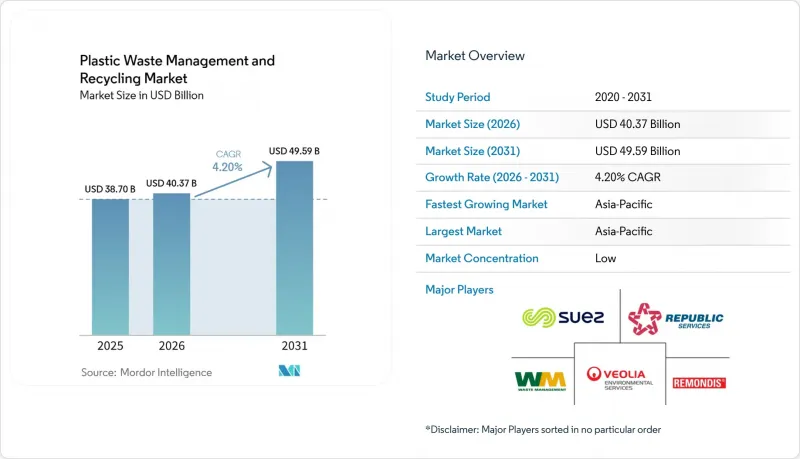
根據 Mordor Intelligence 預測,塑膠廢棄物管理和回收市場規模預計將在 2025 年達到 387 億美元,2026 年達到 403.7 億美元,到 2031 年達到 495.9 億美元,2026 年至 2031 年的複合年成長率為 4.20%。
本報告按來源(住宅、商業、工業及其他)、聚合物類型(聚乙烯及其他)、服務類型(收集、運輸、分類及其他)、最終用戶行業(包裝及其他)和回收方法(機械回收及其他)進行細分。市場預測以價值(美元)和數量(噸)表示。
全球塑膠廢棄物管理及回收市場趨勢及洞察
監管壓力加大:禁止生產者責任延伸制度及一次性塑膠製品
塑膠廢棄物管理和回收市場的發展受到一系列法規的推動,這些法規已從試驗計畫發展成為具有法律約束力的國家和地區法規。加州的SB 54法案於2026年5月1日生效,該法案強制要求生產商從2027年起每年向減排項目捐款5億美元。該法案還要求在2032年將一次性塑膠的使用量減少25%,並逐步轉向完全可回收或可堆肥的包裝。英國的《2024年生產者責任條例》針對塑膠材料設定了具體的回收目標,即到2026年達到57%,到2027年達到59%,並建立了收費系統,對難以回收的包裝設計處以罰款。歐盟的《包裝和包裝廢棄物條例》於2025年生效,並將於2026年8月12日起實施。該條例設定了再生材料含量的目標,並對所有類別的包裝設計制定了更嚴格的規則。加拿大也已開始透過其「聯邦塑膠登記處」建立報告系統,該系統要求產量超過報告基準值的生產商披露其投放市場的塑膠產品。隨著這些法規逐步生效,塑膠廢棄物管理和回收市場正受益於對收集系統、包裝重新設計、回收合約和合規機制的持續投入,而非一次性的短期投資。
全球塑膠廢棄物產生量激增。
塑膠廢棄物管理和回收市場擴張的另一個原因是,廢棄物產生速度的成長已經超過了收集和處理系統的能力。聯合國環境規劃署(UNEP)在2025年估計,每年將有1,900萬至2,300萬噸塑膠流入水生生態系統,將持續迫使各國政府和生產商改善廢棄物管理系統。經合組織(OECD)在2024年表示,如果政策目標仍然有限,到2040年,每年的塑膠廢棄物可能增加70%,達到6.17億噸。包裝材料是這一趨勢中最突出的部分,因為它們的生命週期短,佔全球塑膠產量的很大一部分,很快就會變成廢棄物。世界銀行在2026年的報告中指出,預計到2050年,全球廢棄物總量將激增,其中最大的因素是快速都市化的地區。這意味著分類、收集和處置系統將面臨越來越沉重的負擔。因此,塑膠廢棄物管理和回收市場對家庭垃圾收集計畫、先進的資源回收系統和押金制度的支持力度不斷加大,以確保原料在混入混合廢物流之前更加清潔。
收集和分類系統面臨的挑戰
塑膠廢棄物管理和回收市場仍面臨根本性的供應限制。這是因為原料的品質取決於廢棄物在到達回收商之前是如何收集和分類的。在許多市場,薄膜的收集仍然有限,軟性廢棄物了現有的系統,地方政府仍然缺乏大規模生產清潔打包塑膠所需的必要基礎設施。世界銀行在2026年指出,低收入地區在廢棄物收集和處理方面的差距尤為嚴重,導致大量廢棄物無法被納入正規的收集系統。聯合國環境規劃署(UNEP)也指出,管理不善的塑膠廢棄物大量外流,顯示收集系統的脆弱性並非小問題,而是限制回收產業發展的核心因素。押金返還制度為飲料容器提供了一種更好的處理途徑,但這種制度尚未普及,即使在主要經濟體之間,其實施情況也存在差異。在收集系統擴展和分類品質得到提高之前,塑膠廢棄物管理和回收市場將繼續面臨產量下降、營運成本上升以及高純度再生樹脂成長放緩的困境。
細分市場分析
到2025年,工業廢棄物將佔塑膠廢棄物管理和回收市場的39.5%,成為最大的來源。這是因為工業廢棄物的流入量更可預測,且成分更清潔,屬於單一材料流。邊角料、邊緣廢棄物和生產線旁包裝廢棄物仍然是回收商的理想材料,因為與混合的家用塑膠相比,它們更容易包裝、分類和再加工。受電子商務物流、零售包裝流通以及生產者責任制法規的加強(這些法規將收整合本轉移到企業)的推動,預計到2031年,商業廢棄物將以5.4%的複合年成長率成長。這一趨勢將為回收商提供穩定的原料來源。
從長遠發展的角度來看,住宅垃圾仍然十分重要,但由於混合收集導致品質下降以及食品污染造成可用產量減少,其商業化利用面臨挑戰。押金返還機制正在改善飲料包裝的現狀,幫助回收商獲得比常規垃圾收集項目更高品質的PET和HDPE。其他來源的垃圾,包括機構、農業和醫療包裝廢棄物,目前規模仍然較小,但收集工作已得到有效管理,並且由於聚合物混合比例較低,可能創造出有價值的細分市場。展望未來,隨著物流網路、零售連鎖店和生產商資助的系統圍繞可回收包裝的收集而更加規範化,商業廢棄物有望縮小與工業廢棄物在塑膠廢棄物管理和回收市場中的差距。
區域分析
預計到2025年,亞太地區將佔據全球塑膠廢棄物管理和回收市場佔有率的38.4%,並將繼續保持最大且成長最快的區域市場地位,到2031年將以4.9%的複合年成長率成長。該地區受惠於快速的都市化、大量的包裝廢棄物、進口廢棄物限制後國內加工需求的成長,以及政府大力推動循環利用材料的措施。中國對循環經濟的推動和對包裝廢棄物更嚴格的監管,持續支撐國內的回收投資;印度接受再生PET用於食品包裝,也改善了高價值國內應用領域的前景。此外,日本承諾到2030年投入1兆日圓(約64億美元)用於保障再生資源,這顯示回收能力已不再只是一個環境問題,而是長期產業規劃的一部分。這些因素使亞太地區的塑膠廢棄物管理和回收市場擁有比其他任何地區都更強勁的成長基礎。
歐洲仍然是監管主導區域市場中最突出的地區。歐盟的《包裝和包裝廢棄物法規》、關於再生材料含量的規定以及回收目標,正在推動對更完善的分類、瓶子回收和先進處理基礎設施的投資。北美在各州主導的政策(例如加州的SB 54法案)的推動下持續成長。然而,由於缺乏統一的聯邦框架,全部區域的合規標準和投資訊號仍然存在差異。因此,儘管北美塑膠廢棄物管理和回收市場展現出強勁的專案活動,但在監管一致性方面仍落後於歐洲。
拉丁美洲和中東及非洲地區雖然目前市場規模相對較小,但作為處於成長初期階段的關鍵區域,其重要性日益凸顯。針對再生PET產能的定向投資以及生產者責任制的逐步推行,促使當地加工基地在全面監管實施之前就已建立起來。因此,儘管各地區情況不盡相同,但由於新的產能建設在需求完全成熟之前就已經啟動,前景依然樂觀。縱觀整個塑膠廢棄物管理和回收市場,亞太地區正在顯著擴張,歐洲正透過不斷完善的監管措施取得進展,北美則透過國家主導的項目穩步推進,而新興地區正在建設產能,這有望為預測期後半段的強勁成長奠定基礎。
其他好處:
- Excel格式的市場預測(ME)表
- 3個月的分析師支持
目錄
第1章:引言
- 研究假設和市場定義
- 調查範圍
第2章:調查方法
第3章執行摘要
第4章 市場狀況
- 市場概覽
- 市場促進因素
- 監管壓力日益增大:禁止使用EPR和一次性塑膠製品。
- 全球塑膠廢棄物產生量激增。
- 包裝廢棄物和電子商務廢棄物增加
- 加大對回收基礎設施的投資
- 向循環經濟模式轉型
- 對再生塑膠(PCR材料)的需求不斷成長
- 市場限制因素
- 收集和分類系統面臨的挑戰
- 高成本的先進回收技術
- 受污染塑膠廢棄物的流動
- 再生塑膠價格波動
- 價值供應鏈分析
- 監理情勢
- 技術展望
- 波特五力模型
- 創業生態系分析
- 再生塑膠與原生塑膠的比較分析
- 全球貿易趨勢和進口限制(廢棄塑膠)
第5章 市場規模與成長預測
- 來源
- 住宅
- 商業設施(零售、辦公室等)
- 產業
- 其他(組織、農業等)
- 按聚合物類型
- 聚乙烯(PE)
- 聚丙烯(PP)
- 聚對苯二甲酸乙二醇酯(PET)
- 聚氯乙烯(PVC)
- 聚苯乙烯(PS)
- 其他
- 按服務類型
- 收集、運輸、分類和分離
- 處置/處理
- 掩埋處置
- 回收和資源回收
- 焚燒和垃圾焚化發電
- 其他(化學處理、堆肥等)
- 其他服務(諮詢、審計、訓練等)
- 按最終用戶行業分類
- 包裝
- 建設與拆除
- 汽車和運輸業
- 消費品
- 醫療保健
- 電氣和電子設備
- 其他
- 透過回收方法
- 機械回收
- 化學回收
- 熱能回收
- 其他
- 按地區
- 北美洲
- 美國
- 加拿大
- 墨西哥
- 南美洲
- 巴西
- 阿根廷
- 智利
- 其他南美國家
- 歐洲
- 德國
- 英國
- 法國
- 義大利
- 西班牙
- 俄羅斯
- 比荷盧經濟聯盟(比利時、荷蘭、盧森堡)
- 北歐國家(丹麥、芬蘭、冰島、挪威、瑞典)
- 其他歐洲國家
- 亞太地區
- 中國
- 印度
- 日本
- 韓國
- 澳洲
- 東南亞(印尼、越南、泰國、馬來西亞、菲律賓)
- 其他亞太國家
- 中東和非洲
- 阿拉伯聯合大公國
- 沙烏地阿拉伯
- 土耳其
- 卡達
- 南非
- 埃及
- 奈及利亞
- 其他中東和非洲國家
- 北美洲
第6章 競爭情勢
- 市場集中度
- 策略趨勢
- 市佔率分析
- 公司簡介
- Veolia Environnement SA
- SUEZ
- Waste Management Inc.
- Republic Services
- Remondis SE & Co. KG
- Waste Connections
- Clean Harbors
- Biffa
- Reworld(Covanta Holding Corporation)
- FCC Environment
- Eastman
- Urbaser
- KW Plastics
- TerraCycle
- Loop Industries
- Carbios
- GFL Environmental
- Hawkvale Limited
- Hahn Plastics Limited
- Recology Inc.
第7章 市場機會與未來展望
According to Mordor Intelligence, the plastic waste management and recycling market size is projected to be USD 38.70 billion in 2025, USD 40.37 billion in 2026, and reach USD 49.59 billion by 2031, growing at a CAGR of 4.20% from 2026 to 2031.
This report is Segmented by Source (Residential, Commercial, Industrial, and Others), by Polymer Type (Polyethylene, and More), by Service Type (Collection, Transportation, Sorting & Segregation, and More), by End-User Industry (Packaging, and More), and by Recycling Methods (Mechanical Recycling, and More). The Market Forecasts are Provided in Terms of Value (USD) and Volume (Tons).
Global Plastic Waste Management and Recycling Market Trends and Insights
Increasing Regulatory Pressures: EPR and Bans on Single-Use Plastics
The plastic waste management and recycling market is being pushed forward by regulations that have shifted from pilot programs to binding national and regional rules. California's SB 54 became effective on May 1, 2026, and it requires producers to support a USD 500 million annual mitigation program from 2027, with a 25% reduction in single-use plastic by 2032 and a move toward fully recyclable or compostable packaging. The United Kingdom's Producer Responsibility Obligations Regulations 2024 introduced material-specific recycling targets for plastic at 57% in 2026 and 59% in 2027, alongside a fee structure that penalizes packaging designs that are hard to recycle. The European Union's Packaging and Packaging Waste Regulation entered into force in 2025 and applies from August 12, 2026. It sets recycled content targets and stricter packaging design rules across categories. Canada has also started building reporting discipline through the Federal Plastics Registry, which requires producers above the reporting threshold to disclose the plastic they place on the market. As these rules take hold in a staggered manner, the plastic waste management and recycling market is benefiting from sustained spending on collection systems, packaging redesign, recycling contracts, and compliance systems rather than a single, short burst of investment.
Surge in Global Plastic Waste Generation
The plastic waste management and recycling market is also expanding because waste generation is rising faster than collection and treatment systems can keep up. UNEP noted in 2025 that 19-23 million tonnes of plastic enter aquatic ecosystems each year, which continues to put pressure on governments and producers to improve waste management systems. The OECD stated in 2024 that annual plastic waste could rise by 70% to 617 million tonnes by 2040 if policy ambition remains limited. Packaging remains the most visible part of this flow because it has short use cycles and a high share of global plastic production, so it converts quickly into post-consumer waste. The World Bank reported in 2026 that total global waste volumes are on course to rise sharply by 2050, with the steepest pressure coming from fast urbanizing regions, which means sorting, collection, and disposal systems will face growing strain. As a result, the plastic waste management and recycling market is seeing stronger support for curbside programs, material recovery upgrades, and deposit systems that can capture cleaner feedstock before it is lost to mixed waste streams.
Challenges in Collection & Segregation Systems
The plastic waste management and recycling market still faces a basic supply constraint because feedstock quality depends on how waste is collected and separated before it reaches a recycler. In many markets, film collection remains limited, flexible formats clog existing systems, and local authorities still lack the infrastructure needed to produce clean bales at scale. The World Bank highlighted in 2026 that waste collection and treatment gaps remain especially severe in lower-income settings, which keeps large volumes of material outside formal recovery systems. UNEP also pointed to the scale of mismanaged plastic leakage, showing that collection weaknesses are not a marginal issue but a central limit on recycling growth. Deposit return systems offer a cleaner route for beverage containers, but they are not universal, and their rollout is uneven across major economies. Until collection expands and segregation improves, the plastic waste management and recycling market will continue to face lower yields, higher operating costs, and slower growth in high-purity recycled resin.
Other drivers and restraints analyzed in the detailed report include:
- Expansion of Packaging & E-Commerce Waste
- Boosted Investments in Recycling Infrastructure
- Contaminated Plastic Waste Streams
For complete list of drivers and restraints, kindly check the Table Of Contents.
Segment Analysis
Industrial waste accounted for 39.5% of the plastic waste management and recycling market in 2025, making it the largest source segment because it arrives in more predictable volumes and cleaner mono-material streams. Trim scrap, edge waste, and line-side packaging waste remain attractive to recyclers because they are easier to bale, sort, and reprocess than mixed household plastics. Commercial waste is forecast to expand at 5.4% CAGR through 2031, supported by e-commerce distribution, retail packaging flows, and tighter producer responsibility rules that are moving collection costs back to businesses. This pattern provides recyclers with a stable feedstock base.
Residential waste remains important for long-term scale, but it is harder to monetize because quality losses from co-mingled collection and food contamination reduce usable output. Deposit return systems improve this picture for beverage packaging, and they help recyclers secure cleaner PET and HDPE streams than standard curbside programs usually deliver. Other source streams, including institutional, agricultural, and medical packaging waste, remain smaller but can create useful niche opportunities where collection is controlled, and the polymer mix is narrow. Over time, the plastic waste management and recycling market is likely to see commercial waste narrow the gap with industrial waste as logistics networks, retail chains, and producer-funded systems become more organized around the recovery of recyclable packaging.
Complete Report Scope:
- By Source
- Residential
- Commercial (retail, office, etc.)
- Industrial
- Others (institutional, agricultural, etc)
- By Polymer Type
- Polyethylene (PE)
- Polypropylene (PP)
- Polyethylene Terephthalate (PET)
- Polyvinyl Chloride (PVC)
- Polystyrene (PS)
- Others
- By Service Type
- Collection, Transportation, Sorting & Segregation
- Disposal / Treatment
- Landfill
- Recycling & Resource Recovery
- Incineration & Waste-to-Energy
- Others (Chemical Treatment, Composting, etc.)
- Others (Consulting, Audit & Training, etc.)
- By End-User Industry
- Packaging
- Construction & Demolition
- Automotive & Transportation
- Consumer Goods
- Medical & Healthcare
- Electrical & Electronics
- Others
- By Recycling Methods
- Mechanical Recycling
- Chemical Recycling
- Thermal Recycling
- Others
- By Geography
- North America
- United States
- Canada
- Mexico
- South America
- Brazil
- Argentina
- Chile
- Rest of South America
- Europe
- Germany
- United Kingdom
- France
- Italy
- Spain
- Russia
- BENELUX (Belgium, Netherlands, and Luxembourg)
- NORDICS (Denmark, Finland, Iceland, Norway, and Sweden)
- Rest of Europe
- Asia-Pacific
- China
- India
- Japan
- South Korea
- Australia
- Southeast Asia (Indonesia, Vietnam, Thailand, Malaysia, Philippines)
- Rest of Asia-Pacific
- Middle East & Africa
- United Arab Emirates
- Saudi Arabia
- Turkey
- Qatar
- South Africa
- Egypt
- Nigeria
- Rest of Middle East & Africa
- North America
Geography Analysis
Asia-Pacific accounted for 38.4% of the plastic waste management and recycling market share in 2025 and is forecast to grow at 4.9% CAGR through 2031, keeping it both the largest and fastest-growing regional segment. The region benefits from rapid urbanization, high packaging volumes, stronger domestic processing needs after waste-import controls, and wider government focus on circular material use. China's circular economy push and tighter controls on packaging waste continue to support local recycling investment, and India's acceptance of recycled PET for food packaging has improved the outlook for higher-value domestic applications. Japan's commitment to mobilize JPY 1 trillion (USD 6.40 billion) by 2030 for recycled resource security also shows that recycling capacity is becoming part of long-term industrial planning rather than a narrow environmental issue. These factors give the plastic waste management and recycling market a stronger growth base in Asia-Pacific than in any other geography.
Europe remains the most regulation-led regional market. The European Union's Packaging and Packaging Waste Regulation, recycled content rules, and collection targets are forcing investment in better sorting, bottle recovery, and advanced processing infrastructure. North America continues to build momentum through state-led policies such as California SB 54. However, the absence of a single federal framework means compliance standards and investment signals are still fragmented across the region. That leaves the North American plastic waste management and recycling market with solid project activity but less regulatory consistency than in Europe.
Latin America, the Middle East, and Africa remain smaller in current value, but they are becoming more important as early-stage growth corridors. Targeted investments in recycled PET capacity and the gradual spread of producer responsibility rules are helping establish local processing bases ahead of wider enforcement. The regional story is therefore uneven, but directionally positive, because new capacity is being built before demand is fully mature. Across the plastic waste management and recycling market, Asia-Pacific is expanding on scale, Europe is advancing through regulatory depth, North America is progressing through state-led programs, and emerging regions are building beachhead capacity that could support stronger growth later in the forecast period.
- Veolia Environnement S.A.
- SUEZ
- Waste Management Inc.
- Republic Services
- Remondis SE & Co. KG
- Waste Connections
- Clean Harbors
- Biffa
- Reworld (Covanta Holding Corporation)
- FCC Environment
- Eastman
- Urbaser
- KW Plastics
- TerraCycle
- Loop Industries
- Carbios
- GFL Environmental
- Hawkvale Limited
- Hahn Plastics Limited
- Recology Inc.
Additional Benefits:
- The market estimate (ME) sheet in Excel format
- 3 months of analyst support
TABLE OF CONTENTS
1 Introduction
- 1.1 Study Assumptions & Market Definition
- 1.2 Scope of the Study
2 Research Methodology
3 Executive Summary
4 Market Landscape
- 4.1 Market Overview
- 4.2 Market Drivers
- 4.2.1 Increasing Regulatory Pressures: EPR and Bans on Single-Use Plastics
- 4.2.2 Surge in Global Plastic Waste Generation
- 4.2.3 Expansion of Packaging & E-commerce Waste
- 4.2.4 Boosted Investments in Recycling Infrastructure
- 4.2.5 Transition Towards Circular Economy Models
- 4.2.6 Growing Demand for Recycled Plastics (PCR Materials)
- 4.3 Market Restraints
- 4.3.1 Challenges in Collection & Segregation Systems
- 4.3.2 Expensive Advanced Recycling Technologies
- 4.3.3 Contaminated Plastic Waste Streams
- 4.3.4 Fluctuating Prices of Recycled Plastics
- 4.4 Value / Supply-Chain Analysis
- 4.5 Regulatory Landscape
- 4.6 Technological Outlook
- 4.7 Porter's Five Forces
- 4.7.1 Threat of New Entrants
- 4.7.2 Bargaining Power of Suppliers
- 4.7.3 Bargaining Power of Buyers
- 4.7.4 Threat of Substitutes
- 4.7.5 Industry Rivalry
- 4.8 Startup Ecosystem Analysis
- 4.9 Analysis of Recycled Plastics on Virgin Plastics
- 4.10 Global Trade Flows & Import Restrictions (waste plastics)
5 Market Size and Growth Forecasts (Value & Volume)
- 5.1 By Source
- 5.1.1 Residential
- 5.1.2 Commercial (retail, office, etc.)
- 5.1.3 Industrial
- 5.1.4 Others (institutional, agricultural, etc)
- 5.2 By Polymer Type
- 5.2.1 Polyethylene (PE)
- 5.2.2 Polypropylene (PP)
- 5.2.3 Polyethylene Terephthalate (PET)
- 5.2.4 Polyvinyl Chloride (PVC)
- 5.2.5 Polystyrene (PS)
- 5.2.6 Others
- 5.3 By Service Type
- 5.3.1 Collection, Transportation, Sorting & Segregation
- 5.3.2 Disposal / Treatment
- 5.3.2.1 Landfill
- 5.3.2.2 Recycling & Resource Recovery
- 5.3.2.3 Incineration & Waste-to-Energy
- 5.3.2.4 Others (Chemical Treatment, Composting, etc.)
- 5.3.3 Others (Consulting, Audit & Training, etc.)
- 5.4 By End-User Industry
- 5.4.1 Packaging
- 5.4.2 Construction & Demolition
- 5.4.3 Automotive & Transportation
- 5.4.4 Consumer Goods
- 5.4.5 Medical & Healthcare
- 5.4.6 Electrical & Electronics
- 5.4.7 Others
- 5.5 By Recycling Methods
- 5.5.1 Mechanical Recycling
- 5.5.2 Chemical Recycling
- 5.5.3 Thermal Recycling
- 5.5.4 Others
- 5.6 By Geography
- 5.6.1 North America
- 5.6.1.1 United States
- 5.6.1.2 Canada
- 5.6.1.3 Mexico
- 5.6.2 South America
- 5.6.2.1 Brazil
- 5.6.2.2 Argentina
- 5.6.2.3 Chile
- 5.6.2.4 Rest of South America
- 5.6.3 Europe
- 5.6.3.1 Germany
- 5.6.3.2 United Kingdom
- 5.6.3.3 France
- 5.6.3.4 Italy
- 5.6.3.5 Spain
- 5.6.3.6 Russia
- 5.6.3.7 BENELUX (Belgium, Netherlands, and Luxembourg)
- 5.6.3.8 NORDICS (Denmark, Finland, Iceland, Norway, and Sweden)
- 5.6.3.9 Rest of Europe
- 5.6.4 Asia-Pacific
- 5.6.4.1 China
- 5.6.4.2 India
- 5.6.4.3 Japan
- 5.6.4.4 South Korea
- 5.6.4.5 Australia
- 5.6.4.6 Southeast Asia (Indonesia, Vietnam, Thailand, Malaysia, Philippines)
- 5.6.4.7 Rest of Asia-Pacific
- 5.6.5 Middle East & Africa
- 5.6.5.1 United Arab Emirates
- 5.6.5.2 Saudi Arabia
- 5.6.5.3 Turkey
- 5.6.5.4 Qatar
- 5.6.5.5 South Africa
- 5.6.5.6 Egypt
- 5.6.5.7 Nigeria
- 5.6.5.8 Rest of Middle East & Africa
- 5.6.1 North America
6 Competitive Landscape
- 6.1 Market Concentration
- 6.2 Strategic Moves
- 6.3 Market Share Analysis
- 6.4 Company Profiles {(includes Global level Overview, Market level overview, Core Segments, Financials as available, Strategic Information, Market Rank/Share for key companies, Products & Services, and Recent Developments)}
- 6.4.1 Veolia Environnement S.A.
- 6.4.2 SUEZ
- 6.4.3 Waste Management Inc.
- 6.4.4 Republic Services
- 6.4.5 Remondis SE & Co. KG
- 6.4.6 Waste Connections
- 6.4.7 Clean Harbors
- 6.4.8 Biffa
- 6.4.9 Reworld (Covanta Holding Corporation)
- 6.4.10 FCC Environment
- 6.4.11 Eastman
- 6.4.12 Urbaser
- 6.4.13 KW Plastics
- 6.4.14 TerraCycle
- 6.4.15 Loop Industries
- 6.4.16 Carbios
- 6.4.17 GFL Environmental
- 6.4.18 Hawkvale Limited
- 6.4.19 Hahn Plastics Limited
- 6.4.20 Recology Inc.
7 Market Opportunities & Future Outlook
- 7.1 White-space & unmet-need assessment

 新加坡塑膠廢棄物管理服務:市場佔有率分析、行業趨勢和統計數據以及成長預測(2026-2031 年)美國塑膠廢棄物管理服務:市場佔有率分析、行業趨勢和統計數據以及成長預測(2026-2031 年)英國塑膠廢棄物管理服務:市場佔有率分析、行業趨勢和統計數據、成長預測(2026-2031 年)日本塑膠廢棄物管理服務:市場佔有率分析、產業趨勢與統計及成長預測(2026-2031)德國塑膠廢棄物管理服務:市場佔有率分析、產業趨勢與統計及成長預測(2026-2031)
 塑膠廢棄物管理服務市場:按服務類型、塑膠類型、來源和最終用途產業分類-2026-2032年全球市場預測
 全球塑膠廢棄物管理市場規模、佔有率、趨勢和成長分析報告(2026-2034年)
 塑膠廢棄物管理市場:依塑膠類型、應用、回收方法、技術、國家及地區分類-全球產業分析、市場規模、市場佔有率及2026年至2033年預測
 寵物水族箱及池塘維護系統市場預測至2034年-全球水族箱設備及系統、池塘設備及系統、水族箱及池塘耗材、水族箱及池塘配件、服務及解決方案以及區域分析自動化寵物護理系統市場預測至2034年—按系統類型、寵物類型、連接方式、技術、最終用戶、分銷管道和地區分類的全球分析