


 |
市場調查報告書
商品編碼
2099835
德國塑膠廢棄物管理服務:市場佔有率分析、產業趨勢與統計及成長預測(2026-2031)Germany Plastic Waste Management Services - Market Share Analysis, Industry Trends & Statistics, Growth Forecasts (2026 - 2031) |
||||||

※ 本網頁內容可能與最新版本有所差異。詳細情況請與我們聯繫。
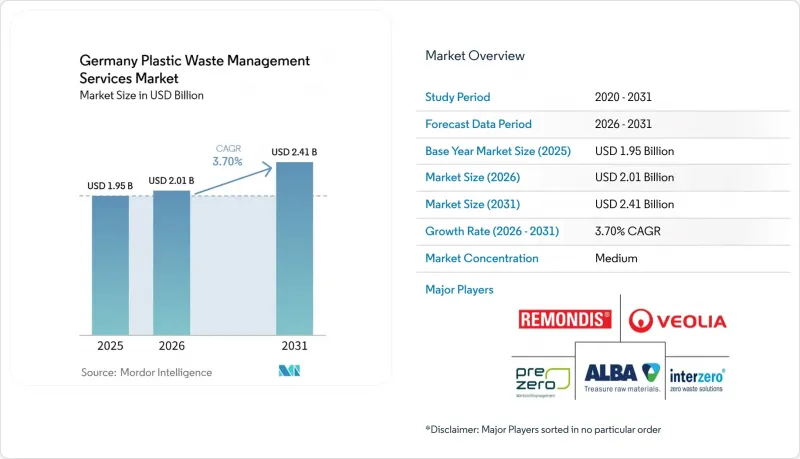
根據 Mordor Intelligence 預測,德國塑膠廢棄物管理服務市場規模將從 2025 年的 19.5 億美元和 2026 年的 20.1 億美元成長到 2031 年的 24.1 億美元,2026 年至 2031 年的年複合成長率(CAGR)為 3.70%。
本報告按來源(住宅、商業、工業及其他)、服務提供者(公共/市政、私人廢棄物管理公司及其他)和服務類型(收集、運輸、分類/分離、處置/處理及其他)進行分類。市場預測以美元計價。
德國塑膠廢棄物管理服務市場的趨勢與洞察
德國的雙軌垃圾收集網路和較高的家庭參與率
德國的「黃袋」和「黃桶」回收系統仍然是德國塑膠廢棄物管理服務市場持續成長的基礎。到2025年,43個專門的分類處理設施將處理260萬噸輕量包裝,參與雙軌制系統的輕量包裝總回收率將超過90%。如此高的家庭參與度維持了收集路線的效率,並確保了企業消費後塑膠的穩定供應。在下一個成長階段,將難以收集的商業和工業廢棄物納入正式合約比擴大家庭收集範圍更為重要。尤其值得注意的是,目前德國每年560萬噸塑膠廢棄物中只有320萬噸進入回收流程。此外,德國包裝法規規定的強制性分類和收集義務使得收集服務成為強制性的而非可選項,這有助於整個市場合約續約的穩定性。
VerpackDG 加強了回收配額和包裝法規。
德國包裝方法已提高塑膠包裝的回收要求,目前強制要求機械回收率達到63%,並設定了2025年底達到65%、2030年底達到70%的目標。 Dual Systems公司在2024年達到了輕質包裝材料50%的回收標準,回收率達到52.55%。這表明合規是可以實現的,但也越來越依賴加工品質和下游加工能力。這正在改變德國塑膠廢棄物管理服務市場的商業結構,因為僅靠承擔繁重物流負擔的合約已不足以滿足未來的回收率目標。企業面臨進一步提升國內聚合物升級能力的壓力,以便將分類後的廢棄物從低價值的收集途徑轉移到高價值的回收途徑。自2026年8月起,《塑膠廢棄物法規》(PPWR)將新增多項要求。預計有關可回收性的設計標準和再生材料含量的規定將增加對可審計合規支援的需求。
混合和受污染塑膠廢棄物的處理成本很高
在德國塑膠廢棄物管理服務市場,混合和受污染的塑膠廢棄物持續擠壓著利潤空間。根據德國塑膠廢棄物管理局(ZSVR)2025年的數據,僅有52.55%的輕質包裝廢棄物符合回收標準,這意味著大部分回收材料仍需走成本高昂的替代處理途徑。商業和工業塑膠的回收處理更具挑戰性,因為塗層薄膜、複合材料和多材料結構在實現有效的聚合物分離之前需要進行更多預處理。即使表面上看回收量可觀,這也增加了人事費用、分類和清潔負擔。在基於PPWR的生態設計標準能夠簡化包裝形式並帶來更清潔的回收流程之前,許多企業在分類通用材料方面仍將面臨經濟壓力。
細分市場分析
到2025年,工業廢棄物仍將是最大的廢棄物來源,佔市場佔有率的40.80%,而商業廢棄物預計到2031年將以4.1%的複合年成長率成長。工業廢棄物來源持續產生塑膠廢棄物,這些廢棄物來自製造、化學加工、包裝和汽車組裝等環節,與規模小規模、分散的廢棄物來源相比,它們為處理服務提供者提供了更穩定的合約基礎。這些廢棄物通常成分較為均一,包括廢料、清洗材料和單一材料包裝,因此適合簽訂長期原料供應合約。德國塑膠廢棄物管理服務產業正受益於這些更清潔的工業廢棄物來源,因為投入物的品質更可預測,從而提高了產量,並確保下游製程的穩定利用。
透過「黃色垃圾袋」和「黃色垃圾桶」收集的住宅垃圾仍然是最主要的收集來源。然而,由於收集密度已經很高且網路成熟,限制了收入成長。因此,德國塑膠廢棄物管理服務市場短期內的大部分擴張將依賴商業廢棄物和混合工業廢棄物,而不是開發新的居民生活垃圾收集路線。德國建築業協會(BKV)委託進行的一項研究表明,德國混合廢棄物和建築廢棄物中存在100萬噸未使用的塑膠廢棄物,這解釋了為什麼這一來源吸引了新的收集商的注意。 「其他」類別,包括來自機構、農業和建築業的塑膠,如果營運商建立專門的收集和物流系統,也能提供一定的利潤空間。同時,預計到2024年,德國的再生塑膠量將達到172.7萬噸,佔總回收量的14.4%,凸顯了對可靠再生材料日益成長的需求。
其他好處:
- Excel格式的市場預測(ME)表
- 3個月的分析師支持
目錄
第1章:引言
- 研究假設和市場定義
- 調查範圍
第2章:調查方法
第3章執行摘要
第4章 市場狀況
- 市場概覽
- 市場促進因素
- 德國的雙軌制回收網路和較高的家庭參與率
- VerpackDG 制定了更嚴格的回收配額和包裝法規。
- 受擴大生產者責任制計畫的推動,對經認證的廢棄物管理服務的需求增加。
- 擴建先進的分選、洗滌和聚合物增強基礎設施
- 數位化廢棄物溯源、路線最佳化和報告流程自動化。
- 汽車和包裝產業對再生材料的採購需求推動了這項需求。
- 市場限制因素
- 處理混合和受污染塑膠廢棄物的成本很高
- 能源和營運成本不斷上漲
- 廢棄物收集和回收作業人手不足
- 原生聚合物價格的波動正在影響消費後再生塑膠(PCR)產業的競爭。
- 價值供應鏈分析
- 監理情勢
- 技術展望
- 波特五力模型
- 創業生態系分析
- 全球貿易趨勢和進口限制
- 地緣政治事件對市場的影響
第5章 市場規模與成長預測
- 來源
- 住宅
- 商業設施(零售、辦公室等)
- 產業
- 其他(組織、農業等)
- 透過服務供應商
- 公共/市政
- 私人廢棄物管理公司
- 其他組織包括生產者責任組織(PRO)等。
- 按服務類型
- 收集、運輸、分類和分離
- 處置/處理
- 掩埋處置
- 回收和資源回收
- 焚燒和垃圾焚化發電
- 其他(化學加工等)
- 其他服務(諮詢、審計、訓練等)
第6章 競爭情勢
- 市場集中度
- 策略趨勢
- 市佔率分析
- 公司簡介
- Remondis SE & Co. KG
- PreZero International
- Veolia Environnement SA
- ALBA Group
- Interzero
- Der Grune Punkt(Duales System Holding)
- SUEZ
- Tomra Systems
- EEW Energy from Waste GmbH
- Lobbe Holding GmbH & Co KG
- PURUS PLASTICS GmbH
- RIGK GmbH
- APK AG
- Systec Plastics GmbH
- Pekutherm Kunststoffe GmbH
- Bartscherer & Co. Recycling GmbH
- CreaCycle GmbH
- Cabka Group GmbH
- Karl Meyer AG
- Otto Dorner Entsorgung GmbH
第7章 市場機會與未來展望
According to Mordor Intelligence, the Germany plastic waste management services market size is projected to expand from USD 1.95 billion in 2025 and USD 2.01 billion in 2026 to USD 2.41 billion by 2031, registering a CAGR of 3.70% between 2026 to 2031.
This report is Segmented by Source (Residential, Commercial, Industrial, and Others), by Service Provider (Public/Municipal, Private Waste Management Companies, and Others), and by Service Type (Collection, Transportation, Sorting & Segregation, Disposal / Treatment, and Others). The Market Forecasts are Provided in Terms of Value (USD).
Germany Plastic Waste Management Services Market Trends and Insights
Germany's Dual-System Collection Network and High Household Participation
Germany's Yellow Bag and Yellow Bin system remains the foundation for recurring service demand in the Germany plastic waste management services market. In 2025, 43 dedicated sorting facilities processed 2.6 million tons of lightweight packaging, and total lightweight packaging recovery exceeded 90% of the volumes participating in dual systems. That level of household participation keeps collection routes efficient and gives operators a dependable flow of post-consumer plastics. The next growth step is less about adding household coverage and more about bringing harder commercial and industrial streams into formal contracts, especially because only 3.2 million of Germany's 5.6 million tons of annual plastic waste currently enter recycling channels. Separate collection duties under German packaging rules also keep collection services non-discretionary, which supports stable contract renewal patterns across the market.
VerpackDG Recycling Quotas and Packaging Compliance Escalation
Germany's Packaging Act has already raised plastic packaging recycling obligations, with a 63% mechanical recycling requirement in place today, a 65% threshold due by the end of 2025, and a 70% requirement due by the end of 2030. Dual systems cleared the 50% lightweight packaging recycling threshold in 2024, reaching 52.55%, confirming that compliance is possible but increasingly dependent on processing quality and downstream capacity.This is changing the commercial mix in the Germany plastic waste management services market because logistics-heavy contracts alone are no longer enough to secure future quota performance. Operators are under pressure to add more domestic polymer-upgrading capacity so that sorted output can move into higher-value recycling channels rather than lower-value recovery routes. The PPWR will add another layer from August 2026, as recyclability design standards and recycled-content rules will increase the need for auditable compliance support.
High Processing Costs for Mixed and Contaminated Plastic Waste
Mixed and contaminated plastic waste continues to limit margins in the Germany plastic waste management services market. ZSVR data for 2025 showed that only 52.55% of total lightweight packaging collection volumes met the recycling threshold, which means a large share of collected material still moved into costlier alternative treatment paths. Commercial and industrial plastics can add another layer of difficulty because coated films, laminates, and multi-material formats often need more pre-treatment before viable polymer separation. This increases labor, sorting, and cleaning intensity even when collection volumes look attractive on paper. Until eco-design standards under the PPWR translate into simpler packaging formats and cleaner incoming streams, many operators will continue to face pressure on commodity sorting economics.
Other drivers and restraints analyzed in the detailed report include:
- Extended Producer Responsibility-Led Demand for Certified Waste Management Services
- Expansion of Advanced Sorting, Washing, and Polymer-Upgrading Infrastructure
- Rising Energy and Operating Costs
For complete list of drivers and restraints, kindly check the Table Of Contents.
Segment Analysis
Industrial waste remained the largest source segment in 2025, accounting for 40.80% of the market share, while commercial waste is forecast to expand at 4.1% CAGR through 2031. Industrial generators produce recurring plastic waste from manufacturing, chemical processing, packaging conversion, and automotive assembly, providing processors with a steadier contract base than fragmented, smaller generators. Those waste streams are often more homogeneous, including off-cuts, purge material, and mono-material wraps, so they fit long-term feedstock agreements well. The Germany plastic waste management services industry benefits from these cleaner industrial streams because more predictable input quality supports better yields and a more stable downstream offtake.
Residential waste remains the most visible collection stream through Yellow Bags and Yellow Bins. Still, its revenue growth is more limited because collection density is already high and the network is mature. That keeps much of the near-term expansion in the Germany plastic waste management services market tied to commercial and mixed business waste rather than new household route buildout. A BKV-commissioned study identified 1 million tons of untapped plastic waste in Germany's mixed commercial and construction streams, which explains why this source group is drawing fresh collection interest. The others segment, including institutional, agricultural, and construction plastics, can also deliver niche margins when operators build specialized take-back logistics, while Germany's post-consumer recycled plastic conversion reached 1,727kt in 2024, equal to 14.4% of total conversion, which supports stronger demand for reliable recycled feedstock.
Complete Report Scope:
- By Source
- Residential
- Commercial (retail, office, etc.)
- Industrial
- Others (institutional, agricultural, etc)
- By Service Provider
- Public/Municipal
- Private Waste Management Companies
- Others - Producer Responsibility Organizations (PROs), etc.
- By Service Type
- Collection, Transportation, Sorting & Segregation
- Disposal / Treatment
- Landfill
- Recycling & Resource Recovery
- Incineration & Waste-to-Energy
- Others (Chemical Treatment, etc.)
- Others (Consulting, Audit & Training, etc.)
List of Companies Covered in this Report:
- Remondis SE & Co. KG
- PreZero International
- Veolia Environnement S.A.
- ALBA Group
- Interzero
- Der Grune Punkt (Duales System Holding)
- SUEZ
- Tomra Systems
- EEW Energy from Waste GmbH
- Lobbe Holding GmbH & Co KG
- PURUS PLASTICS GmbH
- RIGK GmbH
- APK AG
- Systec Plastics GmbH
- Pekutherm Kunststoffe GmbH
- Bartscherer & Co. Recycling GmbH
- CreaCycle GmbH
- Cabka Group GmbH
- Karl Meyer AG
- Otto Dorner Entsorgung GmbH
Additional Benefits:
- The market estimate (ME) sheet in Excel format
- 3 months of analyst support
TABLE OF CONTENTS
1 Introduction
- 1.1 Study Assumptions & Market Definition
- 1.2 Scope of the Study
2 Research Methodology
3 Executive Summary
4 Market Landscape
- 4.1 Market Overview
- 4.2 Market Drivers
- 4.2.1 Germany's Dual-System Collection Network And High Household Participation
- 4.2.2 VerpackDG Recycling Quotas And Packaging Compliance Escalation
- 4.2.3 Extended Producer Responsibility-Led Demand For Certified Waste Management Services
- 4.2.4 Expansion Of Advanced Sorting, Washing, And Polymer-Upgrading Infrastructure
- 4.2.5 Digital Waste Traceability, Route Optimization, And Reporting Automation
- 4.2.6 Demand Pull From Automotive And Packaging Recycled-Content Procurement
- 4.3 Market Restraints
- 4.3.1 High Processing Costs for Mixed and Contaminated Plastic Waste
- 4.3.2 Rising Energy and Operating Costs
- 4.3.3 Labor Shortages in Waste Collection and Recycling Operations
- 4.3.4 Volatility in Virgin Polymer Prices Affects PCR Competitiveness
- 4.4 Value / Supply-Chain Analysis
- 4.5 Regulatory Landscape
- 4.6 Technological Outlook
- 4.7 Porter's Five Forces
- 4.7.1 Threat of New Entrants
- 4.7.2 Bargaining Power of Suppliers
- 4.7.3 Bargaining Power of Buyers
- 4.7.4 Threat of Substitutes
- 4.7.5 Industry Rivalry
- 4.8 Startup Ecosystem Analysis
- 4.9 Global Trade Flows & Import Restrictions
- 4.10 Impact of Geopolitical Events on the Market
5 Market Size and Growth Forecasts (Value)
- 5.1 By Source
- 5.1.1 Residential
- 5.1.2 Commercial (retail, office, etc.)
- 5.1.3 Industrial
- 5.1.4 Others (institutional, agricultural, etc)
- 5.2 By Service Provider
- 5.2.1 Public/Municipal
- 5.2.2 Private Waste Management Companies
- 5.2.3 Others - Producer Responsibility Organizations (PROs), etc.
- 5.3 By Service Type
- 5.3.1 Collection, Transportation, Sorting & Segregation
- 5.3.2 Disposal / Treatment
- 5.3.2.1 Landfill
- 5.3.2.2 Recycling & Resource Recovery
- 5.3.2.3 Incineration & Waste-to-Energy
- 5.3.2.4 Others (Chemical Treatment, etc.)
- 5.3.3 Others (Consulting, Audit & Training, etc.)
6 Competitive Landscape
- 6.1 Market Concentration
- 6.2 Strategic Moves
- 6.3 Market Share Analysis
- 6.4 Company Profiles {(includes Global level Overview, Market level overview, Core Segments, Financials as available, Strategic Information, Market Rank/Share for key companies, Products & Services, and Recent Developments)}
- 6.4.1 Remondis SE & Co. KG
- 6.4.2 PreZero International
- 6.4.3 Veolia Environnement S.A.
- 6.4.4 ALBA Group
- 6.4.5 Interzero
- 6.4.6 Der Grune Punkt (Duales System Holding)
- 6.4.7 SUEZ
- 6.4.8 Tomra Systems
- 6.4.9 EEW Energy from Waste GmbH
- 6.4.10 Lobbe Holding GmbH & Co KG
- 6.4.11 PURUS PLASTICS GmbH
- 6.4.12 RIGK GmbH
- 6.4.13 APK AG
- 6.4.14 Systec Plastics GmbH
- 6.4.15 Pekutherm Kunststoffe GmbH
- 6.4.16 Bartscherer & Co. Recycling GmbH
- 6.4.17 CreaCycle GmbH
- 6.4.18 Cabka Group GmbH
- 6.4.19 Karl Meyer AG
- 6.4.20 Otto Dorner Entsorgung GmbH
7 Market Opportunities & Future Outlook
- 7.1 White-space & unmet-need assessment

 新加坡塑膠廢棄物管理服務:市場佔有率分析、行業趨勢和統計數據以及成長預測(2026-2031 年)美國塑膠廢棄物管理服務:市場佔有率分析、行業趨勢和統計數據以及成長預測(2026-2031 年)英國塑膠廢棄物管理服務:市場佔有率分析、行業趨勢和統計數據、成長預測(2026-2031 年)日本塑膠廢棄物管理服務:市場佔有率分析、產業趨勢與統計及成長預測(2026-2031)
 塑膠廢棄物管理服務市場:按服務類型、塑膠類型、來源和最終用途產業分類-2026-2032年全球市場預測塑膠廢棄物管理與回收:市場佔有率分析、產業趨勢與統計、成長預測(2026-2031)
 全球塑膠廢棄物管理市場規模、佔有率、趨勢和成長分析報告(2026-2034年)
 塑膠廢棄物管理市場:依塑膠類型、應用、回收方法、技術、國家及地區分類-全球產業分析、市場規模、市場佔有率及2026年至2033年預測
 寵物水族箱及池塘維護系統市場預測至2034年-全球水族箱設備及系統、池塘設備及系統、水族箱及池塘耗材、水族箱及池塘配件、服務及解決方案以及區域分析自動化寵物護理系統市場預測至2034年—按系統類型、寵物類型、連接方式、技術、最終用戶、分銷管道和地區分類的全球分析