


 |
市場調查報告書
商品編碼
2099801
客戶旅程編配:市場佔有率分析、產業趨勢與統計、成長預測(2026-2031)Customer Journey Orchestration - Market Share Analysis, Industry Trends & Statistics, Growth Forecasts (2026 - 2031) |
||||||

※ 本網頁內容可能與最新版本有所差異。詳細情況請與我們聯繫。
根據 Mordor Intelligence 預測,客戶旅程編配市場規模預計將在 2025 年達到 115.6 億美元,2026 年達到 130.9 億美元,到 2031 年達到 244.1 億美元,2026 年至 2031 年的複合年成長率為 13.27%。
本報告按元件(軟體和服務)、部署模式(雲端、本地部署、混合部署)、應用程式(客戶旅程設計和體驗管理等)、組織規模(大型企業和中小企業)、最終用戶產業(零售和電子商務等)以及地區進行細分。市場預測以價值(美元)表示。
全球客戶旅程編配市場趨勢與洞察
對即時、個人化旅程的需求日益成長
由於靜態宣傳活動無法滿足客戶在數位管道日益成長的期望,即時個人化正從一項可選功能轉變為客戶旅程編配市場的核心營運需求。企業越來越需要能夠在同一互動視窗內處理當前行為、近期購買記錄、通路環境和服務歷史的系統。 Adobe 於 2025 年 9 月率先推出 AI 代理,用於變革客戶體驗,引領了這項轉變。其中包括 Adobe Journey Optimizer 中的 Journey Agent,它能夠根據預設目標建立和編配跨網頁、行動應用程式和電子郵件的旅程。 Twilio 隨後於 2026 年 5 月推出了 Conversation Orchestrator、Conversation Memory 和 Conversation Intelligence。所有這些產品都旨在維護客戶情境,並支援跨通路的 AI 與人協作互動。隨著越來越多的供應商將即時編配置於其產品藍圖的核心位置,客戶旅程編配市場正從逐一宣傳活動活動執行模式轉向持續互動模式。
日益成長的整合各觸點分散客戶資料的需求
客戶資料碎片化仍然是客戶旅程編配市場中有效編配面臨的最明顯障礙之一。這是因為訊號通常分散在 CRM、電商、服務和分析等不同的系統中。當這些記錄無法互聯時,旅程的邏輯就會不完整,下一步行動的決策將基於片面的上下文訊息,而非完整的關係。 2025 年 3 月,Adobe 發布了 Experience Platform Agent Orchestrator 來解決這個問題。憑藉與 Acxiom、AWS、Genesys、IBM、Microsoft、SAP、ServiceNow 和 Workday 等公司的夥伴關係,它支援跨客戶服務、ERP(企業資源規劃)、協作和資料管理環境的協同執行。這些供應商趨勢表明,買家不僅在評估決策的質量,還在檢驗平台與其現有企業架構的整合程度。因此,生態系統的廣度已成為客戶旅程編配市場競爭的核心因素,尤其是在擁有多個傳統平台的大規模客戶之間。
與傳統 CRM、CDP 和行銷系統整合的複雜性。
許多大型企業正嘗試將新的編配層連接到其原有的客戶關係管理 (CRM)、行銷、商務和服務系統中,但整合的複雜性仍然是客戶旅程編配市場面臨的主要障礙。這些環境通常並非旨在即時傳遞客戶訊號,導致部署延遲和運作碎片化。 Adobe Experience Platform Agent Orchestrator 的合作夥伴主導架構表明,買家非常重視跨客戶服務、企業應用程式、協作工具和資料環境的認證整合。 SAP 和 Google Cloud 也在 2026 年 4 月擴展了合作夥伴關係,以支援 SAP Engagement Cloud、SAP CX、Joule 和 Gemini Enterprise 上的多代理 AI。這反映了市場將現有企業系統與新的編配和 AI 工作流程連接起來的整體需求。在這些環境之間的整合變得更加簡單之前,客戶旅程編配市場將繼續面臨更長的企業銷售週期和在複雜客戶中更具選擇性的部署。
細分市場分析
在2025年的客戶旅程編配市場中,軟體將佔據76.84%的佔有率,這反映了企業在該領域的支出以平台主導的特徵。採購企業仍然將大部分資源投入到旅程建構器、即時決策引擎、客戶資料連接器和跨通路核心編配層。這也表明,在客戶經驗營運現代化過程中,企業仍然傾向於可重複使用的互動系統,而不是一次性客製化開發。已部署的軟體基礎架構之所以重要,是因為平台帶來的持續收入使供應商有更多資金用於人工智慧功能、合規性管理以及更深入的生態系統整合。
預計到2031年,服務業將以15.92%的複合年成長率成長,並有望成為成長最快的組成部分,因為僅靠內部團隊難以滿足部署和管治的需求。這一成長與平台在更多業務部門的採用後,實施、系統整合、營運管理、培訓和最佳化工作密切相關。客戶旅程編配市場在這些領域正經歷更廣泛的變革,因為人工智慧驅動的部署需要新的營運實踐來進行模型監控、旅程測試和內容管理。因此,服務業的成長並非因為軟體的重要性降低,而是因為企業負責人越來越需要外部支援才能大規模地從軟體中獲取價值。
預計到2025年,客戶旅程編配市場中,雲端將佔據61.63%的市場佔有率,這表明可擴展、集中更新的環境仍然是主流的採用策略。企業重視雲端採用通常帶來的基礎設施負擔減輕、發布週期縮短以及易於存取預先建置的AI功能等優勢。這使得雲端成為新部署的核心,尤其對於那些希望加快行銷、服務和商務團隊價值實現速度的公司而言更是如此。因此,目前客戶旅程編配市場的格局仍然嚴重偏向雲,雲端已成為企業廣泛部署的預設架構。
預計到2031年,本地部署環境將以15.37%的複合年成長率成長,這將導致一種不尋常的模式:規模最大的模型和成長最快的模型並不一致。這種轉變與資料主權、特定產業合規性以及買家對將敏感決策資料遷移到受控環境之外的謹慎態度有關。為了因應這項壓力,Braze於2026年4月在Google Cloud上推出了BrazeAI Decisioning Studio的歐盟託管服務,此舉直接滿足了歐洲的資料居住要求。出於類似的原因,混合部署也變得越來越重要,因為許多買家希望在進行基於雲端的推理和協調的同時,仍然希望將某些客戶記錄和受監管的工作流程保留在他們自己的受控系統附近。
區域分析
到2025年,北美將佔據客戶旅程編配市場39.18%的佔有率,並繼續保持在該地區的領先地位。該地區受益於企業早期採用、高額技術投資以及眾多提供客戶經驗和CRM工作流程的領先供應商。此外,北美擁有完善的企業應用部署基礎設施,使其成為涵蓋行銷、服務和商務的編配功能的理想市場。隨著主要平台供應商不斷建立以企業數據和跨通路互動為核心的AI主導藍圖,美國的客戶旅程編配市場尤其活躍。同時,各州的隱私法規也迫使買家更加關注用戶同意管治和資料使用邊界。
由於強勁的企業需求,歐洲仍然是客戶旅程編配市場的重要參與者,但部署方案越來越受到隱私、資料儲存位置和稽核要求的影響。德國、英國和法國仍然是區域需求的核心,尤其是在銀行、金融和保險 (BFSI) 以及電信業,這些行業的客戶互動頻繁且受到嚴格監管。為了因應這種環境,Braze 於 2026 年 4 月在 Google Cloud 上推出了 BrazeAI Decisioning Studio 的歐盟託管服務,確保即時決策資料不會流出歐盟。因此,該地區仍然是法律規範如何重塑客戶旅程編配市場平台架構的最典型例證之一。
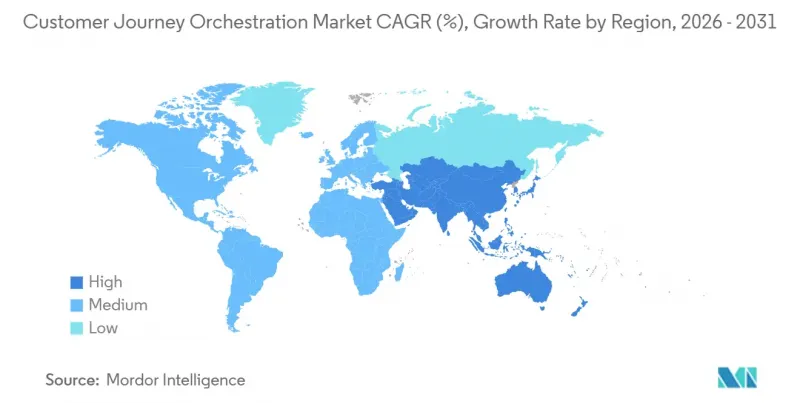
預計到2031年,亞太地區將以18.43%的複合年成長率成長,成為客戶旅程編配市場成長最快的地區。中國、印度、日本、韓國和澳洲是主要的需求中心,這得益於大規模的數位使用者群體以及對即時互動日益成長的期望。該地區普遍存在的「行動優先」行為正迫使供應商調整編配模型,減少對傳統以電子郵件為中心的互動模式的依賴。東南亞地區則受益於以通訊主導的商務和以應用程式為中心的服務使用行為,這要求編配能夠快速回應大量的數位觸點。類似的機會也促使人們關注在地化和資料管治,因為區域隱私法規和居住要求與產品設計之間的聯繫日益緊密。
- Salesforce, Inc.
- Adobe Inc.
- Oracle Corporation
- Microsoft Corporation
- IBM Corporation
- SAP SE
- NICE Ltd.
- Genesys Cloud Services, Inc.
- Pegasystems Inc.
- Twilio Inc.
- Braze, Inc.
- Sprinklr, Inc.
- Medallia, Inc.
- Qualtrics International Inc.
- Verint Systems Inc.
- SAS Institute Inc.
- Acquia, Inc.
- Contentsquare
- Quadient SA
- Tealium Inc.
- Insider
- MoEngage, Inc.
- Amperity, Inc.
- Dynamic Yield by Mastercard
- InMoment, Inc.
其他好處:
- Excel格式的市場預測(ME)表
- 3個月的分析師支持
目錄
第1章:引言
- 研究假設和市場定義
- 調查範圍
第2章:調查方法
第3章執行摘要
第4章 市場狀況
- 市場概覽
- 市場促進因素
- 對即時、個人化客戶體驗的需求日益成長。
- 日益成長的整合各觸點分散客戶資料的需求
- 擴大人工智慧驅動的決策自動化和「次優行動」的範圍。
- 擴大雲端原生客戶經驗堆疊的採用
- 數位行銷流程往往包含較長的考慮階段,因此提高轉換率的壓力越來越大。
- 低層級升降機編配在中型企業中越來越受歡迎。
- 市場限制因素
- 與傳統 CRM、CDP 和行銷系統整合的複雜性。
- 資料隱私、同意和管治限制
- 難以證明各孤立業務部門的投資報酬率有所提升。
- 專業旅程設計和分析人員短缺
- 產業價值鏈分析
- 監理情勢
- 技術展望
- 宏觀經濟因素對市場的影響
- 波特五力分析
第5章 市場規模與成長預測
- 按組件
- 軟體
- 服務
- 部署模式
- 雲
- 現場
- 混合
- 透過使用
- 客戶旅程設計與體驗管理
- 宣傳活動管理
- 個人化
- 分析與報告
- 旅程最佳化
- 按組織規模
- 大公司
- 小型企業
- 按最終用戶行業分類
- BFSI
- 零售與電子商務
- IT/通訊
- 衛生保健
- 旅遊與飯店
- 媒體與娛樂
- 其他終端用戶產業
- 按地區
- 北美洲
- 美國
- 加拿大
- 墨西哥
- 南美洲
- 巴西
- 阿根廷
- 其他南美國家
- 歐洲
- 德國
- 英國
- 法國
- 義大利
- 西班牙
- 俄羅斯
- 其他歐洲國家
- 亞太地區
- 中國
- 印度
- 日本
- 韓國
- 澳洲
- 其他亞太國家
- 中東和非洲
- 中東
- 沙烏地阿拉伯
- 阿拉伯聯合大公國
- 其他中東國家
- 非洲
- 南非
- 奈及利亞
- 其他非洲國家
- 中東
- 北美洲
第6章 競爭情勢
- 市場集中度
- 策略趨勢
- 市佔率分析
- 公司簡介
- Salesforce, Inc.
- Adobe Inc.
- Oracle Corporation
- Microsoft Corporation
- IBM Corporation
- SAP SE
- NICE Ltd.
- Genesys Cloud Services, Inc.
- Pegasystems Inc.
- Twilio Inc.
- Braze, Inc.
- Sprinklr, Inc.
- Medallia, Inc.
- Qualtrics International Inc.
- Verint Systems Inc.
- SAS Institute Inc.
- Acquia, Inc.
- Contentsquare
- Quadient SA
- Tealium Inc.
- Insider
- MoEngage, Inc.
- Amperity, Inc.
- Dynamic Yield by Mastercard
- InMoment, Inc.
第7章 市場機會與未來展望
According to Mordor Intelligence, the customer journey orchestration market size is projected to be USD 11.56 billion in 2025, USD 13.09 billion in 2026, and reach USD 24.41 billion by 2031, growing at a CAGR of 13.27% from 2026 to 2031.
This report is Segmented by Component (Software, and Services), Deployment Mode (Cloud, On-Premises, and Hybrid), Application (Customer Journey Design and Experience Management, and More), Organization Size (Large Enterprises, and Small and Medium Enterprises), End User Industry (Retail and E-Commerce, and More), and Geography. The Market Forecasts are Provided in Terms of Value (USD).
Global Customer Journey Orchestration Market Trends and Insights
Rising Demand for Real-Time Personalized Journeys
Real-time personalization is moving from an optional feature to a core operating requirement in the customer journey orchestration market because static campaigns are not meeting rising customer expectations across digital channels. Enterprises increasingly want systems that can react to current behavior, recent purchases, channel context, and service history within the same interaction window. Adobe reinforced this shift in September 2025 when it announced the general availability of AI agents for customer experience transformation, including Journey Agent in Adobe Journey Optimizer that creates and orchestrates journeys across web, mobile, app, and email based on defined goals. Twilio pushed the same direction in May 2026 with Conversation Orchestrator, Conversation Memory, and Conversation Intelligence, all built to preserve customer context and support coordinated AI and human interactions across channels. As more vendors center their product roadmaps on real-time orchestration, the customer journey orchestration market is moving toward continuous engagement models rather than campaign-by-campaign execution.
Growing Need to Unify Fragmented Customer Data Across Touchpoints
Fragmented customer data remains one of the clearest barriers to useful orchestration in the customer journey orchestration market because signals often sit across separate CRM, commerce, service, and analytics systems. When those records do not connect, journey logic becomes incomplete, and the next action is based on partial context instead of the full relationship. Adobe addressed this problem in March 2025 through the launch of Experience Platform Agent Orchestrator, supported by partnerships with Acxiom, AWS, Genesys, IBM, Microsoft, SAP, ServiceNow, and Workday to enable coordinated execution across customer service, enterprise resource planning, collaboration, and data management environments. That vendor behavior shows that buyers are not only evaluating decisioning quality, but they are also testing how well a platform can sit across the existing enterprise stack. This keeps ecosystem breadth close to the center of competition in the customer journey orchestration market, especially in large accounts with multiple legacy platforms.
Integration Complexity with Legacy CRM, CDP, and Marketing Systems
Integration complexity is still a meaningful brake on the customer journey orchestration market because many large organizations are trying to connect new orchestration layers to older CRM, marketing, commerce, and service systems. Those environments were often not designed to emit customer signals in real time, which slows implementation and keeps activation fragmented. The partner-heavy structure of Adobe Experience Platform Agent Orchestrator shows how much value buyers place on certified integrations across customer service, enterprise applications, collaboration tools, and data environments. SAP and Google Cloud also expanded their partnership in April 2026 to support multi-agent AI across SAP Engagement Cloud, SAP CX, Joule, and Gemini Enterprise, which reflects the wider market need to bridge established enterprise systems with newer orchestration and AI workflows. Until integration becomes simpler across those environments, the customer journey orchestration market will continue to face longer enterprise sales cycles and more selective rollouts in complex accounts.
Other drivers and restraints analyzed in the detailed report include:
- Expansion of AI-Driven Decisioning and Next-Best-Action Automation
- Increasing Adoption of Cloud-Native Customer Experience Stacks
- Data Privacy, Consent, and Governance Constraints
For complete list of drivers and restraints, kindly check the Table Of Contents.
Segment Analysis
Software held 76.84% share in the customer journey orchestration market in 2025, which reflects the platform-led nature of enterprise spending in this category. Buyers continue to allocate most value to journey builders, real-time decisioning engines, customer data connectors, and the core orchestration layer that sits across channels. This also shows that enterprises still prefer reusable systems of engagement over one-off custom builds when they modernize customer experience operations. The installed software base matters because recurring platform revenue gives vendors more room to fund AI features, compliance controls, and deeper ecosystem integration.
Services are projected to grow at 15.92% CAGR through 2031, making them the faster-moving component as deployment and governance needs become harder to manage with internal teams alone. That expansion is tied to implementation, system integration, managed operations, training, and optimization work that follows platform adoption across more business units. The customer journey orchestration market is seeing a broader shift here because AI-enabled deployment requires new operating practices around model oversight, journey testing, and content management. As a result, services are growing not because software is weakening, but because enterprise buyers increasingly need outside support to activate software value at scale.
Cloud accounted for 61.63% share of the customer journey orchestration market size in 2025, which shows that most deployments still favor scalable and centrally updated environments. Enterprises value the lower infrastructure burden, the faster release cycle, and the easier access to prebuilt AI features that cloud deployment usually provides. This keeps cloud at the center of new rollouts, especially for companies that want faster time to value across marketing, service, and commerce teams. The current structure of the customer journey orchestration market, therefore, still leans toward cloud as the default architecture for broad enterprise adoption.
On-premises is projected to expand at 15.37% CAGR through 2031, which creates an unusual pattern where the largest model and the fastest-growing model are not the same. The shift is linked to data sovereignty, sector-specific compliance, and buyer caution around moving sensitive decisioning data outside controlled environments. Braze responded to that pressure in April 2026 through EU hosting on Google Cloud for BrazeAI Decisioning Studio, a move aimed directly at European data residency needs. Hybrid deployment is gaining relevance for the same reason because many buyers want cloud-based inference and coordination while keeping selected customer records or regulated workflows closer to their own governed systems.
Complete Report Scope:
- By Component
- Software
- Services
- By Deployment Mode
- Cloud
- On-Premises
- Hybrid
- By Application
- Customer Journey Design and Experience Management
- Campaign Management
- Personalization
- Analytics and Reporting
- Journey Optimization
- By Organization Size
- Large Enterprises
- Small and Medium Enterprises
- By End User Industry
- BFSI
- Retail and E-Commerce
- IT and Telecommunications
- Healthcare
- Travel and Hospitality
- Media and Entertainment
- Other End User Industries
- By Geography
- North America
- United States
- Canada
- Mexico
- South America
- Brazil
- Argentina
- Rest of South America
- Europe
- Germany
- United Kingdom
- France
- Italy
- Spain
- Russia
- Rest of Europe
- Asia-Pacific
- China
- India
- Japan
- South Korea
- Australia
- Rest of Asia-Pacific
- Middle East and Africa
- Middle East
- Saudi Arabia
- United Arab Emirates
- Rest of Middle East
- Africa
- South Africa
- Nigeria
- Rest of Africa
- Middle East
- North America
Geography Analysis
North America held 39.18% of the customer journey orchestration market share in 2025, which kept the region in the lead. The region benefits from early enterprise adoption, high technology spending, and the presence of many of the largest software vendors serving customer experience and CRM workflows. A large installed base of enterprise applications also makes North America a natural launch market for orchestration features that extend across marketing, service, and commerce. The customer journey orchestration market in the United States remains especially active because major platform vendors continue to build AI-led roadmaps around enterprise data and cross-channel engagement. At the same time, state-level privacy rules are pushing buyers to pay closer attention to consent governance and data activation boundaries.
Europe remains important in the customer journey orchestration market because enterprise demand is strong, but deployment choices are shaped more heavily by privacy, residency, and audit requirements. Germany, the United Kingdom, and France continue to anchor regional demand, especially in BFSI and telecommunications, where customer interactions are frequent and regulated. Braze addressed this environment in April 2026 with EU hosting on Google Cloud for BrazeAI Decisioning Studio, so that real-time decisioning data no longer leaves the European Union region. The region, therefore, remains one of the clearest examples of how regulatory structure can reshape platform architecture in the customer journey orchestration market.
Asia-Pacific is projected to expand at 18.43% CAGR through 2031, making it the fastest-growing geography in the customer journey orchestration market. China, India, Japan, South Korea, and Australia are the main demand centers, supported by large digital user bases and rising expectations for real-time engagement. Mobile-first behavior across much of the region is pushing vendors to support orchestration models that are less dependent on traditional email-heavy engagement patterns. Southeast Asia adds another layer of momentum because messaging-led commerce and app-centric service behavior require orchestration that can react quickly across high-volume digital touchpoints. The same opportunity is drawing attention to localization and data governance, since regional privacy rules and residency expectations are becoming harder to separate from product design.
- Salesforce, Inc.
- Adobe Inc.
- Oracle Corporation
- Microsoft Corporation
- IBM Corporation
- SAP SE
- NICE Ltd.
- Genesys Cloud Services, Inc.
- Pegasystems Inc.
- Twilio Inc.
- Braze, Inc.
- Sprinklr, Inc.
- Medallia, Inc.
- Qualtrics International Inc.
- Verint Systems Inc.
- SAS Institute Inc.
- Acquia, Inc.
- Contentsquare
- Quadient S.A.
- Tealium Inc.
- Insider
- MoEngage, Inc.
- Amperity, Inc.
- Dynamic Yield by Mastercard
- InMoment, Inc.
Additional Benefits:
- The market estimate (ME) sheet in Excel format
- 3 months of analyst support
TABLE OF CONTENTS
1 INTRODUCTION
- 1.1 Study Assumptions and Market Definition
- 1.2 Scope of the Study
2 RESEARCH METHODOLOGY
3 EXECUTIVE SUMMARY
4 MARKET LANDSCAPE
- 4.1 Market Overview
- 4.2 Market Drivers
- 4.2.1 Rising Demand for Real-Time Personalized Journeys
- 4.2.2 Growing Need to Unify Fragmented Customer Data Across Touchpoints
- 4.2.3 Expansion of AI-Driven Decisioning and Next-Best-Action Automation
- 4.2.4 Increasing Adoption of Cloud-Native Customer Experience Stacks
- 4.2.5 Rising Pressure To Improve Conversion in High-Consideration Digital Journeys
- 4.2.6 Lower-Lift Orchestration Use Cases Emerging in Mid-Market Enterprises
- 4.3 Market Restraints
- 4.3.1 Integration Complexity With Legacy CRM, CDP, and Marketing Systems
- 4.3.2 Data Privacy, Consent, and Governance Constraints
- 4.3.3 Difficulty Proving Incremental ROI Across Siloed Business Units
- 4.3.4 Shortage of Specialized Journey Design and Analytics Talent
- 4.4 Industry Value-Chain Analysis
- 4.5 Regulatory Landscape
- 4.6 Technological Outlook
- 4.7 Impact of Macroeconomic Factors on the Market
- 4.8 Porter's Five Forces Analysis
- 4.8.1 Threat Of New Entrants
- 4.8.2 Bargaining Power Of Buyers
- 4.8.3 Bargaining Power Of Suppliers
- 4.8.4 Threat Of Substitutes
- 4.8.5 Intensity of Competitive Rivalry
5 MARKET SIZE AND GROWTH FORECASTS (VALUE)
- 5.1 By Component
- 5.1.1 Software
- 5.1.2 Services
- 5.2 By Deployment Mode
- 5.2.1 Cloud
- 5.2.2 On-Premises
- 5.2.3 Hybrid
- 5.3 By Application
- 5.3.1 Customer Journey Design and Experience Management
- 5.3.2 Campaign Management
- 5.3.3 Personalization
- 5.3.4 Analytics and Reporting
- 5.3.5 Journey Optimization
- 5.4 By Organization Size
- 5.4.1 Large Enterprises
- 5.4.2 Small and Medium Enterprises
- 5.5 By End User Industry
- 5.5.1 BFSI
- 5.5.2 Retail and E-Commerce
- 5.5.3 IT and Telecommunications
- 5.5.4 Healthcare
- 5.5.5 Travel and Hospitality
- 5.5.6 Media and Entertainment
- 5.5.7 Other End User Industries
- 5.6 By Geography
- 5.6.1 North America
- 5.6.1.1 United States
- 5.6.1.2 Canada
- 5.6.1.3 Mexico
- 5.6.2 South America
- 5.6.2.1 Brazil
- 5.6.2.2 Argentina
- 5.6.2.3 Rest of South America
- 5.6.3 Europe
- 5.6.3.1 Germany
- 5.6.3.2 United Kingdom
- 5.6.3.3 France
- 5.6.3.4 Italy
- 5.6.3.5 Spain
- 5.6.3.6 Russia
- 5.6.3.7 Rest of Europe
- 5.6.4 Asia-Pacific
- 5.6.4.1 China
- 5.6.4.2 India
- 5.6.4.3 Japan
- 5.6.4.4 South Korea
- 5.6.4.5 Australia
- 5.6.4.6 Rest of Asia-Pacific
- 5.6.5 Middle East and Africa
- 5.6.5.1 Middle East
- 5.6.5.1.1 Saudi Arabia
- 5.6.5.1.2 United Arab Emirates
- 5.6.5.1.3 Rest of Middle East
- 5.6.5.2 Africa
- 5.6.5.2.1 South Africa
- 5.6.5.2.2 Nigeria
- 5.6.5.2.3 Rest of Africa
- 5.6.5.1 Middle East
- 5.6.1 North America
6 COMPETITIVE LANDSCAPE
- 6.1 Market Concentration
- 6.2 Strategic Moves
- 6.3 Market Share Analysis
- 6.4 Company Profiles (includes Global Level Overview, Market Level Overview, Core Segments, Financials as available, Strategic Information, Market Rank/Share, Products and Services, Recent Developments)
- 6.4.1 Salesforce, Inc.
- 6.4.2 Adobe Inc.
- 6.4.3 Oracle Corporation
- 6.4.4 Microsoft Corporation
- 6.4.5 IBM Corporation
- 6.4.6 SAP SE
- 6.4.7 NICE Ltd.
- 6.4.8 Genesys Cloud Services, Inc.
- 6.4.9 Pegasystems Inc.
- 6.4.10 Twilio Inc.
- 6.4.11 Braze, Inc.
- 6.4.12 Sprinklr, Inc.
- 6.4.13 Medallia, Inc.
- 6.4.14 Qualtrics International Inc.
- 6.4.15 Verint Systems Inc.
- 6.4.16 SAS Institute Inc.
- 6.4.17 Acquia, Inc.
- 6.4.18 Contentsquare
- 6.4.19 Quadient S.A.
- 6.4.20 Tealium Inc.
- 6.4.21 Insider
- 6.4.22 MoEngage, Inc.
- 6.4.23 Amperity, Inc.
- 6.4.24 Dynamic Yield by Mastercard
- 6.4.25 InMoment, Inc.
7 MARKET OPPORTUNITIES AND FUTURE OUTLOOK
- 7.1 White-Space and Unmet-Need Assessment

 全球客戶旅程分析市場規模、佔有率、趨勢和成長分析報告(2026-2034)
 歐洲客戶旅程分析:市場佔有率分析、產業趨勢與統計、成長預測(2026-2031 年)北美客戶旅程分析:市場佔有率分析、產業趨勢與統計、成長預測(2026-2031 年)
 客戶旅程管理市場:按組件、觸點管道、部署類型、組織規模和產業分類-2026-2032年全球市場預測
 客戶旅程分析市場報告:按組件、觸點、部署類型、組織規模、應用、產業垂直領域和地區分類(2026-2034 年)
 2026年全球客戶旅程分析市場報告
 客戶旅程分析市場分析及預測(至 2035 年):按類型、產品類型、服務、技術、組件、應用、部署類型、最終用戶和解決方案分類客戶旅程分析市場規模、佔有率、成長及全球產業分析:依類型、應用和地區劃分的洞察與未來預測(2026-2034 年)
 客戶旅程分析市場 - 全球產業規模、佔有率、趨勢、機會和預測(按組件、應用、觸點、產業垂直領域、地區和競爭格局分類,2021-2031 年預測)日本客戶旅程分析市場報告:按組件、觸點、實施類型、組織規模、應用、產業和地區分類(2026-2034 年)