


 |
市場調查報告書
商品編碼
2099504
歐洲客戶旅程分析:市場佔有率分析、產業趨勢與統計、成長預測(2026-2031 年)Europe Customer Journey Analytics - Market Share Analysis, Industry Trends & Statistics, Growth Forecasts (2026 - 2031) |
||||||

※ 本網頁內容可能與最新版本有所差異。詳細情況請與我們聯繫。
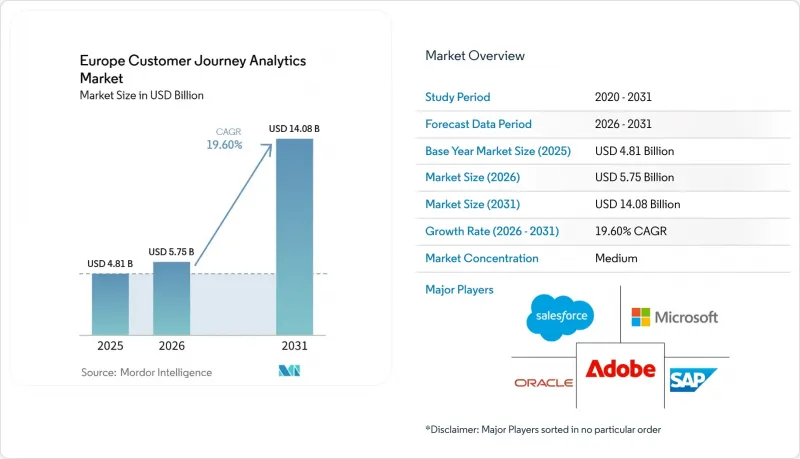
根據 Mordor Intelligence 預測,歐洲客戶旅程分析市場規模預計將在 2025 年達到 48.1 億美元,2026 年達到 57.5 億美元,到 2031 年達到 140.8 億美元,2026 年至 2031 年的複合年成長率為 19.60%。
本報告按元件(解決方案和服務)、部署模式(雲端、本地部署、混合部署)、應用程式(旅程地圖和視覺化等)、企業規模(大型企業、中小企業)、最終用戶產業(資訊科技和電信等)以及地區進行細分。市場預測以價值(美元)表示。
歐洲客戶旅程分析市場的趨勢與洞察
即時編配的需求日益成長
由於靜態分析已無法保證轉換率和服務效果,歐洲各地的公司正在使用能夠在客戶活躍期間做出回應的系統取代延遲的客戶旅程報告。 2026 年,Adobe 將客戶旅程分析、旅程最佳化器和即時客戶資料平台 (CDP) 整合到 CX Enterprise Coworker 中,顯示即時決策支援正在融入核心客戶工作流程。 Contentsquare 也在 2026 年發布了 AI 代理功能、提示分析和對話智慧,反映了從被動式儀表板向主動式旅程監控的轉變。 FullStory 於 2026 年 6 月添加了 StoryAI 代理和工作流程智慧,將自主發現和行動擴展到數位體驗管理領域。隨著買家彌合這一營運差距,歐洲客戶旅程分析市場正轉向大規模的平台契約,將發現、建議和激活整合到單一的營運層中。
在隱私受限管道上擴展第一方資料項目
隱私法規和取得第三方訊號的難度迫使企業更加重視自身的行為數據、CRM記錄和忠誠度計畫互動數據,並重構完整的客戶路徑。 Adobe在2026年表示,其CX Analytics的發布將滿足企業在後Cookie時代對跨通路旅程衡量的需求,這顯示第一方數據是產品設計的核心。 Adobe也在2025年推出了Customer Journey Analytics B2B Edition,支援對個人、採購群組、客戶和商機等不同層面的旅程進行分析,凸顯了在複雜的決策週期中對強大且自主的資料模型的廣泛需求。從實際角度來看,這意味著隨著企業在不依賴不可靠的外部追蹤方法的情況下尋求更強的可視性,歐洲客戶旅程分析市場正在蓬勃發展。因此,一種新的採購模式正在興起:資料整合的品質與儀錶板的深度同等重要,因為第一方資料基礎薄弱會限制高階建模的價值。
與傳統CRM和客服中心整合的複雜性。
客戶旅程分析只有在客戶關係管理 (CRM)、客服中心、計費系統和數位管道的數據能夠一致地整合時才能發揮作用,但這對許多大型企業來說仍然是一個挑戰。這個問題並非科技時代獨有;許多公司仍然運作著各自獨立的部門系統,這些系統擁有不同的所有者、工作流程和統一的資料定義。德國電信的遷移案例說明了企業為何尋求擺脫繁瑣的預處理環境,同時也凸顯了順利實施雲端分析所需的架構工作量之大。沃達豐義大利的現代化轉型歷程也反映了類似的問題,因為將客戶資料工作流程遷移到 BigQuery 需要分階段進行,而不是簡單的軟體安裝。正因如此,歐洲客戶旅程分析市場的引進週期才會如此漫長,尤其是在舊系統中隱藏的依賴關係只有在整合工作開始後才會顯現出來的情況下。
細分市場分析
到2025年,解決方案將佔總收入的68.44%,而服務板塊預計到2031年將以22.68%的複合年成長率成長。這項收入領先優勢表明,企業平台合約仍然是歐洲客戶旅程分析市場的基礎,尤其是在大規模買家已經擁有廣泛的軟體生態系統的情況下。這些合約通常涵蓋核心分析功能、身分管理、報告層以及跨多個營運職能的旅程衡量。企業平台的長期更新周期以及大規模客戶在採購中對成熟供應商的持續偏好,將繼續推動解決方案收入的成長。這也解釋了為什麼許多組織首先要確保其技術棧的安全,然後再圍繞它擴展其營運模式。
服務的加速成長表明,僅靠軟體已不足以從用戶旅程數據中產生商業性價值。購買企業越來越需要部署、資料模型設計、管治建置、儀表板調優以及上運作後業務應用程式等方面的支援。當需要同時協調雲端遷移、人工智慧工作流程和隱私管理時,這種趨勢尤其明顯。因此,歐洲客戶旅程分析市場正轉向更長期的供應商合作關係,將平台訂閱與諮詢服務和託管支援結合。具體而言,服務不再只是基本的售後附加功能,而是成為包裹軟體的效能層。
到 2025 年,按部署模式分類,雲端將佔銷售額的 70.86%,證實了彈性基礎設施已成為新型分析投資的預設值。這種主導地位反映了處理大規模行為資料集、更快地整合管道以及在無需維護龐大的本地硬體的情況下支援人工智慧功能的需求。在歐洲客戶旅程分析市場,雲端的採用與向基於 API 的架構和與資料倉儲整合的工作流程的廣泛轉變相一致。買家重視降低基礎設施摩擦以及快速部署分析功能更新的能力,尤其是在客戶數量隨季節或宣傳活動波動的情況下。正因如此,對於許多大型客戶而言,雲端已從一種替代部署選項轉變為主要架構的標準。
在監管嚴格的環境、需要考慮主權因素的環境,尤其是在難以獲得內部批准在公共雲端上進行處理的情況下,本地部署仍然至關重要。因此,混合模式透過分階段現代化而非強制突然取代舊有系統,繼續發揮重要作用。德國電信遷移到自主平台,展現了在滿足歐洲資料儲存要求的同時實現雲端規模分析的能力。同樣,沃達豐義大利遷移到Google雲端和BigQuery,顯示大型企業在確保業務連續性的前提下,願意對核心客戶資料工作流程進行現代化改造。這些變化共同提高了歐洲客戶旅程分析市場競爭供應商的標準,因為買家現在既需要規模,也需要區域合規性。
其他好處:
- Excel格式的市場預測(ME)表
- 3個月的分析師支持
目錄
第1章:引言
- 研究假設和市場定義
- 調查範圍
第2章:調查方法
第3章執行摘要
第4章 市場狀況
- 市場概覽
- 市場促進因素
- 即時編配的需求日益成長
- 在隱私受限管道上擴展第一方資料項目
- 擴大人工智慧驅動的「下一步最佳行動模型」的應用範圍
- 遷移到雲端原生 CX 和分析堆疊
- 不斷發展的可組合客戶資料架構
- 複雜購買過程中跨通路歸因的必要性
- 市場限制因素
- 與傳統CRM和客服中心整合的複雜性。
- 歐洲市場資料隱私同意的碎片化
- 缺乏旅程分析人才和數據工程能力。
- 人工智慧主導的旅程決策中的模型漂移和管治風險
- 產業價值鏈分析
- 宏觀經濟因素對市場的影響
- 科技趨勢
- 監理情勢
- 波特五力分析
第5章 市場規模與成長預測
- 按組件
- 解決方案
- 服務
- 部署模式
- 雲
- 現場
- 混合
- 透過使用
- 旅程地圖和視覺化
- 宣傳活動和旅程編配
- 品牌和產品管理
- 客戶行為與歸因
- 按公司規模
- 大公司
- 小型企業
- 按最終用戶行業分類
- 銀行、金融服務和保險(BFSI)
- 零售與電子商務
- 資訊科技/通訊
- 醫療保健和生命科學
- 媒體與娛樂
- 旅遊與飯店
- 汽車與出行
- 其他終端用戶產業
- 按地區
- 德國
- 英國
- 法國
- 義大利
- 西班牙
- 其他歐洲國家
第6章 競爭情勢
- 市場集中度
- 策略趨勢
- 市佔率分析
- 公司簡介
- Adobe Inc.
- Salesforce, Inc.
- Oracle Corporation
- Microsoft Corporation
- SAP SE
- IBM Corporation
- NICE Ltd.
- Verint Systems Inc.
- Contentsquare SA
- Glassbox Ltd.
- FullStory, Inc.
- Quantum Metric, Inc.
- Mixpanel, Inc.
- Amplitude, Inc.
- Medallia, Inc.
- Tealium, Inc.
- Genesys Telecommunications Laboratories, LLC
- Calabrio, Inc.
- Woopra, Inc.
- CSG Systems International, Inc.
第7章 市場機會與未來展望
According to Mordor Intelligence, the Europe customer journey analytics market size is projected to be USD 4.81 billion in 2025, USD 5.75 billion in 2026, and reach USD 14.08 billion by 2031, growing at a CAGR of 19.60% from 2026 to 2031.
This report is Segmented by Component (Solutions, and Services), Deployment Mode (Cloud, On-Premises, and Hybrid), Application (Journey Mapping and Visualisation, and More), End-User Enterprise Size (Large Enterprises, and Small and Mid-Size Enterprises), End-User Industry (Information Technology and Telecom, and More), and Geography. The Market Forecasts are Provided in Terms of Value (USD).
Europe Customer Journey Analytics Market Trends and Insights
Rising Demand for Real-Time Journey Orchestration
Enterprises across Europe are replacing delayed journey reporting with systems that respond while the customer is still active, because static analysis no longer protects conversion or service outcomes. Adobe connected Customer Journey Analytics, Journey Optimizer, and Real-Time CDP within CX Enterprise Coworker in 2026, which shows how live decision support is moving into core customer workflows. Contentsquare also launched AI agent capabilities, prompt analytics, and conversation intelligence in 2026, which reflects the shift toward active journey monitoring rather than passive dashboards. FullStory added StoryAI Agents and Workflow Intelligence in June 2026, extending autonomous discovery and action into digital experience management. As buyers close this execution gap, the Europe customer journey analytics market is moving toward larger platform contracts that combine detection, recommendation, and activation into a single operating layer.
Expansion of First-Party Data Programs Across Privacy-Constrained Channels
Privacy restrictions and weaker third-party signal availability are pushing companies to depend more on owned behavioral data, CRM records, and loyalty interactions to rebuild a complete customer path. Adobe said in 2026 that its CX Analytics launch addressed enterprise demand for cross-channel journey measurement in a post-cookie environment, which shows how first-party data has become central to product design. Adobe also introduced the Customer Journey Analytics B2B Edition in 2025 to analyze journeys across individuals, buying groups, accounts, and opportunities, underscoring a broader need for durable, owned data models in complex decision-making cycles. In practical terms, this means the Europe customer journey analytics market is gaining momentum as organizations seek stronger visibility without relying on unstable external tracking methods. The result is a buying pattern in which data integration quality matters as much as dashboard depth, because poor first-party foundations limit the value of advanced modeling.
High Integration Complexity with Legacy CRM and Contact Center Systems
Customer journey analytics only works when data from CRM, contact center, billing, and digital channels can be connected consistently, and that remains difficult in many large organizations. The problem is not limited to the technology age, because many enterprises still operate business-unit systems with separate owners, different workflows, and inconsistent data definitions. Deutsche Telekom's migration case shows why companies are leaving behind heavy-preprocessing environments, yet it also highlights the scale of architectural work required before cloud analytics can operate smoothly. Vodafone Italy's modernization path points to the same issue, because moving customer data workflows into BigQuery required a staged transformation rather than a simple software installation. This keeps deployment cycles long in the Europe customer journey analytics market, especially where hidden dependencies in older systems are discovered only after integration begins.
Other drivers and restraints analyzed in the detailed report include:
- Wider Adoption of AI-Based Journey Next-Best-Action Models
- Migration to Cloud-Native CX and Analytics Stacks
- Data Privacy Consent Fragmentation across European Markets
For complete list of drivers and restraints, kindly check the Table Of Contents.
Segment Analysis
Solutions held 68.44% revenue share in 2025, while services are projected to grow at a 22.68% CAGR through 2031. The revenue lead shows that enterprise platform contracts still anchor the Europe customer journey analytics market, especially where large buyers already use broad software ecosystems. These contracts usually cover core analytics capabilities, identity management, reporting layers, and journey measurement across several business functions. That installed base keeps solutions in front of current revenue, because replacement cycles for enterprise platforms are long and procurement still favors established vendors in large accounts. It also explains why many organizations first secure the technology stack and then expand the operating model around it.
The faster service growth shows that software alone is no longer enough to deliver commercial results from journey data. Buyers increasingly need help with implementation, data model design, governance setup, dashboard tuning, and business adoption after go-live. This pattern is especially evident when cloud migration, AI workflows, and privacy controls must be coordinated simultaneously. As a result, the Europe customer journey analytics market is shifting toward longer vendor relationships that mix platform subscriptions with advisory and managed support. In practical terms, services are becoming a performance layer around the software rather than a basic post-sale add-on.
Cloud accounted for 70.86% of deployment-mode revenue in 2025, confirming that elastic infrastructure has become the default setting for new analytics investments. That lead reflects the need to process larger behavioral datasets, unify channels faster, and support AI functions without maintaining heavy local hardware. In the Europe customer journey analytics market, cloud adoption aligns with the broader shift toward API-based architectures and warehouse-connected workflows. Buyers see value in lower infrastructure friction and faster rollout of analytics updates, especially when customer volumes change across seasons or campaigns. This is why cloud has moved from an alternative deployment choice to the main architecture baseline across many large accounts.
On-premises deployments still matter in regulated or sovereignty-sensitive settings, particularly where public cloud processing remains a harder internal approval path. Hybrid models, therefore, retain a role because they allow organizations to modernize in stages rather than force an abrupt replacement of legacy systems. Deutsche Telekom's sovereign platform migration illustrates how cloud-scale analytics can be introduced while still respecting European data location requirements. Vodafone Italy's move to Google Cloud and BigQuery also shows that major enterprises are willing to modernize core customer data workflows when operational continuity can be protected. Together, these shifts are raising the standard for vendors competing in the Europe customer journey analytics market, because buyers now expect both scale and regional compliance support.
Complete Report Scope:
- By Component
- Solutions
- Services
- By Deployment Mode
- Cloud
- On-Premises
- Hybrid
- By Application
- Journey Mapping and Visualisation
- Campaign and Journey Orchestration
- Brand and Product Management
- Customer Behaviour and Attribution
- By End-User Enterprise Size
- Large Enterprises
- Small and Mid-Size Enterprises
- By End-User Industry
- Banking, Financial Services, and Insurance (BFSI)
- Retail and eCommerce
- Information Technology and Telecom
- Healthcare and Life-Sciences
- Media and Entertainment
- Travel and Hospitality
- Automotive and Mobility
- Other End-User Industries
- By Geography
- Germany
- United Kingdom
- France
- Italy
- Spain
- Rest of Europe
List of Companies Covered in this Report:
- Adobe Inc.
- Salesforce, Inc.
- Oracle Corporation
- Microsoft Corporation
- SAP SE
- IBM Corporation
- NICE Ltd.
- Verint Systems Inc.
- Contentsquare SA
- Glassbox Ltd.
- FullStory, Inc.
- Quantum Metric, Inc.
- Mixpanel, Inc.
- Amplitude, Inc.
- Medallia, Inc.
- Tealium, Inc.
- Genesys Telecommunications Laboratories, LLC
- Calabrio, Inc.
- Woopra, Inc.
- CSG Systems International, Inc.
Additional Benefits:
- The market estimate (ME) sheet in Excel format
- 3 months of analyst support
TABLE OF CONTENTS
1 INTRODUCTION
- 1.1 Study Assumptions and Market Definition
- 1.2 Scope of the Study
2 RESEARCH METHODOLOGY
3 EXECUTIVE SUMMARY
4 MARKET LANDSCAPE
- 4.1 Market Overview
- 4.2 Market Drivers
- 4.2.1 Rising Demand for Real-Time Journey Orchestration
- 4.2.2 Expansion of First-Party Data Programs across Privacy-Constrained Channels
- 4.2.3 Wider Adoption of AI-Based Journey Next-Best-Action Models
- 4.2.4 Migration to Cloud-Native CX and Analytics Stacks
- 4.2.5 Growth of Composable Customer Data Architectures
- 4.2.6 Need for Cross-Channel Attribution in Complex Buying Journeys
- 4.3 Market Restraints
- 4.3.1 High Integration Complexity With Legacy CRM and Contact Center Systems
- 4.3.2 Data Privacy Consent Fragmentation across European Markets
- 4.3.3 Shortage of Journey Analytics Talent and Data Engineering Capacity
- 4.3.4 Model Drift and Governance Risk in AI-Driven Journey Decisions
- 4.4 Industry Value Chain Analysis
- 4.5 Impact of Macroeconomic Factors on the Market
- 4.6 Technology Outlook
- 4.7 Regulatory Landscape
- 4.8 Porter's Five Forces Analysis
- 4.8.1 Threat of New Entrants
- 4.8.2 Bargaining Power of Suppliers
- 4.8.3 Bargaining Power of Buyers
- 4.8.4 Threat of Substitutes
- 4.8.5 Competitive Rivalry
5 MARKET SIZE AND GROWTH FORECASTS (VALUE)
- 5.1 By Component
- 5.1.1 Solutions
- 5.1.2 Services
- 5.2 By Deployment Mode
- 5.2.1 Cloud
- 5.2.2 On-Premises
- 5.2.3 Hybrid
- 5.3 By Application
- 5.3.1 Journey Mapping and Visualisation
- 5.3.2 Campaign and Journey Orchestration
- 5.3.3 Brand and Product Management
- 5.3.4 Customer Behaviour and Attribution
- 5.4 By End-User Enterprise Size
- 5.4.1 Large Enterprises
- 5.4.2 Small and Mid-Size Enterprises
- 5.5 By End-User Industry
- 5.5.1 Banking, Financial Services, and Insurance (BFSI)
- 5.5.2 Retail and eCommerce
- 5.5.3 Information Technology and Telecom
- 5.5.4 Healthcare and Life-Sciences
- 5.5.5 Media and Entertainment
- 5.5.6 Travel and Hospitality
- 5.5.7 Automotive and Mobility
- 5.5.8 Other End-User Industries
- 5.6 By Geography
- 5.6.1 Germany
- 5.6.2 United Kingdom
- 5.6.3 France
- 5.6.4 Italy
- 5.6.5 Spain
- 5.6.6 Rest of Europe
6 COMPETITIVE LANDSCAPE
- 6.1 Market Concentration
- 6.2 Strategic Moves
- 6.3 Market Share Analysis
- 6.4 Company Profiles (includes Global Level Overview, Market Level Overview, Core Segments, Financials as available, Strategic Information, Market Rank/Share, Products and Services, Recent Developments)
- 6.4.1 Adobe Inc.
- 6.4.2 Salesforce, Inc.
- 6.4.3 Oracle Corporation
- 6.4.4 Microsoft Corporation
- 6.4.5 SAP SE
- 6.4.6 IBM Corporation
- 6.4.7 NICE Ltd.
- 6.4.8 Verint Systems Inc.
- 6.4.9 Contentsquare SA
- 6.4.10 Glassbox Ltd.
- 6.4.11 FullStory, Inc.
- 6.4.12 Quantum Metric, Inc.
- 6.4.13 Mixpanel, Inc.
- 6.4.14 Amplitude, Inc.
- 6.4.15 Medallia, Inc.
- 6.4.16 Tealium, Inc.
- 6.4.17 Genesys Telecommunications Laboratories, LLC
- 6.4.18 Calabrio, Inc.
- 6.4.19 Woopra, Inc.
- 6.4.20 CSG Systems International, Inc.
7 MARKET OPPORTUNITIES AND FUTURE OUTLOOK
- 7.1 White-Space and Unmet-Need Assessment

 全球客戶旅程分析市場規模、佔有率、趨勢和成長分析報告(2026-2034)
 客戶旅程編配:市場佔有率分析、產業趨勢與統計、成長預測(2026-2031)北美客戶旅程分析:市場佔有率分析、產業趨勢與統計、成長預測(2026-2031 年)
 客戶旅程管理市場:按組件、觸點管道、部署類型、組織規模和產業分類-2026-2032年全球市場預測
 客戶旅程分析市場報告:按組件、觸點、部署類型、組織規模、應用、產業垂直領域和地區分類(2026-2034 年)
 2026年全球客戶旅程分析市場報告
 客戶旅程分析市場分析及預測(至 2035 年):按類型、產品類型、服務、技術、組件、應用、部署類型、最終用戶和解決方案分類客戶旅程分析市場規模、佔有率、成長及全球產業分析:依類型、應用和地區劃分的洞察與未來預測(2026-2034 年)
 客戶旅程分析市場 - 全球產業規模、佔有率、趨勢、機會和預測(按組件、應用、觸點、產業垂直領域、地區和競爭格局分類,2021-2031 年預測)日本客戶旅程分析市場報告:按組件、觸點、實施類型、組織規模、應用、產業和地區分類(2026-2034 年)