


 |
市場調查報告書
商品編碼
2099462
北美客戶旅程分析:市場佔有率分析、產業趨勢與統計、成長預測(2026-2031 年)North America Customer Journey Analytics - Market Share Analysis, Industry Trends & Statistics, Growth Forecasts (2026 - 2031) |
||||||

※ 本網頁內容可能與最新版本有所差異。詳細情況請與我們聯繫。
根據 Mordor Intelligence 預測,北美客戶旅程分析市場規模將從 2025 年的 73.5 億美元和 2026 年的 88 億美元成長到 2031 年的 215.6 億美元,2026 年至 2031 年的複合年成長率為 19.64%。
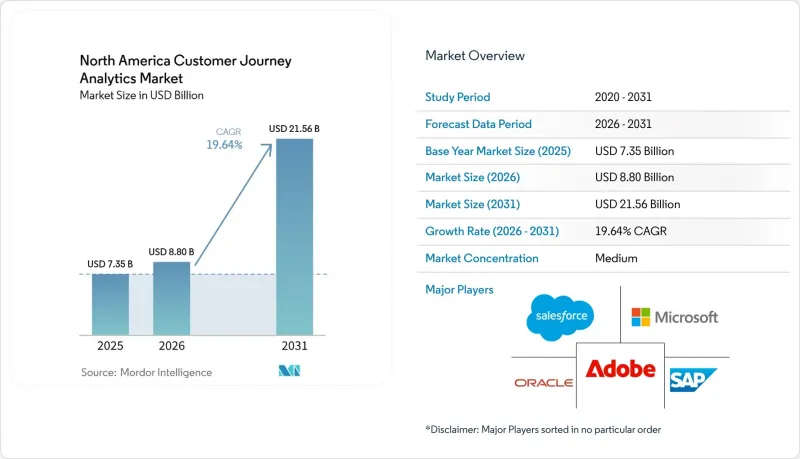
本報告按組件(解決方案和服務)、部署模式(雲端、本地部署、混合部署)、應用程式(宣傳活動和編配等)、企業規模(大型企業、中小企業)、最終用戶產業(媒體和娛樂等)以及地區進行細分。市場預測以美元計價。
北美客戶旅程分析市場趨勢與洞察
利用人工智慧加速洞察用戶旅程
基於代理的人工智慧正推動北美客戶旅程分析市場邁向更加重視行動的階段。這是因為企業現在不僅期望平台能夠解釋發生了什麼,還能推薦並執行相應的行動。這一轉變意義重大,因為旅程數據不再僅僅在宣傳活動或服務事件結束後才被使用;客戶越來越需要能夠在互動進行中做出反應的系統。 Adobe 透過發布 Customer Journey Analytics B2B Edition 進一步闡明了這一轉變,將旅程智慧的角色擴展到更廣泛的體驗工作流程。這顯示分析與客戶層面和相關人員層面的決策更加緊密地連結在一起。 Salesforce 也透過發布銷售團隊 3 強化了類似的趨勢,強調了自主問題解決、可觀測性和更廣泛的語言支援。所有這些都表明,客戶旅程的解讀和回應正在以最小的人工干預延遲實現。在北美客戶旅程分析市場,真正的影響在於,每一次由人工智慧驅動的互動都會產生更多的行為數據,為能夠跨通路組織和管理訊號的平台帶來更高的價值。隨著時間的推移,競爭的重點正從單純的儀錶板的廣度轉移到模型的品質、編配的速度和管治的深度。
對整合客戶可見性的需求日益成長
北美客戶旅程分析市場擴張的另一個原因是,許多公司仍然難以將客戶行為在網站、行動應用、商務系統、客服中心和線下交易等管道整合到一個可操作的單一視圖中。這個問題不容忽視,因為人工智慧驅動的建議依賴於底層ID和事件資料的品質和連續性。 2025年6月,Adobe發布了Customer Journey Analytics B2B Edition,旨在應對這項挑戰。此解決方案不僅提供對消費者旅程的整合可見性,還提供對複雜企業採購環境的整合可見性,並在帳戶、採購小組和商機層面提供分析功能。 NICE也朝著這個方向發展,增強了與Salesforce Data Cloud的整合。零拷貝存取減少了在系統間複製記錄的需求,使企業能夠利用關聯資料而無需額外的資料移動或核對步驟。因此,整合可見性的需求不僅成為一種報告偏好,而且成為尋求一致個性化、客戶維繫工作流程和跨職能客戶責任結構的公司的基本營運要求。隨著這項需求的日益普遍,北美客戶旅程分析市場正在轉變,供應商不再局限於單一功能,而是轉向能夠跨越多個數據環境的供應商。
與傳統資料棧進行高階整合的複雜性
在北美客戶旅程分析市場,整合仍然是最持久的營運瓶頸。這是因為許多買家仍在管理分散的 CRM、ERP、電商、服務和客服中心環境,這些環境建構在多個技術週期之上。挑戰不僅在於技術層面;每個系統通常都有其自身的所有權規則、自訂工作流程和客戶記錄定義。 2025 年 8 月,NICE 擴展了與 Salesforce Service Cloud 和 Data Cloud 的整合,以應對這一挑戰,其中包括零拷貝雙向訪問,從而直接解決了部署延遲和資料重複移動的最大原因之一。即使連接器性能有所提升,許多組織仍然需要較長的部署週期才能使旅程分析在營運上可靠運行,這減緩了沒有專門工程團隊的中型企業的採用速度。這影響了北美客戶旅程分析市場,在該市場中,負責人往往更傾向於選擇擁有強大服務、成熟連接器庫和清晰遷移路徑的供應商,而不是功能清單豐富的供應商。此外,由於即使在初始實施和後續營運之後,通常也需要持續的整合支持,這也是服務業成長速度快於解決方案產業的原因之一。
細分市場分析
到2025年,解決方案將佔銷售額的70.15%,軟體平台將繼續在北美客戶旅程分析市場佔據核心地位。客戶旅程分析需要事件收集、身分匹配、視覺化、編配和管治,但由於企業內部團隊很少能快速建立這些功能或以同等規模維護它們,因此企業仍然傾向於使用專用系統。這種趨勢是結構性的,而非暫時的,因為大多數買家更喜歡檢驗的、可運行的環境,而不是跨多個部門建立和維護自己的技術堆疊。大規模組織的採購流程也有利於解決方案的普及,在這些流程中,標準化和供應商責任與分析柔軟性同等重要。正因如此,即使部署需求變得越來越複雜,北美客戶旅程分析市場仍以平台支出為主。
同時,預計到2031年,服務市場將以22.59%的複合年成長率成長,成為成長最快的細分市場。服務領域的成長不僅體現在設定工作上,因為許多部署現在都需要託管最佳化、整合支援、旅程設計、管治調整以及部署後的變更管理。 Pegasystems於2026年6月推出顧客互動工作室(Customer Engagement Studio),進一步強化了這個發展方向。該工作室將人工智慧交付與管治工作流程和結果更緊密地結合起來。這支援了一種新的模式,即價值越來越與執行支援掛鉤,而不僅僅是許可證存取權限。在客戶旅程分析產業,這種轉變意味著,一旦平台成為日常工作流程的一部分,擁有強大的專業服務和託管服務的供應商就能更好地留住客戶。這也解釋了為什麼能夠在單一合作關係中將軟體、部署深度和可衡量的業務成果相結合的供應商在北美客戶旅程分析市場備受青睞。
預計到2025年,雲端運算將佔據北美客戶旅程分析市場65.29%的佔有率,並將以22.09%的複合年成長率(CAGR)保持最快成長速度,直到2031年。這一成長動能意義重大,因為雲端運算轉型仍在進行中,顯示其尚未達到成熟階段,成長速度也未必然放緩。買家持續選擇雲端運算,是因為它能夠減輕基礎設施管理負擔、加快功能交付速度,並滿足人工智慧驅動型分析對彈性運算的需求。此外,雲端運算還支援新增的訊號類型和支援新的管道,而無需等待本地基礎設施升級。因此,北美客戶旅程分析市場不僅將雲端運算視為一種託管模式,更將其視為加速實驗和提升旅程視覺的基礎架構。
2026年3月,Contentsquare順應此趨勢,透過雲端原生方式擴展了其訊號擷取範圍,涵蓋網站、行動應用程式、AI助理和支援對話。這意義重大,因為隨著通路擴展成為標準,雲端平台更適合採集新型數據,且部署阻力較小。在醫療保健和金融服務等行業,本地部署模式仍然具有價值,因為這些行業的機構對敏感資料和內部審查流程的控制更為嚴格。對於希望在受控的本地環境中維護特定資料集,同時又希望在分析和編配保持柔軟性的大型企業而言,混合配置仍然可行。雖然這些替代方案在客戶旅程分析行業中仍然發揮作用,但北美客戶旅程分析市場顯然正在向「雲端優先」的採購模式轉變。這是因為大多數新的AI主導用例在更具可擴展性的環境中運作效率更高。
其他好處:
- Excel格式的市場預測(ME)表
- 3個月的分析師支持
目錄
第1章:引言
- 研究假設和市場定義
- 調查範圍
第2章:調查方法
第3章執行摘要
第4章 市場狀況
- 市場概覽
- 市場促進因素
- 對客戶資料整合的需求日益成長
- 利用人工智慧加速客戶體驗分析
- 全通路體驗的個人化需求
- 即時預防客戶流失和優先考慮客戶維繫
- 實施以隱私為先的分析架構
- 將旅程分析擴展到收益管理
- 市場限制因素
- 與傳統資料棧相關的複雜高級整合
- 隱私和同意管理限制
- 企業實施的總擁有成本較高
- 負責實施旅程分析的人員短缺
- 產業價值鏈分析
- 宏觀經濟因素對市場的影響
- 科技趨勢
- 監理情勢
- 波特五力分析
第5章 市場規模與成長預測
- 按組件
- 解決方案
- 服務
- 部署模式
- 雲
- 現場
- 混合
- 透過使用
- 旅程地圖和視覺化
- 宣傳活動和旅程編配
- 品牌和產品管理
- 客戶行為與歸因
- 按公司規模
- 大公司
- 小型企業
- 按最終用戶行業分類
- 銀行、金融服務和保險(BFSI)
- 零售與電子商務
- 資訊科技/通訊
- 醫療保健和生命科學
- 媒體與娛樂
- 旅遊與飯店
- 汽車與出行
- 其他終端用戶產業
- 按地區
- 美國
- 加拿大
- 墨西哥
第6章 競爭情勢
- 市場集中度
- 策略趨勢
- 市佔率分析
- 公司簡介
- Adobe Inc.
- Salesforce, Inc.
- NICE Ltd.
- Genesys Cloud Services, Inc.
- Medallia, Inc.
- SAP SE
- Microsoft Corporation
- Oracle Corporation
- IBM Corporation
- SAS Institute Inc.
- Amplitude, Inc.
- Acoustic, Inc.
- Verint Systems Inc.
- Quadient SA
- Dynatrace, Inc.
- Contentsquare SAS
- ChurnZero, Inc.
- Pega Systems Inc.
- Qualtrics, LLC
- Woopra, Inc.
第7章 市場機會與未來展望
According to Mordor Intelligence, the North America customer journey analytics market size is projected to expand from USD 7.35 billion in 2025 and USD 8.80 billion in 2026 to USD 21.56 billion by 2031, registering a CAGR of 19.64% between 2026 and 2031.
This report is Segmented by Component (Solutions, and Services), Deployment Mode (Cloud, On-Premises, and Hybrid), Application (Campaign and Journey Orchestration, and More), End-User Enterprise Size (Large Enterprises, and Small and Mid-Size Enterprises), End-User Industry (Media and Entertainment, and More), and Geography. The Market Forecasts are Provided in Terms of Value (USD).
North America Customer Journey Analytics Market Trends and Insights
Acceleration of AI-Driven Journey Insights
Agentic AI is pushing the North America customer journey analytics market into a more execution-focused phase, because enterprises now expect platforms to recommend and trigger actions rather than only explain what happened. That change matters because journey data is no longer being used only after a campaign or service event ends, and buyers increasingly want systems that can react while the interaction is still active. Adobe made this shift more visible when it launched the Customer Journey Analytics B2B Edition and expanded the role of journey intelligence across broader experience workflows, demonstrating how analytics is being tied more closely to account- and stakeholder-level decisioning. Salesforce reinforced the same direction when it launched Agentforce 3 and highlighted autonomous resolution, observability, and broader language support, all of which point to customer journeys being interpreted and acted on with less human delay. The practical effect on the North America customer journey analytics market is that each AI-assisted interaction generates more behavioral data, thereby increasing the value of platforms that can organize and govern signals across channels. Over time, this is moving competition toward model quality, orchestration speed, and governance depth, rather than simple dashboard breadth.
Rising Demand for Unified Customer Visibility
The North America customer journey analytics market is also expanding because many enterprises still struggle to connect customer behavior across websites, mobile apps, commerce systems, contact centers, and offline transactions into one usable view. That problem has become harder to ignore because AI-driven recommendations are only as strong as the quality and continuity of the underlying identity and event data. Adobe addressed this issue in June 2025 when it introduced the Customer Journey Analytics B2B Edition, with account-level, buying group-level, and opportunity-level analysis, extending unified visibility into complex enterprise buying environments beyond consumer journeys. NICE also moved in this direction by tightening integration with Salesforce Data Cloud, as zero-copy access reduces the need to duplicate records across systems and helps organizations work with connected data without adding another layer of movement and reconciliation. The need for unified visibility is therefore not a reporting preference; it is becoming a basic operating requirement for enterprises that want consistent personalization, retention workflows, and cross-functional customer accountability. As that requirement spreads, the North America customer journey analytics market is favoring vendors that can span multiple data environments rather than remain isolated within a single function.
High Integration Complexity with Legacy Data Stacks
Integration remains the most stubborn operating restraint in the North America customer journey analytics market because many buyers still manage disconnected CRM, ERP, commerce, service, and contact center environments built over several technology cycles. The challenge is not only technical, as each system often has its own ownership rules, custom workflows, and definitions of the customer record. NICE responded to this issue in August 2025 by expanding integration with Salesforce Service Cloud and Data Cloud, including zero-copy bidirectional access, which directly addressed one of the biggest causes of deployment delay and duplicated data movement. Even with better connectors, many organizations still need long implementation windows before journey analytics becomes operationally reliable, and this slows adoption among mid-sized companies that lack dedicated engineering teams. The effect on the North America customer journey analytics market is that procurement often favors vendors with stronger services, proven connector libraries, and clearer migration paths rather than the broadest feature list. This is also why services are growing faster than solutions, because buyers frequently need ongoing integration support after the initial deployment goes live.
Other drivers and restraints analyzed in the detailed report include:
- Omnichannel Experience Personalization Requirements
- Real-Time Churn Reduction and Retention Prioritization
- Privacy and Consent Management Constraints
For complete list of drivers and restraints, kindly check the Table Of Contents.
Segment Analysis
Solutions accounted for 70.15% of revenue in 2025, keeping software platforms at the center of the North America customer journey analytics market. Enterprises still preferred purpose-built systems because journey analytics requires event collection, identity stitching, visualization, orchestration, and governance, in a form that internal teams rarely build quickly or maintain at a comparable scale. That preference is structural rather than temporary, because most buyers prefer a tested operating environment rather than creating and supporting their own stack across multiple departments. Solutions also benefit from the way procurement works in larger organizations, where standardization and vendor accountability matter as much as analytical flexibility. This kept the North America customer journey analytics market anchored in platform spending, even as implementation needs became more complex.
Services, however, are projected to expand at a 22.59% CAGR through 2031, making them the fastest-growing segment. Growth in services reflects more than setup work, because many deployments now require managed optimization, integration support, journey design, governance tuning, and change management after launch. Pegasystems strengthened this direction in June 2026 when it introduced Customer Engagement Studio and linked AI delivery more closely to governed workflows and outcomes, which supports a model in which value is increasingly tied to execution support rather than only license access. In the customer journey analytics industry, that shift means vendors with strong professional and managed services can better protect accounts once the platform becomes part of daily operations. It also explains why the North America customer journey analytics market is rewarding vendors that can combine software, implementation depth, and measurable business outcomes in a single relationship.
Cloud accounted for 65.29% of the North America customer journey analytics market in 2025 and is also projected to post the fastest growth at a 22.09% CAGR through 2031. This combination is important because it shows that migration is still underway and that the cloud has not yet reached a point where growth naturally tapers off due to maturity. Buyers continue to choose the cloud because it reduces infrastructure management, enables faster feature delivery, and meets the elastic computing needs of AI-driven analytics. It also makes it easier to add new signal types and support new channels without waiting for local infrastructure upgrades. The North America customer journey analytics market, therefore, continues to treat cloud not simply as a hosting model, but as the base architecture for faster experimentation and broader journey visibility.
Contentsquare reflected this pattern in March 2026, expanding signal ingestion to websites, mobile apps, AI assistants, and support conversations via a cloud-native approach. That matters because channel expansion is becoming the norm, and cloud platforms are better positioned to absorb new data types without significant deployment friction. On-premises models still retain value in healthcare and financial services, where organizations can maintain greater control over sensitive data and internal review processes. Hybrid setups also remain relevant for large enterprises that want the flexibility of analytics and orchestration while keeping selected datasets in controlled internal environments. In the customer journey analytics industry, these alternatives keep a role, but the North America customer journey analytics market is clearly moving toward cloud-first buying patterns because most new AI-led use cases work better in more scalable environments.
Complete Report Scope:
- By Component
- Solutions
- Services
- By Deployment Mode
- Cloud
- On-Premises
- Hybrid
- By Application
- Journey Mapping and Visualisation
- Campaign and Journey Orchestration
- Brand and Product Management
- Customer Behaviour and Attribution
- By End-User Enterprise Size
- Large Enterprises
- Small and Mid-Size Enterprises
- By End-User Industry
- Banking, Financial Services, and Insurance (BFSI)
- Retail and eCommerce
- Information Technology and Telecom
- Healthcare and Life-Sciences
- Media and Entertainment
- Travel and Hospitality
- Automotive and Mobility
- Other End-User Industries
- By Geography
- United States
- Canada
- Mexico
List of Companies Covered in this Report:
- Adobe Inc.
- Salesforce, Inc.
- NICE Ltd.
- Genesys Cloud Services, Inc.
- Medallia, Inc.
- SAP SE
- Microsoft Corporation
- Oracle Corporation
- IBM Corporation
- SAS Institute Inc.
- Amplitude, Inc.
- Acoustic, Inc.
- Verint Systems Inc.
- Quadient S.A.
- Dynatrace, Inc.
- Contentsquare S.A.S.
- ChurnZero, Inc.
- Pega Systems Inc.
- Qualtrics, LLC
- Woopra, Inc.
Additional Benefits:
- The market estimate (ME) sheet in Excel format
- 3 months of analyst support
TABLE OF CONTENTS
1 INTRODUCTION
- 1.1 Study Assumptions and Market Definition
- 1.2 Scope of the Study
2 RESEARCH METHODOLOGY
3 EXECUTIVE SUMMARY
4 MARKET LANDSCAPE
- 4.1 Market Overview
- 4.2 Market Drivers
- 4.2.1 Rising Demand for Unified Customer Visibility
- 4.2.2 Acceleration of AI-Driven Journey Insights
- 4.2.3 Omnichannel Experience Personalization Requirements
- 4.2.4 Real-Time Churn Reduction and Retention Prioritization
- 4.2.5 Privacy-First Analytics Architecture Adoption
- 4.2.6 Expansion of Journey Analytics into Revenue Operations
- 4.3 Market Restraints
- 4.3.1 High Integration Complexity with Legacy Data Stacks
- 4.3.2 Privacy and Consent Management Constraints
- 4.3.3 High Total Cost of Ownership for Enterprise Rollouts
- 4.3.4 Shortage of Journey Analytics Implementation Talent
- 4.4 Industry Value Chain Analysis
- 4.5 Impact of Macroeconomic Factors on the Market
- 4.6 Technology Outlook
- 4.7 Regulatory Landscape
- 4.8 Porter's Five Forces Analysis
- 4.8.1 Threat of New Entrants
- 4.8.2 Bargaining Power of Suppliers
- 4.8.3 Bargaining Power of Buyers
- 4.8.4 Threat of Substitutes
- 4.8.5 Competitive Rivalry
5 MARKET SIZE AND GROWTH FORECASTS (VALUE)
- 5.1 By Component
- 5.1.1 Solutions
- 5.1.2 Services
- 5.2 By Deployment Mode
- 5.2.1 Cloud
- 5.2.2 On-Premises
- 5.2.3 Hybrid
- 5.3 By Application
- 5.3.1 Journey Mapping and Visualisation
- 5.3.2 Campaign and Journey Orchestration
- 5.3.3 Brand and Product Management
- 5.3.4 Customer Behaviour and Attribution
- 5.4 By End-User Enterprise Size
- 5.4.1 Large Enterprises
- 5.4.2 Small and Mid-Size Enterprises
- 5.5 By End-User Industry
- 5.5.1 Banking, Financial Services, and Insurance (BFSI)
- 5.5.2 Retail and eCommerce
- 5.5.3 Information Technology and Telecom
- 5.5.4 Healthcare and Life-Sciences
- 5.5.5 Media and Entertainment
- 5.5.6 Travel and Hospitality
- 5.5.7 Automotive and Mobility
- 5.5.8 Other End-User Industries
- 5.6 By Geography
- 5.6.1 United States
- 5.6.2 Canada
- 5.6.3 Mexico
6 COMPETITIVE LANDSCAPE
- 6.1 Market Concentration
- 6.2 Strategic Moves
- 6.3 Market Share Analysis
- 6.4 Company Profiles (includes Global Level Overview, Market Level Overview, Core Segments, Financials as available, Strategic Information, Market Rank/Share, Products and Services, Recent Developments)
- 6.4.1 Adobe Inc.
- 6.4.2 Salesforce, Inc.
- 6.4.3 NICE Ltd.
- 6.4.4 Genesys Cloud Services, Inc.
- 6.4.5 Medallia, Inc.
- 6.4.6 SAP SE
- 6.4.7 Microsoft Corporation
- 6.4.8 Oracle Corporation
- 6.4.9 IBM Corporation
- 6.4.10 SAS Institute Inc.
- 6.4.11 Amplitude, Inc.
- 6.4.12 Acoustic, Inc.
- 6.4.13 Verint Systems Inc.
- 6.4.14 Quadient S.A.
- 6.4.15 Dynatrace, Inc.
- 6.4.16 Contentsquare S.A.S.
- 6.4.17 ChurnZero, Inc.
- 6.4.18 Pega Systems Inc.
- 6.4.19 Qualtrics, LLC
- 6.4.20 Woopra, Inc.
7 MARKET OPPORTUNITIES AND FUTURE OUTLOOK
- 7.1 White-Space and Unmet-Need Assessment

 全球客戶旅程分析市場規模、佔有率、趨勢和成長分析報告(2026-2034)
 客戶旅程編配:市場佔有率分析、產業趨勢與統計、成長預測(2026-2031)歐洲客戶旅程分析:市場佔有率分析、產業趨勢與統計、成長預測(2026-2031 年)
 客戶旅程管理市場:按組件、觸點管道、部署類型、組織規模和產業分類-2026-2032年全球市場預測
 客戶旅程分析市場報告:按組件、觸點、部署類型、組織規模、應用、產業垂直領域和地區分類(2026-2034 年)
 2026年全球客戶旅程分析市場報告
 客戶旅程分析市場分析及預測(至 2035 年):按類型、產品類型、服務、技術、組件、應用、部署類型、最終用戶和解決方案分類客戶旅程分析市場規模、佔有率、成長及全球產業分析:依類型、應用和地區劃分的洞察與未來預測(2026-2034 年)
 客戶旅程分析市場 - 全球產業規模、佔有率、趨勢、機會和預測(按組件、應用、觸點、產業垂直領域、地區和競爭格局分類,2021-2031 年預測)日本客戶旅程分析市場報告:按組件、觸點、實施類型、組織規模、應用、產業和地區分類(2026-2034 年)