


 |
市場調查報告書
商品編碼
2099769
機場和港口連接的光纖基礎設施:市場佔有率分析、行業趨勢和統計數據以及成長預測(2026-2031 年)Fiber Optic Infrastructure For Airports and Seaports Connectivity - Market Share Analysis, Industry Trends & Statistics, Growth Forecasts (2026 - 2031) |
||||||

※ 本網頁內容可能與最新版本有所差異。詳細情況請與我們聯繫。
據 Mordor Intelligence 稱,機場和港口連接的光纖基礎設施市場預計將從 2025 年的 3.8502 億美元成長到 2026 年的 4.3045 億美元,到 2031 年達到 7.5183 億美元,2026 年至 2031 年的複合年成長率為 1.80%。
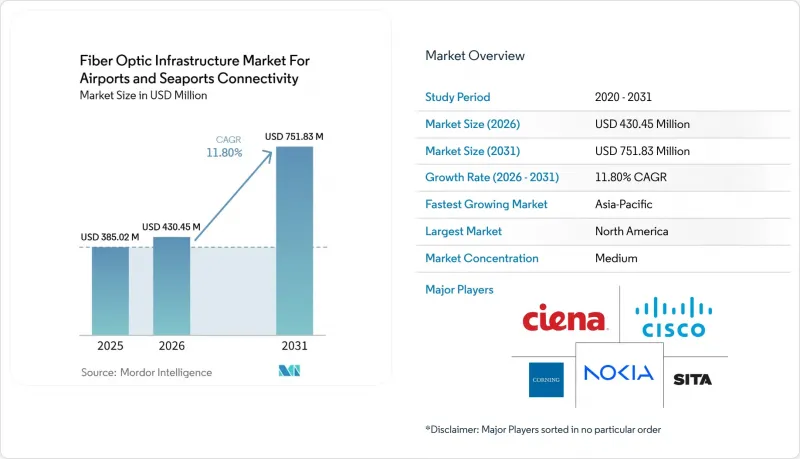
本報告按組件(光纖電纜、連接器和適配器等)、連接類型(無源光區域網路、有源光纖網路等)、應用(旅客航站樓連接等)、最終用戶(機場和港口營運商等)以及地區進行細分。市場預測以美元計價。
機場和港口連接光纖基礎設施市場洞察與趨勢
機場和港口的數位轉型正在推動網路投資。
機場和港口連接的光纖基礎設施市場正受益於航站樓、貨運區和控制系統等各領域向互聯運營的廣泛轉變。在機場,越來越多的服務正遷移到共用的數位平台,這提升了能夠同時支援多個關鍵任務功能的高容量光纖骨幹網路的價值。港口也呈現類似的趨勢,數位化物流、設備監控和智慧港口應用都依賴於覆蓋整個港口的穩定、低延遲連接。 2025年1月,瓦倫西亞港運作了其專屬的5G網路,以支持其「智慧港口4.0」框架,這表明港口數位化轉型與更強大的連接基礎設施之間存在著密切聯繫。在航空領域,美國聯邦航空管理局(FAA)2026年的預算提案重點在於通訊現代化和基於IP的基礎設施,凸顯了在整個機場環境中進行骨幹網路全面升級的必要性。由於機場和港口營運商同時對多個系統進行現代化改造,機場和港口連接的光纖基礎設施市場呈現集中採購活動的特點,而不是緩慢而穩定的更新週期。
容錯要求正在加速航空樞紐從銅纜到光纖的過渡。
機場和港口光纖基礎設施市場的發展也受到主要航空樞紐對更強大通訊的需求的推動。傳統的銅纜網路維護困難,操作員在需要更高容量、更清晰的訊號效能和更強的抗干擾能力時,選擇有限。美國聯邦航空管理局 (FAA) 2026 財政年度預算文件強調將繼續投資通訊基礎設施、語音交換和機場電纜環路維護,所有這些都表明骨幹網路現代化改造之路漫長。 2026 年 5 月,L3Harris 宣布已完成 FAA 通訊現代化專案 50% 以上的工作,以高速光纖、無線和衛星鏈路取代了傳統的銅纜和分時多工(TDM) 技術。該公司還表示,該專案每月部署 150 至 200 條新的網路路徑,並預計在 2027 年完成。這表明,以容錯性為重點的現代化改造不僅是一個計劃,而且已經全面展開。因此,連接機場和港口的光纖基礎設施市場不僅與提高頻寬密切相關,而且與提高可靠性也密切相關。
高昂的土木工程和土地開發成本限制了專案的實施速度。
機場和港口光纖基礎設施市場仍面臨許多根本性的實施挑戰,因為在運作中的機場和港口內進行安裝成本高昂且會干擾營運。承包商必須在跑道、滑行道、貨櫃存放場、安檢區和鋪設路面等區域內作業,這不僅延緩了進度,還使得安裝成本遠高於光纜本身的成本。美國聯邦航空管理局(FAA)的預算文件顯示,機場光纜環形回路系統需要專門的維護資金,這表明在運作中的機場進行地下通訊工程是一項持續的基礎設施負擔,而非一次性專案。對於小規模的本地設施而言,這些現場條件會延緩現代化進程,因為資金通常優先用於安全措施、停機坪或航站樓建設。因此,機場和港口光纖基礎設施市場在營運商能夠將通訊設備升級與大規模重建計畫結合的地區發展最為迅速。在成本受限的環境下,實施需要分階段進行,以避免干擾運作中的運營,這使得普及速度低於潛在需求。
細分市場分析
到2025年,光纖電纜將佔據機場和港口連接光纖基礎設施市場45.12%的佔有率。這反映了它們作為整個機場和港口系統底層物理層的重要角色。由於老舊的交通樞紐仍然依賴難以維護且無法滿足當前資料負載的銅纜通訊資產,因此電纜市場仍然受到替換需求的驅動。此外,由於機場和港口需要長距離的訊號完整性、抗干擾能力以及未來容量擴展的餘裕,因此電纜在機場和港口連接的光纖基礎設施市場中也更受青睞。連接器、分路器和放大器等被動設備佔據著至關重要的中間位置,決定著操作員如何有效地將鏈路擴展到終端、周邊區域和設備區域。隨著營運商努力簡化設備設計並減少大型站點中的活動連接點,這些設備的作用變得越來越重要。
收發器和光學模組是成長最快的組件類別,預計從2026年到2031年將以11.23%的複合年成長率成長。機場和港口連接的光纖基礎設施市場這一細分領域正受益於更智慧的交通管理、更豐富的監控流以及向更高連接性的現場資產的轉變,所有這些都提升了有源光性能的價值。在先前的升級週期中已經鋪設了光纖的營運商現在正尋求重新思考其主動層,以從現有設施中挖掘更大的吞吐量。 2025年11月,康寧和諾基亞宣布推出一項聯合解決方案,該方案整合了面向歐洲、中東和非洲地區以及亞太地區的被動和有源光區域網路產品。這表明,供應商的目標客戶是那些希望最大限度減少整個網路堆疊整合差距的客戶。康寧也表示,此整合解決方案支援1 Gbps到100 Gbps的速度,與傳統銅纜相比,可以降低佈線成本和整體擁有成本,這進一步強化了在複雜的園區環境中採用有源光升級的理由。因此,機場和港口連接的光纖基礎設施市場正在從單純的電纜數量轉向更高附加價值的組成,其中包括來自智慧、管理和生命週期更新的收入。
至2025年,城域和回程傳輸光纖將佔35.03%的市場佔有率,繼續保持其在機場和港口光纖基礎設施市場中最大連接層的地位。這一定位合理,因為機場和港口依賴於本地運營、城域網路以及外部控制和物流系統之間強大的連接。此外,城域和回程傳輸線路在機場和港口連接的光纖基礎設施中發揮戰略性作用,因為它們構成了貨物協調、指揮功能、遠端存取以及更廣泛的公司間資料交換的基礎。在連接資產和物流基礎設施開始重疊的港口環境中,海底電纜線路正變得日益重要。這種重疊可能會增強港口側數位基礎設施的商業價值,因為它可以在同一地點同時支援營運流量和更廣泛的網路互連需求。
無源光區域網路預計將成為成長最快的網路,到2031年複合年成長率將達到12.34%。隨著航站樓運營商尋求更簡化的架構、減少有源樓層交換機的數量以及更便捷的跨建築和遠程支持區域的集中管理,這種模式在機場和港口連接的光纖基礎設施市場正日益受到青睞。康寧公司表示,其與諾基亞的合作旨在以單一的高速光纖網路取代傳統的銅線,以支援Wi-Fi 7、雲端運算、物聯網和智慧建築等應用場景,這與機場航站大樓和物流園區的需求高度契合。新聞稿指出,與基於銅線的方案相比,該解決方案可減少70%的佈線,並將總擁有成本(TCO)降低50%。這解釋了為什麼光區域網路在複雜的交通樞紐中極具吸引力,因為這些樞紐需要更長的資產使用壽命和更低的維護成本。事實上,無源光區域網路為進入機場和港口連接的光纖基礎設施市場提供了機遇,包括新建航站樓項目和現有設施的大規模佈線升級。此外,這將加強那些能夠將被動設備、主動電子設備和網路管理打包成單一提案的供應商的地位。
區域分析
到2025年,北美將佔據最大的區域市場佔有率,達到32.13%,成為機場和港口光纖基礎設施市場最大的參與者。美國在該區域處於領先地位,其航空通訊現代化建設已在積極推進,而不僅僅停留在初步規劃階段。 2026年美國聯邦航空管理局(FAA)的預算文件強調了對通訊基礎設施、語音交換和機場電纜環路維護的大規模支出,所有這些都旨在支持航空資產的持續升級。 2026年5月,L3Harris宣布,FAA的全國性現代化計畫已完成超過50%,並表示將在當年新增175名員工,以確保該計畫按計畫於2027年完成。憑藉這些進展,北美仍然是機場和港口光纖基礎設施市場的核心,其支出預測、執行規模和強大的成熟供應商基礎都使其佔據領先地位。
預計到2031年,亞太地區將以12.34%的複合年成長率(CAGR)成為所有地區中成長最快的地區。在新建機場、智慧港口投資以及在整個交通基礎設施中實施數位化營運模式的日益成長的需求的推動下,連接機場和港口的光纖基礎設施市場正在該地區迅速擴張。雖然瓦倫西亞港位於亞太地區之外,但其私有5G案例研究充分體現了亞太港口在操作技術現代化過程中優先考慮的貨櫃、設備和監控應用場景。該地區的這一成長趨勢也得益於待開發區基礎設施,這使得營運商能夠從一開始就建立原生光纖架構,而無需對舊設施維修。
到2025年,歐洲、中東和非洲以及南美洲將構成剩餘的區域基礎,其中歐洲是北美以外技術最成熟的地區。歐洲機場和港口光纖基礎設施市場受益於標準的積極採用、大規模園區環境以及能夠支援光纖區域網路和有源層更新的現有基礎設施。康寧公司宣布,其與諾基亞在企業光纖通訊領域的合作已涵蓋歐洲、中東和非洲以及亞太地區,這表明供應商將歐洲及其周邊市場視為大型園區光纖通訊現代化改造的積極目標。在新加坡,海事及港務管理局發布了關於光纖電纜鋪設作業的第119號港口和海事通告(2025年),表明世界領先的港口生態系統之一將繼續發展連接基礎設施。雖然南美洲和中東及非洲部分地區仍以專案主導,但機場擴建、港口自動化和數位走廊規劃仍在推動機場和海港連接基礎設施市場的發展。因此,該地區的情況是已開發市場成熟的替換需求和發展中市場選擇性擴張需求的結合。
其他好處:
- Excel格式的市場預測(ME)表
- 3個月的分析師支持
目錄
第1章:引言
- 研究假設和市場定義
- 調查範圍
第2章:調查方法
第3章執行摘要
第4章 市場狀況
- 市場概覽
- 市場促進因素
- 機場和港口的數位化需要高頻寬骨幹網
- 客運、貨運、安保和營運系統之間的網路整合。
- 擴展專用 5G、Wi-Fi 7 和邊緣運算架構
- 關鍵任務操作技術的彈性要求
- 基於生命週期的銅線和傳統多模網路更新
- 多廠商交通園區互通性的必要性
- 市場限制因素
- 高昂的土木工程成本以及與停駛相關的調整成本
- 複雜的授權程序和停機時間限制。
- 關鍵基礎設施的網路安全和實體安全風險
- 漫長的維修週期以及與其他港口和機場項目的預算競爭。
- 價值鏈分析
- 監理情勢
- 技術展望
- 波特五力分析
第5章 市場規模與成長預測
- 按組件
- 光纖電纜
- 連接器和適配器
- 分線器和耦合器
- 收發器和光學模組
- 其他規則
- 按連線類型
- 無源光區域網路
- 有源光纖網路
- 城域和回程傳輸光纖連接
- 水下和沿海通訊線路的連接
- 透過使用
- 旅客航廈連接
- 空中交通管制和運作通訊
- 貨運碼頭及物流網路
- 安全、監控、存取控制、連接
- 其他用途
- 最終用戶
- 飛機場
- 海港和貨櫃碼頭
- 機場和港口營運商
- 系統整合商和託管服務供應商
- 按地區
- 北美洲
- 美國
- 加拿大
- 墨西哥
- 南美洲
- 巴西
- 阿根廷
- 其他南美國家
- 歐洲
- 英國
- 德國
- 法國
- 義大利
- 其他歐洲國家
- 亞太地區
- 中國
- 日本
- 印度
- 韓國
- 其他亞太國家
- 中東和非洲
- 中東
- 以色列
- 沙烏地阿拉伯
- 阿拉伯聯合大公國
- 土耳其
- 其他中東國家
- 非洲
- 南非
- 埃及
- 其他非洲國家
- 中東
- 北美洲
第6章 競爭情勢
- 市場集中度
- 策略趨勢
- 市佔率分析
- 公司簡介
- Cisco Systems, Inc.
- Nokia Corporation
- SITA
- Corning Incorporated
- Ciena Corporation
- Huawei Technologies Co., Ltd.
- Tellabs, Inc.
- CommScope Holding Company, Inc.
- Prysmian SpA
- AFL
- TE Connectivity Ltd.
- Furukawa Electric Co., Ltd.
- Nexans SA
- Adtran Holdings, Inc.
- Juniper Networks, Inc.
- ZTE Corporation
- Sterlite Technologies Limited
- Infinera Corporation
- Belden Inc.
- Fujitsu Limited
第7章 市場機會與未來展望
According to Mordor Intelligence, the fiber optic infrastructure market for airports and seaports connectivity is expected to increase from USD 385.02 million in 2025 to USD 430.45 million in 2026 and reach USD 751.83 million by 2031, growing at a CAGR of 11.80% over 2026-2031.
This report is Segmented by Component (Fiber Optic Cable, Connectors and Adapters, and More), Connectivity Type (Passive Optical LAN, Active Optical Network, and More), Application (Passenger Terminal Connectivity, and More), End User (Airports and Ports Operators, and More), and Geography. The Market Forecasts are Provided in Terms of Value (USD).
Insights and Trends of Fiber Optic Infrastructure Market For Airports and Seaports Connectivity
Airport and Seaport Digital Transformation Drives Network Investment
The fiber optic infrastructure market for airports and seaports connectivity is benefiting from a broad shift toward connected operations across terminals, cargo areas, and control systems. Airports are moving more services onto shared digital platforms, and this shift raises the value of high-capacity fiber backbones that can support multiple mission-critical functions simultaneously. The same pattern is visible at ports, where digital logistics, equipment monitoring, and smart-port applications depend on stable low-latency connectivity across the site. Valenciaport activated its own private 5G network in January 2025 to support its Smart Port 4.0 framework, showing how digital transformation at ports is tied to stronger underlying connectivity infrastructure. In aviation, the FAA's 2026 budget materials placed major emphasis on telecommunications modernization and IP-based infrastructure, which supports the case for broad backbone upgrades across airport environments. Because airport and port operators are modernizing several systems simultaneously, the fiber-optic infrastructure market for airports and seaports connectivity is seeing concentrated procurement activity rather than a slow, steady replacement cycle.
Resiliency Requirements Accelerate Copper-To-Fiber Migration at Aviation Hubs
The fiber optic infrastructure market for airports and seaports connectivity is also being pushed by the need for more resilient communications at major aviation hubs. Legacy copper networks are harder to maintain, and they leave fewer options when operators need higher capacity, cleaner signal performance, and better resistance to interference. FAA budget documents for 2026 highlighted continued investment in telecommunications infrastructure, voice switching, and sustainment of airport cable loops, all of which point to a long runway for backbone modernization. L3Harris stated in May 2026 that it had completed more than 50% of the FAA telecommunications modernization effort and was replacing legacy copper and time division multiplexing technology with high-speed fiber, wireless, and satellite links. The company also said the program was deploying 150 to 200 new network paths each month and remained on track for completion in 2027, indicating that resiliency-led replacement is already well underway rather than a planning theme. This keeps the fiber-optic infrastructure market for airports and seaports connectivity closely tied to the reliability agenda, not just to bandwidth growth.
High Civil Works and Site Preparation Costs Limit Deployment Velocity
The fiber optic infrastructure market for airports and seaports connectivity still faces a fundamental execution challenge because installation within active airports and seaports is expensive and disruptive. Contractors often need to work around runways, taxiways, container yards, security zones, and sealed surfaces, which slows progress and raises the installed cost far above the cost of cable itself. FAA budget documents show that airport cable loop systems require dedicated sustainment funding, which underlines that underground telecom work at operating airports is a continuing infrastructure burden rather than a one-time event. For smaller regional facilities, those site conditions can delay modernization because capital is usually directed first toward safety, apron, or terminal needs. The fiber optic infrastructure market for airports and seaports connectivity, therefore, expands fastest where operators can combine telecom upgrades with larger redevelopment programs. In cost-constrained settings, the need to stage work around live operations keeps deployment velocity below underlying demand.
Other drivers and restraints analyzed in the detailed report include:
- Expansion of Private 5G at Ports Creates Sustained Fiber Backhaul Demand
- Lifecycle Replacement of Aging Copper Infrastructure Generates Replacement Wave
- Cybersecurity And Physical Threats To Fiber Assets Increase Total Cost Of Ownership
For complete list of drivers and restraints, kindly check the Table Of Contents.
Segment Analysis
In 2025, fiber optic cable accounted for 45.12% share of the fiber optic infrastructure market for airports and seaports connectivity industry, reflecting its role as the base physical layer across airport and seaport systems. The cable segment remains anchored by replacement demand, since older transport hubs still rely on copper-based telecom assets that are harder to maintain and less suitable for present data loads. The fiber-optic infrastructure market for airports and seaports connectivity also favors cable because airports and ports require long-distance signal integrity, immunity to interference, and room for future capacity upgrades. Passive items such as connectors, splitters, and amplifiers hold an important middle position because they determine how efficiently operators can extend links across terminals, perimeters, and equipment zones. Their role becomes more important as operators try to simplify plant design and reduce the number of active touchpoints across large sites.
Transceivers and optical modules are the fastest-growing component group, with an 11.23% CAGR expected from 2026 to 2031. This part of the fiber-optic infrastructure market for airports and seaports connectivity benefits from the shift toward smarter traffic handling, richer surveillance streams, and more connected field assets, all of which raise the value of active optical performance. Operators that already laid fiber in earlier upgrade cycles are now revisiting active layers to unlock additional throughput from their installed plant. Corning and Nokia announced in November 2025 that they were combining passive and active optical LAN offerings in a joint solution for EMEA and APAC, which shows how vendors are targeting customers that want fewer integration gaps across the network stack. Corning also said the combined offer supports speeds from 1 Gbps to 100 Gbps and reduces cabling and total ownership cost against legacy copper, which strengthens the case for active optical upgrades in complex campus environments. As a result, the fiber optic infrastructure market for airports and seaports connectivity is moving beyond cable volume alone and toward a higher-value mix that includes intelligence, management, and lifecycle refresh revenue.
Metro and backhaul fiber held a 35.03% share in 2025, keeping it the largest connectivity layer in the fiber optic infrastructure market for airports and seaports connectivity. That position is logical because airports and seaports depend on strong connections between local operations, metropolitan networks, and external control or logistics systems. The fiber optic infrastructure for airports and seaports connectivity also gives metro and backhaul links a strategic role because they sit underneath cargo coordination, command functions, remote access, and wider enterprise data exchange. Subsea and submarine cable links are gaining strategic visibility around port environments where connectivity assets and logistics infrastructure are starting to overlap. That overlap can strengthen the business case for port-side digital infrastructure because the same location can support operational traffic and wider network interconnection needs.
Passive optical LAN is expected to deliver the fastest growth, with a 12.34% CAGR through 2031. The fiber optic infrastructure market for airports and seaports connectivity is favoring this model because terminal operators want simpler architectures, fewer active floor switches, and easier centralized management across buildings and remote support areas. Corning said its collaboration with Nokia was designed to replace legacy copper with a single high-speed fiber network for Wi-Fi 7, cloud, IoT, and smart-building use cases, which aligns closely with airport terminal and logistics campus needs. The same release said the solution can reduce cabling by 70% and total cost of ownership by 50% against copper-based designs, which explains why optical LAN is attractive in complex transport campuses that want long asset life and lower maintenance load. In practice, passive optical LAN gives the fiber optic infrastructure market for airports and seaports connectivity a route into both new terminal projects and major rewiring programs at older facilities. It also strengthens the position of vendors that can package passive plant, active electronics, and network management under one offer.
Complete Report Scope:
- By Component
- Fiber Optic Cable
- Connectors and Adapters
- Splitters and Couplers
- Transceivers and Optical Modules
- Other Components
- By Connectivity Type
- Passive Optical LAN
- Active Optical Network
- Metro and Backhaul Fiber Connectivity
- Subsea and Coastal Link Connectivity
- By Application
- Passenger Terminal Connectivity
- Air Traffic Control and Operational Communications
- Cargo Terminal and Logistics Connectivity
- Security, Surveillance, and Access Control Connectivity
- Other Applications
- By End User
- Airports
- Seaports and Container Terminals
- Airport and Port Operators
- System Integrators and Managed Service Providers
- By Geography
- North America
- United States
- Canada
- Mexico
- South America
- Brazil
- Argentina
- Rest of South America
- Europe
- United Kingdom
- Germany
- France
- Italy
- Rest of Europe
- Asia-Pacific
- China
- Japan
- India
- South Korea
- Rest of Asia-Pacific
- Middle East and Africa
- Middle East
- Israel
- Saudi Arabia
- United Arab Emirates
- Turkey
- Rest of Middle East
- Africa
- South Africa
- Egypt
- Rest of Africa
- Middle East
- North America
Geography Analysis
North America held the largest regional share at 32.13% in 2025, which gave it the largest position in the fiber optic infrastructure market for airports and seaports connectivity share. The region is led by the United States, where aviation telecom modernization is already in active rollout rather than in early planning. FAA budget materials for 2026 highlighted major spending on telecommunications infrastructure, voice switching, and airport cable loop sustainment, all of which support a durable upgrade cycle across aviation assets. L3Harris said in May 2026 that it had surpassed 50% completion in the nationwide FAA modernization effort and was adding 175 positions during the year to keep the program on track for 2027 completion. That progress keeps North America at the center of the fiber optic infrastructure market for airports and seaports connectivity because it combines spending visibility, execution scale, and a strong base of established vendors.
Asia Pacific is expected to post the fastest regional CAGR at 12.34% through 2031. The fiber optic infrastructure market for airports and seaports connectivity industry is expanding quickly in the region because it combines new airport builds, smart-port investment, and a wider willingness to adopt digital operating models across transport infrastructure. Valenciaport is outside the region, but its private 5G example shows the type of container, equipment, and surveillance use cases that Asia Pacific ports are also prioritizing as they modernize operational technology. The region's growth profile is also supported by greenfield infrastructure, which lets operators specify fiber-native architectures from the start instead of retrofitting older facilities.
Europe, the Middle East and Africa, and South America formed the remaining regional base in 2025, with Europe standing out as the most technically mature area outside North America. The fiber-optic infrastructure market for airports and seaports connectivity in Europe benefits from strong standards adoption, large campus environments, and an installed base that is ready for optical LAN and active-layer refresh programs. Corning said its enterprise optical collaboration with Nokia was available across EMEA and APAC, which shows that vendors view Europe and nearby markets as active targets for large campus optical modernization. In Singapore, the Maritime and Port Authority issued Port Marine Notice No. 119 of 2025 for a fiber optic cable laying operation, which points to continuing connectivity work inside one of the world's key port ecosystems. South America and parts of the Middle East and Africa remain more project-driven, but they still add to the fiber optic infrastructure market for airports and seaports connectivity industry where airport expansion, port automation, and digital corridor plans are moving forward. The regional picture therefore combines mature replacement demand in advanced markets with selective build-out demand in developing ones.
- Cisco Systems, Inc.
- Nokia Corporation
- SITA
- Corning Incorporated
- Ciena Corporation
- Huawei Technologies Co., Ltd.
- Tellabs, Inc.
- CommScope Holding Company, Inc.
- Prysmian S.p.A.
- AFL
- TE Connectivity Ltd.
- Furukawa Electric Co., Ltd.
- Nexans S.A.
- Adtran Holdings, Inc.
- Juniper Networks, Inc.
- ZTE Corporation
- Sterlite Technologies Limited
- Infinera Corporation
- Belden Inc.
- Fujitsu Limited
Additional Benefits:
- The market estimate (ME) sheet in Excel format
- 3 months of analyst support
TABLE OF CONTENTS
1 INTRODUCTION
- 1.1 Study Assumptions and Market Definition
- 1.2 Scope of the Study
2 RESEARCH METHODOLOGY
3 EXECUTIVE SUMMARY
4 MARKET LANDSCAPE
- 4.1 Market Overview
- 4.2 Market Drivers
- 4.2.1 Airport and Seaport Digitization Requiring High-Bandwidth Backbones
- 4.2.2 Network Convergence Across Passenger, Cargo, Safety, and Operations Systems
- 4.2.3 Expansion of Private 5G, Wi-Fi 7, and Edge Compute Architectures
- 4.2.4 Resiliency Requirements for Mission-Critical Operational Technology
- 4.2.5 Lifecycle Replacement of Copper and Legacy Multimode Networks
- 4.2.6 Interoperability Demand Across Multi-Vendor Transportation Campuses
- 4.3 Market Restraints
- 4.3.1 High Civil Works and Shutdown Coordination Costs
- 4.3.2 Complex Permitting and Operational Downtime Constraints
- 4.3.3 Cybersecurity and Physical Security Exposure Across Critical Infrastructure
- 4.3.4 Long Upgrade Cycles and Budget Competition with Other Port and Airport Projects
- 4.4 Value Chain Analysis
- 4.5 Regulatory Landscape
- 4.6 Technological Outlook
- 4.7 Porter's Five Forces Analysis
- 4.7.1 Bargaining Power of Suppliers
- 4.7.2 Bargaining Power of Buyers
- 4.7.3 Threat of New Entrants
- 4.7.4 Threat of Substitutes
- 4.7.5 Industry Rivalry
5 MARKET SIZE AND GROWTH FORECASTS (VALUE)
- 5.1 By Component
- 5.1.1 Fiber Optic Cable
- 5.1.2 Connectors and Adapters
- 5.1.3 Splitters and Couplers
- 5.1.4 Transceivers and Optical Modules
- 5.1.5 Other Components
- 5.2 By Connectivity Type
- 5.2.1 Passive Optical LAN
- 5.2.2 Active Optical Network
- 5.2.3 Metro and Backhaul Fiber Connectivity
- 5.2.4 Subsea and Coastal Link Connectivity
- 5.3 By Application
- 5.3.1 Passenger Terminal Connectivity
- 5.3.2 Air Traffic Control and Operational Communications
- 5.3.3 Cargo Terminal and Logistics Connectivity
- 5.3.4 Security, Surveillance, and Access Control Connectivity
- 5.3.5 Other Applications
- 5.4 By End User
- 5.4.1 Airports
- 5.4.2 Seaports and Container Terminals
- 5.4.3 Airport and Port Operators
- 5.4.4 System Integrators and Managed Service Providers
- 5.5 By Geography
- 5.5.1 North America
- 5.5.1.1 United States
- 5.5.1.2 Canada
- 5.5.1.3 Mexico
- 5.5.2 South America
- 5.5.2.1 Brazil
- 5.5.2.2 Argentina
- 5.5.2.3 Rest of South America
- 5.5.3 Europe
- 5.5.3.1 United Kingdom
- 5.5.3.2 Germany
- 5.5.3.3 France
- 5.5.3.4 Italy
- 5.5.3.5 Rest of Europe
- 5.5.4 Asia-Pacific
- 5.5.4.1 China
- 5.5.4.2 Japan
- 5.5.4.3 India
- 5.5.4.4 South Korea
- 5.5.4.5 Rest of Asia-Pacific
- 5.5.5 Middle East and Africa
- 5.5.5.1 Middle East
- 5.5.5.1.1 Israel
- 5.5.5.1.2 Saudi Arabia
- 5.5.5.1.3 United Arab Emirates
- 5.5.5.1.4 Turkey
- 5.5.5.1.5 Rest of Middle East
- 5.5.5.2 Africa
- 5.5.5.2.1 South Africa
- 5.5.5.2.2 Egypt
- 5.5.5.2.3 Rest of Africa
- 5.5.5.1 Middle East
- 5.5.1 North America
6 COMPETITIVE LANDSCAPE
- 6.1 Market Concentration
- 6.2 Strategic Moves
- 6.3 Market Share Analysis
- 6.4 Company Profiles (includes Global Level Overview, Market Level Overview, Core Segments, Financials as available, Strategic Information, Market Rank/Share, Products and Services, Recent Developments)
- 6.4.1 Cisco Systems, Inc.
- 6.4.2 Nokia Corporation
- 6.4.3 SITA
- 6.4.4 Corning Incorporated
- 6.4.5 Ciena Corporation
- 6.4.6 Huawei Technologies Co., Ltd.
- 6.4.7 Tellabs, Inc.
- 6.4.8 CommScope Holding Company, Inc.
- 6.4.9 Prysmian S.p.A.
- 6.4.10 AFL
- 6.4.11 TE Connectivity Ltd.
- 6.4.12 Furukawa Electric Co., Ltd.
- 6.4.13 Nexans S.A.
- 6.4.14 Adtran Holdings, Inc.
- 6.4.15 Juniper Networks, Inc.
- 6.4.16 ZTE Corporation
- 6.4.17 Sterlite Technologies Limited
- 6.4.18 Infinera Corporation
- 6.4.19 Belden Inc.
- 6.4.20 Fujitsu Limited
7 MARKET OPPORTUNITIES AND FUTURE OUTLOOK
- 7.1 White-Space and Unmet-Need Assessment

 全球數位轉型市場規模、佔有率、趨勢和成長分析報告(2026-2034)
 印度軟體服務出口:市場佔有率分析、產業趨勢與統計及成長預測(2026-2031)行銷轉型服務市場:市場佔有率分析、產業趨勢與統計、成長預測(2026-2031)數位轉型(DX):市場佔有率分析、產業趨勢與統計、成長預測(2026-2031)
 物流市場數位轉型:2026-2032年全球市場預測數位轉型市場:按產品類型、部署方式、組織規模、應用和產業分類-全球市場預測(2026-2032 年)製造業數位轉型:市場佔有率分析、產業趨勢與統計及成長預測(2026-2031)數位孿生永續發展平台:市場佔有率分析、產業趨勢與統計、成長預測(2026-2031)美國數位轉型:市場佔有率分析、產業趨勢與統計及成長預測(2026-2031 年)印尼數位轉型:市場佔有率分析、產業趨勢與統計及成長預測(2026-2031)