


 |
市場調查報告書
商品編碼
2099188
數位孿生永續發展平台:市場佔有率分析、產業趨勢與統計、成長預測(2026-2031)Digital Sustainability Twin Platform - Market Share Analysis, Industry Trends & Statistics, Growth Forecasts (2026 - 2031) |
||||||

※ 本網頁內容可能與最新版本有所差異。詳細情況請與我們聯繫。
據 Mordor Intelligence 稱,2025 年數位孿生永續發展平台市場價值為 31.8 億美元,預計 2026 年將達到 39.2 億美元,到 2031 年將達到 128.4 億美元,2026 年至 2031 年的複合年成長率為 26.76%。
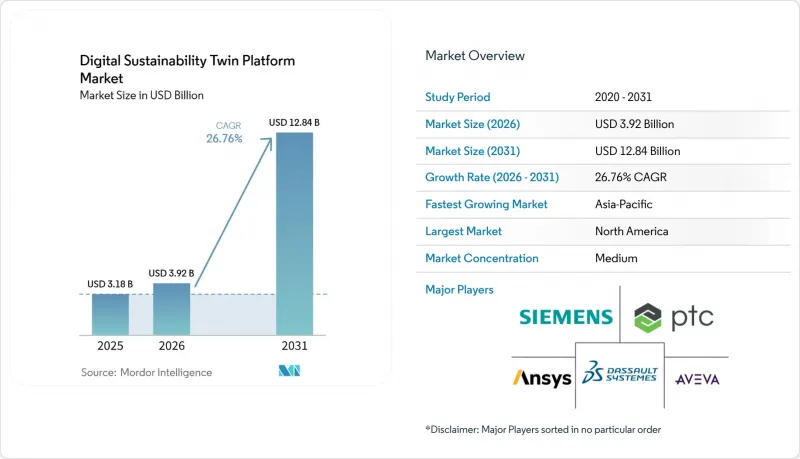
本報告按組件(平台和服務)、部署模式(雲端等)、企業規模(大型企業和中小企業)、最終用戶行業(工業製造、能源和公共產業、建築和房地產、物流和運輸、政府和智慧城市等)以及地區進行細分。市場預測以價值(美元)表示。
全球數位孿生永續發展平台市場趨勢與洞察
永續發展報告和碳核算面臨的壓力
歐盟的《永續發展報告指令》提高了對符合審計要求的永續發展數據的需求,而碳邊境調節機制(自2026年起將碳排放報告與財務風險更直接地掛鉤)則顯著提升了數位孿生永續發展平台市場的合規性要求。這使得能夠以更強的可追溯性追蹤排放的平台價值更高,而非依賴人工文件和分散的報告鏈。根據2025年12月發表在《系統》(Systems)期刊上的一篇論文,已實施以永續發展為重點的數位孿生技術的公司的平均ESG評分為0.79,而未實施的公司的平均ESG評分為0.72。這一差異意義重大,因為投資者、審計師和監管機構越來越關注的不僅是資訊揭露的數量,還有數據的來源、模型的透明度和報告結果的可複現性。繼續依賴基於電子表格方法的公司將面臨更大的檢驗負擔,因為靜態文件無法像即時模型環境那樣清晰地保留營運背景。因此,能夠將每個排放值與底層資產、流程階段和時間戳聯繫起來的供應商,在數位孿生永續性平台市場中,處於有利地位,可以抓住合規主導的需求。
對即時能源和排放最佳化的需求
數位孿生永續發展平台市場需求的成長,部分原因是買家不僅意識到永續發展報告透明度的提高,還意識到其可衡量的營運效益。發表於《科學報告》(Scientific Reports)的一項2026年研究表明,人工智慧驅動的數位孿生技術在電力系統資產管理中將投資回報率提高了9.8%,同時支援97%的可變可再生能源採用率,且不影響電網柔軟性。在工廠層面,西門子報告稱,透過在其安貝格智慧工廠實施人工智慧增強數位孿生技術,能耗降低了25%,二氧化碳排放量降低了20%。這些成果為營運經理和財務團隊提供了更直接的經濟論證,從而擴大了買家群體。即使在碳定價或正式報告要求成為主要促進因素之前,如果投資能夠透過節能和提高吞吐量來證明其合理性,那麼其吸引力就更大了。正因如此,數位孿生永續發展平台市場不僅作為一種永續發展工具,而且作為一種營運工具,都備受關注。
OT 和 IT 系統之間高階整合的複雜性。
數位孿生永續發展平台市場面臨的最大營運挑戰仍然是如何將工廠系統、企業軟體和永續發展模式整合到單一、可靠的環境中。永續發展孿生需要來自電錶、設備遙測、過程歷史記錄和外部碳排放因子的時間同步數據,但這些數據流最初並非設計用於協同工作。對於老舊的工業設施而言,情況更加複雜,因為這些設施的控制系統、報告工具和安全措施是多年來分階段建造的。 IEC 62443 等標準增加了必要的網路安全審計環節,但同時也延長了互聯工業環境的部署週期,並增加了實施負擔。因此,在許多專案中,從視覺化到決策支援所需的時間比買家最初預期的要長。正因如此,整合工作仍然是數位孿生永續發展平台市場成本、進度和部署風險的核心因素。
細分市場分析
2025年,平台部分佔據了83.14%的市場佔有率,繼續在數位孿生永續發展平台市場的企業採購決策中佔據核心地位。其價值主要集中在核心軟體層,包括模擬引擎、資料擷取工具、工作流程控制和碳排放建模框架。買家通常會在這一階段投入大部分初始資金,因為平台決定了未來營運數據、永續發展指標和報告輸出如何協同運作。西門子於2026年1月發布了「數位孿生組合器」(Digital Twin Composer),展示了這個方法。該組合器將即時營運技術(OT)資料整合、基於實體的人工智慧(AI)模擬和永續發展關鍵績效指標(KPI)儀錶板整合到一個統一的環境中。早期客戶案例表明,透過虛擬性能驗證,資本支出減少了10%至15%,這促成了首批大規模平台合約的簽訂。
預計到2031年,服務市場將以30.28%的複合年成長率成長,成為數位孿生永續發展平台市場中成長最快的細分領域。這一趨勢源自於實施後的場景,一旦底層系統就位,模型校準、排放映射、場景設計和報告一致性就變得至關重要。隨著企業從單一站點部署擴展到多站點部署,需要在不同的營運環境中調整假設、閾值和管治,服務業務機會將進一步擴大。在這種情況下,服務支出將成為持續性需求,而非一次性部署階段的需求。 Springer Nature在2026年的一份報告中指出,在循環經濟的數位孿生框架內,持續的專家設定對於將營運數據轉化為可操作的永續發展情報至關重要。這項發現支持了這樣一種觀點:數位孿生永續發展平台市場服務的成長與結構成熟度的需求相關,而不僅僅是一次性部署支援。
到 2025 年,基於雲端的部署將佔據 66.83% 的市場佔有率,成為整個數位孿生永續發展平台市場中最受歡迎的架構選擇。其優勢在於更低的架構開銷、更易於跨多個地點擴展,以及對集中式碳排放和營運資料聚合的更佳支援。當企業希望在分散式資產中應用通用報告邏輯並加速存取情境建模功能時,雲端環境尤其有用。 2025 年 4 月,微軟發布了一項案例研究,其中 Enerjisa Uretim 利用 Azure 數位孿生技術,每秒處理來自水力、風力和太陽能發電廠的超過 50,000 個訊號,同時結合即時監控和電力預測,展示了該模型的規模優勢。此案例研究突顯了雲端架構為何對需要廣泛資產可見性和整合永續發展邏輯的組織仍然具有吸引力。
混合部署預計到2031年將以31.46%的複合年成長率成長,顯示許多用戶選擇混合架構,而不是完全從本地系統遷移。在資產密集型營運中,強大的本地控制對於時間緊迫的決策仍然至關重要,尤其是在延遲、流程穩定性和工廠安全仍然至關重要的情況下。另一方面,雲端資源可用於碳排放模擬、情境測試和跨站點永續性報告。簡而言之,這種成長最快的模式使營運管理靠近資產,同時將要求苛刻的分析和揭露工作負載放在可以透過共用運算輕鬆擴展的位置。因此,數位孿生永續性平台市場正在適應行業特定的限制,而不是對所有最終用戶強加統一的架構。隨著部署擴展到具有複雜營運環境和嚴格正常運作要求的行業,這種平衡將繼續至關重要。
區域分析
2025年,北美佔據了數位孿生永續發展平台市場36.26%的佔有率,其中大部分需求來自美國。能源、工業製造和商業房地產領域的大規模應用鞏固了這一市場主導地位。該地區還受益於超大規模資料中心業者提供的強大基礎設施,降低了多站點雲端部署的門檻。 2026年5月,AVEVA和亞馬遜雲端服務(AWS)透過一項專注於雲端工業智慧(包括數位孿生功能和協同遷移計畫)的多年合作協議,進一步鞏固了雙方的市場地位。儘管加拿大和墨西哥的市場佔有率仍然較小,但對供應鏈透明度的需求持續推動該地區的市場擴張。
預計到2031年,亞太地區將以29.24%的複合年成長率成長,成為數位孿生永續發展平台市場成長最快的地區。中國「碳排放達峰、碳中和」政策創造了大規模的應用機會。根據新華社報道,海爾的「高州COSMOPlat」平台支持了一個零碳工業園區,該園區能源利用率超過80%,每個設施每年減少二氧化碳排放32600噸。日本也不斷鞏固其市場地位,日立能源將於2026年4月推出「EcoSpace」平台,用於可視化整個輸配電基礎設施全生命週期的環境影響。在印度、韓國、澳洲和紐西蘭,工業人工智慧、智慧建築和能源轉型計畫正在推動市場發展,因為它們創造了對更優質的永續發展數據和資產可視性的需求。
2025年,歐洲在區域佔有率方面位居第二,德國、英國和法國仍是主要貢獻市場。該地區的優勢在於其高度監管密度,CSRD、CBAM、歐盟分類法、ESPR以及供應鏈實質審查法規提升了可審計永續性資料在整個工業價值鏈中的價值。在法國,一項針對各地區的國家數位孿生計畫於2026年4月啟動,為公共部門帶來了新的成長點。同時,全部區域對合規性的強勁需求也持續推動數位孿生技術的應用。南美洲和中東及非洲的絕對佔有率仍然小規模,但由於智慧城市計畫和能源轉型方面的支出,它們仍然是重要的成長區域。在這些地區,數位孿生技術的應用傾向於集中在公共產業、基礎設施和公共投資等用例中,而不是廣泛的私營部門部署。
其他好處:
- Excel格式的市場預測(ME)表
- 3個月的分析師支持
目錄
第1章:引言
- 研究假設和市場定義
- 調查範圍
第2章:調查方法
第3章執行摘要
第4章 市場狀況
- 市場概覽
- 市場促進因素
- 永續發展報告和碳核算面臨的壓力
- 對即時能源和排放最佳化的需求
- 工業4.0在資產密集型企業的擴張
- 利用雲端運算和人工智慧實現模擬的可擴展性
- 為在智慧建築和智慧城市中實施數位孿生技術做好準備
- 氣候變遷和供應鏈波動下的業務永續營運計劃
- 市場限制因素
- OT 和 IT 系統之間高階整合的複雜性。
- 模擬、資料融合和永續建模領域人才短缺。
- 對資料管治、網路安全和模型保證方面的擔憂。
- 延長在多個地點實施永續發展雙子專案的投資回收期。
- 產業價值鏈分析
- 宏觀經濟因素對市場的影響
- 監理情勢
- 技術展望
- 波特五力分析
第5章 市場規模與成長預測
- 按組件
- 平台
- 服務
- 部署模式
- 基於雲端的
- 現場
- 混合
- 按公司規模
- 大公司
- 小型企業
- 按最終用戶行業分類
- 工業製造
- 能源公用事業
- 建築與房地產
- 物流/運輸
- 政府和智慧城市
- 其他終端用戶產業
- 按地區
- 北美洲
- 美國
- 加拿大
- 墨西哥
- 南美洲
- 巴西
- 阿根廷
- 其他南美國家
- 歐洲
- 德國
- 英國
- 法國
- 西班牙
- 義大利
- 俄羅斯
- 其他歐洲國家
- 亞太地區
- 中國
- 印度
- 日本
- 韓國
- 澳洲和紐西蘭
- 其他亞太國家
- 中東
- 沙烏地阿拉伯
- 阿拉伯聯合大公國
- 土耳其
- 其他中東國家
- 非洲
- 南非
- 奈及利亞
- 埃及
- 其他非洲國家
- 北美洲
第6章 競爭情勢
- 市場集中度
- 策略趨勢
- 市佔率分析
- 公司簡介
- Siemens AG
- Dassault Systemes SE
- PTC Inc.
- Ansys, Inc.
- AVEVA Group Limited
- Bentley Systems, Incorporated
- Autodesk, Inc.
- IBM Corporation
- Microsoft Corporation
- Amazon Web Services, Inc.
- SAP SE
- Schneider Electric SE
- GE Vernova Inc.
- Rockwell Automation, Inc.
- Cognite AS
- Hitachi, Ltd.
- Oracle Corporation
- Altair Engineering Inc.
- AspenTech
- Honeywell International, Inc.
第7章 市場機會與未來展望
According to Mordor Intelligence, the digital sustainability twin platform market size was valued at USD 3.18 billion in 2025 and is expected to reach USD 3.92 billion in 2026 and USD 12.84 billion by 2031, growing at a CAGR of 26.76% from 2026 to 2031.
This report is Segmented by Component (Platform, and Services), Deployment Mode (Cloud-Based, and More), Enterprise Size (Large Enterprises, and SMEs), End-User Industry (Industrial Manufacturing, Energy and Utilities, Buildings and Real Estate, Logistics and Transportation, Government and Smart Cities, and More), and Geography. The Market Forecasts are Provided in Terms of Value (USD).
Global Digital Sustainability Twin Platform Market Trends and Insights
Sustainability Reporting and Carbon Accounting Pressure
The compliance case for the digital sustainability twin platform market strengthened sharply as the EU Corporate Sustainability Reporting Directive increased the need for audit-ready sustainability data, and the Carbon Border Adjustment Mechanism tied carbon reporting more directly to financial exposure from 2026 onward. This raised the value of platforms that can track emissions with stronger traceability rather than rely on manual files and fragmented reporting chains. A December 2025 paper in Systems reported that companies using sustainability-focused digital twins had an average ESG score of 0.79, compared with 0.72 for non-adopters. That gap matters because investors, auditors, and regulators increasingly look beyond disclosure volume and focus more on data lineage, model transparency, and repeatability of reported results. Companies that stay with spreadsheet-heavy methods face higher verification effort because static files do not preserve operational context as clearly as live model environments. Vendors that can connect each emissions value to the source asset, process step, and time stamp are therefore better placed to win compliance-led demand in the digital sustainability twin platform market.
Real-Time Energy and Emissions Optimization Demand
Demand in the digital sustainability twin platform market also rose because buyers started to see measurable operating gains, not just cleaner sustainability reporting. A 2026 study in Scientific Reports showed that AI-driven digital twins in power system asset management improved investment ROI by 9.8% while supporting 97% variable renewable energy penetration without reducing grid flexibility. At the facility level, Siemens reported that its AI-enhanced digital twin deployment at the Amberg Smart Factory reduced energy consumption by 25% and cut CO2 emissions by 20%. These results widened the buyer base because they gave operations leaders and finance teams a more direct economic case for adoption. The appeal is especially strong when energy savings and throughput gains can justify investment even before carbon prices or formal reporting requirements become the main trigger. This is why the digital sustainability twin platform market is gaining traction as an operations tool as much as a sustainability tool.
High Integration Complexity Across OT And IT Systems
The hardest operating challenge in the digital sustainability twin platform market remains the job of bringing plant systems, enterprise software, and sustainability models into one dependable environment. Sustainability twins require time-synchronized data from energy meters, equipment telemetry, process historians, and external carbon factors, and those data streams were not originally designed to work together. This becomes more difficult in older industrial sites where control layers, reporting tools, and security practices were built in separate stages over many years. Standards such as IEC 62443 add a necessary layer of cybersecurity review, but they also extend deployment timelines and increase implementation effort for connected industrial environments. The result is that many projects take longer to move from visibility to decision support than buyers first expect. This keeps integration work near the center of cost, timing, and adoption risk in the digital sustainability twin platform market.
Other drivers and restraints analyzed in the detailed report include:
- Industry 4.0 Expansion Across Asset-Intensive Operations
- Cloud and AI-Enabled Simulation Scalability
- Shortage of Simulation, Data Fusion, and Sustainability Modeling Talent
For complete list of drivers and restraints, kindly check the Table Of Contents.
Segment Analysis
The platform segment held 83.14% of the market in 2025, which kept it at the center of enterprise buying decisions in the digital sustainability twin platform market. Much of that value sat in core software layers such as simulation engines, data ingestion tools, workflow controls, and carbon modeling frameworks. Buyers often commit most of their initial spend at this stage because the platform determines how operating data, sustainability metrics, and reporting outputs will connect later. Siemens illustrated this approach in January 2026 when it introduced Digital Twin Composer with real-time OT data integration, physics-based AI simulation, and sustainability KPI dashboards in a single environment. Early customer use reported 10-15% capital expenditure reductions through virtual commissioning, which helped support large upfront platform contracts.
Services are projected to grow at 30.28% CAGR through 2031, making them the faster-moving part of the digital sustainability twin platform market size. This pattern reflects what happens after deployment, because model calibration, emissions mapping, scenario design, and reporting alignment become more important once the base system is in place. The services opportunity expands further when companies move from one site to many sites and need to adjust assumptions, thresholds, and governance across each operating context. In that setting, service spending becomes a recurring requirement rather than a one-time implementation step. Springer Nature reported in 2026 that circular economy digital twin frameworks require ongoing expert configuration to turn operational data into actionable sustainability intelligence. That finding supports the view that services growth in the digital sustainability twin platform market is tied to structural maturity needs, not just temporary rollout support.
Cloud-based deployment accounted for 66.83% of the market in 2025, making it the most popular architecture choice across the digital sustainability twin platform market. Its lead came from lower infrastructure overhead, easier scaling across multiple sites, and better support for centralized carbon and operational data aggregation. Cloud environments are especially useful when companies want shared reporting logic across distributed assets and faster access to scenario modeling capacity. Microsoft showed the scale of this model in April 2025 when it said Enerjisa Uretim used Azure Digital Twins to process more than 50,000 signals per second from hydropower, wind, and solar plants while combining real-time monitoring with production forecasting. That example highlights why cloud architecture remains attractive for organizations that need broad asset visibility and consolidated sustainability logic.
Hybrid deployment is projected to grow at 31.46% CAGR through 2031, which shows that many users are choosing a mixed architecture instead of a full move away from local systems. Asset-intensive operations still need strong local control for time-sensitive decisions, especially where latency, process stability, and plant safety remain critical. At the same time, cloud resources are useful for carbon simulation, scenario testing, and cross-site sustainability reporting. This means the fastest-growing model keeps operational control close to the asset while placing heavier analytics and disclosure workloads where shared computing is easier to scale. The digital sustainability twin platform market is therefore adapting to industrial constraints rather than forcing a uniform architecture on every end user. That balance should remain important as adoption expands in sectors with complex operating environments and strict uptime requirements.
Complete Report Scope:
- By Component
- Platform
- Services
- By Deployment Mode
- Cloud-Based
- On-Premises
- Hybrid
- By Enterprise Size
- Large Enterprises
- SMEs
- By End-User Industries
- Industrial Manufacturing
- Energy and Utilities
- Buildings and Real Estate
- Logistics and Transportation
- Government and Smart Cities
- Other End-User Industries
- By Geography
- North America
- United States
- Canada
- Mexico
- South America
- Brazil
- Argentina
- Rest of South America
- Europe
- Germany
- United Kingdom
- France
- Spain
- Italy
- Russia
- Rest of Europe
- Asia-Pacific
- China
- India
- Japan
- South Korea
- Australia and New Zealand
- Rest of Asia-Pacific
- Middle East
- Saudi Arabia
- United Arab Emirates
- Turkey
- Rest of Middle East
- Africa
- South Africa
- Nigeria
- Egypt
- Rest of Africa
- North America
Geography Analysis
North America held 36.26% of the digital sustainability twin platform market share in 2025, with the United States accounting for most of the region's demand. Large deployments in energy, industrial manufacturing, and commercial real estate supported this lead. The region also benefited from deep hyperscaler infrastructure, which reduced friction for multi-site cloud-based implementations. AVEVA and Amazon Web Services strengthened that position in May 2026 through a multi-year collaboration focused on industrial intelligence in the cloud, including digital twin capabilities and joint migration programs. Canada and Mexico remained smaller contributors, but supply chain transparency requirements continued to support regional expansion.
Asia-Pacific is projected to grow at 29.24% CAGR through 2031, making it the fastest-expanding geography in the digital sustainability twin platform market. China's dual-carbon policy is creating large-scale deployment opportunities, and Xinhua reported that Haier's Kaoshu COSMOPlat supported zero-carbon industrial parks with energy utilization rates above 80% and annual CO2 reductions of 32,600 tonnes per installation. Japan is also strengthening its position, and Hitachi Energy launched EcoSpace in April 2026 to visualize lifecycle environmental impacts across transmission and distribution grid infrastructure. India, South Korea, Australia, and New Zealand are adding momentum as industrial AI, smart building, and energy transition programs create demand for better sustainability data and asset visibility.
Europe held the second-largest regional share in 2025, and Germany, the United Kingdom, and France remained the main contributor markets. The region's strength came from regulatory density because CSRD, CBAM, the EU Taxonomy, ESPR, and supply chain due diligence rules all increased the value of auditable sustainability data across industrial value chains. France added a public-sector growth layer in April 2026 through its national digital twin program for territories, while broader regional adoption continued to benefit from strong compliance demand. South America, the Middle East, and Africa remained smaller in absolute value, but smart city programs and energy transition spending kept them relevant growth pockets. In these regions, adoption stayed more concentrated in utility, infrastructure, and public investment use cases than in broad private-sector rollouts.
- Siemens AG
- Dassault Systemes SE
- PTC Inc.
- Ansys, Inc.
- AVEVA Group Limited
- Bentley Systems, Incorporated
- Autodesk, Inc.
- IBM Corporation
- Microsoft Corporation
- Amazon Web Services, Inc.
- SAP SE
- Schneider Electric SE
- GE Vernova Inc.
- Rockwell Automation, Inc.
- Cognite AS
- Hitachi, Ltd.
- Oracle Corporation
- Altair Engineering Inc.
- AspenTech
- Honeywell International, Inc.
Additional Benefits:
- The market estimate (ME) sheet in Excel format
- 3 months of analyst support
TABLE OF CONTENTS
1 INTRODUCTION
- 1.1 Study Assumptions and Market Definition
- 1.2 Scope of the Study
2 RESEARCH METHODOLOGY
3 EXECUTIVE SUMMARY
4 MARKET LANDSCAPE
- 4.1 Market Overview
- 4.2 Market Drivers
- 4.2.1 Sustainability Reporting and Carbon Accounting Pressure
- 4.2.2 Real-Time Energy and Emissions Optimization Demand
- 4.2.3 Industry 4.0 Expansion Across Asset-Intensive Operations
- 4.2.4 Cloud and AI-Enabled Simulation Scalability
- 4.2.5 Digital Twin Readiness for Smart Buildings and Smart Cities
- 4.2.6 Operational Resilience Planning Under Climate and Supply Chain Volatility
- 4.3 Market Restraints
- 4.3.1 High Integration Complexity Across OT and IT Systems
- 4.3.2 Shortage of Simulation, Data Fusion, and Sustainability Modeling Talent
- 4.3.3 Data Governance, Cybersecurity, and Model Assurance Concerns
- 4.3.4 Long Payback Period for Multi-Site Sustainability Twin Deployments
- 4.4 Industry Value Chain Analysis
- 4.5 Impact of Macroeconomic Factors on the Market
- 4.6 Regulatory Landscape
- 4.7 Technological Outlook
- 4.8 Porter's Five Forces Analysis
- 4.8.1 Bargaining Power of Suppliers
- 4.8.2 Bargaining Power of Buyers
- 4.8.3 Threat of New Entrants
- 4.8.4 Threat of Substitutes
- 4.8.5 Intensity of Competitive Rivalry
5 MARKET SIZE AND GROWTH FORECASTS (VALUE)
- 5.1 By Component
- 5.1.1 Platform
- 5.1.2 Services
- 5.2 By Deployment Mode
- 5.2.1 Cloud-Based
- 5.2.2 On-Premises
- 5.2.3 Hybrid
- 5.3 By Enterprise Size
- 5.3.1 Large Enterprises
- 5.3.2 SMEs
- 5.4 By End-User Industries
- 5.4.1 Industrial Manufacturing
- 5.4.2 Energy and Utilities
- 5.4.3 Buildings and Real Estate
- 5.4.4 Logistics and Transportation
- 5.4.5 Government and Smart Cities
- 5.4.6 Other End-User Industries
- 5.5 By Geography
- 5.5.1 North America
- 5.5.1.1 United States
- 5.5.1.2 Canada
- 5.5.1.3 Mexico
- 5.5.2 South America
- 5.5.2.1 Brazil
- 5.5.2.2 Argentina
- 5.5.2.3 Rest of South America
- 5.5.3 Europe
- 5.5.3.1 Germany
- 5.5.3.2 United Kingdom
- 5.5.3.3 France
- 5.5.3.4 Spain
- 5.5.3.5 Italy
- 5.5.3.6 Russia
- 5.5.3.7 Rest of Europe
- 5.5.4 Asia-Pacific
- 5.5.4.1 China
- 5.5.4.2 India
- 5.5.4.3 Japan
- 5.5.4.4 South Korea
- 5.5.4.5 Australia and New Zealand
- 5.5.4.6 Rest of Asia-Pacific
- 5.5.5 Middle East
- 5.5.5.1 Saudi Arabia
- 5.5.5.2 United Arab Emirates
- 5.5.5.3 Turkey
- 5.5.5.4 Rest of Middle East
- 5.5.6 Africa
- 5.5.6.1 South Africa
- 5.5.6.2 Nigeria
- 5.5.6.3 Egypt
- 5.5.6.4 Rest of Africa
- 5.5.1 North America
6 COMPETITIVE LANDSCAPE
- 6.1 Market Concentration
- 6.2 Strategic Moves
- 6.3 Market Share Analysis
- 6.4 Company Profiles (includes Global Level Overview, Market Level Overview, Core Segments, Financials as available, Strategic Information, Market Rank/Share, Products and Services, Recent Developments)
- 6.4.1 Siemens AG
- 6.4.2 Dassault Systemes SE
- 6.4.3 PTC Inc.
- 6.4.4 Ansys, Inc.
- 6.4.5 AVEVA Group Limited
- 6.4.6 Bentley Systems, Incorporated
- 6.4.7 Autodesk, Inc.
- 6.4.8 IBM Corporation
- 6.4.9 Microsoft Corporation
- 6.4.10 Amazon Web Services, Inc.
- 6.4.11 SAP SE
- 6.4.12 Schneider Electric SE
- 6.4.13 GE Vernova Inc.
- 6.4.14 Rockwell Automation, Inc.
- 6.4.15 Cognite AS
- 6.4.16 Hitachi, Ltd.
- 6.4.17 Oracle Corporation
- 6.4.18 Altair Engineering Inc.
- 6.4.19 AspenTech
- 6.4.20 Honeywell International, Inc.
7 MARKET OPPORTUNITIES AND FUTURE OUTLOOK
- 7.1 White-Space and Unmet-Need Assessment

 全球數位轉型市場規模、佔有率、趨勢和成長分析報告(2026-2034)
 印度軟體服務出口:市場佔有率分析、產業趨勢與統計及成長預測(2026-2031)行銷轉型服務市場:市場佔有率分析、產業趨勢與統計、成長預測(2026-2031)數位轉型(DX):市場佔有率分析、產業趨勢與統計、成長預測(2026-2031)
 物流市場數位轉型:2026-2032年全球市場預測數位轉型市場:按產品類型、部署方式、組織規模、應用和產業分類-全球市場預測(2026-2032 年)機場和港口連接的光纖基礎設施:市場佔有率分析、行業趨勢和統計數據以及成長預測(2026-2031 年)製造業數位轉型:市場佔有率分析、產業趨勢與統計及成長預測(2026-2031)美國數位轉型:市場佔有率分析、產業趨勢與統計及成長預測(2026-2031 年)印尼數位轉型:市場佔有率分析、產業趨勢與統計及成長預測(2026-2031)