


 |
市場調查報告書
商品編碼
2073661
印尼數位轉型:市場佔有率分析、產業趨勢與統計及成長預測(2026-2031)Indonesia Digital Transformation - Market Share Analysis, Industry Trends & Statistics, Growth Forecasts (2026 - 2031) |
||||||

※ 本網頁內容可能與最新版本有所差異。詳細情況請與我們聯繫。
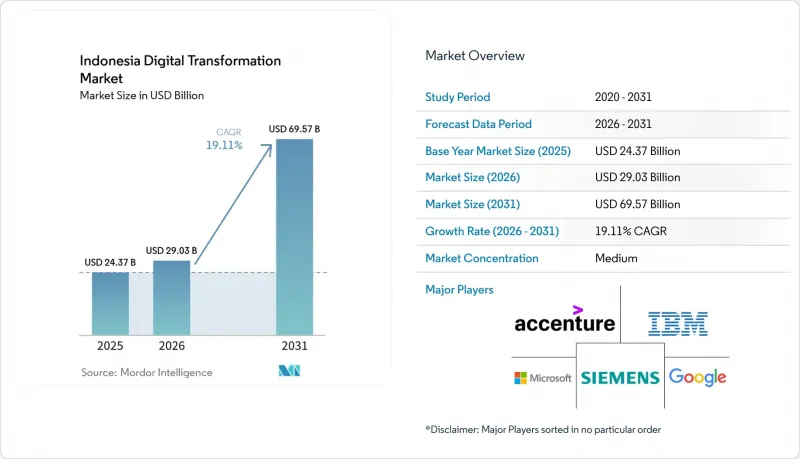
根據 Mordor Intelligence 預測,印尼數位轉型市場規模預計將從 2025 年的 243.7 億美元成長到 2026 年的 290.3 億美元,然後在 2031 年達到 695.7 億美元,2026 年至 2031 年的複合年成長率為 19.11%。
本報告按解決方案類型(分析、人工智慧 (AI) 和機器學習、其他)、最終用戶(製造業、石油天然氣和公共產業、其他)、部署模式(本地部署、其他)、企業規模(大型企業、其他)、功能(營運和生產、其他)以及地區進行細分。市場預測以美元 (USD) 為單位。
印尼數位轉型市場的趨勢與洞察
利用超大規模資料中心業者雲端服務商加速雲端基礎架構的部署
AWS宣布將投資50億美元在西爪哇建造資料中心叢集,而微軟也已撥款17億美元用於確保額外的容量並建造符合個人資料保護法的本地區域。這些本土設施將滿足資料居住要求,並降低分析、人工智慧推理和電子商務工作負載的延遲。金融機構已從中受益。印尼Jago銀行已將其核心應用程式遷移到谷歌雲,Krom銀行已將其面向客戶的服務遷移到AWS,從而在不影響合規性的前提下獲得了可擴展的運算能力。邊緣節點正在區域城市部署,使工廠感測器和自動導引運輸車(AGV)能夠近乎即時地處理資料。企業表示,隨著跨境資料傳輸罰款的擔憂逐漸消退,本地雲端區域的可用性已使雲端遷移速度年增約40%。
行動裝置和超級應用的迅速普及
印尼「行動優先」的市場環境,以及智慧型手機在主要城市和鄉村地區不斷成長的普及率,為數位服務提供了沃土。像Gojek旗下的「GoTo」及其區域競爭對手Grab這樣的超級應用,已經從叫車平台發展成為涵蓋支付、保險和B2B物流的綜合生態系統。 GoTo宣布,其2024年的交易總額將達到137.4兆印尼幣,其覆蓋全國的2D碼支付系統(QRIS)目前連接了超過2,240萬家商戶,擴大了數位支付的覆蓋範圍。商業、支付和按需服務的緊密互聯產生了精細的消費者數據,使廣告商和零售商能夠透過人工智慧驅動的細分來進行精準宣傳活動。此外,超級應用程式與雲端服務供應商的合作,使中小企業能夠透過熟悉的行動介面,一鍵存取庫存管理、核算和融資解決方案。
對網路安全和資料主權的持續擔憂
2024年10月,《個人資料保護法》全面生效,對資料外洩通知設定了嚴格的時限,並規定了域外適用條款,這些條款同樣適用於印尼境外的子公司。金融機構現在必須要求供應商透過第三方審計和本地化金鑰管理系統來證明其合規性。 2022年第82號總統令進一步將銀行業、電信業和能源業指定為關鍵資訊基礎設施,並強制要求定期進行安全評估。雖然這些措施降低了系統性風險,但合規成本卻在不斷上升,企業在將敏感工作負載遷移到公共雲端時也面臨更嚴格的審查。根據印尼央行的網路安全事件統計數據,2024年針對關鍵產業的持續性高階威脅(APT)年增34.4%,這推動了對與數位轉型藍圖緊密整合的託管偵測與回應(MDR)服務的需求。
細分市場分析
在印尼的數位轉型市場中,工業機器人領域正經歷最快的成長,預計從2026年到2031年,其複合年成長率將達到22.05%,這主要得益於工廠部署協作機器人用於焊接、取放和品質檢測等任務。在工業機器人的驅動下,印尼的數位轉型市場預計將成長三倍以上,因為汽車、消費品和電子產品工廠正在利用人工智慧視覺系統維修傳統的生產線。同時,在主權地區滿足資料本地化法規的推動下,雲端運算和邊緣運算將在2025年佔據技術支出的最大佔有率,達到28.07%。物聯網部署正從概念驗證(PoC)走向成熟,應用於大規模生產監控,尤其是在食品加工廠,濕度和溫度感測器的引入正在降低食品腐敗率。積層製造仍然是一個小眾領域,但人們對按需生產備件的興趣日益濃厚,這將縮短偏遠地區採礦作業的前置作業時間。
雲端資料庫、容器編排管理和人工智慧平台構成了連接這些點解決方案的數位骨幹。網路安全工具將零信任架構整合到工廠網路中,保護可程式邏輯控制器 (PLC) 免受勒索軟體威脅。用於遠端維護和員工培訓的擴增實境(XR) 應用降低了差旅成本並提高了安全性。一個追蹤棕櫚油供應鏈的區塊鏈先導計畫正在發展成為一個聯盟管治模式,該模式可在不洩露敏感資訊的情況下促進競爭對手之間的資料共用。這些多元化的技術組合凸顯了印尼數位轉型市場的蓬勃發展,其範圍正從最初的雲端遷移擴展到全端數位化。
到2025年,製造業將佔技術支出的23.78%,體現了其與「印尼製造4.0」生產力目標的早期契合。自動化物料搬運系統、數位雙胞胎和預測性維護分析已帶來切實的成本節約效益,證明了持續投資的合理性。相較之下,在遠距遠端醫療報銷政策和醫院認證標準(強制採用電子健康記錄)的推動下,醫療保健產業在印尼連線健診系統中正迅速擴張,預計將以23.62%的複合年成長率成長。新創公司正在將人工智慧聊天機器人整合到分診服務中,以減輕離島上人手不足的診所的負擔。石油、天然氣和公共產業營運商正在部署物聯網感測器和數位雙胞胎,以提高安全性並最佳化資產運作,而零售連鎖店則正在利用與超級應用程式和雲端POS系統的整合來實現全通路庫存管理。
隨著區域醫療中心升級影像和檢測設備,印尼醫療保健產業的數位轉型市場規模預計將迅速擴大。銀行和保險公司正在利用基於機器學習的詐欺偵測技術來減少拒賠,並將這些預算重新分配到客戶體驗自動化方面。公共機構正在將面向公民的服務數位化,並透過將後勤部門記錄與基於雲端的工作流引擎整合來提高透明度。教育機構正在擴展其學習管理平台,媒體公司正在利用OTT(網路電視)傳輸和定向廣告從其大規模的用戶群中獲取收入。每個行業都在製定自己的數位化藍圖,但它們都共同通用可靠的連接和安全的數據處理框架。
其他好處:
- Excel格式的市場預測(ME)表
- 3個月的分析師支持
目錄
第1章:引言
- 研究假設和市場定義
- 調查範圍
第2章:調查方法
第3章執行摘要
第4章 市場狀況
- 市場概覽
- 市場促進因素
- 利用超大規模資料中心業者雲端服務商加速雲端基礎架構的部署
- 行動裝置和超級應用的迅速普及
- 政府的「印尼4.0」激勵計劃
- 為位於離島的工廠提供 5G 和 LEO 衛星回程傳輸
- 本地AI-ASIC設計新創企業的崛起
- 千禧世代數位原生代勞動力的快速成長
- 市場限制因素
- 對網路安全和資料主權的持續擔憂
- 企業級人才短缺
- 各州監理合規情況的差異
- 過度依賴進口工業機器人
- 產業價值鏈分析
- 監理情勢
- 技術展望
- 宏觀經濟因素的影響
- 波特五力分析
- 產業生態系分析
- 當前市場狀況和數位轉型實踐的演變
- 關鍵指標
- 科技支出趨勢
- 物聯網設備數量
- 網路攻擊總數
- IT專業人員的發展趨勢
- 網路成長與滲透率
- 數位競爭力排名
- 固定和行動寬頻普及率現狀
- 雲採用狀況
- 人工智慧實施
- 電子商務滲透率
第5章 市場規模與成長預測
- 按解決方案類型
- 分析、人工智慧、機器學習
- 擴增實境(XR)
- 物聯網 (IoT)
- 工業機器人
- 區塊鏈
- 積層製造/3D列印
- 網路安全
- 雲端邊緣運算
- 其他類型—數位雙胞胎、移動性、連結性
- 最終用戶
- 製造業
- 石油、天然氣和公共產業
- 零售與電子商務
- 運輸/物流
- 衛生保健
- 銀行、金融服務和保險(BFSI)
- 通訊/IT
- 政府/公共部門
- 其他最終用戶-教育、媒體與娛樂、環境
- 部署模式
- 現場
- 雲
- 混合
- 按公司規模
- 大公司
- 中小企業
- 按功能
- 營運和生產
- 客戶經驗和前台
- 財會
- 人力資源
- 供應鍊和採購
第6章 競爭情勢
- 市場集中度
- 策略趨勢
- 市佔率分析
- 公司簡介
- Accenture plc
- International Business Machines Corporation
- Microsoft Corporation
- Alphabet Inc.(Google LLC)
- Amazon Web Services Inc.
- SAP SE
- Oracle Corporation
- PT Telekomunikasi Indonesia(Persero)Tbk.
- Hewlett Packard Enterprise Company
- Cisco Systems Inc.
- Infosys Limited
- Siemens AG
- Apple Inc.
- Cognex Corporation
- Tata Consultancy Services Limited
- PT Multipolar Technology Tbk
- Salesforce Inc.
- Alibaba Cloud(Singapore)Private Limited
- Capgemini SE
- Fujitsu Limited
第7章 市場機會與未來展望
According to Mordor Intelligence, the indonesia digital transformation market size is expected to grow from USD 24.37 billion in 2025 to USD 29.03 billion in 2026 and is forecast to reach USD 69.57 billion by 2031 at 19.11% CAGR over 2026-2031.
This report is Segmented by Type (Analytics, Artificial Intelligence and Machine Learning, and More), End User (Manufacturing, Oil Gas and Utilities, and More), Deployment Mode (On-Premise, and More), Enterprise Size (Large Enterprises, and More), Function (Operations and Production, and More), and Geography. The Market Forecasts are Provided in Terms of Value (USD).
Indonesia Digital Transformation Market Trends and Insights
Accelerated Cloud Infrastructure Rollouts by Hyperscalers
AWS has committed USD 5 billion to build data-center clusters in West Java, while Microsoft has earmarked USD 1.7 billion for additional capacity, creating localized regions that comply with the Personal Data Protection Law. These sovereign facilities satisfy data-residency rules and shorten latency for analytics, AI inference, and e-commerce workloads. Financial institutions are already capitalizing; Bank Jago moved core applications to Google Cloud, and Krom Bank migrated customer-facing services to AWS, gaining scalable computing power without compromising compliance. Edge nodes are being deployed across secondary cities so that factory-floor sensors and autonomous guided vehicles can process data in near real time. Enterprises report that the availability of local cloud zones has accelerated cloud migration velocity by roughly 40% year over year as fear of cross-border data transfer penalties subsides.
Rapid Proliferation of Mobile Devices and Super-Apps
Indonesia's mobile-first environment has become fertile ground for digital services, with smartphone adoption climbing across both metropolitan and second-tier cities. Super-apps such as Gojek's GoTo and regional rival Grab have evolved from ride-hailing platforms into integrated ecosystems encompassing payments, insurance, and B2B logistics. GoTo disclosed gross transaction value of 137.4 trillion rupiah in 2024, and the national QRIS system now links more than 22.4 million merchants, widening the reach of digital payments. The intertwined nature of commerce, payments, and on-demand services generates granular consumer data, enabling AI-driven segmentation that advertisers and retailers leverage for targeted campaigns. Partnerships between super-apps and cloud providers are also giving SMEs one-click access to inventory management, bookkeeping, and lending solutions embedded within familiar mobile interfaces.
Persistent Cyber-Security and Data-Sovereignty Concerns
Full enforcement of the Personal Data Protection Law in October 2024 introduced strict breach notification timelines and extraterritorial provisions that catch subsidiaries outside Indonesia. Financial institutions now require vendors to demonstrate compliance through third-party audits and localized key-management systems. Presidential Regulation 82/2022 further designates the banking, telecom, and energy sectors as vital information infrastructure and mandates periodic security assessments. While these measures mitigate systemic risk, compliance costs have risen, and enterprises face heightened scrutiny when moving sensitive workloads to the public cloud. Cyber-incident statistics from the central bank show that advanced persistent threats targeting critical sectors jumped 34.4% year over year in 2024, prompting demand for managed detection and response services tightly integrated into digital-transformation roadmaps.
Other drivers and restraints analyzed in the detailed report include:
- Government "Making Indonesia 4.0" Incentives
- 5G and LEO-Satellite Backhaul for Outer-Island Factories
- Shortage of Enterprise-Grade Talent
For complete list of drivers and restraints, kindly check the Table Of Contents.
Segment Analysis
Industrial robotics recorded the fastest expansion within the Indonesia digital transformation market, advancing at a 22.05% CAGR over 2026-2031 as factories adopt collaborative robots for welding, pick-and-place, and quality inspection tasks. The Indonesia digital transformation market size attributable to industrial robots is set to more than triple as automotive, consumer-goods, and electronics plants retrofit legacy lines with AI-enabled vision systems. Simultaneously, cloud and edge computing held the largest slice of technology spending at 28.07% in 2025, powered by sovereign regions that satisfy data-localization rules. IoT deployments are maturing from proof-of-concept to scaled production monitoring, especially in food-processing facilities where humidity and temperature sensors have cut spoilage rates. Additive manufacturing remains niche but is gaining interest for spare-parts on-demand production, cutting lead times for remote mining operations.
Cloud databases, container orchestration, and AI platforms serve as the digital backbone connecting these point solutions. Cybersecurity tools embed zero-trust architecture into plant networks to safeguard programmable logic controllers from ransomware threats. Extended-reality applications for remote maintenance and workforce training lower travel costs and enhance safety. Blockchain pilots tracing palm-oil supply chains are moving into consortium governance models that encourage data-sharing among competitors without exposing proprietary information. The diverse technology mix underscores how the Indonesia digital transformation market continues broadening beyond initial cloud migrations toward full-stack digitization.
Manufacturing captured 23.78% of technology spend in 2025, reflecting early alignment with "Making Indonesia 4.0" productivity targets. Automated material-handling systems, digital twins, and predictive-maintenance analytics yielded tangible cost savings that justify ongoing investment. In contrast, the healthcare segment is scaling rapidly within the Indonesia connected healthcare ecosystem, with a forecast 23.62% CAGR, fuelled by telehealth reimbursement policies and hospital accreditation standards that require electronic health-record adoption. Start-ups are integrating AI chatbots into triage services, lightening the load on understaffed clinics across remote islands. Oil, gas, and utilities operators embed IoT sensors and digital twins to enhance safety and optimize asset uptime, while retail chains rely on super-app integration and cloud POS systems for omnichannel inventories.
The Indonesia digital transformation market size tied to healthcare stands to increase sharply as community health centers upgrade imaging and diagnostics. Banks and insurers apply machine-learning fraud detection to reduce claim denials, freeing budget for customer-experience automation. Public-sector agencies digitize citizen services, aligning back-office records with cloud-based workflow engines that improve transparency. Education institutions scale learning-management platforms, while media operators embrace OTT distribution and targeted advertising to monetize large subscriber bases. Each vertical is carving distinct digital roadmaps, yet all share a common dependence on reliable connectivity and secure data-handling frameworks.
Complete Report Scope:
- By Solution ype
- Analytics, Artificial Intelligence and Machine Learning
- Extended Reality (XR)
- Internet of Things (IoT)
- Industrial Robotics
- Blockchain
- Additive Manufacturing / 3D Printing
- Cybersecurity
- Cloud and Edge Computing
- Other Types - Digital Twin, Mobility and Connectivity
- By End User
- Manufacturing
- Oil, Gas and Utilities
- Retail and E-commerce
- Transportation and Logistics
- Healthcare
- Banking, Financial Services and Insurance (BFSI)
- Telecom and IT
- Government and Public Sector
- Other End Users - Education, Media and Entertainment, Environment
- By Deployment Mode
- On-premise
- Cloud
- Hybrid
- By Enterprise Size
- Large Enterprises
- Small and Medium-sized Enterprises (SMEs)
- By Function
- Operations and Production
- Customer Experience and Front-office
- Finance and Accounting
- Human Resources
- Supply Chain and Procurement
List of Companies Covered in this Report:
- Accenture plc
- International Business Machines Corporation
- Microsoft Corporation
- Alphabet Inc. (Google LLC)
- Amazon Web Services Inc.
- SAP SE
- Oracle Corporation
- PT Telekomunikasi Indonesia (Persero) Tbk.
- Hewlett Packard Enterprise Company
- Cisco Systems Inc.
- Infosys Limited
- Siemens AG
- Apple Inc.
- Cognex Corporation
- Tata Consultancy Services Limited
- PT Multipolar Technology Tbk
- Salesforce Inc.
- Alibaba Cloud (Singapore) Private Limited
- Capgemini SE
- Fujitsu Limited
Additional Benefits:
- The market estimate (ME) sheet in Excel format
- 3 months of analyst support
TABLE OF CONTENTS
1 INTRODUCTION
- 1.1 Study Assumptions and Market Definition
- 1.2 Scope of the Study
2 RESEARCH METHODOLOGY
3 EXECUTIVE SUMMARY
4 MARKET LANDSCAPE
- 4.1 Market Overview
- 4.2 Market Drivers
- 4.2.1 Accelerated cloud infrastructure roll-outs by hyperscalers
- 4.2.2 Rapid proliferation of mobile devices and super-apps
- 4.2.3 Government's "Making Indonesia 4.0" incentives
- 4.2.4 5G and LEO-satellite backhaul for outer-island factories
- 4.2.5 Rise of local AI-ASIC design start-ups
- 4.2.6 Millennial digital-native labour surge
- 4.3 Market Restraints
- 4.3.1 Persistent cyber-security and data-sovereignty concerns
- 4.3.2 Shortage of enterprise-grade talent
- 4.3.3 Fragmented regulatory compliance across provinces
- 4.3.4 Over reliance on imported industrial robotics
- 4.4 Industry Value-Chain Analysis
- 4.5 Regulatory Landscape
- 4.6 Technological Outlook
- 4.7 Impact of Macroeconomic Factors
- 4.8 Porter's Five Forces Analysis
- 4.8.1 Threat of New Entrants
- 4.8.2 Bargaining Power of Suppliers
- 4.8.3 Bargaining Power of Buyers
- 4.8.4 Threat of Substitutes
- 4.8.5 Competitive Rivalry
- 4.9 Industry Ecosystem Analysis
- 4.10 Current Market Scenario and Evolution of Digital Transformation Practices
- 4.11 Key Metrics
- 4.11.1 Technology Spending Trends
- 4.11.2 Number of IoT Devices
- 4.11.3 Total Cyberattacks
- 4.11.4 Technology Staffing Trends
- 4.11.5 Internet Growth and Penetration
- 4.11.6 Digital Competitiveness Ranking
- 4.11.7 Fixed and Mobile Broadband Coverage
- 4.11.8 Cloud Adoption
- 4.11.9 AI Adoption
- 4.11.10 E-commerce Penetration
5 MARKET SIZE AND GROWTH FORECASTS (VALUE)
- 5.1 By Solution ype
- 5.1.1 Analytics, Artificial Intelligence and Machine Learning
- 5.1.2 Extended Reality (XR)
- 5.1.3 Internet of Things (IoT)
- 5.1.4 Industrial Robotics
- 5.1.5 Blockchain
- 5.1.6 Additive Manufacturing / 3D Printing
- 5.1.7 Cybersecurity
- 5.1.8 Cloud and Edge Computing
- 5.1.9 Other Types - Digital Twin, Mobility and Connectivity
- 5.2 By End User
- 5.2.1 Manufacturing
- 5.2.2 Oil, Gas and Utilities
- 5.2.3 Retail and E-commerce
- 5.2.4 Transportation and Logistics
- 5.2.5 Healthcare
- 5.2.6 Banking, Financial Services and Insurance (BFSI)
- 5.2.7 Telecom and IT
- 5.2.8 Government and Public Sector
- 5.2.9 Other End Users - Education, Media and Entertainment, Environment
- 5.3 By Deployment Mode
- 5.3.1 On-premise
- 5.3.2 Cloud
- 5.3.3 Hybrid
- 5.4 By Enterprise Size
- 5.4.1 Large Enterprises
- 5.4.2 Small and Medium-sized Enterprises (SMEs)
- 5.5 By Function
- 5.5.1 Operations and Production
- 5.5.2 Customer Experience and Front-office
- 5.5.3 Finance and Accounting
- 5.5.4 Human Resources
- 5.5.5 Supply Chain and Procurement
6 COMPETITIVE LANDSCAPE
- 6.1 Market Concentration
- 6.2 Strategic Moves
- 6.3 Market Share Analysis
- 6.4 Company Profiles (includes Global-level Overview, Market-level Overview, Core Segments, Financials as available, Strategic Information, Market Rank/Share for key companies, Products and Services, and Recent Developments)
- 6.4.1 Accenture plc
- 6.4.2 International Business Machines Corporation
- 6.4.3 Microsoft Corporation
- 6.4.4 Alphabet Inc. (Google LLC)
- 6.4.5 Amazon Web Services Inc.
- 6.4.6 SAP SE
- 6.4.7 Oracle Corporation
- 6.4.8 PT Telekomunikasi Indonesia (Persero) Tbk.
- 6.4.9 Hewlett Packard Enterprise Company
- 6.4.10 Cisco Systems Inc.
- 6.4.11 Infosys Limited
- 6.4.12 Siemens AG
- 6.4.13 Apple Inc.
- 6.4.14 Cognex Corporation
- 6.4.15 Tata Consultancy Services Limited
- 6.4.16 PT Multipolar Technology Tbk
- 6.4.17 Salesforce Inc.
- 6.4.18 Alibaba Cloud (Singapore) Private Limited
- 6.4.19 Capgemini SE
- 6.4.20 Fujitsu Limited
7 MARKET OPPORTUNITIES AND FUTURE OUTLOOK
- 7.1 White-space and Unmet-need Assessment

 全球數位轉型市場規模、佔有率、趨勢和成長分析報告(2026-2034)
 印度軟體服務出口:市場佔有率分析、產業趨勢與統計及成長預測(2026-2031)行銷轉型服務市場:市場佔有率分析、產業趨勢與統計、成長預測(2026-2031)數位轉型(DX):市場佔有率分析、產業趨勢與統計、成長預測(2026-2031)
 物流市場數位轉型:2026-2032年全球市場預測數位轉型市場:按產品類型、部署方式、組織規模、應用和產業分類-全球市場預測(2026-2032 年)機場和港口連接的光纖基礎設施:市場佔有率分析、行業趨勢和統計數據以及成長預測(2026-2031 年)製造業數位轉型:市場佔有率分析、產業趨勢與統計及成長預測(2026-2031)數位孿生永續發展平台:市場佔有率分析、產業趨勢與統計、成長預測(2026-2031)美國數位轉型:市場佔有率分析、產業趨勢與統計及成長預測(2026-2031 年)