


 |
市場調查報告書
商品編碼
2099765
HBM在國防和航太運算領域的應用:市場佔有率分析、產業趨勢和統計數據以及成長預測(2026-2031年)HBM For Defense and Space Computing - Market Share Analysis, Industry Trends & Statistics, Growth Forecasts (2026 - 2031) |
||||||

※ 本網頁內容可能與最新版本有所差異。詳細情況請與我們聯繫。
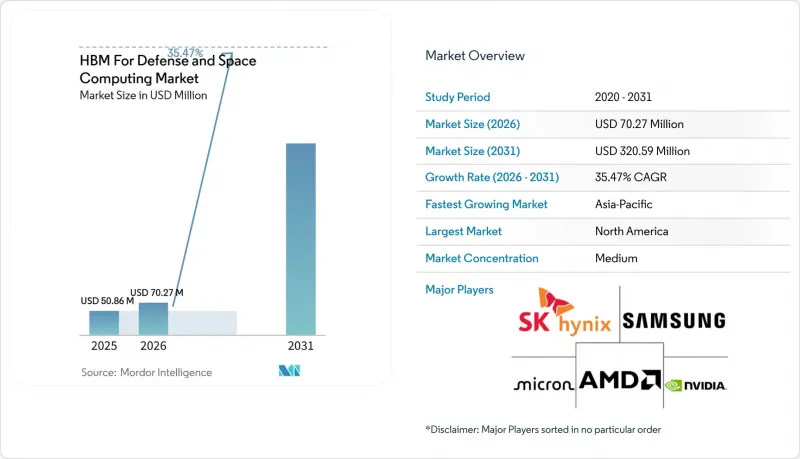
根據 Mordor Intelligence 預測,國防和航空航太領域的 HBM 市場規模預計將在 2025 年達到 5,086 萬美元,到 2031 年達到 3.2059 億美元,2026 年至 2031 年的複合年成長率為 35.47%。
本報告依技術(HBM2、HBM2E、HBM3、HBM3E、HBM4)、單棧記憶體容量(4GB以下、4GB-8GB、8GB-16GB、16GB-32GB、32GB以上)、處理器介面(CPU、GPU、FPGA、ASIC等)、應用程式(高效能運算、人工智慧和駕駛系統進行系統計算、區電等)、應用程式(高效能運算、人工智慧和駕駛系統。市場預測以美元(USD)計價。
全球國防與航太運算領域的HBM趨勢與洞察
航太級人工智慧和感測器融合工作負載對高密度記憶體模型(HBM)的需求日益成長
太空系統越來越需要直接在星載上處理融合的感測器數據,不再僅僅作為中繼和觀測器,這推動了國防和太空運算領域對高頻寬(HBM)市場頻寬的需求。 2026年發表在《科學報告》(Scientific Reports)上的一項研究描述了一種星載運算架構,該架構能夠在無需持續地面支援的情況下執行自主任務規劃、多衛星感測器融合和健康管理,這表明未來太空船設計對本地高頻寬記憶體的需求將持續存在。這種轉變也有助於提高運行安全性,因為增強的本地推理減少了在易受攻擊的通訊視窗期間定期傳輸原始資料的需要。 Syntiant和Novi Space在2026年3月展示了低功耗AI在軌推理用於即時目標偵測,證明了這種轉變,為高頻寬記憶體(HBM)在國防和太空運算市場的實際部署提供了清晰的概念驗證。此外,Frontgrade Gaisler 也透過與瑞典航太局於 2025 年 4 月簽署的太空神經形態人工智慧商業化協議,證實了類似的方向。這表明,機載人工智慧不再只是實驗室概念,而是進入了獲得資助的專案活動階段。
國防領域向機載即時分析的重大轉變。
國防系統整合商正在圍繞即時本地分析重新設計任務電腦,並將面向國防和航太計算市場的高頻寬記憶體(HBM)整合到主流平台設計中。 2025年9月,Parry Labs推出了Forge Boss,這是首款3U VPX卡,它結合了FPGA訊號傳輸和AI加速,用於戰術邊緣任務運算。這表明高頻寬記憶體不再是獨立的樣機,而是整合到可立即投入作戰的開放式架構模組中。 2026年3月,Pacific Defense發布了基於AMD Versal AI Edge Series Gen 2的DSP3100VP模組,進一步推進了這個方向。此模組面向電子戰、訊號情報和自主追蹤等需要在邊緣進行即時資料處理的工作負載。此外,HBM還減少了記憶體和處理器等獨立設備之間的高速訊號傳輸量,從而降低了機載和環境適應性系統的電磁相容性(EMC)負載,使領先的國防製造商更容易獲得認證。隨著更多符合 SOSA 和 CMOSS 標準的產品進入市場,國防和航空航太計算市場的 HBM 正在受益於同時評估性能和合規性的採購模式。
與抗輻射認證、篩檢和可靠性保證相關的成本。
對於國防和航空航太計算領域的HBM市場而言,抗輻射加固認證仍然是最大的障礙之一。這是因為每一代新產品都必須經過漫長而高成本的檢驗過程,才能信任用於關鍵任務。 Teledyne e2v在經歷了漫長的認證過程後,於2026年3月開始生產其16GB DDR4-X1飛行模型,但即使是這款產品,其記憶體架構也遠落後於當前商用HBM產品。 HBM的複雜之處在於其堆疊晶片和穿透矽通孔(TSV)產生的輻射特性,而這些特性無法透過傳統的認證方法進行評估。 BAE Systems在2026年6月也指出了類似的難題,當時他們在抗輻射加固平台上展示了其Endura處理器,並要求其符合高可靠性應用的「可信來源」規則。只要測試、篩檢和確保可靠性的成本居高不下,面向國防和航空航太運算市場的新一代HBM產品的認證速度就將持續低於商用記憶體。
細分市場分析
截至2025年,HBM3在國防和航空航太計算領域的HBM市場佔有43.54%的市場佔有率,但預計HBM4將從小規模的基數上以36.67%的複合年成長率成長,直至2031年。 JEDEC於2025年4月發布了HBM4標準。該標準採用2048位元介面,總頻寬高達2 TB/s,每個堆疊32個通道,並向下兼容HBM3控制器,這使得已進入認證流程的國防設計更容易實現過渡。 HBM在國防和航空航太運算市場的商業化進程比其在國防領域的應用速度更快,因為HBM4仍需24至36個月的認證期才能支援更廣泛的任務應用。三星於 2026 年 5 月開始交付其 12 層 HBM4E 的樣品,該頻寬為 3.6 TB/s,容量為 48 GB,比上一代產品能源效率提高了 16%。
商業發布與國防領域實用化準備之間的這種差距意義重大,因為它使得國防和航太運算市場中的 HBM 需要持續的設計引進週期,而不僅僅是一次性的升級。雖然較早的 HBM1 和 HBM2 部署仍會在有限的維修基礎上繼續使用,但隨著傳統專案接近使用壽命終點,它們的重要性正在降低。在下一階段,圍繞 HBM4 的設計工作可能會更加專業化,因為它將專注於客製化的基礎晶片邏輯,以支援堆疊內部特定的國防校正、控制或加速功能。如果這個方向得以維持,國防和航太運算產業的 HBM 或許會開闢一條不同的道路,而不是只落後於商業藍圖。然而,商業產品的產量趨勢仍然至關重要,因為它們將決定國防買家在談判下一代產品准入時擁有多大的影響力。
截至2025年,8GB至16GB容量範圍將佔國防和航太運算領域HBM市場規模的47.81%,而16GB至32GB容量範圍預計將以36.44%的複合年成長率成長至2031年。這個主要容量範圍反映了目前任務電腦、訊號情報處理器和空間人工智慧闆卡的設計要點,這些設備必須滿足嚴格的散熱和品質限制。在這個容量範圍內,HBM也開始展現出相對於傳統記憶體的明顯效能和功耗優勢,同時也能相容於現有的可靠散熱設計。 4GB及以下和4GB至8GB容量範圍仍依賴較舊的部署方案,隨著這些平台的更新換代,其市場機會正在逐漸減少。 32GB以上的容量選項正在評估中,以滿足最嚴苛的運算負載需求,但在抗輻射性和整合方面面臨更大的挑戰。
在國防和航太運算市場,HBM 容量的提升意義遠不止於容量的增加,其更高的頻寬密度也至關重要。美光科技宣布,其 36 GB 12 堆疊式 HBM4 的頻寬超過 2.8 TB/s,能源效率比 HBM3E 提升 20% 以上。這正推動設計方向朝向更高吞吐量、更少堆疊式記憶體的方向轉變。由於雷達和訊號情報系統通常更受資料傳輸速率而非標稱運算資源的限制,單一更高頻寬的堆疊式記憶體就能徹底改變架構選擇。因此,頻寬從 16 GB 提升到 32 GB 不僅意味著國防和航太運算市場 HBM 規格的升級,更意味著記憶體設計的重新調整。減少堆疊式記憶體的數量可以節省基板面積和需要認證的介面數量,從而從效能和程式成本的角度出發,使更高頻寬成為更具吸引力的選擇。
區域分析
到2025年,北美將繼續保持其領先地位,佔據國防和航太運算領域高密度記憶體(HBM)市場49.06%的佔有率。美國憑藉其龐大的國防電子產品採購規模以及對可靠製造和先進半導體技術的直接支持,鞏固了其主導地位。 「美國晶片國防基金」(CHIPS for America Defense Fund)每年撥款4億美元,直至2027會計年度,持續支持先進封裝、可靠採購和認證活動所需的國內基礎設施建設。 ATSP5合約架構涵蓋微電子生命週期的各個階段,並包括與國防和航太運算領域HBM市場直接相關的3D先進封裝工作,從而進一步加強了該地區的基礎。加拿大透過與盟友在監視、海上巡邏和太空情報領域進行聯合採購,為該地區的基礎建設提供支持,而墨西哥的參與度相對小規模,主要限於支持和間接供應鏈角色。
預計到2025年,歐洲將在國防和航太運算市場中佔據第二大佔有率,這得益於北約的現代化計劃以及與下一代飛機和無人平台相關的國防和航太計算高頻寬記憶體(HBM)活動。法國、義大利、英國和德國將繼續透過其在雷達、任務系統、衛星計畫和電子戰領域的工作,為該地區做出重大貢獻。 2026年5月,Frontgrade Gaisler在歐盟委員會COSMIC7計畫的資助下,開發了一款用於航太應用的7奈米RISC-V處理器。該處理器以及未來的高頻寬記憶體配置將提升該地區的運算基礎設施。此外,歐盟產業政策正在推動從盟國和區域供應商採購用於高度敏感應用的產品,預計這將逐步提升歐洲在國防和航太運算市場高頻寬記憶體領域的地位。
預計到2031年,亞太地區將以36.47%的複合年成長率成長,成為國防和航太運算領域HBM市場成長最快的地區。韓國仍然佔據中心地位,因為全球HBM供應嚴重依賴韓國供應商。三星將於2026年5月向主要客戶交付12層HBM4E樣品,進一步鞏固其領先地位。日本正透過增加國防費用來加強其地位,美光將於2026年7月在廣島舉行大型HBM擴建計畫的奠基儀式,這表明日本對該地區記憶體生產能力的長期投資。台灣仍然至關重要,因為封裝的供應是商業和國防項目通用的限制因素,該地區先進封裝的供應嚴重依賴台積電。印度仍處於起步階段,但其國內半導體政策和國防現代化正在為其未來進入國防和航太計算領域的HBM市場鋪平道路。南美洲、中東和非洲等地區的需求才剛開始出現,進口國防電子產品的採購被認為比開發本地的 HBM(人體迫擊砲)系統更為重要。
其他好處:
- Excel格式的市場預測(ME)表
- 3個月的分析師支持
目錄
第1章:引言
- 研究假設和市場定義
- 調查範圍
第2章:調查方法
第3章執行摘要
第4章 市場狀況
- 市場概覽
- 市場促進因素
- 航太級人工智慧和感測器融合工作負載對高密度記憶體模型(HBM)的需求日益成長
- 國防領域重點轉向引入即時分析
- 在符合 SWaP 限制的任務電腦中,從離散記憶體過渡到 3D 堆疊記憶體。
- 政府為國內先進半導體供應鏈提供資金支持。
- 利用GPU、FPGA和AI加速器的可重構任務處理架構的發展
- 透過現代化改造延長傳統軍事和航太平台的使用壽命
- 市場限制因素
- 與輻射抗性評估、篩檢和可靠性保證相關的成本。
- 與HBM相容的先進封裝產能供不應求
- 對可靠晶圓代工廠的出口限制與約束
- 加固平台的熱學、功率和整合複雜性
- 供應鏈分析
- 監理情勢
- 技術展望
- 宏觀經濟因素對市場的影響
- 波特五力分析
第5章 市場規模與成長預測
- 透過技術
- HBM2
- HBM2E
- HBM3
- HBM3E
- HBM4
- 每個堆疊的記憶體容量
- 最高 4 GB
- 4 GB~8 GB
- 8 GB~16 GB
- 16 GB~32 GB
- 32 GB 或更多
- 透過處理器介面
- CPU
- GPU
- FPGA
- ASIC
- 人工智慧加速器
- 網路和通訊處理器
- 透過使用
- 任務計算
- 高效能運算
- 人工智慧與自主系統
- 雷達、光電和訊號情報處理
- 太空船搭載的處理
- 電子戰和訊號處理
- 按地區
- 北美洲
- 美國
- 加拿大
- 墨西哥
- 歐洲
- 德國
- 英國
- 法國
- 義大利
- 其他歐洲國家
- 亞太地區
- 中國
- 日本
- 韓國
- 台灣
- 印度
- 其他亞太國家
- 南美洲
- 中東和非洲
- 北美洲
第6章 競爭情勢
- 市場集中度
- 策略趨勢
- 市佔率分析
- 公司簡介
- Samsung Electronics Co., Ltd.
- SK hynix Inc.
- Micron Technology, Inc.
- NVIDIA Corporation
- Advanced Micro Devices, Inc.
- Intel Corporation
- Broadcom Inc.
- Marvell Technology, Inc.
- Fujitsu Limited
- IBM Corporation
- Taiwan Semiconductor Manufacturing Company Limited
- Cadence Design Systems, Inc.
- BAE Systems plc
- RTX Corporation
- Lockheed Martin Corporation
- Northrop Grumman Corporation
- Thales SA
- Leonardo SpA
- Airbus SE
- Frontgrade Technologies
- Aitech Systems Ltd.
- Teledyne Technologies Incorporated
- Microchip Technology Incorporated
- Honeywell International Inc.
第7章 市場機會與未來展望
According to Mordor Intelligence, the HBM for defense and space computing market was valued at USD 50.86 million in 2025 and is projected to reach USD 320.59 million by 2031, advancing at a CAGR of 35.47% during 2026-2031.
This report is Segmented by Technology (HBM2, HBM2E, HBM3, HBM3E, and HBM4), Memory Capacity Per Stack (Up To 4 GB, 4 GB To 8 GB, 8 GB To 16 GB, 16 GB To 32 GB, and More), Processor Interface (CPU, GPU, FPGA, ASIC, and More), Application (High-Performance Computing, AI and Autonomous Systems, Radar, and More), and Geography. The Market Forecasts are Provided in Terms of Value (USD).
Global HBM For Defense and Space Computing Market Trends and Insights
Rising HBM Demand in Space-Grade AI And Sensor Fusion Workloads
Space systems are moving beyond relay and observation roles and are increasingly expected to process fused sensor data directly onboard, which raises the bandwidth bar for the HBM for defense and space computing market. A 2026 study in Scientific Reports described an onboard computing architecture that could run autonomous mission planning, multisatellite sensor fusion, and health management without constant ground support, which points to sustained demand for local high-bandwidth memory in future spacecraft designs. This change also improves operational security because more local inference means less routine transmission of raw data during vulnerable communication windows. Syntiant and Novi Space showed this shift in March 2026 when they demonstrated low-power AI inference in orbit for real-time object detection, which gave the HBM for defense and space computing market a visible proof point for practical deployment. Frontgrade Gaisler also reinforced the same direction through its April 2025 Swedish National Space Agency contract to commercialize neuromorphic AI for space, showing that onboard AI has moved into funded program activity rather than remaining a laboratory concept.
Defense Prime Shift Toward Onboard Real-Time Analytics
Defense integrators are redesigning mission computers around real-time local analytics, and that is pushing the HBM for defense and space computing market into mainstream platform design. Parry Labs launched Forge Boss in September 2025 as the first 3U VPX card to combine FPGA signal processing with AI acceleration for tactical-edge mission computing, which shows how high-bandwidth memory is now tied to deployable open-architecture modules rather than stand-alone prototypes. Pacific Defense extended that direction in March 2026 with its DSP3100VP module built on AMD Versal AI Edge Series Gen 2, aimed at electronic warfare, signal intelligence, and autonomous tracking workloads where data must be processed immediately at the edge. HBM also reduces the amount of high-speed signaling between separate memory and processor devices, which lowers electromagnetic compatibility stress in airborne and ruggedized systems and makes qualification easier for defense primes. As more SOSA- and CMOSS-aligned products come to market, the HBM for defense and space computing market is gaining from a purchasing model that rewards performance and compliance at the same time.
Radiation Qualification, Screening, and Reliability Costs
Radiation qualification remains one of the hardest barriers for the HBM for defense and space computing market because each new generation must pass a long and costly validation path before it can be trusted in critical missions. Teledyne e2v began production of its 16 GB DDR4-X1 flight models in March 2026 after an extended qualification process, and even this involved a memory architecture that sits well behind current commercial HBM generations. HBM adds further complexity because stacked dies and through-silicon vias introduce radiation behaviors that older qualification methods were not built to evaluate. BAE Systems highlighted the same burden in June 2026 when it demonstrated its Endura processor on a radiation-hardened platform while still operating within trusted-source rules for high-assurance use. As long as test, screening, and reliability costs remain heavy, the HBM for defense and space computing market will keep qualifying new generations slower than the commercial memory cycle.
Other drivers and restraints analyzed in the detailed report include:
- Transition From Discrete Memory To 3D-Stacked Memory in SWaP-Constrained Mission Computers
- Government Funding for Domestic Advanced Semiconductor Supply Chains
- Limited Supply of HBM-Qualified Advanced Packaging Capacity
For complete list of drivers and restraints, kindly check the Table Of Contents.
Segment Analysis
HBM3 held 43.54% of the HBM for defense and space computing market share in 2025, while HBM4 is projected to expand at a 36.67% CAGR through 2031 from a much smaller base. JEDEC released the HBM4 standard in April 2025 with a 2048-bit interface, up to 2 TB/s total bandwidth, 32 channels per stack, and backward compatibility with HBM3 controllers, which makes the transition path more practical for defense designs already in qualification. Commercial availability is moving faster than defense adoption because the HBM for defense and space computing market still needs a 24- to 36-month qualification window before HBM4 can support broader mission use. Samsung began shipping 12-layer HBM4E samples in May 2026, and the product reached 3.6 TB/s bandwidth with 48 GB capacity and 16% better energy efficiency than the prior generation.
That gap between commercial release and defense readiness is important because it creates a recurring design-in cycle rather than a single upgrade event in the HBM for defense and space computing market. Older HBM1 and HBM2 deployments will continue to serve a limited retrofit base, but they are losing relevance as legacy programs near end of service life. The next phase may also become more specialized because design work around HBM4 points toward customized base-die logic that could support defense-specific correction, control, or acceleration functions within the stack itself. If that direction holds, the HBM for defense and space computing industry may begin to diverge from the commercial roadmap rather than simply follow it with a delay. Commercial volume trends will still matter because they determine how much leverage defense buyers have when negotiating access to later generations.
The 8 GB to 16 GB band accounted for 47.81% of the HBM for defense and space computing market size in 2025, while the 16 GB to 32 GB band is projected to expand at a 36.44% CAGR through 2031. The leading band reflects the current design point for mission computers, SIGINT processors, and space-grade AI boards that must fit into constrained thermal and mass envelopes. It also marks the range where HBM begins to deliver a clear performance and power advantage over conventional memory while still fitting into existing rugged cooling designs. Up to 4 GB and 4 GB to 8 GB categories remain tied to older deployments and face a narrowing opportunity set as those platforms move toward replacement. Above 32 GB options are entering evaluation for the most demanding computing loads, but they face a steeper path on radiation and integration.
Bandwidth density is what makes the higher-capacity transition more meaningful for the HBM for defense and space computing market than raw capacity alone. Micron stated that its HBM4 36 GB 12-high stack reached more than 2.8 TB/s and over 20% better power efficiency than HBM3E, which supports a design shift toward fewer stacks carrying more throughput. Radar and SIGINT systems are often limited by how fast data can move rather than by nominal compute resources, so a single higher-bandwidth stack can change architecture choices across the board. That is why the move into the 16 GB to 32 GB band signals a reset in memory design rather than a simple specification increase in the HBM for defense and space computing market. Fewer stacks can also reduce board area and the number of interfaces that must be qualified, which makes the higher-capacity band more attractive from both performance and program cost perspectives.
Complete Report Scope:
- By Technology
- HBM2
- HBM2E
- HBM3
- HBM3E
- HBM4
- By Memory Capacity Per Stack
- Up To 4 GB
- 4 GB To 8 GB
- 8 GB To 16 GB
- 16 GB To 32 GB
- Above 32 GB
- By Processor Interface
- CPU
- GPU
- FPGA
- ASIC
- AI Accelerators
- Networking and Communication Processors
- By Application
- Mission Computing
- High-Performance Computing
- AI and Autonomous Systems
- Radar, EO and SIGINT Processing
- Spacecraft On-Board Processing
- Electronic Warfare and Signal Processing
- By Geography
- North America
- United States
- Canada
- Mexico
- Europe
- Germany
- United Kingdom
- France
- Italy
- Rest of Europe
- Asia-Pacific
- China
- Japan
- South Korea
- Taiwan
- India
- Rest of Asia-Pacific
- South America
- Middle East and Africa
- North America
Geography Analysis
North America held 49.06% of the HBM for defense and space computing market share in 2025, which kept it in the leading regional position. The United States anchors that lead through its scale in defense electronics procurement and through direct support for trusted manufacturing and advanced semiconductor work. The CHIPS for America Defense Fund is allocating USD 400 million per year through FY2027, and that continues to support the domestic base needed for advanced packaging, trusted sourcing, and qualification activities. The ATSP5 contract framework also strengthens the region because it covers a wide microelectronics lifecycle and includes 3D advanced packaging work that matters directly to the HBM for defense and space computing market. Canada supports the regional base through allied procurement in surveillance, maritime patrol, and space intelligence, while Mexico remains a smaller participant tied mainly to support and indirect supply chain roles.
Europe held the second-largest position in 2025, supported by NATO modernization programs and next-generation air and unmanned platform activity in the HBM for defense and space computing market. France, Italy, the United Kingdom, and Germany remain the main regional contributors through radar, mission systems, satellite programs, and electronic warfare work. Frontgrade Gaisler received European Commission funding in May 2026 under the COSMIC7 program to develop a 7 nm RISC-V processor for space applications, which supports a stronger regional computing base next to future high-bandwidth memory configurations. EU industrial policy is also nudging procurement toward allied and regional suppliers for sensitive applications, which should gradually improve Europe's position in the HBM for defense and space computing market.
Asia-Pacific is projected to advance at a 36.47% CAGR through 2031, making it the fastest-growing region in the HBM for defense and space computing market. South Korea remains central because global HBM supply depends heavily on Korean vendors, and Samsung moved further ahead in May 2026 by shipping 12-layer HBM4E samples to major customers. Japan is strengthening its role through defense spending growth and through Micron's July 2026 groundbreaking for a major HBM expansion in Hiroshima, which signals long-cycle investment in regional memory capacity. Taiwan remains critical because advanced packaging availability in the wider region depends heavily on TSMC, which makes packaging access a shared constraint across commercial and defense programs. India is still at an early stage, but domestic semiconductor policy and defense modernization are starting to create a pathway for future participation in the HBM for defense and space computing market. South America and the Middle East and Africa remain nascent demand zones where procurement of imported defense electronics matters more than local HBM development.
- Samsung Electronics Co., Ltd.
- SK hynix Inc.
- Micron Technology, Inc.
- NVIDIA Corporation
- Advanced Micro Devices, Inc.
- Intel Corporation
- Broadcom Inc.
- Marvell Technology, Inc.
- Fujitsu Limited
- IBM Corporation
- Taiwan Semiconductor Manufacturing Company Limited
- Cadence Design Systems, Inc.
- BAE Systems plc
- RTX Corporation
- Lockheed Martin Corporation
- Northrop Grumman Corporation
- Thales S.A.
- Leonardo S.p.A.
- Airbus SE
- Frontgrade Technologies
- Aitech Systems Ltd.
- Teledyne Technologies Incorporated
- Microchip Technology Incorporated
- Honeywell International Inc.
Additional Benefits:
- The market estimate (ME) sheet in Excel format
- 3 months of analyst support
TABLE OF CONTENTS
1 INTRODUCTION
- 1.1 Study Assumptions and Market Definition
- 1.2 Scope of the Study
2 RESEARCH METHODOLOGY
3 EXECUTIVE SUMMARY
4 MARKET LANDSCAPE
- 4.1 Market Overview
- 4.2 Market Drivers
- 4.2.1 Rising HBM Demand in Space-Grade AI and Sensor Fusion Workloads
- 4.2.2 Defense Prime Shift Toward On-Board Real-Time Analytics
- 4.2.3 Transition From Discrete Memory To 3D-Stacked Memory In SWaP-Constrained Mission Computers
- 4.2.4 Government Funding For Domestic Advanced Semiconductor Supply Chains
- 4.2.5 Growth In Reconfigurable Mission Processing Architectures Using GPUs, FPGAs, and AI Accelerators
- 4.2.6 Extended Lifecycle Modernization Of Legacy Military And Space Platforms
- 4.3 Market Restraints
- 4.3.1 Radiation Qualification, Screening, and Reliability Costs
- 4.3.2 Limited Supply Of HBM-Qualified Advanced Packaging Capacity
- 4.3.3 Export Controls and Trusted-Foundry Constraints
- 4.3.4 Thermal, Power, and Integration Complexity In Ruggedized Platforms
- 4.4 Supply Chain Analysis
- 4.5 Regulatory Landscape
- 4.6 Technological Outlook
- 4.7 Impact Of Macroeconomic Factors On The Market
- 4.8 Porter's Five Forces Analysis
- 4.8.1 Threat of New Entrants
- 4.8.2 Bargaining Power of Suppliers
- 4.8.3 Bargaining Power of Buyers
- 4.8.4 Threat of Substitutes
- 4.8.5 Intensity of Competitive Rivalry
5 MARKET SIZE AND GROWTH FORECASTS (VALUE)
- 5.1 By Technology
- 5.1.1 HBM2
- 5.1.2 HBM2E
- 5.1.3 HBM3
- 5.1.4 HBM3E
- 5.1.5 HBM4
- 5.2 By Memory Capacity Per Stack
- 5.2.1 Up To 4 GB
- 5.2.2 4 GB To 8 GB
- 5.2.3 8 GB To 16 GB
- 5.2.4 16 GB To 32 GB
- 5.2.5 Above 32 GB
- 5.3 By Processor Interface
- 5.3.1 CPU
- 5.3.2 GPU
- 5.3.3 FPGA
- 5.3.4 ASIC
- 5.3.5 AI Accelerators
- 5.3.6 Networking and Communication Processors
- 5.4 By Application
- 5.4.1 Mission Computing
- 5.4.2 High-Performance Computing
- 5.4.3 AI and Autonomous Systems
- 5.4.4 Radar, EO and SIGINT Processing
- 5.4.5 Spacecraft On-Board Processing
- 5.4.6 Electronic Warfare and Signal Processing
- 5.5 By Geography
- 5.5.1 North America
- 5.5.1.1 United States
- 5.5.1.2 Canada
- 5.5.1.3 Mexico
- 5.5.2 Europe
- 5.5.2.1 Germany
- 5.5.2.2 United Kingdom
- 5.5.2.3 France
- 5.5.2.4 Italy
- 5.5.2.5 Rest of Europe
- 5.5.3 Asia-Pacific
- 5.5.3.1 China
- 5.5.3.2 Japan
- 5.5.3.3 South Korea
- 5.5.3.4 Taiwan
- 5.5.3.5 India
- 5.5.3.6 Rest of Asia-Pacific
- 5.5.4 South America
- 5.5.5 Middle East and Africa
- 5.5.1 North America
6 COMPETITIVE LANDSCAPE
- 6.1 Market Concentration
- 6.2 Strategic Moves
- 6.3 Market Share Analysis
- 6.4 Company Profiles (includes Global Level Overview, Market Level Overview, Core Segments, Financials as available, Strategic Information, Market Rank/Share, Products and Services, Recent Developments)
- 6.4.1 Samsung Electronics Co., Ltd.
- 6.4.2 SK hynix Inc.
- 6.4.3 Micron Technology, Inc.
- 6.4.4 NVIDIA Corporation
- 6.4.5 Advanced Micro Devices, Inc.
- 6.4.6 Intel Corporation
- 6.4.7 Broadcom Inc.
- 6.4.8 Marvell Technology, Inc.
- 6.4.9 Fujitsu Limited
- 6.4.10 IBM Corporation
- 6.4.11 Taiwan Semiconductor Manufacturing Company Limited
- 6.4.12 Cadence Design Systems, Inc.
- 6.4.13 BAE Systems plc
- 6.4.14 RTX Corporation
- 6.4.15 Lockheed Martin Corporation
- 6.4.16 Northrop Grumman Corporation
- 6.4.17 Thales S.A.
- 6.4.18 Leonardo S.p.A.
- 6.4.19 Airbus SE
- 6.4.20 Frontgrade Technologies
- 6.4.21 Aitech Systems Ltd.
- 6.4.22 Teledyne Technologies Incorporated
- 6.4.23 Microchip Technology Incorporated
- 6.4.24 Honeywell International Inc.
7 MARKET OPPORTUNITIES AND FUTURE OUTLOOK
- 7.1 White-Space and Unmet-Need Assessment

 2026-2034年全球汽車人工智慧晶片組市場規模、佔有率、趨勢和成長分析報告全球人工智慧晶片組市場規模、佔有率、趨勢和成長分析報告(2026-2034)
 人工智慧晶片組:市場佔有率分析、產業趨勢與統計及成長預測(2026-2031 年)HBM在網路交換和封包處理中的應用:市場佔有率分析、行業趨勢和統計數據以及成長預測(2026-2031)
 人工智慧(AI)晶片組市場:2026-2032年全球市場預測(按晶片組類型、架構、部署方式、應用和最終用途分類)AI GPU晶片:市佔率分析、產業趨勢與統計及成長預測(2026-2031年)HBM在人工智慧推理中的應用:市場佔有率分析、行業趨勢與統計數據以及成長預測(2026-2031年)HBM在AI GPU的應用:市佔率分析、產業趨勢與統計、成長預測(2026-2031)
 人工智慧影像處理晶片市場:按晶片類型、部署模式、應用、終端用戶產業、國家和地區分類-產業分析、市場規模、市場佔有率及2026年至2033年預測GPU架構與運算IP授權:市場佔有率分析、產業趨勢與統計資料以及成長預測(2026-2031年)