


 |
市場調查報告書
商品編碼
2122742
人工智慧晶片組:市場佔有率分析、產業趨勢與統計及成長預測(2026-2031 年)AI Chipsets - Market Share Analysis, Industry Trends & Statistics, Growth Forecasts (2026 - 2031) |
||||||

※ 本網頁內容可能與最新版本有所差異。詳細情況請與我們聯繫。
根據 Mordor Intelligence 估計,人工智慧晶片組市場到 2026 年的價值將達到 702.5 億美元,高於 2025 年的 530.6 億美元,預計到 2031 年將達到 2859 億美元。
預計 2026 年至 2031 年的複合年成長率將達到 32.41%。
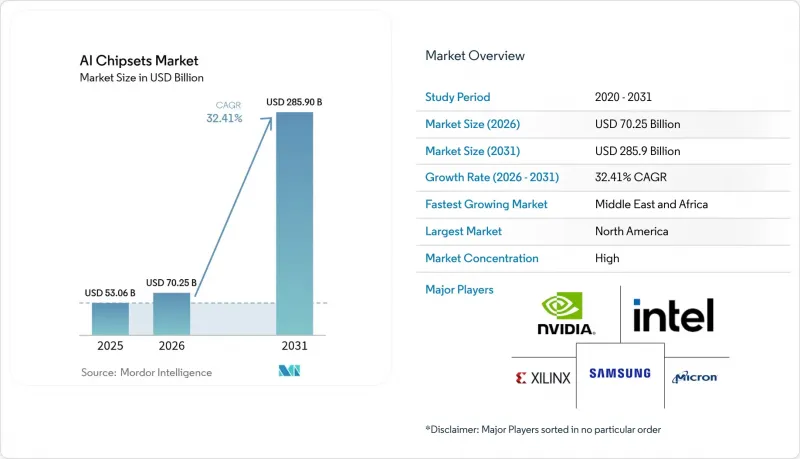
本報告按元件(CPU、GPU、其他)、處理類型(訓練、推理)、部署位置(雲端/超大規模資料中心、企業本地資料中心、其他)、應用程式(消費性電子、汽車、其他)、技術節點和地區進行細分。市場預測以美元(USD)為單位。
全球人工智慧晶片組市場趨勢與洞察
尖端模型開發者對訓練運算的需求爆炸性成長。
大規模語言模型的年度運算需求每18個月成長十倍,推動了多晶片GPU和先進封裝解決方案的持續訂單。受Blackwell超級電腦出貨量的推動,NVIDIA的資料中心收入預計將在2025年第四季達到356億美元,凸顯了超大規模客戶為人工智慧專門儲備的大量庫存。多模態模型的開發者現在需要數千個互連的加速器,從而推動了對CoWoS基板和下一代HBM堆疊的需求。因此,預計到2027年,領先的人工智慧公司將佔據全球15-20%的人工智慧運算能力,確保3nm級半導體的持續供應。這種需求集中度將加劇短期供不應求,但對於能夠採用先進製程製程的供應商而言,這將建立一個多年的收入來源。因此,預計人工智慧晶片組市場將在整個預測期內受益於結構性高水準的訓練採購。
汽車領域「軟體定義車輛(SDV)」的晶片設計訂單。
汽車製造商正在將眾多電控系統整合到支援人工智慧的集中式運算域中。產業分析師預測,到2035年,80%的新車將具備人工智慧功能,這將為推理加速器創造龐大的部署基礎。恩智浦半導體(NXP)採用5奈米製程製造的S32N處理器,在滿足嚴格的ASIL D安全等級要求的同時,可提供34 TOPS的性能,這表明汽車級安全性和人工智慧處理能力可以共存於單一裝置中。由於每個設計週期長達7到10年,目前車型中使用的半導體為供應商提供了穩定的、類似退休金的收入來源。因此,目前正在獲得的L3級自動駕駛、感測器融合和空中下載(OTA)升級功能的設計訂單預計將在預測期內進一步推高市場需求。
3奈米以下製程供應鏈中的微影術瓶頸
用於2nm製程製造的高數值孔徑(高NA)EUV設備單價超過3億美元,且數量仍有限。台積電首條2nm中試生產線計劃於2025年底開始量產,但面臨主要客戶的大量預購訂單。產能短缺推高了晶圓價格,並延長了採用這些製程節點製造的AI加速器的交付週期。中國被排除在高NA光刻技術之外,進一步加劇了全球供應鏈的片段化,引發了人們對技術標準兩極化的擔憂。因此,短期內供應量將減少,AI晶片組市場的成長速度也將放緩,直到2027年後更多晶圓廠投入運作。
細分市場分析
儘管預計到 2031 年,NPU 和 ASIC 的複合年成長率將達到 44.2%,但 GPU 憑藉其在訓練方面無與倫比的平行處理能力,在 2025 年仍保持了 51.40% 的 AI 晶片組市場佔有率。隨著尖端模型不斷擴大對運算資源的需求,GPU 出貨量的絕對值將繼續成長,但特定細分市場向矽晶片的佔有率轉移已是不爭的事實。記憶體和儲存供應商正享受著強勁的成長勢頭。三星的 HBM3E 堆疊目前單晶片容量已達 36GB,在滿足更大上下文視窗需求的同時,也推高了平均售價。自 2024 年以來 HBM 價格上漲了 500%,凸顯了市場頻寬。晶片組的異構設計將 CPU、NPU 和 HBM 整合在通用中介層上,從而最佳化了邊緣推理的功耗限制。掌握了先進的 2.5D 封裝、晶片互連和記憶體共置技術的供應商預計將在不斷發展的 AI 晶片組市場中獲得高利潤率。
CPU領域正透過引入片上AI加速器和新的指令集進行轉型,從而在融合控制邏輯和推理的傳統工作負載中保持其重要性。 FPGA正在重獲發展勢頭,尤其是在工業機器人和通訊閘道領域,這些領域更注重確定性延遲和現場可升級性,而非絕對吞吐量。架構多樣性最終將擴大潛在市場規模(TAM),因為每個工作負載都會被分配到最高效的晶片模組。因此,隨著系統整合商需要的是承包子系統而非單一組件,能夠整合多晶片解決方案的供應商有望顯著提升其市場佔有率。
到2025年,訓練晶片將佔人工智慧晶片組市場佔有率的60.30%,其核心是每個機架可處理數百千兆次浮點運算的超大規模資料中心叢集。由於多模態模型中參數數量呈現幾何級數成長,預計訓練晶片的市場規模將持續擴大,有些人預測2030年將需要1億個H100級GPU。然而,隨著企業在各行各業部署生成式人工智慧服務並在網路邊緣嵌入小型模型,推理晶片的出貨量預計將以36.9%的複合年成長率成長。 Cerebras Systems和高通聯合展示了其產品在性價比方面比現有解決方案提升了10倍,凸顯了新架構顛覆傳統成本曲線的潛力。
邊緣推理加速器優先考慮能效而非浮點運算效能,促使供應商採用低電壓SRAM、近記憶體運算以及類比處理技術來實現注意力機制和卷積等核心功能。這種二元性導致了兩條並行的產品藍圖:用於訓練的超高密度水冷晶片和用於推理的超薄毫瓦級ASIC晶片。同時涉足這兩個領域的供應商可以交叉銷售軟體工具鏈,而專業供應商則可以瞄準延遲、安全性或價格敏感型終端等細分市場。由此產生的競爭格局正在推動整個人工智慧晶片組市場的創新。
區域分析
預計到2025年,亞太地區將持續維持主導地位,佔據人工智慧晶片組市場41.10%的佔有率。中國1,430億美元的人工智慧自給自足計畫、台灣地區在先進人工智慧製造領域超過90%的佔有率,以及韓國在人腦記憶體(HBM)領域的統治地位,都進一步鞏固了該地區的優勢。日本超級電腦「富嶽」的升級改造也進一步提振了國內對訓練加速器的需求。因此,儘管短期出口限制會帶來一些摩擦,但亞太地區相關市場規模預計將穩定成長。
北美受惠於強大的研發生態系統、超大規模的資本投資以及《晶片與科學法案》提供的政府補貼。英偉達的平台主導地位和英特爾的晶圓代工廠回流策略,在加強區域供應鏈管理的同時,也確保了北美能夠獲得最先進的生產能力。這些因素使北美得以保持其作為全球第二大消費市場的地位,尤其是在訓練叢集和雲端服務提供商的客製化加速器方面。
中東和非洲雖然絕對規模較小,但預計將實現34.1%的複合年成長率,成為人工智慧晶片組市場成長最快的地區。英偉達在阿拉伯聯合大公國打造的以GPU為中心的「星門園區」以及沙烏地阿拉伯400億美元的「2030願景」人工智慧基金,正吸引西方科技公司的直接投資。針對沙漠氣候的散熱設計以及針對阿拉伯語大規模語言模型(LLM)的客製化方案,正在拓展人工智慧晶片組的應用範圍,凸顯了本地化條件如何催生客製化的晶片解決方案。歐洲持續專注於資料主權和能源效率,推動GAIA-X雲端標準的製定,以鼓勵企業選擇低功耗人工智慧晶片組的規格。南美洲是一個新興的應用區域,正利用邊緣人工智慧技術進行農業和自然資源監測,但在先進節點的取得方面仍然落後。
其他好處
- Excel格式的市場預測(ME)表
- 3個月的分析師支持
目錄
第1章:引言
- 研究假設和市場定義
- 調查範圍
第2章:調查方法
第3章執行摘要
第4章 市場洞察
- 市場概覽
- 產業吸引力—五力分析
- 新進入者的威脅
- 買方的議價能力
- 供應商的議價能力
- 替代品的威脅
- 競爭公司之間的競爭
- 產業價值鏈分析
- 評估 COVID-19 對人工智慧晶片組市場的影響
第5章 市場動態
- 市場促進因素
- 自動駕駛技術的需求不斷成長
- 物聯網邊緣分析的發展
- 市場限制因素
- 設計和人工智慧介面的複雜性
第6章 市場細分
- 按組件
- 中央處理器(CPU)
- 圖形處理器(GPU)
- 神經網路處理器(NNP)
- 其他
- 透過使用
- 家用電子產品
- 車
- 衛生保健
- 自動化機器人
- 其他
- 按地區
- 北美洲
- 歐洲
- 亞太地區
- 拉丁美洲
- 中東
第7章 競爭情勢
- 公司簡介
- Advanced Micro Devices Inc.(AMD)
- Xilinx Inc.
- Graphcore Ltd
- Huawei Technologies Co. Ltd
- IBM Corporation
- Intel Corporation
- NVIDIA Corporation
- Micron Technology Inc.
- Samsung Semiconductor(Samsung Electronics Co. Ltd)
第8章 投資分析
第9章:市場展望
According to Mordor Intelligence, AI chipsets market size in 2026 is estimated at USD 70.25 billion, growing from 2025 value of USD 53.06 billion with 2031 projections showing USD 285.9 billion, growing at 32.41% CAGR over 2026-2031.
This report is Segmented by Component (CPU, GPU, and More), Processing Type (Training, Inference), Deployment Location (Cloud/Hyperscale Data Center, Enterprise On-Prem Data Center and More), Application (Consumer Electronics, Automotive & Transportation, and More), Technology Node and Geography. The Market Forecasts are Provided in Terms of Value (USD).
Global AI Chipsets Market Trends and Insights
Exploding Training-Compute Demand from Frontier-Model Developers
Annual compute needs for large-scale language models are increasing ten-foldev ery 18 months, driving sustained orders for multi-die GPUs and advanced packaging solutions. NVIDIA's data-center revenue rose to USD 35.6 billion in Q4 2025 on the back of Blackwell supercomputer shipments, underscoring how hyperscale customers are accumulating vast AI-specific inventories. Multimodal model builders now require thousands of interconnected accelerators, pushing demand for CoWoS substrates and next-generation HBM stacks. As a result, leading AI companies are expected to control 15-20% of global AI-compute capacity by 2027, ensuring continuous procurement of 3 nm-class silicon. This volume concentration intensifies near-term shortages but establishes a multi-year revenue pipeline for suppliers that can execute at advanced nodes. Consequently, the AI chipsets market will benefit from a structurally higher baseline of training-oriented purchases through the forecast horizon.
Automotive "Software-Defined Vehicle" Silicon Design Wins
Automakers are consolidating scores of electronic control units into centralized AI-enabled compute domains. Industry analysts project that 80% of new vehicles will embed AI functionality by 2035, creating a large installed base for inference-class accelerators. NXP's S32N processors built on 5 nm technology deliver 34 TOPS while meeting rigorous ASIL D requirements, signalling that automotive-grade safety and AI horsepower can coexist in a single device. With each design cycle spanning seven to ten years, silicon selected for today's models generates annuity-like volume for their suppliers. Design wins now being awarded for Level 3 autonomy, sensor fusion, and over-the-air upgradability will therefore compound demand during the forecast period.
Supply-Chain Lithography Bottlenecks Below 3 nm
High-NA EUV machines required for 2 nm production cost more than USD 300 million each and remain limited in quantity. TSMC's first 2 nm pilot line enters mass production in late 2025 but faces heavy pre-allocations from flagship customers. Capacity scarcity drives higher wafer pricing and lengthens delivery lead times for AI accelerators fabricated on these nodes. China's exclusion from High-NA lithography further fragments global supply chains, raising the prospect of dual technology standards. The net effect lowers near-term unit availability and tempers the AI chipsets market growth rate until additional fabs come online after 2027.
Other drivers and restraints analyzed in the detailed report include:
- Ultra-Low-Power Edge AI ASIC Breakthroughs
- National AI-Infrastructure Stimulus Programs
- AI-Model Compression Reducing Silicon Requirements
For complete list of drivers and restraints, kindly check the Table Of Contents.
Segment Analysis
GPUs retained 51.40% AI chipsets market share in 2025 by delivering unmatched parallelism for training, even as NPUs and ASICs are forecast to grow at a 44.2% CAGR by 2031. The market size allocated to GPU shipments will continue rising in absolute terms as frontier models swell compute budgets, yet the share shift toward domain-specific silicon is unmistakable. Memory and storage suppliers enjoy extraordinary tailwinds: HBM3E stacks from Samsung now reach 36 GB per die, meeting larger context window demands while raising average selling prices. A 500% increase in HBM pricing since 2024 confirms the market's appetite for bandwidth over raw frequency. Heterogeneous designs based on chiplets are integrating CPUs, NPUs, and HBM on a common interposer to optimize power envelopes for edge inference. Vendors that master advanced 2.5D packaging, die-to-die interconnects, and memory co-location will capture premium margins within the evolving AI chipsets market.
The CPU segment adapts through on-die AI accelerators and new instruction sets, preserving relevance in traditional workloads that intermingle control logic and inference. FPGAs regain momentum where deterministic latency or in-field upgradability outweighs absolute throughput, especially inside industrial robots and telecom gateways. Architectural diversity ultimately raises the total addressable market because each workload maps to the most efficient silicon block. Suppliers capable of orchestrating multi-chiplet solutions are thus positioned for outsized share gains as system integrators demand turnkey subsystems rather than discrete parts.
Training commanded 60.30% of AI chipsets market share in 2025, anchored by hyperscale data-center clusters running hundreds of petaflops per rack. The market size linked to training will keep growing because parameter counts in multimodal models expand geometrically; scenarios point to 100 million H100-class GPUs required by 2030. Still, inference shipments will scale at a 36.9% CAGR as enterprises roll out generative AI services across verticals and embed smaller models at the network edge. Cerebras Systems and Qualcomm jointly demonstrated 10X price-performance gains versus incumbent solutions, confirming that fresh architectures can disrupt historical cost curves.
Edge inference accelerators place energy efficiency above FLOPS, spurring chip vendors to adopt low-voltage SRAM, near-memory compute, and analog processing for kernels such as attention or convolution. This dichotomy creates two parallel product roadmaps: ultra-dense, liquid-cooled dies for training, and svelte, milliwatt-class ASICs for inference. Vendors that straddle both categories can cross-sell software toolchains, while specialists may seize niches around latency, security, or price-sensitive endpoints. The resulting competitive tension sustains innovation across the AI chipsets market.
Complete Report Scope:
- By Component
- Central Processing Unit (CPU)
- Graphics Processing Unit (GPU)
- Neural Network Processor (NNP)
- Other Components
- By Application
- Consumer Electronics
- Automotive
- Healthcare
- Automation and Robotics
- Other Applications
- By Geography
- North America
- Europe
- Asia-Pacific
- Latin America
- Middle-East
Geography Analysis
Asia-Pacific maintained leadership with 41.10% AI chipsets market share in 2025. China's USD 143 billion AI-self-reliance program, Taiwan's >90% share in advanced AI manufacturing, and South Korea's hegemony in HBM reinforce the region's advantage. Japan's Fugaku supercomputer upgrade further cements local demand for training-class accelerators. As a result, the market size tied to Asia-Pacific will expand steadily despite near-term export-control friction.
North America benefits from a deep R&D ecosystem, hyperscale capex, and government subsidies under the CHIPS and Science Act. NVIDIA's platform dominance and Intel's foundry reshore strategy tighten regional supply-chain control while preserving access to bleeding-edge capacity. These factors keep North America as the second-largest consumption base, especially for training clusters and custom accelerators for cloud providers.
The Middle East and Africa region, although smaller in absolute terms, is projected to post a 34.1% CAGR, making it the fastest-growing territory in the AI chipsets market. The UAE's Stargate campus anchored by NVIDIA GPUs and Saudi Arabia's Vision 2030 USD 40 billion AI fund draw direct investment from Western tech firms. Customizations for desert-climate thermals and Arabic-language LLMs broaden the application spectrum, underscoring how local conditions can trigger tailored silicon solutions. Europe remains focused on data sovereignty and energy efficiency, championing GAIA-X cloud standards that influence spec selection toward lower-power AI chipsets. South America is an emerging adopter, leveraging edge AI for agriculture and natural-resource monitoring, yet still trails on advanced-node access.
- Advanced Micro Devices Inc. (AMD)
- Xilinx Inc.
- Graphcore Ltd
- Huawei Technologies Co. Ltd
- IBM Corporation
- Intel Corporation
- NVIDIA Corporation
- Micron Technology Inc.
- Samsung Semiconductor (Samsung Electronics Co. Ltd)
Additional Benefits:
- The market estimate (ME) sheet in Excel format
- 3 months of analyst support
TABLE OF CONTENTS
1 INTRODUCTION
- 1.1 Study Assumptions and Market Definition
- 1.2 Scope of the Study
2 RESEARCH METHODOLOGY
3 EXECUTIVE SUMMARY
4 MARKET INSIGHTS
- 4.1 Market Overview
- 4.2 Industry Attractiveness - Porter's Five Forces Analysis
- 4.2.1 Threat of New Entrants
- 4.2.2 Bargaining Power of Buyers
- 4.2.3 Bargaining Power of Suppliers
- 4.2.4 Threat of Substitute Products
- 4.2.5 Intensity of Competitive Rivalry
- 4.3 Industry Value Chain Analysis
- 4.4 Assessment of the Impact of COVID-19 on the AI Chipsets Market
5 MARKET DYNAMICS
- 5.1 Market Drivers
- 5.1.1 Increase in Demand for Autonomous Driving Technology
- 5.1.2 Growth in Edge Analytics for IoT Application
- 5.2 Market Restraints
- 5.2.1 Complexity in Design and AI Interface
6 MARKET SEGMENTATION
- 6.1 By Component
- 6.1.1 Central Processing Unit (CPU)
- 6.1.2 Graphics Processing Unit (GPU)
- 6.1.3 Neural Network Processor (NNP)
- 6.1.4 Other Components
- 6.2 By Application
- 6.2.1 Consumer Electronics
- 6.2.2 Automotive
- 6.2.3 Healthcare
- 6.2.4 Automation and Robotics
- 6.2.5 Other Applications
- 6.3 By Geography
- 6.3.1 North America
- 6.3.2 Europe
- 6.3.3 Asia-Pacific
- 6.3.4 Latin America
- 6.3.5 Middle-East
7 COMPETITIVE LANDSCAPE
- 7.1 Company Profiles
- 7.1.1 Advanced Micro Devices Inc. (AMD)
- 7.1.2 Xilinx Inc.
- 7.1.3 Graphcore Ltd
- 7.1.4 Huawei Technologies Co. Ltd
- 7.1.5 IBM Corporation
- 7.1.6 Intel Corporation
- 7.1.7 NVIDIA Corporation
- 7.1.8 Micron Technology Inc.
- 7.1.9 Samsung Semiconductor (Samsung Electronics Co. Ltd)
8 INVESTMENT ANALYSIS
9 FUTURE OF THE MARKET

 2026-2034年全球汽車人工智慧晶片組市場規模、佔有率、趨勢和成長分析報告全球人工智慧晶片組市場規模、佔有率、趨勢和成長分析報告(2026-2034)
 HBM在國防和航太運算領域的應用:市場佔有率分析、產業趨勢和統計數據以及成長預測(2026-2031年)HBM在網路交換和封包處理中的應用:市場佔有率分析、行業趨勢和統計數據以及成長預測(2026-2031)
 人工智慧(AI)晶片組市場:2026-2032年全球市場預測(按晶片組類型、架構、部署方式、應用和最終用途分類)AI GPU晶片:市佔率分析、產業趨勢與統計及成長預測(2026-2031年)HBM在人工智慧推理中的應用:市場佔有率分析、行業趨勢與統計數據以及成長預測(2026-2031年)HBM在AI GPU的應用:市佔率分析、產業趨勢與統計、成長預測(2026-2031)
 人工智慧影像處理晶片市場:按晶片類型、部署模式、應用、終端用戶產業、國家和地區分類-產業分析、市場規模、市場佔有率及2026年至2033年預測GPU架構與運算IP授權:市場佔有率分析、產業趨勢與統計資料以及成長預測(2026-2031年)