


 |
市場調查報告書
商品編碼
2099418
HBM在人工智慧推理中的應用:市場佔有率分析、行業趨勢與統計數據以及成長預測(2026-2031年)HBM For AI Inference - Market Share Analysis, Industry Trends & Statistics, Growth Forecasts (2026 - 2031) |
||||||

※ 本網頁內容可能與最新版本有所差異。詳細情況請與我們聯繫。
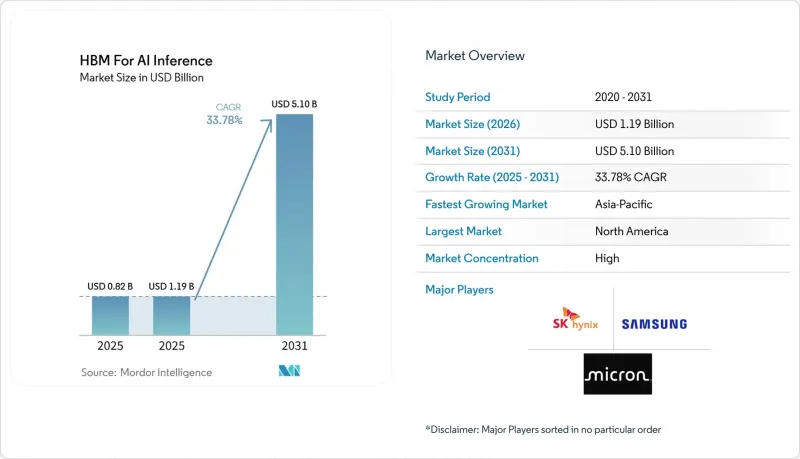
根據 Mordor Intelligence 預測,人工智慧推理的 HBM 市場規模預計將在 2025 年達到 8.2 億美元,到 2031 年達到 51 億美元,2026 年至 2031 年的複合年成長率為 33.78%。
本報告按 HBM 代數(HBM2E、HBM3E、HBM4 等)、計算平台(GPU、CPU、NPU、FPGA)、部署方式(雲端、本地部署)、最終用戶(雲端服務供應商、企業、政府機構等)、封裝整合方式(2.5D、3D、扇出型)以及其他地區(北美地區、歐洲)以及其他地區(北美地區)以及其他地區(北美地區)以及其他地區(北美地區)以及其他地區(北美地區)。市場預測以美元計價。
全球人腦模型市場趨勢及人工智慧推理洞察
生成式人工智慧日益成長的工作負載密度正在推動每個加速器中 HBM(硬體阻塞微波)數量的增加。
隨著每一代加速器技術的迭代,記憶體容量和頻寬都在不斷提升,產品升級也直接推動了用於人工智慧推理的HBM市場的擴張。據NVIDIA稱,Blackwell B200配備了192GB的HBM3e,每個GPU的記憶體頻寬達到了8.0TB/s,與上一代產品相比,單設備記憶體容量顯著提升。 NVIDIA也發布了基於大規模HBM頻寬的「Vera Rubin」平台,這表明下一代效能提升將圍繞記憶體遷移和運算密度展開。美光錶示,HBM4旨在提升基於代理的人工智慧推理的吞吐量和能效,這進一步證明了即使加速器單元成長不均衡,增加HBM負載也是合理的。三星將於2026年開始商業化出貨HBM4,並將其定位為“性能更高”和“散熱性能更優”,這印證了內存堆疊的價值隨著每一次平台迭代都在不斷提升。這一趨勢意義重大,因為即使加速器出貨量增速不及預期,用於人工智慧推理的 HBM 市場仍永續擴張。這是因為每個經過認證的軟體包如今都能帶來更多收益。
使用長文本上下文模型進行備忘錄反彈推斷
用於人工智慧推理的 HBM 市場之所以蓬勃發展,也得益於一個簡單的事實:長上下文推理對記憶體的負載遠高於以往的模型部署方式。美光解釋說,基於代理的人工智慧推理對記憶體流量極為敏感,當記憶體存取成為瓶頸時,由於平行處理和鍵值快取的負載增加,回應時間會顯著延長。隨著上下文視窗的擴展,記憶體需求不僅隨模型規模而成長,也隨活躍序列處理而成長,這促使買家轉向更高頻寬的記憶體層級。美光的 HBM4 規格目標是每個堆疊超過 2.8 TB/s 的吞吐量,並且比 HBM3e 的能源效率提升 20% 以上,這直接有助於降低大規模部署中每個晶片的成本。從實際部署的角度來看,記憶體頻寬現在同時影響推理服務品質、叢集利用率和能耗。因此,用於人工智慧推理的 HBM 市場正變得越來越與模型架構和服務行為緊密相關,而不僅僅是加速器的發布。
封裝層面的嚴格熱設計和良率限制。
溫度控管和堆疊良率仍然是限制人工智慧推理以HBM市場需求轉化為實際出貨收入的關鍵因素。西門子指出,隨著HBM4的推出,介面密度和封裝複雜度都會增加,因此散熱性能將成為量產前的首要設計考量。層數的增加會使熱量集中在堆疊內部,從而加重對鍵合質量、封裝設計和系統散熱的要求。三星在其2026年推出的HBM4產品中強調提升熱阻,這表明供應商已將散熱和穩定性視為核心商業需求,而非次要最佳化。如果這些因素導致認證流程延遲或可用產能減少,實際供應量的成長速度將低於公佈的產能。這種限制不會削弱人工智慧推理用HBM市場的需求,但會限制已認證的供應量能夠快速應用於大規模推理專案。
細分市場分析
2025年,HBM3佔據58.31%的市場佔有率,而HBM4預計到2031年將以34.58%的複合年成長率成長。這一構成比表明,市場正在朝著新的推理性能標準邁進,同時仍受現有部署規模的支撐。 HBM3之所以能維持其主導地位,是因為Hopper、H200和早期Blackwell系統在2025年佔據了已部署加速器需求的大部分。 HBM3e作為過渡產品,使供應商和客戶能夠在無需等待HBM4大規模全面認證的情況下提升頻寬。 HBM2E則繼續扮演小規模的傳統角色,主要應用於那些仍支持活躍推理工作負載的舊加速器系統。
下一階段的發展更取決於商業化準備情況,而非規格本身。三星宣布其HBM4產品每腳吞吐量達到11.7 Gbps,每堆疊吞吐量達到3.3 TB/s,並提升了能源效率和熱阻。美光則宣稱HBM4每堆疊吞吐量超過2.8 TB/s,能效比HBM3e提升20%以上,將此次代際更迭的重點放在推理的經濟性上。隨著供應商開始提供HBM4E樣品並進行認證,預計用於人工智慧推理的HBM市場將出現比以往加速器週期更快的記憶體更新換代速度。這種加速將使能夠擴大生產規模並快速檢驗效能的供應商獲得優勢,因為客戶在選擇記憶體時,越來越重視令牌吞吐量、功耗和封裝密度,而不僅僅是向下相容性。
預計到2025年,GPU將佔總需求的82.74%,而NPU預計到2031年將以34.73%的複合年成長率成長。這項預測仍反映了當前前沿推理工作負載集中在GPU密集型雲端叢集的現實。 GPU的主導地位也反映了現有軟體生態系統在服務大規模模型時對成熟加速器堆疊的持續偏好。 CPU和FPGA平台對於少數對延遲敏感的任務以及小批量任務仍然很重要,但它們並非當前需求的核心。主要的變化在於,專用推理硬體的成長速度現在超過了通用加速器的普及速度。
這種轉變在人工智慧推理用HBM市場的設計選擇和採購模式中均有體現。 AWS開發了以HBM3e為核心的Trainium3,其定位是用於生成式人工智慧推理,而非追求廣泛的訓練性能等效性。這表明記憶體行為正在引導客製化晶片的設計。谷歌發表了配備192GB HBM的TPU Ironwood,凸顯了專門設計的推理平台正持續向高記憶體整合方向融合。 NVIDIA的藍圖也朝著更多面向推理的功能轉變,縮小了以GPU為中心和類似NPU的設計優先順序之間的實際差距。在這種情況下,人工智慧推理用HBM產業正從單一主導的運算模式轉向更廣泛的加速器組合。然而,在整個預測期內,GPU仍可能保持最大的市場佔有率。
區域分析
預計到2025年,北美仍將是人工智慧推理用HBM的最大區域需求中心,佔全球整體市場佔有率的49.93%。該地區受益於超大規模資料中心業者、內部晶片研發項目以及商業模式服務基礎設施的集中佈局。微軟在美國資料中心部署用於推理的Maia 200,充分展現了廠商自有加速器堆疊如何推動區域需求成長。北美也是尖端人工智慧服務商業部署的關鍵樞紐,對先進記憶體的需求仍然強勁。儘管需求旺盛,但該地區在認證HBM的生產和先進封裝方面仍然嚴重依賴亞洲供應鏈。
預計到2031年,亞太地區將以34.64%的複合年成長率成長,成為人工智慧推理用HBM市場的主要生產中心。韓國仍是核心市場,三星和SK海力士是高性能HBM的核心供應商。三星計畫於2026年實現HBM4的商業化,凸顯了該地區在下一代記憶體發展中的作用,從藍圖到量產出貨,都離不開該地區的支持。日本也透過美光在廣島的擴建計畫鞏固了其市場地位,該計畫將擴大其先進的HBM製造地。即使儲存晶圓在其他地區生產,台灣憑藉其先進的封裝和系統整合技術仍然至關重要。隨著日本、印度、韓國和台灣對人工智慧基礎設施投資的增加,亞太地區正在增強人工智慧推理用HBM市場的供需兩端。
儘管歐洲、南美以及中東和非洲的市場佔有率總合較小,但它們的角色正在逐漸增強。在歐洲,資料主權和公共部門人工智慧計畫的優先發展正在提升當地對託管推理能力的興趣。南美的規模仍然有限,但雲端運算的普及和對資料中心的選擇性投資正在為未來對人腦模型(HBM)的需求奠定更穩定的基礎。中東和非洲地區仍處於基礎設施發展週期的早期階段,但國家人工智慧計畫和早期資料中心計畫正開始轉化為對支援HBM的系統的需求。在全部區域,短期目標並非達到北美或亞太地區的規模,而是擴大人工智慧推理HBM市場的地理覆蓋範圍,並減少對少數成熟部署站點的依賴。
其他好處:
- Excel格式的市場預測(ME)表
- 3個月的分析師支持
目錄
第1章:引言
- 研究假設和市場定義
- 調查範圍
第2章:調查方法
第3章執行摘要
第4章 市場狀況
- 市場概覽
- 市場促進因素
- 生成式人工智慧日益成長的工作量密度導致每個加速器使用的 HBM(硬體阻塞微波)數量增加。
- 基於長文本上下文模型的記憶體約束推理
- 利用雲端和超大規模資料中心業者雲端擴展人工智慧叢集
- 邊緣推理:對低延遲和高能效的需求
- 先進封裝技術的進步使得層數增加成為可能。
- 採用超大規模資料中心業者的「推理優先」客製化晶片
- 市場限制因素
- 封裝層面存在嚴格的散熱和良率限制。
- 先進高密度脂蛋白(HBM)的供應基礎合格。
- 對先進包裝能力的高度依賴
- 出口限制和供應鏈本地化帶來的摩擦
- 產業供應鏈分析
- 監理情勢
- 技術展望
- 波特五力分析
- 宏觀經濟因素對市場的影響
第5章 市場規模與成長預測
- 按世代分類的 HBM
- HBM2E
- HBM3
- HBM3E
- HBM4
- 透過運算平台
- GPU
- CPU
- NPU
- FPGA
- 其他運算平台
- 不同的發展
- 雲
- 現場
- 最終用戶
- 雲端服務供應商
- 公司
- 政府/公共部門
- 其他最終用戶
- 按類別分類的軟體包整合
- 2.5D包裝
- 3D包裝
- 扇出包裝
- 按地區
- 北美洲
- 美國
- 加拿大
- 墨西哥
- 歐洲
- 德國
- 英國
- 法國
- 義大利
- 其他歐洲國家
- 亞太地區
- 中國
- 日本
- 韓國
- 台灣
- 印度
- 其他亞太國家
- 南美洲
- 中東和非洲
- 北美洲
第6章 競爭情勢
- 市場集中度
- 策略趨勢
- 市佔率分析
- 公司簡介
- SK hynix Inc.
- Samsung Electronics Co., Ltd.
- Micron Technology, Inc.
- Other Ecosystem Players
- NVIDIA Corporation
- Advanced Micro Devices, Inc.
- Intel Corporation
- Qualcomm Incorporated
- Google LLC
- Amazon Web Services, Inc.
- Microsoft Corporation
- Huawei Technologies Co., Ltd.
- Broadcom Inc.
- Taiwan Semiconductor Manufacturing Company Limited
- Apple Inc.
- Meta Platforms, Inc.
- Cerebras Systems, Inc.
- Groq, Inc.
- SambaNova Systems, Inc.
- d-Matrix, Inc.
- Tenstorrent Inc.
第7章 市場機會與未來展望
According to Mordor Intelligence, the HBM for AI inference market was valued at USD 0.82 billion in 2025 and is forecast to reach USD 5.1 billion by 2031, growing at a CAGR of 33.78% during 2026-2031.
This report is Segmented by HBM Generation (HBM2E, HBM3E, and HBM4, and More), Compute Platform (GPU, CPU, NPU, and FPGA), Deployment (Cloud, and On-Premises), End User (Cloud Service Providers, Enterprises, Government, and More), Package Integration (2. 5D, 3D, and Fan-Out), and Geography (North America, Europe, Asia-Pacific, and More). The Market Forecasts are Provided in Terms of Value (USD).
Global HBM For AI Inference Market Trends and Insights
Generative AI Workload Density Raising HBM Per-Accelerator Content
Each new accelerator cycle delivers greater memory capacity and bandwidth, turning product upgrades into direct expansion for the HBM AI inference market. NVIDIA stated that the Blackwell B200 features 192 GB of HBM3e and delivers 8.0 TB/s of memory bandwidth per GPU, which materially increases memory capacity per device versus the prior generation. NVIDIA also outlined the Vera Rubin platform, which is built around a much larger HBM bandwidth envelope, showing that the next performance step is being built around memory movement as much as compute density. Micron said HBM4 is designed to improve both throughput and power efficiency for agentic AI inference, which strengthens the case for higher HBM content even when accelerator unit growth is uneven. Samsung began commercial HBM4 shipments in 2026 and positioned the product around higher performance and better thermal behavior, reinforcing that memory stack value is rising with every platform change. This pattern matters because the HBM for AI inference market can keep expanding even when accelerator shipments do not rise at the same pace, as more revenue is being captured in every qualified package.
Memory-Bound Inference From Long-Context Models
The HBM for AI inference market is also being lifted by the simple fact that long-context inference reads memory far more aggressively than earlier model deployments. Micron described agentic AI inference as highly sensitive to memory traffic and showed that concurrency and KV-cache pressure can sharply extend response time when memory access becomes the bottleneck. As context windows grow, the memory requirement scales with active sequence handling and not only with model size, which keeps pushing buyers toward higher-bandwidth memory tiers. Micron's HBM4 specification targets greater than 2.8 TB/s per stack and more than 20% better power efficiency than HBM3e, which directly supports lower cost per token at scale. In practical deployment terms, memory bandwidth now influences inference quality of service, cluster utilization, and energy use simultaneously. That is why the HBM for AI inference market is increasingly tied to model architecture and serving behavior, rather than just headline accelerator launches.
High Package-Level Thermal and Yield Constraints
Thermal management and stack yield remain immediate limits on how quickly the HBM for AI inference market can convert demand into shipped revenue. Siemens noted that HBM4 increases both interface density and package complexity, making thermal behavior a first-order design issue before production begins. Higher layer counts increase heat concentration within the stack, which raises the burden on bonding quality, package design, and system cooling. Samsung's 2026 HBM4 launch emphasized thermal resistance improvements, which shows that suppliers are treating heat and stability as core commercial requirements rather than secondary optimizations. When those factors slow qualification or reduce usable output, effective supply grows more slowly than announced capacity. This restraint does not weaken demand for the HBM for AI inference market, but it does cap how fast qualified supply can reach large inference programs.
Other drivers and restraints analyzed in the detailed report include:
- Cloud and Hyperscaler AI Cluster Expansion
- Edge Inference Demand for Lower Latency and Higher Energy Efficiency
- Limited Qualified Supply Base for Advanced HBM
For complete list of drivers and restraints, kindly check the Table Of Contents.
Segment Analysis
HBM3 held 58.31% share in 2025, while HBM4 is projected to expand at a 34.58% CAGR through 2031. That split shows a market still anchored in current deployment volume, but already moving toward a new standard for inference performance. HBM3 remained dominant because Hopper, H200, and early Blackwell systems accounted for the largest share of deployed accelerator demand in 2025. HBM3e served as the bridge generation, helping suppliers and customers raise bandwidth without waiting for full HBM4 qualification at scale. HBM2E remained in a smaller legacy role, primarily tied to older accelerator installations that still support active inference workloads.
The next phase is being shaped by commercial readiness rather than by specification alone. Samsung said its HBM4 product delivers 11.7 Gbps per pin and 3.3 TB/s per stack with improved power efficiency and thermal resistance. Micron positioned HBM4 at more than 2.8 TB/s per stack and with more than 20% better power efficiency than HBM3e, keeping the generation shift centered on inference economics. As suppliers move into HBM4E sampling and qualification, the HBM for AI inference market is likely to see faster turnover between memory generations than earlier accelerator cycles. That faster cadence will reward suppliers that can scale output and validate performance quickly, because customers are increasingly aligning memory selection with token throughput, power draw, and package density rather than with backward compatibility alone.
GPU accounted for 82.74% of demand in 2025, while NPU is projected to expand at a 34.73% CAGR through 2031. The starting point still reflects the reality that frontier inference workloads are concentrated in GPU-rich cloud clusters. GPU dominance also reflects the installed software ecosystem, which continues to favor mature accelerator stacks for large model serving. CPU and FPGA platforms remain relevant for narrower latency-sensitive or low-batch tasks, but they do not define the volume center of current demand. The main change is that specialized inference hardware is now growing faster than general-purpose accelerator deployment.
That change is visible in both design choices and procurement models across the HBM for the AI inference market. AWS built Trainium3 around HBM3e and positioned it for generative AI inference rather than for broad training parity, which shows how memory behavior is guiding custom silicon design. Google documented TPU Ironwood with 192 GB of HBM, underscoring that purpose-built inference platforms still converge on advanced memory integration. NVIDIA's roadmap is also moving toward more inference-oriented capabilities, which narrows the practical gap between GPU-centric and NPU-like design priorities. In that context, the HBM for AI inference industry is shifting from a single dominant compute pattern toward a broader accelerator mix, even though GPUs are likely to remain the largest platform through the forecast period.
Complete Report Scope:
- By HBM Generation
- HBM2E
- HBM3
- HBM3E
- HBM4
- By Compute Platform
- GPU
- CPU
- NPU
- FPGA
- Other Compute Platforms
- By Deployment
- Cloud
- On-Premises
- By End User
- Cloud Service Providers
- Enterprises
- Government and Public Sector
- Other End Users
- By Package Integration
- 2.5D Packaging
- 3D Packaging
- Fan-Out Packaging
- By Geography
- North America
- United States
- Canada
- Mexico
- Europe
- Germany
- United Kingdom
- France
- Italy
- Rest of Europe
- Asia-Pacific
- China
- Japan
- South Korea
- Taiwan
- India
- Rest of Asia-Pacific
- South America
- Middle East and Africa
- North America
Geography Analysis
North America held 49.93% of the global total in 2025 and remained the largest regional demand center in the HBM for AI inference market. The region benefits from the concentration of hyperscalers, internal silicon programs, and commercial model-serving infrastructure. Microsoft launched Maia 200 for inference in its U.S. data center footprint, which shows how regional demand is being reinforced by operator-owned accelerator stacks. North America also remains the main center for the commercial deployment of frontier AI services, which sustains high pull-through for advanced memory. Even with that demand strength, the region still depends heavily on Asian supply chains for qualified HBM output and advanced packaging.
Asia-Pacific is projected to grow at a 34.64% CAGR through 2031 and is the main production base for the HBM for AI inference market. South Korea remains central because Samsung and SK Hynix are core suppliers across the top performance tiers. Samsung's HBM4 commercialization in 2026 confirms the region's role in advancing next-generation memory from the roadmap to volume shipments. Japan is also strengthening its position through Micron's Hiroshima expansion plans, which support a broader manufacturing footprint for advanced HBM. Taiwan remains indispensable through advanced packaging and system integration, even when memory wafers are produced elsewhere. As AI infrastructure investment rises across Japan, India, South Korea, and Taiwan, the Asia-Pacific region is strengthening both the supply and demand sides of the HBM for AI inference market.
Europe, South America, and the Middle East and Africa together represent a smaller share, but their role is gradually improving. In Europe, data sovereignty priorities and public-sector AI programs are supporting local interest in controlled-inference capacity. South America is still limited in scale, yet cloud adoption and selective data center investment are creating a steadier base for future HBM demand. The Middle East and Africa are earlier in the buildout cycle, but national AI programs and early data center projects are beginning to translate into demand for HBM-equipped systems. Across these regions, the near-term role is not to rival North America or Asia-Pacific in scale, but to expand the geographic reach of the HBM for AI inference market and reduce its dependence on a small set of mature deployment centers.
- SK hynix Inc.
- Samsung Electronics Co., Ltd.
- Micron Technology, Inc.
Additional Benefits:
- The market estimate (ME) sheet in Excel format
- 3 months of analyst support
TABLE OF CONTENTS
1 INTRODUCTION
- 1.1 Study Assumptions and Market Definition
- 1.2 Scope of the Study
2 RESEARCH METHODOLOGY
3 EXECUTIVE SUMMARY
4 MARKET LANDSCAPE
- 4.1 Market Overview
- 4.2 Market Drivers
- 4.2.1 Generative AI Workload Density Raising HBM Per-Accelerator Content
- 4.2.2 Memory-Bound Inference From Long-Context Models
- 4.2.3 Cloud and Hyperscaler AI Cluster Expansion
- 4.2.4 Edge Inference Demand for Lower Latency and Higher Energy Efficiency
- 4.2.5 Advanced Packaging Progress Enabling Higher Stack Counts
- 4.2.6 Inference-First Custom Silicon Adoption by Hyperscalers
- 4.3 Market Restraints
- 4.3.1 High Package-Level Thermal and Yield Constraints
- 4.3.2 Limited Qualified Supply Base for Advanced HBM
- 4.3.3 Heavy Dependence on Advanced Packaging Capacity
- 4.3.4 Export Controls and Supply Chain Localization Friction
- 4.4 Industry Supply Chain Analysis
- 4.5 Regulatory Landscape
- 4.6 Technological Outlook
- 4.7 Porter's Five Forces Analysis
- 4.7.1 Bargaining Power of Buyers
- 4.7.2 Bargaining Power of Suppliers
- 4.7.3 Threat of New Entrants
- 4.7.4 Threat of Substitutes
- 4.7.5 Intensity of Competitive Rivalry
- 4.8 Impact of Macroeconomic Factors on the Market
5 MARKET SIZE AND GROWTH FORECASTS (VALUE)
- 5.1 By HBM Generation
- 5.1.1 HBM2E
- 5.1.2 HBM3
- 5.1.3 HBM3E
- 5.1.4 HBM4
- 5.2 By Compute Platform
- 5.2.1 GPU
- 5.2.2 CPU
- 5.2.3 NPU
- 5.2.4 FPGA
- 5.2.5 Other Compute Platforms
- 5.3 By Deployment
- 5.3.1 Cloud
- 5.3.2 On-Premises
- 5.4 By End User
- 5.4.1 Cloud Service Providers
- 5.4.2 Enterprises
- 5.4.3 Government and Public Sector
- 5.4.4 Other End Users
- 5.5 By Package Integration
- 5.5.1 2.5D Packaging
- 5.5.2 3D Packaging
- 5.5.3 Fan-Out Packaging
- 5.6 By Geography
- 5.6.1 North America
- 5.6.1.1 United States
- 5.6.1.2 Canada
- 5.6.1.3 Mexico
- 5.6.2 Europe
- 5.6.2.1 Germany
- 5.6.2.2 United Kingdom
- 5.6.2.3 France
- 5.6.2.4 Italy
- 5.6.2.5 Rest of Europe
- 5.6.3 Asia-Pacific
- 5.6.3.1 China
- 5.6.3.2 Japan
- 5.6.3.3 South Korea
- 5.6.3.4 Taiwan
- 5.6.3.5 India
- 5.6.3.6 Rest of Asia-Pacific
- 5.6.4 South America
- 5.6.5 Middle East and Africa
- 5.6.1 North America
6 COMPETITIVE LANDSCAPE
- 6.1 Market Concentration
- 6.2 Strategic Moves
- 6.3 Market Share Analysis
- 6.4 Company Profiles (includes Global Level Overview, Market Level Overview, Core Segments, Financials as available, Strategic Information, Products and Services, Recent Developments)
- 6.4.1 SK hynix Inc.
- 6.4.2 Samsung Electronics Co., Ltd.
- 6.4.3 Micron Technology, Inc.
- 6.5 Other Ecosystem Players
- 6.5.1 NVIDIA Corporation
- 6.5.2 Advanced Micro Devices, Inc.
- 6.5.3 Intel Corporation
- 6.5.4 Qualcomm Incorporated
- 6.5.5 Google LLC
- 6.5.6 Amazon Web Services, Inc.
- 6.5.7 Microsoft Corporation
- 6.5.8 Huawei Technologies Co., Ltd.
- 6.5.9 Broadcom Inc.
- 6.5.10 Taiwan Semiconductor Manufacturing Company Limited
- 6.5.11 Apple Inc.
- 6.5.12 Meta Platforms, Inc.
- 6.5.13 Cerebras Systems, Inc.
- 6.5.14 Groq, Inc.
- 6.5.15 SambaNova Systems, Inc.
- 6.5.16 d-Matrix, Inc.
- 6.5.17 Tenstorrent Inc.
7 MARKET OPPORTUNITIES AND FUTURE OUTLOOK
- 7.1 White-Space and Unmet-Need Assessment

 2026-2034年全球汽車人工智慧晶片組市場規模、佔有率、趨勢和成長分析報告全球人工智慧晶片組市場規模、佔有率、趨勢和成長分析報告(2026-2034)
 人工智慧晶片組:市場佔有率分析、產業趨勢與統計及成長預測(2026-2031 年)HBM在國防和航太運算領域的應用:市場佔有率分析、產業趨勢和統計數據以及成長預測(2026-2031年)HBM在網路交換和封包處理中的應用:市場佔有率分析、行業趨勢和統計數據以及成長預測(2026-2031)
 人工智慧(AI)晶片組市場:2026-2032年全球市場預測(按晶片組類型、架構、部署方式、應用和最終用途分類)AI GPU晶片:市佔率分析、產業趨勢與統計及成長預測(2026-2031年)HBM在AI GPU的應用:市佔率分析、產業趨勢與統計、成長預測(2026-2031)
 人工智慧影像處理晶片市場:按晶片類型、部署模式、應用、終端用戶產業、國家和地區分類-產業分析、市場規模、市場佔有率及2026年至2033年預測GPU架構與運算IP授權:市場佔有率分析、產業趨勢與統計資料以及成長預測(2026-2031年)