


 |
市場調查報告書
商品編碼
2099413
AI GPU晶片:市佔率分析、產業趨勢與統計及成長預測(2026-2031年)AI GPU Chip - Market Share Analysis, Industry Trends & Statistics, Growth Forecasts (2026 - 2031) |
||||||

※ 本網頁內容可能與最新版本有所差異。詳細情況請與我們聯繫。
根據 Mordor Intelligence 預測,人工智慧 GPU 晶片市場規模將從 2025 年的 1,675 億美元成長到 2026 年的 2,884 億美元,然後在 2031 年達到 6,217 億美元,2026 年至 2031 年的複合年成長率為 16.60%。
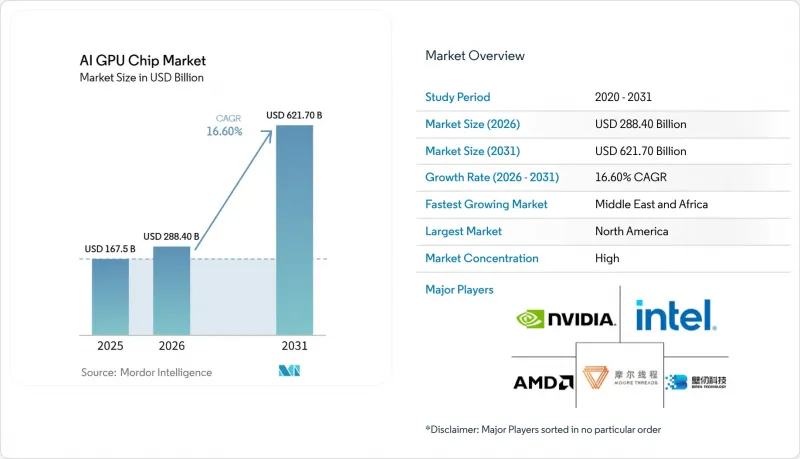
本報告按產品類型(資料中心用AI GPU、邊緣AI GPU、客戶端AI GPU)、運算能力(用於訓練和推理的GPU等)、部署環境(超大規模雲端和雲端、企業資料中心等)、工作負載(生成式AI和大規模語言模型、電腦視覺和機器人等)以及地區進行細分。市場預測以美元(USD)為單位。
全球人工智慧GPU晶片市場趨勢與洞察
擴大企業專有模型的微調範圍
企業對自有模型的微調不再局限於一次性的先導計畫,而是逐漸成為企業持續運營的實踐,尤其對於那些希望利用自身資料訓練模型的企業而言。這種轉變對人工智慧GPU晶片市場有重大影響,因為反覆的重新訓練、評估和部署會產生持續的硬體需求,而非一次性的採購週期。許多企業也在尋求能夠同時支援微調和推理的混合叢集,這使得功能多樣的GPU配置比應用範圍有限的固定用途系統更有價值。對於高利用率的人工智慧工作負載,本地部署的經濟效益正變得越來越顯著。聯想報告稱,對於持續的工作負載,本地生成式人工智慧部署的獲利週期比雲端部署短得多,不到四個月即可實現盈利。此外,高度監管產業的資料管理要求也促使一些模型客製化工作在更接近內部基礎設施的位置進行,從而將人工智慧GPU晶片市場擴展到超大規模資料中心業者中心之外。
快速擴展超大規模人工智慧訓練叢集
AI GPU晶片市場仍然主要由大規模超大規模訓練叢集驅動,這些集群需要高度整合的機架、高密度網路和更先進的散熱能力。由於即使在模型部署之後也需要擴展服務集群,因此這些採購不再局限於單一訓練週期,而是在訓練和推理環境中保持活躍的採購週期。現代機架級系統正被訂購用於大規模工作負載,從而推動了對高階加速器、交換器、電源和記憶體的需求,這些需求都在同一建造週期內產生。 AMD在2026年2月與Meta達成一項多年期、6吉瓦的夥伴關係,在Meta的AI資料中心部署AMD Instinct GPU,進一步鞏固了這一趨勢。只要超大規模資料中心超大規模資料中心業者繼續將其尖端訓練集群與其大規模推理集群分開,AI GPU晶片市場預計將出現比傳統運算升級週期更持續的採購。
先進包裝產能瓶頸
先進封裝仍是限制AI/GPU晶片市場將設計需求轉化為實際出貨系統速度的現實瓶頸。現代AI加速器依賴邏輯晶片和堆疊式高頻寬記憶體的複雜整合,因此封裝良率和吞吐量與晶圓供應同等重要。西門子指出,HBM4的整合正變得日益複雜,朝向更高頻寬和更高密度堆疊配置的轉變也加重了封裝生產線的負擔。即使供應商的產品需求強勁,由於記憶體、封裝和後端組裝都需要同步擴展,交貨週期也可能延長。這種限制將減緩產量成長,有利於擁有更強大供應鏈關係的供應商,並且在可預見的未來,AI/GPU晶片市場仍將繼續依賴有限的製造基礎。
細分市場分析
到2025年,用於資料中心的AI GPU將佔據AI GPU晶片市場93.11%的佔有率,這一集中度反映了最新硬體能夠大規模部署的領域。關鍵產品在設計時充分考慮了高密度機架、高速互連和專用冷卻系統,使得大規模資料中心環境成為當前旗艦平台的理想部署場所。此外,部署的成功取決於記憶體、網路和溫度控管的協同運作,因此廠商之間的競爭主要集中在整個系統的設計上,而非單一晶片。因此,儘管新的需求中心不斷湧現,AI GPU晶片市場仍嚴重偏向集中式運算環境。
預計到 2031 年,邊緣 AI GPU 將以 17.44% 的複合年成長率成長,其成長與機器人、工業自動化和本地推理需求密切相關。 NVIDIA 的機器人平台設計整合了用於訓練的 DGX 系統、用於仿真的 RTX PRO 伺服器以及用於設備端推理的 Jetson 硬體,表明邊緣堆疊正成為更廣泛的 AI 部署模型的一部分。面向客戶端的 AI GPU 在整個 AI GPU 晶片行業中所佔佔有率仍然很小,但隨著設備製造商在工作站和筆記型電腦中添加 AI 原生功能,它們的重要性正在日益提升。 NVIDIA 於 2026 年發布的 RTX Spark 表明,客戶端設備正在成為 AI GPU 部署的新切入點,尤其是在本地模型執行、設計工作流程和緊湊推理至關重要的領域。
預計到2025年,訓練GPU將佔AI GPU晶片市場規模的52.33%,這一主導地位主要歸功於前沿模型開發和大規模公共運算專案。訓練平台仍然需要最高的互連密度和最強的擴展性能,這支撐了對高階機架式架構的持續需求。同時,預計到2031年,推理GPU的複合年成長率將達到17.62%,這一差異表明,訓練完成後,模型服務正成為大規模、更常規的計算任務。因此,AI GPU晶片市場正從「訓練優先」的模式轉向更平衡的模式,配置密度與模型創建同等重要。
在企業環境中,為每個工作負載建立獨立的系統叢集並不現實,因此,集訓練和推理於一體的平台正變得越來越實用。這些採購企業通常需要共用叢集,以便在同一部署基礎架構上進行模型微調、評估和應用交付。這種營運模式擴展了市場的中階,避免了需求僅集中在最昂貴的訓練硬體上。這也解釋了人工智慧GPU晶片行業對記憶體充足且配置靈活的晶片日益成長的興趣,他們優先考慮整體利用率,即使這意味著犧牲尖峰時段性能。
區域分析
到2025年,北美將佔據全球AI GPU晶片市場38.44%的佔有率,憑藉其超大規模投資和最強大的開發者生態系統,仍將是最大的買家地區。美國繼續透過投資雲端平台、軟體相容性以及以CUDA和NVLink為中心的系統級整合來滿足其大部分需求。加拿大在「自主運算」領域活性化,貝爾公司和Cohere公司於2026年6月簽署了一份價值2.2億美元的契約,將在不列顛哥倫比亞省部署2304套NVIDIA Grace Blackwell GB200 NVL72系統。墨西哥目前更受益於與美國的製造和組裝合作,而非大規模的國內AI GPU部署。因此,即使有更多地區正在製定自己的運算策略,北美仍將是AI GPU晶片市場的短期銷售量中心。
在歐洲,自主運算在人工智慧GPU晶片市場中扮演越來越重要的角色,政策、公共資金和合規性等因素都在推動對國內基礎設施的需求。經合組織在公共雲端運算可用性方面的努力也印證了這樣一種觀點:公共部門的人工智慧能力正日益受到重視,而這種重視體現在韌性和自主性這兩個標準上。亞太地區的情況則更為多元化,從韓國14億美元的國家GPU計畫到印度和東南亞,隨著本土模式的開發不斷擴展,這些地區的需求也不斷成長。法國也已表示有意實現自主系統供應商的多元化,這表明隨著採購流程的成熟,該地區未來可能會支援多種軟硬體堆疊。
預計到2031年,中東和非洲地區的人工智慧GPU晶片市場將以17.42%的複合年成長率成長,在所有地區中成長最高。阿拉伯聯合大公國持續建構系統化的人工智慧能力,其技術創新研究院(TII)與英偉達(NVIDIA)合作,在該地區建立了一個正式的機器人和先進人工智慧系統研究中心。非洲的學術計算基礎設施也在不斷擴展,開普敦大學將於2026年推出“非洲計算舉措”,旨在擴大高階人工智慧系統的研究應用範圍。南美洲目前規模仍然較小,但巴西耗資3.6億美元的人工智慧超級電腦計畫於2027年投入運作,顯示該地區正以更明確的公共目標進入採購週期。
其他好處:
- Excel格式的市場預測(ME)表
- 3個月的分析師支持
目錄
第1章:引言
- 研究假設和市場定義
- 調查範圍
第2章:調查方法
第3章執行摘要
第4章 市場狀況
- 市場概覽
- 市場促進因素
- 業務拓展與專有模型的微調
- 超大規模人工智慧訓練叢集的快速擴張
- HBM4相容性與先進封裝升級週期
- 國家主導的人工智慧採購和國內運算安全
- 利用 NVLink-CXL 和 UALink 實現加速器容量池化
- 高TDP GPU機架水冷技術的標準化
- 市場限制因素
- 先進包裝產能瓶頸
- 叢集規模部署中總擁有成本 (TCO) 增加
- 出口限制和地緣政治供應鏈摩擦
- 客製化ASIC和專有加速器之間的競爭
- 產業價值鏈分析
- 監理情勢
- 技術展望
- 宏觀經濟因素對市場的影響
- 波特五力分析
第5章 市場規模與成長預測
- 依產品類型
- 用於資料中心人工智慧的GPU
- 用於邊緣人工智慧的GPU
- 面向客戶的AI GPU
- 透過計算函數
- 訓練 GPU
- 用於推理的GPU
- GPU同時用於訓練和推理
- 按部署環境
- 超大規模和雲
- 企業資料中心
- 政府和研究機構
- 邊緣和終端部署
- 按工作量
- 生成式人工智慧和大規模語言模型
- 電腦視覺與機器人技術
- 語音和自然語言處理
- 建議、搜尋、圖分析
- 科學計算和其他人工智慧工作負載
- 按地區
- 北美洲
- 美國
- 加拿大
- 墨西哥
- 歐洲
- 德國
- 英國
- 法國
- 義大利
- 其他歐洲國家
- 亞太地區
- 中國
- 日本
- 韓國
- 印度
- 東南亞
- 其他亞太國家
- 南美洲
- 中東和非洲
- 北美洲
第6章 競爭情勢
- 市場集中度
- 策略趨勢
- Market Positioning Analysis
- 公司簡介
- NVIDIA Corporation
- Advanced Micro Devices, Inc.
- Intel Corporation
- Moore Threads Technology Co., Ltd.
- Biren Technology Co., Ltd.
- Huawei Technologies Co., Ltd.
- Google LLC
- Amazon.com, Inc.
- Microsoft Corporation
- Alibaba Group Holding Limited
- Meta Platforms, Inc.
- Cerebras Systems, Inc.
- Graphcore Limited
- SambaNova Systems, Inc.
- Qualcomm Incorporated
- Tenstorrent Inc.
- Shanghai Iluvatar CoreX Semiconductor Co., Ltd.
- Shanghai Denglin Technology Co., Ltd.
- Hygon Information Technology Co., Ltd.
- Glenfly Tech Co., Ltd.
第7章 市場機會與未來展望
According to Mordor Intelligence, the AI GPU chip market size is expected to grow from USD 167.5 billion in 2025 to USD 288.4 billion in 2026 and is forecast to reach USD 621.7 billion by 2031 at 16.60% CAGR over 2026-2031.
This report is Segmented by Product Type (Data Center AI GPUs, Edge AI GPUs, and Client AI GPUs), Compute Function (Mixed Training and Inference GPUs, and More), Deployment Environment (Hyperscale and Cloud, Enterprise Data Centers, and More), Workload (Generative AI and Large Language Models, Computer Vision and Robotics, and More), and Geography. The Market Forecasts are Provided in Terms of Value (USD).
Global AI GPU Chip Market Trends and Insights
Expanding Enterprise Fine-Tuning of Proprietary Models
Enterprise fine-tuning has moved beyond one-off pilot work and is becoming a recurring operating practice for companies that want models trained on proprietary data. That shift matters for the AI GPU chip market because repeated retraining, evaluation, and deployment create ongoing hardware demand rather than a single purchase cycle. Many enterprises also want mixed clusters that support both fine-tuning and inference, which increases the value of versatile GPU configurations instead of narrow, fixed-purpose systems. On-premise economics are becoming easier to justify for high-utilization AI work, and Lenovo reported that on-premise generative AI deployments can reach breakeven against cloud in under 4 months for sustained workloads. Data control requirements in regulated sectors are also keeping some model customization closer to internal infrastructure, which broadens the buyer base of the AI GPU chip market beyond hyperscalers.
Rapid Scale-Up of Hyperscale AI Training Clusters
The AI GPU chip market is still being shaped by larger hyperscale training clusters that need tightly integrated racks, dense networking, and more advanced cooling. These purchases are no longer limited to one training wave because serving fleets also need to grow after model deployment, which keeps procurement cycles active across both training and inference estates. The newest rack-scale systems are being ordered for large frontier workloads, and that raises demand for high-end accelerators, switching, power delivery, and memory in the same build cycle. AMD reinforced this pattern in February 2026 when it announced a multi-year 6-gigawatt partnership with Meta to deploy AMD Instinct GPUs across Meta's AI data centers. As long as hyperscalers continue to separate frontier training fleets from large inference fleets, the AI GPU chip market is likely to see more continuous buying than in earlier compute upgrade cycles.
Advanced Packaging Capacity Bottlenecks
Advanced packaging remains a practical limit on how fast the AI GPU chip market can convert design demand into shipped systems. Modern AI accelerators depend on complex integration of logic dies and stacked high-bandwidth memory, and that makes packaging yield and throughput as important as wafer supply. Siemens highlighted the growing complexity of HBM4 integration, and the move to higher bandwidth and denser stack configurations increases the burden on packaging lines. Even when vendors have strong product demand, delivery schedules can still stretch because memory, packaging, and backend assembly must all scale together. This restraint slows volume growth, favors vendors with stronger supply relationships, and keeps the AI GPU chip market dependent on a narrow manufacturing base in the near term.
Other drivers and restraints analyzed in the detailed report include:
- HBM4 Readiness and Advanced Packaging Upgrade Cycle
- Sovereign AI Procurement and Domestic Compute Security
- Rising Total Cost of Ownership for Cluster-Scale Deployments
For complete list of drivers and restraints, kindly check the Table Of Contents.
Segment Analysis
Data center AI GPUs held 93.11% of the AI GPU chip market share in 2025, and that concentration reflected where the newest hardware could be deployed at scale. The leading products are designed around dense racks, high-speed interconnects, and specialized cooling, which makes large data center environments the natural fit for current flagship platforms. This also keeps vendor competition centered on full system design rather than on the chip alone, because deployment success depends on memory, networking, and thermal management working together. The AI GPU chip market therefore still leans heavily toward centralized compute environments even as new demand pockets begin to appear.
Edge AI GPUs are projected to expand at a 17.44% CAGR through 2031, and that growth is tied to robotics, industrial automation, and localized inference needs. NVIDIA's robotics platform design, which links DGX systems for training with RTX PRO servers for simulation and Jetson hardware for on-device inference, shows how the edge stack is becoming part of a broader AI deployment model. Client AI GPUs remain a smaller part of the AI GPU chip industry, but they are gaining relevance as device makers add AI-native features to workstations and laptops. NVIDIA's RTX Spark announcement in 2026 showed that client devices are becoming another entry point for AI GPU adoption, especially where local model execution, design workflows, and compact inferencing are important.
Training GPUs accounted for 52.33% of the AI GPU chip market size in 2025, and that lead came from frontier model development and large public compute programs. Training platforms still need the highest interconnect density and the most aggressive scaling behavior, which supports continued demand for premium rack architectures. Inference GPUs, however, are projected to expand at a 17.62% CAGR through 2031, and that difference shows how model serving is becoming the larger recurring compute task after training is complete. The AI GPU chip market is therefore shifting from a training-first narrative to a more balanced model where deployment intensity matters as much as model creation.
Mixed training and inference platforms are gaining a practical role in enterprise environments that cannot justify separate fleets for each workload. These buyers often need a shared cluster that can fine-tune models, run evaluation cycles, and serve applications from the same installed base. That operating pattern broadens the middle of the market and keeps demand from concentrating only in the most expensive training hardware. It also explains why the AI GPU chip industry is seeing more interest in memory-rich and flexible configurations that trade some peak specialization for higher overall utilization.
Complete Report Scope:
- By Product Type
- Data Center AI GPUs
- Edge AI GPUs
- Client AI GPUs
- By Compute Function
- Training GPUs
- Inference GPUs
- Mixed Training and Inference GPUs
- By Deployment Environment
- Hyperscale and Cloud
- Enterprise Data Centers
- Government and Research Institutions
- Edge and Endpoint Deployments
- By Workload
- Generative AI and Large Language Models
- Computer Vision and Robotics
- Speech and Natural Language Processing
- Recommendation, Search, and Graph Analytics
- Scientific Computing and Other AI Workloads
- By Geography
- North America
- United States
- Canada
- Mexico
- Europe
- Germany
- United Kingdom
- France
- Italy
- Rest of Europe
- Asia-Pacific
- China
- Japan
- South Korea
- India
- Southeast Asia
- Rest of Asia-Pacific
- South America
- Middle East and Africa
- North America
Geography Analysis
North America held 38.44% of the global AI GPU chip market in 2025, and the region remained the largest buyer because it combines hyperscale spending with the deepest developer ecosystem. The United States still anchors most of that demand through cloud platform investment, software compatibility, and system-level integration around CUDA and NVLink. Canada is becoming more active in sovereign compute, and Bell and Cohere signed a USD 220 million agreement in June 2026 to deploy 2,304 NVIDIA Grace Blackwell GB200 NVL72 systems in British Columbia. Mexico benefits more through manufacturing and assembly ties to the United States than through large domestic AI GPU deployments at this stage. This keeps North America at the center of near-term volume for the AI GPU chip market even as more regions build local compute agendas.
Europe is building a larger sovereign compute role in the AI GPU chip market, with policy, public funding, and compliance all pushing demand toward domestic infrastructure. OECD work on public cloud compute availability supports the view that public-sector AI capacity is increasingly being evaluated through resilience and sovereignty criteria. Asia-Pacific presents a broader mix, from South Korea's USD 1.4 billion national GPU program to growing demand in India and Southeast Asia as domestic model development expands. France also signaled willingness to diversify vendors for sovereign systems, which suggests the region may support more than one software and hardware stack as procurement matures.
The Middle East and Africa is projected to expand at a 17.42% CAGR through 2031, which gives it the fastest regional growth rate in the AI GPU chip market. The UAE continues to build institutional AI capacity, and the Technology Innovation Institute's partnership with NVIDIA gives the region a formal research base in robotics and advanced AI systems. Africa is also adding academic compute infrastructure, and the University of Cape Town launched the African Compute Initiative in 2026 to expand research access to high-end AI systems. South America remains smaller in current scale, but Brazil's plan for a USD 360 million AI supercomputer due in 2027 shows that the region is entering the procurement cycle with more visible public ambition.
- NVIDIA Corporation
- Advanced Micro Devices, Inc.
- Intel Corporation
- Moore Threads Technology Co., Ltd.
- Biren Technology Co., Ltd.
- Huawei Technologies Co., Ltd.
- Google LLC
- Amazon.com, Inc.
- Microsoft Corporation
- Alibaba Group Holding Limited
- Meta Platforms, Inc.
- Cerebras Systems, Inc.
- Graphcore Limited
- SambaNova Systems, Inc.
- Qualcomm Incorporated
- Tenstorrent Inc.
- Shanghai Iluvatar CoreX Semiconductor Co., Ltd.
- Shanghai Denglin Technology Co., Ltd.
- Hygon Information Technology Co., Ltd.
- Glenfly Tech Co., Ltd.
Additional Benefits:
- The market estimate (ME) sheet in Excel format
- 3 months of analyst support
TABLE OF CONTENTS
1 INTRODUCTION
- 1.1 Study Assumptions and Market Definition
- 1.2 Scope of the Study
2 RESEARCH METHODOLOGY
3 EXECUTIVE SUMMARY
4 MARKET LANDSCAPE
- 4.1 Market Overview
- 4.2 Market Drivers
- 4.2.1 Expanding Enterprise Fine-Tuning of Proprietary Models
- 4.2.2 Rapid Scale-Up of Hyperscale AI Training Clusters
- 4.2.3 HBM4 Readiness and Advanced Packaging Upgrade Cycle
- 4.2.4 Sovereign AI Procurement and Domestic Compute Security
- 4.2.5 NVLink-CXL and UALink Pooling of Accelerator Capacity
- 4.2.6 Liquid Cooling Standardization for High-TDP GPU Racks
- 4.3 Market Restraints
- 4.3.1 Advanced Packaging Capacity Bottlenecks
- 4.3.2 Rising Total Cost of Ownership for Cluster-Scale Deployments
- 4.3.3 Export Controls and Geopolitical Supply Friction
- 4.3.4 Competition From Custom ASICs and Proprietary Accelerators
- 4.4 Industry Value Chain Analysis
- 4.5 Regulatory Landscape
- 4.6 Technological Outlook
- 4.7 Impact of Macroeconomic Factors on the Market
- 4.8 Porter's Five Forces Analysis
- 4.8.1 Bargaining Power of Suppliers
- 4.8.2 Bargaining Power of Buyers
- 4.8.3 Threat of New Entrants
- 4.8.4 Threat of Substitutes
- 4.8.5 Industry Rivalry
5 MARKET SIZE AND GROWTH FORECASTS (VALUE)
- 5.1 By Product Type
- 5.1.1 Data Center AI GPUs
- 5.1.2 Edge AI GPUs
- 5.1.3 Client AI GPUs
- 5.2 By Compute Function
- 5.2.1 Training GPUs
- 5.2.2 Inference GPUs
- 5.2.3 Mixed Training and Inference GPUs
- 5.3 By Deployment Environment
- 5.3.1 Hyperscale and Cloud
- 5.3.2 Enterprise Data Centers
- 5.3.3 Government and Research Institutions
- 5.3.4 Edge and Endpoint Deployments
- 5.4 By Workload
- 5.4.1 Generative AI and Large Language Models
- 5.4.2 Computer Vision and Robotics
- 5.4.3 Speech and Natural Language Processing
- 5.4.4 Recommendation, Search, and Graph Analytics
- 5.4.5 Scientific Computing and Other AI Workloads
- 5.5 By Geography
- 5.5.1 North America
- 5.5.1.1 United States
- 5.5.1.2 Canada
- 5.5.1.3 Mexico
- 5.5.2 Europe
- 5.5.2.1 Germany
- 5.5.2.2 United Kingdom
- 5.5.2.3 France
- 5.5.2.4 Italy
- 5.5.2.5 Rest of Europe
- 5.5.3 Asia-Pacific
- 5.5.3.1 China
- 5.5.3.2 Japan
- 5.5.3.3 South Korea
- 5.5.3.4 India
- 5.5.3.5 Southeast Asia
- 5.5.3.6 Rest of Asia-Pacific
- 5.5.4 South America
- 5.5.5 Middle East and Africa
- 5.5.1 North America
6 COMPETITIVE LANDSCAPE
- 6.1 Market Concentration
- 6.2 Strategic Moves
- 6.3 Market Positioning Analysis
- 6.4 Company Profiles (includes Global Level Overview, Market Level Overview, Core Segments, Financials as available, Strategic Information, Market Rank/Share, Products and Services, Recent Developments)
- 6.4.1 NVIDIA Corporation
- 6.4.2 Advanced Micro Devices, Inc.
- 6.4.3 Intel Corporation
- 6.4.4 Moore Threads Technology Co., Ltd.
- 6.4.5 Biren Technology Co., Ltd.
- 6.4.6 Huawei Technologies Co., Ltd.
- 6.4.7 Google LLC
- 6.4.8 Amazon.com, Inc.
- 6.4.9 Microsoft Corporation
- 6.4.10 Alibaba Group Holding Limited
- 6.4.11 Meta Platforms, Inc.
- 6.4.12 Cerebras Systems, Inc.
- 6.4.13 Graphcore Limited
- 6.4.14 SambaNova Systems, Inc.
- 6.4.15 Qualcomm Incorporated
- 6.4.16 Tenstorrent Inc.
- 6.4.17 Shanghai Iluvatar CoreX Semiconductor Co., Ltd.
- 6.4.18 Shanghai Denglin Technology Co., Ltd.
- 6.4.19 Hygon Information Technology Co., Ltd.
- 6.4.20 Glenfly Tech Co., Ltd.
7 MARKET OPPORTUNITIES AND FUTURE OUTLOOK
- 7.1 White Space and Unmet-Need Assessment

 2026-2034年全球汽車人工智慧晶片組市場規模、佔有率、趨勢和成長分析報告全球人工智慧晶片組市場規模、佔有率、趨勢和成長分析報告(2026-2034)
 人工智慧晶片組:市場佔有率分析、產業趨勢與統計及成長預測(2026-2031 年)HBM在國防和航太運算領域的應用:市場佔有率分析、產業趨勢和統計數據以及成長預測(2026-2031年)HBM在網路交換和封包處理中的應用:市場佔有率分析、行業趨勢和統計數據以及成長預測(2026-2031)
 人工智慧(AI)晶片組市場:2026-2032年全球市場預測(按晶片組類型、架構、部署方式、應用和最終用途分類)HBM在人工智慧推理中的應用:市場佔有率分析、行業趨勢與統計數據以及成長預測(2026-2031年)HBM在AI GPU的應用:市佔率分析、產業趨勢與統計、成長預測(2026-2031)
 人工智慧影像處理晶片市場:按晶片類型、部署模式、應用、終端用戶產業、國家和地區分類-產業分析、市場規模、市場佔有率及2026年至2033年預測GPU架構與運算IP授權:市場佔有率分析、產業趨勢與統計資料以及成長預測(2026-2031年)