


 |
市場調查報告書
商品編碼
2099519
亞太地區企業內容管理 (ECM):市場佔有率分析、產業趨勢與統計及成長預測 (2026-2031)Asia-Pacific Enterprise Content Management (ECM) - Market Share Analysis, Industry Trends & Statistics, Growth Forecasts (2026 - 2031) |
||||||

※ 本網頁內容可能與最新版本有所差異。詳細情況請與我們聯繫。
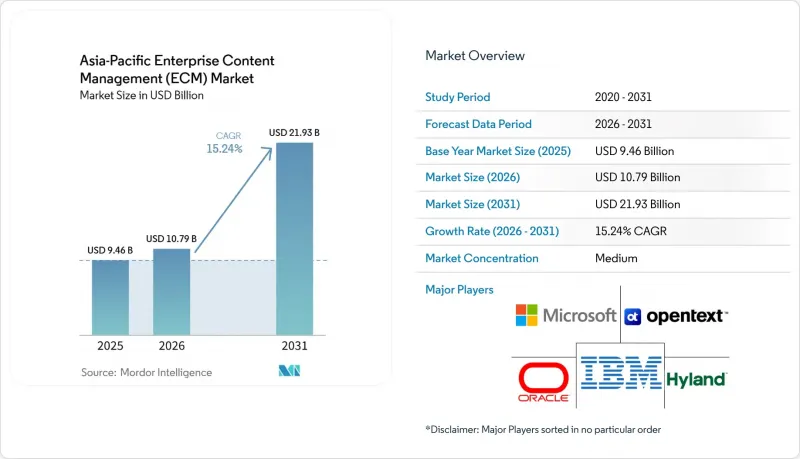
根據 Mordor Intelligence 預測,亞太地區企業內容管理 (ECM) 市場規模將從 2025 年的 94.6 億美元成長到 2026 年的 107.9 億美元,然後在 2031 年達到 219.3 億美元,2026 年至 2031 年的複合年成長率為 15.4%。
本報告按解決方案類型(文件管理、記錄管理等)、部署模式(本地部署、雲端部署、混合部署)、企業規模(中小企業、大型企業)、最終用戶行業(銀行、金融服務和保險 (BFSI)、政府和公共部門、醫療保健等)以及地區進行細分。市場預測以美元 (USD) 計價。
亞太地區企業內容管理(ECM)市場趨勢及洞察。
採用雲端優先方法實現內容架構現代化
在亞太企業內容管理 (ECM) 市場,雲端採用不再是試點項目,而是許多新部署的預設起點。微軟在印尼的雲端投資計畫是更廣泛的區域基礎設施發展工作的一部分,旨在鼓勵企業將其內容工作流程遷移到更接近超大規模資料中心業者環境的雲端平台,並採用人工智慧驅動的生產力工具。 2025 年 1 月,日本商業系統公司 (Japan Business Systems) 發布了一套面向地方政府的文件管理和電子核准系統,該系統利用了現有的 Microsoft 365 授權。這表明,買家無需投資一套完全獨立的雲端技術堆疊即可擴展其雲端採用規模。在亞太企業內容管理市場,基礎設施的擴展和簡化的採購流程正在縮短從現代化規劃到生產部署的時間。隨著客戶越來越需要內建可擴展性、更快的升級速度和更便捷的人工智慧整合,而非更長的硬體更新周期,供應商的選擇標準也在改變。因此,亞太地區的企業內容管理 (ECM) 市場正在向雲端原生營運模式轉型,即使在以前更傾向於託管本地環境的領域也是如此。
利用生成式人工智慧進行自動分類和搜尋
在亞太地區,生成式人工智慧正在改變企業內容管理 (ECM) 市場中平台的角色。客戶現在不僅期望系統能夠儲存內容,還能分類、標記、搜尋和摘要。微軟於 2025 年發布的 SharePoint Embedded 專案表明,ECM 功能正在從用於文件儲存的後端儲存庫演變為人工智慧基礎架構。 OpenText 也緊跟著,在 2026 年 6 月的發布週期中,進一步將內容管理與 Microsoft Copilot 和 Guidewire 整合。日立解決方案公司也在 2025 年 11 月升級了其內容生命週期管理器,將增強的搜尋功能與基於生成式人工智慧的屬性提取和搜尋功能相結合,這反映了對現有文件資產進行管治搜尋的日益成長的需求。這提升了能夠妥善處理區域語言、本地格式和符合監管要求的工作流程,而無需客戶在部署後實施額外人工智慧工具的平台的價值。因此,亞太地區的企業內容管理市場正從以儲存庫主導的採購模式轉向以決策支援、搜尋品質和工作流程智慧為導向的模式。
遷移遺留程式碼庫的複雜性
許多組織仍然維護著元資料缺陷、存取規則不一致、流程記錄不完整的傳統儲存庫,這使得舊有系統遷移成為亞太地區企業內容管理 (ECM) 市場的一大障礙。發表於 2025 年 11 月《計算分析與應用雜誌》(Journal of Computational Analysis and Applications) 的一項研究發現,將低品質內容遷移到雲端系統而不進行基於管治的清理會增加合規風險、削弱人工智慧的輸出並降低部署效果。這項風險在亞太 ECM 市場尤其顯著,因為許多買家試圖同時進行現代化和自動化,幾乎沒有時間進行耗時的遷移前清理工作。遷移延遲也會影響購買行為,因為那些設想進行平台部署專案的組織可能會發現,在軟體價值顯現之前,他們已經投入了服務費、記錄更正和用戶培訓等費用。對於參與大規模轉型專案的供應商而言,執行的徹底性與產品的功能同等重要。此外,較舊的儲存庫比買家最初預期的更加複雜和混亂,這意味著亞太地區 ECM 市場的成長速度可能不會像表面需求所顯示的那樣快。
細分市場分析
到2025年,文件管理將佔亞太地區企業內容管理(ECM)市場26.14%的佔有率,成為最大的解決方案類別。這證實了集中式儲存庫仍然是大多數部署的基礎。這種情況反映了亞太地區整個ECM產業普遍存在的一個簡單營運需求:企業和公共機構在實施任何自動化之前,需要安全地儲存大量非結構化文件並使其搜尋。在中國中山,一個集中式文件管理平台的部署旨在幫助超過34,000名公務員在2026年前處理超過600,000份政策文件。這展現了儲存庫在支持政府大規模數位化方面的強大作用。記錄管理、案例管理、數位資產管理和Web內容管理將繼續滿足各種獨特的需求,尤其是在不同部門和行業之間存在保留規則、案例追溯、媒體處理或發布工作流程差異的情況下。在亞太ECM市場,這意味著即使相關模組變得更加專業化,文件管理仍將是基礎。
預計從2026年到2031年,工作流程和業務流程管理將以17.82%的複合年成長率成長,成為成長最快的解決方案類別,因為買家正從單純的儲存轉向基於管治的執行。這種轉變體現在供應商的策略中,例如,Newgen將於2026年5月發布其企業編排層,將人工智慧代理整合到受管業務流程中,而不是將其作為獨立的疊加層提供。在日本也出現了類似的趨勢,日立解決方案公司增強了其內容生命週期管理器,使其具備生成式人工智慧提取和互動式搜尋功能。這兩項功能都有助於快速回應累積的文件資產。在亞太地區的企業內容管理(ECM)市場,數位資產管理的重要性也日益凸顯,零售、媒體和電子商務等產業對版本控制和快速內容重複使用的需求不斷成長。隨著時間的推移,該類別的組成正從孤立的單一功能工具轉向關注每個解決方案如何在更廣泛的管治和工作流程堆疊中有效運作。
到2025年,雲端運算將佔據亞太地區企業內容管理(ECM)市場73.41%的佔有率,成為主導部署模式。這證實了新計畫通常以「雲端優先」為前提。在亞太企業內容管理市場,這一佔有率不僅代表新部署(待開發區採購)。許多客戶正在用持續更新的訂閱式平台替換分散的檔案伺服器和老舊的本機儲存庫。 2025年7月,日本航空自衛隊在73個基地為超過47,000名人員部署了Box系統。這表明,即使是對安全性要求較高的組織也願意將其內容營運整合到雲端原生平台中。隨著內容量的成長,雲端模式也日益滿足嵌入式人工智慧、遠端存取和降低基礎設施管理負擔等需求。因此,在亞太ECM市場,人們越來越傾向於將雲端運算視為標準作業環境,而不僅僅是一種選擇。
此外,預計到2031年,雲端市場將以18.24%的複合年成長率成長,顯示隨著現有系統環境的遷移,雲端仍然是成長最快的採用途徑。在亞太企業內容管理(ECM)市場,對混合解決方案的需求依然強勁。這是因為一些買家需要在雲端運行其工作流程和協作層,同時將敏感記錄保存在國內或受控的基礎設施上。在主權法規而非成本比較更直接影響採用選擇的地區,這種趨勢尤其明顯。雖然這增加了部署的複雜性,但由於供應商必須跨越多個環境管理策略、整合和持續配置,因此也可能增加合約金額。在國防、資訊和司法領域,由於尚未完全接受雲端遷移,本地部署系統仍發揮穩定的作用。儘管長期方向明確,但雲端遷移的普及程度仍不均衡。
其他好處:
- Excel格式的市場預測(ME)表
- 3個月的分析師支持
目錄
第1章:引言
- 研究假設和市場定義
- 調查範圍
第2章:調查方法
第3章執行摘要
第4章 市場狀況
第5章 市場概覽
- 市場促進因素
- 採用雲端優先方法實現內容架構現代化
- 利用 GenAI 實現分類和搜尋自動化
- 公共部門和受監管行業的監管數位化
- 遠端工作和分散式知識存取的要求
- 國家資料居住要求和在地化計劃
- 面向跨國企業的多語言內容管理
- 市場限制因素
- 遷移遺留程式碼庫的複雜性
- ERP、CRM 和業務系統整合面臨的挑戰
- 跨境雲端採用中的資料主權約束
- 缺乏企業內容管理 (ECM) 技能,並依賴專家進行實施。
- 產業價值鏈分析
- 監理情勢
- 技術展望
- 宏觀經濟因素對市場的影響
- 波特五力分析
第6章 市場規模與成長預測
- 透過解決方案
- 文件管理
- 記錄管理
- 工作流程和業務流程管理
- 個案管理
- 數位資產管理
- 網站內容管理
- 其他解決方案
- 部署模式
- 現場
- 雲
- 混合
- 按公司規模
- 中小企業
- 大公司
- 按最終用戶行業分類
- BFSI
- 政府/公共部門
- 衛生保健
- 資訊科技/通訊
- 製造業
- 零售
- 媒體與娛樂
- 教育
- 能源公用事業
- 其他終端用戶產業
- 按地區
- 中國
- 日本
- 印度
- 韓國
- 澳洲
- 其他亞太國家
第7章 競爭情勢
- 市場集中度
- 策略趨勢
- 市佔率分析
- 公司簡介
- Microsoft Corporation
- OpenText Corporation
- IBM Corporation
- Oracle Corporation
- Hyland Software, Inc.
- Box, Inc.
- Adobe Inc.
- M-Files Corporation
- Newgen Software Technologies Limited
- Laserfiche, Inc.
- DocuWare GmbH
- SAP SE
- Xerox Holdings Corporation
- Datamatics Global Services Limited
- Hewlett Packard Enterprise Company
- iManage LLC
- SER Group GmbH
- Fabasoft AG
- Egnyte, Inc.
- Everteam Global Services SAS
- iManage LLC
- Egnyte Inc.
第8章 市場機會與未來展望
- 評估閒置頻段和未滿足的需求
According to Mordor Intelligence, the Asia-Pacific enterprise content management (ECM) market size is expected to grow from USD 9.46 billion in 2025 to USD 10.79 billion in 2026 and is forecast to reach USD 21.93 billion by 2031 at 15.24% CAGR over 2026-2031.
This report is Segmented by Solution Type (Document Management, Records Management, and More), Deployment Mode (On-Premises, Cloud, and Hybrid), Enterprise Size (Small and Medium Enterprises (SME), and Large Enterprises), End-User Industry (BFSI, Government and Public Sector, Healthcare, and More), and Geography. The Market Forecasts are Provided in Terms of Value (USD).
Asia-Pacific Enterprise Content Management (ECM) Market Trends and Insights
Cloud-First Content Architecture Modernization
Cloud adoption is no longer a trial path in the Asia-Pacific enterprise content management (ECM) market, because it has become the default starting point for many new deployments. Microsoft's cloud investment program in Indonesia was part of a broader regional infrastructure push that encouraged enterprises to move content workflows closer to hyperscaler environments and to adopt AI-enabled productivity tools. Japan Business Systems also launched a document management and electronic approval system for local governments in January 2025 that leveraged existing Microsoft 365 licenses, demonstrating how cloud adoption could be expanded without requiring buyers to fund a fully separate stack. In the Asia-Pacific enterprise content management market, this combination of infrastructure expansion and lower-friction procurement is shortening the time between modernization planning and live rollout. It also changes vendor selection because customers increasingly want built-in scalability, faster upgrades, and easier AI integration rather than long hardware refresh cycles. As a result, the Asia-Pacific enterprise content management (ECM) market is moving toward cloud-native operating models even in settings that previously preferred controlled on-premises estates.
GenAI-Assisted Classification and Search Automation
Generative AI is changing the role of platforms in the Asia-Pacific enterprise content management (ECM) market, as customers now expect systems to classify, tag, retrieve, and summarize content rather than simply store it. Microsoft's SharePoint Embedded program in 2025 showed that ECM functions were being repositioned as AI infrastructure rather than just back-end repositories for document retention. OpenText followed suit, aligning content management more closely with Microsoft Copilot and Guidewire in its June 2026 release cycle. Hitachi Solutions also upgraded its content lifecycle manager in November 2025 with generative AI-based attribute extraction and retrieval-augmented search, reflecting rising demand for governed search across existing document estates. This is raising the value of platforms that can work well with regional languages, local formats, and regulated workflows without forcing customers to bolt on separate AI tools after deployment. In turn, the Asia-Pacific enterprise content management market is shifting from repository-led buying toward decision support, search quality, and workflow intelligence.
Legacy Repository Migration Complexity
Legacy migration remains a significant brake on the Asia-Pacific enterprise content management (ECM) market because many organizations still maintain legacy repositories with weak metadata, inconsistent access rules, and incomplete process records. Research published in the Journal of Computational Analysis and Applications in November 2025 stated that moving low-quality content into cloud systems without governance clean-up can increase compliance risk, weaken AI outputs, and reduce adoption outcomes. That risk is especially important in the Asia-Pacific ECM market because many buyers are trying to modernize and automate simultaneously, leaving less room for a slow preparatory clean-up phase. Migration delays can also change buying behavior, as organizations that expected a platform project sometimes end up funding services, record remediation, and user training before the software's value becomes visible. This makes execution depth almost as important as product capability for vendors competing in large transformation programs. It also means the APAC ECM market can grow more slowly than headline demand suggests, as older repositories are deeper and messier than buyers first assumed.
Other drivers and restraints analyzed in the detailed report include:
- Regulatory Digitization in Public Sector and Regulated Industries
- Remote Work and Distributed Knowledge Access Requirements
- Integration Friction With ERP, CRM, And Line-Of-Business Systems
For complete list of drivers and restraints, kindly check the Table Of Contents.
Segment Analysis
Document management accounted for 26.14% of the Asia-Pacific enterprise content management (ECM) market in 2025, making it the largest solution category and confirming that centralized repositories remain the foundation of most deployments. This position reflects a simple operational need across the Asia-Pacific enterprise content management industry, since enterprises and public bodies still need secure, searchable storage for large volumes of unstructured files before they can automate anything on top of them. Zhongshan City in China used a centralized document management platform to support more than 34,000 civil servants working on over 600,000 policy documents by 2026, which showed how repository strength can support wider government digitization at scale. Records management, case management, digital asset management, and web content management continue to serve distinct needs, especially when retention rules, case traceability, media handling, or publishing workflows differ across departments or sectors. In the Asia-Pacific ECM market, this means document management remains foundational even as adjacent modules become more specialized.
Workflow and business process management is projected to grow at a 17.82% CAGR from 2026 to 2031, which makes it the fastest-expanding solution category as buyers move from storage toward governed execution. That shift is visible in vendor strategy, as Newgen launched its Enterprise Orchestration Layer in May 2026 to embed AI agents into managed business processes rather than offering them as a separate overlay. The same direction appeared in Japan when Hitachi Solutions enhanced its content lifecycle manager with generative AI extraction and interactive search, both of which support faster action on accumulated document assets. Digital asset management is also gaining relevance in the Asia-Pacific enterprise content management market, where retail, media, and online commerce are placing greater pressure on version control and rapid content reuse. Over time, the category mix is becoming less about isolated point tools and more about how well each solution operates within a broader governance and workflow stack.
Cloud accounted for 73.41% of the Asia-Pacific enterprise content management (ECM) market in 2025, making it the clear lead deployment model and confirming that new projects typically begin with a cloud-first assumption. In the APAC enterprise content management market, this share reflects more than just greenfield buying, as many customers are now replacing fragmented file servers and aging on-premises repositories with subscription-based platforms that can be continuously updated. Japan's Air Self-Defense Force deployed Box across more than 47,000 personnel and 73 bases in July 2025, which showed that even security-sensitive institutions were willing to consolidate content operations on a cloud-native platform. The cloud model also aligns with demand for embedded AI, remote access, and lower infrastructure management burden, all of which matter more as content volumes rise. This is why the APAC ECM market increasingly views the cloud not as an alternative, but as the standard operating environment.
Cloud is also projected to expand at a 18.24% CAGR through 2031, indicating it remains the fastest-growing deployment path as existing estates continue to migrate. Hybrid demand remains important in the Asia-Pacific enterprise content management (ECM) market, as some buyers need sensitive records to remain in-country or on controlled infrastructure while workflow and collaboration layers run in the cloud. That pattern is especially relevant where sovereignty rules shape deployment choices more directly than cost comparisons do. It increases delivery complexity but can also boost contract value because vendors must manage policy controls, integration, and ongoing configuration across multiple environments. On-premises systems still play a stable role in defense, intelligence, and judicial workloads that have not fully moved to cloud authorization, so the transition to deployment remains uneven even as the long-term direction is clear.
Complete Report Scope:
- By Solution
- Document Management
- Records Management
- Workflow and Business Process Management
- Case Management
- Digital Asset Management
- Web Content Management
- Other Solutions
- By Deployment Mode
- On-Premises
- Cloud
- Hybrid
- By Enterprise Size
- Small and Medium Enterprises (SME)
- Large Enterprises
- By End-User Industry
- BFSI
- Government and Public Sector
- Healthcare
- IT and Telecommunications
- Manufacturing
- Retail
- Media and Entertainment
- Education
- Energy and Utilities
- Other End-User Industries
- By Geography
- China
- Japan
- India
- South Korea
- Australia
- Rest of Asia-Pacific
List of Companies Covered in this Report:
- Microsoft Corporation
- OpenText Corporation
- IBM Corporation
- Oracle Corporation
- Hyland Software, Inc.
- Box, Inc.
- Adobe Inc.
- M-Files Corporation
- Newgen Software Technologies Limited
- Laserfiche, Inc.
- DocuWare GmbH
- SAP SE
- Xerox Holdings Corporation
- Datamatics Global Services Limited
- Hewlett Packard Enterprise Company
- iManage LLC
- SER Group GmbH
- Fabasoft AG
- Egnyte, Inc.
- Everteam Global Services SAS
- iManage LLC
- Egnyte Inc.
Additional Benefits:
- The market estimate (ME) sheet in Excel format
- 3 months of analyst support
TABLE OF CONTENTS
1 INTRODUCTION
- 1.1 Study Assumptions and Market Definition
- 1.2 Scope of the Study
2 RESEARCH METHODOLOGY
3 EXECUTIVE SUMMARY
4 MARKET LANDSCAPE
5 Market Overview
- 5.1 Market Drivers
- 5.1.1 Cloud-First Content Architecture Modernization
- 5.1.2 GenAI-Assisted Classification And Search Automation
- 5.1.3 Regulatory Digitization In Public Sector And Regulated Industries
- 5.1.4 Remote Work and Distributed Knowledge Access Requirements
- 5.1.5 Sovereign Data Residency and Localization Programmes
- 5.1.6 Multilingual Content Operations Across Cross-Border Enterprises
- 5.2 Market Restraints
- 5.2.1 Legacy Repository Migration Complexity
- 5.2.2 Integration Friction With ERP, CRM, and Line-Of-Business Systems
- 5.2.3 Data Sovereignty Constraints on Cross-Border Cloud Rollouts
- 5.2.4 ECM Skills Shortage And Implementation Dependency On Specialists
- 5.3 Industry Value-Chain Analysis
- 5.4 Regulatory Landscape
- 5.5 Technological Outlook
- 5.6 Impact of Macroeconomic Factors on the Market
- 5.7 Porter's Five Forces Analysis
- 5.7.1 Threat of New Entrants
- 5.7.2 Bargaining Power of Buyers
- 5.7.3 Bargaining Power of Suppliers
- 5.7.4 Threat of Substitutes
- 5.7.5 Intensity of Competitive Rivalry
6 MARKET SIZE AND GROWTH FORECASTS (VALUE)
- 6.1 By Solution
- 6.1.1 Document Management
- 6.1.2 Records Management
- 6.1.3 Workflow and Business Process Management
- 6.1.4 Case Management
- 6.1.5 Digital Asset Management
- 6.1.6 Web Content Management
- 6.1.7 Other Solutions
- 6.2 By Deployment Mode
- 6.2.1 On-Premises
- 6.2.2 Cloud
- 6.2.3 Hybrid
- 6.3 By Enterprise Size
- 6.3.1 Small and Medium Enterprises (SME)
- 6.3.2 Large Enterprises
- 6.4 By End-User Industry
- 6.4.1 BFSI
- 6.4.2 Government and Public Sector
- 6.4.3 Healthcare
- 6.4.4 IT and Telecommunications
- 6.4.5 Manufacturing
- 6.4.6 Retail
- 6.4.7 Media and Entertainment
- 6.4.8 Education
- 6.4.9 Energy and Utilities
- 6.4.10 Other End-User Industries
- 6.5 By Geography
- 6.5.1 China
- 6.5.2 Japan
- 6.5.3 India
- 6.5.4 South Korea
- 6.5.5 Australia
- 6.5.6 Rest of Asia-Pacific
7 COMPETITIVE LANDSCAPE
- 7.1 Market Concentration
- 7.2 Strategic Moves
- 7.3 Market Share Analysis
- 7.4 Company Profiles (includes Global Level Overview, Market Level Overview, Core Segments, Financials as Available, Strategic Information, Market Rank/Share for Key Companies, Products and Services, and Recent Developments)
- 7.4.1 Microsoft Corporation
- 7.4.2 OpenText Corporation
- 7.4.3 IBM Corporation
- 7.4.4 Oracle Corporation
- 7.4.5 Hyland Software, Inc.
- 7.4.6 Box, Inc.
- 7.4.7 Adobe Inc.
- 7.4.8 M-Files Corporation
- 7.4.9 Newgen Software Technologies Limited
- 7.4.10 Laserfiche, Inc.
- 7.4.11 DocuWare GmbH
- 7.4.12 SAP SE
- 7.4.13 Xerox Holdings Corporation
- 7.4.14 Datamatics Global Services Limited
- 7.4.15 Hewlett Packard Enterprise Company
- 7.4.16 iManage LLC
- 7.4.17 SER Group GmbH
- 7.4.18 Fabasoft AG
- 7.4.19 Egnyte, Inc.
- 7.4.20 Everteam Global Services SAS
- 7.4.21 iManage LLC
- 7.4.22 Egnyte Inc.
8 MARKET OPPORTUNITIES AND FUTURE OUTLOOK
- 8.1 White-Space and Unmet-Need Assessment

 基於雲端的企業內容管理市場-2026年至2032年全球市場預測企業內容管理市場-2026-2032年全球市場預測
 法國企業內容管理 (ECM):市場佔有率分析、產業趨勢與統計及成長預測 (2026-2031)零售業企業內容管理 (ECM):市場佔有率分析、產業趨勢與統計數據以及成長預測 (2026-2031)IT和電信行業的企業內容管理(ECM):市場佔有率分析、行業趨勢和統計數據以及成長預測(2026-2031)中東和非洲企業內容管理 (ECM):市場佔有率分析、行業趨勢和統計數據以及成長預測 (2026-2031)南美洲企業內容管理 (ECM):市場佔有率分析、產業趨勢與統計及成長預測 (2026-2031)印度企業內容管理 (ECM):市場佔有率分析、產業趨勢與統計及成長預測 (2026-2031)德國企業內容管理 (ECM):市場佔有率分析、產業趨勢與統計及成長預測 (2026-2031)教育企業內容管理(ECM):市場佔有率分析、產業趨勢與統計、成長預測(2026-2031)