


 |
市場調查報告書
商品編碼
2097472
人力資源合規軟體:市場佔有率分析、產業趨勢與統計及成長預測(2026-2031 年)HR Compliance Software - Market Share Analysis, Industry Trends & Statistics, Growth Forecasts (2026 - 2031) |
||||||

※ 本網頁內容可能與最新版本有所差異。詳細情況請與我們聯繫。
據 Mordor Intelligence 稱,人力資源合規軟體市場預計將從 2025 年的 72.9 億美元成長到 2026 年的 77.9 億美元,到 2031 年達到 114.6 億美元,預計 2026 年至 2031 年的複合年成長率為 8.03%。
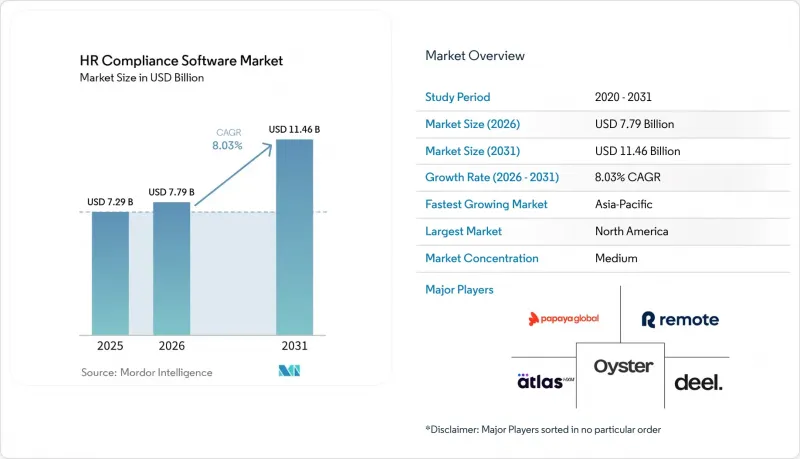
本報告按功能(例如,人力資源合規與監管管理、考勤管理合規)、部署類型(例如,雲端部署、本地部署)、企業規模(中小企業、大型企業)、最終用戶行業(例如,銀行、金融服務、保險)和地區進行細分。市場預測以美元計價。
全球人力資源合規軟體市場趨勢與洞察
跨多個司法管轄區的勞動和稅收制度日益複雜化。
到2026年,將有超過30個國家提高法定最低工資標準,在美國,30個州和地區的最低工資標準將高於聯邦最低工資標準,但各地的實施日期和計算規則各不相同。在人力資源合規軟體市場,日益重疊的義務使得管轄權追蹤不再只是偶爾的法律審查,而成為一項日常營運挑戰。根據Strada Global預測,受即時報告要求、員工分類變化和工資閾值調整等因素的影響,主要經濟體的薪資核算複雜性將在2025年達到歷史新高。隨著監管日益複雜,電子表格、提醒和諮詢顧問主導的監控成本成長速度超過了自動化成本的成長速度。這項轉變意義重大,因為人力資源合規軟體市場的買家現在不再將監管管理視為後勤部門附加功能,而是將其視為核心營運基礎設施。 Remote Research的研究表明,51%的人力資源主管將在2025年積極尋求新的整合合規平台,這主要是由於多邊監管管理的需要。
加速中小企業採用雲端運算
根據英國政府2024年的一項調查,69%的小型企業雇主正在使用科技和網路軟體來管理其業務運作。在人力資源合規軟體市場,軟體親和性的提高正在縮短雲端合規工具的銷售週期。這是因為與幾年前相比,所需的營運變更較少。 Mosey在2025年的一項調查顯示,只有37%的組織實施了專門的合規平台,而55%的組織仍然使用電子表格進行至少部分合規追蹤。這一差距表明,人力資源合規軟體市場存在巨大的轉型空間,許多公司實現了一般營運的數位化,但監管管理尚未實現。此外,Mosey報告稱,到2025年,企業在外部合規顧問、法律顧問和會計師方面的平均年度支出為25,000美元,這通常超過了SaaS訂閱的費用。 ISG在2025年的研究發現,與孤立的系統相比,完全整合的人力資源生態系統可帶來近兩倍的投資報酬率(ROI),這支持了成長型雇主整合到平台上的趨勢。
跨境資料隱私和主權問題的複雜性
人力資源合規軟體市場在跨國資料隱私方面持續面臨諸多摩擦點。這是因為GDPR並非取代各國法規,而是與各國法規進行交互,並以統一標準加以規範。這種結構使得跨國部署更加困難,因為供應商必須根據不同國家調整其儲存、傳輸和保留邏輯。德國聯邦勞動法院已明確指出,雇主若在沒有正當法律依據的情況下透過雲端人力資源系統傳輸員工數據,可能需要承擔損害賠償責任。越南首部人工智慧法於2026年3月生效,在現有的資料本地化規則基礎上,增加了對外國技術供應商的管治義務。在人力資源合規軟體市場,這些主權要求增加了基礎設施和法律成本,削弱了雲端供應商通常依賴的規模經濟效益。雇主仍然需要軟體,但往往也需要法律諮詢支持,因為不同司法管轄區的報告方法、資料保留期限和諮詢義務仍然存在差異。
細分市場分析
2025年,人力資源合規與監管管理佔銷售額的36.51%,在人力資源合規軟體市場各功能組中佔最大佔有率。這一主導地位源於其作為雇主進入新司法管轄區的基礎層的作用,因為它通常提供規則庫、提交邏輯和更新監控,後續模組才能發揮作用。此外,隨著各國政府推廣採用防篡改且更易於存取的考勤記錄,人力資源合規軟體市場對「考勤管理合規」的需求依然強勁。西班牙於2026年頒布了數位考勤登記條例,強制要求勞動監察員使用可互通的記錄。在德國,根據《社會保險程序條例》(Beitragsverfahrensverordnung),到2027年1月,工資單將全部採用電子形式,從而將考勤記錄與工資單緊密聯繫起來。
2026年,隨著美國勞工部提案廢除原有的獨立承包商規則,並以修訂後的「經濟實質測試」取而代之,「員工分類和就業合格」的重要性在人力資源合規軟體產業中迅速提升。這項變更迫使擁有眾多承包商的企業審查多個業務部門的承包商狀態、文件和審計風險。 「合規培訓和政策管理」領域也從中受益,因為快速政策創建和經律師審核的模板模型的引入,在不影響法律規制的前提下,減輕了更新的負擔。預計到2031年,福利管理和文件合規將以8.69%的複合年成長率成長,而推動這一人力資源合規軟體市場細分領域發展的,是需要以更細粒度的方式報告工資組成和福利。畢馬威指出,儘管歐盟工資透明指令要求雇主在報告中分別列出基本工資、浮動工資和福利,但一些成員國可能仍會繼續執行更嚴格的國家法規,優先考慮可配置系統而非固定模板。
到2025年,本地部署將佔總收入的57.29%,這表明人力資源合規軟體市場仍擁有大規模的部署基礎,這些部署與傳統的薪資核算和ERP系統緊密相關。這種情況反映了資料居住要求、審計追蹤連續性的需求以及整合方面的限制,而非對雲端模式缺乏興趣。 Strada Global指出,到2025年,全球近40%的公司仍將使用傳統的本地部署平台,整合難題和預算限制減緩了轉型進程。實際上,許多雇主正在採用混合模式,將敏感的薪資記錄保留在公司內部,同時將規則監控和報告工作流程遷移到供應商管理的環境中。這種折衷方案使採購公司能夠在不承擔全面遷移相關風險的情況下,對其依賴的人力資源合規軟體架構進行現代化改造,即使在法規快速變化的情況下也是如此。
預計到2031年,基於雲端的採用率將以9.41%的複合年成長率成長,成為人力資源合規軟體市場成長最快的採用模式。 ISG 2025年的一項調查顯示,全球69%的組織將以SaaS或混合雲端架構作為其人力資源技術的核心。這一點意義重大,因為合規軟體依賴頻繁的內容和規則更新,而集中式發布週期比企業主導的修補程式更容易實現這些更新。中小企業(SME)是推動這一成長的主要力量,因為它們通常缺乏基礎設施的持續投入成本,並且越來越希望合規自動化功能作為捆綁式人力資源軟體的一部分,而不是單獨購買。儘管區域隱私法規和人工智慧文件要求仍然是雲端供應商面臨的挑戰,但能夠根據本地需求最佳化資料處理的供應商正在將合規設計轉化為競爭優勢。
區域分析
2025年,北美地區佔全球銷售額的34.22%,成為人力資源合規軟體市場最大的區域。美國仍然是該市場的主要驅動力,因為各州每年修訂的勞動法超過600次,對於在多個州擁有員工的雇主而言,人工監管難以為繼。加州、紐約州、科羅拉多和康乃狄克州在薪資、假期和人工智慧招募方面的法規最為嚴格,即使在同一個國家內,合規範圍也十分廣泛。 2025年7月,Paychex收購了SixFifty,將自動化勞動法合規功能整合到其薪資核算和人力資源服務套件中,從而鞏固了其在該地區的地位。隨後,2026年2月,美國勞工部發布了關於獨立承包商的新法規草案,迫使許多雇主重新評估其分類管理,這再次激發了人們對人力資源合規軟體的興趣。
歐洲在人力資源合規軟體市場仍佔據第二大區域佔有率,其中英國、德國和法國是主要的收入來源。根據歐盟的《薪資透明指令》,擁有150名或以上員工的雇主必須在2027年6月7日前提交首份性別薪資差距報告,報告需使用2026年的員工資料。這是本輪週期中最明確的支出截止日期之一。國家法規以及歐盟標準也是至關重要的因素,例如德國勞動法院收緊了人力資源資料傳輸規則,西班牙也加強了對工時電子記錄的要求。為此,SD Worx於2026年4月在多個歐洲國家推出了「法律觀察」(Legal Watch)服務,將監管監控轉化為區域人力資源合規軟體市場的商業產品。
預計到2031年,亞太地區將以9.02%的複合年成長率成長,成為人力資源合規軟體市場成長最快的區域市場。新加坡將於2025年將其職場公平指南升級為具有法律約束力的法規;韓國將於2026年3月啟動關於在職場使用人工智慧的三方諮詢;越南將於2026年3月頒布其首部人工智慧法。 2025年12月,ADP在澳洲和紐西蘭推出了「Lyric HCM」系統,該系統具備符合公平勞動法、一鍵式薪資名冊和美國國稅局要求的設計功能,展現了供應商為各自地區進行產品本地化的努力。雖然南美洲和中東及非洲地區在人力資源合規軟體市場中所佔佔有率仍然相對較小,但巴西的勞動力數位化、阿拉伯聯合大公國的工資保障以及沙烏地阿拉伯的「沙烏地阿拉伯化」政策持續催生特定的市場需求。
其他好處:
- Excel格式的市場預測(ME)表
- 3個月的分析師支持
目錄
第1章:引言
- 研究假設和市場定義
- 調查範圍
第2章:調查方法
第3章執行摘要
第4章 市場狀況
- 市場概覽
- 市場促進因素
- 跨多個司法管轄區的勞動和稅務問題日益複雜化
- 加速中小企業採用雲端運算
- 人工智慧驅動的薪資核算錯誤檢測
- 受監管產業的人力資源數位化
- 歐盟支出用於解決工資透明度問題
- 就業中的人工智慧管治要求
- 市場限制因素
- 跨境資料隱私和主權問題的複雜性
- 從與傳統ERP系統整合的薪資核算系統切換到新系統成本很高。
- 人工智慧決策的可解釋性以及記錄保存的負擔。
- 監管政策變化的速度已經超過了廠商的產品發布週期。
- 產業價值鏈分析
- 監理情勢
- 技術展望
- 宏觀經濟因素對市場的影響
- 波特五力分析
第5章 市場規模與成長預測
- 功能性別
- 人力資源合規與監管管理
- 考勤管理合規性
- 員工福利管理與文件合規性
- 勞工分類和就業資格
- 合規培訓和政策管理
- 其他功能
- 部署模式
- 基於雲端的
- 現場
- 混合
- 按組織規模
- 小型企業
- 大公司
- 按最終用戶行業分類
- 銀行業、金融服務業及保險業
- 醫療保健和生命科學
- 資訊科技/通訊
- 製造業
- 零售與電子商務
- 政府/公共部門
- 其他終端用戶產業
- 按地區
- 北美洲
- 美國
- 加拿大
- 墨西哥
- 南美洲
- 巴西
- 阿根廷
- 智利
- 其他南美國家
- 歐洲
- 英國
- 德國
- 法國
- 義大利
- 西班牙
- 俄羅斯
- 其他歐洲國家
- 亞太地區
- 中國
- 日本
- 印度
- 韓國
- 澳洲和紐西蘭
- 其他亞太國家
- 中東
- 阿拉伯聯合大公國
- 沙烏地阿拉伯
- 土耳其
- 其他中東國家
- 非洲
- 南非
- 奈及利亞
- 其他非洲國家
- 北美洲
第6章 競爭情勢
- 市場集中度
- 策略趨勢
- 市佔率分析
- 公司簡介
- Atlas Technology Solutions, Inc.
- Cezanne HR Limited
- ComplianceHR
- Deel Inc.
- Emtrain, Inc.
- Employment Hero Pty Ltd.
- EVERYDAY SOFTWARE, SL
- Hi Bob Limited
- Mitratech Holdings, Inc.
- Multiplier Technologies Pte. Ltd.
- Namely, Inc.
- Neeyamo Enterprise Solution Private Limited
- Oyster HR, Inc.
- Papaya Global Ltd.
- PayFit SAS
- Personio SE & Co. KG
- Remote Technology Services, Inc.
- Rippling People Center Inc.
- SixFifty Technologies, LLC
- VirgilHR, Inc.
第7章 市場機會與未來展望
According to Mordor Intelligence, the HR compliance software market size is expected to increase from USD 7.29 billion in 2025 to USD 7.79 billion in 2026 and reach USD 11.46 billion by 2031, growing at a CAGR of 8.03% over 2026-2031.
This report is Segmented by Functionality (HR Compliance and Regulatory Management, Time and Attendance Compliance, and More), Deployment Mode (Cloud-Based, On-Premises, and More), Organization Size (Small and Medium-Sized Enterprises, and Large Enterprises), End-User Industry (Banking, Financial Services and Insurance, and More), and Geography. The Market Forecasts are Provided in Terms of Value (USD).
Global HR Compliance Software Market Trends and Insights
Rising Multi-Jurisdiction Labor and Tax Complexity
More than 30 countries raised statutory minimum wage floors in 2026, and the United States had 30 states plus territories with minimums above the federal floor, each with separate effective dates and calculation rules. In the HR compliance software market, the spread of overlapping obligations has made jurisdiction tracking a daily operational task rather than an occasional legal review. Strada Global reported record payroll complexity across major economies in 2025, driven by real-time reporting mandates, changes in worker classification, and revised wage thresholds. As rule sets multiply, the cost of spreadsheets, reminders, and consultant-led monitoring rises faster than the cost of automation. That shift matters because buyers in the HR compliance software market are now treating regulatory management as core operating infrastructure rather than a back-office add-on. Remote found that 51% of HR leaders were actively looking for a new integrated compliance platform in 2025, with multi-country regulatory management cited as the main reason.
Accelerating SME Cloud Adoption
The UK Government found in 2024 that 69% of SME employers were using technology or web-based software to manage business operations. In the HR compliance software market, broader software comfort shortens the sales cycle for cloud compliance tools because the operational change required is lower than it was a few years ago. Mosey found in 2025 that only 37% of organizations had a dedicated compliance platform, while 55% still used spreadsheets for at least some compliance tracking. That mismatch leaves the HR compliance software market with a large conversion pool among firms that have digitized general operations but not regulatory control. Mosey also reported average annual spending of USD 25,000 on external compliance consultants, legal advisors, and accountants in 2025, a level that often exceeds the cost of a SaaS subscription. ISG found in 2025 that fully integrated HR ecosystems delivered nearly twice the return on investment of siloed systems, which supports platform consolidation among growing employers.
Cross-Border Data Privacy and Sovereignty Complexity
The HR compliance software market faces a durable friction point in cross-border data privacy because GDPR interacts with national rules rather than replacing them with a uniform standard. That structure makes multinational deployment more difficult, since vendors must tailor storage, transfer, and retention logic by country. Germany's Federal Labor Court clarified that employers who transfer employee data through cloud-based HR systems without an adequate legal basis may face liability for damages. Vietnam's first AI law took effect in March 2026 and added governance duties for foreign technology vendors alongside existing data localization rules. In the HR compliance software market, these sovereignty requirements increase infrastructure and legal costs, weakening the scale advantage that cloud vendors typically rely on. Employers still need software, but they often need legal advisory support as well because reporting methods, retention windows, and consultation duties continue to vary across jurisdictions.
Other drivers and restraints analyzed in the detailed report include:
- AI-Driven Payroll Error Detection
- Regulated-Industry HR Digitization
- High Switching Costs From Legacy ERP-Linked Payroll
For complete list of drivers and restraints, kindly check the Table Of Contents.
Segment Analysis
HR Compliance and Regulatory Management accounted for 36.51% of revenue in 2025, giving this module the largest share of the HR compliance software market among functionality groups. Its lead came from its role as the base layer for employers entering new jurisdictions, since rule libraries, filing logic, and update monitoring are usually in place before adjacent modules add value. The HR compliance software market also saw steady demand for Time and Attendance Compliance as governments pushed for tamper-resistant and more accessible working-time records. Spain advanced a digital working-time registration decree in 2026 that required interoperable records for labor inspectors. Germany will require fully electronic wage documentation under the Beitragsverfahrensverordnung by January 2027, which keeps attendance records and payroll evidence closely linked.
Worker Classification and Employment Eligibility gained urgency in the HR compliance software industry during 2026 after the U.S. Department of Labor proposed rescinding the prior independent contractor rule and replacing it with a revised economic reality test. That change pushed organizations with large contractor pools to review status, documentation, and audit exposure across multiple business units. Compliance Training and Policy Management also benefited from faster policy generation and attorney-reviewed template models that lowered update friction without removing legal oversight. Benefits Administration and Document Compliance is projected to grow at an 8.69% CAGR through 2031, and this segment of the HR compliance software market is being driven by the need to report pay components and benefits in more disaggregated forms. KPMG noted that the EU Pay Transparency Directive requires employers to separate base pay, variable pay, and benefits in reporting, while member states may still apply stricter national rules that favor configurable systems over fixed templates.
On-premises deployment accounted for 57.29% of revenue in 2025, indicating that the HR compliance software market still has a large installed base tied to legacy payroll and ERP systems. This position reflects data residency demands, audit-trail continuity needs, and integration constraints rather than a lack of interest in cloud models. Strada Global said in 2025 that nearly 40% of global businesses remained on legacy on-premises platforms, with integration difficulty and budget pressure slowing migration. In practice, many employers are using hybrid models that keep sensitive payroll records in-house while shifting rule monitoring and reporting workflows into vendor-managed environments. That middle path lets buyers modernize the HR compliance software market architecture they depend on without taking full cutover risk during active regulatory change.
Cloud-based deployment is projected to grow at a 9.41% CAGR through 2031, making it the fastest-moving deployment model in the HR compliance software market. ISG found in 2025 that SaaS or hybrid cloud architectures formed the HR technology core for 69% of organizations globally. That matters because compliance software depends on frequent content and rules updates, which are easier to deliver through centralized release cycles than through enterprise-managed patching. SMEs are pushing much of this growth because they often lack sunk infrastructure costs and increasingly expect compliance automation as part of bundled HR software rather than as a separate purchase. Regional privacy rules and AI documentation duties still raise the bar for cloud vendors, but providers that can localize data handling are turning compliance design into a competitive advantage.
Complete Report Scope:
- By Functionality
- HR Compliance and Regulatory Management
- Time and Attendance Compliance
- Benefits Administration and Document Compliance
- Worker Classification and Employment Eligibility
- Compliance Training and Policy Management
- Other Functionalities
- By Deployment Mode
- Cloud-Based
- On-Premises
- Hybrid
- By Organization Size
- Small and Medium-Sized Enterprises
- Large Enterprises
- By End-User Industry
- Banking, Financial Services and Insurance
- Healthcare and Life Sciences
- Information Technology and Telecommunications
- Manufacturing
- Retail and E-commerce
- Government and Public Sector
- Other End-User Industries
- By Geography
- North America
- United States
- Canada
- Mexico
- South America
- Brazil
- Argentina
- Chile
- Rest of South America
- Europe
- United Kingdom
- Germany
- France
- Italy
- Spain
- Russia
- Rest of Europe
- Asia-Pacific
- China
- Japan
- India
- South Korea
- Australia and New Zealand
- Rest of Asia-Pacific
- Middle East
- United Arab Emirates
- Saudi Arabia
- Turkey
- Rest of Middle East
- Africa
- South Africa
- Nigeria
- Rest of Africa
- North America
Geography Analysis
North America accounted for 34.22% of revenue in 2025, making it the largest geography in the HR compliance software market. The United States remains the central driver because employment law changes more than 600 times each year at the state level, making manual monitoring unsustainable for employers with multi-state workforces. California, New York, Colorado, and Connecticut have enacted some of the most stringent rules on wages, leave, and AI use in employment, which keeps the compliance scope wide even within a single country. Paychex strengthened its regional position when it acquired SixFifty in July 2025 and combined employment law automation with its payroll and HR services stack. The U.S. Department of Labor then proposed a new independent contractor rule in February 2026, prompting many employers to review classification controls and sparking renewed interest in HR compliance software.
Europe remained the second-largest regional market for HR compliance software, with the United Kingdom, Germany, and France as major revenue drivers. Employers with 150 or more workers must submit their first gender pay gap reports by June 7, 2027, using 2026 workforce data under the EU Pay Transparency Directive, which has created one of the clearest spending deadlines in the current cycle. National layers matter as much as the EU baseline because Germany's labor court tightened rules on HR data transfers and Spain advanced digital working-time registration requirements. SD Worx responded in April 2026 by launching Legal Watch across several European countries, turning regulatory monitoring into a commercial product inside the regional HR compliance software market.
Asia-Pacific is projected to expand at a 9.02% CAGR through 2031, making it the fastest-growing regional segment in the HR compliance software market. Singapore moved workplace fairness from guidance to enforceable law in 2025, South Korea opened a tripartite process on AI use in workplaces in March 2026, and Vietnam enacted its first AI law, effective from March 2026. ADP extended Lyric HCM into Australia and New Zealand in December 2025 with design features tied to Fair Work, Single Touch Payroll, and Inland Revenue requirements, showing how vendors are localizing product fit for the region. South America, the Middle East, and Africa remain smaller parts of the HR compliance software market, but labor digitization in Brazil, wage protection in the UAE, and Saudization in Saudi Arabia continue to create targeted demand.
- Atlas Technology Solutions, Inc.
- Cezanne HR Limited
- ComplianceHR
- Deel Inc.
- Emtrain, Inc.
- Employment Hero Pty Ltd.
- EVERYDAY SOFTWARE, S.L.
- Hi Bob Limited
- Mitratech Holdings, Inc.
- Multiplier Technologies Pte. Ltd.
- Namely, Inc.
- Neeyamo Enterprise Solution Private Limited
- Oyster HR, Inc.
- Papaya Global Ltd.
- PayFit SAS
- Personio SE & Co. KG
- Remote Technology Services, Inc.
- Rippling People Center Inc.
- SixFifty Technologies, LLC
- VirgilHR, Inc.
Additional Benefits:
- The market estimate (ME) sheet in Excel format
- 3 months of analyst support
TABLE OF CONTENTS
1 INTRODUCTION
- 1.1 Study Assumptions and Market Definition
- 1.2 Scope of the Study
2 RESEARCH METHODOLOGY
3 EXECUTIVE SUMMARY
4 MARKET LANDSCAPE
- 4.1 Market Overview
- 4.2 Market Drivers
- 4.2.1 Rising Multi-Jurisdiction Labor and Tax Complexity
- 4.2.2 Accelerating SME Cloud Adoption
- 4.2.3 AI-Driven Payroll Error Detection
- 4.2.4 Regulated-Industry HR Digitization
- 4.2.5 EU Pay Transparency Readiness Spending
- 4.2.6 AI-In-Employment Governance Requirements
- 4.3 Market Restraints
- 4.3.1 Cross-Border Data Privacy and Sovereignty Complexity
- 4.3.2 High Switching Costs From Legacy ERP-Linked Payroll
- 4.3.3 AI Decision Explainability and Record-Retention Burden
- 4.3.4 Rule Change Velocity Outpacing Vendor Release Cycles
- 4.4 Industry Value Chain Analysis
- 4.5 Regulatory Landscape
- 4.6 Technological Outlook
- 4.7 Impact of Macroeconomic Factors on the Market
- 4.8 Porter's Five Forces Analysis
- 4.8.1 Threat of New Entrants
- 4.8.2 Bargaining Power of Buyers
- 4.8.3 Bargaining Power of Suppliers
- 4.8.4 Threat of Substitutes
- 4.8.5 Industry Rivalry
5 MARKET SIZE AND GROWTH FORECASTS (VALUE)
- 5.1 By Functionality
- 5.1.1 HR Compliance and Regulatory Management
- 5.1.2 Time and Attendance Compliance
- 5.1.3 Benefits Administration and Document Compliance
- 5.1.4 Worker Classification and Employment Eligibility
- 5.1.5 Compliance Training and Policy Management
- 5.1.6 Other Functionalities
- 5.2 By Deployment Mode
- 5.2.1 Cloud-Based
- 5.2.2 On-Premises
- 5.2.3 Hybrid
- 5.3 By Organization Size
- 5.3.1 Small and Medium-Sized Enterprises
- 5.3.2 Large Enterprises
- 5.4 By End-User Industry
- 5.4.1 Banking, Financial Services and Insurance
- 5.4.2 Healthcare and Life Sciences
- 5.4.3 Information Technology and Telecommunications
- 5.4.4 Manufacturing
- 5.4.5 Retail and E-commerce
- 5.4.6 Government and Public Sector
- 5.4.7 Other End-User Industries
- 5.5 By Geography
- 5.5.1 North America
- 5.5.1.1 United States
- 5.5.1.2 Canada
- 5.5.1.3 Mexico
- 5.5.2 South America
- 5.5.2.1 Brazil
- 5.5.2.2 Argentina
- 5.5.2.3 Chile
- 5.5.2.4 Rest of South America
- 5.5.3 Europe
- 5.5.3.1 United Kingdom
- 5.5.3.2 Germany
- 5.5.3.3 France
- 5.5.3.4 Italy
- 5.5.3.5 Spain
- 5.5.3.6 Russia
- 5.5.3.7 Rest of Europe
- 5.5.4 Asia-Pacific
- 5.5.4.1 China
- 5.5.4.2 Japan
- 5.5.4.3 India
- 5.5.4.4 South Korea
- 5.5.4.5 Australia and New Zealand
- 5.5.4.6 Rest of Asia-Pacific
- 5.5.5 Middle East
- 5.5.5.1 United Arab Emirates
- 5.5.5.2 Saudi Arabia
- 5.5.5.3 Turkey
- 5.5.5.4 Rest of Middle East
- 5.5.6 Africa
- 5.5.6.1 South Africa
- 5.5.6.2 Nigeria
- 5.5.6.3 Rest of Africa
- 5.5.1 North America
6 COMPETITIVE LANDSCAPE
- 6.1 Market Concentration
- 6.2 Strategic Moves
- 6.3 Market Share Analysis
- 6.4 Company Profiles (includes Global Level Overview, Market Level Overview, Core Segments, Financials as available, Strategic Information, Market Rank/Share, Products and Services, Recent Developments)
- 6.4.1 Atlas Technology Solutions, Inc.
- 6.4.2 Cezanne HR Limited
- 6.4.3 ComplianceHR
- 6.4.4 Deel Inc.
- 6.4.5 Emtrain, Inc.
- 6.4.6 Employment Hero Pty Ltd.
- 6.4.7 EVERYDAY SOFTWARE, S.L.
- 6.4.8 Hi Bob Limited
- 6.4.9 Mitratech Holdings, Inc.
- 6.4.10 Multiplier Technologies Pte. Ltd.
- 6.4.11 Namely, Inc.
- 6.4.12 Neeyamo Enterprise Solution Private Limited
- 6.4.13 Oyster HR, Inc.
- 6.4.14 Papaya Global Ltd.
- 6.4.15 PayFit SAS
- 6.4.16 Personio SE & Co. KG
- 6.4.17 Remote Technology Services, Inc.
- 6.4.18 Rippling People Center Inc.
- 6.4.19 SixFifty Technologies, LLC
- 6.4.20 VirgilHR, Inc.
7 MARKET OPPORTUNITIES AND FUTURE OUTLOOK
- 7.1 White-Space and Unmet-Need Assessment

 人力資源規劃軟體市場:全球市場預測,2026-2032年核心人力資源軟體市場:依模組、定價模式、人力資源營運模式、部署模式、企業規模和產業分類-2026-2032年全球市場預測
 OKR和目標管理軟體:市場佔有率分析、行業趨勢和統計數據以及成長預測(2026-2031年)缺勤管理軟體:市佔率分析、產業趨勢與統計及成長預測(2026-2031 年)北美人力資源合規軟體:市場佔有率分析、產業趨勢與統計及成長預測(2026-2031 年)員工入職前跟進和新員工入職自動化平台:市場佔有率分析、行業趨勢和統計數據以及成長預測(2026-2031 年)歐洲員工入職:市場佔有率分析、產業趨勢與統計及成長預測(2026-2031 年)核心人力資源軟體:市場佔有率分析、產業趨勢與統計、成長預測(2026-2031)
 人力資源管理軟體市場 - 全球產業規模、佔有率、趨勢、機會、預測:按部署類型、組織規模、類型、最終用戶、地區和競爭對手分類,2021-2031 年
 員工績效管理軟體市場規模、佔有率和趨勢分析報告:按組件、部署類型、企業規模、最終用途、地區和細分市場預測(2026-2033 年)