


 |
市場調查報告書
商品編碼
2073588
歐洲鉛酸蓄電池:市場佔有率分析、行業趨勢和統計數據以及成長預測(2026-2031 年)Europe Lead-acid Battery - Market Share Analysis, Industry Trends & Statistics, Growth Forecasts (2026 - 2031) |
||||||

※ 本網頁內容可能與最新版本有所差異。詳細情況請與我們聯繫。
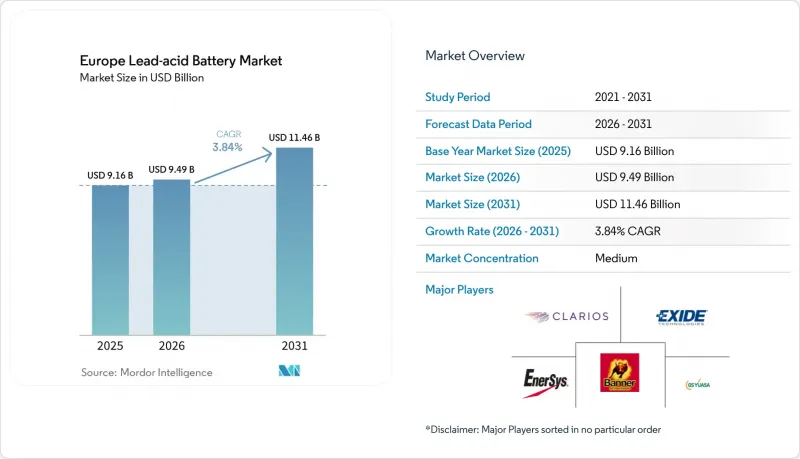
根據 Mordor Intelligence 預測,歐洲鉛酸電池市場預計將從 2025 年的 91.6 億美元成長到 2026 年的 94.9 億美元,到 2031 年達到 114.6 億美元,2026 年至 2031 年的複合年預計成長率為 3.84%。
本報告按結構類型(液壓式和閥控式鉛酸蓄電池)、應用領域(啟動、照明和點火、固定式、動力和牽引、攜帶式及其他)以及地區(德國、英國、法國、西班牙、義大利、北歐國家、俄羅斯和其他歐洲國家)進行細分。市場規模和預測均以美元計價。
歐洲鉛酸蓄電池市場趨勢與洞察
內燃機(ICE)和微混合動力汽車銷售成長
到2025年11月,內燃機和混合動力系統將佔歐洲新車註冊量的83%,這意味著歐洲仍將有大量車輛需要每4-6年更換一次輔助電池。在德國,2024年汽車產量為410萬輛,其中大部分配備了48伏特輕混系統,需要使用先進的液態電解質電池或AGM(水基吸附式電池)。在俄羅斯,2024年輕型汽車銷量為147萬輛,但電池式電動車的普及率仍低於1%,東歐地區對傳統SLI電池的需求依然強勁。在義大利,2024年電池式電動車的佔比僅為4.2%,凸顯了區域差異,而歐洲鉛酸電池市場則佔主導地位。由於歐洲車輛的平均使用壽命接近9年,因此售後市場週期較穩定。
資料中心和UPS設施的擴建
預計到2024年,歐洲資料中心容量將達到10吉瓦,並以每年8-10%的速度成長,這主要得益於雲端和邊緣營運商在法蘭克福、阿姆斯特丹、倫敦和巴黎等城市擴建設施。當備用時間少於15分鐘且成本限制超過了鋰離子電池的能量密度優勢時,閥控式鉛酸電池(VRLA)仍佔UPS部署的約80%。通訊業者營運約50萬個基地台,並計畫在2025年新增10萬個5G小型基地台。每個小型基地台都依賴48伏特的VRLA電池組,該電池組能夠抵抗溫度波動。新型純鉛酸AGM電池設計可在部分充電狀態下運作可將循環壽命延長20%,進而降低業者的整體成本。對於支援對延遲敏感型工作負載的邊緣資料中心而言,無需主動通風的封閉式設備是更好選擇。
鋰離子電池成本的快速下降
2023年,鋰離子電池組的價格跌破每千瓦時140美元,預計到2030年還將再下降40%,這將縮小其與閥控式鉛酸蓄電池(VRLA)在許多固定式應用領域的總擁有成本(TCO)差距。法蘭克福和阿姆斯特丹的超大規模營運商已在新建設中指定使用鋰離子備用電源,以實現15年的使用壽命和80%的放電深度。西班牙計畫興建的10.5吉瓦公用事業規模電池儲能專案主要針對2-4小時的能源轉換,幾乎全部採用鋰離子電池。這使得鉛酸電池的應用範圍僅限於短時應用。碳酸鋰價格的急劇下跌削弱了先前支撐歐洲鉛酸電池市場的材料成本優勢。儘管如此,由於鉛酸電池在寒冷氣候下的性能以及在回收方面的領先地位,它們仍然擁有穩固的市場佔有率。
細分市場分析
到2025年,液態電池將佔總銷量的63.8%,這主要得益於注重成本的汽車售後市場買家,他們每四到六年就會更換一次SLI(同步感應式混合動力)電池。 VRLA(閥控式鉛酸蓄電池),包括AGM和膠體電池,正以每年6.1%的速度成長,因為通訊業者和資料中心優先考慮封閉式運作和降低通風需求。在液態電池技術領域,鈣銀柵格技術的不斷改進,將微混合動力怠速熄火系統的壽命延長至30萬次循環。 AGM電池目前已佔高階SLI需求的25%,並受惠於Clarios在漢諾威、茨維考和西班牙投資2億歐元新建的產能。膠體電池雖然產量較小,但在太陽能儲存和船舶領域,其市場佔有率正在不斷擴大,因為其抗震性和深度放電性能使其較高的價格物有所值。
在德國、荷蘭和法國的物流中心,先進的電解式鉛酸電池仍然在堆高機領域佔據穩固地位,這些堆高機依賴現有的充電室。歐盟「85%回收率」的要求對這兩種電池結構類型均不構成障礙,因為歐洲鉛酸電池市場的回收率已達到99%,而鋰離子電池回收商仍處於規模化發展的初期階段。
其他好處:
- Excel格式的市場預測(ME)表
- 3個月的分析師支持
目錄
第1章:引言
- 研究假設和市場定義
- 調查範圍
第2章:調查方法
第3章執行摘要
第4章 市場狀況
- 市場概覽
- 市場促進因素
- 內燃機汽車和微混合動力汽車的銷售成長
- 資料中心和UPS部署的擴展
- 歐盟指令,旨在促進住宅太陽能發電和儲能系統
- 倉儲自動化正在推高電力需求。
- 鉛酸電池和碳電池在部分充電狀態的進展
- 歐盟循環經濟法規將回收率提升至99%。
- 市場限制因素
- 鋰離子電池化學成分成本的快速下降
- 嚴格的鉛排放法規和合規成本
- 高純度原鉛精礦供應緊張
- 原始設備製造商正在擴大試用固體起動電池。
- 供應鏈分析
- 監理情勢
- 技術展望
- 波特五力模型
第5章 市場規模與成長預測
- 透過施工方法
- Flooded
- VRLA
- 透過使用
- 啟動、照明和點火 (SLI)
- 固定式
- 動力/驅動系統(堆高機、高爾夫球車)
- 可攜式及其他
- 按地區
- 德國
- 英國
- 法國
- 西班牙
- 義大利
- 北歐國家
- 俄羅斯
- 其他歐洲國家
第6章 競爭情勢
- 市場集中度
- 策略趨勢(併購、聯盟、購電協議)
- 市場佔有率分析(主要公司的市場排名和佔有率)
- 公司簡介
- Clarios(Johnson Controls Power Solutions)
- Exide Technologies
- GS Yuasa Corp.
- EnerSys
- Robert Bosch GmbH
- Amara Raja Batteries Ltd
- Leoch International
- BAE Batterien GmbH
- Banner GmbH
- FIAMM Energy Technology
- Hoppecke Batteries
- Saft Batteries
- Midac SpA
- Exmet Industries
- TAB dd
- Monbat AD
- Akkumulatorenfabrik MOLL
- C&D Technologies
- Narada Power
- NorthStar Battery
第7章 市場機會與未來展望
According to Mordor Intelligence, the europe lead-acid battery market size is expected to increase from USD 9.16 billion in 2025 to USD 9.49 billion in 2026 and reach USD 11.46 billion by 2031, growing at a CAGR of 3.84% over 2026-2031.
This report is Segmented by Construction Method (Flooded and VRLA), Application (Starting-Lighting-Ignition, Stationary, Motive/Traction, and Portable and Others), and Geography (Germany, United Kingdom, France, Spain, Italy, NORDIC Countries, Russia, and Rest of Europe). The Market Sizes and Forecasts are Provided in Terms of Value (USD).
Europe Lead-acid Battery Market Trends and Insights
Rising Sales of ICE and Micro-hybrid Vehicles
Internal-combustion and hybrid drivetrains represented 83% of European new-car registrations through November 2025, preserving a wide installed base that must replace auxiliary batteries every 4-6 years. Germany produced 4.1 million vehicles in 2024, most of which integrate 48-volt mild-hybrid systems needing advanced flooded or absorbed-glass-mat (AGM) units. Russia's 1.47 million light-vehicle sales in 2024 showed battery-electric penetration below 1%, extending demand for conventional SLI batteries across Eastern Europe. Italy reported only a 4.2% battery-electric share in 2024, highlighting regional divergence that benefits the European lead-acid battery market. A fleet age near nine years across the continent sustains predictable aftermarket cycles.
Expanding Data-center and UPS Installations
European data-center capacity reached 10 GW in 2024 and is growing 8-10% annually as cloud and edge operators scale facilities in Frankfurt, Amsterdam, London, and Paris. Valve-regulated lead-acid (VRLA) batteries still dominate roughly 80% of UPS deployments where backup duration is under 15 minutes and cost discipline outweighs lithium-ion's energy-density advantage. Telecom carriers operate about 500,000 tower sites and will add 100,000 5G small cells by 2025, each relying on 48-volt VRLA strings tolerant of temperature swings. New pure-lead AGM designs extend cycle life by 20% in partial-state-of-charge duty, reducing total cost for operators. Edge data centers that support latency-sensitive workloads favor sealed units requiring no active ventilation.
Rapid Cost Decline of Lithium-ion Chemistries
Lithium-ion pack prices slipped below USD 140 per kWh in 2023 and are set to fall another 40% by 2030, narrowing the total-cost-of-ownership gap with VRLA in many stationary uses. Hyperscale operators in Frankfurt and Amsterdam already specify lithium-ion backup for new builds to gain 15-year life and 80% depth of discharge. Spain's 10.5 GW utility-scale battery pipeline is almost entirely lithium-ion for two-to-four-hour energy-shifting projects, sidelining lead-acid to shorter-duration roles. Plunging lithium-carbonate prices removed a materials-cost advantage that previously supported the European lead-acid battery market. Even so, cold-weather performance and recycling leadership preserve defensible niches.
Other drivers and restraints analyzed in the detailed report include:
- EU Directives Driving Residential Solar-plus-storage
- Warehouse Automation Boosting Motive-power Demand
- Stringent Lead-emission Limits and Compliance Costs
For complete list of drivers and restraints, kindly check the Table Of Contents.
Segment Analysis
Flooded products delivered 63.8% revenue in 2025, thanks to cost-focused automotive aftermarket buyers who replace SLI units every four to six years. VRLA, encompassing AGM and gel types, is growing 6.1% annually as telecom carriers and data centers prioritize sealed operation and reduced ventilation demands. Flooded technology continues to refine calcium-silver grids that extend micro-hybrid start-stop life to 300,000 cycles. AGM already holds 25% of premium SLI demand and benefits from EUR 200 million of new capacity added by Clarios in Hanover, Zwickau, and Spain. Gel variants, though smaller in absolute volume, win share in solar-storage and marine segments where vibration resistance and deep-discharge capability justify higher price points.
Advanced flooded traction batteries remain entrenched in forklifts across German, Dutch, and French logistics hubs that rely on established charging rooms. The EU's 85% recycled-content mandate poses no hurdle to either construction type because the European lead-acid battery market already meets a 99% collection and recycling rate, whereas lithium-ion recyclers remain in early scale-up stages.
Complete Report Scope:
- By Construction Method
- Flooded
- VRLA
- By Application
- Starting-Lighting-Ignition (SLI)
- Stationary
- Motive/Traction (Forklifts, Golf-carts)
- Portable and Others
- By Geography
- Germany
- United Kingdom
- France
- Spain
- Italy
- NORDIC Countries
- Russia
- Rest of Europe
List of Companies Covered in this Report:
- Clarios (Johnson Controls Power Solutions)
- Exide Technologies
- GS Yuasa Corp.
- EnerSys
- Robert Bosch GmbH
- Amara Raja Batteries Ltd
- Leoch International
- BAE Batterien GmbH
- Banner GmbH
- FIAMM Energy Technology
- Hoppecke Batteries
- Saft Batteries
- Midac SpA
- Exmet Industries
- TAB d.d.
- Monbat AD
- Akkumulatorenfabrik MOLL
- C&D Technologies
- Narada Power
- NorthStar Battery
Additional Benefits:
- The market estimate (ME) sheet in Excel format
- 3 months of analyst support
TABLE OF CONTENTS
1 Introduction
- 1.1 Study Assumptions & Market Definition
- 1.2 Scope of the Study
2 Research Methodology
3 Executive Summary
4 Market Landscape
- 4.1 Market Overview
- 4.2 Market Drivers
- 4.2.1 Rising sales of ICE & micro-hybrid vehicles
- 4.2.2 Expanding data-center & UPS installations
- 4.2.3 EU directives driving residential solar-plus-storage
- 4.2.4 Warehouse automation boosting motive-power demand
- 4.2.5 Partial-state-of-charge lead-carbon advances
- 4.2.6 EU circular-economy rules favouring 99% recyclability
- 4.3 Market Restraints
- 4.3.1 Rapid cost decline of Li-ion chemistries
- 4.3.2 Stringent lead-emission limits & compliance costs
- 4.3.3 Tight supply of high-purity primary lead concentrate
- 4.3.4 Growing OEM trials of solid-state starter batteries
- 4.4 Supply-Chain Analysis
- 4.5 Regulatory Landscape
- 4.6 Technological Outlook
- 4.7 Porter's Five Forces
- 4.7.1 Bargaining Power of Suppliers
- 4.7.2 Bargaining Power of Consumers
- 4.7.3 Threat of New Entrants
- 4.7.4 Threat of Substitutes
- 4.7.5 Intensity of Competitive Rivalry
5 Market Size & Growth Forecasts
- 5.1 By Construction Method
- 5.1.1 Flooded
- 5.1.2 VRLA
- 5.2 By Application
- 5.2.1 Starting-Lighting-Ignition (SLI)
- 5.2.2 Stationary
- 5.2.3 Motive/Traction (Forklifts, Golf-carts)
- 5.2.4 Portable and Others
- 5.3 By Geography
- 5.3.1 Germany
- 5.3.2 United Kingdom
- 5.3.3 France
- 5.3.4 Spain
- 5.3.5 Italy
- 5.3.6 NORDIC Countries
- 5.3.7 Russia
- 5.3.8 Rest of Europe
6 Competitive Landscape
- 6.1 Market Concentration
- 6.2 Strategic Moves (M&A, Partnerships, PPAs)
- 6.3 Market Share Analysis (Market Rank/Share for key companies)
- 6.4 Company Profiles (includes Global level Overview, Market level overview, Core Segments, Financials as available, Strategic Information, Products & Services, and Recent Developments)
- 6.4.1 Clarios (Johnson Controls Power Solutions)
- 6.4.2 Exide Technologies
- 6.4.3 GS Yuasa Corp.
- 6.4.4 EnerSys
- 6.4.5 Robert Bosch GmbH
- 6.4.6 Amara Raja Batteries Ltd
- 6.4.7 Leoch International
- 6.4.8 BAE Batterien GmbH
- 6.4.9 Banner GmbH
- 6.4.10 FIAMM Energy Technology
- 6.4.11 Hoppecke Batteries
- 6.4.12 Saft Batteries
- 6.4.13 Midac SpA
- 6.4.14 Exmet Industries
- 6.4.15 TAB d.d.
- 6.4.16 Monbat AD
- 6.4.17 Akkumulatorenfabrik MOLL
- 6.4.18 C&D Technologies
- 6.4.19 Narada Power
- 6.4.20 NorthStar Battery
7 Market Opportunities & Future Outlook
- 7.1 White-space & Unmet-need Assessment

 鉛酸蓄電池市場:按類型、電壓範圍、電池結構、功能、應用和銷售管道分類-2026-2032年全球市場預測
 固定式鉛酸蓄電池:市場佔有率分析、產業趨勢與統計及成長預測(2026-2031 年)鉛酸蓄電池(LAB):市場佔有率分析、行業趨勢和統計數據以及成長預測(2026-2031 年)
 摩托車鉛酸蓄電池市場分析與預測(至2035年):類型、產品、技術、組件、應用、最終用戶、功能、安裝類型、解決方案
 2026-2030年全球工業用鉛酸蓄電池市場
 2026-2032年歐洲乘用車鉛酸蓄電池售後市場
 VRLA電池市場機會、成長促進因素、產業趨勢分析及2026-2035年預測
 VRLA電池市場規模、佔有率和成長分析:按類型、電壓、容量、應用、最終用戶、銷售管道和地區分類-2026-2033年產業預測北美鉛酸蓄電池市場:市場佔有率分析、行業趨勢和統計數據以及成長預測(2026-2031 年)VRLA電池:市佔率分析、產業趨勢與統計、成長預測(2026-2031年)