


 |
市場調查報告書
商品編碼
2072616
VRLA電池:市佔率分析、產業趨勢與統計、成長預測(2026-2031年)VRLA Battery - Market Share Analysis, Industry Trends & Statistics, Growth Forecasts (2026 - 2031) |
||||||

※ 本網頁內容可能與最新版本有所差異。詳細情況請與我們聯繫。
根據 Mordor Intelligence 預測,VRLA 電池市場預計將從 2025 年的 468.4 億美元成長到 2026 年的 490.9 億美元,到 2031 年達到 609.7 億美元,2026 年至 2031 年的複合年成長率為 4.43%。
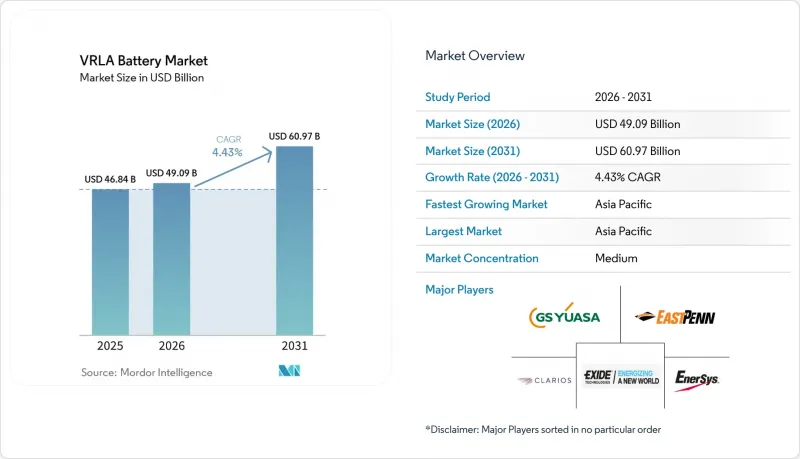
本報告按類型(AGM、凝膠、TPPL、混合凝膠/AGM)、應用(UPS、通訊和資料中心、儲能、汽車、工業、間歇照明、醫療設備)、最終用戶(住宅、商業、工業、公共產業)和地區(北美、歐洲、亞太、南美、中東和非洲)進行細分。市場預測以美元計價。
全球VRLA電池市場趨勢與洞察
電信基礎設施對可靠備用電源的需求日益成長
小型基地台的部署需要2-4小時的自主運作,但必須避免鋰離子電池帶來的火災風險。由於鋰離子電池的授權流程較為複雜,AGM VRLA(吸附式玻璃纖維隔板閥控鉛酸)電池仍是首選方案。這是因為AGM電池無需主動冷卻,並且在人口密集的都市區可以降低保險成本。在印度,鐵塔業者採用5年AGM電池更換週期,以避免鋰電池的溫度控管成本。非洲的18,000個離網站也採用了這種方法,將VRLA電池與太陽能發電系統結合,以最大限度地減少柴油發電機的使用。開放式無線存取網(Open RAN)架構也受益於緊湊的VRLA電池配置,但西歐的先導計畫表明,到2028年,在電網穩定的市場中,鋰電池可能會改變這一趨勢。
在二、三線城市擴展邊緣資料中心和UPS
對延遲敏感的應用正逐漸轉移到運算能力較低的小規模設施,通常使用 10-50kW 的 UPS 系統。對於一個 20kW 的邊緣站點,AGM VRLA 電池的成本約為 8,000 美元,而同等容量的鋰離子電池則需 14,000 美元。 VRLA 電池也避免了電池管理的複雜性,這會使安裝工作量增加 30%。然而,當機架空間有限時,這種趨勢會改變。採用能量密度高三倍的鋰離子電池可以騰出更多用於創造收益的伺服器占地面積。預計在 2027 年後,當鋰離子電池組的價格降至每千瓦時 100 美元以下時,這一趨勢將進一步加速發展。
磷酸鐵鋰電池組價格大幅下降。
由於供應過剩,2025年上半年中國磷酸鐵鋰電池組的價格每噸下降了3000多元人民幣,使其與閥控式鉛酸蓄電池(VRLA)在三年運作週期內的成本差距縮小至個位數。邊緣資料中心營運商現在願意支付10-15%的溢價,因為鋰電池可以節省60-70%的機架空間,這直接轉化為更高的託管收入。在越南,電動摩托車製造商計劃在2025年將鉛酸蓄電池的使用量減少85%,凸顯了替代風險。然而,由於循環壽命認證,固定式磷酸鐵鋰電池的價格仍然比鉛酸蓄電池高出25-30%,並且在95%的電池壽命都處於浮充狀態的應用場景中,其價格仍然與閥控式鉛酸蓄電池具有競爭力。
細分市場分析
由於在UPS系統和通訊機櫃中的廣泛應用,AGM技術預計在2025年將佔總銷售額的63.3%。混合凝膠/AGM電池目前佔據9.8%的市場佔有率,但正以7.8%的複合年成長率成長,這主要得益於市場對在溫度高達55 度C的環境下擁有12-15年浮充壽命電池的需求。 TPPL瞄準企業資料中心和鐵路號誌系統等高階細分市場,透過提供15-20年的使用壽命(價格溢價30-40%)來延長更換週期。
成本因素在市場區隔中起著至關重要的作用。一顆12V 100Ah的AGM電池售價約200美元,比混合膠體電池便宜約25%。然而,AGM電池有熱衰減問題,在溫度高於45 度C時,其壽命會減半。 FIAMM公司於2026年推出的「Pure Guard」技術,導致混合膠體電池的需求下降了20%,並縮小了外形規格的差距。 EnerSys公司已將物聯網感測器整合到TPPL電池組中,以實現預測性維護,從而解決因不當補充電解液而導致的VRLA電池過早失效(佔總量的18-22%)問題。隨著數位護照的即將實施,TPPL和混合膠體電池等具有穩定健康狀態(SoH)的化學電池有望進一步擴大市場佔有率。
區域分析
預計到2025年,亞太地區將佔全球銷售額的43.1%,並在2031年之前維持5.1%的複合年成長率。中國繼續保持其在通用AGM電池出口領域的主導地位,而印度則透過住宅UPS系統的銷售推動國內市場成長。東協市場的情況則較為複雜。在越南,鉛酸電池仍佔摩托車市場85%的佔有率,但在泰國,政府補貼已將鉛酸電池和鋰離子電池之間的成本差距縮小至個位數。
在北美,超大規模資料中心營運商正在將現有企業設施升級為TPPL電池,同時優先考慮為新建邊緣設施採用鋰離子電池。 2025會計年度,EnerSys公司透過45X條款稅額扣抵,用於支持美國國內TPPL電池的生產,並減少對亞洲供應鏈的依賴。然而,隨著這些稅額扣抵將於2032年到期,人們對未來的擔憂日益加劇。
在歐洲,歐盟電池法規為企業帶來了挑戰。雖然這些法規提高了單位成本,但也為擁有閉合迴路回收系統的現有企業帶來了競爭優勢。合規要求使逆向物流成本增加了12%至15%,影響了整體盈利。
在中國,隨著鋰離子電池在都市區資料中心的普及,國內VRLA電池市場趨於穩定。面向出口的製造商正專注於混合凝膠電池和TPPL電池,以期抓住中東和非洲的高利潤商機。
在印度,預計到2025年,邊緣資料中心容量將增加180兆瓦,其中68%的部署將採用AGM VRLA電池,因為其耐用性和電網相容性更佳。在東協,鉛酸電池仍佔越南電動摩托車市場85%的佔有率,而政府補貼正在加速印尼和泰國鋰離子電池的普及。
其他好處
- Excel格式的市場預測(ME)表
- 3個月的分析師支持
目錄
第1章:引言
- 研究假設和市場定義
- 調查範圍
第2章:調查方法
第3章執行摘要
第4章 市場狀況
- 市場概覽
- 市場促進因素
- 電信基礎設施對可靠的間歇式電源的需求日益成長。
- 二、三線城市資料中心與UPS的擴張
- 需要低資本支出儲能可再生能源微電網
- 與運作為 3 年或更短的鋰離子電池相比,具有成本優勢。
- 東協和非洲的微出行熱潮
- 針對55 度C氣候條件設計的混合凝膠型VRLA
- 市場限制因素
- 磷酸鐵鋰電池組價格大幅下降。
- 鉛價波動和嚴格的回收指令
- 用於邊緣UPS(10千瓦或以下)的優質機架空間
- 由於對維護方面的誤解而導致的過早失效
- 供應鏈分析
- 監理情勢
- 技術展望
- 波特五力模型
第5章 市場規模與成長預測
- 按類型
- 吸收式玻璃纖維隔板(AGM)
- 凝膠
- 薄板純鉛(TPPL)
- 混合凝膠/AGM
- 透過使用
- 不斷電系統(UPS)
- 通訊和資料中心
- 儲能
- 汽車和運輸業
- 工業的
- 間斷照明
- 醫療設備和玩具
- 最終用戶
- 住宅
- 商業的
- 產業
- 公共產業
- 按地區
- 北美洲
- 美國
- 加拿大
- 墨西哥
- 歐洲
- 德國
- 英國
- 法國
- 義大利
- 北歐國家
- 俄羅斯
- 其他歐洲國家
- 亞太地區
- 中國
- 印度
- 日本
- 韓國
- ASEAN
- 其他亞太國家
- 南美洲
- 巴西
- 阿根廷
- 其他南美國家
- 中東和非洲
- 沙烏地阿拉伯
- 阿拉伯聯合大公國
- 南非
- 埃及
- 其他中東和非洲國家
- 北美洲
第6章 競爭情勢
- 市場集中度
- 策略趨勢(併購、聯盟、購電協議)
- 市場佔有率分析(主要公司的市場排名和佔有率)
- 公司簡介
- GS Yuasa Corporation
- Panasonic Corporation
- Exide Technologies
- EnerSys
- C&D Technologies
- Clarios
- East Penn Manufacturing
- Leoch International
- Amara Raja Batteries
- Haze Battery Company
- Narada Power Source
- Vision Group
- Koyo Battery
- BB Battery
- FIAMM Energy Technology
- Saft(TotalEnergies)
- HOPPECKE Batterien
- Trojan Battery
- NorthStar Battery
- Eternity Technologies
- 其他主要參與企業
第7章 市場機會與未來展望
According to Mordor Intelligence, the VRLA battery market size is expected to increase from USD 46.84 billion in 2025 to USD 49.09 billion in 2026 and reach USD 60.97 billion by 2031, growing at a CAGR of 4.43% over 2026-2031.
This report is Segmented by Type (AGM, Gel, TPPL, Hybrid-Gel/AGM), Application (UPS, Telecom & Data Centers, Energy Storage, Automotive, Industrial, Emergency Lighting, Medical Devices), End-User (Residential, Commercial, Industrial, Utilities), and Geography (North America, Europe, Asia-Pacific, South America, Middle East and Africa). Market Forecasts are Provided in Value (USD).
Global VRLA Battery Market Trends and Insights
Rising demand for reliable back-up power in telecom infrastructure
Small-cell 5G deployments require 2-4 hours of autonomy without the fire-risk profile associated with lithium-ion batteries, which complicates permitting processes. AGM VRLA (Absorbent Glass Mat Valve-Regulated Lead-Acid) batteries remain the preferred choice as they eliminate the need for active cooling and reduce insurance costs in densely populated urban areas. In India, tower operators adopt five-year AGM replacement cycles to avoid the thermal management expenses of lithium batteries. This approach is similarly observed across 18,000 off-grid sites in Africa, where solar arrays are paired with VRLA batteries to minimize diesel generator usage. Open RAN architectures also benefit from compact VRLA battery configurations; however, pilot projects in Western Europe indicate that lithium batteries could challenge this preference in stable-grid markets by 2028.
Edge Data-Center & UPS Build-Outs in Tier-2/3 Cities
Latency-sensitive applications are shifting compute capacity to smaller facilities, which typically utilize 10-50 kW UPS systems. A 20 kW edge site incurs approximately USD 8,000 for AGM VRLA batteries compared to USD 14,000 for equivalent lithium-ion batteries, while also avoiding the added battery-management complexity that increases installation labor by 30%. However, the preference shifts when rack space becomes limited; lithium-ion batteries, with their threefold energy density, free up floor space for revenue-generating servers. This shift is anticipated to gain momentum once lithium-ion pack prices fall below USD 100/kWh, projected after 2027.
Rapid price decline of LFP battery packs
Overcapacity led to a reduction in Chinese LFP pack prices by more than CNY 3,000 per ton in the first half of 2025, narrowing the cost difference with VRLA batteries to single digits for three-year duty cycles. Edge data center operators are now willing to pay a 10-15% premium for lithium batteries due to their ability to save 60-70% of rack space, which can be directly translated into increased colocation revenue. In Vietnam, electric two-wheeler OEMs reduced lead-acid battery usage to 85% in 2025, highlighting the risk of substitution. However, stationary-grade LFP batteries continue to command a 25-30% premium due to cycle-life certifications, maintaining VRLA's competitiveness in applications where batteries spend 95% of their lifespan in float mode.
Other drivers and restraints analyzed in the detailed report include:
- Renewable Micro-Grids Needing Low-CAPEX Storage
- Cost Advantage Versus Lithium-Ion for <= 3-Year Duty Cycles
- Lead Price Volatility & Stringent Recycling Directives
For complete list of drivers and restraints, kindly check the Table Of Contents.
Segment Analysis
AGM technology accounted for 63.3% of the projected 2025 revenue, driven by its widespread use in UPS systems and telecom cabinets. Hybrid-Gel/AGM currently holds a 9.8% revenue share but is growing at a compound annual growth rate (CAGR) of 7.8%, supported by demand for 12-15-year float life in environments with temperatures reaching 55 °C. TPPL caters to premium niche markets, including enterprise data centers and rail signaling, offering 15-20-year lifespans at a 30-40% price premium, which extends replacement intervals.
Cost considerations play a significant role in market segmentation. A 12 V 100 Ah AGM unit is priced at approximately USD 200, about 25% less than Hybrid-Gel. However, AGM batteries experience thermal derating, which reduces their lifespan by half in temperatures exceeding 45 °C. FIAMM's 2026 Pure Guard launch led to a 20% reduction in Hybrid-Gel volume, narrowing the form-factor gap with lithium batteries. EnerSys has integrated IoT sensors into TPPL battery packs, enabling predictive maintenance to address the 18-22% of premature VRLA failures caused by inadequate topping-up practices. With the upcoming digital passport requirement, chemistries with stable state-of-health profiles, such as TPPL and Hybrid-Gel, are positioned to capture additional market share.
Complete Report Scope:
- By Type
- Absorbent Glass Mat (AGM)
- Gel
- Thin-Plate Pure Lead (TPPL)
- Hybrid-Gel/AGM
- By Application
- Uninterruptible Power Supply (UPS)
- Telecom and Data Centers
- Energy Storage Systems
- Automotive and Transportation
- Industrial Equipment
- Emergency Lighting
- Medical Devices and Toys
- By End-user
- Residential
- Commercial
- Industrial
- Utilities
- By Geography
- North America
- United States
- Canada
- Mexico
- Europe
- Germany
- United Kingdom
- France
- Italy
- NORDIC Countries
- Russia
- Rest of Europe
- Asia-Pacific
- China
- India
- Japan
- South Korea
- ASEAN Countries
- Rest of Asia-Pacific
- South America
- Brazil
- Argentina
- Rest of South America
- Middle East and Africa
- Saudi Arabia
- United Arab Emirates
- South Africa
- Egypt
- Rest of Middle East and Africa
- North America
Geography Analysis
In 2025, the Asia-Pacific region accounted for 43.1% of global revenue and is projected to grow at a 5.1% CAGR through 2031. China remains a leader in commodity AGM exports, while India drives domestic growth through residential UPS sales. ASEAN markets show a mixed landscape: Vietnam's two-wheeler market remains 85% lead-acid, whereas Thai government subsidies have reduced the cost gap between lead-acid and lithium-ion batteries to single digits.
In North America, hyperscale data center operators are retrofitting enterprise facilities with TPPL batteries while favoring lithium-ion for new edge builds. Section 45X tax credits allocated USD 184.6 million to EnerSys in FY2025, supporting domestic TPPL production and mitigating reliance on Asian supply chains. However, the expiration of these credits in 2032 raises future concerns.
Europe faces challenges from the EU Battery Regulation, which has increased per-unit costs but also created competitive advantages for established players with closed-loop recycling systems. Reverse-logistics costs have risen by 12-15% due to compliance requirements, impacting overall profitability.
China's VRLA market is stabilizing domestically as lithium-ion batteries gain popularity in urban data centers. Export-oriented manufacturers are focusing on Hybrid-Gel and TPPL variants to capture higher-margin opportunities in the Middle East and Africa.
India added 180 MW of edge data center capacity in 2025, with 68% of installations specifying AGM VRLA batteries due to their durability and compatibility with the grid. In ASEAN, Vietnam's electric two-wheeler market remains predominantly lead-acid at 85%, while Indonesia and Thailand are accelerating lithium-ion adoption through government subsidies.
- GS Yuasa Corporation
- Panasonic Corporation
- Exide Technologies
- EnerSys
- C&D Technologies
- Clarios
- East Penn Manufacturing
- Leoch International
- Amara Raja Batteries
- Haze Battery Company
- Narada Power Source
- Vision Group
- Koyo Battery
- B.B. Battery
- FIAMM Energy Technology
- Saft ( TotalEnergies )
- HOPPECKE Batterien
- Trojan Battery
- NorthStar Battery
- Eternity Technologies
- Other Notable Players
Additional Benefits:
- The market estimate (ME) sheet in Excel format
- 3 months of analyst support
TABLE OF CONTENTS
1 Introduction
- 1.1 Study Assumptions & Market Definition
- 1.2 Scope of the Study
2 Research Methodology
3 Executive Summary
4 Market Landscape
- 4.1 Market Overview
- 4.2 Market Drivers
- 4.2.1 Rising demand for reliable back-up power in telecom infrastructure
- 4.2.2 Data-center & UPS build-outs in Tier-2/3 cities
- 4.2.3 Renewable micro-grids needing low-CAPEX storage
- 4.2.4 Cost advantage vs. lithium-ion for <= 3-yr duty cycles
- 4.2.5 Micro-mobility boom in ASEAN & Africa
- 4.2.6 Hybrid-gel VRLA designs for 55 °C climates
- 4.3 Market Restraints
- 4.3.1 Rapid price decline of LFP battery packs
- 4.3.2 Lead price volatility & stringent recycling directives
- 4.3.3 Rack-space premium in edge UPS (Below 10 kW)
- 4.3.4 Premature failures due to maintenance myths
- 4.4 Supply-Chain Analysis
- 4.5 Regulatory Landscape
- 4.6 Technological Outlook
- 4.7 Porter's Five Forces
- 4.7.1 Threat of New Entrants
- 4.7.2 Bargaining Power of Buyers
- 4.7.3 Bargaining Power of Suppliers
- 4.7.4 Threat of Substitutes
- 4.7.5 Competitive Rivalry
5 Market Size & Growth Forecasts
- 5.1 By Type
- 5.1.1 Absorbent Glass Mat (AGM)
- 5.1.2 Gel
- 5.1.3 Thin-Plate Pure Lead (TPPL)
- 5.1.4 Hybrid-Gel/AGM
- 5.2 By Application
- 5.2.1 Uninterruptible Power Supply (UPS)
- 5.2.2 Telecom and Data Centers
- 5.2.3 Energy Storage Systems
- 5.2.4 Automotive and Transportation
- 5.2.5 Industrial Equipment
- 5.2.6 Emergency Lighting
- 5.2.7 Medical Devices and Toys
- 5.3 By End-user
- 5.3.1 Residential
- 5.3.2 Commercial
- 5.3.3 Industrial
- 5.3.4 Utilities
- 5.4 By Geography
- 5.4.1 North America
- 5.4.1.1 United States
- 5.4.1.2 Canada
- 5.4.1.3 Mexico
- 5.4.2 Europe
- 5.4.2.1 Germany
- 5.4.2.2 United Kingdom
- 5.4.2.3 France
- 5.4.2.4 Italy
- 5.4.2.5 NORDIC Countries
- 5.4.2.6 Russia
- 5.4.2.7 Rest of Europe
- 5.4.3 Asia-Pacific
- 5.4.3.1 China
- 5.4.3.2 India
- 5.4.3.3 Japan
- 5.4.3.4 South Korea
- 5.4.3.5 ASEAN Countries
- 5.4.3.6 Rest of Asia-Pacific
- 5.4.4 South America
- 5.4.4.1 Brazil
- 5.4.4.2 Argentina
- 5.4.4.3 Rest of South America
- 5.4.5 Middle East and Africa
- 5.4.5.1 Saudi Arabia
- 5.4.5.2 United Arab Emirates
- 5.4.5.3 South Africa
- 5.4.5.4 Egypt
- 5.4.5.5 Rest of Middle East and Africa
- 5.4.1 North America
6 Competitive Landscape
- 6.1 Market Concentration
- 6.2 Strategic Moves (M&A, Partnerships, PPAs)
- 6.3 Market Share Analysis (Market Rank/Share for key companies)
- 6.4 Company Profiles (includes Global level Overview, Market level overview, Core Segments, Financials as available, Strategic Information, Products & Services, and Recent Developments)
- 6.4.1 GS Yuasa Corporation
- 6.4.2 Panasonic Corporation
- 6.4.3 Exide Technologies
- 6.4.4 EnerSys
- 6.4.5 C&D Technologies
- 6.4.6 Clarios
- 6.4.7 East Penn Manufacturing
- 6.4.8 Leoch International
- 6.4.9 Amara Raja Batteries
- 6.4.10 Haze Battery Company
- 6.4.11 Narada Power Source
- 6.4.12 Vision Group
- 6.4.13 Koyo Battery
- 6.4.14 B.B. Battery
- 6.4.15 FIAMM Energy Technology
- 6.4.16 Saft ( TotalEnergies )
- 6.4.17 HOPPECKE Batterien
- 6.4.18 Trojan Battery
- 6.4.19 NorthStar Battery
- 6.4.20 Eternity Technologies
- 6.4.21 Other Notable Players
7 Market Opportunities & Future Outlook
- 7.1 White-space & Unmet-Need Assessment

 閥控式鉛酸蓄電池(VRLA)市場報告:趨勢、預測與競爭分析(至2035年)
 固定式電池市場-2026-2032年全球市場預測閥控式鉛酸蓄電池(VRLA)市場:依電壓、類型、應用、國家及地區分類-全球產業分析、市場規模、市場佔有率及2026年至2033年預測
 電解電解液電池市場:商業機會、成長要素、產業趨勢分析及2026-2035年預測。鉛酸蓄電池市場:按類型、電壓範圍、電池結構、功能、應用和銷售管道分類-2026-2032年全球市場預測
 固定式鉛酸蓄電池:市場佔有率分析、產業趨勢與統計及成長預測(2026-2031 年)鉛酸蓄電池(LAB):市場佔有率分析、行業趨勢和統計數據以及成長預測(2026-2031 年)
 2026-2030年全球工業用鉛酸蓄電池市場
 2026-2032年歐洲乘用車鉛酸蓄電池售後市場北美鉛酸蓄電池市場:市場佔有率分析、行業趨勢和統計數據以及成長預測(2026-2031 年)