


 |
市場調查報告書
商品編碼
2097130
固定式鉛酸蓄電池:市場佔有率分析、產業趨勢與統計及成長預測(2026-2031 年)Stationary Lead-Acid Battery - Market Share Analysis, Industry Trends & Statistics, Growth Forecasts (2026 - 2031) |
||||||

※ 本網頁內容可能與最新版本有所差異。詳細情況請與我們聯繫。
根據 Mordor Intelligence 預測,固定式鉛酸電池的市場規模預計將從 2025 年的 56 億美元成長到 2026 年的 59.1 億美元,到 2031 年達到 77.6 億美元,2026 年至 2031 年的複合年成長率為 5.61%。
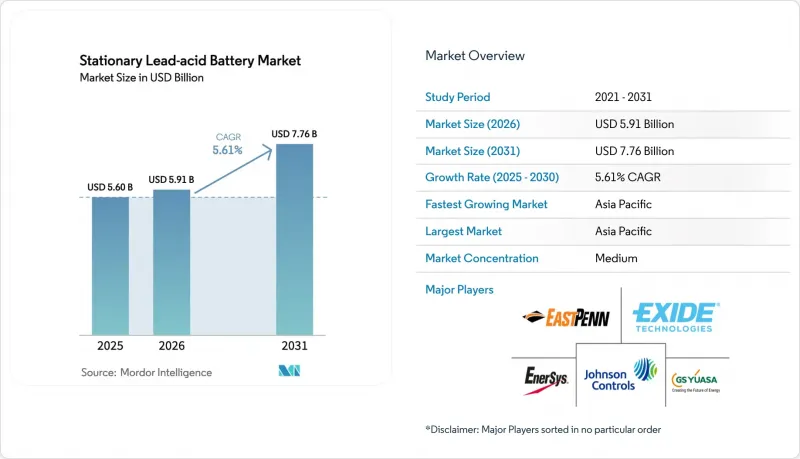
本報告按技術(液態和閥控式鉛酸蓄電池)、應用(通訊、UPS和資料中心、公共產業和儲能、工業設備和電力、石油天然氣和採礦、安防和緊急照明)以及地區(北美、歐洲、亞太、南美以及中東和非洲)進行細分。市場規模和預測以美元計價。
全球固定式鉛酸蓄電池市場趨勢及洞察
資料中心備份恢復
全球資料中心面積的爆炸性成長促使人們重新評估對電池可靠性的預期。 2025年1月,加州莫斯蘭丁資料中心發生事故,造成一座400兆瓦鋰離子電池設施部分受損,加州監管機構也因此加強了安全檢查。此後,營運商開始將熱穩定性置於體積效率之上。為此,EnerSys公司提供整合先進監控韌體的高性能耐火材料電池架,無需維修消防系統即可確保99.99%的運轉率。根據執行時間 Institute的研究顯示,74%的超大規模資料中心管理人員已將熱失控評估項目加入採購清單中,這直接有利於鉛酸電池。太平洋天然氣電力公司(PG&E)已停止購買用於高溫環境的新型密封式閥控式鉛酸蓄電池(VRLA),理由是通風耐火材料電池組的使用壽命更長。
亞太地區和非洲農村地區的高密度電信塔
第五代行動通訊網路需要高密度的基地台網路,其中許多基地台位於印度、印尼和奈及利亞等電力供應不穩定的偏遠地區或無電網覆蓋區域。根據GSMA的一項調查,低收入國家農村地區58%的基地台仍使用柴油-電池混合動力系統,其中超過70%的基地台由於成本低且易於維護而選擇鉛酸電池組。洛克斐勒基金會已將通訊業者定位為微電網開發商的關鍵客戶,從而推動了對能夠承受日常深度充放電循環的2V工業電池的訂單。鉛酸電池由於其對部分充電狀態、高溫環境和粗暴操作的耐受性,可以保持更長的維護週期。當安裝地點距離服務中心數百公里時,這一點至關重要。這種需求的激增正在推動區域出貨量的成長,並推動全球固定式鉛酸電池市場實現1個百分點的複合年成長率。
5kWh以下系統中鋰離子電池的TCO平價化進程正在加速。
鋰離子電池的成本正在迅速下降,縮小了小型備用電源的總擁有成本 (TCO) 差距。阿貢國家實驗室的數據預測,到 2035 年,美國電池組的成本將為每千瓦時 86 美元,而到 2029 年,在稅額扣抵下,成本可能降至每千瓦時 56 美元。對於安裝商而言,在比較 3 千瓦時壁掛式電池組時,較小的面積、更低的維護成本和更輕的結構等優勢,足以抵消鉛酸電池較低的購置價格。儘管存在關稅,中國出口商目前已能以低於每千瓦時 100 美元的價格出口電芯,這使得零售銀行 UPS 機房和緊急照明系統的電池更換成為一個極具吸引力的選擇。 《自然·能源》雜誌的模擬結果表明,鈉離子電池將在 2030 年後進入市場,進一步加劇利潤率的壓力。因此,固定式鉛酸電池市場雖然在重負載浮充應用領域仍保持一定的市場佔有率,但在輕負載領域卻正在失去市場佔有率。
細分市場分析
預計到2025年,電解電解質固定式鉛酸蓄電池將佔據固定式鉛酸蓄電池市場42.1%的佔有率,並以6.8%的複合年成長率成長。太平洋煤氣電力公司(PG&E)決定逐步淘汰高溫艙內的密封式閥控式鉛酸蓄電池組,這重新激發了人們對通風式設計的興趣,此類設計即使在高達35 度C的環境下也能持續運行而不出現容量衰減。預計到2031年,電解電解質固定式鉛酸蓄電池市場規模將達到34.8億美元,主要得益於薄片鑄造技術的進步,該技術顯著降低了水分流失。
先進薄片鑄造(TPPL)電池和鉛碳混合電池兼具液態電池的耐用性和閥控式鉛酸電池(VRLA)的便利性。它們正被應用於通訊設備中,因為通訊設備經常需要進行部分充放電循環,但其高昂的成本限制了它們的普及。到2025年,VRLA仍將是最大的收入來源,市佔率將達到57.9%,但其成長速度正在放緩,因為終端用戶越來越願意接受有限的現場維護,以換取液態電池更長的使用壽命。預計合金和自動化成型生產線的持續研發將使這三種化學體系保持盈利,並維持固定式鉛酸電池市場的廣度。
區域分析
預計到2025年,亞太地區將佔據最大的市場佔有率,達到44.6%,這主要得益於中國、印度和東協的通訊業者在其本地設施中部署48V機架。該地區的固定式鉛酸電池市場預計將以6.0%的複合年成長率成長,到2031年將超過35億美元。中國對冶煉廠的監管日益嚴格,使其成為提煉鉛的淨進口國,這導致區域供應趨緊,但也增加了本土一體化品牌的利潤。在日本和韓國,預計都市區和鐵路項目的電池更換週期將較為可預測,而澳洲的礦業公司正在部署大型閥控式鉛酸蓄電池組,用於運輸卡車和露營地的電氣化改造。
北美市場仍受替換需求主導,這與維吉尼亞和德克薩斯州資料中心的重組以及醫院的標準化密切相關。 《通貨膨脹抑制法案》提供的額外激勵措施有利於國產鑄造的電網,使EnerSys能夠將其關閉的墨西哥工廠的生產轉移到賓州的新生產線。在歐洲,合規性是重中之重。更高的回收配額使Clarios和Exide得以對其在德國、西班牙和捷克共和國的熔爐進行現代化改造,從而確保了對OEM和固定管道的供應,儘管單位成長率仍然較低。
中東和非洲地區預計到2031年將保持9.2%的年複合成長率(CAGR),成為成長最快的地區,這主要得益於沙烏地阿拉伯48吉瓦時的目標以及埃及在非洲開發銀行(AfDB)資助下開展的早期獨立項目。南非1吉瓦儲能專案的成功得標以及阿拉伯聯合大公國800兆瓦時的採購顯示市場正在擴張,但2027年以後的競標仍存在財務風險。在南美洲,巴西的「Mover」計畫以及私營部門在電動車供應鏈中的舉措正在推動市場成長。綜上所述,這些趨勢凸顯了固定式鉛酸電池市場為何能持續向傳統主要區域以外的地區擴張。
其他好處:
- Excel格式的市場預測(ME)表
- 3個月的分析師支持
目錄
第1章:引言
- 研究假設和市場定義
- 調查範圍
第2章:調查方法
第3章執行摘要
第4章 市場狀況
- 市場概覽
- 市場促進因素
- 恢復資料中心備份
- 亞太地區和非洲農村地區的高密度電信塔
- 對成本敏感國家的電網級可再生能源平滑
- 強制要求採礦業和石油天然氣產業採用離網供電。
- 從鋰過渡到關鍵基礎設施安全
- 南美洲的再工業化計劃
- 市場限制因素
- 加速實現5千瓦以下系統中鋰離子電池的總擁有成本與能源價格的持平
- 歐盟更嚴格的鉛回收配額正在影響新的生產能力。
- 鉛價波動給OEM廠商的利潤率帶來了壓力。
- 延後2027年及以後在中東和非洲地區的公共部門資本投資
- 供應鏈分析
- 監理情勢
- 技術展望
- 波特五力模型
第5章 市場規模與成長預測
- 透過技術
- 液體類型
- VRLA
- 透過使用
- 溝通
- UPS 和資料中心
- 公共產業與儲能
- 工業設備和電源
- 石油、天然氣和採礦業
- 安全和緊急照明
- 按地區
- 北美洲
- 美國
- 加拿大
- 墨西哥
- 歐洲
- 德國
- 英國
- 法國
- 西班牙
- 義大利
- 北歐國家
- 俄羅斯
- 其他歐洲國家
- 亞太地區
- 中國
- 印度
- 日本
- 韓國
- 東南亞國協
- 澳洲和紐西蘭
- 其他亞太國家
- 南美洲
- 巴西
- 阿根廷
- 智利
- 其他南美國家
- 中東和非洲
- 沙烏地阿拉伯
- 阿拉伯聯合大公國
- 南非
- 埃及
- 其他中東和非洲國家
- 北美洲
第6章 競爭情勢
- 市場集中度
- 策略趨勢(併購、聯盟、購電協議)
- 市場佔有率分析(主要公司的市場排名和佔有率)
- 公司簡介
- Johnson Controls International plc
- Exide Technologies
- EnerSys
- East Penn Manufacturing
- GS Yuasa Corporation
- C&D Technologies
- Amara Raja Batteries
- Panasonic Holdings
- Leoch International
- Narada Power
- HOPPECKE Batteries
- NorthStar Battery
- CSB Energy Technology
- Hitachi Chemical Energy Tech
- Exide Industries(India)
- Coslight Power
- FIAMM Energy Technology
- Rolls-Surrette
- Zhejiang Tianneng
- Vision Group(Shenzhen Center Power)
第7章 市場機會與未來展望
According to Mordor Intelligence, the stationary lead-Acid battery market size is expected to increase from USD 5.60 billion in 2025 to USD 5.91 billion in 2026 and reach USD 7.76 billion by 2031, growing at a CAGR of 5.61% over 2026-2031.
This report is Segmented by Technology (Flooded and VRLA), Application (Telecom, UPS and Data Centres, Utilities and Energy Storage, Industrial Equipment and Motive Power, Oil and Gas and Mining, and Security and Emergency Lighting), and Geography (North America, Europe, Asia-Pacific, South America, and Middle East and Africa). The Market Sizes and Forecasts are Provided in Terms of Value (USD).
Global Stationary Lead-Acid Battery Market Trends and Insights
Data-center Back-Up Renaissance
Explosive growth in global data-center footprints has reset expectations for battery reliability. Operators now rank thermal stability above volumetric efficiency after the January 2025 Moss Landing incident damaged part of a 400 MW lithium-ion site, prompting California regulators to toughen safety inspections. EnerSys responded with high-rate flooded racks that integrate advanced monitoring firmware to guarantee 99.99% uptime without introducing fire-suppression retrofits. Survey data from the Uptime Institute shows 74% of hyperscale managers have added thermal-runaway scoring to procurement checklists, directly benefiting lead chemistry. Pacific Gas & Electric subsequently halted new sealed VRLA purchases for high-temperature rooms, citing superior longevity from ventilated flooded strings.
Telecom Tower Densification in Rural Asia-Pacific & Africa
Fifth-generation networks require dense tower grids, many in off-grid or weak-grid zones of India, Indonesia, and Nigeria. GSMA research confirms that 58% of rural base-stations in low-income countries remain diesel-battery hybrids, and more than 70% of those hybrids specify lead-acid packs for cost and maintenance simplicity. The Rockefeller Foundation identified telecom anchors as prime customers for mini-grid developers, kick-starting orders for 2 V industrial cells that handle deep daily cycles. Lead-acid tolerance for partial state of charge, high ambient heat, and rough handling keeps service intervals long, a decisive factor when sites are hundreds of kilometers from service hubs. This demand surge lifts regional shipment volumes and injects a full point of CAGR uplift into the global Stationary Lead-Acid Battery Market.
Accelerating Li-ion TCO Parity Below 5 kWh Systems
Lithium-ion costs are falling fast enough to narrow the total-cost gap in small backup units. Argonne data place U.S. pack expenses at USD 86 kWh by 2035, and tax credits may trim that to USD 56 kWh by 2029. When installers compare a 3 kWh wall-mount set, the slimmer footprint, lower maintenance, and lighter structure all offset the lead's lower sticker price. Chinese exporters already ship sub-USD 100 kWh cells despite tariffs, making swap-outs tempting for retail banking UPS rooms and emergency lighting arrays. Nature Energy modeling shows sodium-ion lines could join the contest after 2030, adding further margin strain. As a result, the Stationary Lead-Acid Battery Market concedes share in light-duty categories even while holding ground in heavy float service.
Other drivers and restraints analyzed in the detailed report include:
- Grid-Scale Renewable Smoothing in Cost-Sensitive Nations
- Mining & Oil-and-Gas Off-Grid Electrification Mandates
- Stricter EU Lead-Recycling Quotas Hitting New Capacity
For complete list of drivers and restraints, kindly check the Table Of Contents.
Segment Analysis
Flooded units controlled 42.1% of the Stationary Lead-Acid Battery Market share in 2025 and are forecast to grow at a 6.8% CAGR. Pacific Gas & Electric's decision to retire sealed VRLA strings in high-temperature rooms revived interest in vented designs that tolerate sustained 35 °C without capacity fade. The Stationary Lead-Acid Battery Market size attached to flooded formats is projected at USD 3.48 billion by 2031, helped by thin-plate casting upgrades that slash water loss.
Advanced TPPL and lead-carbon hybrids sit between flooded robustness and VRLA convenience. They capture telecom shelters where partial-state cycling is routine, yet price premiums cap penetration. VRLA still owns the largest revenue pool at a 57.9% 2025 share, but its curve moderates as end-users accept limited onsite maintenance in exchange for longer service life from flooded racks. Continuous alloy R&D and automated formation lines should keep all three chemistries profitable, preserving breadth in the Stationary Lead-Acid Battery Market.
Complete Report Scope:
- By Technology
- Flooded
- VRLA
- By Application
- Telecom
- UPS and Data Centres
- Utilities and Energy Storage
- Industrial Equipment and Motive Power
- Oil and Gas and Mining
- Security and Emergency Lighting
- By Geography
- North America
- United States
- Canada
- Mexico
- Europe
- Germany
- United Kingdom
- France
- Spain
- Italy
- NORDIC Countries
- Russia
- Rest of Europe
- Asia-Pacific
- China
- India
- Japan
- South Korea
- ASEAN Countries
- Australia and New Zealand
- Rest of Asia-Pacific
- South America
- Brazil
- Argentina
- Chile
- Rest of South America
- Middle East and Africa
- Saudi Arabia
- United Arab Emirates
- South Africa
- Egypt
- Rest of Middle East and Africa
- North America
Geography Analysis
Asia-Pacific generated the largest 44.6% slice in 2025 as China, India, and ASEAN telecom operators stocked rural sites with 48 V racks. The Stationary Lead-Acid Battery Market size in the region is forecast to surpass USD 3.5 billion by 2031 on a 6.0% CAGR. Stricter Chinese smelter standards turned the nation into a net refined-lead importer, tightening regional supply but boosting profits for integrated local brands. Japan and South Korea provide predictable replacement cycles in metro and rail projects, while Australian miners deploy heavy VRLA packs to electrify haul trucks and camps.
North America remains replacement-driven, tied to data-center rebuilds in Virginia and Texas and to hospital code upgrades. The Inflation Reduction Act adders reward domestically cast grids, enabling EnerSys to shift volumes from a closed Mexican site to new Pennsylvania lines. Europe concentrates on compliance. Recycling quotas spur Clarios and Exide to modernize German, Spanish, and Czech furnaces, locking in supply for OEM and stationary channels despite lower headline unit growth.
The Middle East & Africa posts the fastest 9.2% CAGR through 2031, chasing Saudi Arabia's 48 GWh target and Egypt's early standalone projects supported by AfDB finance. South Africa's 1 GW storage awards and the UAE's 800 MWh procurement illustrate breadth, yet fiscal risk lingers for post-2027 tenders. South America rides Brazil's Mover program and private EV supply-chain commitments. Combined, these patterns underscore why the Stationary Lead-Acid Battery Market continues spreading beyond its traditional strongholds.
- Johnson Controls International plc
- Exide Technologies
- EnerSys
- East Penn Manufacturing
- GS Yuasa Corporation
- C&D Technologies
- Amara Raja Batteries
- Panasonic Holdings
- Leoch International
- Narada Power
- HOPPECKE Batteries
- NorthStar Battery
- CSB Energy Technology
- Hitachi Chemical Energy Tech
- Exide Industries (India)
- Coslight Power
- FIAMM Energy Technology
- Rolls-Surrette
- Zhejiang Tianneng
- Vision Group (Shenzhen Center Power)
Additional Benefits:
- The market estimate (ME) sheet in Excel format
- 3 months of analyst support
TABLE OF CONTENTS
1 Introduction
- 1.1 Study Assumptions & Market Definition
- 1.2 Scope of the Study
2 Research Methodology
3 Executive Summary
4 Market Landscape
- 4.1 Market Overview
- 4.2 Market Drivers
- 4.2.1 Data-center back-up renaissance
- 4.2.2 Telecom tower densification in rural Asia Pacific & Africa
- 4.2.3 Grid-scale renewable smoothing in cost-sensitive nations
- 4.2.4 Mining & oil-&-gas off-grid electrification mandates
- 4.2.5 Safety-driven pivot from lithium in critical infrastructure
- 4.2.6 Re-industrialisation programs in South America
- 4.3 Market Restraints
- 4.3.1 Accelerating Li-ion TCO parity below 5 kWh systems
- 4.3.2 Stricter EU lead-recycling quotas hitting new capacity
- 4.3.3 Volatile lead prices squeezing OEM margins
- 4.3.4 Public-sector cap-ex deferrals post 2027 in MEA
- 4.4 Supply-Chain Analysis
- 4.5 Regulatory Landscape
- 4.6 Technological Outlook
- 4.7 Porter's Five Forces
- 4.7.1 Bargaining Power of Suppliers
- 4.7.2 Bargaining Power of Buyers
- 4.7.3 Threat of New Entrants
- 4.7.4 Threat of Substitutes
- 4.7.5 Competitive Rivalry
5 Market Size & Growth Forecasts
- 5.1 By Technology
- 5.1.1 Flooded
- 5.1.2 VRLA
- 5.2 By Application
- 5.2.1 Telecom
- 5.2.2 UPS and Data Centres
- 5.2.3 Utilities and Energy Storage
- 5.2.4 Industrial Equipment and Motive Power
- 5.2.5 Oil and Gas and Mining
- 5.2.6 Security and Emergency Lighting
- 5.3 By Geography
- 5.3.1 North America
- 5.3.1.1 United States
- 5.3.1.2 Canada
- 5.3.1.3 Mexico
- 5.3.2 Europe
- 5.3.2.1 Germany
- 5.3.2.2 United Kingdom
- 5.3.2.3 France
- 5.3.2.4 Spain
- 5.3.2.5 Italy
- 5.3.2.6 NORDIC Countries
- 5.3.2.7 Russia
- 5.3.2.8 Rest of Europe
- 5.3.3 Asia-Pacific
- 5.3.3.1 China
- 5.3.3.2 India
- 5.3.3.3 Japan
- 5.3.3.4 South Korea
- 5.3.3.5 ASEAN Countries
- 5.3.3.6 Australia and New Zealand
- 5.3.3.7 Rest of Asia-Pacific
- 5.3.4 South America
- 5.3.4.1 Brazil
- 5.3.4.2 Argentina
- 5.3.4.3 Chile
- 5.3.4.4 Rest of South America
- 5.3.5 Middle East and Africa
- 5.3.5.1 Saudi Arabia
- 5.3.5.2 United Arab Emirates
- 5.3.5.3 South Africa
- 5.3.5.4 Egypt
- 5.3.5.5 Rest of Middle East and Africa
- 5.3.1 North America
6 Competitive Landscape
- 6.1 Market Concentration
- 6.2 Strategic Moves (M&A, Partnerships, PPAs)
- 6.3 Market Share Analysis (Market Rank/Share for key companies)
- 6.4 Company Profiles (includes Global level Overview, Market level overview, Core Segments, Financials as available, Strategic Information, Products & Services, and Recent Developments)
- 6.4.1 Johnson Controls International plc
- 6.4.2 Exide Technologies
- 6.4.3 EnerSys
- 6.4.4 East Penn Manufacturing
- 6.4.5 GS Yuasa Corporation
- 6.4.6 C&D Technologies
- 6.4.7 Amara Raja Batteries
- 6.4.8 Panasonic Holdings
- 6.4.9 Leoch International
- 6.4.10 Narada Power
- 6.4.11 HOPPECKE Batteries
- 6.4.12 NorthStar Battery
- 6.4.13 CSB Energy Technology
- 6.4.14 Hitachi Chemical Energy Tech
- 6.4.15 Exide Industries (India)
- 6.4.16 Coslight Power
- 6.4.17 FIAMM Energy Technology
- 6.4.18 Rolls-Surrette
- 6.4.19 Zhejiang Tianneng
- 6.4.20 Vision Group (Shenzhen Center Power)
7 Market Opportunities & Future Outlook
- 7.1 White-space & Unmet-need Assessment

 閥控式鉛酸蓄電池(VRLA)市場報告:趨勢、預測與競爭分析(至2035年)
 固定式電池市場-2026-2032年全球市場預測閥控式鉛酸蓄電池(VRLA)市場:依電壓、類型、應用、國家及地區分類-全球產業分析、市場規模、市場佔有率及2026年至2033年預測
 電解電解液電池市場:商業機會、成長要素、產業趨勢分析及2026-2035年預測。鉛酸蓄電池市場:按類型、電壓範圍、電池結構、功能、應用和銷售管道分類-2026-2032年全球市場預測
 鉛酸蓄電池(LAB):市場佔有率分析、行業趨勢和統計數據以及成長預測(2026-2031 年)
 2026-2030年全球工業用鉛酸蓄電池市場
 2026-2032年歐洲乘用車鉛酸蓄電池售後市場北美鉛酸蓄電池市場:市場佔有率分析、行業趨勢和統計數據以及成長預測(2026-2031 年)VRLA電池:市佔率分析、產業趨勢與統計、成長預測(2026-2031年)