


 |
市場調查報告書
商品編碼
2072663
歐洲紙板:市場佔有率分析、產業趨勢與統計、成長預測(2026-2031)Europe Cartonboard - Market Share Analysis, Industry Trends & Statistics, Growth Forecasts (2026 - 2031) |
||||||

※ 本網頁內容可能與最新版本有所差異。詳細情況請與我們聯繫。
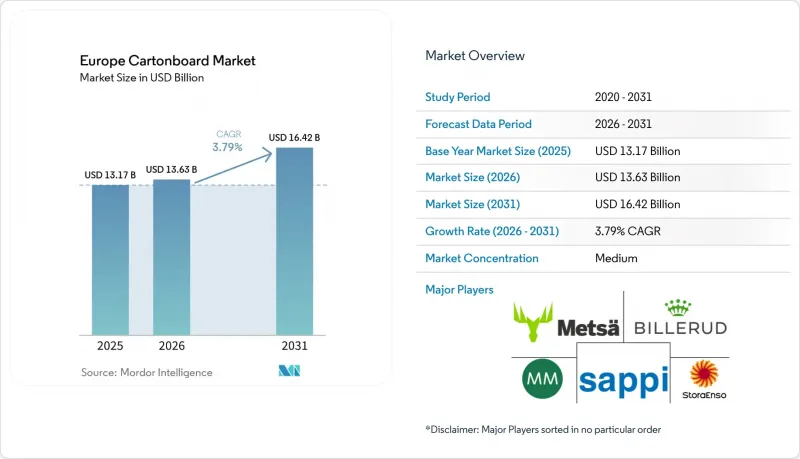
根據 Mordor Intelligence 預測,歐洲瓦楞紙板市場規模預計在 2025 年達到 131.7 億美元,2026 年達到 136.3 億美元,到 2031 年達到 164.2 億美元,2026 年至 2031 年的複合年成長率為 3.79%。
本報告按產品等級(實心漂白紙板、實心未漂白紙板、折疊盒用紙板、白襯塑合板、液體包裝用紙板、食品服務用紙板)、包裝形式(折疊盒、液體包裝、套筒和托盤等)、終端用戶行業(食品、飲料等)和地區(德國、英國等)進行細分。市場預測以美元(USD)為單位。
歐洲紙板市場趨勢與洞察
基於PPWR和SUPD的塑膠纖維替代品
歐盟第2025/40號條例將於2025年2月11日生效,並於2026年8月12日起適用於所有27個歐盟成員國,為歐洲瓦楞紙板市場建立全部區域包裝法規。該條例超越了先前的指令模式,將注重可回收性的設計標準、強制性再生材料含量以及生產者延伸責任制(EPR)費用的調整與品牌所有者無法輕易推遲的包裝選擇直接掛鉤。實際上,這將加大重新設計複雜塑膠包裝的壓力,而許多瓦楞紙板包裝已經符合新框架下的可回收性要求。 Mayr-Melnhof Karton AG已將纖維材料定位為客戶進行包裝變更專案的過渡工具,這表明法規正成為歐洲紙板市場銷售流程中不可或缺的一部分。根據 Pro Carton 在 2026 年進行的一項消費者調查,53% 的歐洲受訪者表示,包裝不可回收是他們更換品牌的原因,這促使零售商的規格和品牌所有者的計劃朝著同一個方向發展。
適用於食品零售業的可回收、可直接上架的包裝
在德國、法國和英國的食品零售業,包裝方案正轉向可回收的單一材料瓦楞紙板解決方案,用於商店展示包裝。永續性正成為更多品類產品陳列的商業性要求,而不僅僅是品牌偏好。這點意義重大,因為生產者延伸責任制(EPR)費用的調整越來越有利於可回收包裝,使得改用瓦楞紙板的經濟效益與產品展示優勢並列,從而促進了企業內部決策。這一趨勢正在推動對可折疊紙板的需求,因為貨架包裝更傾向於易於印刷、加工效率高且即使紙張重量降低也易於回收的包裝形式。在荷蘭舉行的 Smurfit Westrock「2026 創新活動」上,超過 450 位客戶出席了活動,會上推出了三款基於人工智慧的包裝設計工具,展示了數位化開發如何縮短貨架包裝的客製化週期。類似的理念也正在擴展到電商二級包裝領域。品牌正在尋求單一的紙板格式,以最大限度地減少重新設計,更清晰地表達永續性聲明,並可從商店展示到最後一公里配送始終如一地使用。
能源和紙漿成本波動,尤其是再生紙漿。
2026年,能源和纖維成本仍將是製造商面臨的最緊迫的業務挑戰,歐洲紙板市場,尤其是那些缺乏整合纖維和能源系統充分保障的紙板等級,受到的壓力尤為顯著。 Birelude在2025年第四季公佈財報中指出,歐洲地區瓦楞紙板和白面牛皮紙的供應過剩導致需求疲軟,價格壓力持續到2026年第一季,限制了造紙商透過定價彌補原料成本飆升的能力。這種供應過剩和公用事業收費波動的雙重挑戰對再生瓦楞紙板製造商而言尤其嚴峻,因為一旦市場環境不穩定,他們的容錯空間就非常有限。此外,隨著現貨價格走勢變得難以預測,買家將更加重視合約的穩定性和供應的持續性,這將導致加工商的採購行為改變。在產能運轉率得到更明顯的改善之前,預計歐洲瓦楞紙板市場各等級和各製造商的利潤率復甦仍將持續波動。
細分市場分析
到2025年,瓦楞紙板原紙將佔歐洲瓦楞紙板市場佔有率的33.91%,成為最大的產品等級,這得益於其能夠透過單一、廣泛的加工平台滿足食品、醫藥和化妝品等行業的應用需求。其主導地位源自於其與膠印、數位印刷和柔版印刷的兼容性,使其能夠從日常食品包裝順利過渡到高價值零售展示包裝。這一規模得益於完善的加工基礎設施和「貨架即用」的零售規範,這些規範已使瓦楞紙板在該地區的大部分地區佔據優先地位。芬蘭斯特拉恩索公司(Strah Enso)斥資10億歐元(10.8億美元)建造的Łúl生產線每年新增75萬噸產能,而梅特薩紙板公司(Metsä Board)投資2.1億歐元(2.27億美元)擴建的胡蘇姆工廠每年新增20萬噸產能。由於新增供應正被市場消化,這給短期價格復甦帶來了沉重壓力。漂白實心紙板在餐飲服務業、藥品包裝和高階化妝品領域繼續佔據高階市場地位,而未漂白實心紙板在工業和高耐久性應用領域仍屬於小眾產品。此外,在2026年8月監管合規期限到來之前,餐飲服務業的紙板正朝著不含PFAS的配方轉型。
預計2026年至2031年間,液體包裝紙板的複合年成長率將達到5.17%,成為歐洲紙板市場成長最快的產品類別。利樂公司和Sterilgarda Alimenti公司於2026年4月推出了一款1升裝的無菌紙盒,該紙盒採用紙基隔離層,標誌著無鋁紙盒技術的首次工業規模應用。利樂公司也決定投資6,000萬歐元(約6,500萬美元)在瑞典隆德先導工廠,這是其到2030年每年投資1億歐元(約1.09億美元)用於永續包裝研發計畫的一部分。這清晰地表明了液體紙盒技術的快速發展。此外,隨著市場需求轉向紙張用量較高的飲料包裝形式,製造商正在升級其核心液體紙板資產,以提高效率、品管和產品柔軟性。白襯紙板仍然用於價格敏感的二級包裝,但隨著歐洲紙板市場能源成本和成本可見度變得越來越不穩定,其相對地位正在減弱。
其他好處:
- Excel格式的市場預測(ME)表
- 3個月的分析師支持
目錄
第1章:引言
- 研究假設和市場定義
- 調查範圍
第2章:調查方法
第3章執行摘要
第4章 市場狀況
- 市場概覽
- 市場促進因素
- PPWR 和 SUPD 下的塑膠纖維替代
- 食品零售業中的可回收貨架包裝
- 藥品序列化與防篡改紙盒
- 升級您的高階美容及個人護理用品包裝盒。
- 包裝上採用QR碼進行合規性和數位化展示
- 食品服務業板材中不含 PFAS 的隔離層的過渡
- 市場限制因素
- 能源和紙漿成本的波動,尤其是再生紙的成本波動。
- 透過制定重複使用規則和減少包裝來控制單位成長。
- 中小加工商面臨的合規相關資料負擔
- 輕量化:以超過單位需求成長速度的速度減少重量。
- 產業價值鏈分析
- 宏觀經濟因素對市場的影響
- 監理情勢
- 技術展望
- 貿易趨勢和運輸能力分析
- 波特五力分析
第5章 市場規模與成長預測
- 按產品等級
- 固體漂白紙板
- 固體未漂白紙板
- 折疊紙板
- 球場用球的白色底面
- 用於液體包裝的紙板
- 食品服務用紙板
- 按包裝類型
- 折疊紙箱
- 液體包裝
- 袖套和托盤
- 其他包裝形式(杯子、食品服務容器)
- 按最終用戶行業分類
- 食物
- 飲料
- 藥品和醫療保健
- 菸草
- 化妝品和盥洗用品
- 其他終端用戶產業(玩具、服飾、汽車、家居用品、電器、餐飲服務業)
- 國家
- 德國
- 英國
- 法國
- 義大利
- 西班牙
- 其他歐洲國家
第6章 競爭情勢
- 市場集中度
- 策略趨勢
- 市佔率分析
- 公司簡介
- Metsa Board Corporation
- Stora Enso Oyj
- Mayr-Melnhof Karton AG
- Billerud Aktiebolag
- Sappi Limited
- RDM Group SpA
- WEIG-Karton GmbH & Co. KG
- Iggesund Paperboard AB
- Kotkamills Oy
- Pankaboard Oy
- Graphic Packaging International, LLC
- Smurfit Westrock plc
- Mondi plc
- Van Genechten Packaging NV
- Edelmann Group GmbH
- Tetra Pak International SA
- SIG Group AG
- Elopak ASA
第7章 市場機會與未來展望
According to Mordor Intelligence, the europe cartonboard market size is projected to be USD 13.17 billion in 2025, USD 13.63 billion in 2026, and reach USD 16.42 billion by 2031, growing at a CAGR of 3.79% from 2026 to 2031.
This report is Segmented by Product Grade (Solid Bleached Board, Solid Unbleached Board, Folding Boxboard, White-Lined Chipboard, Liquid Packaging Board, and Food Service Board), Packaging Format (Folding Cartons, Liquid Packaging, Sleeve and Tray, and More), End-User Industry (Food, Beverage, and More), and Geography (Germany, United Kingdom, and More). The Market Forecasts are Provided in Terms of Value (USD).
Europe Cartonboard Market Trends and Insights
Plastic-To-Fiber Substitution Under PPWR And SUPD
Regulation (EU) 2025/40 entered into force on February 11, 2025, and will apply across all 27 EU member states from August 12, 2026, giving the Europe cartonboard market one common packaging rulebook across the region. The regulation goes beyond the earlier directive model by tying design-for-recycling criteria, recycled-content obligations, and EPR fee modulation directly to packaging choices that brand owners cannot easily delay. In practical terms, this places greater pressure to redesign complex plastic formats, while many carton formats already meet recyclability expectations under the new framework. Mayr-Melnhof Karton AG has already positioned fiber-based materials as transition tools for customers working through packaging change programs, showing how regulation is becoming part of the sales process in the Europe cartonboard market. Pro Carton found in its 2026 consumer survey that 53% of European respondents cited non-recyclable packaging as a reason for brand switching, which is pushing retailer specifications and brand-owner timelines in the same direction.
Recyclable Shelf-Ready Packs In Food Retail
Food retail packaging programs in Germany, France, and the United Kingdom are moving shelf-ready formats toward recyclable mono-material carton solutions, turning sustainability from a brand preference into a commercial listing condition in more categories. This matters because EPR fee modulation increasingly rewards recyclable packaging, so the financial case for carton conversion now sits alongside the merchandising case, making decisions easier to justify internally. The effect supports folding boxboard demand because shelf-ready packs favor formats that print well, convert efficiently, and remain easy to recycle even when basis weights are reduced. Smurfit Westrock's 2026 Innovation Event in the Netherlands brought together more than 450 customers and introduced 3 AI-based packaging design tools that demonstrate how digital development is shortening customization cycles for shelf-ready packaging. The same logic now extends to e-commerce secondary packaging, where brands want one cartonboard format that can move from shelf display to last-mile shipment with minimal redesign and a clearer sustainability claim.
Energy And Pulp Cost Volatility, Especially In Recycled Grades
Energy and fiber costs remained the most immediate operating challenge for producers in 2026, and the European cartonboard market felt that pressure most sharply in grades with less protection from integrated fiber and energy systems. Billerud stated in its Q4 2025 results that overcapacity in cartonboard and white top kraftliner in Region Europe kept demand subdued and price pressure visible into Q1 2026, limiting mills' ability to recover higher input costs through pricing. That combination of loose supply and volatile utilities is especially difficult for recycled-board producers because they have less margin room when market conditions turn unstable. It also changes converter purchasing behavior, with buyers placing more value on contract stability and supply consistency when spot pricing becomes harder to read. Until capacity utilization improves more clearly, margin recovery in the European cartonboard market is likely to remain uneven across grades and producer types.
Other drivers and restraints analyzed in the detailed report include:
- Pharmaceutical Serialization And Tamper-Evident Cartons
- Premium Beauty And Personal Care Carton Upgrading
- Reuse And Packaging-Minimization Rules Capping Unit Growth
For complete list of drivers and restraints, kindly check the Table Of Contents.
Segment Analysis
Folding boxboard held 33.91% of the European cartonboard market share in 2025, making it the largest product grade because it can serve food, pharmaceutical, and cosmetics applications through a single broad converting base. Its leading position also reflects its compatibility with offset, digital, and flexographic printing, enabling the grade to move from everyday grocery packaging into higher-value retail presentation formats with minimal friction. That scale is supported by established converter infrastructure and by shelf-ready retail specifications that already favor folding boxboard across much of the region. Stora Enso's EUR 1 billion (USD 1.08 billion) Oulu line in Finland added 750,000 tonnes of annual capacity, and Metsa Board's EUR 210 million (USD 227 million) Husum expansion added 200,000 tonnes annually, which has weighed on near-term price recovery while new supply is still being absorbed. Solid bleached board continues to occupy the premium tier in food service, pharmaceutical packaging, and luxury beauty work, while solid unbleached board remains more niche in industrial and heavy-duty uses, and food service board is moving through PFAS-free reformulation ahead of the August 2026 compliance date.
Liquid packaging board is projected to expand at a 5.17% CAGR from 2026 to 2031, making it the fastest-growing product grade in the European cartonboard market. Tetra Pak and Sterilgarda Alimenti launched a 1-liter aseptic carton with a paper-based barrier in April 2026, providing the first commercial industrial-scale proof point for aluminum-free carton technology. Tetra Pak also committed EUR 60 million (USD 65 million) to a paper-based barrier pilot plant in Lund, Sweden, as part of its plan to invest EUR 100 million (USD 109 million) annually through 2030 in sustainable packaging development, underscoring how quickly the liquid carton technology frontier is advancing. Producers are also upgrading core liquid board assets to improve efficiency, quality control, and product flexibility as demand shifts toward more paper-intensive beverage formats. White-lined chipboard still serves price-sensitive secondary packaging, but its relative position is weaker when energy costs and cost visibility become less stable across the European cartonboard market.
Complete Report Scope:
- By Product Grade
- Solid Bleached Board
- Solid Unbleached Board
- Folding Boxboard
- White-Lined Chipboard
- Liquid Packaging Board
- Food Service Board
- By Packaging Format
- Folding Cartons
- Liquid Packaging
- Sleeve and Tray
- Other Packaging Formats (Cups, Foodservice Containers)
- By End-User Industry
- Food
- Beverage
- Pharmaceutical and Healthcare
- Tobacco
- Cosmetics and Toiletries
- Other End-User Industries (Toy, Apparel, Automotive, Household, Electrical, Foodservice)
- By Country
- Germany
- United Kingdom
- France
- Italy
- Spain
- Rest of Europe
List of Companies Covered in this Report:
- Metsa Board Corporation
- Stora Enso Oyj
- Mayr-Melnhof Karton AG
- Billerud Aktiebolag
- Sappi Limited
- RDM Group S.p.A.
- WEIG-Karton GmbH & Co. KG
- Iggesund Paperboard AB
- Kotkamills Oy
- Pankaboard Oy
- Graphic Packaging International, LLC
- Smurfit Westrock plc
- Mondi plc
- Van Genechten Packaging NV
- Edelmann Group GmbH
- Tetra Pak International S.A.
- SIG Group AG
- Elopak ASA
Additional Benefits:
- The market estimate (ME) sheet in Excel format
- 3 months of analyst support
TABLE OF CONTENTS
1 INTRODUCTION
- 1.1 Study Assumptions and Market Definition
- 1.2 Scope of the Study
2 RESEARCH METHODOLOGY
3 EXECUTIVE SUMMARY
4 MARKET LANDSCAPE
- 4.1 Market Overview
- 4.2 Market Drivers
- 4.2.1 Plastic-to-Fiber Substitution Under PPWR and SUPD
- 4.2.2 Recyclable Shelf-Ready Packs in Food Retail
- 4.2.3 Pharmaceutical Serialization and Tamper-Evident Cartons
- 4.2.4 Premium Beauty and Personal Care Carton Upgrading
- 4.2.5 QR-Enabled Compliance and Digital Labeling on Pack
- 4.2.6 PFAS-Free Barrier Migration in Food Service Board
- 4.3 Market Restraints
- 4.3.1 Energy and Pulp Cost Volatility, Especially in Recycled Grades
- 4.3.2 Reuse and Packaging-Minimization Rules Capping Unit Growth
- 4.3.3 Compliance Data Burden for Small and Mid-Sized Converters
- 4.3.4 Lightweighting Reducing Tonnes Faster Than Unit Demand
- 4.4 Industry Value Chain Analysis
- 4.5 Impact of Macroeconomic Factors on the Market
- 4.6 Regulatory Landscape
- 4.7 Technological Outlook
- 4.8 Trade Flow and Capacity Analysis
- 4.9 Porter's Five Forces Analysis
- 4.9.1 Threat of New Entrants
- 4.9.2 Bargaining Power of Suppliers
- 4.9.3 Bargaining Power of Buyers
- 4.9.4 Threat of Substitutes
- 4.9.5 Intensity of Competitive Rivalry
5 MARKET SIZE AND GROWTH FORECASTS (VALUE)
- 5.1 By Product Grade
- 5.1.1 Solid Bleached Board
- 5.1.2 Solid Unbleached Board
- 5.1.3 Folding Boxboard
- 5.1.4 White-Lined Chipboard
- 5.1.5 Liquid Packaging Board
- 5.1.6 Food Service Board
- 5.2 By Packaging Format
- 5.2.1 Folding Cartons
- 5.2.2 Liquid Packaging
- 5.2.3 Sleeve and Tray
- 5.2.4 Other Packaging Formats (Cups, Foodservice Containers)
- 5.3 By End-User Industry
- 5.3.1 Food
- 5.3.2 Beverage
- 5.3.3 Pharmaceutical and Healthcare
- 5.3.4 Tobacco
- 5.3.5 Cosmetics and Toiletries
- 5.3.6 Other End-User Industries (Toy, Apparel, Automotive, Household, Electrical, Foodservice)
- 5.4 By Country
- 5.4.1 Germany
- 5.4.2 United Kingdom
- 5.4.3 France
- 5.4.4 Italy
- 5.4.5 Spain
- 5.4.6 Rest of Europe
6 COMPETITIVE LANDSCAPE
- 6.1 Market Concentration
- 6.2 Strategic Moves
- 6.3 Market Share Analysis
- 6.4 Company Profiles (includes Global Level Overview, Market Level Overview, Core Segments, Financials as available, Strategic Information, Market Rank/Share, Products and Services, Recent Developments)
- 6.4.1 Metsa Board Corporation
- 6.4.2 Stora Enso Oyj
- 6.4.3 Mayr-Melnhof Karton AG
- 6.4.4 Billerud Aktiebolag
- 6.4.5 Sappi Limited
- 6.4.6 RDM Group S.p.A.
- 6.4.7 WEIG-Karton GmbH & Co. KG
- 6.4.8 Iggesund Paperboard AB
- 6.4.9 Kotkamills Oy
- 6.4.10 Pankaboard Oy
- 6.4.11 Graphic Packaging International, LLC
- 6.4.12 Smurfit Westrock plc
- 6.4.13 Mondi plc
- 6.4.14 Van Genechten Packaging NV
- 6.4.15 Edelmann Group GmbH
- 6.4.16 Tetra Pak International S.A.
- 6.4.17 SIG Group AG
- 6.4.18 Elopak ASA
7 MARKET OPPORTUNITIES AND FUTURE OUTLOOK
- 7.1 White-Space and Unmet-Need Assessment

 瓦楞紙板折疊市場規模、佔有率和成長分析:按產品類型、瓦楞類型、材料、應用、最終用途產業和地區分類-2026-2033年產業預測
 瓦楞紙板製造機械市場規模、佔有率和成長分析:按機器類型、自動化程度、紙板類型、應用、最終用戶和地區分類-2026-2033年產業預測
 瓦楞紙板折疊包裝市場分析及預測(至2035年):類型、產品、技術、應用、材料類型、製程、最終用戶、功能、解決方案
 瓦楞紙板市場:全球預測,2026-2032年
 貨架襯墊市場規模、佔有率和成長分析:按材料、產品類型、應用、最終用戶、分銷管道、厚度和地區分類-2026-2033年產業預測
 中東和非洲紙板市場:市場佔有率分析、行業趨勢和統計數據以及成長預測(2026-2031 年)德國紙板:市場佔有率分析、產業趨勢與統計、成長預測(2026-2031)法國紙板:市場佔有率分析、產業趨勢與統計、成長預測(2026-2031)北美紙板:市場佔有率分析、產業趨勢與統計、成長預測(2026-2031)南美洲紙板市場:市場佔有率分析、產業趨勢與統計、成長預測(2026-2031)