


 |
市場調查報告書
商品編碼
2066619
遊戲GPU:市佔率分析、產業趨勢與統計及成長預測(2026-2031年)Gaming GPU - Market Share Analysis, Industry Trends & Statistics, Growth Forecasts (2026 - 2031) |
||||||

※ 本網頁內容可能與最新版本有所差異。詳細情況請與我們聯繫。
根據 Mordor Intelligence 預測,遊戲 GPU 市場預計將從 2025 年的 333.2 億美元成長到 2026 年的 387.2 億美元,到 2031 年達到 662.4 億美元,2026 年至 2031 年的複合年預計成長率為 11.34%。
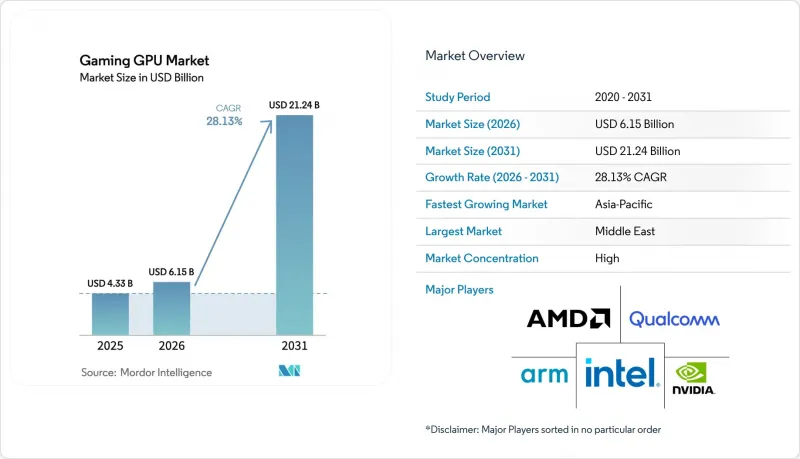
本報告按GPU類型(獨立GPU和整合GPU)、裝置類型(遊戲桌上型電腦、遊戲筆記型電腦、智慧型手機和平板電腦)、最終用戶類型(休閒玩家和發燒友/專業玩家)、記憶體類型(GDDR6、GDDR6X、統一記憶體和其他記憶體類型)以及地區進行細分。市場預測以美元計價。
全球遊戲GPU市場趨勢與洞察
AI 超採樣和射線追蹤更新周期
在遊戲GPU市場,AI超採樣和神經渲染是推動需求成長最強勁的動力之一。 NVIDIA推出了DLSS 4,它採用基於變壓器的渲染管線和多幀生成技術,並宣佈到2025年5月,超過125款遊戲將支援該功能。這一轉變意義重大,因為即使是以前透過軟體調校將老顯卡性能發揮到極致的玩家,現在如果不升級到基於Blackwell架構的硬體,也無法達到相同的性能水平。 AMD在發布RDNA 4時也強化了類似的趨勢,將更高的射線追蹤吞吐量和AI圖形處理能力定位為標準配置,而非高階附加功能。這進一步拉大了新舊硬體之間的效能差距,使得每一次重大架構更新的商業性意義遠超簡單的週期性升級。
電競和競技FPS遊戲的升級需求
市場持續受到競技遊戲的驅動,在競技遊戲領域,幀穩定性和低延遲與影像品質同等重要。 NVIDIA 大力推廣「Reflex 2」技術,聲稱該技術可將輸入延遲降低高達 75%,這與電子競技和需要快速反應的遊戲類型的需求不謀而合。事實上,這正在改變玩家升級顯示卡的標準,使其不再僅僅關注解析度,而是轉向關注運動響應和控制精度。遊戲圖形處理器 (GPU) 市場將從中受益,因為如果新硬體能夠提供可衡量的延遲優勢,而這種優勢無法透過簡單的升級在舊平台上實現,那麼即使是效能尚可的顯示卡,玩家也更願意升級。即使整體消費性電子市場趨於謹慎,這也將維持對高級產品的需求。
高階GPU的價格和較長的更換週期
由於高階顯示卡價格高昂,遊戲GPU市場仍面臨明顯的供需限制。 NVIDIA推出的GeForce RTX 5090售價高達1,999美元,其他Blackwell系列顯示卡也推高了高階顯示卡的價格區間。 AMD則在中階採取了更為激進的定價策略,但其市場定位表明,價格親民仍然是其市場競爭策略的核心要素。許多消費者認為,配備GDDR6X記憶體的顯示卡足以滿足大多數當前遊戲的需求,尤其是在現有裝置量已廣泛支援相關功能的情況下。這使得高階市場的收入保持強勁,但也導致價格敏感型細分市場的產品更換速度放緩。
細分市場分析
到2025年,獨立顯示卡將佔據遊戲GPU市場77.83%的佔有率,顯示專用顯示卡硬體對營收和效能預期有著多麼強大的影響力。市場仍依賴獨立顯示卡來處理4K遊戲、進階射線追蹤和AI驅動的渲染工作負載,整合顯示卡在高階市場難以與之匹敵。 2025年,NVIDIA擴展了其Blackwell產品線的價格範圍,涵蓋了從RTX 5090到RTX 5050的桌面級產品。 AMD憑藉著RDNA 4架構,加劇了成本績效領域的競爭,強調在相近的價格水準下提升每個運算單元的射線追蹤吞吐量和增加記憶體容量。
此外,由於軟體對高階渲染功能的支援不斷擴展,獨立顯示卡市場仍保持強勁動能。據英偉達稱,超過800款遊戲和應用程式支援RTX技術,這大大延長了獨立顯示卡在廣泛部署環境下的商業性生命週期。雖然整合式顯示卡在主流遊戲中效能和重要性都在不斷提升,但其影響在低階市場比高階市場更為顯著。簡言之,業界普遍認為獨立顯示卡尚未佔據絕對主導,但入門級市場的競爭日益激烈。事實上,獨立顯示卡仍然佔據最高的消費佔有率,因為遊戲玩家、內容創作者和高階筆記型電腦買家仍然需要整合顯示卡難以持續提供的效能優勢。因此,儘管低階市場的趨勢日趨多變,但獨立顯示卡仍是市場的核心收入來源。
儘管遊戲桌上型電腦在2025年佔據了48.37%的銷售佔有率,但預計2026年至2031年間,遊戲筆記型電腦的複合年成長率將達到11.94%。這一趨勢表明,雖然桌上型電腦仍然是遊戲圖形處理器(GPU)市場最大的收入來源,但目前的成長重點正在轉向可攜式系統。 NVIDIA透過推出採用Blackwell Max-Q架構的RTX 50系列筆記型電腦GPU,推動了這項轉變,這些GPU顯著提升了行動裝置的能效,延長了電池續航力,並獲得了高階OEM廠商的廣泛支援。市場正受益於效能差距的縮小,這種差距曾經將許多遊戲發燒友束縛在桌上型電腦上。
筆記型電腦的成長不僅反映了硬體設計的轉變,也反映了消費者購買邏輯的改變。消費者越來越需要一款能夠同時滿足遊戲、工作、學習和旅行需求,且不犧牲最新AI渲染功能的設備。 NVIDIA將DLSS 4和Blackwell功能擴展到筆記型電腦系統,使用戶能夠在固定的桌面環境之外使用高級圖形功能,從而支持了這一轉變。行動遊戲設備也為市場增添了新的維度,高階平板電腦和智慧型手機現在也具備了以往僅限於大型平台的圖形處理能力。聯發科發布的2026年旗艦產品表明,行動裝置正在朝著更高的影格速率和射線追蹤支援的方向發展,使得設備之間的界限比以往任何時候都更加模糊。
區域分析
預計到2025年,亞太地區將佔據全球遊戲GPU市場52.88%的佔有率,並在2031年之前以12.31%的複合年成長率成長。該地區強勁的市場表現得益於電子競技的深度參與、龐大的遊戲玩家群體以及對高階PC、筆記型電腦和中階。此外,亞太地區的遊戲GPU市場也獲得了更多年輕玩家的支持,他們更傾向於在不同裝置間切換,而不是固守單一平台。另一方面,出口限制使得高階GPU在中國的取得變得困難,這可能會重塑全部區域的產品定位和廠商的業務機會。
北美仍然是全球第二大市場,銷量領先,這得益於較高的平均售價、成熟的PC遊戲文化以及狂熱玩家比休閒玩家更頻繁地升級硬體的強勁需求。美國市場對高階獨立顯示卡尤為重要,頂級高性能產品的需求依然大規模。 NVIDIA的「Blackwell」產品發布以及廣泛的OEM支援表明,北美在高階產品的發布和早期推廣中繼續發揮著至關重要的作用。歐洲的需求模式與之類似,電子競技和PC硬體的日益普及為高階產品市場提供了穩定的支撐。
儘管南美和中東及非洲地區的銷售額佔比較小,但這三個地區在遊戲領域的實際重要性卻持續成長。在南美,市場需求主要集中在中階系統和行動遊戲,因為價格仍然是硬體選擇的主要考慮因素。在中東和非洲,由於對電競場館的投資以及部分市場消費者對高階產品需求的不斷成長,高階遊戲環境正在蓬勃發展。此外,Arm持續拓展行動GPU IP也為這些地區的市場提供了支持,因為許多用戶發現,相比高階PC,高階智慧型手機更容易提供更強大的圖形處理能力。
其他好處:
- Excel格式的市場預測(ME)表
- 3個月的分析師支持
目錄
第1章:引言
- 研究假設和市場定義
- 調查範圍
第2章:調查方法
第3章執行摘要
第4章 市場狀況
- 市場概覽
- 市場促進因素
- AI驅動的影像放大和射線追蹤更新周期
- 電子競技和競技性FPS遊戲推動了升級需求。
- 遊戲筆記型電腦和掌上型電腦的普及
- 行動射線追蹤和GPU在高階智慧型手機的普及
- PC開發重點與Steam Deck最佳化
- 以創作者為中心的使用者生成內容和即時模組工作負載
- 市場限制因素
- 高階GPU的價格和較長的更換週期
- 雲端遊戲和「工作級」整合式顯示卡作為替代方案
- GDDR7和下一代記憶體供應緊張
- 出口限制以及中國特有的遊戲SKU碎片化
- 宏觀經濟因素對市場的影響
- 產業價值鏈分析
- 監理情勢
- 技術展望
- 波特五力分析
第5章 市場規模與成長預測
- 按GPU類型
- 獨立顯示卡
- 整合顯示卡
- 依設備類型
- 遊戲桌上型電腦
- 遊戲筆記型電腦
- 智慧型手機和平板電腦(手機遊戲)
- 最終用戶
- 休閒玩家
- 遊戲愛好者/職業玩家
- 按記憶體類型
- GDDR6
- GDDR6X
- 統一記憶體
- 其他記憶體類型(GDDR5、傳統記憶體)
- 按地區
- 北美洲
- 美國
- 加拿大
- 墨西哥
- 歐洲
- 德國
- 英國
- 法國
- 義大利
- 其他歐洲國家
- 亞太地區
- 中國
- 日本
- 韓國
- 印度
- 東南亞
- 其他亞太國家
- 南美洲
- 中東和非洲
- 北美洲
第6章 競爭情勢
- 市場集中度
- 策略趨勢
- 市佔率分析
- 公司簡介
- NVIDIA Corporation
- Advanced Micro Devices, Inc.
- Intel Corporation
- Qualcomm Technologies, Inc.
- Apple Inc.
- Samsung Electronics Co., Ltd.
- Arm Limited
- MediaTek Inc.
- Imagination Technologies Limited
- ASUSTeK Computer Inc.
- Micro-Star International Co., Ltd.
- GIGA-BYTE Technology Co., Ltd.
- Acer Inc.
- Lenovo Group Limited
- Dell Technologies Inc.
- HP Inc.
- Razer Inc.
- ZOTAC Technology Limited
- SAPPHIRE Technology Limited
- TUL Corporation
第7章 市場機會與未來展望
According to Mordor Intelligence, the gaming GPU market size is expected to increase from USD 33.32 billion in 2025 to USD 38.72 billion in 2026 and reach USD 66.24 billion by 2031, growing at a CAGR of 11.34% over 2026-2031.
This report is Segmented by GPU Type (Discrete GPUs, and Integrated GPUs), Device Type (Gaming Desktops, Gaming Laptops, and Smartphones and Tablets), End-User Type (Casual Gamers, and Enthusiast/Professional Gamers), Memory Type (GDDR6, GDDR6X, Unified Memory, and Other Memory Types), and Geography. The Market Forecasts are Provided in Terms of Value (USD).
Global Gaming GPU Market Trends and Insights
AI Upscaling and Ray Tracing Refresh Cycle
The gaming GPU market is seeing one of its strongest demand triggers from AI upscaling and neural rendering. NVIDIA introduced DLSS 4 with a transformer-based rendering pipeline and Multi Frame Generation, and stated that the feature set would be available across more than 125 titles by May 2025. That change matters because gamers who had stretched older cards through software tuning could no longer reach the same performance threshold without moving to Blackwell-based hardware. AMD reinforced the same direction when it launched RDNA 4, positioning higher ray tracing throughput and AI-ready graphics capabilities as standard expectations rather than premium extras. This creates a wider performance gap between new and older hardware, making each major architecture launch more commercially meaningful than a routine refresh.
Esports and Competitive FPS Upgrade Demand
The market continues to be driven by competitive gaming, where frame consistency and low latency matter as much as visual quality. NVIDIA placed strong emphasis on Reflex 2, saying the technology can reduce input latency by up to 75%, which directly aligns with the needs of esports and fast-response game genres. In practice, that shifts upgrade logic away from resolution alone and toward motion response and control precision. The gaming graphics processing unit (GPU) market benefits because serious players are more willing to replace still-functional cards when new hardware offers a measurable latency advantage that older platforms cannot replicate through simple updates. This also keeps premium products relevant even when the broader consumer electronics environment becomes more cautious.
Premium GPU Pricing and Long Replacement Cycles
The gaming GPU market still faces a clear demand limit from high selling prices at the premium end. NVIDIA launched the GeForce RTX 5090 at USD 1,999, while the rest of the Blackwell stack also established a higher price ladder across top performance tiers. AMD responded with more aggressive pricing in the mid-range, but its positioning also showed that affordability has become a central part of competitive strategy in the market. Many buyers still find that recent GDDR6X-based cards remain sufficient for a large share of current titles, especially when feature support is already broad across the installed base. That keeps revenue healthy at the high end but slows unit replacement in more price-sensitive parts of the market.
Other drivers and restraints analyzed in the detailed report include:
- Gaming Laptop and Handheld Pc Proliferation
- Mobile Ray Tracing and Premium Smartphone GPU Adoption
- GDDR7 and Advanced Memory Tightness
For complete list of drivers and restraints, kindly check the Table Of Contents.
Segment Analysis
Discrete GPUs held 77.83% of the gaming GPU market in 2025, which shows how strongly dedicated graphics hardware still shapes revenue and performance expectations. The market continues to rely on discrete cards for 4K gaming, advanced ray tracing, and AI-assisted rendering workloads, while integrated solutions still struggle to match them at the top end. NVIDIA expanded the pricing range for its Blackwell lineup in 2025, stretching from the RTX 5090 down to the RTX 5050 desktop product. AMD added pressure in the value-oriented part of the segment with RDNA 4, emphasizing higher ray tracing throughput per compute unit and greater memory capacity at comparable price points.
The market also remains favorable to discrete cards, as software support continues to expand for advanced rendering features. NVIDIA stated that more than 800 games and applications support RTX technologies, which helps extend the commercial life of dedicated cards across a wide installed base. Integrated graphics are becoming more capable and more relevant in mainstream gaming, but they are influencing the lower end of the market more than the premium end. That means the industry is not seeing discrete leadership collapse, but it is seeing the entry tier become more contested. In practical terms, discrete GPUs still anchor the highest-value portion of spending because serious players, creators, and premium laptop buyers continue to look for a performance margin that integrated solutions rarely deliver consistently. The result is that the market keeps its core revenue base in dedicated hardware even as the lower tiers become more fluid.
Gaming desktops held 48.37% of revenue in 2025, while gaming laptops are projected to expand at an 11.94% CAGR from 2026 to 2031. That pattern shows that the gaming graphics processing unit (GPU) market still depends on desktops for its largest revenue pool, but current growth is shifting toward portable systems. NVIDIA supported that transition when it rolled out RTX 50 Laptop GPUs with Blackwell Max-Q, tying higher mobile efficiency to longer battery life and broader premium OEM coverage. The market benefits because this narrows the historical performance gap that once kept many serious players tied to desktop towers.
Laptop growth also reflects a change in purchase logic rather than only a change in hardware design. Buyers increasingly want a single device that can handle gaming, work, study, and travel without sacrificing access to newer AI rendering features. NVIDIA's extension of DLSS 4 and Blackwell capabilities into laptop systems supports that shift by making advanced graphics features available beyond fixed desktop setups. Mobile gaming devices add another layer to the market, as premium tablets and smartphones now feature graphics capabilities once limited to larger platforms. MediaTek's 2026 flagship launch showed how mobile devices are moving toward higher frame rates and ray tracing support, which keeps the overall device boundary more fluid than before.
Geography Analysis
Asia-Pacific held 52.88% of the gaming GPU market share in 2025 and is projected to grow at a 12.31% CAGR through 2031. The market is strongest in this region because it combines deep esports engagement, large gamer populations, and rising demand for premium PCs, laptops, and mobile gaming devices. South Korea and Japan remain important for high-end hardware spending, while India and Southeast Asia add scale through broader adoption of gaming smartphones and mid-range laptops. The gaming GPU market also draws support in Asia-Pacific from a younger gaming base that is comfortable moving across device types rather than staying within a single platform. At the same time, export controls have made it more difficult for China to obtain premium GPUs, potentially reshaping product positioning and vendor opportunities across the region.
North America remains the second-largest regional revenue base, supported by high average selling prices, a mature PC gaming culture, and strong demand from enthusiasts who replace hardware more often than casual players. The United States market is especially important for premium discrete cards, where top-tier performance products still find buyers at scale. NVIDIA's Blackwell product rollouts and broad OEM support show how central North America remains for premium launches and early adoption. Europe follows a similar demand pattern, with interest in competitive gaming and PC hardware supporting a steady market for higher-end products.
South America, the Middle East, and Africa are smaller in terms of revenue, but all three regions continue to grow in practical gaming relevance. In South America, demand is more concentrated in mid-range systems and mobile gaming because affordability remains a major factor in hardware choice. In the Middle East and Africa, premium gaming setups are gaining visibility through esports venue investment and higher-end consumer demand in selected markets. Arm's continued expansion of mobile GPU IP also supports market in these regions, as premium smartphones remain a more accessible path to advanced graphics features than top-tier PCs for many users.
- NVIDIA Corporation
- Advanced Micro Devices, Inc.
- Intel Corporation
- Qualcomm Technologies, Inc.
- Apple Inc.
- Samsung Electronics Co., Ltd.
- Arm Limited
- MediaTek Inc.
- Imagination Technologies Limited
- ASUSTeK Computer Inc.
- Micro-Star International Co., Ltd.
- GIGA-BYTE Technology Co., Ltd.
- Acer Inc.
- Lenovo Group Limited
- Dell Technologies Inc.
- HP Inc.
- Razer Inc.
- ZOTAC Technology Limited
- SAPPHIRE Technology Limited
- TUL Corporation
Additional Benefits:
- The market estimate (ME) sheet in Excel format
- 3 months of analyst support
TABLE OF CONTENTS
1 INTRODUCTION
- 1.1 Study Assumptions and Market Definition
- 1.2 Scope of the Study
2 RESEARCH METHODOLOGY
3 EXECUTIVE SUMMARY
4 MARKET LANDSCAPE
- 4.1 Market Overview
- 4.2 Market Drivers
- 4.2.1 AI Upscaling and Ray Tracing Refresh Cycle
- 4.2.2 Esports and Competitive FPS Upgrade Demand
- 4.2.3 Gaming Laptop and Handheld PC Proliferation
- 4.2.4 Mobile Ray Tracing and Premium Smartphone GPU Adoption
- 4.2.5 PC Development Focus and Steam Deck Optimization
- 4.2.6 Creator-Centric UGC and Real-Time Modding Workloads
- 4.3 Market Restraints
- 4.3.1 Premium GPU Pricing and Long Replacement Cycles
- 4.3.2 Cloud Gaming and Good-Enough Integrated Graphics Substitution
- 4.3.3 GDDR7 and Advanced Memory Tightness
- 4.3.4 Export Controls and China-Specific Gaming SKU Fragmentation
- 4.4 Impact of Macroeconomic Factors on the Market
- 4.5 Industry Value Chain Analysis
- 4.6 Regulatory Landscape
- 4.7 Technological Outlook
- 4.8 Porter's Five Forces Analysis
- 4.8.1 Threat of New Entrants
- 4.8.2 Bargaining Power of Suppliers
- 4.8.3 Bargaining Power of Buyers
- 4.8.4 Threat of Substitutes
- 4.8.5 Intensity of Competitive Rivalry
5 MARKET SIZE AND GROWTH FORECASTS
- 5.1 By GPU Type
- 5.1.1 Discrete GPUs
- 5.1.2 Integrated GPUs
- 5.2 By Device Type
- 5.2.1 Gaming Desktops
- 5.2.2 Gaming Laptops
- 5.2.3 Smartphones and Tablets (Mobile Gaming)
- 5.3 By End-User Type
- 5.3.1 Casual Gamers
- 5.3.2 Enthusiast / Professional Gamers
- 5.4 By Memory Type
- 5.4.1 GDDR6
- 5.4.2 GDDR6X
- 5.4.3 Unified Memory
- 5.4.4 Other Memory Types (GDDR5, Legacy)
- 5.5 By Geography
- 5.5.1 North America
- 5.5.1.1 United States
- 5.5.1.2 Canada
- 5.5.1.3 Mexico
- 5.5.2 Europe
- 5.5.2.1 Germany
- 5.5.2.2 United Kingdom
- 5.5.2.3 France
- 5.5.2.4 Italy
- 5.5.2.5 Rest of Europe
- 5.5.3 Asia-Pacific
- 5.5.3.1 China
- 5.5.3.2 Japan
- 5.5.3.3 South Korea
- 5.5.3.4 India
- 5.5.3.5 Southeast Asia
- 5.5.3.6 Rest of Asia-Pacific
- 5.5.4 South America
- 5.5.5 Middle East and Africa
- 5.5.1 North America
6 COMPETITIVE LANDSCAPE
- 6.1 Market Concentration
- 6.2 Strategic Moves
- 6.3 Market Share Analysis
- 6.4 Company Profiles (includes Global Level Overview, Market Level Overview, Core Segments, Financials as available, Strategic Information, Market Rank/Share, Products and Services, Recent Developments)
- 6.4.1 NVIDIA Corporation
- 6.4.2 Advanced Micro Devices, Inc.
- 6.4.3 Intel Corporation
- 6.4.4 Qualcomm Technologies, Inc.
- 6.4.5 Apple Inc.
- 6.4.6 Samsung Electronics Co., Ltd.
- 6.4.7 Arm Limited
- 6.4.8 MediaTek Inc.
- 6.4.9 Imagination Technologies Limited
- 6.4.10 ASUSTeK Computer Inc.
- 6.4.11 Micro-Star International Co., Ltd.
- 6.4.12 GIGA-BYTE Technology Co., Ltd.
- 6.4.13 Acer Inc.
- 6.4.14 Lenovo Group Limited
- 6.4.15 Dell Technologies Inc.
- 6.4.16 HP Inc.
- 6.4.17 Razer Inc.
- 6.4.18 ZOTAC Technology Limited
- 6.4.19 SAPPHIRE Technology Limited
- 6.4.20 TUL Corporation
7 MARKET OPPORTUNITIES AND FUTURE OUTLOOK
- 7.1 White-Space and Unmet-Need Assessment


