


 |
市場調查報告書
商品編碼
1940819
越南公路貨運:市場佔有率分析、產業趨勢與統計、成長預測(2026-2031)Vietnam Road Freight Transport - Market Share Analysis, Industry Trends & Statistics, Growth Forecasts (2026 - 2031) |
||||||

※ 本網頁內容可能與最新版本有所差異。詳細情況請與我們聯繫。
越南公路貨運市場在 2025 年的價值為 262.7 億美元,預計到 2031 年將達到 373.6 億美元,高於 2026 年的 278.6 億美元。
預計在預測期(2026-2031 年)內,複合年成長率將達到 6.05%。
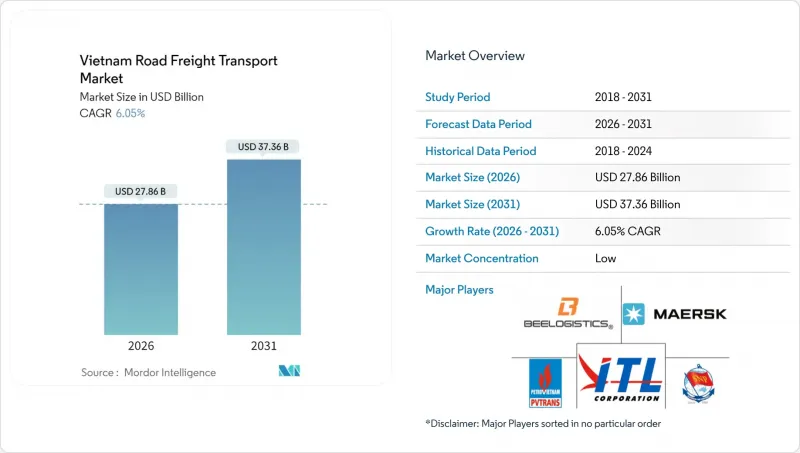
這項擴張反映了持續的基礎設施投資、不斷擴大的產業叢集以及加速數位化應用共同作用,旨在提高貨運效率,並將貨物可視性樹立為新的行業標準。基於國家5000公里目標的高速公路建設正在穩步推進,這將縮短南北運輸時間,為出口商提供可預測的前置作業時間,並為製定具有競爭力的路線策略奠定基礎。隨著托運人對即時運價搜尋、即時追蹤和動態路線最佳化等功能的需求日益成長,數位化貨運平台正迅速發展。同時,在主要都會區試運行電動卡車標誌著向低排放運輸的逐步轉型。即使在DSV和DB Schenker於2025年4月合併之後,競爭格局依然分散,因為本地專家仍然掌握著詳盡的路線資訊,並與越南製造業保持著緊密的聯繫。 「智慧門戶」計劃的跨境改革進一步鞏固了越南作為連接中國和東協貿易路線門戶的地位。
越南公路貨運市場趨勢及展望
到2030年,高速公路網將迅速擴張至5,000公里。
越南計劃在2030年建成總長5,000公里的高速公路網,其中包括一條耗資250億美元、全長1,811公里的南北高速公路。這條高速公路將使河內和胡志明市之間的通行時間縮短多達40%。專用貨運車道將緩解目前90%的貨車通行量所佔國道的擁擠狀況,使運輸公司能夠提高裝載率並降低燃油成本。沿線製造商將能夠更靈活地調整零件到貨時間和生產計畫,從而減少庫存積壓。通往邊境口岸的新支線將促進與中國和寮國的貿易往來,使越南成為東協與中國之間貨運的首選陸路橋樑。完善的實體網路,結合收費站的互通性和4G/5G網路覆蓋,將支援即時車輛診斷和路線最佳化。
快速發展的電子商務和零售物流
預計到2025年,線上零售額將達到570億美元,將推動物流公司轉向樞紐輻射式營運模式和城市微型倉配中心。配送頻率不斷提高,而平均包裹尺寸卻在縮小,這促使車隊多元化發展,包括小型貨車和用於生鮮食品訂單的冷藏最後一公里配送車。越南電信郵政(ViettelPost)已擴展其跨境小包裹服務,並整合了API介面的追蹤功能,以實現關鍵邊境口岸的自動清關。投資人正大力投資倉儲機器人技術和基於人工智慧的路線規劃器,以減少配送失敗率。區域擴張策略正在二、三線城市增設配送中心,擴大潛在需求,但營運商在維持成本效益方面面臨挑戰。
物流成本佔GDP的比例持續居高不下。
到2024年,越南物流成本佔GDP的比例將達到16.8%,遠高於已開發經濟體10-11%的水準。運輸方式分散、回程傳輸匹配不佳以及繁瑣的海關手續推高了交貨成本,並限制了中小企業使用公路貨運。尤其是在農村地區,遵守ISO 22000和HACCP標準增加了文書工作和低溫運輸設備的成本,而基礎設施支援不足。出口商為了因應前置作業時間的不確定性而持有額外的緩衝庫存,這增加了營運資金需求,並削弱了其在價格敏感型農產品領域的競爭力。
細分市場分析
到2025年,製造業將佔越南貨運量的35.12%,反映出越南公路貨運市場正向該國的電子和機械組裝叢集轉型。受製造業主導的貨運需求推動,越南公路貨運市場規模預計將穩定成長,這得益於工廠使用率的提高和國內零件採購的深入。同時,受電子商務的驅動,批發和零售業預計將在2026年至2031年間以6.55%的複合年成長率成長,這將刺激高頻補貨需求,並推動運輸網路擴展至郊區配送中心。該領域的趨勢有利於那些能夠提供SKU級別可視性和溫控能力的生鮮食品運輸業者。在公路和港口發展的支撐下,建築材料貨運量將保持穩定。此外,石油和天然氣計劃將需要運輸專用管道和鑽機零件,而目前很少有重型運輸業者能夠提供此類服務。隨著水產品和水果出口的可追溯性法規日益嚴格,農產品運輸商正在投資物聯網托盤和隔熱簾式拖車,以通過歐盟和日本的嚴格檢查。
在越南公路貨運市場,結合倉儲設施和運輸服務的公私合營正為製造商提供一站式物流解決方案。高價值電子產品貨物依賴即時定位追蹤和緊急通知技術,以降低竊盜率為代價,但也導致保全成本上升。多個貨運交易平台應運而生,用於對接中部地區的回程傳輸貨物,有助於減少空駛里程,並略微降低該行業的成本佔GDP比重。同時,以往依賴海運進行東協內部貨物運輸的製造商,擴大採用道路運輸,以緩解港口堵塞,更快地抵達區域樞紐,從而提升國內貨運公司的運力。
越南南北區域特徵和兩個大都會圈支撐著消費需求,預計2025年,國內貨運市場佔有率將維持在63.45%。然而,國際貨運預計在2026年至2031年間將以7.10%的複合年成長率成長,這表明市場對避免多次港口轉運的門到門道路運輸解決方案的需求將會增加。友義海關的數位化計畫旨在2030年實現高達50%的文書工作自動化,從而縮短清關時間,並鼓勵越南托運人選擇跨境卡車運輸而非多式聯運路線。目前,越南國際公路道路運輸市場規模與越南和中國政府同步進行的監管更新密切相關,兩國都在試驗基於區塊鏈技術的原產地證書。
在國內,高速公路的發展縮短了前置作業時間,使零售商能夠將庫存集中到少數幾個區域配送中心,同時仍能保證當日送達。在國際航運方面,GEODIS已將越南納入亞洲公路網,提供保稅卡車運輸服務至新加坡。憑藉可靠的運輸時間保障,空運的高價優勢受到挑戰。向曼谷和金邊出口水果和家具的中小型企業擴大選擇溫控或毛毯包裹的卡車運輸服務,其收費系統低於短途航線的同等海運貨櫃運費。
到2025年,整車運輸(FTL)將佔80.98%的市場佔有率,主要受大宗貨物運輸和合約製造運輸的推動。然而,線上零售固有的小額訂單正在推動零擔運輸(LTL)的成長,預計2026年至2031年的複合年成長率將達到6.82%。儘管整車運輸在越南公路貨運市場仍佔據主導地位,但技術賦能的零擔共乘模式正日益受到托運人的青睞,他們希望在不犧牲交貨時間的前提下降低成本。路線最佳化演算法將提貨點集中在河內和胡志明市附近,然後透過夜間運輸的方式將貨物拼裝到高速公路拖車上,進行南北向的調度。
整車運輸業者受益於電子產品和服裝出口商提供的穩定貨運量,這些出口商擁有年度卡車配額,從而能夠根據車輛配置進行定價,以保障利潤率。零擔運輸業者則以自動化分類中心和靈活的交貨時間窗口脫穎而出,滿足消費者的期望。隨著承運商採用數位貨運匹配系統,以往未充分利用的卡車貨廂空間正被充分利用,逐步提升整個產業的裝載率和每噸公里二氧化碳排放。
其他福利:
- Excel格式的市場預測(ME)表
- 分析師支持(3個月)
目錄
第1章 引言
- 研究假設和市場定義
- 調查範圍
第2章調查方法
第3章執行摘要
第4章 市場情勢
- 市場概覽
- 按經濟活動分類的GDP分配
- 按經濟活動分類的GDP成長
- 經濟表現及概覽
- 電子商務產業的趨勢
- 製造業趨勢
- 運輸和倉儲業的GDP
- 物流績效
- 道路長度
- 出口趨勢
- 進口趨勢
- 燃油價格趨勢
- 卡車運輸營運成本
- 按車型分類的卡車擁有數量
- 主要卡車供應商
- 公路貨運量趨勢
- 公路貨運價格趨勢
- 透過交通方式分享
- 通貨膨脹
- 法律規範
- 價值鍊和通路分析
- 市場促進因素
- 到2030年,高速公路網將迅速擴張至5,000公里。
- 快速發展的電子商務和零售物流
- 電子元件供應鏈近岸外包外國直接投資激增
- 製造業產出快速成長和工業園區擴張
- 國際金融公司支持的20億美元基金,用於中小企業物流數位化
- 將電動車和替代燃料卡車引入市政合約
- 市場限制
- 物流成本佔GDP的比例持續居高不下。
- 卡車車隊老化(90%的車輛車齡超過5年)
- 中老邊境等待時間出現瓶頸
- 燃油價格波動和煉油廠停產導致運費上漲
- 市場創新
- 波特五力分析
- 新進入者的威脅
- 買方的議價能力
- 供應商的議價能力
- 替代品的威脅
- 競爭對手之間的競爭
第5章 市場規模與成長預測
- 終端用戶產業
- 農業、漁業、林業
- 建造
- 製造業
- 石油天然氣、採礦和採石
- 批發和零售
- 其他
- 目的地
- 國內的
- 國際的
- 卡車裝載規範
- 整車運輸 (FTL)
- 低於100%的運費(零擔運輸)
- 貨櫃運輸
- 貨櫃運輸
- 非貨櫃運輸
- 距離
- 長途
- 短程交通
- 貨物類型
- 液體貨物
- 固態貨物
- 溫度控制
- 非溫控型
- 溫度控制
第6章 競爭情勢
- 市場集中度
- 關鍵策略舉措
- 市佔率分析
- 公司簡介
- AP Moller-Maersk
- ASG Corporation
- Aviation Logistics Corporation
- Bee Logistics Corporation
- CMA CGM Group(Including CEVA Logistics)
- DHL Group
- Expeditors International of Washington, Inc.
- Gemadept
- GEODIS
- Hop Nhat International Joint Stock Company
- Indo Trans Logistics Corporation
- Kintetsu Group Holdings Co., Ltd.
- Linfox Pty Ltd.
- MACS Maritime Joint Stock Company
- MP Logistics
- Nguyen Ngoc Logistics Corporation
- Nippon Express Holdings
- NYK(Nippon Yusen Kaisha)Line
- PetroVietnam Transportation Corporation(PVTrans)
- Royal Cargo, Inc.
- Saigon Newport Corporation
- Transimex
- U&I Logistics Corporation
- VNT Logistics
- Viet Total Logistics Co., Ltd.
- Vietnam Foreign Trade Logistics Joint Stock Company(VINATRANS)
- ViettelPost(including Viettel Logistics)
第7章 市場機會與未來展望
The Vietnam road freight transport market was valued at USD 26.27 billion in 2025 and estimated to grow from USD 27.86 billion in 2026 to reach USD 37.36 billion by 2031, at a CAGR of 6.05% during the forecast period (2026-2031).
This expansion reflects sustained infrastructure spending, expanding industrial clusters, and accelerating digital adoption that collectively improve freight productivity and make shipment visibility the new industry baseline. Continued expressway build-out under the 5,000 km national target compresses north-south transit times, supports predictable lead times for exporters, and underpins competitive routing strategies. Digital freight platforms gain ground as shippers demand instantaneous rate discovery, real-time tracking, and dynamic route optimization, while electric truck pilots in major metro areas signal a gradual shift toward low-emission haulage. Competition remains fragmented even after the April 2025 DSV-DB Schenker merger because local specialists retain intimate route knowledge and strong relationships with Vietnamese manufacturers. Cross-border reforms at smart gate projects further widen the country's gateway role between China and ASEAN trade lanes.
Vietnam Road Freight Transport Market Trends and Insights
Rapid Expressway Expansion to 5,000 Km by 2030
Vietnam aims to complete 5,000 km of expressways by 2030, including the USD 25 billion, 1,811 km North-South backbone that will slash travel time between Hanoi and Ho Chi Minh City by up to 40%. Dedicated freight lanes alleviate congestion on national highways where 90% of trucks currently operate, allowing carriers to boost payload utilization and cut fuel costs. Manufacturers along the corridor gain flexibility to synchronize inbound component flows with production timetables, thereby reducing buffer inventories. New spur links to border checkpoints unlock trade potential with China and Laos, positioning Vietnam as a preferred overland bridge for ASEAN-China cargo. The improved physical network, when paired with tolling interoperability and 4G/5G coverage, supports real-time vehicle diagnostics and route optimization.
Booming E-Commerce and Retail Logistics
Online retail sales are projected to reach USD 57 billion in 2025, a figure that pushes carriers toward hub-and-spoke models and urban micro-fulfillment centers. Average shipment sizes fall even as delivery frequency rises, prompting fleet diversification into smaller vans and refrigerated last-mile vehicles for fresh grocery orders. ViettelPost expanded its cross-border parcel service and embedded API-driven tracking that automates customs clearance at major crossings. Investors fund warehouse robotics and AI-based route planners that reduce failed delivery attempts. Rural outreach strategies add second- and third-tier city spokes to networks, broadening addressable demand while challenging operators to maintain cost efficiency.
Persistently High Logistics-to-GDP Cost Ratio
Vietnam's 16.8% logistics cost-to-GDP ratio in 2024 significantly exceeds the 10-11% levels seen in developed economies. Fragmented transport modes, limited backhaul matching, and cumbersome customs processes inflate delivered-goods pricing and limit road freight adoption among SMEs. Compliance with ISO 22000 and HACCP adds paperwork and cold-chain hardware expenses without matching infrastructure support, especially in rural districts. Exporters incur additional buffer inventories to hedge against uncertain lead times, inflating working capital requirements and weakening competitiveness on price-sensitive agricultural goods.
Other drivers and restraints analyzed in the detailed report include:
- Surge in Near-Shoring FDI for Electronics Supply Chains
- Manufacturing Output Surge and Industrial-Park Build-Out
- Aging Truck Fleet Exceeding Five Years for 90% of Vehicles
For complete list of drivers and restraints, kindly check the Table Of Contents.
Segment Analysis
Manufacturing represented 35.12% of 2025 shipments, underscoring how the Vietnam road freight transport market mirrors the nation's pivot into electronics and machinery assembly clusters. Vietnam road freight transport market size for manufacturing-driven consignments is forecast to scale consistently as plant utilization rises and component sourcing deepens domestically. Wholesale and retail trade, propelled by e-commerce, is set to expand faster at a 6.55% CAGR between 2026-2031, stimulating high-frequency replenishment demand that stretches carrier networks into suburban fulfillment nodes. The segment dynamics reward operators that offer SKU-level visibility and temperature-controlled capacity to meet fresh grocery deliveries. Construction cargoes remain stable, anchored by road and port developments, whereas oil and gas projects mandate specialized tubular and rig-component transport that only a handful of heavy-haul carriers can furnish. As traceability mandates tighten in seafood and fruit exports, agriculture shippers invest in IoT-enabled pallets and insulated curtainsider trailers to pass stringent EU and Japanese inspections.
The Vietnam road freight transport market benefits from public-private partnerships that bundle warehouse property with trucking services, giving manufacturers a one-stop logistics solution. High-value electronics consignments rely on real-time geofencing and panic-button technology, elevating security costs but reducing pilferage rates. Multiple freight exchanges arise to match backhaul loads from central provinces, helping reduce empty-run kilometers and slightly easing the sector's cost-to-GDP ratio. At the same time, manufacturers that previously leaned on sea freight for intra-ASEAN moves now deploy road to bridge port congestion or reach regional hubs faster, expanding addressable tonnage for domestic carriers.
Domestic traffic retained a 63.45% share in 2025 as north-south linear geography and two mega-cities anchor consumer demand clusters. Yet international consignments posting a 7.10% CAGR between 2026-2031 point to rising appetite for door-to-door road solutions that circumvent multiple port hand-offs. Customs digitalization at Hữu Nghị is designed to automate up to 50% of paperwork by 2030, cutting clearance time benchmarks and encouraging Vietnamese shippers to book cross-dock truck runs instead of multimodal routings. Vietnam road freight transport market size for cross-border loads is now tied to synchronized regulatory upgrades between Vietnamese and Chinese authorities who trial blockchain-based certificates of origin.
Domestically, the expressway roll-out compresses lead times, enabling retailers to consolidate inventory into fewer regional DCs while still honoring same-day delivery promises. For international moves, GEODIS stitched Vietnam into its Asia Road Network, offering bonded trucking to Singapore with hard transit commitments that challenge airfreight's price premium. SMEs exporting fruit or furniture to Bangkok and Phnom Penh increasingly book temperature-regulated or blanket-wrapped truck services as rates undercut comparable ocean box-rates on short-haul corridors.
Full-truck-load (FTL) commands 80.98% share in 2025 thanks to bulk commodity flows and manufacturing contract carriage. However, fragmented order sizes inherent in online retail lift the LTL growth trajectory to 6.82% CAGR between 2026-2031. Vietnam road freight transport market share for FTL remains high but tech-enabled LTL pooling gains trust among shippers seeking cost savings without sacrificing delivery windows. Route-optimization algorithms cluster pickups around Hanoi and Ho Chi Minh City belts before dispatching consolidated line-haul trailers south- and northbound overnight.
FTL operators enjoy predictable volumes from electronics and apparel exporters that secure annual truck quotas, enabling asset-specific pricing that protects margins. LTL specialists differentiate via automated sortation hubs and configurable delivery slots that satisfy consumer-side expectations. As carriers adopt digital freight matching, previously under-utilized truck deck space is monetized, gradually improving industry load factors and CO2 per-ton-kilometer metrics.
The Vietnam Road Freight Transport Market Report is Segmented by End User Industry (Manufacturing, and More), Destination (Domestic and International), Truckload Specification (FTL and LTL), Distance (Long Haul and Short Haul), Goods Configuration (Fluid Goods and Solid Goods), Temperature Control (Non-Temperature and Temperature Controlled), and by Containerization. The Market Forecasts are Provided in Terms of Value (USD).
List of Companies Covered in this Report:
- A.P. Moller-Maersk
- ASG Corporation
- Aviation Logistics Corporation
- Bee Logistics Corporation
- CMA CGM Group (Including CEVA Logistics)
- DHL Group
- Expeditors International of Washington, Inc.
- Gemadept
- GEODIS
- Hop Nhat International Joint Stock Company
- Indo Trans Logistics Corporation
- Kintetsu Group Holdings Co., Ltd.
- Linfox Pty Ltd.
- MACS Maritime Joint Stock Company
- MP Logistics
- Nguyen Ngoc Logistics Corporation
- Nippon Express Holdings
- NYK (Nippon Yusen Kaisha) Line
- PetroVietnam Transportation Corporation (PVTrans)
- Royal Cargo, Inc.
- Saigon Newport Corporation
- Transimex
- U&I Logistics Corporation
- VNT Logistics
- Viet Total Logistics Co., Ltd.
- Vietnam Foreign Trade Logistics Joint Stock Company (VINATRANS)
- ViettelPost (including Viettel Logistics)
Additional Benefits:
- The market estimate (ME) sheet in Excel format
- 3 months of analyst support
TABLE OF CONTENTS
1 Introduction
- 1.1 Study Assumptions and Market Definition
- 1.2 Scope of the Study
2 Research Methodology
3 Executive Summary
4 Market Landscape
- 4.1 Market Overview
- 4.2 GDP Distribution by Economic Activity
- 4.3 GDP Growth by Economic Activity
- 4.4 Economic Performance and Profile
- 4.4.1 Trends in E-Commerce Industry
- 4.4.2 Trends in Manufacturing Industry
- 4.5 Transport and Storage Sector GDP
- 4.6 Logistics Performance
- 4.7 Length of Roads
- 4.8 Export Trends
- 4.9 Import Trends
- 4.10 Fuel Pricing Trends
- 4.11 Trucking Operational Costs
- 4.12 Trucking Fleet Size by Type
- 4.13 Major Truck Suppliers
- 4.14 Road Freight Tonnage Trends
- 4.15 Road Freight Pricing Trends
- 4.16 Modal Share
- 4.17 Inflation
- 4.18 Regulatory Framework
- 4.19 Value Chain and Distribution Channel Analysis
- 4.20 Market Drivers
- 4.20.1 Rapid Expressway Expansion to 5,000 Km by 2030
- 4.20.2 Booming E-Commerce and Retail Logistics
- 4.20.3 Surge in Near-Shoring FDI for Electronics Supply Chains
- 4.20.4 Manufacturing Output Surge and industrial-Park Build-Out
- 4.20.5 IFC-Backed USD 2 Billion Fund for SME Logistics Digitalization
- 4.20.6 Adoption of Electric/Alt-Fuel Trucks in Municipal Contracts
- 4.21 Market Restraints
- 4.21.1 Persistently High Logistics-to-GDP Cost Ratio
- 4.21.2 Aging Truck Fleet >5 Yrs for 90 % of Vehicles
- 4.21.3 Border-Crossing Dwell-Time Bottlenecks with China and Laos
- 4.21.4 Volatile Fuel Prices and Refinery Disruptions Raise Haulage Rates
- 4.22 Technology Innovations in the Market
- 4.23 Porter's Five Forces Analysis
- 4.23.1 Threat of New Entrants
- 4.23.2 Bargaining Power of Buyers
- 4.23.3 Bargaining Power of Suppliers
- 4.23.4 Threat of Substitutes
- 4.23.5 Competitive Rivalry
5 Market Size and Growth Forecasts (Value, USD)
- 5.1 End User Industry
- 5.1.1 Agriculture, Fishing, and Forestry
- 5.1.2 Construction
- 5.1.3 Manufacturing
- 5.1.4 Oil and Gas, Mining and Quarrying
- 5.1.5 Wholesale and Retail Trade
- 5.1.6 Others
- 5.2 Destination
- 5.2.1 Domestic
- 5.2.2 International
- 5.3 Truckload Specification
- 5.3.1 Full-Truck-Load (FTL)
- 5.3.2 Less than-Truck-Load (LTL)
- 5.4 Containerization
- 5.4.1 Containerized
- 5.4.2 Non-Containerized
- 5.5 Distance
- 5.5.1 Long Haul
- 5.5.2 Short Haul
- 5.6 Goods Configuration
- 5.6.1 Fluid Goods
- 5.6.2 Solid Goods
- 5.7 Temperature Control
- 5.7.1 Non-Temperature Controlled
- 5.7.2 Temperature Controlled
6 Competitive Landscape
- 6.1 Market Concentration
- 6.2 Key Strategic Moves
- 6.3 Market Share Analysis
- 6.4 Company Profiles (Includes Global Level Overview, Market Level Overview, Core Segments, Financials as Available, Strategic Information, Market Rank/Share for Key Companies, Products and Services, and Recent Developments)
- 6.4.1 A.P. Moller-Maersk
- 6.4.2 ASG Corporation
- 6.4.3 Aviation Logistics Corporation
- 6.4.4 Bee Logistics Corporation
- 6.4.5 CMA CGM Group (Including CEVA Logistics)
- 6.4.6 DHL Group
- 6.4.7 Expeditors International of Washington, Inc.
- 6.4.8 Gemadept
- 6.4.9 GEODIS
- 6.4.10 Hop Nhat International Joint Stock Company
- 6.4.11 Indo Trans Logistics Corporation
- 6.4.12 Kintetsu Group Holdings Co., Ltd.
- 6.4.13 Linfox Pty Ltd.
- 6.4.14 MACS Maritime Joint Stock Company
- 6.4.15 MP Logistics
- 6.4.16 Nguyen Ngoc Logistics Corporation
- 6.4.17 Nippon Express Holdings
- 6.4.18 NYK (Nippon Yusen Kaisha) Line
- 6.4.19 PetroVietnam Transportation Corporation (PVTrans)
- 6.4.20 Royal Cargo, Inc.
- 6.4.21 Saigon Newport Corporation
- 6.4.22 Transimex
- 6.4.23 U&I Logistics Corporation
- 6.4.24 VNT Logistics
- 6.4.25 Viet Total Logistics Co., Ltd.
- 6.4.26 Vietnam Foreign Trade Logistics Joint Stock Company (VINATRANS)
- 6.4.27 ViettelPost (including Viettel Logistics)
7 Market Opportunities and Future Outlook
- 7.1 White-Space and Unmet-Need Assessment

 歐洲公路貨運:2026 年
 西班牙公路貨運:市場佔有率分析、行業趨勢和統計數據以及成長預測(2026-2031 年)英國公路貨運:市場佔有率分析、產業趨勢與統計、成長預測(2026-2031 年)印尼陸上貨運:市場佔有率分析、行業趨勢和統計數據以及成長預測(2026-2031 年)
 2026-2030年全球公路貨運市場
 2026年全球公路貨運市場報告
 陸上貨運市場:2026-2032年全球市場預測(依服務類型、貨物類型、所有權、車輛類型及最終用途分類)
 公路貨運服務市場機會、成長促進因素、產業趨勢分析、預測(2026-2035年)美國公路貨運:市場佔有率分析、行業趨勢和統計數據、成長預測(2026-2031 年)日本公路貨運:市佔率分析、產業趨勢與統計及成長預測(2026-2031)