


 |
市場調查報告書
商品編碼
1911498
印度公路貨運:市場佔有率分析、產業趨勢與統計、成長預測(2026-2031)India Road Freight Transport - Market Share Analysis, Industry Trends & Statistics, Growth Forecasts (2026 - 2031) |
||||||

※ 本網頁內容可能與最新版本有所差異。詳細情況請與我們聯繫。
印度公路貨運市場規模預計從2025年的1,539億美元成長到2026年的1,675.1億美元,預計到2031年將達到2,559.2億美元,2026年至2031年的複合年成長率為8.84%。
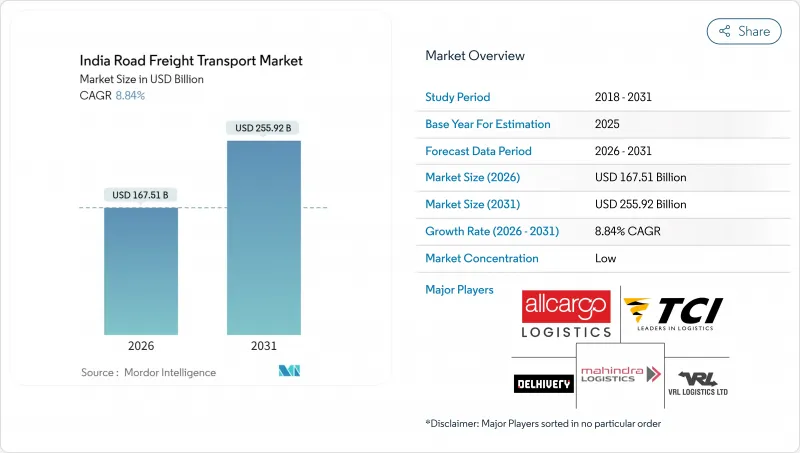
這一令人矚目的成長反映了印度作為全球成長最快的主要經濟體的地位,其主要驅動力包括強勁的製造業復甦、蓬勃發展的電子商務以及公共部門大力推進的高速公路和多模態走廊建設。基礎設施的改善,包括146,145公里長的國家高速公路網、FASTag電子收費系統的廣泛應用以及專用貨運走廊的早期建設,正在縮短運輸時間、提高卡車運轉率並緩解運力短缺問題。商品和服務稅(GST)、電子運單和客戶服務等級協定(SLA)的引入,正在推動正規物流服務的普及,因為托運人越來越傾向於選擇合規且技術先進的供應商。同時,受數位支付和區域(三、四線)城市電子商務需求的推動,印度農村消費的成長正在重塑配送路線,並增強中短途貨運的貨運量前景。
印度公路貨運市場趨勢與洞察
履約迅速擴展到第一和第二大都市區以外。
線上零售在三、四線城市的滲透正推動印度公路貨運市場穩定成長。受智慧型手機在農村地區普及和統一支付介面(UPI)支付快速發展的推動,預計2025年至2030年印度電子商務產業將以22%的複合年成長率成長。快速電商業者正在區域城市建立微型倉配中心,以實現10分鐘送達,從而刺激了零擔貨運和越庫作業的需求。 Delhivery的服務範圍擴展至超過18,700個郵遞區號區域,標誌著新一代物流網路的擴張。區域承運商能夠協商各州的檢查、軸重限制和替代性通行稅,因此在獲取以往僅限於非正式網路的貨運方面具有優勢。數位付款基礎消除了貨到付款的摩擦,並支援小包裹透明且可追溯的發票。
促進基礎設施發展:Bharatmala Gatishakti走廊
到2024年,高速公路日均建設里程將達到40公里,凸顯了「印度公路網計畫」(Bharatmala Plan)的強勁勢頭,該計畫的目標是建成34,800公里高速公路。 「加蒂·沙克蒂計畫」(Gati Shakti Plan)下的綜合規劃已將土地徵用核准時間從數年縮短至數月,並促進了公路、鐵路和公共產業設施走廊的整合。港口與工廠之間連通性的提升已使艾哈默德巴德巴德-孟買和德里-坎普爾高速公路的平均卡車速度提高了15%至20%。馬士基承諾在港口區域投資50億美元,顯示跨國公司對走廊性能提升充滿信心。建設熱潮本身也帶動了對水泥、鋼鐵和機械的需求,從而增加了貨運量,加強了基礎製造業物流。
駕駛人和勞動力老化
旺季期間駕駛人導致車輛閒置,德里至孟買以及班加羅爾至清奈之間的運轉率下降高達20%,從而推高了公路貨運價格並延長了前置作業時間。年輕的勞工越來越傾向在電商中心從事輪班工作,而非進行多日跨州運輸,導致經驗豐富的長途貨運人才流失。各邦的培訓中心各自為政,導致技能認證等級參差不齊,安全標準也不一致。重型車輛駕駛人的薪資預計每年成長12%至15%,而這部分成本最終轉嫁給了托運人。儘管安全技術援助卓有成效,但人力資本的限制仍是限制印度公路貨運市場產能擴張的一大因素。
細分市場分析
國內製造業與生產掛鉤激勵機制的結合,吸引了對電子、汽車零件和製藥業的資本投資,因而帶動了出口貨運量的成長。預計2026年至2031年間,製造業將以10.05%的複合年成長率成長,成為印度公路貨運市場成長最快的領域。受消費主導的日常消費品(FMCG)和耐用消費品回流運輸的支撐,批發和零售貿易將保持30.21%的最大佔有率。農業、漁業和林業將保持穩定,但由於工業貨運的成長,其佔有率略有下降。
生產關聯激勵(PLI)工廠正聚集在港口周圍和西部專用貨運走廊(WDCC)的交匯點,從而提升了古吉拉突邦-馬哈拉斯特拉邦-德里沿線的運輸密度。假設政策維持穩定且外國直接投資(FDI)持續成長,預計到2031年,印度製造業貨物的公路貨運市場規模將超過5,42億美元。隨著低溫運輸缺口的縮小,農業部門的佔有率預計將穩定在10%左右。雖然專用貨運走廊正推動鐵路運輸向更高價值的領域發展,但托運人對門到門柔軟性的偏好仍然保護著道路運輸營運商免受運輸方式轉變的影響。
儘管國內航運網路仍將佔據主導地位,預計到2025年將佔63.02%的市場佔有率,但未來的成長預計將轉向跨境航運網路,2026年至2031年的複合年成長率將達到10.23%。近期成長要素包括印度-孟加拉國走廊的無紙化清關以及IMEC的管道計劃,預計將降低西行貨物的多模態成本。馬士基專注於內陸港口的投資旨在到2030年將出口貨櫃處理能力加倍,預計將提升國際航運在印度公路貨運市場的佔有率。
印度海關平均停留時間為85小時,與亞洲主要樞紐相比仍存在瓶頸。預計數位化清關和基於區塊鏈的載貨證券將顯著縮短這一時間,越來越多的出口商將選擇結合公路和鐵路的貨櫃運輸環線。儘管隨著國內消費的成長,國內運輸距離仍將增加,但全球供應鏈的重組將使印度成為中國的替代選擇,並透過新興的陸海走廊,促進通往海灣合作理事會成員國和歐洲的雙邊路線。
到2025年,整車運輸(FTL)在礦物、鋼捲和預包裝快速消費品(FMCG)領域的市佔率將維持在80.12%。然而,從2026年到2031年,零擔運輸(LTL)的複合年成長率將達到9.89%,超過印度整體公路貨運市場的成長速度。位於那格浦爾、印多爾和海得拉巴的樞紐輻射式倉庫支援快速轉運,使90%的城市對之間的交貨時間縮短至48小時以內。透過演算法將混合貨物分配到托盤集裝箱,提高了裝載率並降低了每公里成本。
輕資產第三方物流利用自營的微型車隊進行最後一公里配送,以最小的資本投入擴大覆蓋範圍。貨運平台提供動態儀錶板和有保障的配送時段,從而實現可預測服務的溢價定價。整車運輸 (FTL) 對大宗貨物仍然很重要,但隨著小批量貨物運輸的日益普遍,其佔有率預計將略有下降。
其他福利:
- Excel格式的市場預測(ME)表
- 分析師支持(3個月)
目錄
第1章 引言
- 研究假設和市場定義
- 調查範圍
第2章調查方法
第3章執行摘要
第4章 市場情勢
- 市場概覽
- 按經濟活動分類的GDP分配
- 按經濟活動分類的GDP成長
- 經濟表現及概況
- 電子商務產業的趨勢
- 製造業趨勢
- 運輸和倉儲業GDP
- 物流績效
- 道路長度
- 出口趨勢
- 進口趨勢
- 燃油價格趨勢
- 卡車運輸營運成本
- 按車型分類的卡車擁有數量
- 主要卡車供應商
- 公路貨運量趨勢
- 公路貨運價格趨勢
- 按交通方式分享
- 通貨膨脹
- 法律規範
- 價值鍊和通路分析
- 市場促進因素
- 電子商務物流履約需求正快速擴展到主要都會區(第一線和二線城市)以外的地區。
- 促進基礎設施發展(透過「印度公路網計畫」和「加蒂沙克蒂走廊」)。
- 微企業擴大採用有組織的第三方/第四方物流模式
- 合理化替代燃料(CNG/LNG)關稅
- 數位貨運市場的快速擴張
- 針對時效性強、保存期限短產品的綠色通道政策
- 市場限制
- 駕駛人和勞動力老化
- 鐵路車輛報廢政策的延遲意味著老舊車輛繼續運作,從而增加了成本。
- 儘管FASTag自動化技術普及,通行費仍上漲。
- 主要都會區以外缺乏冷藏和冷凍物流基地
- 市場創新
- 波特五力分析
- 新進入者的威脅
- 買方的議價能力
- 供應商的議價能力
- 替代品的威脅
- 競爭對手之間的競爭
第5章 市場規模與成長預測
- 終端用戶產業
- 農業、漁業、林業
- 建造
- 製造業
- 石油天然氣、採礦和採石
- 批發和零售
- 其他
- 目的地
- 國內的
- 國際的
- 卡車裝載規範
- 整車運輸 (FTL)
- 低於100%的運費(零擔運輸)
- 貨櫃運輸
- 貨櫃運輸
- 非貨櫃運輸
- 距離
- 長途
- 短程交通
- 貨物類型
- 液體貨物
- 固態貨物
- 溫度控制
- 非溫控型
- 溫度控制
第6章 競爭情勢
- 市場集中度
- 關鍵策略舉措
- 市佔率分析
- 公司簡介
- AP Moller-Maersk
- Allcargo Logistics(including Gati Express)
- CJ Darcl Logistics Limited
- Delhivery Ltd.
- DHL Group
- Expeditors International of Washington, Inc.
- GEODIS
- Mahindra Logistics
- Nippon Express Holdings
- Transport Corporation of India(TCI)
- V-Trans
- Varuna Group
- VRL Logistics Ltd.
- Safexpress
- Shree Tirupati Logistics
- Xpressbees
- Om Logistics Supply Chain
- CKB Group
- Glottis
- SAR Logistics
第7章 市場機會與未來展望
India road freight transport market size in 2026 is estimated at USD 167.51 billion, growing from 2025 value of USD 153.9 billion with 2031 projections showing USD 255.92 billion, growing at 8.84% CAGR over 2026-2031.
The headline growth mirrors India's position as the world's fastest-growing major economy, with a robust manufacturing revival, a booming e-commerce sector, and a decisive public-sector push on highways and multimodal corridors. Infrastructure additions such as the 146,145 km national highway network, widespread FASTag tolling, and the early roll-out of Dedicated Freight Corridors are shrinking transit times, lifting truck utilization, and easing capacity shortages. Organized logistics penetration is rising as GST, e-way bills, and customer-side service-level agreements push shippers toward compliant, technology-equipped providers. Meanwhile, India's rural consumption story, backed by digital payments and tier-3 and tier-4 e-commerce demand, is redrawing delivery routes and fortifying volume prospects for small and mid-distance hauls.
India Road Freight Transport Market Trends and Insights
E-commerce Fulfilment Boom Beyond Tier-1 and Tier-2 Cities
Penetration of online retail into tier-3 and tier-4 catchments is propelling steady incremental volumes for the India road freight transport market. India's e-commerce sector is tracking a 22% CAGR between 2025-2030 as rural smartphone ownership and UPI payments scale rapidly. Quick-commerce players are building micro-fulfilment hubs in secondary towns to meet ten-minute delivery pledges, raising demand for LTL consolidation and cross-docking. Delhivery now covers 18,700+ pin codes, signaling the breadth of new-age distribution lanes. Regional carriers that can negotiate state-level border checks, axle-load limits, and octroi substitutes are positioned to win loads that once stayed within informal networks. The digital payment backbone removes cash-on-delivery friction and supports transparent, trackable invoicing for small consignments.
Infrastructure Push via Bharatmala and Gati Shakti Corridors
Daily highway construction hit 40 km in 2024, underscoring the momentum behind Bharatmala's 34,800 km mandate. Integrated planning under PM Gati Shakti has compressed right-of-way approvals from multiple years to months and is aligning road, rail, and utility corridors. Improved port-to-factory links are already nudging average truck speeds upward by 15-20% on the Ahmedabad-Mumbai and Delhi-Kanpur arteries. Maersk's USD 5 billion port-side investment commitment underlines multinational confidence in corridor performance gains. The construction boom itself churns freight for cement, steel, and machinery, adding volume layers that reinforce basal manufacturing flows.
Driver Shortage and Ageing Workforce
Peak-season fleet idling due to driver gaps has clipped utilization by up to 20% on Delhi-Mumbai and Bangalore-Chennai sectors, inflating line-haul rates and stretching lead times. Young workers favor predictable shifts in e-commerce hubs over week-long interstate runs, causing an experience drain in long-haul trucking. State-run training centers work in silos, leaving skills certification uneven and safety standards patchy. Wage inflation, estimated at 12-15% year-on-year for heavy-vehicle operators, compounds cost-pass-through into shipper tariffs. Safety-tech aids help, yet human capital constraints remain a drag on capacity expansion in the India road freight transport market.
Other drivers and restraints analyzed in the detailed report include:
- Growing Adoption of Organized 3PL/4PL Models by MSMEs
- Rapid Scaling of Digital Freight Marketplaces
- Slow Adoption of Vehicle-Scrappage Policy
For complete list of drivers and restraints, kindly check the Table Of Contents.
Segment Analysis
Domestic manufacturing's link to Production Linked Incentive schemes is attracting electronics, auto-component, and pharmaceutical cap-ex, translating to elevated outbound tonnage. With a 10.05% CAGR between 2026-2031, manufacturing contributes the highest incremental volume to the India road freight transport market. Wholesale and Retail Trade remains the single-largest shareholder at 30.21%, powered by consumption-led FMCG and consumer durables backflows. Agriculture, Fishing, and Forestry retains a steady base, though its share inches down as industrial freight climbs.
PLI-linked factories are clustering near ports and Western Dedicated Freight Corridor junctions, prompting higher load density on Gujarat-Maharashtra-Delhi stretches. The Indian road freight transport market size for manufacturing consignments is likely to exceed USD 54.2 billion by 2031, assuming stable policy continuity and sustained foreign direct investment. Agriculture's share may steady around the low-teens as cold-chain gaps narrow, all else equal. Shipper preference for door-to-door flexibility continues to shield road carriers from modal leakage, even as Dedicated Freight Corridors bring rail into higher-value brackets.
The domestic lattice dominates today with a 63.02% share in 2025, yet future growth tilts toward cross-border links, which are clocking a 10.23% CAGR between 2026-2031. Near-term catalysts include paperless customs on the India-Bangladesh corridor and IMEC's pipeline, which promises multimodal savings on westbound cargo. Maersk's hinterland-driven port investments aim to double export-bound container capacity by 2030, lifting the international slice of the India road freight transport market.
Customs dwell time, averaging 85 hours, remains a bottleneck compared with leading Asian hubs. Digital customs and blockchain-enabled bills of lading are expected to chop that figure materially, pulling more exporters toward truck-plus-rail containerized loops. Domestic mileage will still swell as rural consumption rises, but global supply-chain realignments position India as a China-plus-one alternative, spurring bilateral lanes into GCC and Europe via emerging land-sea corridors.
Full-Truck-Load kept 80.12% share in 2025, serving minerals, steel coils, and packaged FMCG. Yet LTL's 9.89% CAGR between 2026-2031 outpaces the overall India road freight transport market. Hub-and-spoke depots in Nagpur, Indore, and Hyderabad feed rapid trans-shipment, cutting delivery promises to under 48 hours for 90% of urban pairs. Algorithms allocate mixed orders into palletized pods, lifting fill factors and shrinking per-kilo costs.
Asset-light third-party logistics use owner-operator micro fleets for last-mile links, minimizing cap-ex and accelerating coverage. Freight platforms supply dynamic dashboards that guarantee slot times, unlocking premium pricing for predictable service. FTL will remain irreplaceable for bulk commodities, yet its share ratio is projected to erode marginally as parcelization broadens.
The India Road Freight Transport Market Report is Segmented by End User Industry (Manufacturing, and More), Destination (Domestic and International), Truckload Specification (FTL and LTL), Distance (Long Haul and Short Haul), Goods Configuration (Fluid Goods and Solid Goods), Temperature Control (Non-Temperature and Temperature Controlled), and by Containerization. The Market Forecasts are Provided in Terms of Value (USD).
List of Companies Covered in this Report:
- A.P. Moller-Maersk
- Allcargo Logistics (including Gati Express)
- CJ Darcl Logistics Limited
- Delhivery Ltd.
- DHL Group
- Expeditors International of Washington, Inc.
- GEODIS
- Mahindra Logistics
- Nippon Express Holdings
- Transport Corporation of India (TCI)
- V-Trans
- Varuna Group
- VRL Logistics Ltd.
- Safexpress
- Shree Tirupati Logistics
- Xpressbees
- Om Logistics Supply Chain
- CKB Group
- Glottis
- SAR Logistics
Additional Benefits:
- The market estimate (ME) sheet in Excel format
- 3 months of analyst support
TABLE OF CONTENTS
1 Introduction
- 1.1 Study Assumptions and Market Definition
- 1.2 Scope of the Study
2 Research Methodology
3 Executive Summary
4 Market Landscape
- 4.1 Market Overview
- 4.2 GDP Distribution by Economic Activity
- 4.3 GDP Growth by Economic Activity
- 4.4 Economic Performance and Profile
- 4.4.1 Trends in E-Commerce Industry
- 4.4.2 Trends in Manufacturing Industry
- 4.5 Transport and Storage Sector GDP
- 4.6 Logistics Performance
- 4.7 Length of Roads
- 4.8 Export Trends
- 4.9 Import Trends
- 4.10 Fuel Pricing Trends
- 4.11 Trucking Operational Costs
- 4.12 Trucking Fleet Size by Type
- 4.13 Major Truck Suppliers
- 4.14 Road Freight Tonnage Trends
- 4.15 Road Freight Pricing Trends
- 4.16 Modal Share
- 4.17 Inflation
- 4.18 Regulatory Framework
- 4.19 Value Chain and Distribution Channel Analysis
- 4.20 Market Drivers
- 4.20.1 E-Commerce Fulfilment Boom Beyond Tier-1 and Tier-2 Cities
- 4.20.2 Infrastructure Push Via Bharatmala and Gati Shakti Corridors
- 4.20.3 Growing Adoption of Organised 3PL/4PL Models by MSMEs
- 4.20.4 Duty Rationalisation for Alternative Fuels (CNG/LNG)
- 4.20.5 Rapid Scaling of Digital Freight Marketplaces
- 4.20.6 Green-Lane Policy for Time-Critical Perishables
- 4.21 Market Restraints
- 4.21.1 Driver Shortage and Ageing Workforce
- 4.21.2 Slow Adoption of Vehicle-Scrappage Policy Keeps Ageing Fleet Operational, Raising Costs
- 4.21.3 Toll-Cost Inflation Despite FASTag Automation
- 4.21.4 Limited Cold-Chain Nodes Outside Metros
- 4.22 Technology Innovations in the Market
- 4.23 Porter's Five Forces Analysis
- 4.23.1 Threat of New Entrants
- 4.23.2 Bargaining Power of Buyers
- 4.23.3 Bargaining Power of Suppliers
- 4.23.4 Threat of Substitutes
- 4.23.5 Competitive Rivalry
5 Market Size and Growth Forecasts (Value, USD)
- 5.1 End User Industry
- 5.1.1 Agriculture, Fishing, and Forestry
- 5.1.2 Construction
- 5.1.3 Manufacturing
- 5.1.4 Oil and Gas, Mining and Quarrying
- 5.1.5 Wholesale and Retail Trade
- 5.1.6 Others
- 5.2 Destination
- 5.2.1 Domestic
- 5.2.2 International
- 5.3 Truckload Specification
- 5.3.1 Full-Truck-Load (FTL)
- 5.3.2 Less than-Truck-Load (LTL)
- 5.4 Containerization
- 5.4.1 Containerized
- 5.4.2 Non-Containerized
- 5.5 Distance
- 5.5.1 Long Haul
- 5.5.2 Short Haul
- 5.6 Goods Configuration
- 5.6.1 Fluid Goods
- 5.6.2 Solid Goods
- 5.7 Temperature Control
- 5.7.1 Non-Temperature Controlled
- 5.7.2 Temperature Controlled
6 Competitive Landscape
- 6.1 Market Concentration
- 6.2 Key Strategic Moves
- 6.3 Market Share Analysis
- 6.4 Company Profiles (Includes Global Level Overview, Market Level Overview, Core Segments, Financials as Available, Strategic Information, Market Rank/Share for Key Companies, Products and Services, and Recent Developments)
- 6.4.1 A.P. Moller-Maersk
- 6.4.2 Allcargo Logistics (including Gati Express)
- 6.4.3 CJ Darcl Logistics Limited
- 6.4.4 Delhivery Ltd.
- 6.4.5 DHL Group
- 6.4.6 Expeditors International of Washington, Inc.
- 6.4.7 GEODIS
- 6.4.8 Mahindra Logistics
- 6.4.9 Nippon Express Holdings
- 6.4.10 Transport Corporation of India (TCI)
- 6.4.11 V-Trans
- 6.4.12 Varuna Group
- 6.4.13 VRL Logistics Ltd.
- 6.4.14 Safexpress
- 6.4.15 Shree Tirupati Logistics
- 6.4.16 Xpressbees
- 6.4.17 Om Logistics Supply Chain
- 6.4.18 CKB Group
- 6.4.19 Glottis
- 6.4.20 SAR Logistics
7 Market Opportunities and Future Outlook
- 7.1 White-Space and Unmet-Need Assessment

 2026-2030年全球公路貨運市場
 2026年全球公路貨運市場報告
 陸上貨運市場:2026-2032年全球市場預測(依服務類型、貨物類型、所有權、車輛類型及最終用途分類)
 公路貨運服務市場機會、成長促進因素、產業趨勢分析、預測(2026-2035年)
 美國公路貨運:市場佔有率分析、行業趨勢和統計數據、成長預測(2026-2031 年)越南公路貨運:市場佔有率分析、產業趨勢與統計、成長預測(2026-2031)北美公路貨運市場:市場佔有率分析、產業趨勢與統計、成長預測(2026-2031 年)義大利公路貨運:市場佔有率分析、產業趨勢與統計、成長預測(2026-2031 年)
 日本公路貨運市場報告(依產品類型、目的地、整車規格、貨櫃化、距離、溫控、最終用戶和地區分類,2026-2034年)日本公路貨運:市場佔有率分析、產業趨勢與統計、成長預測(2025-2030 年)