

 |
市場調查報告書
商品編碼
1911721
菲律賓電信行動網路營運商 - 市場佔有率分析、產業趨勢與統計、成長預測(2026-2031)Philippines Telecom MNO - Market Share Analysis, Industry Trends & Statistics, Growth Forecasts (2026 - 2031) |
||||||

※ 本網頁內容可能與最新版本有所差異。詳細情況請與我們聯繫。
預計到 2026 年,菲律賓電信行動網路營運商 (MNO) 市場規模將達到 78.1 億美元。
這代表著從 2025 年的 75 億美元成長到 2031 年的 95.8 億美元,2026 年至 2031 年的年複合成長率(CAGR)為 4.16%。
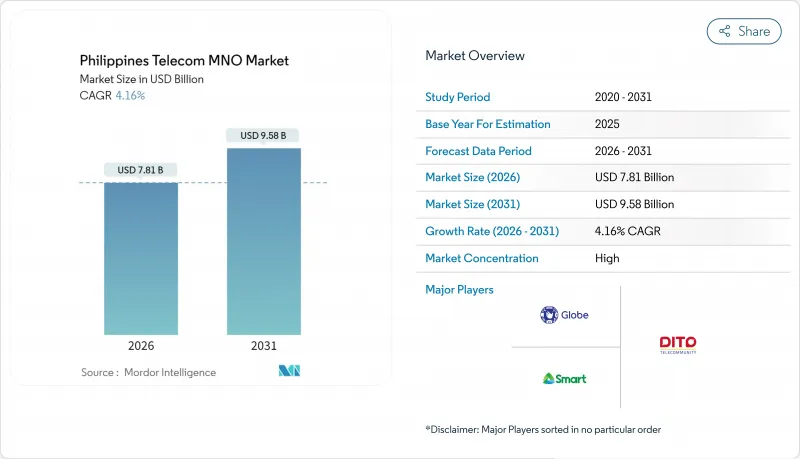
這項成長主要得益於行動資料服務的快速轉型、頻譜改革的推進以及5G網路的日趨成熟,目前5G網路已覆蓋所有主要區域城市。計劃於2026年舉行的新頻譜競標以及強制性基地台共用規則正在降低准入門檻,並擴大服務欠缺地區的網路覆蓋範圍。影片串流媒體和行動遊戲的數據流量持續推動收入成長,而基於金融科技的超級應用則透過將支付、小額貸款和娛樂功能整合到單一登入帳戶中,提高了用戶平均收入(ARPU)。在供應方面,通訊業者正加緊加強網路建設,以應對颱風可能造成的網路中斷,並啟用邊緣資料中心來滿足低延遲的企業運作。
菲律賓電信行動網路營運商市場趨勢與洞察
影片遊戲熱潮導致行動數據消耗量增加
受高清串流媒體和行動電競普及的推動,預計到2024年,菲律賓每月平均數據使用量將達到8.7GB,較2022年成長340%。在Globe Telecom的網路流量尖峰時段,影片流量佔夜間流量的65%,因此該業者正在加速擴容其覆蓋最密集的LTE和5G基地台。在遊戲領域,競技遊戲需要低於30毫秒的延遲,這進一步推動了付費訂閱用戶的成長。全球串流媒體服務商對內容庫的在地化以及菲律賓原創內容的推出,都刺激了數據需求的成長,並促進了用戶獲取。這些因素共同作用,使得行動數據成為菲律賓電信行動網路營運商(MNO)市場的主要收入來源。
5G部署加速和設備價格下降
2024年底,Smart Communications將在馬尼拉大都會區實現95%的人口覆蓋,入門級5G設備的價格也將首次降至10,000披索(約175美元)以下。覆蓋範圍的擴大和價格的降低,使得5G SIM卡用戶數量年增了280%。根據《菲律賓連接器法案》(Connector Dong Pinoy Act),監管流程的簡化將基地台許可證的前置作業時間從18個月縮短至6個月,使營運商能夠提前在人口密集的城市走廊推出服務。設備製造商也透過電子錢包提供分期付款方案,進一步降低了用戶接受5G服務的門檻。這些趨勢支撐了菲律賓電信行動網路營運商(MNO)市場長期收入成長的預測。
營運商面臨投資5G/光纖的壓力
PLDT已為2023-2024會計年度(相當於業務收益的23%)編制了920億披索(約16億美元)的資本支出累計。這主要是由於5G基地台密度增加以及光纖到府(FTTH)在郊區的擴展。每個基地台站點,包括頻譜和回程傳輸邊緣升級,都需要比上一代4G網路多出40%-60%的資金。即將舉行的頻譜競標可能會產生數億美元的領先成本。因此,通訊業者優先考慮ARPU值高的地區,延後遍遠地區的開發,從而減緩了普遍服務的推進速度。
細分市場分析
到2025年,行動資料服務將佔菲律賓通訊業者收入的53.46%,鞏固其在菲律賓行動網路營運商(MNO)市場的主導地位。隨著5G普及率的提升,以及串流影片流量佔高峰流量的60%以上,預計這一佔有率將進一步成長。受馬尼拉大都會智慧城市建設和呂宋島稻米產區農業監測計劃等因素的推動,物聯網(IoT)和機器對機器(M2M)服務將推動菲律賓電信MNO市場規模以4.28%的複合年成長率成長。語音通話收入持續下滑,自2020年以來已下降80%,原因是通訊應用逐漸取代了部分人與人之間的通訊。
為了應對這項挑戰,通訊業者正將OTT影片和音樂訂閱服務捆綁銷售,以實現數據變現並維持客戶參與。商業通訊API正在取代傳統的短信,用於電子商務訂單更新和雙因素認證,從而緩解收入下滑。新興的邊緣雲端服務,例如行動專用網路和網路切片,預計將成為下一波企業合約的基礎。受這些趨勢的影響,以數據為中心的服務產品預計將在預測期內推動菲律賓電信行動網路營運商(MNO)市場的擴張。
菲律賓電信行動網路營運商 (MNO) 市場按服務類型(語音服務、數據網際網路服務、通訊服務、物聯網和機器對機器 (M2M) 服務、OTT 和付費電視服務以及其他服務)和最終用戶(企業、消費者)進行細分。市場預測以價值(美元)和用戶數量(用戶數)為單位。
其他福利
- Excel格式的市場預測(ME)表
- 3個月的分析師支持
目錄
第1章 引言
- 研究假設和市場定義
- 調查範圍
第2章調查方法
第3章執行摘要
第4章 市場情勢
- 市場概覽
- 監理與政策框架
- 當前頻段擁有情形
- 電信業生態系統
- 宏觀經濟與外在因素
- 波特五力模型
- 競爭對手之間的競爭
- 新進入者的威脅
- 供應商的議價能力
- 買方的議價能力
- 替代品的威脅
- 領先行動網路營運商的關鍵績效指標(2020-2025)
- 獨立行動用戶和滲透率
- 行動網路使用者數量和普及率
- 按接入技術分類的SIM卡連線數和滲透率
- 蜂巢式物聯網/M2M連接
- 寬頻連線(移動和固定)
- ARPU(每位用戶平均收入)
- 每用戶平均數據使用量(GB/月)
- 市場促進因素
- 影片遊戲熱潮導致行動數據消耗量增加
- 加速部署 5G 和更經濟實惠的設備
- 政府通用鐵塔和頻譜改革計劃
- 企業數位轉型與物聯網連結需求
- 金融科技超級應用程式(例如 GCash)能夠提高客戶留存率和平均每用戶收入 (ARPU)。
- 抗颱風網路需求推動了密集化建設
- 市場限制
- 通訊業者面臨沉重的5G/光纖資本投資負擔
- 遍遠地區較低的每位用戶平均收入限制了投資收益。
- 透過SIM卡註冊方式取消預付合約
- 氣候變遷導致的通訊中斷增加將提高營運成本和客戶流失風險。
- 技術展望
- 電信領域主要經營模式分析
- 定價模型和定價分析
第5章 市場規模與成長預測
- 通訊總收入和每位用戶平均收入
- 按服務類型
- 語音服務
- 數據和網際網路服務
- 通訊服務
- 物聯網和機器對機器服務
- OTT和付費電視服務
- 其他服務(附加價值服務、漫遊和國際服務、企業和批發服務等)
- 最終用戶
- 公司
- 一般消費者
第6章 競爭情勢
- 市場集中度
- 主要供應商的策略與投資動向(2023-2025)
- 2024年行動網路營運商市場佔有率分析
- 行動網路服務產品基準分析
- 行動網路營運商概況(定期訂閱、解約率、ARPU 等)
- 行動網路營運商公司簡介*
- Globe Telecom
- Smart Communications
- DITO Telecommunity
第7章 市場機會與未來展望
The Philippines Telecom MNO Market size in 2026 is estimated at USD 7.81 billion, growing from 2025 value of USD 7.5 billion with 2031 projections showing USD 9.58 billion, growing at 4.16% CAGR over 2026-2031.
Growth is powered by the rapid pivot to mobile-data services, progressive spectrum reforms and the maturing 5G footprint that now blankets every regional capital. New frequency auctions scheduled for 2026, together with mandatory tower-sharing rules, are lowering entry barriers and widening coverage in underserved municipalities. Data traffic from video streaming and mobile gaming continues to drive incremental revenue, while fintech-anchored super-apps are lifting average revenue per user by bundling payments, micro-loans and entertainment under a single login. On the supply side, operators are racing to harden networks against typhoon-related outages and to bring edge data-centers online for low-latency enterprise workloads.
Philippines Telecom MNO Market Trends and Insights
Rising mobile-data consumption from video and gaming boom
Average monthly data use climbed to 8.7 GB in 2024, a 340% surge since 2022, as high-definition streaming and mobile esports moved into the mainstream. Video now absorbs 65% of peak evening traffic on Globe Telecom's network, prompting the operator to accelerate capacity upgrades on densest LTE and 5G sites. Gaming contributes a further uplift in premium plan uptake because competitive titles require latency below 30 ms. Localization of streaming catalogs by global providers has reinforced this data pull, with Filipino-language originals boosting subscriber acquisition. Together these factors have made mobile data the dominant revenue line in the Philippines telecom MNO market.
Accelerated 5G roll-out and device affordability
By late-2024 Smart Communications reported 95% population coverage in Metro Manila, while entry-level 5G handsets fell below PHP 10,000 (USD 175) for the first time. The confluence of coverage and cost has driven a 280% year-on-year increase in 5G SIMs. Regulatory streamlining under the Konektadong Pinoy Act trimmed tower-permit lead times from 18 months to 6 months, allowing operators to light up dense urban corridors ahead of schedule. Device manufacturers have also bundled installment schemes through e-wallets, further lowering adoption barriers. These trends underpin the long-run revenue uplift baked into the Philippines telecom MNO market forecasts.
Heavy 5G / fiber capex burden on operators
PLDT allocated PHP 92 billion (USD 1.6 billion) in capex during 2024-23% of service revenue-as it densified 5G radios and pushed fiber-to-the-home deeper into suburbs. Each 5G site needs 40-60% more cash than its 4G predecessor once spectrum, backhaul and edge upgrades are included. Upcoming spectrum auctions may add upfront costs running into hundreds of millions of USD. Consequently, carriers prioritize high-ARPU districts and postpone rural builds, slowing universal-service progress.
Other drivers and restraints analyzed in the detailed report include:
- Government common-tower and spectrum-reform programs
- Enterprise digital-transformation and IoT connectivity demand
- Low rural ARPU limiting ROI
For complete list of drivers and restraints, kindly check the Table Of Contents.
Segment Analysis
Mobile-data services generated 53.46% of 2025 operator revenue, confirming their primacy within the Philippines telecom MNO market. This share will widen as 5G penetration spreads beyond early adopters and as streaming video climbs beyond 60% of peak traffic loads. The Philippines telecom MNO market size attributable to IoT and M2M services is forecast to compound at 4.28% annually, underpinned by smart-city deployments in Metro Manila and agro-monitoring projects across Luzon's rice belt. Voice revenue continues its structural retreat-down 80% since 2020-as messaging apps absorb person-to-person traffic.
In response, operators bundle OTT video and music subscriptions, monetizing data while preserving engagement. Business messaging APIs are replacing legacy SMS for e-commerce order updates and two-factor authentication, mitigating revenue loss. Emerging edge-cloud services such as mobile private networks and network slicing are expected to anchor the next wave of enterprise contracts. These dynamics ensure that data-centric offerings will broaden the Philippines telecom MNO market over the forecast horizon.
The Philippines Telecom MNO Market is Segmented by Service Type (Voice Services, Data and Internet Services, Messaging Services, Iot and M2M Services, OTT and PayTV Services, Other Services), End User (Enterprises, Consumers). The Market Forecasts are Provided in Terms of Value (USD) and Volume (Subscribers).
List of Companies Covered in this Report:
- Globe Telecom
- Smart Communications
- DITO Telecommunity
Additional Benefits:
- The market estimate (ME) sheet in Excel format
- 3 months of analyst support
TABLE OF CONTENTS
1 INTRODUCTION
- 1.1 Study Assumptions and Market Definition
- 1.2 Scope of the Study
2 RESEARCH METHODOLOGY
3 EXECUTIVE SUMMARY
4 MARKET LANDSCAPE
- 4.1 Market Overview
- 4.2 Regulatory and Policy Framework
- 4.3 Spectrum Landscape and Competitive Holdings
- 4.4 Telecom Industry Ecosystem
- 4.5 Macroeconomic and External Drivers
- 4.6 Porter's Five Forces
- 4.6.1 Competitive Rivalry
- 4.6.2 Threat of New Entrants
- 4.6.3 Bargaining Power of Suppliers
- 4.6.4 Bargaining Power of Buyers
- 4.6.5 Threat of Substitutes
- 4.7 Key MNO KPIs (2020-2025)
- 4.7.1 Unique Mobile Subscribers and Penetration Rate
- 4.7.2 Mobile Internet Users and Penetration Rate
- 4.7.3 SIM Connections by Access Technology and Penetration
- 4.7.4 Cellular IoT / M2M Connections
- 4.7.5 Broadband Connections (Mobile and Fixed)
- 4.7.6 ARPU (Average Revenue Per User)
- 4.7.7 Average Data Usage per Subscription (GB/month)
- 4.8 Market Drivers
- 4.8.1 Rising mobile-data consumption from video and gaming boom
- 4.8.2 Accelerated 5G roll-out and device affordability
- 4.8.3 Government common-tower and spectrum-reform programs
- 4.8.4 Enterprise digital-transformation and IoT connectivity demand
- 4.8.5 Fin-tech super-apps (e.g., GCash) lifting stickiness and ARPU
- 4.8.6 Typhoon-resilient network requirements driving densification
- 4.9 Market Restraints
- 4.9.1 Heavy 5G / fibre capex burden on operators
- 4.9.2 Low rural ARPU limiting ROI
- 4.9.3 SIM Registration Act-driven prepaid de-activations
- 4.9.4 Climate-related outages raising opex and churn risk
- 4.10 Technological Outlook
- 4.11 Analysis of key business models in Telecom
- 4.12 Analysis of Pricing Models and Pricing
5 MARKET SIZE AND GROWTH FORECASTS (VALUE)
- 5.1 Overall Telecom Revenue and ARPU
- 5.2 Service Type
- 5.2.1 Voice Services
- 5.2.2 Data and Internet Services
- 5.2.3 Messaging Services
- 5.2.4 IoT and M2M Services
- 5.2.5 OTT and PayTV Services
- 5.2.6 Other Services (VAS, Roaming and International Services, Enterprise and Wholesale Services, etc.)
- 5.3 End-User
- 5.3.1 Enterprises
- 5.3.2 Consumer
6 COMPETITIVE LANDSCAPE
- 6.1 Market Concentration
- 6.2 Strategic Moves and Investments by key vendors, 2023-2025
- 6.3 Market share analysis for MNOs, 2024
- 6.4 Product Benchmarking Analysis for mobile network services
- 6.5 MNO snapshot (subscribers, churn rate, ARPU, etc.)
- 6.6 Company Profiles* of MNOs (Includes Business Overview | Service Portfolio | Financials | Business Strategy and Recent Developments | SWOT Analysis)
- 6.6.1 Globe Telecom
- 6.6.2 Smart Communications
- 6.6.3 DITO Telecommunity
7 MARKET OPPORTUNITIES AND FUTURE OUTLOOK
- 7.1 White-space and Unmet-Need Assessment

 2026-2030年全球虛擬行動服務業者(MVNO)服務市場
 中東和非洲行動通訊業者(MNO):市場佔有率分析、產業趨勢、統計數據和成長預測(2026-2031 年)德國行動通訊業者(MNO):市場佔有率分析、產業趨勢與統計、成長預測(2026-2031 年)義大利電信行動網路業者:市場佔有率分析、產業趨勢與統計、成長預測(2026-2031 年)馬來西亞行動通訊業者(MNO)市場佔有率分析、產業趨勢與統計、成長預測(2026-2031)
 5G MVNO市場:2025-2032年全球預測(按套餐類型、最終用戶、設備類型、分銷管道、垂直行業、定價模式和網路類型分類)行動虛擬網路營運商 (MVNO) 市場:2025-2032 年全球預測(按服務類型、分銷管道、費率方案、最終用戶產業和應用分類)
 2025年全球虛擬行動服務業者(MVNO)市場報告虛擬行動服務業者(MVNO):市場佔有率分析、產業趨勢、統計數據和成長預測(2025-2030 年)
 全球物聯網虛擬行動服務業者(MVNO)市場