


 |
市場調查報告書
商品編碼
1910838
中東和非洲數位戶外廣告 (DOOH) - 市場佔有率分析、行業趨勢、統計數據和成長預測 (2026-2031)Middle East And Africa Digital Out Of Home (DOOH) - Market Share Analysis, Industry Trends & Statistics, Growth Forecasts (2026 - 2031) |
||||||

※ 本網頁內容可能與最新版本有所差異。詳細情況請與我們聯繫。
預計到 2026 年,中東和非洲的數位戶外廣告 (DOOH) 市場規模將達到 4.1 億美元。
這代表著從 2025 年的 3.6 億美元成長到 2031 年的 7.5 億美元,2026 年至 2031 年的年複合成長率(CAGR)為 12.95%。
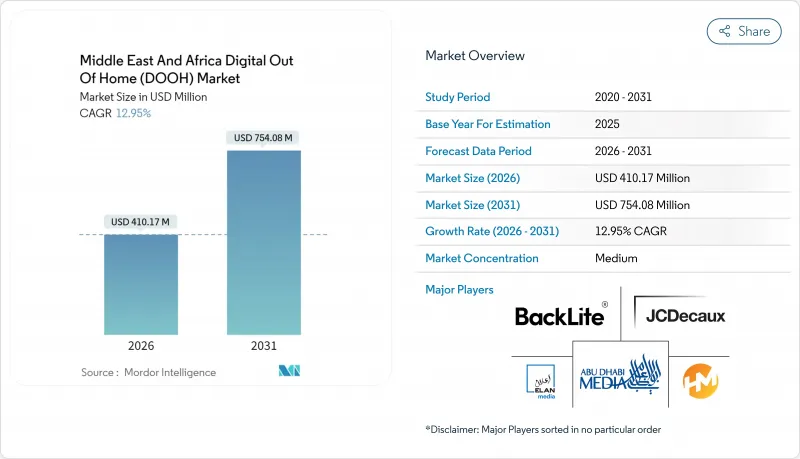
此次擴張反映了NEOM耗資5000億美元的智慧城市基礎設施建設、阿拉伯聯合大公國近乎全國範圍的5G網路部署,以及將戶外螢幕融入交通、零售和旅遊網路的全國性數位轉型計畫。智慧型手機普及率的提高、公共交通網路的擴展以及監管機構對數據驅動型公共服務的推動,正在鞏固中東和北非地區數位戶外廣告(DOOH)市場作為智慧城市核心基礎設施的地位。隨著氣候適應型硬體、可再生能源驅動的LED陣列和人工智慧排播技術與環境法規的契合,國際媒體營運商正在加速投資。同時,區域營運商正透過利用文化專長和政府合作關係,動態地將全球技術與本地夥伴關係相結合,以保護其廣告資源免受新進入者的衝擊。
中東和非洲數位戶外廣告 (DOOH) 市場趨勢與洞察
持續向數位廣告轉型
隨著社群媒體互動達到頂峰,行動網路流量佔總流量的80%以上,區域廣告商正將預算從靜態廣告看板重新分配到資料驅動型網路。埃及的ICT增值預計將在2023年成長15.2%,這反映了數位商務的強勁發展勢頭推動了可衡量的宣傳活動需求。 VIOOH和Broadsign等程序化平台正在改變線上購買方式、受眾細分、動態創新和歸因方式,使其轉向路邊和購物中心螢幕。沙烏地阿拉伯的「2030願景」和阿拉伯聯合大公國的「2021願景」等國家願景將數位戶外廣告(DOOH)資源定位為電子政府應用程式和公共訊息之間的連結紐帶,使中東和北非地區的數位戶外廣告市場成為全通路傳播的重要組成部分。廣告公司正在利用跨裝置標識符,在通勤者接觸到數位匯流排候車亭廣告看板後,向他們的智慧型手機投放同步廣告,展現了傳統戶外廣告無法量化的額外覆蓋範圍。
公共交通基礎設施擴建
海灣合作理事會(GCC)各國政府正大力投資地鐵、電車和快速公車(BRT)計劃,從而創造新的廣告位並培養忠實的客戶群。利雅德地鐵、杜拜2020線和杜哈盧賽爾電車正在增設數百個車站,並計畫配備數位廣告資源。交通管理部門青睞數位廣告形式,允許在同一顯示器上共用時刻表、安全警報和商業內容,從而提升乘客體驗並實現資產變現。穩定的通勤客流量為媒體營運商提供了穩定的廣告曝光率,促使全球品牌重新分配其電視廣告預算。預計到2030年,公共交通客流量將加倍,中東和非洲的數位戶外廣告(DOOH)市場預計將隨著基礎建設的里程碑而穩步成長。
海灣合作理事會成員國實施嚴格的廣告監管。
杜拜2020年第06號法規要求所有廣告必須事先核准,並禁止在某些文化場所投放廣告,這迫使媒體業者謹慎應對錯綜複雜的地方政府和聯邦法規。阿拉伯聯合大公國國家媒體委員會進一步規定,必須大幅使用阿拉伯語,並尊重宗教價值。科威特的授權法對車身動畫廣告徵收額外費用。雖然這些規定旨在保護社會規範,但與西方同行相比,它們也延長了宣傳活動的核准週期,限制了創新自由,並減緩了中東和北非地區數位戶外廣告(DOOH)市場的上線速度。
細分市場分析
至2025年,室內螢幕將佔中東和非洲數位戶外廣告(DOOH)市場的27.35%,預計到2031年將以13.6%的複合年成長率成長。杜拜、利雅德和科威特城的購物中心正在拓展除租金以外的收入來源,在其中庭安裝互動式8K牆,這些牆在非尖峰時段也可作為藝術裝置使用。杜拜機場等機場營運商已與德高集團續簽長期契約,獲得數據豐富的優質廣告資源,每年覆蓋8600萬旅客。購物中心營運商正優先發展室內網路以實現全通路商務,在指示牌上安裝QR碼,引導消費者使用會員應用程式,從而延長顧客停留時間並提高消費額。室內市場的成長也得益於氣候控制,這延長了硬體的使用壽命,並降低了與沙漠高溫相關的維護成本。
到2025年,戶外媒體在中東和非洲地區的數位戶外廣告(DOOH)市場中仍將佔據72.65%的佔有率。例如,阿布達比謝赫扎耶德路和利雅德北部環路沿線的高速公路數位廣告牌,能夠吸引通勤者的目光長達90秒,從而實現更長篇幅的內容展示。政府道路安全法規規定,高達10%的展示時間用於公共訊息,進一步強化了戶外媒體的公共效用。儘管戶外廣告位需要高額的資本投入,但由於其規模和獨特性,其每千次展示成本(CPM)仍然能夠獲得顯著的溢價。智慧城市總體規劃將交通感測器整合到路邊立柱中,打造出物聯網連接的單元,能夠更新內容以進行交通堵塞管理,並將廣告與公共服務資訊融為一體。
到2025年,受中東和非洲以汽車為中心的通勤模式驅動,戶外廣告看板將佔據該地區數位戶外廣告(DOOH)市場佔有率的52.10%。杜拜E11走廊沿線的靜態和影片廣告每週廣告曝光率將達到600萬次,吸引了來自汽車和銀行業等行業的廣告商。然而,預計到2031年,交通廣告的成長速度將超過其他廣告形式,年複合成長率(CAGR)將達到14.05%,這反映了地鐵線路、路面電車線路和快速公車專用道的擴建。例如,利雅德的85個地鐵站將設立專用區域,配備4K螢幕,並與行動購票應用程式和六種語言的擴增實境境地圖相連。
智慧公車候車亭和數位資訊亭等街頭設施正受益於政府競標,這些項目將廣告、無線充電和空氣品質感測器相結合。這種「螢幕+實用功能」模式使營運商能夠同時實現廣告空間和數據分析的雙重獲利,從而提高投資回報率。體育場館、娛樂區和會展中心是小眾但利潤豐厚的領域。 2028年沙烏地阿拉伯特羅傑納滑雪度假村舉辦的亞洲冬季運動會將配備身臨其境型LED隧道,為未來的賽事樹立體驗標竿。
其他福利:
- Excel格式的市場預測(ME)表
- 3個月的分析師支持
目錄
第1章 引言
- 研究假設和市場定義
- 調查範圍
第2章調查方法
第3章執行摘要
第4章 市場情勢
- 市場概覽
- 市場促進因素
- 向數位化廣告的轉型正在進行中。
- 公共交通基礎設施擴建
- 加速程式化數位戶外廣告的普及應用
- 沙烏地阿拉伯的計劃促進智慧城市媒體發展
- 5G賦能的即時動態創新觸發器
- 可再生能源驅動的LED顯示器的ESG推廣
- 市場限制
- 海灣合作理事會成員國實施嚴格的廣告監管。
- 在農村地區繼續使用傳統戶外廣告
- 受眾指標分散
- 高溫環境下的高維護成本
- 產業價值鏈分析
- 技術展望
- 監管環境
- 波特五力分析
- 供應商的議價能力
- 買方的議價能力
- 新進入者的威脅
- 替代品的威脅
- 競爭對手之間的競爭
- 宏觀經濟因素如何影響市場
第5章 市場規模與成長預測
- 按位置
- 室內的
- 戶外
- 透過使用
- 廣告看板
- 運輸
- 街道設施
- 其他用途
- 按銷售管道
- 直接地
- 程序化擔保
- 即時競價(公開交易)
- 按格式類型
- 數位看板
- 數位海報
- 大型LED視訊螢幕
- 互動資訊亭
- 3D全像顯示器
- 最終用戶
- 商業的
- 對機構而言
- 基礎設施
- 零售和娛樂場所
- 按國家/地區
- 沙烏地阿拉伯
- 阿拉伯聯合大公國
- 科威特
- 卡達
- 摩洛哥
- 埃及
- 其他中東和非洲地區
第6章 競爭情勢
- 市場集中度
- 策略趨勢
- 市佔率分析
- 公司簡介
- JCDecaux SE
- ELAN Media WLL
- BackLite Media LLC
- Hypermedia FZ LLC
- Abu Dhabi Media Company PJSC
- Dooha Media WLL
- EyeMedia Advertising WLL
- Pikasso SARL
- Elevision Media FZ LLC
- Al Arabia Outdoor Advertising CJSC
- Faden Media Company Ltd.
- Hills Advertising LLC
- Arabian Outdoor Advertising LLC
- MBC Media Solutions FZ LLC
- Al Barq Digital Media LLC
- Publicity Qatar WLL
- Sahara Media Advertising Co. LLC
- Ethraa Advertising Company LLC
- Wow Media LLC
- Al Fahad Advertising LLC
- Blue Rhine Media LLC
- Pixcom Technologies LLC
第7章 市場機會與未來展望
Middle East and Africa Digital Out-of-Home (DOOH) market size in 2026 is estimated at USD 0.41 billion, growing from 2025 value of USD 0.36 billion with 2031 projections showing USD 0.75 billion, growing at 12.95% CAGR over 2026-2031.
The expansion reflects the integration of NEOM's USD 500 billion smart-city infrastructure, the UAE's near-universal 5G coverage, and country-wide digital transformation agendas that embed out-of-home screens into mobility, retail, and tourism networks. Rising smartphone penetration, public-transit buildout, and a regulatory push toward data-driven public services reinforce the Middle East and Africa Digital Out-of-Home (DOOH) market's positioning as a core smart-city utility. International media owners are accelerating their investment because climate-resilient hardware, renewable-powered LED arrays, and AI scheduling now align with environmental mandates. Regional operators, meanwhile, utilize cultural expertise and government partnerships to safeguard their inventory from new entrants, thereby creating a dynamic blend of global technology and local insight.
Middle East And Africa Digital Out Of Home (DOOH) Market Trends and Insights
Ongoing Shift Toward Digital Advertising
Advertisers in the region are redirecting their budgets from static billboards to data-driven networks as social media engagement peaks and mobile web traffic surpasses 80% of overall browsing. Egypt's ICT value-added increased by 15.2% in FY 2023, reflecting a broader momentum in digital commerce that fuels demand for measurable campaigns. Programmatic platforms such as VIOOH or Broadsign have migrated online buying conventions, audience segments, dynamic creatives, and attribution to roadside and mall screens. National visions, such as Saudi Vision 2030 and UAE Vision 2021, view DOOH inventory as a connective tissue that links e-government apps with public messaging, making the Middle East and Africa Digital Out-of-Home (DOOH) market integral to omnichannel communication. Agencies leverage cross-device identifiers to serve synchronized ads to commuters' phones after exposure to digital bus-shelter panels, proving incremental reach that traditional OOH could not quantify.
Expansion of Public-Transit Infrastructure
GCC governments invest heavily in metro, tram, and bus rapid-transit projects, creating new screen real estate and captive audiences. Riyadh Metro, Dubai Route 2020, and Doha's Lusail tram collectively add hundreds of stations earmarked for digital concessions. Transit authorities prefer digital formats because schedules, safety alerts, and commercial content can be shared on the same display, improving the passenger experience and monetizing assets. The predictable footfall of commuters provides media owners with robust impression counts, encouraging global brands to reallocate their television budgets. With mass-transit passenger volume forecast to double by 2030, the Middle East and Africa Digital Out-of-Home (DOOH) market anticipates steady inventory growth tied to infrastructure milestones.
Stringent Advertising Regulations in GCC
Dubai's 2020 Decree No. 06 requires prior approval for every advertisement and prohibits placements on certain cultural sites, forcing media owners to navigate a complex web of municipal and federal regulations. The UAE's National Media Council further mandates the prominence of the Arabic language and respect for religious values. Kuwait's licensing statutes impose extra fees on animated bus wraps. While the guidelines protect social norms, they prolong campaign approval cycles and limit creative latitude, reducing the speed-to-launch of the Middle East and Africa Digital Out-of-Home (DOOH) market compared to Western peers.
Other drivers and restraints analyzed in the detailed report include:
- Accelerating Adoption of Programmatic DOOH
- Saudi Giga-Projects Boosting Smart-City Media
- Persistence of Traditional OOH in Rural Areas
For complete list of drivers and restraints, kindly check the Table Of Contents.
Segment Analysis
Indoor screens accounted for 27.35% of the Middle East and Africa Digital Out-of-Home (DOOH) market size in 2025 and are projected to register a 13.6% CAGR through 2031. Shopping malls in Dubai, Riyadh, and Kuwait City retrofit atriums with interactive 8K walls that double as art installations during off-peak hours, expanding revenue beyond tenant rents. Airport operators, such as Dubai Airports, renewed long-term concessions with JCDecaux to deliver data-rich, premium inventory that reaches 86 million annual passengers. Mall operators value indoor networks for omnichannel commerce; QR codes on totems link shoppers to loyalty apps, increasing dwell time and basket size. Indoor growth also benefits from climate control, which extends hardware life and moderates maintenance costs associated with desert heat.
Outdoor media maintained a 72.65% share of the Middle East and Africa Digital Out-of-Home (DOOH) market size in 2025. Highway digital billboards around Abu Dhabi's Sheikh Zayed Road and Riyadh's Northern Ring Road capture commuter eyeballs for up to 90 seconds, enabling long-form storytelling. Government road-safety mandates allocate up to 10% of screen time for public messages, reinforcing the medium's civic utility. Although capex is higher, outdoor sites command superior CPM premiums due to scale and exclusivity. Smart-city master plans integrate roadside pylons with traffic sensors, creating IoT-linked units that update content to manage congestion, merging advertising with public-service information.
Billboards captured 52.10% of the Middle East and Africa Digital Out-of-Home (DOOH) market share in 2025, underpinned by the region's car-centric commuting patterns. Static and full-motion faces along Dubai's E 11 corridor deliver 6 million weekly impressions, attracting automotive and banking advertisers. Yet transit advertising is set to outpace all other uses with a 14.05% CAGR through 2031, reflecting expansion of metro lines, tram corridors, and BRT lanes. For example, the Riyadh Metro's 85 stations feature dedicated zones with 4K screens that sync with mobile ticketing apps and offer augmented-reality maps in six languages.
Street furniture, including smart bus shelters and digital way-finding kiosks, benefits from municipal tenders that bundle advertising with wireless charging and air-quality sensors. This "screen-plus-utility" model allows operators to monetize both ad inventory and data analytics, improving ROI. Sports venues, entertainment districts, and expo centers represent niche but high-yield segments; the 2028 Asian Winter Games in Saudi Arabia's Trojena ski resort will deploy immersive LED tunnels, setting experiential benchmarks for future events.
The Middle East and Africa Digital Out of Home (DOOH) Market is Segmented by Location (Indoor and Outdoor), Application (Billboard, Transit, and Other Applications), Sales Channel (Direct Buys, Programmatic Guaranteed, and Real-Time Bidding), Format Type (Digital Billboards, Digital Posters, and More), End-User (Commercial, Institutional, and More), and Country. The Market Forecasts are Provided in Terms of Value (USD).
List of Companies Covered in this Report:
- JCDecaux SE
- ELAN Media W.L.L.
- BackLite Media LLC
- Hypermedia FZ LLC
- Abu Dhabi Media Company PJSC
- Dooha Media W.L.L.
- EyeMedia Advertising W.L.L.
- Pikasso SARL
- Elevision Media FZ LLC
- Al Arabia Outdoor Advertising CJSC
- Faden Media Company Ltd.
- Hills Advertising LLC
- Arabian Outdoor Advertising LLC
- MBC Media Solutions FZ LLC
- Al Barq Digital Media LLC
- Publicity Qatar W.L.L.
- Sahara Media Advertising Co. LLC
- Ethraa Advertising Company LLC
- Wow Media LLC
- Al Fahad Advertising LLC
- Blue Rhine Media LLC
- Pixcom Technologies LLC
Additional Benefits:
- The market estimate (ME) sheet in Excel format
- 3 months of analyst support
TABLE OF CONTENTS
1 INTRODUCTION
- 1.1 Study Assumptions and Market Definition
- 1.2 Scope of the Study
2 RESEARCH METHODOLOGY
3 EXECUTIVE SUMMARY
4 MARKET LANDSCAPE
- 4.1 Market Overview
- 4.2 Market Drivers
- 4.2.1 Ongoing shift toward digital advertising
- 4.2.2 Expansion of public-transit infrastructure
- 4.2.3 Accelerating adoption of programmatic DOOH
- 4.2.4 Saudi giga-projects boosting smart-city media
- 4.2.5 5G-enabled real-time dynamic creative triggers
- 4.2.6 ESG push for renewable-powered LED displays
- 4.3 Market Restraints
- 4.3.1 Stringent advertising regulations in GCC
- 4.3.2 Persistence of traditional OOH in rural areas
- 4.3.3 Fragmented audience-measurement standards
- 4.3.4 High ambient-temperature maintenance costs
- 4.4 Industry Value Chain Analysis
- 4.5 Technological Outlook
- 4.6 Regulatory Landscape
- 4.7 Porter's Five Forces Analysis
- 4.7.1 Bargaining Power of Suppliers
- 4.7.2 Bargaining Power of Buyers
- 4.7.3 Threat of New Entrants
- 4.7.4 Threat of Substitutes
- 4.7.5 Intensity of Competitive Rivalry
- 4.8 Impact of Macroeconomic Factors on the Market
5 MARKET SIZE AND GROWTH FORECASTS (VALUES)
- 5.1 By Location
- 5.1.1 Indoor
- 5.1.2 Outdoor
- 5.2 By Application
- 5.2.1 Billboard
- 5.2.2 Transit
- 5.2.3 Street Furniture
- 5.2.4 Other Applications
- 5.3 By Sales Channel
- 5.3.1 Direct Buys
- 5.3.2 Programmatic Guaranteed
- 5.3.3 Real-Time Bidding (Open Exchange)
- 5.4 By Format Type
- 5.4.1 Digital Billboards
- 5.4.2 Digital Posters
- 5.4.3 Video Screens (Large-Format LED)
- 5.4.4 Interactive Kiosks
- 5.4.5 3D Holographic Displays
- 5.5 By End-User
- 5.5.1 Commercial
- 5.5.2 Institutional
- 5.5.3 Infrastructural
- 5.5.4 Retail and Entertainment Venues
- 5.6 By Country
- 5.6.1 Saudi Arabia
- 5.6.2 United Arab Emirates
- 5.6.3 Kuwait
- 5.6.4 Qatar
- 5.6.5 Morocco
- 5.6.6 Egypt
- 5.6.7 Rest of Middle East and Africa
6 COMPETITIVE LANDSCAPE
- 6.1 Market Concentration
- 6.2 Strategic Moves
- 6.3 Market Share Analysis
- 6.4 Company Profiles {(includes Global level Overview, Market level overview, Core Segments, Financials as available, Strategic Information, Market Rank/Share for key companies, Products and Services, and Recent Developments)}
- 6.4.1 JCDecaux SE
- 6.4.2 ELAN Media W.L.L.
- 6.4.3 BackLite Media LLC
- 6.4.4 Hypermedia FZ LLC
- 6.4.5 Abu Dhabi Media Company PJSC
- 6.4.6 Dooha Media W.L.L.
- 6.4.7 EyeMedia Advertising W.L.L.
- 6.4.8 Pikasso SARL
- 6.4.9 Elevision Media FZ LLC
- 6.4.10 Al Arabia Outdoor Advertising CJSC
- 6.4.11 Faden Media Company Ltd.
- 6.4.12 Hills Advertising LLC
- 6.4.13 Arabian Outdoor Advertising LLC
- 6.4.14 MBC Media Solutions FZ LLC
- 6.4.15 Al Barq Digital Media LLC
- 6.4.16 Publicity Qatar W.L.L.
- 6.4.17 Sahara Media Advertising Co. LLC
- 6.4.18 Ethraa Advertising Company LLC
- 6.4.19 Wow Media LLC
- 6.4.20 Al Fahad Advertising LLC
- 6.4.21 Blue Rhine Media LLC
- 6.4.22 Pixcom Technologies LLC
7 MARKET OPPORTUNITIES AND FUTURE OUTLOOK
- 7.1 White-space and Unmet-Need Assessment

 全球數位戶外廣告市場規模、佔有率、趨勢和成長分析報告(2026-2034年)全球數位戶外廣告市場規模、佔有率、趨勢和成長分析報告(2026-2034年)
 數位戶外(DOOH) 市場:按平台、媒體類型、螢幕尺寸、網路基礎設施、顯示類型和行業分類 - 全球預測,2026-2032 年
 英國戶外廣告和數位戶外廣告:市場佔有率分析、行業趨勢和統計數據以及成長預測(2026-2031 年)歐洲戶外廣告投放:市場佔有率分析、產業趨勢與統計及成長預測(2026-2031 年)新加坡戶外廣告 (OOH) 和數位戶外廣告 (DOOH):市場佔有率分析、行業趨勢和統計數據以及成長預測 (2026-2031)
 全球數位戶外廣告 (DOOH) 市場:按格式類型、位置類型、顯示技術、內容格式、採購模式、應用程式和廣告主規模分類 - 市場規模、行業動態、機會分析和預測 (2026–2035)
 2026年全球程序化戶外廣告平台市場報告數位戶外廣告市場:按形式、終端用戶產業、技術、互動性和應用程式分類-全球預測,2026-2032年2026年全球戶外數位廣告市場報告