

 |
市場調查報告書
商品編碼
1982337
2026 年至 2035 年施工機械輪胎市場的商業機會、成長要素、產業趨勢分析與預測。Construction Equipment Tire Market Opportunity, Growth Drivers, Industry Trend Analysis, and Forecast 2026 - 2035 |
||||||

預計到 2025 年,全球施工機械輪胎市場價值將達到 42.9 億美元,年複合成長率為 5.7%,到 2035 年將達到 71.7 億美元。
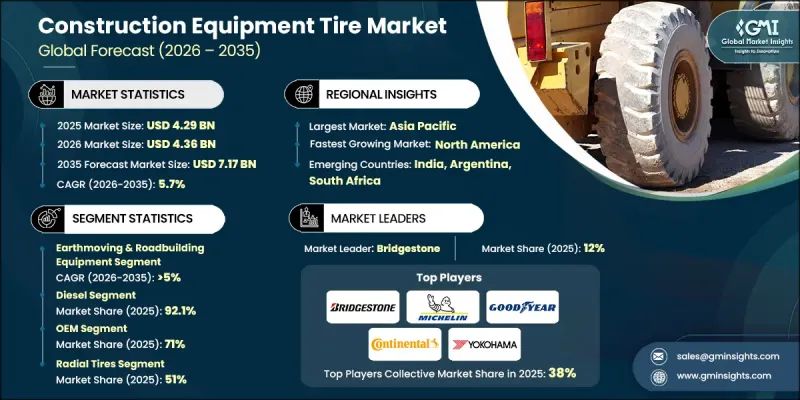
全球基礎設施現代化建設的強勁勢頭是推動施工機械輪胎需求的主要動力。已開發國家和新興國家政府都在大力投資交通網路、城市發展和能源基礎設施,必然需要廣泛部署重型機械。在惡劣環境下運作的機械需要高度耐用、承載能力強、性能卓越的子午線越野輪胎,以承受極端壓力和地形條件。市場參與企業正積極尋求非內部成長策略,例如推出新產品、併購和策略聯盟,以增強其競爭優勢。同時,露天和地下採礦作業的擴張也持續推高了對超大型重型越野輪胎的需求。支援電氣化和可再生能源技術的採礦活動增加,導致在惡劣環境下作業的機械設備使用量上升,加速了輪胎磨損週期,並增強了原廠配套和更換輪胎的需求。輪胎工程技術的不斷進步,包括耐熱化合物、加強型胎側結構以及即時追蹤氣壓、溫度和磨損的輪胎監測技術的整合,進一步提高了整個生命週期的運行效率和性能。
| 市場範圍 | |
|---|---|
| 開始年份 | 2025 |
| 預測期 | 2026-2035 |
| 初始市場規模 | 42.9億美元 |
| 預測金額 | 71.7億美元 |
| 複合年成長率 | 5.7% |
預計到2025年,土木工程和道路施工設備市場佔有率將達到57%,並在2026年至2035年間以5%的複合年成長率成長。交通基礎設施計劃的擴張和區域間互聯互通的改善,推動了用於平整、壓實、裝載和鋪路作業的重型機械的廣泛運轉率。這些機械通常在高負荷和高磨損的路面條件下運作,加速了輪胎的劣化。道路建設計劃工期長,直接導致OEM和售後市場對耐久性、耐熱性和高牽引性能輪胎的需求持續成長。
預計到2025年,柴油動力機械市場佔有率將達到92.1%,並在2035年之前以5%的複合年成長率成長。柴油設備因其運作耐用性和長使用壽命,仍然是大規模基礎設施和採礦應用的關鍵設備。在惡劣條件下持續運作會增加輪胎的熱量積聚和機械應力,縮短更換週期,從而持續推動對高承載能力、重型輪胎解決方案的需求。在許多發展中地區,與其他動力傳動系統相比,柴油動力施工機械仍然易於獲得且經濟高效。
中國施工機械輪胎市場佔全球50%的佔有率,預計2025年市場規模將達到9.944億美元。中國作為全球施工機械製造地中心的強大地位,大大支撐了國內輪胎消費。集中化的工程機械生產設施,既供應國內市場也供應出口市場,持續推動原廠配套輪胎的需求。新興大都會圈的快速城市擴張和基礎設施建設,進一步活性化了土木工程機具和重型設備的運作,從而增強了該地區的輪胎需求。
目錄
第1章:調查方法
第2章執行摘要
第3章業界考察
- 生態系分析
- 供應商情況
- 利潤率分析
- 成本結構
- 每個階段增加的價值
- 影響價值鏈的因素
- 中斷
- 影響產業的因素
- 促進因素
- 全球基礎建設發展
- 採礦和採石業的擴張
- 輪胎材質的技術進步
- 農業和建築機械化的進展
- 產業潛在風險與挑戰
- 原物料價格波動
- 大型工程機械輪胎高成本
- 供應鏈中斷
- 激烈的競爭和價格壓力
- 市場機遇
- 亞太地區的基礎建設熱潮
- 電動和自動駕駛設備的發展
- 翻新和回收解決方案
- 新興礦業市場的擴張
- 促進因素
- 成長潛力分析
- 監理情勢
- 北美洲
- 美國環保署(EPA)
- 美國國家公路交通安全管理局(NHTSA)
- 職業安全與健康管理局(OSHA)
- 美國運輸部(DOT)
- 加拿大機動車輛安全標準(CMVSS)
- 歐洲
- 歐盟機械指令
- 符合CE標誌
- REACH(化學品註冊、評估、授權和限制)
- 歐盟輪胎標籤法規
- 國家型式認可和道路認證要求
- 亞太地區
- 中國強制產品認證(CCC)
- 印度中央機動車輛法規(CMVR)-非公路胎標準
- 與輪胎相關的日本工業標準(JIS)
- 東協統一技術法規
- 澳洲設計規則(ADR)
- 拉丁美洲
- 巴西國家計量院(INMETRO)規章
- 巴西國家交通委員會(CONTRAN)
- 墨西哥NOM輪胎安全標準
- 區域進口和認證要求
- 中東和非洲
- 海灣合作理事會標準化組織(GSO)輪胎法規
- 沙烏地阿拉伯標準、計量和品質組織(SASO)
- 南非國家法規和標準局 (NRCS)
- 遵守道路交通法(NRTA)
- 北美洲
- 關鍵市場趨勢與轉型
- 未來市場趨勢
- 波特的分析
- PESTEL 分析
- 科技與創新趨勢
- 當前技術趨勢
- 新興技術
- 價格分析
- 對過去價格趨勢的分析
- 原物料成本對輪胎價格的影響
- OEM和售後市場價格趨勢
- 各地區價格波動
- 主要企業的定價策略
- 高階市場策略
- 價值層級策略
- 成本定價
- 對過去價格趨勢的分析
- 生產統計
- 生產基地
- 消費者群體
- 進出口
- 成本細分分析
- 專利分析
- 永續性和環境方面
- 永續計劃
- 減少廢棄物策略
- 生產中的能源效率
- 具有環保意識的舉措
- 碳足跡考量
- 人工智慧和生成式人工智慧對市場的影響
- 利用人工智慧改造現有經營模式
- 人工智慧在預測性維護和車隊管理的應用
- 輪胎設計的自動最佳化
- 用於需求預測的供應鏈人工智慧
- 按細分市場分類的生成式人工智慧用例和部署藍圖
- 胎面花紋設計與生成
- 客戶服務聊天機器人和技術支援
- 行銷內容創作
- 風險、限制和監管考量
- 物聯網智慧輪胎中的資料隱私
- 人工智慧演算法的透明度要求
- 人工智慧驅動的產品故障責任
- 利用人工智慧改造現有經營模式
第4章 競爭情勢
- 介紹
- 企業市佔率分析
- 北美洲
- 歐洲
- 亞太地區
- 拉丁美洲
- 中東和非洲(MEA)
- 主要市場公司的競爭分析
- 競爭定位矩陣
- 主要進展
- 併購
- 夥伴關係與合作
- 新產品發布
- 業務拓展計劃及資金籌措
第5章 市場估價與預測:依輪胎類型分類,2022-2035年
- 子午線輪胎
- 偏見
- 堅硬的
- 其他
第6章 市場估算與預測:依設備類型分類,2022-2035年
- 土木工程/道路施工設備
- 後鏟
- 液壓挖土機
- 裝載機
- 壓實設備
- 其他
- 物料輸送和起重機
- 工業車輛
- 全地形起重機
- 用於崎嶇地形的起重機
- 車載起重機
- 混凝土設備
- 混凝土泵
- 混凝土攪拌車
- 瀝青鋪築機
第7章 市場估價與預測:依銷售管道分類,2022-2035年
- OEM
- 售後市場
第8章 市場估計與預測:依胎面深度分類,2022-2035年
- 標準胎面
- 深胎紋
- 超深凹槽
- 淺/光滑胎面
第9章 市場估價與預測:依胎面花紋分類,2022-2035年
- 塊狀踏板
- 胎面花紋
- 羅紋胎面
- 柔和的紅色
第10章 市場估價與預測:依設備尺寸分類,2022-2035年
- 袖珍的
- 中號
- 大的
第11章 市場估計與預測:依促進因素分類,2022-2035年
- 柴油引擎
- CNG/LNG
- 電
第12章 市場估計與預測:依地區分類,2021-2034年
- 北美洲
- 美國
- 加拿大
- 歐洲
- 英國
- 德國
- 法國
- 義大利
- 西班牙
- 俄羅斯
- 丹麥
- 芬蘭
- 挪威
- 瑞典
- 亞太地區
- 中國
- 印度
- 日本
- 韓國
- ANZ
- 新加坡
- 泰國
- 印尼
- 越南
- 拉丁美洲
- 巴西
- 墨西哥
- 阿根廷
- 中東和非洲(MEA)
- 南非
- 沙烏地阿拉伯
- 阿拉伯聯合大公國
第13章:公司簡介
- 世界公司
- Balkrishna Industries
- Bridgestone
- Continental
- Double Coin
- Goodyear Tire &Rubber Company
- Linglong Tire
- Michelin
- Pirelli
- Sumitomo Rubber Industries
- Titan International
- Triangle Tyre
- Yokohama Rubber Company
- Zhongce Rubber
- 當地公司
- Aeolus Tyre
- Apollo Tyres
- CEAT
- JK Tyre &Industries
- Magna Tyres
- MRF
- 新興企業
- Kal Tire Mining Tire
- OTR Engineered Solutions
- Revvo Technologies
The Global Construction Equipment Tire Market was valued at USD 4.29 billion in 2025 and is estimated to grow at a CAGR of 5.7% to reach USD 7.17 billion by 2035.
Strong momentum in global infrastructure modernization is a key factor driving demand for construction equipment tires. Governments across developed and emerging economies are allocating substantial investments toward transportation networks, urban development, and energy infrastructure, which require extensive deployment of heavy machinery. Equipment operating in demanding environments must be fitted with durable, high-load-bearing, and high-performance radial off-the-road tires capable of withstanding extreme pressure and terrain conditions. Market participants are actively pursuing inorganic growth strategies, including product introductions, mergers and acquisitions, and strategic alliances to reinforce their competitive positioning. In parallel, expanding surface and underground mining operations are generating sustained demand for ultra-large and heavy-duty off-road tires. Rising mineral extraction activities to support electrification and renewable energy technologies are increasing equipment usage in harsh landscapes, accelerating tire wear cycles, and strengthening both OEM installations and replacement demand. Continuous advancements in tire engineering, such as heat-resistant compounds, reinforced sidewall construction, and integrated tire monitoring technologies that track real-time pressure, temperature, and wear, are further enhancing operational efficiency and total lifecycle performance.
| Market Scope | |
|---|---|
| Start Year | 2025 |
| Forecast Year | 2026-2035 |
| Start Value | $4.29 Billion |
| Forecast Value | $7.17 Billion |
| CAGR | 5.7% |
The earthmoving and roadbuilding equipment segment accounted for 57% share in 2025 and is anticipated to grow at a CAGR of 5% from 2026 to 2035. Expanding transportation infrastructure projects and improved regional connectivity are driving higher utilization of heavy machinery used in grading, compaction, loading, and paving operations. These machines frequently function under high load intensity and abrasive surface conditions, leading to accelerated tire degradation. The long project timelines associated with road construction directly contribute to sustained demand for durable, heat-resistant, and high-traction tires across both original equipment and aftermarket channels.
The diesel-powered machinery segment held 92.1% share in 2025 and is forecast to grow at a CAGR of 5% through 2035. Diesel equipment remains essential in large-scale infrastructure and mining applications due to its operational durability and extended service life. Continuous operation in demanding conditions increases heat buildup and mechanical stress on tires, shortening replacement intervals and reinforcing recurring demand for high-capacity, heavy-duty tire solutions. In many developing regions, diesel-powered equipment continues to be more accessible and cost-effective compared to alternative powertrains.
China Construction Equipment Tire Market held 50% share, generating USD 994.4 million in 2025. The country's strong position as a global construction equipment manufacturing hub significantly supports domestic tire consumption. A large concentration of machinery production facilities serving both domestic and export markets drives consistent OEM tire fitment demand. Rapid urban expansion and infrastructure development across emerging metropolitan areas are further intensifying earthmoving and heavy equipment operations, strengthening regional tire requirements.
Key companies operating in the Global Construction Equipment Tire Market include Michelin, Bridgestone, Goodyear, Continental, Zhongce Rubber, Titan International, Sumitomo Rubber Industries, Pirelli, Linglong Tire, and Yokohama. Companies in the Construction Equipment Tire Market are enhancing their market foothold through continuous product innovation, capacity expansion, and strategic collaborations. Manufacturers are investing in advanced tire technologies that improve durability, load performance, and fuel efficiency while reducing the total cost of ownership for end users. Strategic mergers, acquisitions, and joint ventures enable firms to expand geographic presence and strengthen distribution networks. Partnerships with original equipment manufacturers secure long-term supply agreements and stable revenue streams. Businesses are also increasing their focus on smart tire solutions equipped with monitoring systems to differentiate their offerings.
Table of Contents
Chapter 1 Methodology
- 1.1 Research approach
- 1.2 Quality Commitments
- 1.2.1 GMI AI policy & data integrity commitment
- 1.2.1.1 Source consistency protocol
- 1.2.1 GMI AI policy & data integrity commitment
- 1.3 Research Trail & Confidence Scoring
- 1.3.1 Research Trail Components
- 1.3.2 Scoring Components
- 1.4 Data Collection
- 1.4.1 Partial list of primary sources
- 1.5 Data mining sources
- 1.5.1 Paid sources
- 1.5.2 Sources, by region
- 1.6 Base estimates and calculations
- 1.6.1 Base year calculation for any one approach
- 1.7 Forecast model
- 1.7.1 Quantified market impact analysis
- 1.7.1.1 Mathematical impact of growth parameters on forecast
- 1.7.1 Quantified market impact analysis
- 1.8 Research transparency addendum
- 1.8.1 Source attribution framework
- 1.8.2 Quality assurance metrics
- 1.8.3 Our commitment to trust
Chapter 2 Executive Summary
- 2.1 Industry 360° synopsis, 2022 - 2035
- 2.2 Key market trends
- 2.2.1 Regional
- 2.2.2 Tire
- 2.2.3 Equipment
- 2.2.4 Tread depth
- 2.2.5 Tread pattern
- 2.2.6 Equipment size
- 2.2.7 Propulsion
- 2.2.8 Sales channel
- 2.3 TAM Analysis, 2026-2035
- 2.4 CXO perspectives: Strategic imperatives
Chapter 3 Industry Insights
- 3.1 Industry ecosystem analysis
- 3.1.1 Supplier landscape
- 3.1.2 Profit margin analysis
- 3.1.3 Cost structure
- 3.1.4 Value addition at each stage
- 3.1.5 Factor affecting the value chain
- 3.1.6 Disruptions
- 3.2 Industry impact forces
- 3.2.1 Growth drivers
- 3.2.1.1 Growth in global infrastructure development
- 3.2.1.2 Expansion of mining and quarrying activities
- 3.2.1.3 Technological advancements in tire materials
- 3.2.1.4 Increasing mechanization in agriculture & construction
- 3.2.2 Industry pitfalls and challenges
- 3.2.2.1 Volatility in raw material prices
- 3.2.2.2 High cost of large OTR tires
- 3.2.2.3 Supply chain disruptions
- 3.2.2.4 Intense competition and price pressure
- 3.2.3 Market opportunities
- 3.2.3.1 Infrastructure boom in Asia Pacific
- 3.2.3.2 Growth in electric & autonomous equipment
- 3.2.3.3 Retreading & recycling solutions
- 3.2.3.4 Expansion in emerging mining markets
- 3.2.1 Growth drivers
- 3.3 Growth potential analysis
- 3.4 Regulatory landscape
- 3.4.1 North America
- 3.4.1.1 Environmental Protection Agency (EPA)
- 3.4.1.2 National Highway Traffic Safety Administration (NHTSA)
- 3.4.1.3 Occupational Safety and Health Administration (OSHA)
- 3.4.1.4 U.S. Department of Transportation (DOT)
- 3.4.1.5 Canadian Motor Vehicle Safety Standards (CMVSS)
- 3.4.2 Europe
- 3.4.2.1 EU Machinery Regulation
- 3.4.2.2 CE Marking Compliance
- 3.4.2.3 REACH (Registration, Evaluation, Authorisation and Restriction of Chemicals)
- 3.4.2.4 EU Tire Labelling Regulation
- 3.4.2.5 National Type Approval & Road Homologation Requirements
- 3.4.3 Asia Pacific
- 3.4.3.1 China Compulsory Certification (CCC)
- 3.4.3.2 Indian Central Motor Vehicle Rules (CMVR) - Off-Highway Tire Norms
- 3.4.3.3 Japanese Industrial Standards (JIS) for Tires
- 3.4.3.4 ASEAN Harmonized Technical Regulations
- 3.4.3.5 Australian Design Rules (ADR)
- 3.4.4 Latin America
- 3.4.4.1 Brazilian National Institute of Metrology (INMETRO) Regulations
- 3.4.4.2 Brazilian National Traffic Council (CONTRAN)
- 3.4.4.3 Mexican NOM Tire Safety Standards
- 3.4.4.4 Regional Import & Certification Requirements
- 3.4.5 Middle East & Africa
- 3.4.5.1 GCC Standardization Organization (GSO) Tire Regulations
- 3.4.5.2 Saudi Standards, Metrology and Quality Organization (SASO)
- 3.4.5.3 South African National Regulator for Compulsory Specifications (NRCS)
- 3.4.5.4 National Road Traffic Act (NRTA) Compliance
- 3.4.1 North America
- 3.5 Major market trends and disruptions
- 3.6 Future market trends
- 3.7 Porter’s analysis
- 3.8 PESTEL analysis
- 3.9 Technology and innovation landscape
- 3.9.1 Current technological trends
- 3.9.2 Emerging technologies
- 3.10 Price analysis
- 3.10.1 Historical price trend analysis
- 3.10.1.1 Raw material cost influence on tire prices
- 3.10.1.2 Oem vs aftermarket pricing dynamics
- 3.10.1.3 Regional price variations
- 3.10.2 Pricing strategy by player
- 3.10.2.1 Premium tier strategy
- 3.10.2.2 Value tier strategy
- 3.10.2.3 Cost-plus pricing
- 3.10.1 Historical price trend analysis
- 3.11 Production statistics
- 3.11.1 Production hubs
- 3.11.2 Consumption hubs
- 3.11.3 Export and import
- 3.12 Cost breakdown analysis
- 3.13 Patent analysis
- 3.14 Sustainability and environmental aspects
- 3.14.1 Sustainable practices
- 3.14.2 Waste reduction strategies
- 3.14.3 Energy efficiency in production
- 3.14.4 Eco-friendly Initiatives
- 3.14.5 Carbon footprint considerations
- 3.15 Impact of AI & generative AI on the market
- 3.15.1 AI-driven disruption of existing business models
- 3.15.1.1 Predictive maintenance & fleet management AI
- 3.15.1.2 Automated tire design optimization
- 3.15.1.3 Supply chain AI for demand forecasting
- 3.15.2 GenAI use cases & adoption roadmap by segment
- 3.15.2.1 Tread pattern design generation
- 3.15.2.2 Customer service chatbots & technical support
- 3.15.2.3 Marketing content creation
- 3.15.3 Risks, limitations & regulatory considerations
- 3.15.3.1 Data privacy in IoT-enabled smart tires
- 3.15.3.2 AI algorithm transparency requirements
- 3.15.3.3 Liability in AI-driven product failures
- 3.15.1 AI-driven disruption of existing business models
Chapter 4 Competitive Landscape, 2025
- 4.1 Introduction
- 4.2 Company market share analysis
- 4.2.1 North America
- 4.2.2 Europe
- 4.2.3 Asia Pacific
- 4.2.4 LATAM
- 4.2.5 MEA
- 4.3 Competitive analysis of major market players
- 4.4 Competitive positioning matrix
- 4.5 Key developments
- 4.5.1 Mergers & acquisitions
- 4.5.2 Partnerships & collaborations
- 4.5.3 New Product Launches
- 4.5.4 Expansion Plans and funding
Chapter 5 Market Estimates & Forecast, By Tire, 2022 - 2035 ($Mn, Units)
- 5.1 Key trends
- 5.2 Radial
- 5.3 Bias
- 5.4 Solid
- 5.5 Others
Chapter 6 Market Estimates & Forecast, By Equipment, 2022 - 2035 ($Mn, Units)
- 6.1 Key trends
- 6.2 Earthmoving & Road Building Equipment
- 6.2.1 Backhoes
- 6.2.2 Excavators
- 6.2.3 Loaders
- 6.2.4 Compaction Equipment
- 6.2.5 Others
- 6.3 Material handling & Crane
- 6.3.1 Industrial trucks
- 6.3.2 All-terrain crane
- 6.3.3 Rough terrain crane
- 6.3.4 Truck loader crane
- 6.4 Concrete equipment
- 6.4.1 Concrete pumps
- 6.4.2 Transit mixers
- 6.4.3 Asphalt pavers
Chapter 7 Market Estimates & Forecast, By Sales Channel, 2022 - 2035 ($Mn, Units)
- 7.1 Key trends
- 7.2 OEM
- 7.3 Aftermarket
Chapter 8 Market Estimates & Forecast, By Tread Depth, 2022 - 2035 ($Mn, Units)
- 8.1 Key trends
- 8.2 Normal tread
- 8.3 Deep tread
- 8.4 Extra deep tread
- 8.5 Shallow/smooth tread
Chapter 9 Market Estimates & Forecast, By Tread Pattern, 2022 - 2035 ($Mn, Units)
- 9.1 Key trends
- 9.2 Block tread
- 9.3 Lugged tread
- 9.4 Ribbed tread
- 9.5 Smooth tread
Chapter 10 Market Estimates & Forecast, By Equipment Size, 2022 - 2035 ($Mn, Units)
- 10.1 Key trends
- 10.2 Compact
- 10.3 Medium
- 10.4 Heavy
Chapter 11 Market Estimates & Forecast, By Propulsion, 2022 - 2035 ($Mn, Units)
- 11.1 Key trends
- 11.2 Diesel
- 11.3 CNG/LNG
- 11.4 Electric
Chapter 12 Market Estimates & Forecast, By Region, 2021 - 2034 ($Mn, Units)
- 12.1 Key trends
- 12.2 North America
- 12.2.1 US
- 12.2.2 Canada
- 12.3 Europe
- 12.3.1 UK
- 12.3.2 Germany
- 12.3.3 France
- 12.3.4 Italy
- 12.3.5 Spain
- 12.3.6 Russia
- 12.3.7 Denmark
- 12.3.8 Finland
- 12.3.9 Norway
- 12.3.10 Sweden
- 12.4 Asia Pacific
- 12.4.1 China
- 12.4.2 India
- 12.4.3 Japan
- 12.4.4 South Korea
- 12.4.5 ANZ
- 12.4.6 Singapore
- 12.4.7 Thailand
- 12.4.8 Indonesia
- 12.4.9 Vietnam
- 12.5 Latin America
- 12.5.1 Brazil
- 12.5.2 Mexico
- 12.5.3 Argentina
- 12.6 MEA
- 12.6.1 South Africa
- 12.6.2 Saudi Arabia
- 12.6.3 UAE
Chapter 13 Company Profiles
- 13.1 Global companies
- 13.1.1 Balkrishna Industries
- 13.1.2 Bridgestone
- 13.1.3 Continental
- 13.1.4 Double Coin
- 13.1.5 Goodyear Tire & Rubber Company
- 13.1.6 Linglong Tire
- 13.1.7 Michelin
- 13.1.8 Pirelli
- 13.1.9 Sumitomo Rubber Industries
- 13.1.10 Titan International
- 13.1.11 Triangle Tyre
- 13.1.12 Yokohama Rubber Company
- 13.1.13 Zhongce Rubber
- 13.2 Regional players
- 13.2.1 Aeolus Tyre
- 13.2.2 Apollo Tyres
- 13.2.3 CEAT
- 13.2.4 JK Tyre & Industries
- 13.2.5 Magna Tyres
- 13.2.6 MRF
- 13.3 Emerging players
- 13.3.1 Kal Tire Mining Tire
- 13.3.2 OTR Engineered Solutions
- 13.3.3 Revvo Technologies

 橡膠壓機市場:依橡膠類型、壓機類型、操作模式、產能、應用及通路分類-全球預測,2026-2032年電動施工機械市場:依設備類型、推進系統和應用分類-全球預測,2026-2032年自動液壓機市場:按壓機類型、控制類型、操作模式和終端用戶產業分類,全球預測,2026-2032年
 中國施工機械:市場佔有率分析、產業趨勢與統計、成長預測(2026-2031)施工機械:市場佔有率分析、產業趨勢與統計、成長預測(2026-2031)東協施工機械:市場佔有率分析、產業趨勢與統計、成長預測(2026-2031)泰國施工機械市場佔有率分析、產業趨勢及統計、成長預測(2026-2031)
 2026年全球建築及道路施工機械市場報告2026年全球施工機械市場報告2026年全球液壓搭乘用電梯市場報告