


 |
市場調查報告書
商品編碼
1928913
低溫運輸物流市場機會、成長要素、產業趨勢分析及預測(2026年至2035年)Cold Chain Logistics Market Opportunity, Growth Drivers, Industry Trend Analysis, and Forecast 2026 - 2035 |
||||||

預計到 2025 年,低溫運輸物流市場規模將達到 3,823 億美元,到 2035 年將達到 1.37 兆美元,年複合成長率為 13.8%。
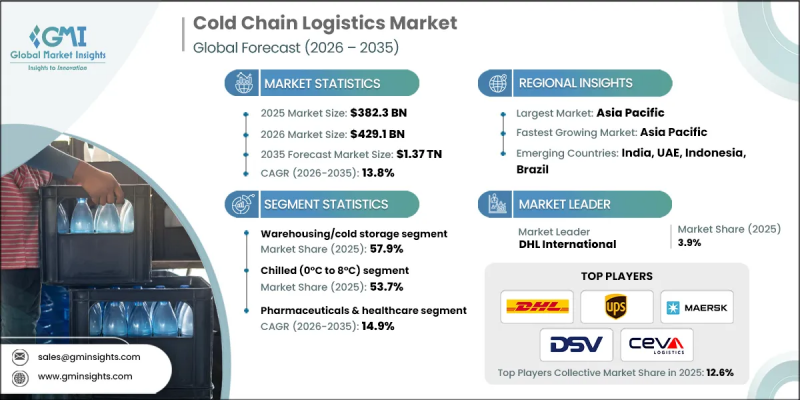
據業內相關人員稱,國際貿易的擴張為專注於溫控供應鏈的物流供應商創造了巨大的機會。此前,由於物流基礎設施不發達,許多進口國處理需要精確溫度控制的貨物的能力受到限制。這種差距限制了市場准入,並導致產品損耗增加。然而,隨著處理溫度敏感型貨物和生鮮食品的行業越來越依賴先進的低溫運輸解決方案,這種情況正在改變。全球健康危機凸顯了可靠溫度控制的重要性,並暴露了多個地區的結構性挑戰。低溫運輸系統如今已被廣泛認為是處理敏感材料的各行各業的必要基礎。同時,由於傳統製冷方式的高能耗和對環境的影響,永續性已成為核心優先事項。因此,供應商正在採用節能技術、替代能源系統和環保冷氣解決方案。從區域來看,亞太地區被視為關鍵市場,這得益於其強大的製造業基礎和不斷成長的投資,預計在預測期內將保持強勁成長。
| 市場覆蓋範圍 | |
|---|---|
| 開始年份 | 2025 |
| 預測期 | 2026-2035 |
| 起始值 | 3823億美元 |
| 預測金額 | 1.37兆美元 |
| 複合年成長率 | 13.8% |
到2025年,倉儲和冷藏保管規模將達到2,212億美元,被認為是低溫運輸物流產業的基石。溫控倉儲設施需要大量的初始投資和較長的運作壽命,並且必須在冷藏運輸網路高效運作之前建成。這些設施能夠長時間保持產品穩定,與僅在運輸過程中產生收入的運輸服務相比,能夠創造更高的單位價值。
預計到2025年,溫度介於0 度C至8 度C之間的冷藏物流市場將佔據53.7%的市場佔有率,並在2035年達到7,199億美元。此溫度範圍預計將佔據最大的市場佔有率,因為它適用於那些無需冷凍即可保持新鮮的產品。全球對這類產品的持續需求正在推動整個分銷管道中冷藏物流解決方案的強勁成長。
美國低溫運輸物流市場預計到2025年將達到1,052億美元,該國持續在全球物流市場佔據主導地位。成長的主要驅動力是數位商務模式的擴張,這促使溫控設施向城市中心附近發展,並增強了「最後一公里」配送能力。此外,為滿足嚴格的溫度控制要求,對先進冷藏運輸和專用儲存系統的投資也在增加。
目錄
第1章調查方法
第2章執行摘要
第3章業界考察
- 生態系分析
- 供應商情況
- 利潤率
- 成本結構
- 每個階段的附加價值
- 影響價值鏈的因素
- 中斷
- 產業影響因素
- 促進要素
- 生鮮食品的需求不斷成長
- 擴大藥品和疫苗分發
- 擴大溫控商品的國際貿易
- 冷凍食品和已調理食品越來越受歡迎
- 產業潛在風險與挑戰
- 發展中地區低溫運輸基礎設施不足
- 能源密集企業和電力供應可靠性挑戰
- 市場機遇
- 新興市場低溫運輸基礎設施的快速發展
- 生物製藥和特種藥物的需求不斷成長
- 消費區附近冷藏倉庫設施的擴建
- 電子商務和線上雜貨平台的成長
- 促進要素
- 成長潛力分析
- 監管環境
- 北美洲
- 食品安全現代化法案(FSMA)
- FDA現行良好生產規範(cGMP)
- 藥品供應鏈安全法案(DSCSA)
- 美國疾病管制與預防中心疫苗儲存與處理指南
- 歐洲
- 歐盟良好經銷規範 (GDP) 指南
- 歐盟通用食品法(EC 法規 178/2002)
- 歐洲藥典溫度要求
- 亞太地區
- 東協-日本低溫運輸物流指南
- ISO 23412 - 冷鏈服務規範
- 國際航空運輸協會易腐貨物規則(PCR)
- 拉丁美洲
- FSSC 22000 - 食品安全管理
- BRCGS 食品安全全球標準
- SQF(安全優質食品)
- 中東和非洲
- 沙烏地阿拉伯食品藥物管理局GDP
- 國家食品安全與低溫運輸運輸法規
- 北美洲
- 波特分析
- PESTEL 分析
- 科技與創新趨勢
- 當前技術趨勢
- 新興技術
- 成本細分分析
- 永續性和環境影響
- 環境影響評估
- 社會影響力和社區服務
- 公司管治與企業社會責任
- 永續金融與投資趨勢
- 案例研究
- 溫度監測和品質保證系統
- 風險管理與營運挑戰
- 網路設計與容量規分類析
- 最後一公里低溫運輸和都市區配送
第4章 競爭情勢
- 介紹
- 公司市佔率分析
- 北美洲
- 歐洲
- 亞太地區
- 拉丁美洲
- 中東和非洲
- 主要市場公司的競爭分析
- 競爭定位矩陣
- 戰略展望矩陣
- 重大進展
- 併購
- 夥伴關係與合作
- 新產品發布
- 企業擴張計畫和資金籌措
第5章 按服務分類的市場估算與預測,2022-2035年
- 倉庫存放/冷藏保管
- 公共倉儲業
- 私人倉庫
- 運輸
- 鐵路
- 空運
- 路
- 水道
- 加值低溫運輸服務
第6章 依溫度範圍分類的市場估計與預測,2022-2035年
- 冷藏(0 度C至8 度C)
- 冷凍(-18度C至-25度C)
- 超低溫冷凍(-25度C~-60度C或更低)
第7章 按應用領域分類的市場估算與預測,2022-2035年
- 食品/飲料
- 水果和蔬菜
- 乳製品和冷凍甜點
- 肉類、家禽和水產品
- 麵包糖果甜點
- 飲料
- 蒸餾食品/加工食品
- 製藥和醫療保健
- 化學品和特殊材料
- 其他用途
第8章 2022-2035年按目的地分類的市場估算與預測
- 國內的
- 國際的
9. 依最終用途分類的市場估計與預測,2022-2035 年
- 食品零售商和超級市場
- 食品加工商和製造商
- 製藥和生物技術公司
- 電子商務平台
- 其他
第10章 2022-2035年各地區市場估計與預測
- 北美洲
- 美國
- 加拿大
- 歐洲
- 德國
- 英國
- 法國
- 義大利
- 西班牙
- 俄羅斯
- 北歐國家
- 比荷盧經濟聯盟
- 亞太地區
- 中國
- 印度
- 日本
- 韓國
- ANZ
- 新加坡
- 馬來西亞
- 印尼
- 越南
- 泰國
- 拉丁美洲
- 巴西
- 墨西哥
- 阿根廷
- 哥倫比亞
- 中東和非洲
- 南非
- 沙烏地阿拉伯
- 阿拉伯聯合大公國
第11章 公司簡介
- 世界公司
- Lineage Logistics
- Americold Logistics
- DHL International
- Kuehne+Nagel
- Maersk
- United Parcel Service(UPS)
- FedEx
- DSV
- CH Robinson
- CEVA Logistics
- Nippon Express
- XPO Logistics
- Kerry Logistics
- Yusen Logistics
- Bollore Logistics
- Agility Logistics
- 區域公司 新冷物流 / 日冷物流/ 巴里斯物流/ Preferred Free
- NewCold
- Nichirei Logistics
- Burris Logistics
- Preferred Freezer Services
- 新興企業
- Snowman Logistics
- Celsius Logistics
- Tippmann
- CJ Logistics
The Cold Chain Logistics Market was valued at USD 382.3 billion in 2025 and is estimated to grow at a CAGR of 13.8% to reach USD 1.37 trillion by 2035.
Industry participants state that rising international trade has unlocked significant opportunities for logistics providers specializing in temperature-controlled supply chains. In earlier years, many importing nations faced limitations in handling goods requiring precise thermal conditions due to an underdeveloped logistics infrastructure. This gap restricted market access and increased product losses. The situation has shifted as industries dealing with temperature-sensitive and perishable commodities increasingly rely on advanced cold chain solutions. Global health events highlighted the importance of reliable temperature management, revealing structural gaps in several regions. Cold chain systems are now widely recognized as critical enablers across multiple sectors handling sensitive materials. At the same time, sustainability has emerged as a central priority, as conventional refrigeration methods are associated with high energy usage and environmental impact. As a result, providers are adopting energy-efficient technologies, alternative power systems, and low-impact cooling solutions. From a regional perspective, Asia Pacific is viewed as the leading market, supported by a strong manufacturing base and rising investments, and it is expected to maintain strong growth momentum over the forecast period.
| Market Scope | |
|---|---|
| Start Year | 2025 |
| Forecast Year | 2026-2035 |
| Start Value | $382.3 Billion |
| Forecast Value | $1.37 Trillion |
| CAGR | 13.8% |
In 2025, the warehousing and cold storage segment accounted for USD 221.2 billion and is regarded as the structural backbone of the cold chain logistics industry. Temperature-controlled storage facilities require high upfront investment and long operational lifespans, and they must be established before refrigerated transport networks can function efficiently. These facilities allow products to remain stable over extended periods, which results in higher value generation per unit when compared with transportation services that only generate revenue during movement.
The chilled temperature category, operating between 0°C and 8°C, represented a 53.7% share in 2025 and is projected to reach USD 719.9 billion by 2035. This range is considered the largest portion of the market due to its suitability for products that require freshness without freezing. Continuous global demand for such goods is sustaining strong growth for chilled logistics solutions across distribution channels.
U.S. Cold Chain Logistics Market generated USD 105.2 billion in 2025. The country continues to hold a dominant position within the global logistics landscape. Growth is being supported by the expansion of digital commerce models, which is encouraging the development of temperature-controlled facilities closer to urban centers and enhancing last-mile capabilities. Additional investments are being directed toward advanced refrigerated transport and specialized storage systems designed to meet strict temperature compliance requirements.
Key companies active in the Global Cold Chain Logistics Market include Lineage Logistics, DHL International, NewCold, United Parcel Service (UPS), Americold Logistics, Maersk, U.S. Cold Storage, CEVA Logistics, DSV, and C.H. Robinson Worldwide. Companies operating in the Global Cold Chain Logistics Market are reinforcing their competitive positions through network expansion, technology integration, and strategic collaborations. Many players are investing heavily in automated and digitally enabled storage facilities to improve efficiency, traceability, and reliability. Fleet modernization, including the adoption of energy-efficient transportation assets, is being prioritized to lower operating costs and meet sustainability goals.
Table of Contents
Chapter 1 Methodology
- 1.1 Research approach
- 1.2 Quality commitments
- 1.2.1 GMI AI policy & data integrity commitment
- 1.3 Research trail & confidence scoring
- 1.3.1 Research trail components
- 1.3.2 Scoring components
- 1.4 Data collection
- 1.4.1 Partial list of primary sources
- 1.5 Data mining sources
- 1.5.1 Paid sources
- 1.6 Base estimates and calculations
- 1.6.1 Base year calculation
- 1.7 Forecast model
- 1.8 Research transparency addendum
Chapter 2 Executive Summary
- 2.1 Industry 360° synopsis
- 2.2 Key market trends
- 2.2.1 Regional
- 2.2.2 Service
- 2.2.3 Temperature Range
- 2.2.4 Application
- 2.2.5 Destination
- 2.2.6 End Use
- 2.3 TAM analysis, 2026-2035
- 2.4 CXO perspectives: Strategic imperatives
- 2.4.1 Executive decision points
- 2.4.2 Critical success factors
- 2.5 Future outlook and recommendations
Chapter 3 Industry Insights
- 3.1 Industry ecosystem analysis
- 3.1.1 Supplier landscape
- 3.1.2 Profit margin
- 3.1.3 Cost structure
- 3.1.4 Value addition at each stage
- 3.1.5 Factor affecting the value chain
- 3.1.6 Disruptions
- 3.2 Industry impact forces
- 3.2.1 Growth drivers
- 3.2.1.1 Growing demand for perishable food products
- 3.2.1.2 Expansion of pharmaceutical and vaccine distribution
- 3.2.1.3 Rising global trade of temperature-sensitive goods
- 3.2.1.4 Increasing adoption of frozen and ready-to-eat foods
- 3.2.2 Industry pitfalls and challenges
- 3.2.2.1 Lack of cold chain infrastructure in developing regions
- 3.2.2.2 Energy-intensive operations and power reliability issues
- 3.2.3 Market opportunities
- 3.2.3.1 Rapid cold chain infrastructure development in emerging markets
- 3.2.3.2 Increasing demand for biologics and specialty pharmaceuticals
- 3.2.3.3 Expansion of cold storage facilities near consumption centers
- 3.2.3.4 Growth of e-commerce and online grocery platforms
- 3.2.1 Growth drivers
- 3.3 Growth potential analysis
- 3.4 Regulatory landscape
- 3.4.1 North America
- 3.4.1.1 Food Safety Modernization Act (FSMA)
- 3.4.1.2 FDA Current Good Manufacturing Practice (cGMP)
- 3.4.1.3 Drug Supply Chain Security Act (DSCSA)
- 3.4.1.4 CDC Vaccine Storage and Handling Guidelines
- 3.4.2 Europe
- 3.4.2.1 EU Good Distribution Practice (GDP) Guidelines
- 3.4.2.2 European Union General Food Law (Regulation EC 178/2002)
- 3.4.2.3 European Pharmacopoeia temperature requirements
- 3.4.3 Asia Pacific
- 3.4.3.1 ASEAN Japan Cold Chain Logistics Guidelines
- 3.4.3.2 ISO 23412 - Cold chain service specifications
- 3.4.3.3 IATA Perishable Cargo Regulations (PCR)
- 3.4.4 Latin America
- 3.4.4.1 FSSC 22000 - food safety management
- 3.4.4.2 BRCGS Food Safety Global Standard
- 3.4.4.3 SQF (Safe Quality Food)
- 3.4.5 Middle East & Africa
- 3.4.5.1 Saudi Food and Drug Authority GDP
- 3.4.5.2 National food safety and cold chain transport regulations
- 3.4.1 North America
- 3.5 Porter';s analysis
- 3.6 PESTEL analysis
- 3.7 Technology and innovation landscape
- 3.7.1 Current technological trends
- 3.7.2 Emerging technologies
- 3.8 Cost breakdown analysis
- 3.9 Sustainability and environmental impact
- 3.9.1 Environmental impact assessment
- 3.9.2 Social impact & community benefits
- 3.9.3 Governance & corporate responsibility
- 3.9.4 Sustainable finance & investment trends
- 3.10 Case studies
- 3.11 Temperature monitoring and quality assurance systems
- 3.12 Risk management and operational challenges
- 3.13 Network Design & Capacity Planning Analysis
- 3.14 Last-Mile Cold Chain & Urban Distribution
Chapter 4 Competitive Landscape, 2025
- 4.1 Introduction
- 4.2 Company market share analysis
- 4.2.1 North America
- 4.2.2 Europe
- 4.2.3 Asia Pacific
- 4.2.4 LATAM
- 4.2.5 MEA
- 4.3 Competitive analysis of major market players
- 4.4 Competitive positioning matrix
- 4.5 Strategic outlook matrix
- 4.6 Key developments
- 4.6.1 Mergers & acquisitions
- 4.6.2 Partnerships & collaborations
- 4.6.3 New product launches
- 4.6.4 Expansion plans and funding
Chapter 5 Market Estimates & Forecast, By Service, 2022 - 2035 ($Bn)
- 5.1 Key trends
- 5.2 Warehousing/Cold Storage
- 5.2.1 Public Warehousing
- 5.2.2 Private Warehousing
- 5.3 Transportation
- 5.3.1 Railways
- 5.3.2 Airways
- 5.3.3 Roadways
- 5.3.4 Waterways
- 5.4 Value-Added Cold Chain Services
Chapter 6 Market Estimates & Forecast, By Temperature Range, 2022 - 2035 ($Bn)
- 6.1 Key trends
- 6.2 Chilled (0°C to 8°C)
- 6.3 Frozen (-18°C to -25°C)
- 6.4 Deep Frozen (-25°C to -60°C or less)
Chapter 7 Market Estimates & Forecast, By Application, 2022 - 2035 ($Bn)
- 7.1 Key trends
- 7.2 Food & Beverage
- 7.2.1 Fruits & vegetables
- 7.2.2 Dairy & frozen desserts
- 7.2.3 Meat, Poultry & Seafood
- 7.2.4 Bakery & Confectionery
- 7.2.5 Beverages
- 7.2.6 Ready-to-Eat Meals / Processed Foods
- 7.3 Pharmaceuticals & Healthcare
- 7.4 Chemicals & Specialty Materials
- 7.5 Other applications
Chapter 8 Market Estimates & Forecast, By Destination, 2022 - 2035 ($Bn)
- 8.1 Key trends
- 8.2 Domestic
- 8.3 International
Chapter 9 Market Estimates & Forecast, By End Use, 2022 - 2035 ($Bn)
- 9.1 Key trends
- 9.2 Food Retailers & Supermarkets
- 9.3 Food Processors & Manufacturers
- 9.4 Pharmaceutical & Biotech Companies
- 9.5 E-Commerce Platforms
- 9.6 Others
Chapter 10 Market Estimates & Forecast, By Region, 2022 - 2035 ($Bn)
- 10.1 Key trends
- 10.2 North America
- 10.2.1 US
- 10.2.2 Canada
- 10.3 Europe
- 10.3.1 Germany
- 10.3.2 UK
- 10.3.3 France
- 10.3.4 Italy
- 10.3.5 Spain
- 10.3.6 Russia
- 10.3.7 Nordics
- 10.3.8 Benelux
- 10.4 Asia Pacific
- 10.4.1 China
- 10.4.2 India
- 10.4.3 Japan
- 10.4.4 South Korea
- 10.4.5 ANZ
- 10.4.6 Singapore
- 10.4.7 Malaysia
- 10.4.8 Indonesia
- 10.4.9 Vietnam
- 10.4.10 Thailand
- 10.5 Latin America
- 10.5.1 Brazil
- 10.5.2 Mexico
- 10.5.3 Argentina
- 10.5.4 Colombia
- 10.6 MEA
- 10.6.1 South Africa
- 10.6.2 Saudi Arabia
- 10.6.3 UAE
Chapter 11 Company Profiles
- 11.1 Global companies
- 11.1.1 Lineage Logistics
- 11.1.2 Americold Logistics
- 11.1.3 DHL International
- 11.1.4 Kuehne + Nagel
- 11.1.5 Maersk
- 11.1.6 United Parcel Service (UPS)
- 11.1.7 FedEx
- 11.1.8 DSV
- 11.1.9 C.H. Robinson
- 11.1.10 CEVA Logistics
- 11.1.11 Nippon Express
- 11.1.12 XPO Logistics
- 11.1.13 Kerry Logistics
- 11.1.14 Yusen Logistics
- 11.1.15 Bollore Logistics
- 11.1.16 Agility Logistics
- 11.2 Regional companies
- 11.2.1 NewCold
- 11.2.2 Nichirei Logistics
- 11.2.3 Burris Logistics
- 11.2.4 Preferred Freezer Services
- 11.3 Emerging companies
- 11.3.1 Snowman Logistics
- 11.3.2 Celsius Logistics
- 11.3.3 Tippmann
- 11.3.4 CJ Logistics

 2026-2030年全球低溫運輸市場
 低溫運輸市場分析及預測(至2035年):依類型、產品類型、服務、技術、組件、應用、設備、解決方案、最終用戶分類
 亞太地區低溫運輸物流:市佔率分析、產業趨勢與統計、成長預測(2026-2031年)西班牙低溫運輸物流:市場佔有率分析、產業趨勢與統計、成長預測(2026-2031)
 低溫運輸物流市場-全球產業規模、佔有率、趨勢、機會與預測:按服務類型、應用、溫度類型、技術、地區和競爭格局分類,2021-2031年
 低溫運輸物流車輛市場依運輸方式、溫度範圍、冷凍技術及終端用戶產業分類-2026-2032年全球預測創新醫藥低溫運輸服務市場:按服務類型、運輸方式、溫度範圍、包裝類型和最終用戶分類,全球預測(2026-2032年)農業溫控物流市場按服務類型、溫度模式、類型、應用和最終用戶分類 - 全球預測 2026-2032印尼低溫運輸物流:市場佔有率分析、產業趨勢與統計、成長預測(2026-2031)印度低溫運輸物流:市場佔有率分析、產業趨勢與統計、成長預測(2026-2031)