


 |
市場調查報告書
商品編碼
1940662
亞太地區低溫運輸物流:市佔率分析、產業趨勢與統計、成長預測(2026-2031年)Asia-Pacific Cold Chain Logistics - Market Share Analysis, Industry Trends & Statistics, Growth Forecasts (2026 - 2031) |
||||||

※ 本網頁內容可能與最新版本有所差異。詳細情況請與我們聯繫。
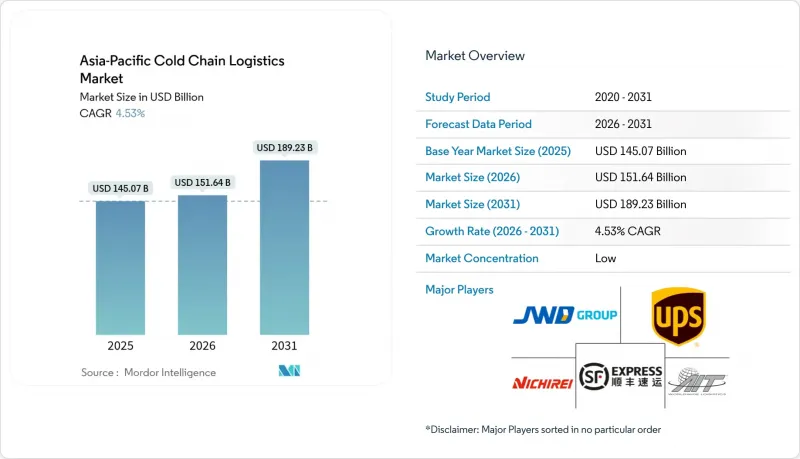
亞太地區低溫運輸物流市場預計將從 2025 年的 1,450.7 億美元成長到 2026 年的 1,516.4 億美元,預計到 2031 年將達到 1,892.3 億美元,2026 年至 2031 年的複合年成長率為 4.53%。
在可支配收入成長、生鮮電商快速普及以及醫藥供應鏈日益成熟的推動下,需求持續穩定上升。同時,倉儲建設整體上正從快速擴張轉向技術主導的高效最佳化。儘管中國在規模上仍保持主導,但印度分散式倉庫的快速發展標誌著向基於地理位置的網路模式的重大轉變,從而實現當日送達。營運商正在採用人工智慧、機器人和自然冷凍系統來降低能耗和人工成本,將卓越營運轉化為亞太低溫運輸物流市場新的成長動力。競爭格局仍保持適度分散,全球整合商正加速併購以確保技術實力。同時,區域性專業企業正利用其來之不易的本地資質和「第一公里」配送經驗來鞏固自身市場地位。
亞太地區低溫運輸物流市場趨勢與洞察
加工食品和冷凍食品的消費量不斷增加
亞洲中等收入家庭對速食、冷凍水產品和多日份蛋白質包的需求日益成長,為亞太低溫運輸物流市場創造了持續的核心需求。為此,超級市場超市正在調整庫存單位(SKU),例如冷凍主菜和半成品麵團,這些產品需要從工廠到商店嚴格控制在-18°C的溫度下。倉儲設施業主正在高層倉庫部署自動化穿梭系統,以分離冷藏、冷凍和超低溫托盤,從而減少運輸時間和能源損耗。智慧標籤記錄時間-溫度曲線,使零售商能夠在展示商品前篩選出有風險的批次,從而減少廢棄物並提高食品安全合規性。都市區家庭規模持續縮小,推動了獨立包裝產品的消費。這些產品在倉儲網路中的配送週期更快,提高了托盤週轉率,並帶來了更高的每立方公尺收益。
電子商務食品宅配的成長
即時配送平台承諾15-30分鐘送達,並正推動下一代微型倉配「暗店」的模組化冷卻模式發展。節能型變速壓縮機結合人工智慧驅動的空調系統,在嚴格控制溫度±0.5°C的前提下,可降低30%的電力消耗。混合被動式和主動式凝膠包裝盒確保冰淇淋即使在曼谷潮濕的午後也能經受住Scooter配送的考驗。物聯網監控器將資料傳輸至消費者應用程式,使溫度透明度成為信任的象徵。隨著生鮮雜貨應用程式向二線城市擴張,需求正從城市邊緣的大型倉庫轉向嵌入人口密集郊區的輻射式配送中心,從而擴大亞太地區低溫運輸物流市場的規模。
冷凍設施的能源和房地產成本不斷上漲
電力成本通常佔營運成本的70%,在東京和悉尼,資料中心需求的不斷成長給電網帶來了巨大壓力,導致電價上漲,擠壓了倉庫的利潤空間。雖然太陽能板維修可以降低25%的電費,但由於需要大量的資本投資和漫長的批准流程,目前僅限於大規模屋頂和新建計劃。同時,城市中心10公里範圍內的地價飛漲,迫使開發商將開發地點轉移到郊區。這意味著價格較低的土地需要更長的運輸距離,從而增加燃料成本。節能隔熱板和可變排氣量壓縮機可以部分抵消不斷上漲的電費,但投資回收期超過五年,這使得小規模企業難以計算投資回報率。
細分市場分析
截至2025年,冷藏倉庫佔亞太地區低溫運輸物流市場的40.55%。現代化的高層冷藏倉庫高度可達40米,穿梭機器人可在60秒內完成托盤運輸,在保持倉庫內精確溫度控制的同時,將人事費用降低一半。營運商正在部署預測性維護軟體,該軟體可監測壓縮機振動和冷媒壓力,從而將非計劃性運作減少15%。
附加價值服務雖然規模較小,但複合年成長率最高,達4.71%,這主要得益於品牌所有者將重新包裝、速凍和產品調理等環節外包給單一第三方物流(3PL) 服務商。服務捆綁模式減少了交接環節,最大限度地降低了溫度偏差和責任糾紛的風險。公共倉庫根據貨物停留時間和溫度範圍提供靈活的部位定價,這吸引了那些希望按不規則時間表出貨的中小型食品出口商。同時,專用的私人設施也吸引了疫苗生產商,他們需要檢驗的佈局和全天候的審核權限。從孤立的倉儲模式轉向承包解決方案的轉變,標誌著亞太地區低溫運輸物流市場正朝著全面的供應鏈協調方向發展。
其他福利:
- Excel格式的市場預測(ME)表
- 3個月的分析師支持
目錄
第1章 引言
- 研究假設和市場定義
- 調查範圍
第2章調查方法
第3章執行摘要
第4章 市場情勢
- 市場概覽
- 市場促進因素
- 加工食品和冷凍食品的消費量增加
- 電子商務生鮮配送的成長
- 擴大藥品低溫運輸
- 協調SPS電子認證和無紙化清關一體化
- 零售商主導的專用冷藏倉庫
- 透過多邊基礎設施走廊擴大冷凍能力
- 市場限制
- 冷凍設施的能源和房地產成本不斷上漲
- 農村地區缺乏首公里基礎設施
- 低全球暖化潛勢冷媒工程師短缺
- 關於排放的ESG資訊揭露負擔存在差異
- 價值/供應鏈分析
- 監管環境
- 技術展望
- 波特五力模型
- 新進入者的威脅
- 買方的議價能力
- 供應商的議價能力
- 替代品的威脅
- 競爭對手之間的競爭
- 排放標準對產業產生影響
- 新冠疫情與地緣政治事件對市場的影響
第5章 市場規模與成長預測
- 按服務類型
- 冷藏保管
- 公共倉庫
- 私人倉儲
- 冷藏運輸
- 路
- 鐵路
- 海
- 航空郵件
- 附加價值服務
- 冷藏保管
- 按溫度類型
- 冷藏(0-5度C)
- 冷凍(-18 至 0°C)
- 環境的
- 超低溫冷凍(低於-20°C)
- 透過使用
- 水果和蔬菜
- 肉類/家禽
- 魚貝類
- 乳製品和冷凍甜點
- 麵包糖果甜點
- 調理食品
- 藥品和生技藥品
- 疫苗和臨床試驗用品
- 化學品/特殊材料
- 其他生鮮產品
- 按國家/地區
- 中國
- 日本
- 印度
- 韓國
- 印尼
- 泰國
- 澳洲
- 新加坡
- 馬來西亞
- 亞太其他地區
第6章 競爭情勢
- 市場集中度
- 策略趨勢
- 市佔率分析
- 公司簡介
- United Parcel Service(UPS)
- JWD Group
- Nichirei Logistics Group Inc
- SF Express
- AIT Worldwide Logistics Inc
- CWT Pte Ltd
- Rokin Logistics
- Lineage Logistics
- Kerry Logistics Network Ltd
- Snowman Logistics Ltd
- ColdEX Logistics Pvt Ltd
- Linfox Pty Ltd
- Yusen Logistics Co Ltd(Part of NYK Line)
- Kuehne+Nagel
- DHL Group
- DSV
- Nippon Express
- Yamato Transport Co. Ltd
- CEVA Logistics
- Konoike Transport Co., Ltd
第7章 市場機會與未來展望
The Asia-Pacific Cold Chain Logistics Market is expected to grow from USD 145.07 billion in 2025 to USD 151.64 billion in 2026 and is forecast to reach USD 189.23 billion by 2031 at 4.53% CAGR over 2026-2031.
Rising disposable incomes, rapid e-grocery penetration, and pharmaceutical supply-chain upgrades keep demand on a steady upward course even as overall warehouse builds move from hyper-expansion to disciplined, technology-led optimization. China retains scale leadership, yet India's faster build-out of distributed depots signals a decisive pivot toward proximity-based networks designed for same-day fulfillment. Operators embed AI, robotics, and natural-refrigerant systems to compress energy intensity and labor exposure, turning operational excellence into the new growth lever for the Asia-Pacific cold chain logistics market. Competition remains moderately fragmented; global consolidators accelerate M&A to secure tech capabilities while regional specialists leverage hard-won local permits and first-mile know-how to guard niche positions.
Asia-Pacific Cold Chain Logistics Market Trends and Insights
Rising Consumption of Processed & Frozen Foods
Asia's middle-income households increasingly favor quick-prep meals, frozen seafood, and multi-day protein packs, creating a durable core of throughput for the Asia-Pacific cold chain logistics market. Supermarket chains respond by shifting stock-keeping units toward frozen entrees and par-baked dough that demand precise -18 °C handling from plant to shelf. Facility owners retrofit high-bay zones with automatic shuttle systems to segregate chilled, frozen, and deep-frozen pallets, trimming travel time and energy loss. Smart labels record time-temperature curves, letting retailers cull at-risk lots before display, which reduces write-offs and tightens food-safety compliance. Urban family sizes continue to shrink, spurring purchases of portioned packs that cycle through storage networks faster, raising pallet-turn velocity and amplifying revenue per cubic meter.
Growth in E-Commerce Grocery Delivery
Instant delivery platforms pledge 15- to 30-minute drop-offs, propelling a new generation of micro-fulfillment "dark" stores furnished with modular coolers. Energy-saving variable-speed compressors paired with AI-driven HVAC trim power draw by 30% while preserving tight +-0.5 °C bands. Hybrid passive-active gel-pack boxes allow ice-cream to survive scooter rides across humid Bangkok afternoons, and IoT monitors feed data to consumer apps, turning temperature transparency into a trust signal. As grocery apps expand into Tier-2 cities, demand shifts from mega-warehouses on city fringes to spoke depots embedded in densely populated suburbs, broadening the Asia-Pacific cold chain logistics market footprint.
High Energy & Real-Estate Cost of Cold Facilities
Electricity often represents 70% of opex, and data-center demand crowds grids across Tokyo and Sydney, driving tariff spikes that erode warehouse margins. Solar-panel retrofits cut bills 25% but entail high capex and lengthy permitting, restricting adoption to larger rooftops or greenfield projects. In parallel, land prices within 10 km of CBDs climb steeply, forcing developers outward where cheaper plots lengthen final-mile legs and elevate fuel spend. Energy-efficient insulation panels and variable-capacity compressors partially offset power hikes, but payback stretches past five years, complicating ROI math for smaller operators.
Other drivers and restraints analyzed in the detailed report include:
- Expansion of Pharmaceutical Cold Chain
- Harmonised SPS e-Certification & Paperless Customs Integration
- Rural First-Mile Infrastructure Gaps
For complete list of drivers and restraints, kindly check the Table Of Contents.
Segment Analysis
Refrigerated storage contributed 40.55% to the Asia-Pacific cold chain logistics market in 2025. Modern high-bay freezers now rise 40 meters, using shuttle robots to pull pallets in under 60 seconds, halving manual labor and maintaining chamber integrity. Operators invest in predictive maintenance software that monitors compressor vibration and coolant pressure, cutting unplanned downtime by 15%.
Value-added services, though smaller, capture the strongest 4.71% CAGR as brand owners outsource repackaging, blast-freezing, and product conditioning to a single 3PL. Service bundling reduces handoffs, thereby minimizing temperature excursions and liability disputes. Public warehouses embrace flexible slot-pricing based on dwell time and temperature band, appealing to SME food exporters eyeing sporadic shipments. Conversely, private dedicated sites attract vaccine manufacturers that demand validated layouts and 24/7 audit access. The shift from siloed warehousing to turnkey solutions underscores how the Asia-Pacific cold chain logistics market pivots toward holistic supply-chain orchestration.
The Asia-Pacific Cold Chain Logistics Market Report is Segmented by Service Type (Refrigerated Storage, Refrigerated Transportation, and Value-Added Services), Temperature Type (Chilled, Frozen, Ambient, and Deep-Frozen/Ultra-Low), Application (Fruits & Vegetables, Meat & Poultry, Fish & Seafood, and More), Country (China, Japan, India, South Korea, Indonesia, and More). The Market Forecasts are Provided in Terms of Value (USD).
List of Companies Covered in this Report:
- United Parcel Service (UPS)
- JWD Group
- Nichirei Logistics Group Inc
- SF Express
- AIT Worldwide Logistics Inc
- CWT Pte Ltd
- Rokin Logistics
- Lineage Logistics
- Kerry Logistics Network Ltd
- Snowman Logistics Ltd
- ColdEX Logistics Pvt Ltd
- Linfox Pty Ltd
- Yusen Logistics Co Ltd (Part of NYK Line)
- Kuehne + Nagel
- DHL Group
- DSV
- Nippon Express
- Yamato Transport Co. Ltd
- CEVA Logistics
- Konoike Transport Co., Ltd
Additional Benefits:
- The market estimate (ME) sheet in Excel format
- 3 months of analyst support
TABLE OF CONTENTS
1 Introduction
- 1.1 Study Assumptions & Market Definition
- 1.2 Scope of the Study
2 Research Methodology
3 Executive Summary
4 Market Landscape
- 4.1 Market Overview
- 4.2 Market Drivers
- 4.2.1 Rising consumption of processed & frozen foods
- 4.2.2 Growth in e-commerce grocery delivery
- 4.2.3 Expansion of pharmaceutical cold chain
- 4.2.4 Harmonised SPS e-Certification & Paperless Customs Integration
- 4.2.5 Retailer-led captive cold warehousing
- 4.2.6 Multilateral Infrastructure Corridors Expanding Refrigerated Capacity
- 4.3 Market Restraints
- 4.3.1 High energy & real-estate cost of cold facilities
- 4.3.2 Rural first-mile infrastructure gaps
- 4.3.3 Shortage of low-GWP refrigerant engineers
- 4.3.4 Divergent ESG disclosure burdens on emissions
- 4.4 Value / Supply-Chain Analysis
- 4.5 Regulatory Landscape
- 4.6 Technological Outlook
- 4.7 Porter's Five Forces
- 4.7.1 Threat of New Entrants
- 4.7.2 Bargaining Power of Buyers
- 4.7.3 Bargaining Power of Suppliers
- 4.7.4 Threat of Substitutes
- 4.7.5 Competitive Rivalry
- 4.8 Impact of Emission Standards on the Industry
- 4.9 Impact of COVID-19 and Geo-Political Events on the Market
5 Market Size & Growth Forecasts (Value)
- 5.1 By Service Type
- 5.1.1 Refrigerated Storage
- 5.1.1.1 Public Warehousing
- 5.1.1.2 Private Warehousing
- 5.1.2 Refrigerated Transportation
- 5.1.2.1 Road
- 5.1.2.2 Rail
- 5.1.2.3 Sea
- 5.1.2.4 Air
- 5.1.3 Value-Added Services
- 5.1.1 Refrigerated Storage
- 5.2 By Temperature Type
- 5.2.1 Chilled (0-5 °C)
- 5.2.2 Frozen (-18-0 °C)
- 5.2.3 Ambient
- 5.2.4 Deep-Frozen / Ultra-Low (less than-20 °C)
- 5.3 By Application
- 5.3.1 Fruits & Vegetables
- 5.3.2 Meat & Poultry
- 5.3.3 Fish & Seafood
- 5.3.4 Dairy & Frozen Desserts
- 5.3.5 Bakery & Confectionery
- 5.3.6 Ready-to-Eat Meals
- 5.3.7 Pharmaceuticals & Biologics
- 5.3.8 Vaccines & Clinical Trial Materials
- 5.3.9 Chemicals & Specialty Materials
- 5.3.10 Other Perishables
- 5.4 By Country
- 5.4.1 China
- 5.4.2 Japan
- 5.4.3 India
- 5.4.4 South Korea
- 5.4.5 Indonesia
- 5.4.6 Thailand
- 5.4.7 Australia
- 5.4.8 Singapore
- 5.4.9 Malaysia
- 5.4.10 Rest of Asia-Pacific
6 Competitive Landscape
- 6.1 Market Concentration
- 6.2 Strategic Moves
- 6.3 Market Share Analysis
- 6.4 Company Profiles (includes Global-level Overview, Market-level Overview, Core Segments, Financials, Strategic Info, Market Rank/Share, Products & Services, Recent Developments)
- 6.4.1 United Parcel Service (UPS)
- 6.4.2 JWD Group
- 6.4.3 Nichirei Logistics Group Inc
- 6.4.4 SF Express
- 6.4.5 AIT Worldwide Logistics Inc
- 6.4.6 CWT Pte Ltd
- 6.4.7 Rokin Logistics
- 6.4.8 Lineage Logistics
- 6.4.9 Kerry Logistics Network Ltd
- 6.4.10 Snowman Logistics Ltd
- 6.4.11 ColdEX Logistics Pvt Ltd
- 6.4.12 Linfox Pty Ltd
- 6.4.13 Yusen Logistics Co Ltd (Part of NYK Line)
- 6.4.14 Kuehne + Nagel
- 6.4.15 DHL Group
- 6.4.16 DSV
- 6.4.17 Nippon Express
- 6.4.18 Yamato Transport Co. Ltd
- 6.4.19 CEVA Logistics
- 6.4.20 Konoike Transport Co., Ltd
7 Market Opportunities & Future Outlook
- 7.1 White-space & Unmet-need Assessment

 RAP冷藏貨櫃市場:依貨櫃類型、冷卻系統類型、隔熱材料、容量、溫度範圍、應用、最終用戶分類,全球預測,2026-2032年
 2026-2030年全球低溫運輸市場
 低溫運輸市場分析及預測(至2035年):依類型、產品類型、服務、技術、組件、應用、設備、解決方案、最終用戶分類
 西班牙低溫運輸物流:市場佔有率分析、產業趨勢與統計、成長預測(2026-2031)
 2026-2034年全球低溫運輸物流市場規模、佔有率、趨勢及成長分析報告
 日本低溫運輸運輸市場:規模、佔有率、趨勢和預測:按類型、應用、設備和地區分類,2026-2034年
 低溫運輸物流市場-全球產業規模、佔有率、趨勢、機會與預測:按服務類型、應用、溫度類型、技術、地區和競爭格局分類,2021-2031年血漿分餾低溫運輸產品市場-全球產業規模、佔有率、趨勢、機會、預測:按類型、最終用戶、地區和競爭格局分類,2021-2031年低溫運輸物流車輛市場依運輸方式、溫度範圍、冷凍技術及終端用戶產業分類-2026-2032年全球預測創新醫藥低溫運輸服務市場:按服務類型、運輸方式、溫度範圍、包裝類型和最終用戶分類,全球預測(2026-2032年)