


 |
市場調查報告書
商品編碼
1871288
功能性食品市場機會、成長促進因素、產業趨勢分析及預測(2025-2034年)Functional Foods Market Opportunity, Growth Drivers, Industry Trend Analysis, and Forecast 2025 - 2034 |
||||||

2024 年全球功能性食品市場價值為 3,322 億美元,預計到 2034 年將以 6.9% 的複合年成長率成長至 6,380 億美元。
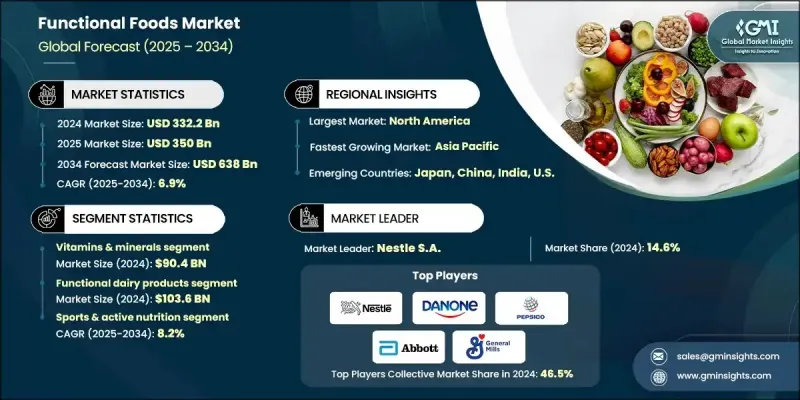
全球人口老化加劇是推動老年人對功能性食品需求成長的關鍵因素。老年人常常面臨心臟病、糖尿病和高血壓等慢性疾病,這些疾病直接影響他們的飲食選擇。研究表明,老年人對功能性食品的消費與其健康需求密切相關,因為這些食品有助於控制或緩解與年齡相關的健康問題。政府推行的促進健康飲食和強調不良飲食對健康影響的措施進一步推動了功能性食品的普及。報告顯示,不健康飲食佔慢性病相關醫療保健總成本的近五分之一,使得飲食干預日益重要。這一趨勢促使生產者專注於營養創新,改進產品配方,以增強免疫力、維持心臟健康和提升整體健康水平,同時滿足消費者對預防性營養的期望。
| 市場範圍 | |
|---|---|
| 起始年份 | 2024 |
| 預測年份 | 2025-2034 |
| 起始值 | 3322億美元 |
| 預測值 | 6380億美元 |
| 複合年成長率 | 6.9% |
維生素和礦物質市場預計在2024年創造904億美元的收入,其健康益處廣受認可。這些成分被添加到飲料、穀物、零食和乳製品中,以增強免疫力、體質和整體健康。成熟市場和新興市場均表現出強勁的市場接受度,這主要得益於人們對健康飲食和預防保健意識的不斷提高。強化食品已成為全球功能性食品組合的核心組成部分。
由於其營養豐富且廣受消費者歡迎,功能性乳製品市場規模預計將在2024年達到1,036億美元。這些產品包括強化牛奶、優格和乳酪,富含維生素、礦物質、蛋白質和益生菌,有助於增強免疫力、促進骨骼健康和消化系統健康。廣泛的分銷網路和消費者對乳製品的良好信任度,推動了其在全球市場的廣泛滲透,使其成為功能性食品的重要組成部分。
預計到2024年,北美功能性食品市佔率將達到38.2%。美國在該地區佔據主導地位,其次是加拿大和墨西哥。肥胖、糖尿病和心血管疾病等生活型態相關健康問題的日益普遍,加速了消費者對營養強化型食品的需求。為此,各公司正大力投資研發、產品創新和多元化,以推出針對心臟健康、消化支持和免疫增強的配方。
全球功能性食品市場的主要參與者包括Arla Foods amba、安麗、巴斯夫、雅培、雀巢、達能、百事可樂、Nutri-Nation、通用磨坊、康寶萊、家樂氏、Standard Functional Foods Group、GFR Pharma、可口可樂和嘉吉。功能性食品產業的公司正在採取多種策略來鞏固其市場地位。他們專注於研發,致力於創造創新且以科學為基礎的產品,以滿足特定的健康需求。透過產品多元化和新配方拓展產品組合,有助於吸引更廣泛的消費族群。策略合作、併購和夥伴關係能夠提陞技術能力和全球分銷網路。此外,各公司也強調永續發展和清潔標籤理念,以迎合消費者的偏好。
目錄
第1章:方法論與範圍
第2章:執行概要
第3章:行業洞察
- 產業生態系分析
- 供應商格局
- 利潤率
- 每個階段的價值增加
- 影響價值鏈的因素
- 中斷
- 產業影響因素
- 成長促進因素
- 健康意識的提高和預防性醫療保健的普及
- 人口老化及與年齡相關的健康問題
- 政府健康計劃和膳食指南
- 產業陷阱與挑戰
- 生產成本高且配方複雜。
- 監理合規與健康聲明限制
- 市場機遇
- 植物性和清潔標籤功能性食品越來越受歡迎
- 數位健康與個人化營養平台的整合
- 成長促進因素
- 成長潛力分析
- 監管環境
- 北美洲
- 歐洲
- 亞太地區
- 拉丁美洲
- 中東和非洲
- 波特的分析
- PESTEL 分析
- 價格趨勢
- 按地區
- 成分類型
- 產品
- 應用
- 未來市場趨勢
- 技術與創新格局
- 當前技術趨勢
- 新興技術
- 專利格局
- 貿易統計(HS編碼)(註:僅提供重點國家的貿易統計資料)
- 主要進口國
- 主要出口國
- 永續性和環境方面
- 永續實踐
- 減少廢棄物策略
- 生產中的能源效率
- 環保舉措
- 碳足跡考量
第4章:競爭格局
- 介紹
- 公司市佔率分析
- 按地區
- 北美洲
- 歐洲
- 亞太地區
- 拉丁美洲
- MEA
- 按地區
- 公司矩陣分析
- 主要市場參與者的競爭分析
- 競爭定位矩陣
- 關鍵進展
- 併購
- 合作夥伴關係與合作
- 新產品發布
- 擴張計劃
第5章:市場估算與預測:依成分類型分類,2021-2034年
- 主要趨勢
- 益生菌
- 益生元
- 維生素和礦物質
- 蛋白質和胺基酸
- 歐米伽脂肪酸
- 植物萃取物
- 纖維
- 類胡蘿蔔素和抗氧化劑
- 其他
第6章:市場估算與預測:依產品分類,2021-2034年
- 主要趨勢
- 功能性乳製品
- 優格
- 強化牛奶
- 起司
- 烘焙食品和穀物
- 強化麵包
- 穀物
- 小吃店
- 功能飲料
- 能量飲料
- 果汁
- 強化水
- 功能性茶/咖啡
- 糖果
- 蛋白質裸露
- 無糖巧克力
- 營養保健糖果
- 嬰幼兒食品
- 肉類和魚類產品
- 富含Omega 3的肉類
- 強化海鮮
- 其他
- 湯
- 調味品
第7章:市場估計與預測:依應用領域分類,2021-2034年
- 主要趨勢
- 運動與活力營養
- 臨床與醫學營養
- 嬰幼兒營養
- 老年人及與年齡相關的健康
- 女性健康與懷孕
- 體重管理
- 消化系統健康
第8章:市場估算與預測:依地區分類,2021-2034年
- 主要趨勢
- 北美洲
- 美國
- 加拿大
- 歐洲
- 德國
- 英國
- 法國
- 西班牙
- 義大利
- 歐洲其他地區
- 亞太地區
- 中國
- 印度
- 日本
- 澳洲
- 韓國
- 亞太其他地區
- 拉丁美洲
- 巴西
- 墨西哥
- 拉丁美洲其他地區
- 中東和非洲
- 沙烏地阿拉伯
- 南非
- 阿拉伯聯合大公國
- 中東和非洲其他地區
第9章:公司簡介
- Nutri-Nation
- BASF SE
- Amway
- General Mills Inc.
- GFR Pharma
- The Coca-Cola Company
- Arla Foods amba
- Amway Corp.
- Herbalife International of America, Inc.
- Cargill, Incorporated
- Standard Functional Foods Group Inc.
- Kellogg's
- Danone SA
- PepsiCo Inc
- Abbott
- Nestle SA
The Global Functional Foods Market was valued at USD 332.2 billion in 2024 and is estimated to grow at a CAGR of 6.9% to reach USD 638 billion by 2034.
The increasing global aging population is a key factor driving the demand for functional foods designed to support health in later years. Older adults often face chronic conditions such as heart disease, diabetes, and high blood pressure, which directly influence their dietary choices. Studies have shown that seniors' consumption of functional foods is closely linked to their health needs, as these foods help manage or mitigate age-related health concerns. Government initiatives promoting better nutrition and highlighting the health impacts of poor diets further encourage functional food adoption. Reports indicate that unhealthy eating accounts for nearly one-fifth of the total healthcare costs associated with chronic diseases, making dietary interventions increasingly critical. This trend has prompted manufacturers to focus on nutritional innovation, reformulating products to address immunity, heart health, and overall well-being while meeting consumer expectations for preventive nutrition.
| Market Scope | |
|---|---|
| Start Year | 2024 |
| Forecast Year | 2025-2034 |
| Start Value | $332.2 Billion |
| Forecast Value | $638 Billion |
| CAGR | 6.9% |
The vitamins and minerals segment generated USD 90.4 billion in 2024, widely recognized for its health benefits. These ingredients are incorporated into beverages, cereals, snacks, and dairy products to support immunity, strength, and general wellness. Both mature and emerging markets show strong adoption rates, driven by rising awareness of healthy diets and preventive healthcare. Fortified products have become a core element of functional food portfolios worldwide.
The functional dairy products reached USD 103.6 billion in 2024, owing to their nutrient-rich composition and high consumer acceptance. These products, including fortified milk, yogurts, and cheeses, are enriched with vitamins, minerals, protein, and probiotics to support immunity, bone health, and digestive wellness. Extensive distribution networks and strong consumer trust in dairy enhance their widespread penetration in global markets, making them foundational to functional food offerings.
North America Functional Foods Market held 38.2% share in 2024. The United States dominates the region, followed by Canada and Mexico. The increasing prevalence of lifestyle-related health conditions such as obesity, diabetes, and cardiovascular diseases has accelerated consumer demand for nutrient-enriched alternatives. In response, companies are investing significantly in research, product innovation, and diversification to introduce formulations targeting heart health, digestive support, and immunity enhancement.
Prominent players in the Global Functional Foods Market include Arla Foods amba, Amway, BASF SE, Abbott, Nestle S.A., Danone SA, PepsiCo Inc., Nutri-Nation, General Mills Inc., Herbalife International of America, Inc., Kellogg's, Standard Functional Foods Group Inc., GFR Pharma, The Coca-Cola Company, and Cargill, Incorporated. Companies in the functional foods sector are adopting multiple strategies to strengthen their market presence. They focus on research and development to create innovative, science-backed products that cater to specific health concerns. Expanding product portfolios through diversification and new formulations helps attract a broader consumer base. Strategic collaborations, mergers, and partnerships enhance technological capabilities and global distribution reach. Firms are also emphasizing sustainability and clean-label initiatives to align with consumer preferences.
Table of Contents
Chapter 1 Methodology & Scope
- 1.1 Market scope and definition
- 1.2 Research design
- 1.2.1 Research approach
- 1.2.2 Data collection methods
- 1.3 Data mining sources
- 1.3.1 Global
- 1.3.2 Regional/Country
- 1.4 Base estimates and calculations
- 1.4.1 Base year calculation
- 1.4.2 Key trends for market estimation
- 1.5 Primary research and validation
- 1.5.1 Primary sources
- 1.6 Forecast model
- 1.7 Research assumptions and limitations
Chapter 2 Executive Summary
- 2.1 Industry 3600 synopsis
- 2.2 Key market trends
- 2.2.1 Regional
- 2.2.2 Ingredient Type
- 2.2.3 Product
- 2.2.4 Application
- 2.3 TAM Analysis, 2025-2034
- 2.4 CXO perspectives: Strategic imperatives
- 2.4.1 Executive decision points
- 2.4.2 Critical success factors
- 2.5 Future Outlook and Strategic Recommendations
Chapter 3 Industry Insights
- 3.1 Industry ecosystem analysis
- 3.1.1 Supplier Landscape
- 3.1.2 Profit Margin
- 3.1.3 Value addition at each stage
- 3.1.4 Factor affecting the value chain
- 3.1.5 Disruptions
- 3.2 Industry impact forces
- 3.2.1 Growth drivers
- 3.2.1.1 Rising health consciousness & preventive healthcare adoption
- 3.2.1.2 Aging population & age-related health concerns
- 3.2.1.3 Government health initiatives & dietary guidelines
- 3.2.2 Industry pitfalls and challenges
- 3.2.2.1 High production costs & complex formulation
- 3.2.2.2 Regulatory compliance & health claim restrictions
- 3.2.3 Market opportunities
- 3.2.3.1 Rising popularity of plant-based and clean-label functional foods
- 3.2.3.2 Integration of digital health and personalized nutrition platforms
- 3.2.1 Growth drivers
- 3.3 Growth potential analysis
- 3.4 Regulatory landscape
- 3.4.1 North America
- 3.4.2 Europe
- 3.4.3 Asia Pacific
- 3.4.4 Latin America
- 3.4.5 Middle East & Africa
- 3.5 Porter's analysis
- 3.6 PESTEL analysis
- 3.6.1 Technology and Innovation Landscape
- 3.6.2 Current technological trends
- 3.6.3 Emerging technologies
- 3.7 Price trends
- 3.7.1 By region
- 3.7.2 Ingredient type
- 3.7.3 Product
- 3.7.4 Application
- 3.8 Future market trends
- 3.9 Technology and Innovation Landscape
- 3.9.1 Current technological trends
- 3.9.2 Emerging technologies
- 3.10 Patent Landscape
- 3.11 Trade statistics (HS code) (Note: the trade statistics will be provided for key countries only)
- 3.11.1 Major importing countries
- 3.11.2 Major exporting countries
- 3.12 Sustainability and environmental aspects
- 3.12.1 Sustainable practices
- 3.12.2 Waste reduction strategies
- 3.12.3 Energy efficiency in production
- 3.12.4 Eco-friendly initiatives
- 3.13 Carbon footprint considerations
Chapter 4 Competitive Landscape, 2024
- 4.1 Introduction
- 4.2 Company market share analysis
- 4.2.1 By region
- 4.2.1.1 North America
- 4.2.1.2 Europe
- 4.2.1.3 Asia Pacific
- 4.2.1.4 LATAM
- 4.2.1.5 MEA
- 4.2.1 By region
- 4.3 Company matrix analysis
- 4.4 Competitive analysis of major market players
- 4.5 Competitive positioning matrix
- 4.6 Key developments
- 4.6.1 Mergers & acquisitions
- 4.6.2 Partnerships & collaborations
- 4.6.3 New product launches
- 4.6.4 Expansion plans
Chapter 5 Market Estimates and Forecast, By Ingredient Type, 2021 - 2034 (USD Billion) (Kilo Tons)
- 5.1 Key trends
- 5.2 Probiotics
- 5.3 Prebiotics
- 5.4 Vitamins & Minerals
- 5.5 Proteins & Amino Acids
- 5.6 Omega Fatty Acids
- 5.7 Plant Extracts
- 5.8 Fibers
- 5.9 Carotenoids & Antioxidants
- 5.10 Others
Chapter 6 Market Estimates and Forecast, By Product, 2021 - 2034 (USD Billion) (Kilo Tons)
- 6.1 Key trends
- 6.2 Functional dairy products
- 6.2.1 Yogurt
- 6.2.2 Fortified milk
- 6.2.3 Cheese
- 6.3 Bakery & cereals
- 6.3.1 Fortified bread
- 6.3.2 Cereals
- 6.3.3 Snacks bar
- 6.4 Functional beverages
- 6.4.1 Energy drinks
- 6.4.2 Juices
- 6.4.3 Enhanced water
- 6.4.4 Functional teas/coffee
- 6.5 Confectionary
- 6.5.1 Protein bares
- 6.5.2 Sugar free chocolates
- 6.5.3 Nutraceutical candies
- 6.6 Infants & baby foods
- 6.6.1 Meat & Fish products
- 6.6.2 Omega 3 Enriched meat
- 6.6.3 Fortified seafood
- 6.7 Others
- 6.7.1 Soups
- 6.7.2 Condiments
Chapter 7 Market Estimates and Forecast, By Application, 2021 - 2034 (USD Billion) (Kilo Tons)
- 7.1 Key trends
- 7.2 Sports & active nutrition
- 7.3 Clinical & medical nutrition
- 7.4 Infant & child nutrition
- 7.5 Elderly & age-related health
- 7.6 Women's health & pregnancy
- 7.7 Weight management
- 7.8 Digestive health
Chapter 8 Market Estimates and Forecast, By Region, 2021 - 2034 (USD Billion) (Kilo Tons)
- 8.1 Key trends
- 8.2 North America
- 8.2.1 U.S.
- 8.2.2 Canada
- 8.3 Europe
- 8.3.1 Germany
- 8.3.2 UK
- 8.3.3 France
- 8.3.4 Spain
- 8.3.5 Italy
- 8.3.6 Rest of Europe
- 8.4 Asia Pacific
- 8.4.1 China
- 8.4.2 India
- 8.4.3 Japan
- 8.4.4 Australia
- 8.4.5 South Korea
- 8.4.6 Rest of Asia Pacific
- 8.5 Latin America
- 8.5.1 Brazil
- 8.5.2 Mexico
- 8.5.3 Rest of Latin America
- 8.6 Middle East and Africa
- 8.6.1 Saudi Arabia
- 8.6.2 South Africa
- 8.6.3 UAE
- 8.6.4 Rest of Middle East and Africa
Chapter 9 Company Profiles
- 9.1 Nutri-Nation
- 9.2 BASF SE
- 9.3 Amway
- 9.4 General Mills Inc.
- 9.5 GFR Pharma
- 9.6 The Coca-Cola Company
- 9.7 Arla Foods amba
- 9.8 Amway Corp.
- 9.9 Herbalife International of America, Inc.
- 9.10 Cargill, Incorporated
- 9.11 Standard Functional Foods Group Inc.
- 9.12 Kellogg's
- 9.13 Danone SA
- 9.14 PepsiCo Inc
- 9.15 Abbott
- 9.16 Nestle S.A.

 機能性食品市場:按產品類型、原料、應用和地區分類
 2026 年至 2035 年機能性食品市場中後生元成分的成長要素、產業趨勢和預測。
 功能性食品和飲料市場預測至2032年:按產品類型、成分、人口統計、產品形式、分銷管道、應用和地區分類的全球分析
 機能性食品市場規模、佔有率及成長分析(按成分、產品、應用及地區分類)-2026-2033年產業預測
 腦健康功能性食品飲料市場規模、佔有率及成長分析(依成分、產品、通路及地區分類)-2026-2033年產業預測全球機能性食品用魚皮膠原蛋白市場:預測(至2032年)-依產品類型、品種、供應來源、配方/等級、萃取/加工方法、應用和地區進行分析2032年機能性食品市場預測:按產品、形態、成分來源、健康益處、消費群組、分銷管道和地區進行的全球分析2032 年富含益生元的食品市場預測:按產品類型、成分、來源、應用、最終用戶和地區進行的全球分析2032 年情緒增強機能性食品市場預測:按產品、類型、性質、包裝、應用、最終用戶和地區進行的全球分析2032 年藻類蛋白食品市場預測:按來源、形式、方法、應用、最終用戶和地區進行的全球分析