


 |
市場調查報告書
商品編碼
2163644
跨境卡車運輸:市場佔有率分析、行業趨勢和統計數據以及成長預測(2026-2031 年)Bonded Cross-Border Trucking - Market Share Analysis, Industry Trends & Statistics, Growth Forecasts (2026 - 2031) |
||||||

※ 本網頁內容可能與最新版本有所差異。詳細情況請與我們聯繫。
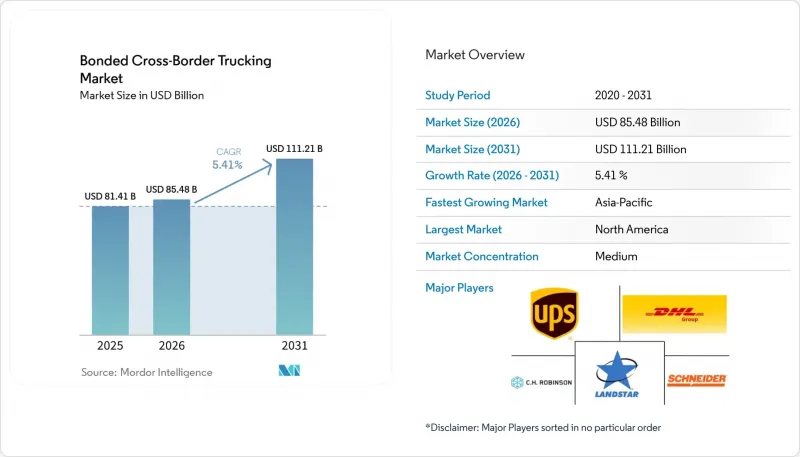
據 Mordor Intelligence 稱,2025 年保稅跨境卡車運輸市場價值 814.1 億美元,預計到 2031 年將達到 1112.1 億美元,而 2026 年為 854.8 億美元,預測期內(2026-2031 年)的複合成長率預計為 5.41%。
保稅跨境卡車運輸市場正受到區域間生產合作日益密切的影響,尤其是在美國、墨西哥和加拿大之間。本報告按終端用戶產業(製造業、零售業等)、負載容量(整車運輸、零擔運輸)、容器化(貨櫃運輸等)、運輸距離(長途運輸等)、貨物類型(液體、固體)、溫度控制方式(溫控運輸等)以及地區(北美、歐洲、亞太地區等)進行細分。市場預測以美元計價。
全球保稅跨境卡車運輸市場趨勢及洞察。
近岸外包和本地製造業擴張
預計到2025年,墨西哥將吸引408.7億美元的外國直接投資,已公佈的工廠建設計畫總額將超過800億美元。 「墨西哥計畫」下的工業發展已在10個州扶持了汽車、航太、電子、醫療設備和物流等產業。這些設施一旦投產,將產生穩定的貨物流,從而增強對可靠邊境服務的需求。隨著製造商需要在多個司法管轄區之間運輸零件而無需立即繳納關稅,保稅跨境卡車運輸市場將不斷擴大。拉雷多仍然是這項活動的中心,在2025年至2026年期間,該市將處理美墨雙邊卡車貿易量的46%。電子產品和先進製造業的興起增加了對頻繁且高價值貨物運輸的需求。 2026年7月,墨西哥的電氣和電子設備出口較去年同期成長134%。與許多傳統商品相比,這些商品的每輛卡車往往需要支付更高的關稅。因此,在邊境附近設有保稅轉運點的承運商可以提供更優惠的營運資金提案。這一趨勢正在將保稅跨境卡車運輸市場拓展到傳統公路運輸路線之外。此外,對可靠的海關記錄、安全的貨物裝卸和可預測的邊境交接的需求也日益成長。
電子商務小包裹的合併出貨和退貨
美國最低限額規定於2025年初發生變化,迫使小包裹代收公司加強其清關能力。這導致更多小包裹轉向正規的保稅處理和收運/運輸。當承運商能夠在最終交付前整合貨物時,保稅跨境卡車運輸市場將從中受益。收運/運輸減少了邊境的零散交易,簡化了文件流程。它還提高了位於小包裹樞紐附近的保稅倉庫的位置。 2026年6月,UPS和Flexport推出了混合收運/運輸網路,該網路將國際貨物先通過保稅倉庫進行分流,然後再進入UPS的地面運輸網路。這種機制降低了從始發地到美國樞紐的貨物被徵收跨洲區域費用的風險。歐盟2026年的最低限額規定也促進了區域內的整合履約。自2026年4月起,法國將對穿越英吉利海峽的卡車實施「強制性物流信封」制度,要求卡車在進入港口前出示一個可掃描的條碼,用於海關和安全文件。這些變更將使那些能夠在一個作業流程中同時管理貨物收集和文件的供應商受益。
海關程序和文件要求分散
即使是跨越多個司法管轄區的單一保稅運輸,其申報格式、分類和到港前要求也可能各不相同。文件錯誤可能導致在中途邊境檢查站被檢查、扣押或重新保稅。隨著涉及邊境數量的增加,成本會迅速攀升。在海關程序可預測的路線上,保稅跨境卡車運輸市場仍具有可擴展性。因此,承運商正將運輸量集中在成熟的邊境檢查站和信譽良好的報關行。 2025年9月,加拿大邊境服務局 (CBSA) 的系統故障中斷了數位化預檢清關流程,迫使承運商恢復紙本流程。加拿大卡車運輸協會 (CTA) 表示,這次中斷導致成本增加,並使供應鏈緊張。即使在系統故障結束後,由於積壓的貨物需要處理,延誤可能仍會持續。一些使用頻率較低的邊境檢查站即使具備實際的處理能力,也可能仍未充分利用。這導致區域網路的運力有差異。標準化的資料格式和可靠的緊急應變程序可以緩解保稅跨境卡車運輸市場的這些限制。
細分市場分析
至2025年,製造業將佔保稅跨境卡車運輸市場佔有率的34.50%。汽車、電子和工業生產的一體化供應商網路支撐著這一地位。零件可以在最終消費國繳納關稅之前以保稅狀態運輸。這有助於管理跨境供應鏈中的營運資金。製造業的需求與既定的生產週期和頻繁的零件流動密切相關。
預計到2031年,批發零售業的複合年成長率將達到7.28%。零售商正利用靠近需求中心的保稅跨境運輸樞紐,而非僅依賴國內安全庫存。農業、漁業、林業、建設業、石油天然氣業、採礦業和採石業也產生了可觀的貨運量。這些產業的需求對商品和專案週期高度敏感。因此,儘管保稅跨境卡車運輸業的基本客群正在擴大,但製造業仍是貨運量的主要來源。
預計到2025年,整車運輸(FTL)將佔保稅跨境卡車運輸市場佔有率的58.60%。汽車零件、工業設備和農產品散裝貨物通常非常適合使用專用拖車運輸。充分利用單輛拖車可以簡化海關文件手續,並降低邊境轉運的風險。整車運輸對於貨量大、運輸時間穩定的貨物仍然適用,也能滿足成熟製造業走廊的營運需求。
預計到2031年,小包裹(零擔)運輸將以6.95%的複合年成長率成長。隨著零售補貨和電子商務物流的擴張,零擔運輸變得越來越普遍。 2025年9月,CH Robinson推出了一項跨境取貨服務,將提貨、運輸、清關和保稅倉儲整合到墨西哥。這項服務解決了墨西哥貨物清關代理相關的提貨限制問題。 2025年,墨西哥的貨運卡車數量較去年同期下降了0.2%,這印證了透過整合來提高車輛利用率的有效性。
區域分析
2025年,北美佔據了保稅跨境卡車運輸市場佔有率的31.50%。根據美國交通統計局的數據,2025年美國與墨西哥之間的卡車貿易額超過4,800億美元。 2026年上半年,墨西哥對美國的出口年增13%,主要成長動力來自電子產品、汽車和先進製造業。 2026年7月,戈迪·豪國際大橋的開通,為溫莎和底特律之間開闢了一條新的商業通道。
預計到2031年,亞太地區的複合年成長率將達到6.93%。 2025年1月至10月,中國與東協之間的跨國卡車運輸量超過11,000輛次,同期貨物價值超過21.2億美元。 「友誼之路智慧港」於2026年4月開始試運營,實現了24小時通關。透過2025年和2026年的投資計劃,德迅集團在泰國的車隊規模增加了約40輛牽引車和100個貨櫃。
歐洲、中東和非洲以及南美洲也是保稅跨境卡車運輸市場的重要貿易走廊。法國的「強制性物流包絡」(Obligatory Logistics Envelope)和奧地利計畫中的「奧地利智慧邊境」(Smart Border Austria)系統正在推進預數據和單證程序的標準化。日本通運(Nippon Express)和cargo-partner於2025年5月推出了「ONE Road」網路,整合了歐洲各地的共乘(Group Age)、零擔(LTL)和整車(FTL)服務。在南美洲以及中東和非洲,基礎設施薄弱,數位海關系統發展不足,但走廊的投資有望從長遠來看改善通行狀況。
其他好處:
- Excel格式的市場預測(ME)表
- 3個月的分析師支持
目錄
第1章:引言
- 研究假設和市場定義
- 調查範圍
第2章:調查方法
第3章執行摘要
第4章 市場狀況
- 市場概覽
- 市場促進因素
- 近岸外包和本地製造業擴張
- 電子商務中的小包裹收取和退貨
- 關稅延期和關稅最佳化要求
- 對時間要求嚴格和受管制貨物數量增加。
- 海關文件和邊境程序的數位化
- 通過第三國,跨越多個國家,擴展陸上橋樑和運輸走廊。
- 市場限制因素
- 海關程序和文件要求分散
- 邊境擁擠和保稅轉運能力不足
- 債券債務、貨物竊盜和保險風險
- 各地對零排放卡車的規定不盡相同。
- 價值供應鏈分析
- 監理情勢
- 技術展望
- 波特五力分析
- 地緣政治事件對市場的影響
第5章 市場規模與成長預測
- 按最終用戶行業分類
- 農業、漁業、林業
- 建造
- 製造業
- 石油和天然氣、採礦和採石
- 批發和零售
- 其他
- 按規格分類的卡車負載容量
- 整車運輸 (FTL)
- 小批量貨物(零擔)
- 透過容器化
- 容器化
- 容器化
- 按距離
- 長途
- 短程航線
- 依產品組成
- 流體產品
- 固體產品
- 按類型進行溫度控制
- 無溫度控制
- 溫度控制
- 按地區
- 北美洲
- 美國
- 加拿大
- 墨西哥
- 南美洲
- 巴西
- 阿根廷
- 秘魯
- 智利
- 其他南美國家
- 歐洲
- 德國
- 英國
- 法國
- 義大利
- 西班牙
- 俄羅斯
- 北歐國家(丹麥、芬蘭、冰島、挪威、瑞典)
- 其他歐洲國家
- 亞太地區
- 中國
- 印度
- 日本
- 韓國
- 澳洲
- 東南亞(東協)
- 其他亞太國家
- 中東和非洲
- 沙烏地阿拉伯
- 阿拉伯聯合大公國
- 卡達
- 南非
- 奈及利亞
- 埃及
- 其他中東和非洲國家
- 北美洲
第6章 競爭情勢
- 市場集中度
- 市場中的關鍵策略舉措
- 市佔率分析
- 公司簡介
- CH Robinson Worldwide, Inc.
- DHL Group
- United Parcel Service of America, Inc.(UPS)
- Landstar System, Inc.
- Schneider National, Inc.
- Werner Enterprises, Inc.
- XPO, Inc.
- JB Hunt Transport Services, Inc.
- DSV A/S
- Kuehne+Nagel
- FedEx
- Knight-Swift Transportation Holdings Inc.
- Ryder System, Inc.
- ArcBest Corporation
- TFI International Inc.
- Penske Corporation
- Rhenus Group
- Nippon Express Holdings, Inc.
- CMA CGM Group(Including CEVA Logistics)
- Talhon LLC
- Singh Truck Lines
- Mex-Cal Truckline
第7章 市場機會與未來展望
According to Mordor Intelligence, the bonded cross-border trucking market size was valued at USD 81.41 billion in 2025 and is estimated to grow from USD 85.48 billion in 2026 to reach USD 111.21 billion by 2031, at a CAGR of 5.41% during the forecast period (2026-2031).
The bonded cross-border trucking market is being shaped by deeper regional production links, especially across the United States, Mexico, and Canada. This report is Segmented by End User Industry (Manufacturing, Retail Trade, and More), by Truckload (FTL, LTL), by Containerization (Containerized, and More), by Distance (Long Haul, and More), by Goods (Fluid, Solid), by Temperature Control (Temperature Controlled, and More), and by Geography (North America, Europe, Asia-Pacific, and More). The Market Forecasts are Provided in Terms of Value (USD).
Global Bonded Cross-Border Trucking Market Trends and Insights
Nearshoring and Regional Manufacturing Expansion
Mexico recorded USD 40.87 billion in foreign direct investment in 2025, while announced factory projects exceeded USD 80 billion. Industrial development under Plan Mexico supported automotive, aerospace, electronics, medical device, and logistics activity across 10 states. These facilities create repeat freight flows once production begins and reinforce demand for reliable border services. The bonded cross-border trucking market gains when manufacturers need to move components through multiple jurisdictions without immediate duty payment. Laredo remained central to this activity and handled 46% of the value of truck-transported bilateral United States-Mexico trade during 2025-2026. Electronics and advanced manufacturing increased the need for frequent, high-value freight movements. Mexican electrical and electronic equipment exports rose 134% year-over-year in July 2026. Such cargo can carry a larger duty exposure per truckload than many conventional shipments. Carriers with bonded staging capacity near crossings can therefore offer a more useful working-capital proposition. This pattern is expanding the bonded cross-border trucking market beyond traditional automotive lanes. It also increases the need for dependable customs records, secure handling, and predictable border handoffs.
E-Commerce Parcel Consolidation and Returns
Changes to the United States de minimis treatment in early 2025 required parcel consolidators to strengthen customs-clearance capabilities. This shifted more small consignments toward formal bonded handling and consolidated movement. The bonded cross-border trucking market benefits when carriers can pool shipments before final distribution. Consolidated transport reduces fragmented border transactions and makes documentation easier to manage. It also makes bonded warehouse locations near parcel hubs more valuable. In June 2026, UPS and Flexport launched a hybrid consolidation network that moved international freight through bonded warehouse nodes before entry into the UPS ground network. The arrangement reduced exposure to transcontinental zone pricing on origin-to-United States hub movements. The European Union's 2026 de minimis change also encouraged bulk fulfillment within the region. France implemented the Obligatory Logistics Envelope from April 2026 for cross-Channel trucks, requiring a single scannable barcode for customs and security documents before the port approach. These changes favor providers that can manage both freight consolidation and documentation in one operating process.
Fragmented Customs Procedures and Documentation Requirements
A single bonded movement across several jurisdictions can involve separate filing formats, classifications, and pre-arrival requirements. A document error can lead to inspection, detention, or re-bonding at an intermediate crossing. This creates costs that rise quickly when more borders are involved. The bonded cross-border trucking market remains easier to scale on corridors with predictable customs procedures. Carriers consequently direct volume toward established crossings and proven brokerage relationships. Canada Border Services Agency system outages in September 2025 interrupted digital pre-clearance and sent carriers back to paper processes. The Canadian Trucking Alliance said the disruptions added costs and strained supply chains. Delays can persist after an outage because accumulated shipments still require processing. Less-used crossings can remain underutilized even when they have physical capacity. The result is uneven throughput across regional networks. Harmonized data standards and reliable contingency procedures would reduce this constraint for the bonded cross-border trucking market.
Other drivers and restraints analyzed in the detailed report include:
- Duty Deferral and Tariff Optimization Requirements
- Digitization of Customs Documentation and Border Processing
- Border Congestion and Limited Bonded Cross-Dock Capacity
For complete list of drivers and restraints, kindly check the Table Of Contents.
Segment Analysis
Manufacturing accounted for 34.50% of the bonded cross-border trucking market share in 2025. Integrated supplier networks for automotive, electronics, and industrial production support this position. Components can move under bond before the final consumption entry triggers duty payment. This supports working-capital management in supply chains that cross several borders. Manufacturing demand is tied to scheduled production cycles and frequent component movements.
Wholesale and retail trade is forecast to register at a CAGR of 7.28% through 2031. Retailers are using cross-border bonded staging closer to demand centers rather than relying only on domestic safety stock. Agriculture, fishing, and forestry, construction, oil and gas, mining, and quarrying also generate meaningful freight volumes. Their demand is more sensitive to commodity and project cycles. The bonded cross-border trucking industry is, therefore, broadening its customer base while manufacturing remains the main source of volume.
Full-truck-load held 58.60% of the bonded cross-border trucking market share in 2025. Automotive parts, industrial equipment, and agricultural bulk shipments often fit dedicated trailer movements. A full trailer can simplify customs documentation and reduce transload exposure at the border. FTL remains useful for high-volume consignments with stable schedules. It also aligns with the operating needs of established manufacturing corridors.
Less-than-truckload is forecast to advance at a CAGR of 6.95% through 2031. Smaller consignments are becoming more common as retail replenishment and e-commerce distribution expand. C.H. Robinson introduced a Mexico cross-border consolidation service in September 2025 that combined consolidation, transport, customs brokerage, and bonded warehousing. The service addressed broker-related consolidation limits for Mexico movements. Mexico's cargo truck fleet declined 0.2% year-over-year in 2025, which supports the case for better equipment use through consolidation.
Complete Report Scope:
- By End User Industry
- Agriculture, Fishing, and Forestry
- Construction
- Manufacturing
- Oil and Gas, Mining and Quarrying
- Wholesale and Retail Trade
- Others
- By Truckload Specification
- Full-Truck-Load (FTL)
- Less than-Truck-Load (LTL)
- By Containerization
- Containerized
- Non-Containerized
- By Distance
- Long Haul
- Short Haul
- By Goods Configuration
- Fluid Goods
- Solid Goods
- By Temperature Control
- Non-Temperature Controlled
- Temperature Controlled
- By Geography
- North America
- United States
- Canada
- Mexico
- South America
- Brazil
- Argentina
- Peru
- Chile
- Rest of South America
- Europe
- Germany
- United Kingdom
- France
- Italy
- Spain
- Russia
- Nordics (Denmark, Finland, Iceland, Norway, and Sweden)
- Rest of Europe
- Asia-Pacific
- China
- India
- Japan
- South Korea
- Australia
- Southeast Asia (ASEAN)
- Rest of Asia-Pacific
- Middle East and Africa
- Saudi Arabia
- United Arab Emirates
- Qatar
- South Africa
- Nigeria
- Egypt
- Rest of Middle East and Africa
- North America
Geography Analysis
North America held 31.50% of the bonded cross-border trucking market share in 2025. United States-Mexico trade by truck exceeded USD 480 billion in 2025, according to the Bureau of Transportation Statistics. Mexican exports to the United States rose 13% year-over-year in the first half of 2026. Electronics, automotive, and advanced manufacturing contributed to this activity. The Gordie Howe International Bridge opened in July 2026 and added a commercial crossing option between Windsor and Detroit.
Asia-Pacific is forecast to register at a CAGR of 6.93% through 2031. China-ASEAN cross-border movements exceeded 11,000 truck trips between January and October 2025. Cargo value exceeded USD 2.12 billion over the same period. Friendship Pass Smart Port began trial operations in April 2026 and enabled 24-hour customs clearance. Kuehne+Nagel added nearly 40 prime movers and 100 containers in Thailand through its 2025 and 2026 investment program.
Europe, the Middle East and Africa, and South America also offer relevant trade corridors for the bonded cross-border trucking market. France's Obligatory Logistics Envelope and Austria's planned Smart Border Austria system are standardizing advance data and documentation processes. Nippon Express and cargo-partner launched the ONE Road network in May 2025 to integrate groupage, LTL, and FTL services across Europe. South America, the Middle East, and Africa face weaker infrastructure and less developed digital clearance systems, but corridor investment can improve long-term access.
- C.H. Robinson Worldwide, Inc.
- DHL Group
- United Parcel Service of America, Inc. (UPS)
- Landstar System, Inc.
- Schneider National, Inc.
- Werner Enterprises, Inc.
- XPO, Inc.
- J.B. Hunt Transport Services, Inc.
- DSV A/S
- Kuehne+Nagel
- FedEx
- Knight-Swift Transportation Holdings Inc.
- Ryder System, Inc.
- ArcBest Corporation
- TFI International Inc.
- Penske Corporation
- Rhenus Group
- Nippon Express Holdings, Inc.
- CMA CGM Group (Including CEVA Logistics)
- Talhon LLC
- Singh Truck Lines
- Mex-Cal Truckline
Additional Benefits:
- The market estimate (ME) sheet in Excel format
- 3 months of analyst support
TABLE OF CONTENTS
1 Introduction
- 1.1 Study Assumptions and Market Definition
- 1.2 Scope of the Study
2 Research Methodology
3 Executive Summary
4 Market Landscape
- 4.1 Market Overview
- 4.2 Market Drivers
- 4.2.1 Nearshoring and Regional Manufacturing Expansion
- 4.2.2 E-commerce Parcel Consolidation and Returns
- 4.2.3 Duty Deferral and Tariff Optimization Requirements
- 4.2.4 Growth of Time-sensitive and Regulated Cargo
- 4.2.5 Digitization of Customs Documentation and Border Processing
- 4.2.6 Expansion of Multi-country Landbridge and Third-country Transit Corridors
- 4.3 Market Restraints
- 4.3.1 Fragmented Customs Procedures and Documentation Requirements
- 4.3.2 Border Congestion and Limited Bonded Cross-dock Capacity
- 4.3.3 Bond Liability, Cargo Theft and Insurance Exposure
- 4.3.4 Divergent Zero-emission Trucking Rules Across Jurisdictions
- 4.4 Value / Supply-Chain Analysis
- 4.5 Regulatory Landscape
- 4.6 Technological Outlook
- 4.7 Porter's Five Forces Analysis
- 4.7.1 Threat of New Entrants
- 4.7.2 Bargaining Power of Suppliers
- 4.7.3 Bargaining Power of Buyers
- 4.7.4 Threat of Substitutes
- 4.7.5 Competitive Rivalry
- 4.8 Impact of Geopolitical Events on the Market
5 Market Size and Growth Forecasts (Value in USD)
- 5.1 By End User Industry
- 5.1.1 Agriculture, Fishing, and Forestry
- 5.1.2 Construction
- 5.1.3 Manufacturing
- 5.1.4 Oil and Gas, Mining and Quarrying
- 5.1.5 Wholesale and Retail Trade
- 5.1.6 Others
- 5.2 By Truckload Specification
- 5.2.1 Full-Truck-Load (FTL)
- 5.2.2 Less than-Truck-Load (LTL)
- 5.3 By Containerization
- 5.3.1 Containerized
- 5.3.2 Non-Containerized
- 5.4 By Distance
- 5.4.1 Long Haul
- 5.4.2 Short Haul
- 5.5 By Goods Configuration
- 5.5.1 Fluid Goods
- 5.5.2 Solid Goods
- 5.6 By Temperature Control
- 5.6.1 Non-Temperature Controlled
- 5.6.2 Temperature Controlled
- 5.7 By Geography
- 5.7.1 North America
- 5.7.1.1 United States
- 5.7.1.2 Canada
- 5.7.1.3 Mexico
- 5.7.2 South America
- 5.7.2.1 Brazil
- 5.7.2.2 Argentina
- 5.7.2.3 Peru
- 5.7.2.4 Chile
- 5.7.2.5 Rest of South America
- 5.7.3 Europe
- 5.7.3.1 Germany
- 5.7.3.2 United Kingdom
- 5.7.3.3 France
- 5.7.3.4 Italy
- 5.7.3.5 Spain
- 5.7.3.6 Russia
- 5.7.3.7 Nordics (Denmark, Finland, Iceland, Norway, and Sweden)
- 5.7.3.8 Rest of Europe
- 5.7.4 Asia-Pacific
- 5.7.4.1 China
- 5.7.4.2 India
- 5.7.4.3 Japan
- 5.7.4.4 South Korea
- 5.7.4.5 Australia
- 5.7.4.6 Southeast Asia (ASEAN)
- 5.7.4.7 Rest of Asia-Pacific
- 5.7.5 Middle East and Africa
- 5.7.5.1 Saudi Arabia
- 5.7.5.2 United Arab Emirates
- 5.7.5.3 Qatar
- 5.7.5.4 South Africa
- 5.7.5.5 Nigeria
- 5.7.5.6 Egypt
- 5.7.5.7 Rest of Middle East and Africa
- 5.7.1 North America
6 Competitive Landscape
- 6.1 Market Concentration
- 6.2 Key Strategic Moves in the Market
- 6.3 Market Share Analysis
- 6.4 Company Profiles (includes Global Level Overview, Market Level Overview, Core Segments, Financials as available, Strategic Information, Geographic/Network Coverage, Products and Services, Recent Developments)
- 6.4.1 C.H. Robinson Worldwide, Inc.
- 6.4.2 DHL Group
- 6.4.3 United Parcel Service of America, Inc. (UPS)
- 6.4.4 Landstar System, Inc.
- 6.4.5 Schneider National, Inc.
- 6.4.6 Werner Enterprises, Inc.
- 6.4.7 XPO, Inc.
- 6.4.8 J.B. Hunt Transport Services, Inc.
- 6.4.9 DSV A/S
- 6.4.10 Kuehne+Nagel
- 6.4.11 FedEx
- 6.4.12 Knight-Swift Transportation Holdings Inc.
- 6.4.13 Ryder System, Inc.
- 6.4.14 ArcBest Corporation
- 6.4.15 TFI International Inc.
- 6.4.16 Penske Corporation
- 6.4.17 Rhenus Group
- 6.4.18 Nippon Express Holdings, Inc.
- 6.4.19 CMA CGM Group (Including CEVA Logistics)
- 6.4.20 Talhon LLC
- 6.4.21 Singh Truck Lines
- 6.4.22 Mex-Cal Truckline
7 Market Opportunities & Future Outlook
- 7.1 White-Space and Unmet-Need Assessment

