


 |
市場調查報告書
商品編碼
2163357
印尼拼箱貨運 (LCL):市場佔有率分析、行業趨勢和統計數據以及成長預測 (2026-2031)Indonesia Less-than Container Load (LCL) - Market Share Analysis, Industry Trends & Statistics, Growth Forecasts (2026 - 2031) |
||||||

※ 本網頁內容可能與最新版本有所差異。詳細情況請與我們聯繫。
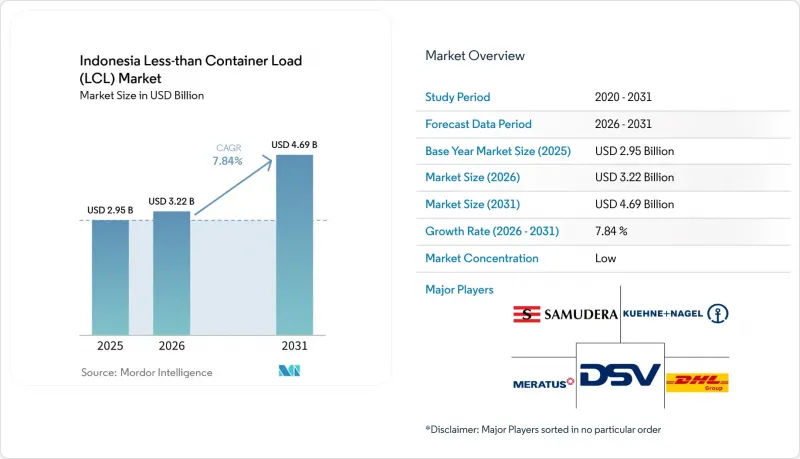
根據 Mordor Intelligence 預測,印尼拼箱貨運市場規模預計在 2025 年達到 29.5 億美元,2026 年達到 32.2 億美元,2031 年達到 46.9 億美元,在預測期(2026-2031 年)內複合年成長率為 7.84%。
印尼拼箱貨運 (LCL) 市場趨勢與洞察
電子商務的成長正在推動對零擔(LCL)跨境運輸的需求。
2025年,印尼引領東南亞跨境電商發展,滿足了小規模線上訂單帶來的拼箱運輸需求。零售商擴大從多個供應商採購,並增加下單一頻率,這推動了對靈活運輸計畫的需求。主要貨櫃貨運站的短訂艙期使得快速收貨和準確的單據變得尤為重要。如果貨運代理商能夠在不延遲交付流程的情況下整合這些訂單,印尼拼箱(LCL)市場將從中受益。除了印尼在全球貿易成長中扮演的重要角色外,DHL已將電子商務和零售業列為該國貿易發展的優先領域。能夠整合訂艙資訊和海關流程的服務供應商可以幫助托運人輕鬆管理頻繁的小額貨運。
製造業的多元化發展導致對來自多個產地的合併運輸的需求增加。
隨著製造商將印尼納入其「中國+1」供應鏈策略,2026年上半年中國當地和香港對印尼的投資額達115億美元,高於2025年同期的41億美元。位於芝卡朗、巴淡島、肯達爾和蘇拉威西島的新建生產基地,預計將產生來自多家工廠、銷往同一海外買家的貨物。在電子產品、汽車零件和紡織品組裝,不僅需要出口運輸,通常還需要採購進口零件,這使得走廊能夠實現雙向拼箱運輸。這一趨勢有利於能夠收集小批量貨物、制定裝載計劃並為拼箱貨物簽發單一載貨證券的承運商。在印尼的拼箱(LCL)市場,利用位於工業園區附近的貨櫃貨運站(CFS)網路,可以減少貨物到達門戶港口之前的裝卸環節。
港口擁擠和貨車延誤延長了運輸時間。
印尼海關規定可能採用過去90天的進口價格基準,而非申報的交易價格來計算課稅價值,這可能會增加海關清關時間的不確定性。貨櫃貨運站門口的卡車排隊也會造成等待時間,貨運代理商要麼自行承擔,要麼透過提高價格轉嫁給客戶。這個問題在丹戎不碌、丹戎霹靂和勿拉灣尤為突出,延誤可能會影響單一貨櫃內裝載的多批小批量貨物。道路狀況和運作可用性將進一步拉大爪哇島與二級港口之間的運輸時間差距。這對高頻次的線上零售出貨構成重大挑戰,因為精準的交貨時間至關重要。雖然最佳化裝貨計畫和取貨時間可以最大限度地減少影響,但在陸路基礎設施改善完成之前,印尼拼箱(LCL)市場仍將持續受到擁擠的影響。
細分市場分析
到2025年,整合服務將佔印尼拼箱(LCL)市場的64.59%。這一結果反映了來自東北亞和東南亞多個貨主的進口貨物以拼箱形式抵達印尼的重要性。在廣州、義烏、新加坡和其他地點進行拼箱意味著,印尼進口商不僅依賴當地的裝卸作業,還要依賴原產國貨櫃貨運站(CFS)的效率。當地業者的大部分收入來自卸貨、清關和卸貨後的配送。這使得能夠有效連接爪哇島各地貨櫃貨運站和客戶地點的營運商具有優勢。
預計2026年至2031年間,整合卸貨和配送業務的複合年成長率將達到9.87%,成為該服務領域中成長率最高的細分市場。在印尼,拼箱運輸市場規模的成長主要得益於從港口卸貨到二、三線城市的貨物運輸。醫療供應鏈、農產品分銷和線上履約等行業都對貨物到達後的分揀、檢驗、重新包裝和倉儲服務產生了需求。如果這些服務能夠準確無誤地在客戶要求的交貨時限內完成,則產生的收入將超過基本運費。當終端客戶距離主要港口較遠時,這種需求最為旺盛。
2025年,國際拼箱貨運佔印尼拼箱貨運市場規模的62.37%。這一地位得益於貿易導向型製造業以及對進口工業原料、家用電器和日常消費品的需求。國際運輸通常透過主要門戶城市附近的貨櫃貨運站(CFS)網路進行。亞洲內部拼箱路線的高昂每立方公尺價格也決定了該業務的短期價格上限。蘇拉威西島和加里曼丹島新產業群聚的形成擴大了出口貨物的始發地,此前這些貨物主要經由爪哇島運輸。
預計2026年至2031年,國內拼箱貨運的複合年成長率將達到10.97%,在所有目的地細分市場中成長率最高。島際消費品分銷、海運航線的擴張以及雅加達和泗水以外地區對線上訂單履行的需求,都支撐了這一履約。政府支持的航線開發可能會創造貨運流量,承運商可以透過定期拼箱航班進行處理。此外,由於部分地區歷來物流網路覆蓋率較低,此細分市場仍有成長空間。國內需求包括項目貨物採購和無需整箱運輸的補充貨運。
其他好處:
- Excel格式的市場預測(ME)表
- 3個月的分析師支持
目錄
第1章:引言
- 研究假設和市場定義
- 調查範圍
第2章:調查方法
第3章執行摘要
- 市場規模、成長率與未來預測
- 拼箱運輸的主要需求促進因素和趨勢
- 主要拼箱貨運入口網站和貨物集中
- 競爭格局與主要零擔貨運供應商
第4章 市場狀況
- 市場概況及零擔貨運市場的重要性
- 市場促進因素
- 電子商務的成長增加了對跨境拼箱(LCL)運輸的需求。
- 製造業多元化發展增加了對多個生產領域進行整合的需求。
- 擴大港口基礎設施以支持零擔貨運網路的發展
- 數位化貨物整合簡化了拼箱(LCL)貨物的協調。
- 回程傳輸利用率低,導致貨物拼裝需求增加。
- 印尼東部的物流缺口為拼箱貨運創造了商機。
- 市場限制因素
- 港口擁擠和貨車延誤導致運輸時間延長。
- 燃油成本和海運費率的波動給拼箱運輸成本帶來了壓力。
- 海關監管條例的碎片化增加了海關文件的複雜性。
- 貨櫃供需失衡降低了島際回程傳輸的效率。
- 價值鏈結構及拼箱貨運流量分析
- 零擔運輸的法律規範與合規性分析
- 對低成本貨運 (LCL) 數位化過程中新技術的引入和趨勢進行分析
- 主要港口和拼箱通道的集中度分析
- 零擔貨運票價及附加費趨勢分析
- 島際LCL連通性與回程傳輸分析
- 波特五力分析
- 地緣政治事件對供應鏈變化的影響
第5章 市場規模與成長預測
- 按服務類型
- 綜合服務
- 脫鉤和分發
- 按目的地
- 國內的
- 國際的
- 就業務性質而言
- 轉發
- NVOCC
- 最終用戶
- 製造業和汽車業
- 零售與電子商務
- 醫療和藥品
- 農業和林業
- 其他最終用戶
- 按貨物類型
- 普通貨物
- 溫控貨物
- 危險品
- 高價值、易碎貨物
- 按地區
- 爪哇島(雅加達和博多)
- 蘇門答臘
- 加里曼丹
- 蘇拉威西
- 峇裡島和努沙登加拉
- 巴布亞地區和摩鹿加群島
第6章 競爭情勢
- 市場集中度
- 策略趨勢
- 市佔率分析
- 公司簡介
- DHL Group
- Kuehne+Nagel International AG
- DSV A/S
- CEVA Logistics
- AP Moller-Maersk
- Expeditors International
- NX Group
- GEODIS
- Rhenus Group
- Yusen Logistics Co., Ltd.
- APL Logistics
- KLN Logistics Group Limited
- Sinotrans Limited
- Dimerco Express Group
- Hellmann Worldwide Logistics
- PT Samudera Indonesia Tbk
- Meratus Group
- PT Cipta Krida Bahari
- PT Kamadjaja Logistics
- PT Puninar Logistics
- Gateway Container Line(GCL)
- Waresix
第7章 市場機會與未來展望
第8章附錄
According to Mordor Intelligence, the Indonesia less-than container load (LCL) market was valued at USD 2.95 billion in 2025 and is estimated to grow from USD 3.22 billion in 2026 to reach USD 4.69 billion by 2031, at a CAGR of 7.84% during the forecast period (2026-2031).
Indonesia Less-than Container Load (LCL) Market Trends and Insights
E-Commerce Growth Increasing Cross-Border LCL Shipment Demand
Indonesia led Southeast Asia's cross-border e-commerce activity in 2025, which supported demand for consolidated cargo from smaller online orders. Retailers increasingly source from several suppliers and place more frequent orders, which raises the need for flexible shipment planning. Short booking windows at major container freight stations place greater value on prompt cargo acceptance and accurate documentation. The Indonesia less-than container load (LCL) market benefits when forwarders can combine these orders without slowing the release process. DHL identified e-commerce and retail as priorities in Indonesia's trade development, alongside the country's expected role in global trade growth. Providers that connect booking information with customs workflows can make frequent small shipments easier for shippers to manage.
Manufacturing Diversification Expanding Multi-Origin Consolidation Requirements
Mainland China and Hong Kong investment in Indonesia reached USD 11.5 billion in the first half of 2026, compared with USD 4.1 billion in the same period of 2025, as manufacturers considered Indonesia within China-plus-one supply-chain plans. New production sites in Cikarang, Batam, Kendal, and Sulawesi can generate cargo from several factory locations for the same overseas buyer. Electronics, automotive components, and textile assembly often need inbound components as well as export shipping, which can support two-way consolidation on a corridor. This pattern favors operators that can collect smaller lots, plan stuffing, and issue a single bill of lading for a combined shipment. In the Indonesia less-than container load (LCL) market, container freight station networks close to industrial estates can reduce handling steps before the cargo reaches a gateway port.
Port Congestion and Truck Delays Increasing Transit Times
Indonesia's customs rules can add uncertainty to clearance scheduling because dutiable values may be assessed using 90-day historical import price benchmarks instead of declared transaction values. Truck queues at container freight station gates also create idle time that consolidators need to absorb or pass on through their pricing. The problem is most visible at Tanjung Priok, Tanjung Perak, and Belawan, where a delay can affect several smaller consignments in one container. Road conditions and truck availability can widen the transit gap between Java and secondary ports. This is difficult for high-frequency online retail shipments that require dependable delivery timing. Better stuffing schedules and collection times can help providers limit the effect, but the Indonesian less-than container load (LCL) market remains exposed to congestion until landside improvements are completed.
Other drivers and restraints analyzed in the detailed report include:
- Port Infrastructure Expansion Supporting LCL Network Development
- Digital Freight Integration Improving LCL Shipment Coordination
- Fuel and Ocean Rate Volatility Pressuring LCL Costs
For complete list of drivers and restraints, kindly check the Table Of Contents.
Segment Analysis
Consolidation services held 64.59% of the Indonesia less-than container load (LCL) market share in 2025. The result reflects the importance of inbound cargo that arrives in mixed-shipper containers from Northeast and Southeast Asian origins. Co-loading at places such as Guangzhou, Yiwu, or Singapore means Indonesian importers depend on performance at origin container freight stations as well as local handling. Local providers earn much of their value from unstuffing, customs coordination, and delivery after discharge. This creates an advantage for operators with efficient links between container freight stations and customer locations across Java.
De-consolidation and distribution is projected to register a 9.87% CAGR from 2026 to 2031, the highest rate within this service segmentation. The Indonesia less-than container load (LCL) market size for this service is supported by cargo moving from port discharge to tier-2 and tier-3 cities. Healthcare supply chains, agricultural flows, and online fulfillment all create demand for sorting, inspection, repackaging, and storage after arrival. These services offer revenue beyond base freight charges when they are completed accurately and within the requested delivery window. The need is strongest where final customers are located far from the main port gateway.
International LCL accounted for 62.37% of the Indonesia less-than container load (LCL) market size in 2025. Trade-oriented manufacturing and demand for imported industrial inputs, consumer electronics, and fast-moving consumer goods supported that position. International shipments often move through container freight station networks near the principal gateways. Higher per-cubic-meter pricing on intra-Asia consolidation lanes also helps set the near-term pricing floor for this business. New industrial clusters in Sulawesi and Kalimantan are broadening the origin base for export cargo that once moved mainly through Java.
Domestic LCL is forecast to register a 10.97% CAGR from 2026 to 2031, the fastest destination segment. Inter-island consumer goods distribution, expanding Sea Toll routes, and online fulfillment needs outside Jakarta and Surabaya support this outlook. Government-backed route development can create cargo flows that operators can serve through scheduled consolidation. The segment also has room to grow because several areas have historically had less frequent logistics coverage. Domestic demand includes project cargo purchases and replenishment shipments that may not need a full container.
Complete Report Scope:
- By Service Type
- Consolidation Services
- De-consolidation and Distribution
- By Destination
- Domestic
- International
- By Nature of Business
- Freight Forwarding
- NVOCCs
- By End User
- Manufacturing and Automotive
- Retail and E-commerce
- Healthcare and Pharmaceuticals
- Agriculture and Forestry
- Other End Users
- By Cargo Type
- General Cargo
- Temperature-Controlled Cargo
- Hazardous Cargo
- High-Value and Sensitive Cargo
- By Region
- Java (Jakarta and BOD)
- Sumatra
- Kalimantan
- Sulawesi
- Bali and Nusa Tenggara
- Papua Region and Maluku Islands
List of Companies Covered in this Report:
- DHL Group
- Kuehne+Nagel International AG
- DSV A/S
- CEVA Logistics
- A.P. Moller - Maersk
- Expeditors International
- NX Group
- GEODIS
- Rhenus Group
- Yusen Logistics Co., Ltd.
- APL Logistics
- KLN Logistics Group Limited
- Sinotrans Limited
- Dimerco Express Group
- Hellmann Worldwide Logistics
- PT Samudera Indonesia Tbk
- Meratus Group
- PT Cipta Krida Bahari
- PT Kamadjaja Logistics
- PT Puninar Logistics
- Gateway Container Line (GCL)
- Waresix
Additional Benefits:
- The market estimate (ME) sheet in Excel format
- 3 months of analyst support
TABLE OF CONTENTS
1 Introduction
- 1.1 Study Assumptions and Market Definition
- 1.2 Scope of the Study
2 Research Methodology
3 Executive Summary
- 3.1 Market Size, Growth, and Forecast Outlook
- 3.2 Key Demand Drivers and LCL Shipping Trends
- 3.3 Major LCL Gateways and Cargo Concentration
- 3.4 Competitive Landscape and Leading LCL Providers
4 Market Landscape
- 4.1 Market Overview and Importance of Less Than Container Load Market
- 4.2 Market Drivers
- 4.2.1 E-commerce Growth Increasing Cross-Border LCL Shipment Demand
- 4.2.2 Manufacturing Diversification Expanding Multi-Origin Consolidation Requirements
- 4.2.3 Port Infrastructure Expansion Supporting LCL Network Development
- 4.2.4 Digital Freight Integration Improving LCL Shipment Coordination
- 4.2.5 Low Backhaul Utilization Increasing Cargo Consolidation Demand
- 4.2.6 Eastern Indonesia Distribution Gaps Creating LCL Opportunities
- 4.3 Market Restraints
- 4.3.1 Port Congestion and Truck Delays Increasing Transit Times
- 4.3.2 Fuel and Ocean Rate Volatility Pressuring LCL Costs
- 4.3.3 Fragmented CFS Regulations Increasing Customs Documentation Complexity
- 4.3.4 Container Imbalances Reducing Inter-Island Backhaul Efficiency
- 4.4 Value Chain Structure and LCL Cargo Flow Analysis
- 4.5 Regulatory Framework and LCL Shipping Compliance Analysis
- 4.6 Technology Adoption and LCL Digitalization Trend Analysis
- 4.7 Major Port and LCL Gateway Concentration Analysis
- 4.8 LCL Freight Rate and Surcharge Trend Analysis
- 4.9 Inter-Island LCL Connectivity and Backhaul Analysis
- 4.10 Porter's Five Forces Analysis
- 4.10.1 Threat of New Entrants
- 4.10.2 Bargaining Power of Buyers
- 4.10.3 Bargaining Power of Suppliers
- 4.10.4 Threat of Substitute Services
- 4.10.5 Intensity of Competitive Rivalry
- 4.11 Impact of Geo-Political Events on Supply Chain Shifts
5 Market Size and Growth Forecasts
- 5.1 By Service Type
- 5.1.1 Consolidation Services
- 5.1.2 De-consolidation and Distribution
- 5.2 By Destination
- 5.2.1 Domestic
- 5.2.2 International
- 5.3 By Nature of Business
- 5.3.1 Freight Forwarding
- 5.3.2 NVOCCs
- 5.4 By End User
- 5.4.1 Manufacturing and Automotive
- 5.4.2 Retail and E-commerce
- 5.4.3 Healthcare and Pharmaceuticals
- 5.4.4 Agriculture and Forestry
- 5.4.5 Other End Users
- 5.5 By Cargo Type
- 5.5.1 General Cargo
- 5.5.2 Temperature-Controlled Cargo
- 5.5.3 Hazardous Cargo
- 5.5.4 High-Value and Sensitive Cargo
- 5.6 By Region
- 5.6.1 Java (Jakarta and BOD)
- 5.6.2 Sumatra
- 5.6.3 Kalimantan
- 5.6.4 Sulawesi
- 5.6.5 Bali and Nusa Tenggara
- 5.6.6 Papua Region and Maluku Islands
6 Competitive Landscape
- 6.1 Market Concentration
- 6.2 Strategic Moves
- 6.3 Market Share Analysis
- 6.4 Company Profiles (includes Global Level Overview, Market Level Overview, Core Segments, Financials as available, Strategic Information, Geographic Coverage, Products and Services, Recent Developments)
- 6.4.1 DHL Group
- 6.4.2 Kuehne+Nagel International AG
- 6.4.3 DSV A/S
- 6.4.4 CEVA Logistics
- 6.4.5 A.P. Moller - Maersk
- 6.4.6 Expeditors International
- 6.4.7 NX Group
- 6.4.8 GEODIS
- 6.4.9 Rhenus Group
- 6.4.10 Yusen Logistics Co., Ltd.
- 6.4.11 APL Logistics
- 6.4.12 KLN Logistics Group Limited
- 6.4.13 Sinotrans Limited
- 6.4.14 Dimerco Express Group
- 6.4.15 Hellmann Worldwide Logistics
- 6.4.16 PT Samudera Indonesia Tbk
- 6.4.17 Meratus Group
- 6.4.18 PT Cipta Krida Bahari
- 6.4.19 PT Kamadjaja Logistics
- 6.4.20 PT Puninar Logistics
- 6.4.21 Gateway Container Line (GCL)
- 6.4.22 Waresix
7 Market Opportunities and Future Outlook
- 7.1 White-Space Opportunities and Unmet LCL Service Needs
- 7.2 High-Potential End-User Segments and Trade Opportunities
- 7.3 Strategic Growth Priorities Across LCL Shipping Ecosystem
- 7.4 Future Market Outlook and Emerging LCL Demand Pockets
8 Appendix

 2026-2030年全球貨櫃班輪市場
 保溫運輸貨櫃市場預測至2034年-按貨櫃類型、隔熱材料、溫度範圍、可重複使用性、最終用戶和地區分類的全球分析
 港口貨物裝卸服務市場:全球市場預測,2026-2032年
 全球貨櫃市場
 裝卸輸送機市場規模、佔有率和成長分析:按輸送機類型、運作模式、應用、最終用戶產業、輸送機配置和地區分類-2026-2033年產業預測
 冷藏貨櫃運輸:市場佔有率分析、行業趨勢和統計數據、成長預測(2026-2031)新加坡航運代理服務:市場佔有率分析、產業趨勢與統計及成長預測(2026-2031 年)亞太地區拼箱貨運 (LCL):市場佔有率分析、產業趨勢和統計數據以及成長預測 (2026-2031)北美保溫運輸貨櫃:市場佔有率分析、產業趨勢與統計及成長預測(2026-2031 年)
 貨櫃短期租賃市場分析及預測(至2035年):按類型、產品、服務、技術、組件、應用、部署、最終用戶及解決方案分類